Communication Barrier
Contents
• Introduction & definitions of communication.
• Communication process.
• Barriers of communication.
• Overcome on barriers of communication.
INTRODUCTION
• Communication can be regarded as a two way process of exchanging
or shaping ideas, feelings and information.
• Broadly it refers "to the countless ways that humans have of keeping
in touch with one another“
• Effective communication is to share meaning and understanding
between the person sending the message and the person receiving the
message.
WHAT IS COMMUNICATION ???
• COMMUNICATION IS THE ART OF TRANSMITTING
KNOWLEDGE, IDEAS, INFORMATION AND THOUGHTS FROM
ONE PERSON TO ANOTHER.
• THE TRANSFER SHOULD BE SUCH THAT THE RECIEVER
UNDERSTANDS THE MEANING AND THE INTENT OF THE
MESSAGE AND GIVE PROPER FEEDBACK
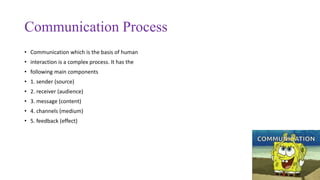
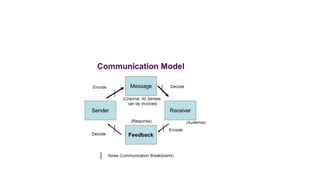
Communication Process
• Communication which is the basis of human
• interaction is a complex process. It has the
• following main components
• 1. sender (source)
• 2. receiver (audience)
• 3. message (content)
• 4. channels (medium)
• 5. feedback (effect)
BARRIERS OF COMMUNICATION
• Unplanned distortion during the communication resulting in the
receiver obtaining a different message than that sent by the sender is
referred to as barriers in communication (also called as “Noise” or
“distortions” in communication).
What is a Barrier in communication?
• Every obstacle that stands between the sender and the receiver.
• The most important thing is the message.
• This message should be clear enough in order to avoid
misunderstandings.
• Seek feedback to check that the message is understood.
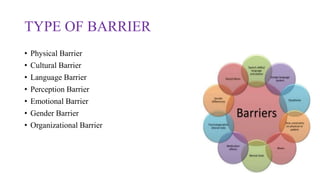
TYPE OF BARRIER
• Physical Barrier
• Cultural Barrier
• Language Barrier
• Perception Barrier
• Emotional Barrier
• Gender Barrier
• Organizational Barrier
Physical Barrier
• Physical barriers is relate to disturbance in the immediate situation
which can interfere in the course of an effective communication
• Some of them are easy to alter whereas some may prove to be tough
obstacles in the process of effective communication.
FACTORS CAUSING PHYSICAL
BARRIER
• Distraction in environment
• Ignorance of medium
• Physical Disability
• Time and Distance
HOW TO OVERCOME
• Self motivated
• Removing obstacles Yourself
• To be updated with latest technologies
• Choosing a suitable environment
Cultural Barrier
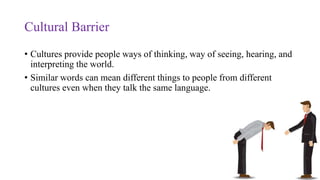
• Cultures provide people ways of thinking, way of seeing, hearing, and
interpreting the world.
• Similar words can mean different things to people from different
cultures even when they talk the same language.
FACTORS CAUSING CULTURAL
BARRIER
• Religion
• Cultural background
• Behavior and nature
HOW TO OVERCOME
• Cross culture environment
• Work in groups and meet with group members frequent
• Have a through knowledge of your counterparts culture background
Language Barrier
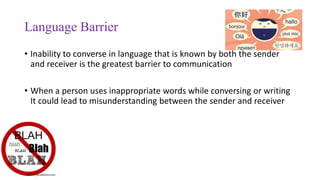
• Inability to converse in language that is known by both the sender
and receiver is the greatest barrier to communication
• When a person uses inappropriate words while conversing or writing
It could lead to misunderstanding between the sender and receiver
FACTORS CAUSING LANGUAGE
BARRIER
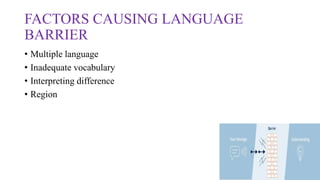
• Multiple language
• Inadequate vocabulary
• Interpreting difference
• Region
HOW TO OVERCOME
• Frequently check for understanding
• Speak slowly and clearly
• Be specific
• Be patient
• Learn Different languages
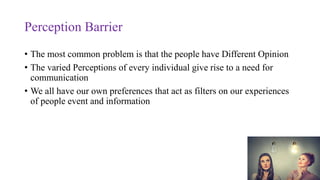
Perception Barrier
• The most common problem is that the people have Different Opinion
• The varied Perceptions of every individual give rise to a need for
communication
• We all have our own preferences that act as filters on our experiences
of people event and information
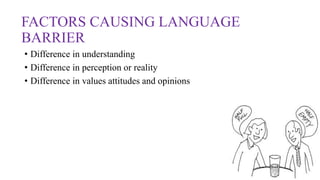
FACTORS CAUSING LANGUAGE
BARRIER
• Difference in understanding
• Difference in perception or reality
• Difference in values attitudes and opinions
HOW TO OVERCOME
• Start by listening others
• Clarify if there is confusion
• Stay calm and be positive
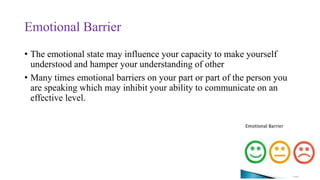
Emotional Barrier
• The emotional state may influence your capacity to make yourself
understood and hamper your understanding of other
• Many times emotional barriers on your part or part of the person you
are speaking which may inhibit your ability to communicate on an
effective level.
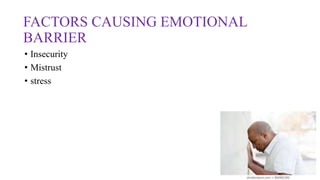
FACTORS CAUSING EMOTIONAL
BARRIER
• Insecurity
• Mistrust
• stress
HOW TO OVERCOME
• Removing yourself from the situation
• Motivation and commitment to change
• Practice expressing recognition
Gender Barrier
• Relationship respect workplace authority and education are common
way men or women are pitted against each other
• The barrier arises because men and women have different ways of
thinking and communication
FACTORS CAUSING GENDER BARRIER
• Fear and shy
• Environment
• Misunderstanding
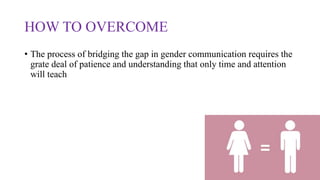
HOW TO OVERCOME
• The process of bridging the gap in gender communication requires the
grate deal of patience and understanding that only time and attention
will teach
Organizational Barrier
• Organizational structure greatly affects the capability of the employees
as far as the communication is concerned
• All the internal factors block the process of communication barriers.
Some such factors have already been discussed like restrictive
environments ,deceptive ,tactics communication network.
FACTORS CAUSING ORGANIZATIONAL
BARRIER
• One way flow
• Organizational structure
• Rules and regulations
• Too many level in Organizational structure
• Status relationship
HOW TO OVERCOME
• Poor structure to the communication
• A distracting environment
• The use of the wrong medium to deliver the communication
• Improving interpersonal relations
• Judicious use of grapevine
DO FOR EFFECTIVE
COMMUNICATION
• For Physical Barriers-
 Appropriate Seating Arrangement
 Ensure Visibility & Audibility
 Environmental Comfort
 Minimize Visual/Oral Distractions
For Semantic Barriers-
• Use of Simple Language
• Symbols & Charts
• Active Listening/ Constructive feedback
For Socio-Psychological Barriers-
• Calling Attention & Motivation
• Assistance & Sympathy
For Cross Cultural Barriers-
• Understanding of Traditions & Customs
• Information of all Sides of Culture
For Organizational Barriers-
• Simple Organizational Structure
• Avoiding Information Overload
• Flexibility in Meeting Targets
Communication barriers

Communication barriers

  • 2.
  • 3.
    Contents • Introduction &definitions of communication. • Communication process. • Barriers of communication. • Overcome on barriers of communication.
  • 4.
    INTRODUCTION • Communication canbe regarded as a two way process of exchanging or shaping ideas, feelings and information. • Broadly it refers "to the countless ways that humans have of keeping in touch with one another“ • Effective communication is to share meaning and understanding between the person sending the message and the person receiving the message.
  • 5.
    WHAT IS COMMUNICATION??? • COMMUNICATION IS THE ART OF TRANSMITTING KNOWLEDGE, IDEAS, INFORMATION AND THOUGHTS FROM ONE PERSON TO ANOTHER. • THE TRANSFER SHOULD BE SUCH THAT THE RECIEVER UNDERSTANDS THE MEANING AND THE INTENT OF THE MESSAGE AND GIVE PROPER FEEDBACK
  • 6.
    Communication Process • Communicationwhich is the basis of human • interaction is a complex process. It has the • following main components • 1. sender (source) • 2. receiver (audience) • 3. message (content) • 4. channels (medium) • 5. feedback (effect)
  • 8.
    BARRIERS OF COMMUNICATION •Unplanned distortion during the communication resulting in the receiver obtaining a different message than that sent by the sender is referred to as barriers in communication (also called as “Noise” or “distortions” in communication).
  • 9.
    What is aBarrier in communication? • Every obstacle that stands between the sender and the receiver. • The most important thing is the message. • This message should be clear enough in order to avoid misunderstandings. • Seek feedback to check that the message is understood.
  • 10.
    TYPE OF BARRIER •Physical Barrier • Cultural Barrier • Language Barrier • Perception Barrier • Emotional Barrier • Gender Barrier • Organizational Barrier
  • 11.
    Physical Barrier • Physicalbarriers is relate to disturbance in the immediate situation which can interfere in the course of an effective communication • Some of them are easy to alter whereas some may prove to be tough obstacles in the process of effective communication.
  • 12.
    FACTORS CAUSING PHYSICAL BARRIER •Distraction in environment • Ignorance of medium • Physical Disability • Time and Distance
  • 13.
    HOW TO OVERCOME •Self motivated • Removing obstacles Yourself • To be updated with latest technologies • Choosing a suitable environment
  • 14.
    Cultural Barrier • Culturesprovide people ways of thinking, way of seeing, hearing, and interpreting the world. • Similar words can mean different things to people from different cultures even when they talk the same language.
  • 15.
    FACTORS CAUSING CULTURAL BARRIER •Religion • Cultural background • Behavior and nature
  • 16.
    HOW TO OVERCOME •Cross culture environment • Work in groups and meet with group members frequent • Have a through knowledge of your counterparts culture background
  • 17.
    Language Barrier • Inabilityto converse in language that is known by both the sender and receiver is the greatest barrier to communication • When a person uses inappropriate words while conversing or writing It could lead to misunderstanding between the sender and receiver
  • 18.
    FACTORS CAUSING LANGUAGE BARRIER •Multiple language • Inadequate vocabulary • Interpreting difference • Region
  • 19.
    HOW TO OVERCOME •Frequently check for understanding • Speak slowly and clearly • Be specific • Be patient • Learn Different languages
  • 20.
    Perception Barrier • Themost common problem is that the people have Different Opinion • The varied Perceptions of every individual give rise to a need for communication • We all have our own preferences that act as filters on our experiences of people event and information
  • 21.
    FACTORS CAUSING LANGUAGE BARRIER •Difference in understanding • Difference in perception or reality • Difference in values attitudes and opinions
  • 22.
    HOW TO OVERCOME •Start by listening others • Clarify if there is confusion • Stay calm and be positive
  • 23.
    Emotional Barrier • Theemotional state may influence your capacity to make yourself understood and hamper your understanding of other • Many times emotional barriers on your part or part of the person you are speaking which may inhibit your ability to communicate on an effective level.
  • 24.
    FACTORS CAUSING EMOTIONAL BARRIER •Insecurity • Mistrust • stress
  • 25.
    HOW TO OVERCOME •Removing yourself from the situation • Motivation and commitment to change • Practice expressing recognition
  • 26.
    Gender Barrier • Relationshiprespect workplace authority and education are common way men or women are pitted against each other • The barrier arises because men and women have different ways of thinking and communication
  • 27.
    FACTORS CAUSING GENDERBARRIER • Fear and shy • Environment • Misunderstanding
  • 28.
    HOW TO OVERCOME •The process of bridging the gap in gender communication requires the grate deal of patience and understanding that only time and attention will teach
  • 29.
    Organizational Barrier • Organizationalstructure greatly affects the capability of the employees as far as the communication is concerned • All the internal factors block the process of communication barriers. Some such factors have already been discussed like restrictive environments ,deceptive ,tactics communication network.
  • 30.
    FACTORS CAUSING ORGANIZATIONAL BARRIER •One way flow • Organizational structure • Rules and regulations • Too many level in Organizational structure • Status relationship
  • 31.
    HOW TO OVERCOME •Poor structure to the communication • A distracting environment • The use of the wrong medium to deliver the communication • Improving interpersonal relations • Judicious use of grapevine
  • 32.
    DO FOR EFFECTIVE COMMUNICATION •For Physical Barriers-  Appropriate Seating Arrangement  Ensure Visibility & Audibility  Environmental Comfort  Minimize Visual/Oral Distractions
  • 33.
    For Semantic Barriers- •Use of Simple Language • Symbols & Charts • Active Listening/ Constructive feedback
  • 34.
    For Socio-Psychological Barriers- •Calling Attention & Motivation • Assistance & Sympathy For Cross Cultural Barriers- • Understanding of Traditions & Customs • Information of all Sides of Culture
  • 35.
    For Organizational Barriers- •Simple Organizational Structure • Avoiding Information Overload • Flexibility in Meeting Targets