Introduction to Communicable
Disease Epidemiology
Dr. Armen Torchyan, MD, MPH
Slides by Dr Rufaidah Dabbagh and Dr. Hafsa Raheel
By the end of this session students
should be able to
• Define communicable disease, control, elimination and eradication
• Draw the cycle of infection
• Give examples of different types of infectious agents associated with diseases in
men
• List the three types of reservoir of infection
• Classify carriers and to explain their public health importance in disease
transmission
• Illustrate with examples the different modes of transmission of communicable
diseases
• Define incubation period and state the importance of the knowledge of the intrinsic
incubation period
• Classify and differentiate between the types of immunity
• Outline the measures for the prevention and control of communicable diseases
What is a Communicable Disease?
It is an illness caused by an infectious agent or its toxic
product that is transmitted from an infected person, animal
or inanimate source to a susceptible host
Source: Heymann DL. Control of communicable diseases manual. 19th
Edition. Washington DC,
USA: American Public Health Association; 2008. 746
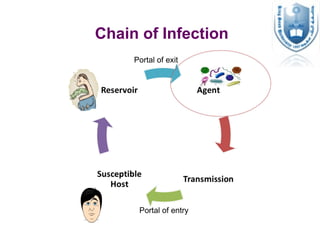
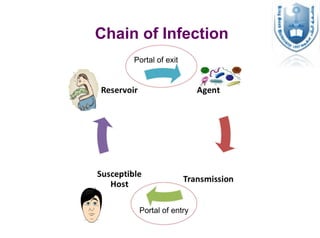
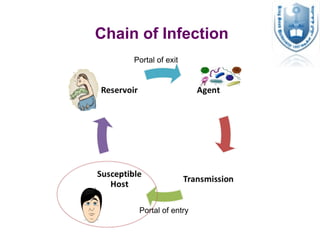
Chain of infection
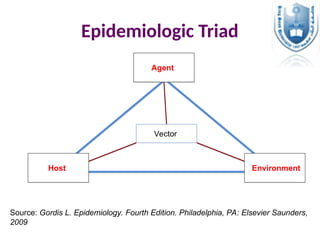
Epidemiologic Triad
Agent
Host Environment
Vector
Source: Gordis L. Epidemiology. Fourth Edition. Philadelphia, PA: Elsevier Saunders,
2009
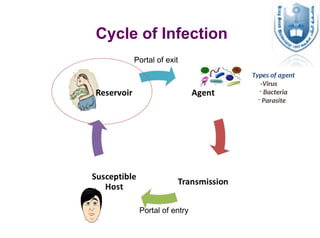
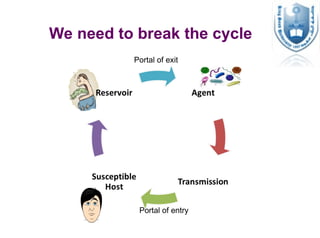
Portal of exit
Portal of entry
Cycle of Infection
Types of agent
-Virus
- Bacteria
- Parasite
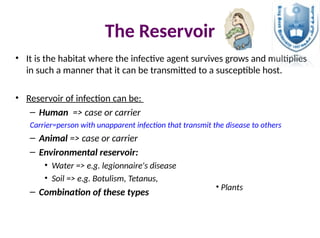
The Reservoir
• It is the habitat where the infective agent survives grows and multiplies
in such a manner that it can be transmitted to a susceptible host.
• Reservoir of infection can be:
– Human => case or carrier
Carrier=person with unapparent infection that transmit the disease to others
– Animal => case or carrier
– Environmental reservoir:
• Water => e.g. legionnaire's disease
• Soil => e.g. Botulism, Tetanus,
– Combination of these types
• Plants
Portal of exit
Portal of entry
Chain of Infection
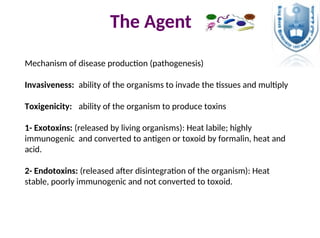
The Agent
Mechanism of disease production (pathogenesis)
Invasiveness: ability of the organisms to invade the tissues and multiply
Toxigenicity: ability of the organism to produce toxins
1- Exotoxins: (released by living organisms): Heat labile; highly
immunogenic and converted to antigen or toxoid by formalin, heat and
acid.
2- Endotoxins: (released after disintegration of the organism): Heat
stable, poorly immunogenic and not converted to toxoid.
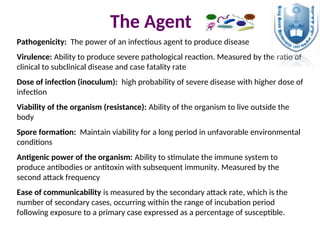
Pathogenicity: The power of an infectious agent to produce disease
Virulence: Ability to produce severe pathological reaction. Measured by the ratio of
clinical to subclinical disease and case fatality rate
Dose of infection (inoculum): high probability of severe disease with higher dose of
infection
Viability of the organism (resistance): Ability of the organism to live outside the
body
Spore formation: Maintain viability for a long period in unfavorable environmental
conditions
Antigenic power of the organism: Ability to stimulate the immune system to
produce antibodies or antitoxin with subsequent immunity. Measured by the
second attack frequency
Ease of communicability is measured by the secondary attack rate, which is the
number of secondary cases, occurring within the range of incubation period
following exposure to a primary case expressed as a percentage of susceptible.
The Agent
Portal of exit
Portal of entry
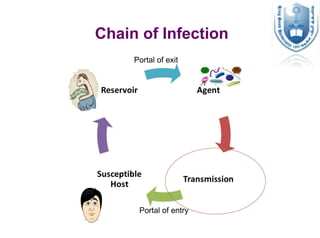
Chain of Infection
The Mode of Transmission
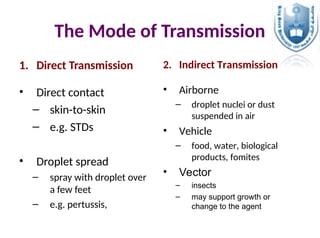
1. Direct Transmission
• Direct contact
– skin-to-skin
– e.g. STDs
• Droplet spread
– spray with droplet over
a few feet
– e.g. pertussis,
2. Indirect Transmission
• Airborne
– droplet nuclei or dust
suspended in air
• Vehicle
– food, water, biological
products, fomites
• Vector
– insects
– may support growth or
change to the agent
INCUBATION PERIOD
It is the period between the entry of the organism and the
appearance of the first symptom of the disease
Knowledge of the incubation period is important for
• Surveillance and quarantine in some diseases
• Application of preventive measures to abort or modify the attack.
• Identification of the source of infection
Portal of exit
Portal of entry
Chain of Infection
The Portal of Entry and Exit
• Portal of entry: it is the path by which the
infectious agent enters that host
• Portal of exit: is the path by which the
infectious agent exits the infected host
• These could be:
• Skin => Direct contact; e.g. scabies, fungal, staph
• Mucous membrane => e.g. HBV, STDs
• Respiratory tract => rhinovirus, EBV
• GIT => E-coli, enteric virus, HAV
• GUT => gonorrhoea, syphilis…..
• Blood => HIV, HCV, HBV, malaria
Portal of exit
Portal of entry
Chain of Infection
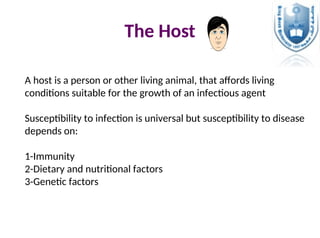
The Host
A host is a person or other living animal, that affords living
conditions suitable for the growth of an infectious agent
Susceptibility to infection is universal but susceptibility to disease
depends on:
1-Immunity
2-Dietary and nutritional factors
3-Genetic factors
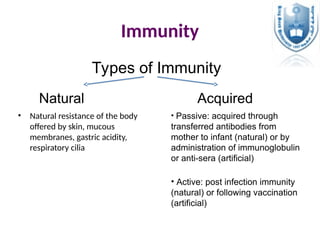
Immunity
• Natural resistance of the body
offered by skin, mucous
membranes, gastric acidity,
respiratory cilia
Types of Immunity
Natural Acquired
• Passive: acquired through
transferred antibodies from
mother to infant (natural) or by
administration of immunoglobulin
or anti-sera (artificial)
• Active: post infection immunity
(natural) or following vaccination
(artificial)
Pre-requisites for transmission of a
communicable disease
The six pre-requisites for the transmission of communicable diseases are
1. Presence of reservoir for infection
2. Presence of microbiological agent
3. Portal of exit through which the microbiological agent leaves the
reservoir
4. Mode of transmission
5. Portal of entry (inlet) through which the microbiological enters the host
6. Presence of susceptible host
Prevention and Control of
Communicable Diseases
Portal of exit
Portal of entry
We need to break the cycle
Control
Activities conducted to bring a disease or a health problem at a
very low level till it becomes no longer a public health problem
Elimination
Termination of all modes of transmission to a reduction of the
incidence of the disease to the zero in a confined or specific
geographic locality as a result of deliberate efforts yet, continued
intervention methods are required
Eradication
Termination of all modes of transmission of infection by
extermination of the infectious agent
Some Definitions
Prevention and Control Measures
Applied to Break Different Stages
of the Infection Chain
Measures That Directed to the Agent
• Sterilization
• Disinfection
• Proper treatment of infected individuals to
kill the agent at its source
Measures Directed to the Reservoir
•Cases: Case finding, reporting to the local health authority in order to apply
the appropriate control measures for contact and the environment, isolation
(strict isolation or discharge/body fluid isolation) for the whole period of
communicability and treatment, surveillance for the longest incubation
period.
•Carriers: Identification of carriers in the community, treatment and
exclusion from work till the organism is eliminated especially if food handlers
or working with children. Its cost effectiveness depends on the proportion of
carrier in the community as well as the sensitivity of their occupation.
•Animal reservoir: Adequate animal husbandry, immunization of animals (if
vaccine is available), treatment of infected animals and killing if treatment is
not feasible.
Measures Directed towards Breaking
Transmission
• Isolation if indicated => to interrupt direct transmission
• Decontaminating of fomites => vehicle transmission
• Promote handwashing => prevent feco-oral transmission
• Modify ventilation and air pressure => prevent airborne transmission
• Control vector population => control vector-borne transmission
•Environment: sanitation of water, food, proper sewage handling
Measures Directed towards
Protecting Portal of Entry
• Using bed-nets
• Wearing masks and gowns to prevent entry of
infected body secretions or droplets through
skin or mucous membranes
• Covering skin and using insect repellents
Measures Directed to the
Host
• Health education
• Adequate personal hygiene
• Sound nutrition
• Immunization
• Chemoprophylaxis
What is the Benefit of Complete
Immunization in the Community?
• Complete immunization coverage can help prevent the agent from reaching
a susceptible host
Herd immunity
• State of immunity within the community
• If a high proportion of individuals in the community are resistant to an
agent, then susceptible people will also be protected by the resistant
majority
• The level of susceptibility increases as new infants are born, an epidemic
will develop after accumulation of susceptible
• It could be produced artificially by immunization, or naturally after infection
Exercise on MERS-Cov
• Middle Eastern Respiratory Syndrome Coronavirus (MERS-Cov)
was first reported in Saudi Arabia in 2012
• In addition to humans, camels have also been infected
• People present with cough, fever and shortness of breath
• incubation period is from 2 to 14 days
• Although not fully understood, it has been reported to spread
from person-to-person through respiratory secretions, through
close contact by care-giving and also in the hospital setting and
possibly by contact with infected camels
• There is currently no available antiviral treatment or vaccine
for MERS-Cov, thus general health precautions are advised
when dealing with sick people
Exercise on MERS-Cov
• Reservoir:
• Portal of Exit:
• Mode of transmission:
• Portal of entry:
• Incubation period:
• Prevention and control measures:
– Factors in host
– Factors in environment -Factors related to agent
-Factors related to reservoir
References
Heymann DL. Control of communicable diseases manual. 19th
Edition.
Washington DC, USA: American Public Health Association; 2008. 746
Gordis L. Epidemiology. Fourth Edition. Philadelphia, PA: Elsevier Saunders, 2009
Centers for Disease Control and Prevention. Introduction to Epidemiology -
Section 10: Chain of Infection. 2012. Retrieved from:
https://www.cdc.gov/ophss/csels/dsepd/ss1978/lesson1/section10.html.
Accessed 19.9.2017.
Centers for Disease Control and Prevention. Information about Middle Eastern
Respiratory Syndrome (MERS). 2015. Available at:
https://www.cdc.gov/coronavirus/mers/downloads/factsheet-mers_en.pdf.
Accessed: 19.9.2017

5- Introduction to Communicable Disease.ppt

  • 1.
    Introduction to Communicable Introductionto Communicable Disease Epidemiology Disease Epidemiology Dr. Armen Torchyan, MD, MPH Slides by Dr Rufaidah Dabbagh and Dr. Hafsa Raheel Slides by Dr Rufaidah Dabbagh and Dr. Hafsa Raheel
  • 2.
    By the endof this session students should be able to • Define communicable disease, control, elimination and eradication • Draw the cycle of infection • Give examples of different types of infectious agents associated with diseases in men • List the three types of reservoir of infection • Classify carriers and to explain their public health importance in disease transmission • Illustrate with examples the different modes of transmission of communicable diseases • Define incubation period and state the importance of the knowledge of the intrinsic incubation period • Classify and differentiate between the types of immunity • Outline the measures for the prevention and control of communicable diseases
  • 3.
    What is aCommunicable Disease? It is an illness caused by an infectious agent or its toxic product that is transmitted from an infected person, animal or inanimate source to a susceptible host Source: Heymann DL. Control of communicable diseases manual. 19th Edition. Washington DC, USA: American Public Health Association; 2008. 746
  • 4.
  • 5.
    Epidemiologic Triad Agent Host Environment Vector Source:Gordis L. Epidemiology. Fourth Edition. Philadelphia, PA: Elsevier Saunders, 2009
  • 6.
    Portal of exit Portalof entry Cycle of Infection Types of agent -Virus - Bacteria - Parasite
  • 7.
    The Reservoir • Itis the habitat where the infective agent survives grows and multiplies in such a manner that it can be transmitted to a susceptible host. • Reservoir of infection can be: – Human => case or carrier Carrier=person with unapparent infection that transmit the disease to others – Animal => case or carrier – Environmental reservoir: • Water => e.g. legionnaire's disease • Soil => e.g. Botulism, Tetanus, – Combination of these types • Plants
  • 8.
    Portal of exit Portalof entry Chain of Infection
  • 9.
    The Agent Mechanism ofdisease production (pathogenesis) Invasiveness: ability of the organisms to invade the tissues and multiply Toxigenicity: ability of the organism to produce toxins 1- Exotoxins: (released by living organisms): Heat labile; highly immunogenic and converted to antigen or toxoid by formalin, heat and acid. 2- Endotoxins: (released after disintegration of the organism): Heat stable, poorly immunogenic and not converted to toxoid.
  • 10.
    Pathogenicity: The powerof an infectious agent to produce disease Virulence: Ability to produce severe pathological reaction. Measured by the ratio of clinical to subclinical disease and case fatality rate Dose of infection (inoculum): high probability of severe disease with higher dose of infection Viability of the organism (resistance): Ability of the organism to live outside the body Spore formation: Maintain viability for a long period in unfavorable environmental conditions Antigenic power of the organism: Ability to stimulate the immune system to produce antibodies or antitoxin with subsequent immunity. Measured by the second attack frequency Ease of communicability is measured by the secondary attack rate, which is the number of secondary cases, occurring within the range of incubation period following exposure to a primary case expressed as a percentage of susceptible. The Agent
  • 11.
    Portal of exit Portalof entry Chain of Infection
  • 12.
    The Mode ofTransmission 1. Direct Transmission • Direct contact – skin-to-skin – e.g. STDs • Droplet spread – spray with droplet over a few feet – e.g. pertussis, 2. Indirect Transmission • Airborne – droplet nuclei or dust suspended in air • Vehicle – food, water, biological products, fomites • Vector – insects – may support growth or change to the agent
  • 13.
    INCUBATION PERIOD It isthe period between the entry of the organism and the appearance of the first symptom of the disease Knowledge of the incubation period is important for • Surveillance and quarantine in some diseases • Application of preventive measures to abort or modify the attack. • Identification of the source of infection
  • 14.
    Portal of exit Portalof entry Chain of Infection
  • 15.
    The Portal ofEntry and Exit • Portal of entry: it is the path by which the infectious agent enters that host • Portal of exit: is the path by which the infectious agent exits the infected host • These could be: • Skin => Direct contact; e.g. scabies, fungal, staph • Mucous membrane => e.g. HBV, STDs • Respiratory tract => rhinovirus, EBV • GIT => E-coli, enteric virus, HAV • GUT => gonorrhoea, syphilis….. • Blood => HIV, HCV, HBV, malaria
  • 16.
    Portal of exit Portalof entry Chain of Infection
  • 17.
    The Host A hostis a person or other living animal, that affords living conditions suitable for the growth of an infectious agent Susceptibility to infection is universal but susceptibility to disease depends on: 1-Immunity 2-Dietary and nutritional factors 3-Genetic factors
  • 18.
    Immunity • Natural resistanceof the body offered by skin, mucous membranes, gastric acidity, respiratory cilia Types of Immunity Natural Acquired • Passive: acquired through transferred antibodies from mother to infant (natural) or by administration of immunoglobulin or anti-sera (artificial) • Active: post infection immunity (natural) or following vaccination (artificial)
  • 19.
    Pre-requisites for transmissionof a communicable disease The six pre-requisites for the transmission of communicable diseases are 1. Presence of reservoir for infection 2. Presence of microbiological agent 3. Portal of exit through which the microbiological agent leaves the reservoir 4. Mode of transmission 5. Portal of entry (inlet) through which the microbiological enters the host 6. Presence of susceptible host
  • 20.
    Prevention and Controlof Communicable Diseases
  • 21.
    Portal of exit Portalof entry We need to break the cycle
  • 22.
    Control Activities conducted tobring a disease or a health problem at a very low level till it becomes no longer a public health problem Elimination Termination of all modes of transmission to a reduction of the incidence of the disease to the zero in a confined or specific geographic locality as a result of deliberate efforts yet, continued intervention methods are required Eradication Termination of all modes of transmission of infection by extermination of the infectious agent Some Definitions
  • 23.
    Prevention and ControlMeasures Applied to Break Different Stages of the Infection Chain
  • 24.
    Measures That Directedto the Agent • Sterilization • Disinfection • Proper treatment of infected individuals to kill the agent at its source
  • 25.
    Measures Directed tothe Reservoir •Cases: Case finding, reporting to the local health authority in order to apply the appropriate control measures for contact and the environment, isolation (strict isolation or discharge/body fluid isolation) for the whole period of communicability and treatment, surveillance for the longest incubation period. •Carriers: Identification of carriers in the community, treatment and exclusion from work till the organism is eliminated especially if food handlers or working with children. Its cost effectiveness depends on the proportion of carrier in the community as well as the sensitivity of their occupation. •Animal reservoir: Adequate animal husbandry, immunization of animals (if vaccine is available), treatment of infected animals and killing if treatment is not feasible.
  • 26.
    Measures Directed towardsBreaking Transmission • Isolation if indicated => to interrupt direct transmission • Decontaminating of fomites => vehicle transmission • Promote handwashing => prevent feco-oral transmission • Modify ventilation and air pressure => prevent airborne transmission • Control vector population => control vector-borne transmission •Environment: sanitation of water, food, proper sewage handling
  • 27.
    Measures Directed towards ProtectingPortal of Entry • Using bed-nets • Wearing masks and gowns to prevent entry of infected body secretions or droplets through skin or mucous membranes • Covering skin and using insect repellents
  • 28.
    Measures Directed tothe Host • Health education • Adequate personal hygiene • Sound nutrition • Immunization • Chemoprophylaxis
  • 29.
    What is theBenefit of Complete Immunization in the Community? • Complete immunization coverage can help prevent the agent from reaching a susceptible host Herd immunity • State of immunity within the community • If a high proportion of individuals in the community are resistant to an agent, then susceptible people will also be protected by the resistant majority • The level of susceptibility increases as new infants are born, an epidemic will develop after accumulation of susceptible • It could be produced artificially by immunization, or naturally after infection
  • 30.
    Exercise on MERS-Cov •Middle Eastern Respiratory Syndrome Coronavirus (MERS-Cov) was first reported in Saudi Arabia in 2012 • In addition to humans, camels have also been infected • People present with cough, fever and shortness of breath • incubation period is from 2 to 14 days • Although not fully understood, it has been reported to spread from person-to-person through respiratory secretions, through close contact by care-giving and also in the hospital setting and possibly by contact with infected camels • There is currently no available antiviral treatment or vaccine for MERS-Cov, thus general health precautions are advised when dealing with sick people
  • 31.
    Exercise on MERS-Cov •Reservoir: • Portal of Exit: • Mode of transmission: • Portal of entry: • Incubation period: • Prevention and control measures: – Factors in host – Factors in environment -Factors related to agent -Factors related to reservoir
  • 32.
    References Heymann DL. Controlof communicable diseases manual. 19th Edition. Washington DC, USA: American Public Health Association; 2008. 746 Gordis L. Epidemiology. Fourth Edition. Philadelphia, PA: Elsevier Saunders, 2009 Centers for Disease Control and Prevention. Introduction to Epidemiology - Section 10: Chain of Infection. 2012. Retrieved from: https://www.cdc.gov/ophss/csels/dsepd/ss1978/lesson1/section10.html. Accessed 19.9.2017. Centers for Disease Control and Prevention. Information about Middle Eastern Respiratory Syndrome (MERS). 2015. Available at: https://www.cdc.gov/coronavirus/mers/downloads/factsheet-mers_en.pdf. Accessed: 19.9.2017

Editor's Notes

  • #5 In order for disease to occur there needs to be interaction between these variables; 1) there needs to be a host that is susceptible to infection (and susceptibility depends on several factors which will be discussed later); 2) there needs to be an infectious agent (in this case we are talking about biological agents); 3) there needs to be the suitable environment that helps the transmission of infection; 4) and then there is the vector in many cases that is the means of transmission of the agent (in cases of indirect transmission….will be discussed in more detail in the coming slides). The interaction of these variables needs to take place in order for the infection to take place and produce disease. The missing link in any part of these angles will prevent the occurrence of disease (for example existence of the suitable environment and an infectious agent, but the host is not susceptible because of immunity. In this case the person will not contract the disease).
  • #6 And from that concept, we can describe the chain of infection. Here we are talking about how the infection is harboured, transmitted, finds a portal of entry into the body and then gets into the susceptible host to cause infection. Let’s take each one of these aspects individually first to see the factors that affect each.
  • #7 Diseases that are transmitted from person-to-person have human reserviors
  • #9 There are several factors that are determined by the biological agent that affect disease development
  • #13 And since we are talking about transmission, it is important here to talk about the incubation period…….
  • #21 It is important for us to understand the infection chain in order to determine the appropriate control and prevention measures and at which stage to direct them
  • #29 Not every single individual should be resistant to the agent, but rather it is sufficient to make a certain percentage of people immune in order for the community to develop appropriate level of herd immunity that protects the immunity from the disease