NEW MUSIC COMPOSERS
By: ANDREW GABIONZA
LNHS
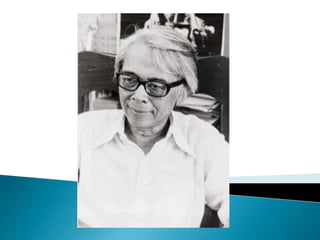
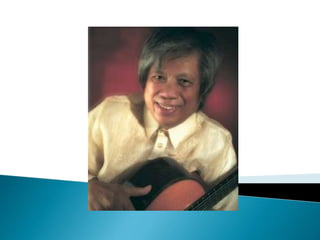
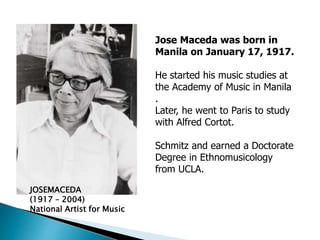
JOSEMACEDA
(1917 – 2004)
National Artist for Music
Jose Maceda was born in
Manila on January 17, 1917.
He started his music studies at
the Academy of Music in Manila
.
Later, he went to Paris to study
with Alfred Cortot.
Schmitz and earned a Doctorate
Degree in Ethnomusicology
from UCLA.
Maceda’s musical style changed when he encountered the music
of the indigenous tribes of Mindoro in 1953.
He then embarked on his life’s work, dedicated to the understanding
and
preservation of Filipino traditional music.
His extensive research and fieldwork resulted in an immense collection
of recorded music taken from the remote mountain villages and far-
flung inland communities in the
Philippines.
Although his compositional approach tended to be Western in style,
Maceda combined sounds of the environment with ethnic instruments.
His compositions were
usually for large groups of musicians.
Among his works are Ugma-Ugma (1963
Agungan (1975), a piece for six gong families;Pagsamba
(1968), Cassettes 100 (1971), a composition for 100 cassette tape
recorders; and
Ugnayan (1974), avant garde musique concrète.
Professor of Piano and Musicology at the College
of Music, University of the Philippines from 1952 to 1990.
He was appointed Executive
Director of its Center for Ethnomusicology in 1997. In the same
year, he was conferred
the honor of National Artist for Music. He passed away in Manila on
May 5, 2004.
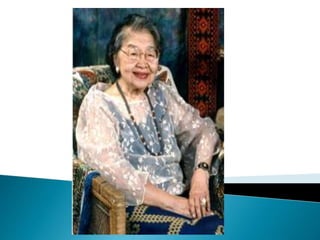
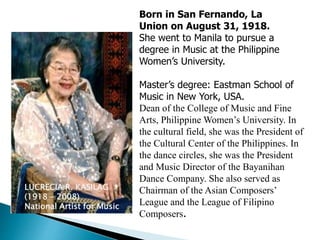
LUCRECIA R. KASILAG
(1918 – 2008)
National Artist for Music
Born in San Fernando, La
Union on August 31, 1918.
She went to Manila to pursue a
degree in Music at the Philippine
Women’s University.
Master’s degree: Eastman School of
Music in New York, USA.
Dean of the College of Music and Fine
Arts, Philippine Women’s University. In
the cultural field, she was the President of
the Cultural Center of the Philippines. In
the dance circles, she was the President
and Music Director of the Bayanihan
Dance Company. She also served as
Chairman of the Asian Composers’
League and the League of Filipino
Composers.
Musical Style: She demonstrated a fusion of
Eastern and Western styles in using
instruments,melody, harmony,
and rhythm.
She is particularly known for incorporating
indigenous Filipino instruments into
orchestral productions
Musical Works:
Toccata for Percussion and Winds (1959),
The Legend of the Sarimanok (1963),
Divertissement and Concertante (1960),
Dularawan (1969),
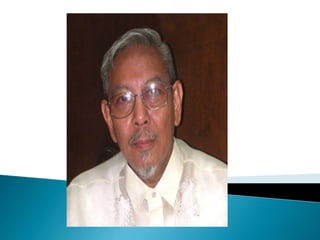
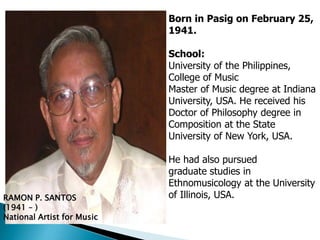
RAMON P. SANTOS
(1941 – )
National Artist for Music
Born in Pasig on February 25,
1941.
School:
University of the Philippines,
College of Music
Master of Music degree at Indiana
University, USA. He received his
Doctor of Philosophy degree in
Composition at the State
University of New York, USA.
He had also pursued
graduate studies in
Ethnomusicology at the University
of Illinois, USA.
Compositional style:
Chromaticism, music seria, and electronic components, combined
with indigenous Philippine music elements.
Works:
Ding Ding Nga Diyawa, Nabasag na Banga at Iba’t iba pang Pinag-
ugpong-ugpong na Pananalita sa
Wikang Pilipino para sa Labing Anim na Tinig, and L’BAD. He had
done extensive research on the gamelan music of Java as well as
the traditional music of the Ibaloi
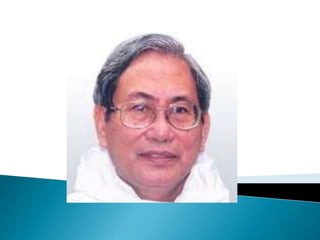
FR. MANUEL MARAMBA, OSB
(1936 – )
He was born on July 4, 1936 in
Pangasinan.
11 years old: he gave his first public
performance at the Bamboo Organ in
Las Piñas.
14 years old: Became the official
accompanist of the Las Piñas Boys
Choir
Youngest finalist to participate in the
National Music Competitions for Young
Artists (NAMCYA) piano competition
in 1978.
School:
University for Music and Performing Arts in Graz, Austria. There,
he earned with distinction the degree of Master of Arts in
Church Music. He also received a Teacher’s Certificate in Organ.
His musical career led him to the United States, where he
performed at Carnegie
Sto. Tomas (UST), Bachelor of Music degree major in Piano at the
Conservatory of Music.
Master of Music degree, Artist Diploma, Bachelor of Music degree in
Composition, and Teacher’s Certificate in Theory from the Peabody
Conservatory of Johns Hopkins University, USA. He received a Master’s
degree of Musical Arts in
Monk at Our Lady of Montserrat Abbey in Manila.
He was the former director of the Paul VI Institute of Liturgy in
Malaybalay, Bukidnon during which he composed the music for the
papal mass.
A prominent canon lawyer, he served on the National Appellate
Matrimonial Tribunal.
He was also a faculty member at the UST Conservatory of Music, St.
Scholatica’s College, and Sta. Isabel College.
Works:
Aba!, Sto. Nino, La Naval, and Lord Takayama Ukon. His
other major compositions are the music for Awakening which was
commissioned by Ballet Philippines and music for Philippine Ballet
Theater’s production of Seven Mansions; three masses –
Papal Mass for World Youth Day, 1995; Mass in Honor of St. Lorenzo
Ruiz, and the Mass in Honor of the Sto. Nino; three cantatas – St.
Lorenzo Ruiz, St. Benedict, and St. Scholastica; Three Psalms; A
hymn in honor of St. Lorenzo Ruiz, and the official hymn of the 1996
National Eucharistic Congress; a zarzuela entitled Ang
Sarswela sa San Salvador, and three orchestral works – Pugad Lawin,
The Virgin of Naval, and Transfiguration.
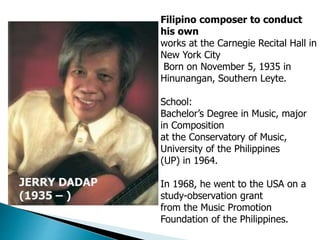
JERRY DADAP
(1935 – )
Filipino composer to conduct
his own
works at the Carnegie Recital Hall in
New York City
Born on November 5, 1935 in
Hinunangan, Southern Leyte.
School:
Bachelor’s Degree in Music, major
in Composition
at the Conservatory of Music,
University of the Philippines
(UP) in 1964.
In 1968, he went to the USA on a
study-observation grant
from the Music Promotion
Foundation of the Philippines.
He received a full scholarship grant from the United
Presbyterian Church of USA from 1969 to 1971.
Postgraduate Diploma in Composition at the Mannes College of
Music in New York, USA.
Upon his return to the Philippines in 1971,
he taught composition, ear training, and orchestration at the Sta.
Isabel College of Music in Manila.
Compositions
The Passionate and the Wild
(1960), Mangamuyo I (1976)
and Mangamuyo II (1977),
The Redemption (1974), Five
Little Fingers (1975), Tubig ng Buhay (1986),
Dakilang Pagpapatawad (1986), Andres
Bonifacio, Ang Dakilang Anak Pawis, Ang Pag-ibig ng Diyos,
Balitaw Nos. 1-7, Lamang
Epic, Lorenzo Ruiz, Chorale Symphonic Ode Nos. 1 and 2,
Aniway at Tomaneg,
Song Cycle, Nos. 1-4, Choral Cycle Nos. 1-3, and
Diyos Ama ay Purihin. His major
works as composer-conductor were performed at the concert
“LAHI” that featured works
by local major composers.
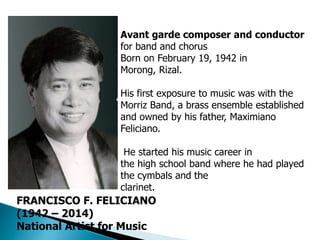
FRANCISCO F. FELICIANO
(1942 – 2014)
National Artist for Music
Avant garde composer and conductor
for band and chorus
Born on February 19, 1942 in
Morong, Rizal.
His first exposure to music was with the
Morriz Band, a brass ensemble established
and owned by his father, Maximiano
Feliciano.
He started his music career in
the high school band where he had played
the cymbals and the
clarinet.
School:
Teacher’s Diploma in Composition and Conducting at the
Conservatory of Music, University of the Philippines (UP) in 1964,
and a Bachelor of Music degree major in Composition in 1967.
Master in Music Composition from the University of the Philippines
Diploma in Music Composition from the Hochschule der Kunst in Berlin,
Germany
Master of Musical Arts and Doctorate in Music Composition from Yale
University School of Music, USA.
He studied composition with Jacob Druckman, Isang Yun, H.W.
Zimmerman and Krystof Penderecki.
Choir conductor and instructor in music fundamentals at St. Andrews
Seminary in Quezon City.
He became an instructor at the UP Conservatory of Music and
conducted the UP Symphony Orchestra.
He was the musical director of the movie Ang Bukas ay Atin and
provided orchestration for a number of musical productions including My
Fair Lady and various Philippine productions.
Works:
More than 30 major works, including the musical dramas Sikhay sa
Kabila ng Paalam, Ashen Wings,and the monumental three-act opera La
Loba Negra (1984).
Prelude and Toccata (1973), Fragments (1976), Life of Wartime Filipino
Hero Jose Abad Santos, and the ballet Yerma (1982).
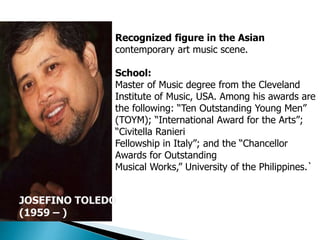
JOSEFINO TOLEDO
(1959 – )
Recognized figure in the Asian
contemporary art music scene.
School:
Master of Music degree from the Cleveland
Institute of Music, USA. Among his awards are
the following: “Ten Outstanding Young Men”
(TOYM); “International Award for the Arts”;
“Civitella Ranieri
Fellowship in Italy”; and the “Chancellor
Awards for Outstanding
Musical Works,” University of the Philippines.`
Toledo served at the Pangkat Kawayan (a bamboo orchestra) from 1966
to 1979 and the Philippine Youth Orchestra (PYO) in 1977-1978. A
principal percussionist of the Manila Symphony Orchestra in 1980-1983,
he later became music director and principal conductor in 1985.
He attended the 1984 International Computer Music Conference in
France.
He was the country’s representative to the 1980 Young Composers
Conference in HongKong, the ASEAN Composers Forum on Traditional
Music in 1989 (Philippines) and 1993 (Singapore), the 1995 ASEAN
Composers Workshop (Indonesia), and the 1996 International
Composers Workshop (Gaudeamus, Amsterdam).
He was also a fellow at the 1990 Pacific Music Festival and Pacific
Composers Conference (Japan).
Toledo is a Music Professor at the College of Music, University of the
Philippines (UP).
He is the founding music director of the Metro Manila Community
Orchestra, the UP
Festival Orchestra, and the Crosswave Symphony Orchestra. He is noted
for conducting the premiere performances of the works of Filipino
composers as well as other Asian
composers. His own music, including works for chorus, orchestra,
chamber ensemble,
solo instrument, and music theater have been performed by well-known
international
artists and ensembles.
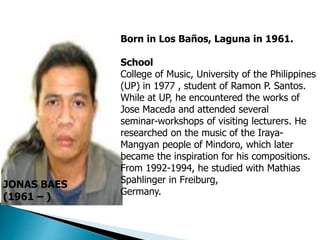
JONAS BAES
(1961 – )
Born in Los Baños, Laguna in 1961.
School
College of Music, University of the Philippines
(UP) in 1977 , student of Ramon P. Santos.
While at UP, he encountered the works of
Jose Maceda and attended several
seminar-workshops of visiting lecturers. He
researched on the music of the Iraya-
Mangyan people of Mindoro, which later
became the inspiration for his compositions.
From 1992-1994, he studied with Mathias
Spahlinger in Freiburg,
Germany.
Baes is known for writing music utilizing unorthodox musical
instruments such as beanpod rattles, leaves, iron-nail chimes, and
various Asian instruments such as bamboo scrapers, bamboo flutes, and
vocal music using Asian vocal techniques.
His early works in the 1980s were influenced by Maceda in the use of
large numbers of performers.
Baes received the Gawad Chancellor para sa Pinakamakusay na
Mananaliksik (Hall of Fame, 2003) from the University of the Philippines.
He is currently an Associate Professor in Composition and Theory at the
UP College of Music as well as an ethnomusicologist, cultural activist,
and writer.
Works
Anderson for four bamboo scrapers, bamui trail caller, sarunai for
oboe, khaen for mouth organ, and about a hundred iron nail chimes

distributed among the audience; 1997/2001; WALA (Nothingness) for
seven or hundreds of men’s voices 1997/2001; DALUY (Flow) 1994;
IBO-IBON (birdwoman) (1996); SALAYSAY,; PATANGISBUWAYA (and
the crocodile weeps) 2003; PANTAWAG (music for calling people) for
15 bamboo scrapers, 15 palm leaves, and 20 muffled “forest” voices
1981; and BASBASAN (blessing) for 20
bean-pod rattles and 20 muffled men’s voices 1983.
TARA KANTA!!!
g10 3rd quarter New composers

g10 3rd quarter New composers

  • 7.
    NEW MUSIC COMPOSERS By:ANDREW GABIONZA LNHS
  • 8.
    JOSEMACEDA (1917 – 2004) NationalArtist for Music Jose Maceda was born in Manila on January 17, 1917. He started his music studies at the Academy of Music in Manila . Later, he went to Paris to study with Alfred Cortot. Schmitz and earned a Doctorate Degree in Ethnomusicology from UCLA.
  • 9.
    Maceda’s musical stylechanged when he encountered the music of the indigenous tribes of Mindoro in 1953. He then embarked on his life’s work, dedicated to the understanding and preservation of Filipino traditional music. His extensive research and fieldwork resulted in an immense collection of recorded music taken from the remote mountain villages and far- flung inland communities in the Philippines. Although his compositional approach tended to be Western in style, Maceda combined sounds of the environment with ethnic instruments. His compositions were usually for large groups of musicians.
  • 10.
    Among his worksare Ugma-Ugma (1963 Agungan (1975), a piece for six gong families;Pagsamba (1968), Cassettes 100 (1971), a composition for 100 cassette tape recorders; and Ugnayan (1974), avant garde musique concrète. Professor of Piano and Musicology at the College of Music, University of the Philippines from 1952 to 1990. He was appointed Executive Director of its Center for Ethnomusicology in 1997. In the same year, he was conferred the honor of National Artist for Music. He passed away in Manila on May 5, 2004.
  • 11.
    LUCRECIA R. KASILAG (1918– 2008) National Artist for Music Born in San Fernando, La Union on August 31, 1918. She went to Manila to pursue a degree in Music at the Philippine Women’s University. Master’s degree: Eastman School of Music in New York, USA. Dean of the College of Music and Fine Arts, Philippine Women’s University. In the cultural field, she was the President of the Cultural Center of the Philippines. In the dance circles, she was the President and Music Director of the Bayanihan Dance Company. She also served as Chairman of the Asian Composers’ League and the League of Filipino Composers.
  • 12.
    Musical Style: Shedemonstrated a fusion of Eastern and Western styles in using instruments,melody, harmony, and rhythm. She is particularly known for incorporating indigenous Filipino instruments into orchestral productions Musical Works: Toccata for Percussion and Winds (1959), The Legend of the Sarimanok (1963), Divertissement and Concertante (1960), Dularawan (1969),
  • 13.
    RAMON P. SANTOS (1941– ) National Artist for Music Born in Pasig on February 25, 1941. School: University of the Philippines, College of Music Master of Music degree at Indiana University, USA. He received his Doctor of Philosophy degree in Composition at the State University of New York, USA. He had also pursued graduate studies in Ethnomusicology at the University of Illinois, USA.
  • 15.
    Compositional style: Chromaticism, musicseria, and electronic components, combined with indigenous Philippine music elements. Works: Ding Ding Nga Diyawa, Nabasag na Banga at Iba’t iba pang Pinag- ugpong-ugpong na Pananalita sa Wikang Pilipino para sa Labing Anim na Tinig, and L’BAD. He had done extensive research on the gamelan music of Java as well as the traditional music of the Ibaloi
  • 16.
    FR. MANUEL MARAMBA,OSB (1936 – ) He was born on July 4, 1936 in Pangasinan. 11 years old: he gave his first public performance at the Bamboo Organ in Las Piñas. 14 years old: Became the official accompanist of the Las Piñas Boys Choir Youngest finalist to participate in the National Music Competitions for Young Artists (NAMCYA) piano competition in 1978.
  • 17.
    School: University for Musicand Performing Arts in Graz, Austria. There, he earned with distinction the degree of Master of Arts in Church Music. He also received a Teacher’s Certificate in Organ. His musical career led him to the United States, where he performed at Carnegie Sto. Tomas (UST), Bachelor of Music degree major in Piano at the Conservatory of Music. Master of Music degree, Artist Diploma, Bachelor of Music degree in Composition, and Teacher’s Certificate in Theory from the Peabody Conservatory of Johns Hopkins University, USA. He received a Master’s degree of Musical Arts in
  • 18.
    Monk at OurLady of Montserrat Abbey in Manila. He was the former director of the Paul VI Institute of Liturgy in Malaybalay, Bukidnon during which he composed the music for the papal mass. A prominent canon lawyer, he served on the National Appellate Matrimonial Tribunal. He was also a faculty member at the UST Conservatory of Music, St. Scholatica’s College, and Sta. Isabel College.
  • 19.
    Works: Aba!, Sto. Nino,La Naval, and Lord Takayama Ukon. His other major compositions are the music for Awakening which was commissioned by Ballet Philippines and music for Philippine Ballet Theater’s production of Seven Mansions; three masses – Papal Mass for World Youth Day, 1995; Mass in Honor of St. Lorenzo Ruiz, and the Mass in Honor of the Sto. Nino; three cantatas – St. Lorenzo Ruiz, St. Benedict, and St. Scholastica; Three Psalms; A hymn in honor of St. Lorenzo Ruiz, and the official hymn of the 1996 National Eucharistic Congress; a zarzuela entitled Ang Sarswela sa San Salvador, and three orchestral works – Pugad Lawin, The Virgin of Naval, and Transfiguration.
  • 20.
    JERRY DADAP (1935 –) Filipino composer to conduct his own works at the Carnegie Recital Hall in New York City Born on November 5, 1935 in Hinunangan, Southern Leyte. School: Bachelor’s Degree in Music, major in Composition at the Conservatory of Music, University of the Philippines (UP) in 1964. In 1968, he went to the USA on a study-observation grant from the Music Promotion Foundation of the Philippines.
  • 21.
    He received afull scholarship grant from the United Presbyterian Church of USA from 1969 to 1971. Postgraduate Diploma in Composition at the Mannes College of Music in New York, USA. Upon his return to the Philippines in 1971, he taught composition, ear training, and orchestration at the Sta. Isabel College of Music in Manila.
  • 22.
    Compositions The Passionate andthe Wild (1960), Mangamuyo I (1976) and Mangamuyo II (1977), The Redemption (1974), Five Little Fingers (1975), Tubig ng Buhay (1986), Dakilang Pagpapatawad (1986), Andres Bonifacio, Ang Dakilang Anak Pawis, Ang Pag-ibig ng Diyos, Balitaw Nos. 1-7, Lamang Epic, Lorenzo Ruiz, Chorale Symphonic Ode Nos. 1 and 2, Aniway at Tomaneg, Song Cycle, Nos. 1-4, Choral Cycle Nos. 1-3, and Diyos Ama ay Purihin. His major works as composer-conductor were performed at the concert “LAHI” that featured works by local major composers.
  • 23.
    FRANCISCO F. FELICIANO (1942– 2014) National Artist for Music Avant garde composer and conductor for band and chorus Born on February 19, 1942 in Morong, Rizal. His first exposure to music was with the Morriz Band, a brass ensemble established and owned by his father, Maximiano Feliciano. He started his music career in the high school band where he had played the cymbals and the clarinet.
  • 24.
    School: Teacher’s Diploma inComposition and Conducting at the Conservatory of Music, University of the Philippines (UP) in 1964, and a Bachelor of Music degree major in Composition in 1967. Master in Music Composition from the University of the Philippines Diploma in Music Composition from the Hochschule der Kunst in Berlin, Germany Master of Musical Arts and Doctorate in Music Composition from Yale University School of Music, USA. He studied composition with Jacob Druckman, Isang Yun, H.W. Zimmerman and Krystof Penderecki.
  • 25.
    Choir conductor andinstructor in music fundamentals at St. Andrews Seminary in Quezon City. He became an instructor at the UP Conservatory of Music and conducted the UP Symphony Orchestra. He was the musical director of the movie Ang Bukas ay Atin and provided orchestration for a number of musical productions including My Fair Lady and various Philippine productions. Works: More than 30 major works, including the musical dramas Sikhay sa Kabila ng Paalam, Ashen Wings,and the monumental three-act opera La Loba Negra (1984). Prelude and Toccata (1973), Fragments (1976), Life of Wartime Filipino Hero Jose Abad Santos, and the ballet Yerma (1982).
  • 26.
    JOSEFINO TOLEDO (1959 –) Recognized figure in the Asian contemporary art music scene. School: Master of Music degree from the Cleveland Institute of Music, USA. Among his awards are the following: “Ten Outstanding Young Men” (TOYM); “International Award for the Arts”; “Civitella Ranieri Fellowship in Italy”; and the “Chancellor Awards for Outstanding Musical Works,” University of the Philippines.`
  • 27.
    Toledo served atthe Pangkat Kawayan (a bamboo orchestra) from 1966 to 1979 and the Philippine Youth Orchestra (PYO) in 1977-1978. A principal percussionist of the Manila Symphony Orchestra in 1980-1983, he later became music director and principal conductor in 1985. He attended the 1984 International Computer Music Conference in France. He was the country’s representative to the 1980 Young Composers Conference in HongKong, the ASEAN Composers Forum on Traditional Music in 1989 (Philippines) and 1993 (Singapore), the 1995 ASEAN Composers Workshop (Indonesia), and the 1996 International Composers Workshop (Gaudeamus, Amsterdam). He was also a fellow at the 1990 Pacific Music Festival and Pacific Composers Conference (Japan).
  • 28.
    Toledo is aMusic Professor at the College of Music, University of the Philippines (UP). He is the founding music director of the Metro Manila Community Orchestra, the UP Festival Orchestra, and the Crosswave Symphony Orchestra. He is noted for conducting the premiere performances of the works of Filipino composers as well as other Asian composers. His own music, including works for chorus, orchestra, chamber ensemble, solo instrument, and music theater have been performed by well-known international artists and ensembles.
  • 29.
    JONAS BAES (1961 –) Born in Los Baños, Laguna in 1961. School College of Music, University of the Philippines (UP) in 1977 , student of Ramon P. Santos. While at UP, he encountered the works of Jose Maceda and attended several seminar-workshops of visiting lecturers. He researched on the music of the Iraya- Mangyan people of Mindoro, which later became the inspiration for his compositions. From 1992-1994, he studied with Mathias Spahlinger in Freiburg, Germany.
  • 30.
    Baes is knownfor writing music utilizing unorthodox musical instruments such as beanpod rattles, leaves, iron-nail chimes, and various Asian instruments such as bamboo scrapers, bamboo flutes, and vocal music using Asian vocal techniques. His early works in the 1980s were influenced by Maceda in the use of large numbers of performers. Baes received the Gawad Chancellor para sa Pinakamakusay na Mananaliksik (Hall of Fame, 2003) from the University of the Philippines. He is currently an Associate Professor in Composition and Theory at the UP College of Music as well as an ethnomusicologist, cultural activist, and writer.
  • 31.
    Works Anderson for fourbamboo scrapers, bamui trail caller, sarunai for oboe, khaen for mouth organ, and about a hundred iron nail chimes distributed among the audience; 1997/2001; WALA (Nothingness) for seven or hundreds of men’s voices 1997/2001; DALUY (Flow) 1994; IBO-IBON (birdwoman) (1996); SALAYSAY,; PATANGISBUWAYA (and the crocodile weeps) 2003; PANTAWAG (music for calling people) for 15 bamboo scrapers, 15 palm leaves, and 20 muffled “forest” voices 1981; and BASBASAN (blessing) for 20 bean-pod rattles and 20 muffled men’s voices 1983.



  • 33.