Infectious Disease Transmission in Tropical Environments Mary Dain ESPM 194 Spring 2007
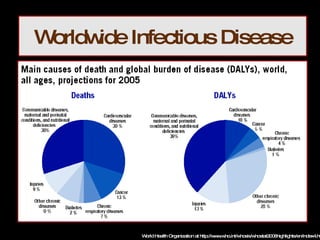
Worldwide Infectious Disease World Health Organization at http://www.who.int/whosis/whostat2006highlights/en/index4.html
What is an infectious disease? American Heritage Stedman's Medical Dictionary  -  infectious disease  ( n.)   A disease resulting from the presence and activity of a pathogenic microbial agent. Four main types of infectious disease carrying-pathogens: bacteria, viruses, protozoa, and helminths
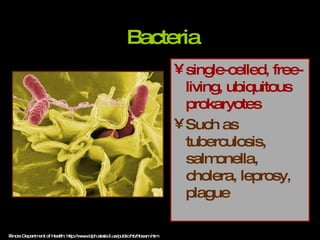
Bacteria single-celled, free-living, ubiquitous prokaryotes   Such as tuberculosis, salmonella, cholera, leprosy, plague Illinois Department of Health: http://www.idph.state.il.us/public/hb/hbsam.htm
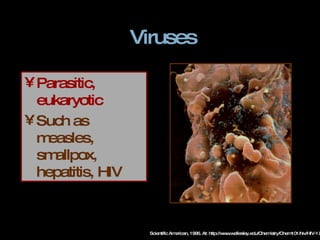
Viruses Parasitic, eukaryotic Such as measles, smallpox, hepatitis, HIV Scientific American, 1995. At: http://www.wellesley.edu/Chemistry/Chem101/hiv/HIV-1.html
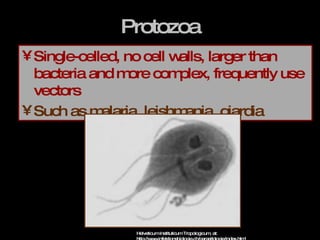
Protozoa Single-celled, no cell walls, larger than bacteria and more complex, frequently use vectors Such as malaria, leishmania, giardia Helveticum Instituticum Tropologicum, at: http://www.infektionsbiologie.ch/parasitologie/index.html
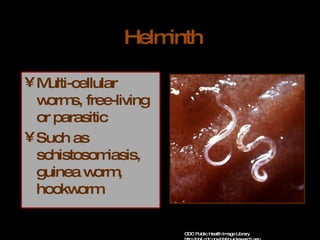
Helminth Multi-cellular worms, free-living or parasitic Such as schistosomiasis, guinea worm, hookworm CDC Public Health Image Library http://phil.cdc.gov/phil/quicksearch.asp
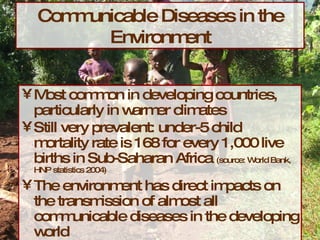
Communicable Diseases in the Environment Most common in developing countries, particularly in warmer climates Still very prevalent: under-5 child mortality rate is 168 for every 1,000 live births in Sub-Saharan Africa  (source: World Bank, HNP statistics 2004) The environment has direct impacts on the transmission of almost all communicable diseases in the developing world
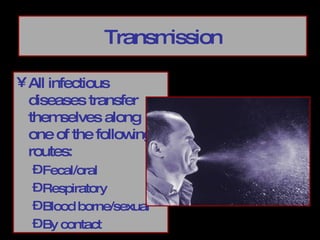
Transmission All infectious diseases transfer themselves along one of the following routes:  Fecal/oral Respiratory Blood borne/sexual By contact
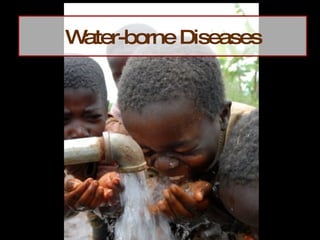
Water-borne Diseases
Cholera Commonly known for pandemics  in England (1817) and New York city (1830’s)  Yet still very common today – there were 100,000 cases of cholera worldwide in 2004, causing 2,300 deaths in 56 different countries
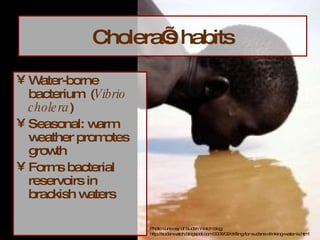
Cholera’s habits Water-borne bacterium  ( Vibrio cholera ) Seasonal: warm weather promotes growth Forms bacterial reservoirs in brackish waters Photo curteosy of Sudan Watch blog: http://sudanwatch.blogspot.com/2006/02/drilling-for-sudans-drinking-water-is.html
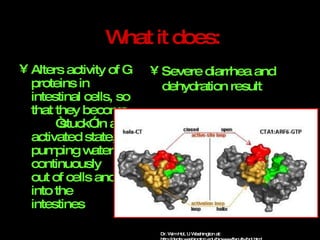
What it does: Alters activity of G proteins in intestinal cells, so that they become  “stuck” in an activated state, pumping water continuously  out of cells and  into the  intestines Severe diarrhea and dehydration result Dr. Wim Hol, U Washington at: http://depts.washington.edu/biowww/faculty/hol.html
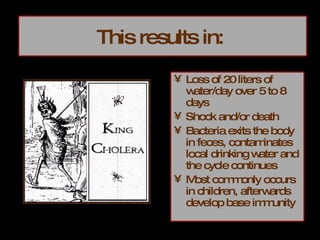
This results in:  Loss of 20 liters of water/day over 5 to 8 days Shock and/or death Bacteria exits the body in feces, contaminates local drinking water and the cycle continues Most commonly occurs in children, afterwards develop base immunity
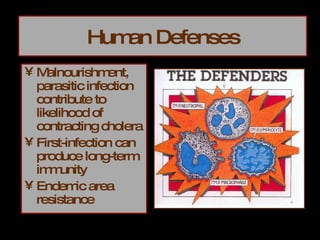
Human Defenses Malnourishment, parasitic infection contribute to likelihood of contracting cholera First-infection can produce long-term immunity Endemic area resistance
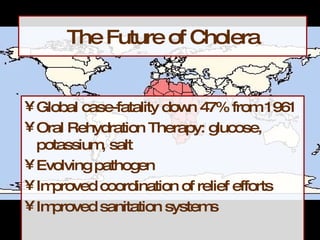
The Future of Cholera Global case-fatality down 47% from 1961 Oral Rehydration Therapy: glucose, potassium, salt Evolving pathogen Improved coordination of relief efforts Improved sanitation systems
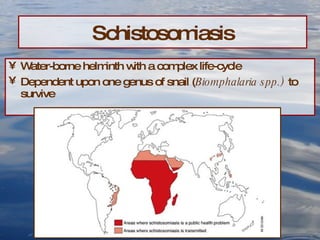
Schistosomiasis Water-borne helminth with a complex life-cycle Dependent upon one genus of snail ( Biomphalaria   spp. )  to survive
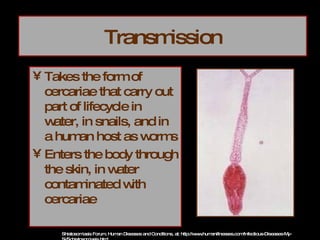
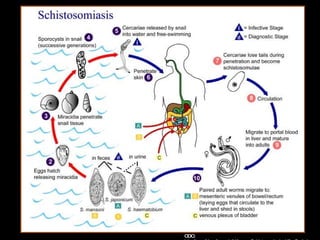
Transmission Takes the form of cercariae that carry out part of lifecycle in water, in snails, and in a human host as worms Enters the body through the skin, in water contaminated with cercariae Shistosomiasis Forum, Human Diseases and Conditions, at: http://www.humanillnesses.com/Infectious-Diseases-My-Si/Schistosomiasis.html
CDC: http://en.wikipedia.org/wiki/Image:Schistosomiasis_Life_Cycle.jpeg
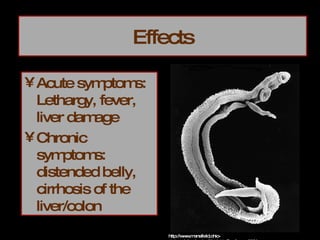
Effects Acute symptoms: Lethargy, fever, liver damage Chronic symptoms: distended belly, cirrhosis of the liver/colon http://www.mansfield.ohio-state.edu/~sabedon/black11_files/image023.jpg
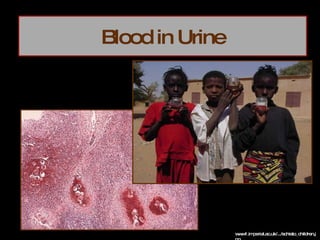
Blood in Urine www1.imperial.ac.uk/.../schisto_children.jpg
Infection Process Shistosome eggs are laid in feces, and hatch when they reach fresh water Common to find shistosomiasis in freshwater sources around the globe, particularly large pools or slow-moving water Any person in the water is at risk of infection
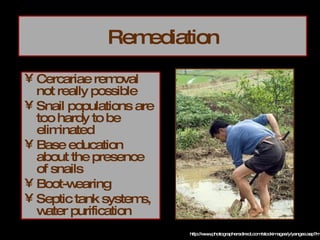
Remediation Cercariae removal not really possible Snail populations are too hardy to be eliminated Base education about the presence of snails Boot-wearing Septic tank systems, water purification http://www.photographersdirect.com/stockimages/y/yangze.asp?ms=y
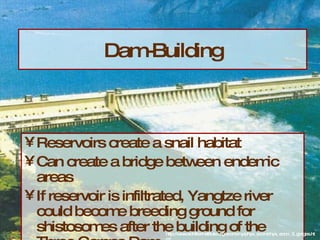
Dam-Building Reservoirs create a snail habitat Can create a bridge between endemic areas If reservoir is infiltrated, Yangtze river could become breeding ground for shistosomes after the building of the Three Gorges Dam http://www.schillerinstitute.org/economy/phys_econ/phys_econ_3_gorges.html
Future of Schistosomiasis Ending dam-building will hinder snail population growth Large-scale irrigation projects must be checked to avoid circariae breeding grounds New drug: praziquantel is effective way to treat symptoms, stop human egg-shedding Vaccine in 10-20 years
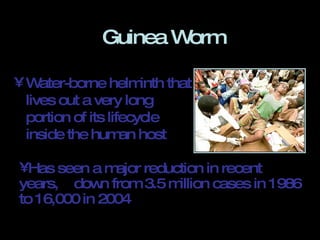
Guinea Worm Water-borne helminth that lives out a very long portion of its lifecycle inside the human host Has seen a major reduction in recent years,  down from 3.5 million cases in 1986 to 16,000 in 2004
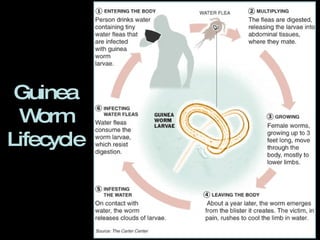
Guinea Worm Lifecycle
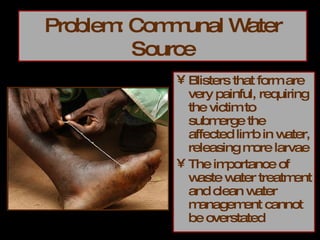
Problem: Communal Water Source Blisters that form are very painful, requiring the victim to submerge the affected limb in water, releasing more larvae The importance of waste water treatment and clean water management cannot be overstated
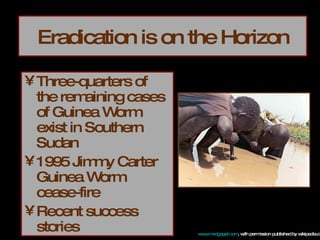
Eradication is on the Horizon Three-quarters of the remaining cases of Guinea Worm exist in Southern Sudan 1995 Jimmy Carter Guinea Worm cease-fire Recent success stories www.medgaget.com , with permission published by wikipedia.org
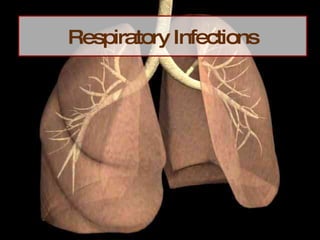
Respiratory Infections
The Big Respiratory Threat of 2007:  Tuberculosis Mycobacterium tuberculosis Leading cause of death among young adults worldwide – 2 billion people are currently infected, 300,000 of them are drug resistant Commonly associated with slums, poverty, and high population density Transmitted through the respiratory route
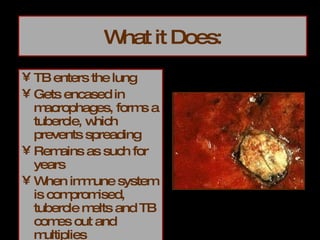
What it Does: TB enters the lung Gets encased in macrophages, forms a tubercle, which prevents spreading Remains as such for years When immune system is compromised, tubercle melts and TB comes out and multiplies
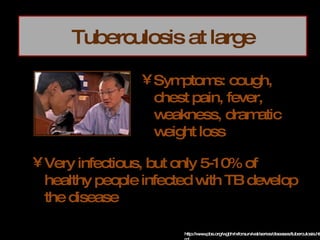
Tuberculosis at large Symptoms: cough, chest pain, fever, weakness, dramatic weight loss http://www.pbs.org/wgbh/rxforsurvival/series/diseases/tuberculosis.html Very infectious, but only 5-10% of healthy people infected with TB develop the disease
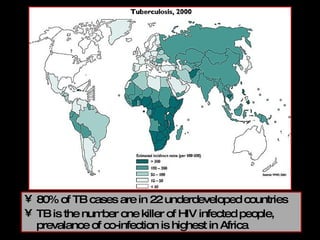
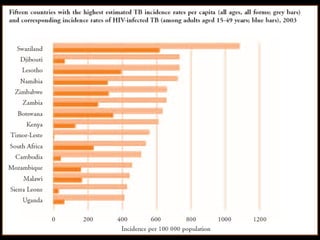
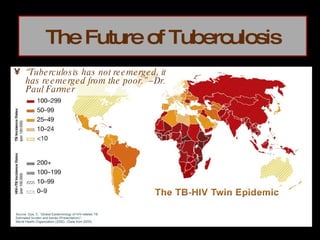
80% of TB cases are in 22 underdeveloped countries TB is the number one killer of HIV infected people, prevalance of co-infection is highest in Africa
 
MDR-TB 4 medications are used widely to treat TB Inexpensive, but must be taken regularly for six to eight months Skipping any dose causes MTB to mutate 80% of all cases of MDR-TB are superstrains, so they are resistant to at least 3 out of 4 drugs used to treat the disease
DOTS World Health Organization’s “Directly Observed Treatment” DOTS campaigns have yielded 85 - 100% cure rates in many clinics 90% in studies in Peru; 100% in Haitian sites BUT today, less than 25% of TB patients worldwide are treated with DOTS Strategy 25% of TB infected have no access to DOTS
The Future of Tuberculosis “ Tuberculosis has not reemerged, it has reemerged from the poor.” –Dr. Paul Farmer
Malaria Water-related, vector-borne, world’s number one parasitic disease 300 – 500 million infections per year 1-3 million deaths per year, 90% are African 3,000 child deaths per day  (WHO, 2002)
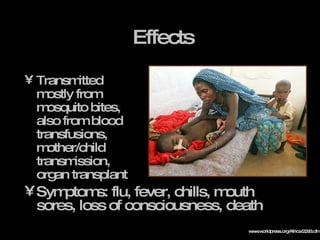
Effects Transmitted mostly from mosquito bites, also from blood transfusions, mother/child transmission, organ transplant Symptoms: flu, fever, chills, mouth sores, loss of consciousness, death www.worldpress.org/Africa/2293.cfm
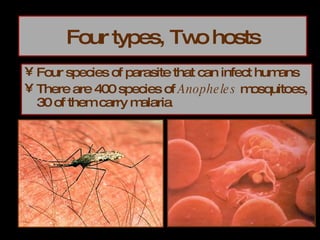
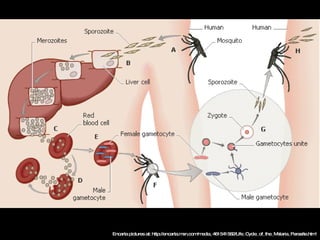
Four types, Two hosts Four species of parasite that can infect humans There are 400 species of  Anopheles  mosquitoes, 30 of them carry malaria
Encarta pictures at: http://encarta.msn.com/media_461541582/Life_Cycle_of_the_Malaria_Parasite.html
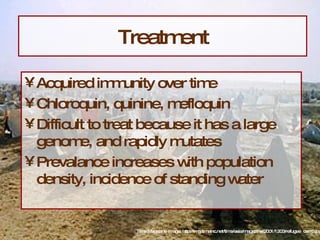
Treatment Acquired immunity over time Chloroquin, quinine, mefloquin Difficult to treat because it has a large genome, and rapidly mutates Prevalance increases with population density, incidence of standing water Time Magazine image: http://img.timeinc.net/time/asia/magazine/2001/1203/refugee_camp.jpg
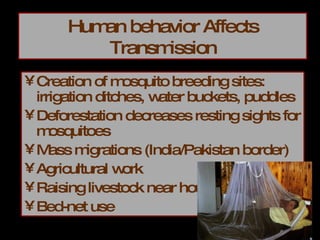
Human behavior Affects Transmission Creation of mosquito breeding sites: irrigation ditches, water buckets, puddles Deforestation decreases resting sights for mosquitoes Mass migrations (India/Pakistan border) Agricultural work Raising livestock near house Bed-net use
Malaria Remediation Efforts Insecticide-treated bed nets Introduction of mosquito-eating fish Filling or covering pits, puddles Pesticide use for indoor and outdoor spraying
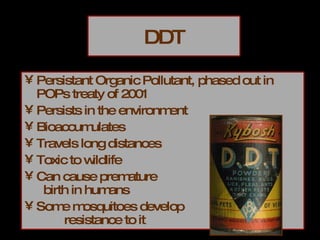
DDT Persistant Organic Pollutant, phased out in POPs treaty of 2001 Persists in the environment Bioaccumulates Travels long distances Toxic to wildlife Can cause premature  birth in humans Some mosquitoes develop  resistance to it
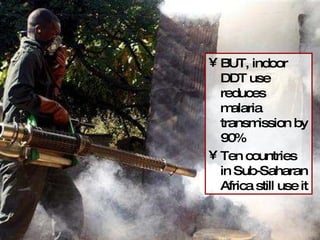
BUT, indoor DDT use reduces malaria transmission by 90% Ten countries in Sub-Saharan Africa still use it
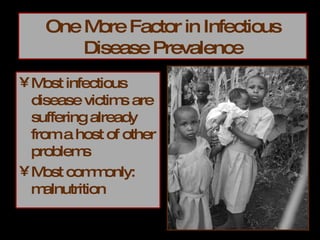
One More Factor in Infectious Disease Prevalence Most infectious disease victims are suffering already from a host of other problems Most commonly: malnutrition
Conclusions In the face of global climate change, warm places will only be getting warmer, and therefore facing more exposure In the face of globalization and development, public health workers, environmental scientists, and public policy workers have to work together in order to decrease mortality rates and increase health expenditures in developing countries
Source Material infectious disease. (n.d.).  The American Heritage® Stedman's Medical Dictionary . Retrieved February 24, 2007, from Dictionary.com website:  http:// dictionary.reference.com /browse/infectious disease Onchocerciasis volvalae at:  http://www.vetmed.ucdavis.edu/courses/vet_eyes/eye_path/epath_s_7377.html WHO communicable diseases:  http:// www.who.int /infectious-disease-news/ -neglected tropical diseases:  http:// www.who.int/neglected_diseases/en / World Bank Health and Population Data, including vital statistics:  http://web.worldbank.org/WBSITE/EXTERNAL/TOPICS/EXTHEALTHNUTRITIONANDPOPULATION/0,,menuPK:282516~pagePK:149018~piPK:149093~theSitePK:282511,00.html Center for Disease Control and Prevention. Department of Health and Human Services. [Online] Available at :http://www.cdc.gov/index.htm  Image sources: Water-borne disease image:  http://www.theirc.org/images/photoessays/drc/pe-drc-pb0506-drc9.jpg Hookworm image:  http:// phil.cdc.gov/phil/quicksearch.asp G protein activation graph:  http:// depts.washington.edu/biowww/faculty/hol.html The defenders image:  http:// www.thehumanbody.ecsd.net/immune_system.htm Imperial College of London blood in urine image:  http://www1.imperial.ac.uk/medicine/research/researchstrategy/researchthemes/publicandint/ide/groupsandcollabs/thesci/ Schistosomiasis life cycle graph, CDC: CDC:  http://en.wikipedia.org/wiki/Image:Schistosomiasis_Life_Cycle.jpeg Yangtze farmer:  http:// www.photographersdirect.com/stockimages/y/yangze.asp?ms =y Three gorges dam:  http://www.schillerinstitute.org/economy/phys_econ/phys_econ_3_gorges.html east African river:  http://www.iwmi.cgiar.org/Africa/files/RIPARWIN/05/_archive/latest.htm guinea worm extraction photo:  http://seattlepi.nwsource.com/africa/worm23.shtml Malaria woman and child:  www.worldpress.org/Africa/2293.cfm DDT:  http://www.sciam.com/media/externalnews/2006-12-07T202947Z_01_NOOTR_RTRIDSP_2_SCIENCE-AIDS-MALARIA-DC.jpg DDR jar:  http :// www.oei.es / decada / ddt.jpg
Common Infectious Disease

  • 1.
    Infectious Disease Transmissionin Tropical Environments Mary Dain ESPM 194 Spring 2007
  • 2.
    Worldwide Infectious DiseaseWorld Health Organization at http://www.who.int/whosis/whostat2006highlights/en/index4.html
  • 3.
    What is aninfectious disease? American Heritage Stedman's Medical Dictionary - infectious disease ( n.) A disease resulting from the presence and activity of a pathogenic microbial agent. Four main types of infectious disease carrying-pathogens: bacteria, viruses, protozoa, and helminths
  • 4.
    Bacteria single-celled, free-living,ubiquitous prokaryotes Such as tuberculosis, salmonella, cholera, leprosy, plague Illinois Department of Health: http://www.idph.state.il.us/public/hb/hbsam.htm
  • 5.
    Viruses Parasitic, eukaryoticSuch as measles, smallpox, hepatitis, HIV Scientific American, 1995. At: http://www.wellesley.edu/Chemistry/Chem101/hiv/HIV-1.html
  • 6.
    Protozoa Single-celled, nocell walls, larger than bacteria and more complex, frequently use vectors Such as malaria, leishmania, giardia Helveticum Instituticum Tropologicum, at: http://www.infektionsbiologie.ch/parasitologie/index.html
  • 7.
    Helminth Multi-cellular worms,free-living or parasitic Such as schistosomiasis, guinea worm, hookworm CDC Public Health Image Library http://phil.cdc.gov/phil/quicksearch.asp
  • 8.
    Communicable Diseases inthe Environment Most common in developing countries, particularly in warmer climates Still very prevalent: under-5 child mortality rate is 168 for every 1,000 live births in Sub-Saharan Africa (source: World Bank, HNP statistics 2004) The environment has direct impacts on the transmission of almost all communicable diseases in the developing world
  • 9.
    Transmission All infectiousdiseases transfer themselves along one of the following routes: Fecal/oral Respiratory Blood borne/sexual By contact
  • 10.
  • 11.
    Cholera Commonly knownfor pandemics in England (1817) and New York city (1830’s) Yet still very common today – there were 100,000 cases of cholera worldwide in 2004, causing 2,300 deaths in 56 different countries
  • 12.
    Cholera’s habits Water-bornebacterium ( Vibrio cholera ) Seasonal: warm weather promotes growth Forms bacterial reservoirs in brackish waters Photo curteosy of Sudan Watch blog: http://sudanwatch.blogspot.com/2006/02/drilling-for-sudans-drinking-water-is.html
  • 13.
    What it does:Alters activity of G proteins in intestinal cells, so that they become “stuck” in an activated state, pumping water continuously out of cells and into the intestines Severe diarrhea and dehydration result Dr. Wim Hol, U Washington at: http://depts.washington.edu/biowww/faculty/hol.html
  • 14.
    This results in: Loss of 20 liters of water/day over 5 to 8 days Shock and/or death Bacteria exits the body in feces, contaminates local drinking water and the cycle continues Most commonly occurs in children, afterwards develop base immunity
  • 15.
    Human Defenses Malnourishment,parasitic infection contribute to likelihood of contracting cholera First-infection can produce long-term immunity Endemic area resistance
  • 16.
    The Future ofCholera Global case-fatality down 47% from 1961 Oral Rehydration Therapy: glucose, potassium, salt Evolving pathogen Improved coordination of relief efforts Improved sanitation systems
  • 17.
    Schistosomiasis Water-borne helminthwith a complex life-cycle Dependent upon one genus of snail ( Biomphalaria spp. ) to survive
  • 18.
    Transmission Takes theform of cercariae that carry out part of lifecycle in water, in snails, and in a human host as worms Enters the body through the skin, in water contaminated with cercariae Shistosomiasis Forum, Human Diseases and Conditions, at: http://www.humanillnesses.com/Infectious-Diseases-My-Si/Schistosomiasis.html
  • 19.
  • 20.
    Effects Acute symptoms:Lethargy, fever, liver damage Chronic symptoms: distended belly, cirrhosis of the liver/colon http://www.mansfield.ohio-state.edu/~sabedon/black11_files/image023.jpg
  • 21.
    Blood in Urinewww1.imperial.ac.uk/.../schisto_children.jpg
  • 22.
    Infection Process Shistosomeeggs are laid in feces, and hatch when they reach fresh water Common to find shistosomiasis in freshwater sources around the globe, particularly large pools or slow-moving water Any person in the water is at risk of infection
  • 23.
    Remediation Cercariae removalnot really possible Snail populations are too hardy to be eliminated Base education about the presence of snails Boot-wearing Septic tank systems, water purification http://www.photographersdirect.com/stockimages/y/yangze.asp?ms=y
  • 24.
    Dam-Building Reservoirs createa snail habitat Can create a bridge between endemic areas If reservoir is infiltrated, Yangtze river could become breeding ground for shistosomes after the building of the Three Gorges Dam http://www.schillerinstitute.org/economy/phys_econ/phys_econ_3_gorges.html
  • 25.
    Future of SchistosomiasisEnding dam-building will hinder snail population growth Large-scale irrigation projects must be checked to avoid circariae breeding grounds New drug: praziquantel is effective way to treat symptoms, stop human egg-shedding Vaccine in 10-20 years
  • 26.
    Guinea Worm Water-bornehelminth that lives out a very long portion of its lifecycle inside the human host Has seen a major reduction in recent years, down from 3.5 million cases in 1986 to 16,000 in 2004
  • 27.
  • 28.
    Problem: Communal WaterSource Blisters that form are very painful, requiring the victim to submerge the affected limb in water, releasing more larvae The importance of waste water treatment and clean water management cannot be overstated
  • 29.
    Eradication is onthe Horizon Three-quarters of the remaining cases of Guinea Worm exist in Southern Sudan 1995 Jimmy Carter Guinea Worm cease-fire Recent success stories www.medgaget.com , with permission published by wikipedia.org
  • 30.
  • 31.
    The Big RespiratoryThreat of 2007: Tuberculosis Mycobacterium tuberculosis Leading cause of death among young adults worldwide – 2 billion people are currently infected, 300,000 of them are drug resistant Commonly associated with slums, poverty, and high population density Transmitted through the respiratory route
  • 32.
    What it Does:TB enters the lung Gets encased in macrophages, forms a tubercle, which prevents spreading Remains as such for years When immune system is compromised, tubercle melts and TB comes out and multiplies
  • 33.
    Tuberculosis at largeSymptoms: cough, chest pain, fever, weakness, dramatic weight loss http://www.pbs.org/wgbh/rxforsurvival/series/diseases/tuberculosis.html Very infectious, but only 5-10% of healthy people infected with TB develop the disease
  • 34.
    80% of TBcases are in 22 underdeveloped countries TB is the number one killer of HIV infected people, prevalance of co-infection is highest in Africa
  • 35.
  • 36.
    MDR-TB 4 medicationsare used widely to treat TB Inexpensive, but must be taken regularly for six to eight months Skipping any dose causes MTB to mutate 80% of all cases of MDR-TB are superstrains, so they are resistant to at least 3 out of 4 drugs used to treat the disease
  • 37.
    DOTS World HealthOrganization’s “Directly Observed Treatment” DOTS campaigns have yielded 85 - 100% cure rates in many clinics 90% in studies in Peru; 100% in Haitian sites BUT today, less than 25% of TB patients worldwide are treated with DOTS Strategy 25% of TB infected have no access to DOTS
  • 38.
    The Future ofTuberculosis “ Tuberculosis has not reemerged, it has reemerged from the poor.” –Dr. Paul Farmer
  • 39.
    Malaria Water-related, vector-borne,world’s number one parasitic disease 300 – 500 million infections per year 1-3 million deaths per year, 90% are African 3,000 child deaths per day (WHO, 2002)
  • 40.
    Effects Transmitted mostlyfrom mosquito bites, also from blood transfusions, mother/child transmission, organ transplant Symptoms: flu, fever, chills, mouth sores, loss of consciousness, death www.worldpress.org/Africa/2293.cfm
  • 41.
    Four types, Twohosts Four species of parasite that can infect humans There are 400 species of Anopheles mosquitoes, 30 of them carry malaria
  • 42.
    Encarta pictures at:http://encarta.msn.com/media_461541582/Life_Cycle_of_the_Malaria_Parasite.html
  • 43.
    Treatment Acquired immunityover time Chloroquin, quinine, mefloquin Difficult to treat because it has a large genome, and rapidly mutates Prevalance increases with population density, incidence of standing water Time Magazine image: http://img.timeinc.net/time/asia/magazine/2001/1203/refugee_camp.jpg
  • 44.
    Human behavior AffectsTransmission Creation of mosquito breeding sites: irrigation ditches, water buckets, puddles Deforestation decreases resting sights for mosquitoes Mass migrations (India/Pakistan border) Agricultural work Raising livestock near house Bed-net use
  • 45.
    Malaria Remediation EffortsInsecticide-treated bed nets Introduction of mosquito-eating fish Filling or covering pits, puddles Pesticide use for indoor and outdoor spraying
  • 46.
    DDT Persistant OrganicPollutant, phased out in POPs treaty of 2001 Persists in the environment Bioaccumulates Travels long distances Toxic to wildlife Can cause premature birth in humans Some mosquitoes develop resistance to it
  • 47.
    BUT, indoor DDTuse reduces malaria transmission by 90% Ten countries in Sub-Saharan Africa still use it
  • 48.
    One More Factorin Infectious Disease Prevalence Most infectious disease victims are suffering already from a host of other problems Most commonly: malnutrition
  • 49.
    Conclusions In theface of global climate change, warm places will only be getting warmer, and therefore facing more exposure In the face of globalization and development, public health workers, environmental scientists, and public policy workers have to work together in order to decrease mortality rates and increase health expenditures in developing countries
  • 50.
    Source Material infectiousdisease. (n.d.). The American Heritage® Stedman's Medical Dictionary . Retrieved February 24, 2007, from Dictionary.com website: http:// dictionary.reference.com /browse/infectious disease Onchocerciasis volvalae at: http://www.vetmed.ucdavis.edu/courses/vet_eyes/eye_path/epath_s_7377.html WHO communicable diseases: http:// www.who.int /infectious-disease-news/ -neglected tropical diseases: http:// www.who.int/neglected_diseases/en / World Bank Health and Population Data, including vital statistics: http://web.worldbank.org/WBSITE/EXTERNAL/TOPICS/EXTHEALTHNUTRITIONANDPOPULATION/0,,menuPK:282516~pagePK:149018~piPK:149093~theSitePK:282511,00.html Center for Disease Control and Prevention. Department of Health and Human Services. [Online] Available at :http://www.cdc.gov/index.htm Image sources: Water-borne disease image: http://www.theirc.org/images/photoessays/drc/pe-drc-pb0506-drc9.jpg Hookworm image: http:// phil.cdc.gov/phil/quicksearch.asp G protein activation graph: http:// depts.washington.edu/biowww/faculty/hol.html The defenders image: http:// www.thehumanbody.ecsd.net/immune_system.htm Imperial College of London blood in urine image: http://www1.imperial.ac.uk/medicine/research/researchstrategy/researchthemes/publicandint/ide/groupsandcollabs/thesci/ Schistosomiasis life cycle graph, CDC: CDC: http://en.wikipedia.org/wiki/Image:Schistosomiasis_Life_Cycle.jpeg Yangtze farmer: http:// www.photographersdirect.com/stockimages/y/yangze.asp?ms =y Three gorges dam: http://www.schillerinstitute.org/economy/phys_econ/phys_econ_3_gorges.html east African river: http://www.iwmi.cgiar.org/Africa/files/RIPARWIN/05/_archive/latest.htm guinea worm extraction photo: http://seattlepi.nwsource.com/africa/worm23.shtml Malaria woman and child: www.worldpress.org/Africa/2293.cfm DDT: http://www.sciam.com/media/externalnews/2006-12-07T202947Z_01_NOOTR_RTRIDSP_2_SCIENCE-AIDS-MALARIA-DC.jpg DDR jar: http :// www.oei.es / decada / ddt.jpg