NURSING CARE PLAN FOR A CHILD WITH PNEUMONIA
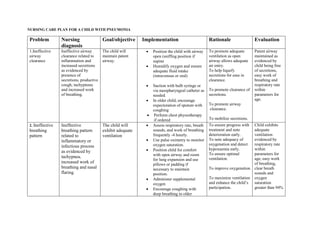
Problem Nursing
diagnosis
Goal/objective Implementation Rationale Evaluation
1.Ineffective
airway
clearance
Ineffective airway
clearance related to
inflammation and
increased secretions
as evidenced by
presence of
secretions, productive
cough, tachypnoea
and increased work
of breathing.
The child will
maintain patent
airway.
 Position the child with airway
open (sniffing position if
supine
 Humidify oxygen and ensure
adequate fluid intake
(intravenous or oral)
 Suction with bulb syringe or
via nasopharyngeal catheter as
needed.
 In older child, encourage
expectoration of sputum with
coughing
 Perform chest physiotherapy
if ordered
To promote adequate
ventilation as open
airway allows adequate
air entry.
To help liquefy
secretions for ease in
clearance.
To promote clearance of
secretions.
To promote airway
clearance.
To mobilize secretions.
Patent airway
maintained as
evidenced by
child being free
of secretions,
easy work of
breathing and
respiratory rate
within
parameters for
age.
2. Ineffective
breathing
pattern
Ineffective
breathing pattern
related to
inflammatory or
infectious process
as evidenced by
tachypnea,
increased work of
breathing and nasal
flaring.
The child will
exhibit adequate
ventilation
 Assess respiratory rate, breath
sounds, and work of breathing
frequently -4 hourly.
 Use pulse oximetry to monitor
oxygen saturation.
 Position child for comfort
with open airway and room
for lung expansion and use
pillows or padding if
necessary to maintain
position.
 Administer supplemental
oxygen
 Encourage coughing with
deep breathing in older
To ensure progress with
treatment and note
deterioration early.
To note adequacy of
oxygenation and detect
hypoxaemia early.
To ensure optimal
ventilation.
To improve oxygenation
To maximize ventilation
and enhance the child’s
participation.
Child exhibits
adequate
ventilation
evidenced by
respiratory rate
within
parameters for
age, easy work
of breathing,
clear breath
sounds and
oxygen
saturation
greater than 94%
children which can be done
through play
Problem Nursing
diagnosis
Goal/objective Implementation Rationale Evaluation
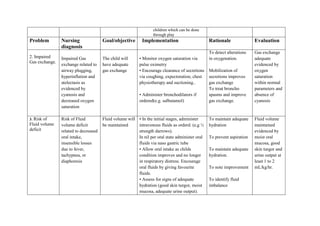
2. Impaired
Gas exchange.
Impaired Gas
exchange related to
airway plugging,
hyperinflation and
atelectasis as
evidenced by
cyanosis and
decreased oxygen
saturation
The child will
have adequate
gas exchange
• Monitor oxygen saturation via
pulse oximetry
• Encourage clearance of secretions
via coughing, expectoration, chest
physiotherapy and suctioning..
• Administer bronchodilators if
ordered(e.g. salbutamol)
To detect alterations
in oxygenation.
Mobilization of
secretions improves
gas exchange
To treat broncho
spasms and improve
gas exchange.
Gas exchange
adequate
evidenced by
oxygen
saturation
within normal
parameters and
absence of
cyanosis
3. Risk of
Fluid volume
deficit
Risk of Fluid
volume deficit
related to decreased
oral intake,
insensible losses
due to fever,
tachypnea, or
diaphoresis
Fluid volume will
be maintained
• In the initial stages, administer
intravenous fluids as orderd. (e,g ½
strength darrows).
In nil per oral state administer oral
fluids via naso gastric tube
• Allow oral intake as childs
condition improves and no longer
in respiratory distress. Encourage
oral fluids by giving favourite
fluids.
• Assess for signs of adequate
hydration (good skin turgor, moist
mucosa, adequate urine output).
To maintain adequate
hydration
To prevent aspiration
To maintain adequate
hydration.
To note improvement
To identify fluid
imbalance
Fluid volume
maintained
evidenced by
moist oral
mucosa, good
skin turgor and
urine output at
least 1 to 2
mL/kg/hr.
• Strictly monitor fluid intake and
output
Problem Nursing
diagnosis
Goal/objective Implementation Rationale Evaluation
4. Altered
nutrition less
than body
requirements
Altered nutrition
less than body
requirements
related to inability
to feed or loss of
appetite as
evidenced by poor
oral intake
Child will
maintain
adequate
nutritional intake
Introduce small frequent feeds as
child’s condition improves.
In older children, oral toilet can be
done.
Assist family and child to choose
higher-calorie, protein-rich foods
Coax younger children to eat better
by playing games and offering
favourite foods
Small frequent meals
are better tolerated
To increases child’s
appetite
To optimize growth
potential.
To improve food
intake.
Adequate
nutritional
intake
maintained as
evidenced by
weight gain or
weight
maintenance.
5, Activity
intolerance
Activity intolerance
related to high
respiratory demand
as evidenced by
increased work of
breathing and
requirement for
frequent rest when
playing.
Child will resume
normal activity
level
Provide rest periods balanced with
periods of activity.
Carry out nursing procedures
collectively and allow visiting of
the child at scheduled times.
Activity increases myocardial
oxygen demand so must be
balanced with rest.
• Provide small, frequent meals
• Encourage quiet activities that do
not require exertion
• Allow gradual increase in activity
as tolerated, keeping pulse
To allow for sufficient
rest hence promoting
activity tolerance
when awake
To prevent overtiring
and abdominal
distension as infants
and younger children
use abdominal
muscles for breathing
To prevent boredom.
To minimize risk for
further respiratory
compromise.
Child able to
tolerate activity
without
difficulty
breathing.
Pulse oximetry
reading within
normal range
oximetry reading within normal
parameters.
Problem Nursing
diagnosis
Goal/objective Implementation Rationale Evaluation
6. Fear and
anxiety
Fear and anxiety
related to difficulty
breathing,
unfamiliar
personnel,
procedures, and
environment
(hospital) as
evidenced by
clinging, crying,
fussing,
verbalization, or
lack of cooperation
To allay anxiety
and reduce fear
• Establish trusting relationship
with the child and family.
• Explain procedures to child at
developmentally appropriate level
• Provide favourite blanket or toy
to the child, as well as comfort
measures preferred by child such as
rocking or music.
• Involve parents in care of the
child, allow caretaker to spend
enough time with the child and
allow for periods of play
To decrease anxiety
and fear.
To decrease fear of
unknown.
For added security
To allay anxiety and
decrease fear.
Fear and
anxiety allayed
evidenced by
decreased
episodes of
crying or
fussing, child
appears happy
and will be
able to play.
7. Altered
family
processes.
Family processes
altered, related to
child’s illness or
hospitalization as
evidenced by
family’s presence in
the hospital,
missed work and
demonstration of
inadequate coping
Parents will
demonstrate
adequate coping
and decreased
anxiety.
• Encourage parent’s verbalization
of concerns related to child’s
illness.
• Explain therapy, procedures, and
child’s behaviour to parents.
This allows for
identification of
concerns and
demonstrates to the
family that the nurse
cares about them as
well.
To develop an
understanding of the
child’s current status
which helps decrease
anxiety
Parents
demonstrate
adequate
coping and
decreased
anxiety:
Parents are
involved in
child’s care,
ask appropriate
questions and
are able to
•Encourage parental involvement
in child’s care.
This makes parents
feel needed and
valued.
discuss child’s
care and
condition
calmly.
TIME SPECIFIC
OBJECTIVE
CONTENT TEACHING
METHOD
AUDIO
VISUAL
AIDS
TEACHER’S
ACTIVITY
STUDENT’S
ACTIVITY
EVALUATION
List the
complication
of
pneumonia
 Pleural effusion
 Empyema
 Lung abscess
 Sepsis
 pneumothorax
Lecture/
Discussion
Flip chart
LCD
Markers
Explaining.
Asking
questions
Listening
Taking notes
Asking
questions
What are the
complications
of pneumonia?
REFERENCES
Hull J and Johnson D.I (1999). Essential Paediatrics. 4th
edition. Churchill. London.
Lassauer T and Clayden G. (2001). Illustrated Textbook of Paediatrics. 2nd
edition. Mosby. London.
Royle A.J and Walsh M, (1992), Watson’s Medical – Surgical Nursing and Related Physiology, 4th
Edition, Butler and Tanner Ltd, Frome and London,
Great Britain.
Ignatavicius D.D and Workman M.L, (2002), Medical Surgical Nursing: Critical Thinking for Collaborative care, 4th
Edition, W.B.
Saunders Company, Philadelphia, USA

pneumonia_nursing_care_plan.docx

  • 1.
    NURSING CARE PLANFOR A CHILD WITH PNEUMONIA Problem Nursing diagnosis Goal/objective Implementation Rationale Evaluation 1.Ineffective airway clearance Ineffective airway clearance related to inflammation and increased secretions as evidenced by presence of secretions, productive cough, tachypnoea and increased work of breathing. The child will maintain patent airway.  Position the child with airway open (sniffing position if supine  Humidify oxygen and ensure adequate fluid intake (intravenous or oral)  Suction with bulb syringe or via nasopharyngeal catheter as needed.  In older child, encourage expectoration of sputum with coughing  Perform chest physiotherapy if ordered To promote adequate ventilation as open airway allows adequate air entry. To help liquefy secretions for ease in clearance. To promote clearance of secretions. To promote airway clearance. To mobilize secretions. Patent airway maintained as evidenced by child being free of secretions, easy work of breathing and respiratory rate within parameters for age. 2. Ineffective breathing pattern Ineffective breathing pattern related to inflammatory or infectious process as evidenced by tachypnea, increased work of breathing and nasal flaring. The child will exhibit adequate ventilation  Assess respiratory rate, breath sounds, and work of breathing frequently -4 hourly.  Use pulse oximetry to monitor oxygen saturation.  Position child for comfort with open airway and room for lung expansion and use pillows or padding if necessary to maintain position.  Administer supplemental oxygen  Encourage coughing with deep breathing in older To ensure progress with treatment and note deterioration early. To note adequacy of oxygenation and detect hypoxaemia early. To ensure optimal ventilation. To improve oxygenation To maximize ventilation and enhance the child’s participation. Child exhibits adequate ventilation evidenced by respiratory rate within parameters for age, easy work of breathing, clear breath sounds and oxygen saturation greater than 94%
  • 2.
    children which canbe done through play Problem Nursing diagnosis Goal/objective Implementation Rationale Evaluation 2. Impaired Gas exchange. Impaired Gas exchange related to airway plugging, hyperinflation and atelectasis as evidenced by cyanosis and decreased oxygen saturation The child will have adequate gas exchange • Monitor oxygen saturation via pulse oximetry • Encourage clearance of secretions via coughing, expectoration, chest physiotherapy and suctioning.. • Administer bronchodilators if ordered(e.g. salbutamol) To detect alterations in oxygenation. Mobilization of secretions improves gas exchange To treat broncho spasms and improve gas exchange. Gas exchange adequate evidenced by oxygen saturation within normal parameters and absence of cyanosis 3. Risk of Fluid volume deficit Risk of Fluid volume deficit related to decreased oral intake, insensible losses due to fever, tachypnea, or diaphoresis Fluid volume will be maintained • In the initial stages, administer intravenous fluids as orderd. (e,g ½ strength darrows). In nil per oral state administer oral fluids via naso gastric tube • Allow oral intake as childs condition improves and no longer in respiratory distress. Encourage oral fluids by giving favourite fluids. • Assess for signs of adequate hydration (good skin turgor, moist mucosa, adequate urine output). To maintain adequate hydration To prevent aspiration To maintain adequate hydration. To note improvement To identify fluid imbalance Fluid volume maintained evidenced by moist oral mucosa, good skin turgor and urine output at least 1 to 2 mL/kg/hr.
  • 3.
    • Strictly monitorfluid intake and output Problem Nursing diagnosis Goal/objective Implementation Rationale Evaluation 4. Altered nutrition less than body requirements Altered nutrition less than body requirements related to inability to feed or loss of appetite as evidenced by poor oral intake Child will maintain adequate nutritional intake Introduce small frequent feeds as child’s condition improves. In older children, oral toilet can be done. Assist family and child to choose higher-calorie, protein-rich foods Coax younger children to eat better by playing games and offering favourite foods Small frequent meals are better tolerated To increases child’s appetite To optimize growth potential. To improve food intake. Adequate nutritional intake maintained as evidenced by weight gain or weight maintenance. 5, Activity intolerance Activity intolerance related to high respiratory demand as evidenced by increased work of breathing and requirement for frequent rest when playing. Child will resume normal activity level Provide rest periods balanced with periods of activity. Carry out nursing procedures collectively and allow visiting of the child at scheduled times. Activity increases myocardial oxygen demand so must be balanced with rest. • Provide small, frequent meals • Encourage quiet activities that do not require exertion • Allow gradual increase in activity as tolerated, keeping pulse To allow for sufficient rest hence promoting activity tolerance when awake To prevent overtiring and abdominal distension as infants and younger children use abdominal muscles for breathing To prevent boredom. To minimize risk for further respiratory compromise. Child able to tolerate activity without difficulty breathing. Pulse oximetry reading within normal range
  • 4.
    oximetry reading withinnormal parameters. Problem Nursing diagnosis Goal/objective Implementation Rationale Evaluation 6. Fear and anxiety Fear and anxiety related to difficulty breathing, unfamiliar personnel, procedures, and environment (hospital) as evidenced by clinging, crying, fussing, verbalization, or lack of cooperation To allay anxiety and reduce fear • Establish trusting relationship with the child and family. • Explain procedures to child at developmentally appropriate level • Provide favourite blanket or toy to the child, as well as comfort measures preferred by child such as rocking or music. • Involve parents in care of the child, allow caretaker to spend enough time with the child and allow for periods of play To decrease anxiety and fear. To decrease fear of unknown. For added security To allay anxiety and decrease fear. Fear and anxiety allayed evidenced by decreased episodes of crying or fussing, child appears happy and will be able to play. 7. Altered family processes. Family processes altered, related to child’s illness or hospitalization as evidenced by family’s presence in the hospital, missed work and demonstration of inadequate coping Parents will demonstrate adequate coping and decreased anxiety. • Encourage parent’s verbalization of concerns related to child’s illness. • Explain therapy, procedures, and child’s behaviour to parents. This allows for identification of concerns and demonstrates to the family that the nurse cares about them as well. To develop an understanding of the child’s current status which helps decrease anxiety Parents demonstrate adequate coping and decreased anxiety: Parents are involved in child’s care, ask appropriate questions and are able to
  • 5.
    •Encourage parental involvement inchild’s care. This makes parents feel needed and valued. discuss child’s care and condition calmly. TIME SPECIFIC OBJECTIVE CONTENT TEACHING METHOD AUDIO VISUAL AIDS TEACHER’S ACTIVITY STUDENT’S ACTIVITY EVALUATION List the complication of pneumonia  Pleural effusion  Empyema  Lung abscess  Sepsis  pneumothorax Lecture/ Discussion Flip chart LCD Markers Explaining. Asking questions Listening Taking notes Asking questions What are the complications of pneumonia?
  • 6.
    REFERENCES Hull J andJohnson D.I (1999). Essential Paediatrics. 4th edition. Churchill. London. Lassauer T and Clayden G. (2001). Illustrated Textbook of Paediatrics. 2nd edition. Mosby. London. Royle A.J and Walsh M, (1992), Watson’s Medical – Surgical Nursing and Related Physiology, 4th Edition, Butler and Tanner Ltd, Frome and London, Great Britain. Ignatavicius D.D and Workman M.L, (2002), Medical Surgical Nursing: Critical Thinking for Collaborative care, 4th Edition, W.B. Saunders Company, Philadelphia, USA