Prepared by:
Orlando A. Pistan, MAEd
Psychology Instructor
COMMON METHODS USED IN RESEARCH
Psychological
research refers
to studies that
psychologists conduct
to analyze the experiences
and behaviors of individuals
or groups.
Their research can have
educational, occupational,
and clinical applications.
COMMON METHODS USED IN RESEARCH
Introspection
Observation
Life-history method
Survey method
Experimental method
Statistical method
COMMON METHODS USED IN RESEARCH
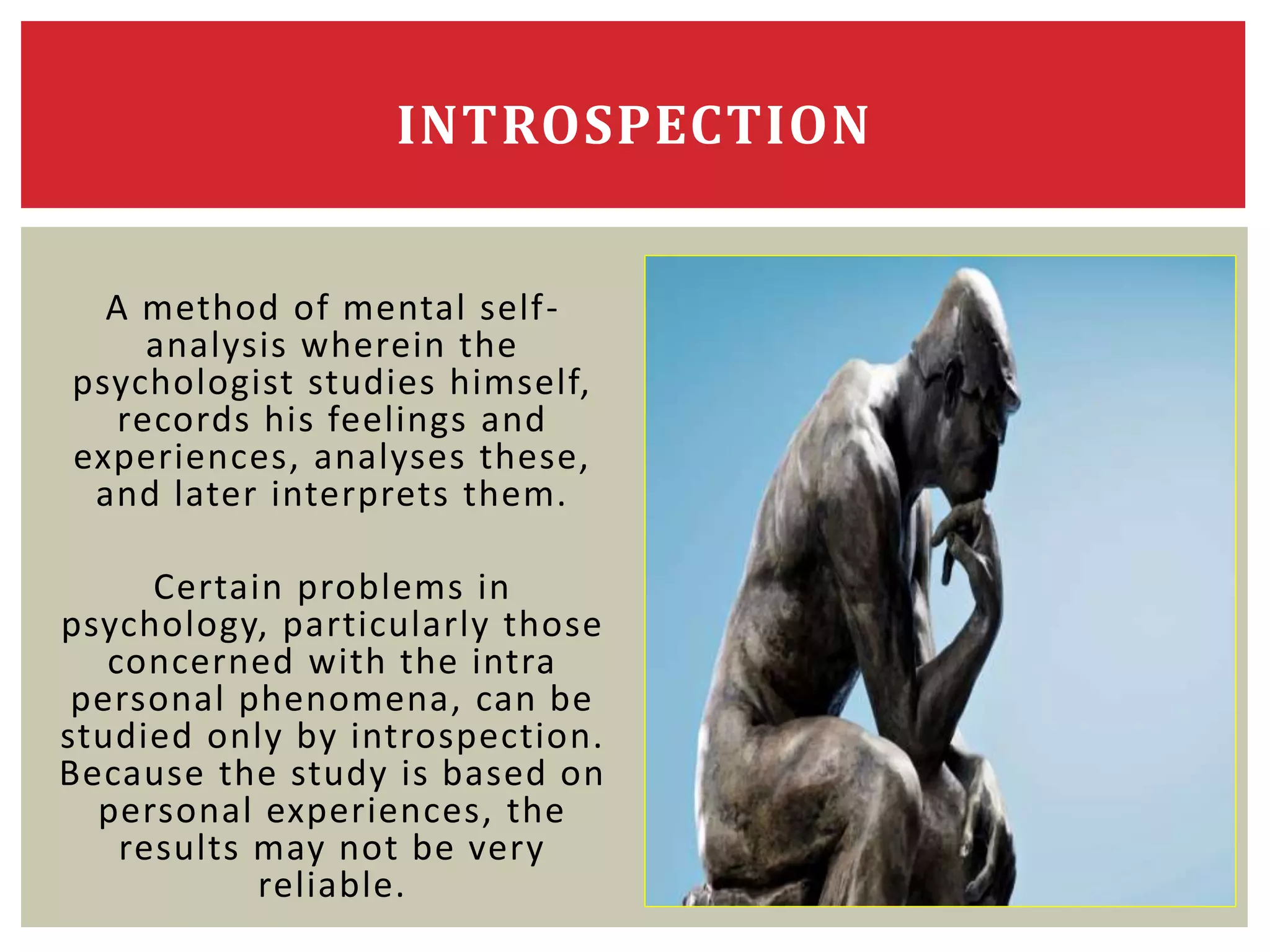
A method of mental self-
analysis wherein the
psychologist studies himself,
records his feelings and
experiences, analyses these,
and later interprets them.
Certain problems in
psychology, particularly those
concerned with the intra
personal phenomena, can be
studied only by introspection.
Because the study is based on
personal experiences, the
results may not be very
reliable.
INTROSPECTION
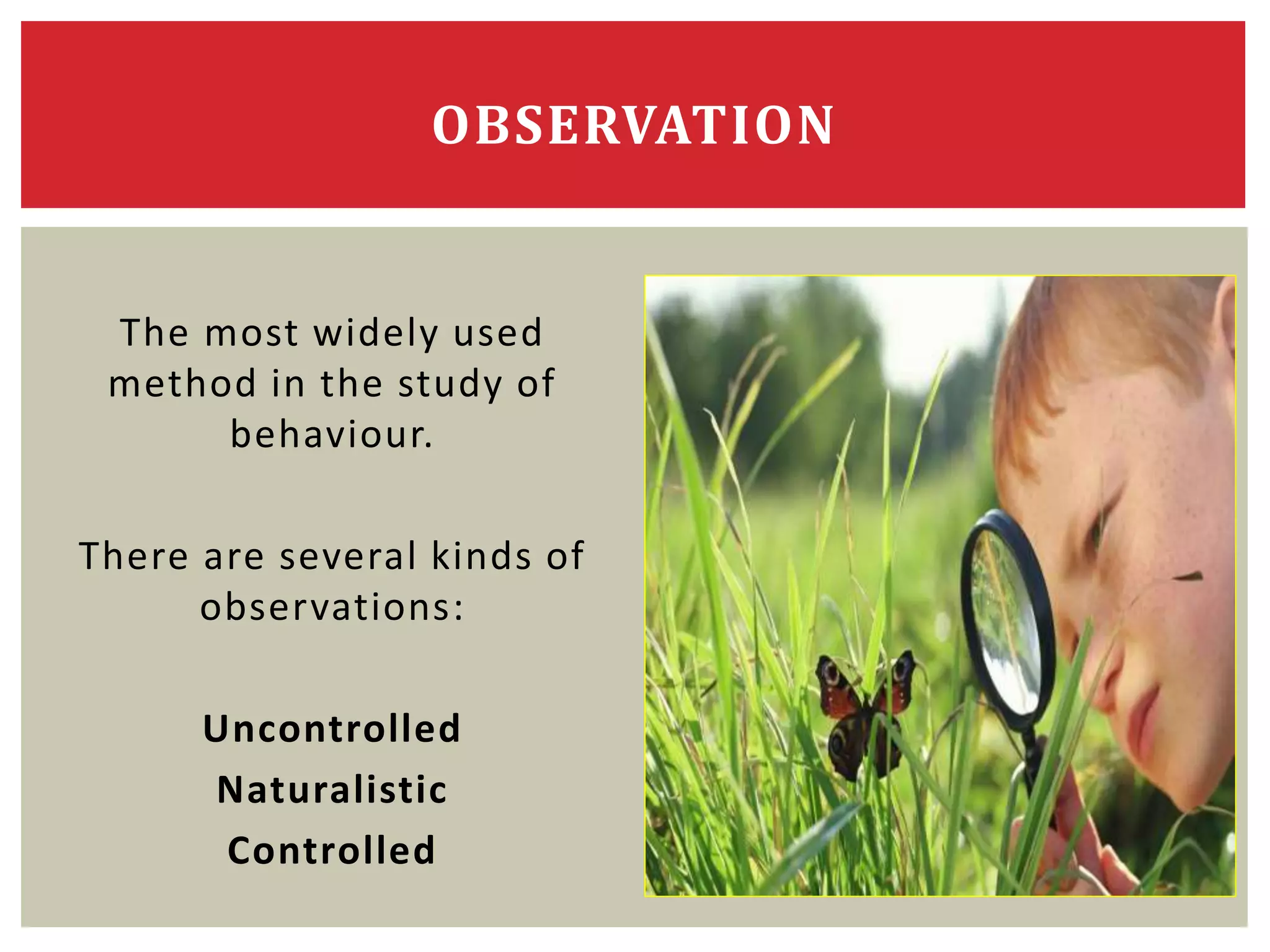
The most widely used
method in the study of
behaviour.
There are several kinds of
observations:
Uncontrolled
Naturalistic
Controlled
OBSERVATION
Does not follow any
particular scope of
behaviour to be observed.
It is casual, and the
psychologist is free to
observe any activity that
arises without formally
recording such behaviour.
UNCONTROLLED
The observation of
things as they naturally
happen.
Other investigators call
this field-study method,
where critical
observations are made
from nature “in the
raw”.
NATURALISTIC
Follows certain rules,
factors, or control in
gathering materials in
order to draw the best
conclusions.
Certain requirements or
specifications limit the
activity of the observer.
CONTROLLED
COMPARISON
Parameter Recording
Uncontrolled No No
Naturalistic No Yes
Controlled Yes Yes
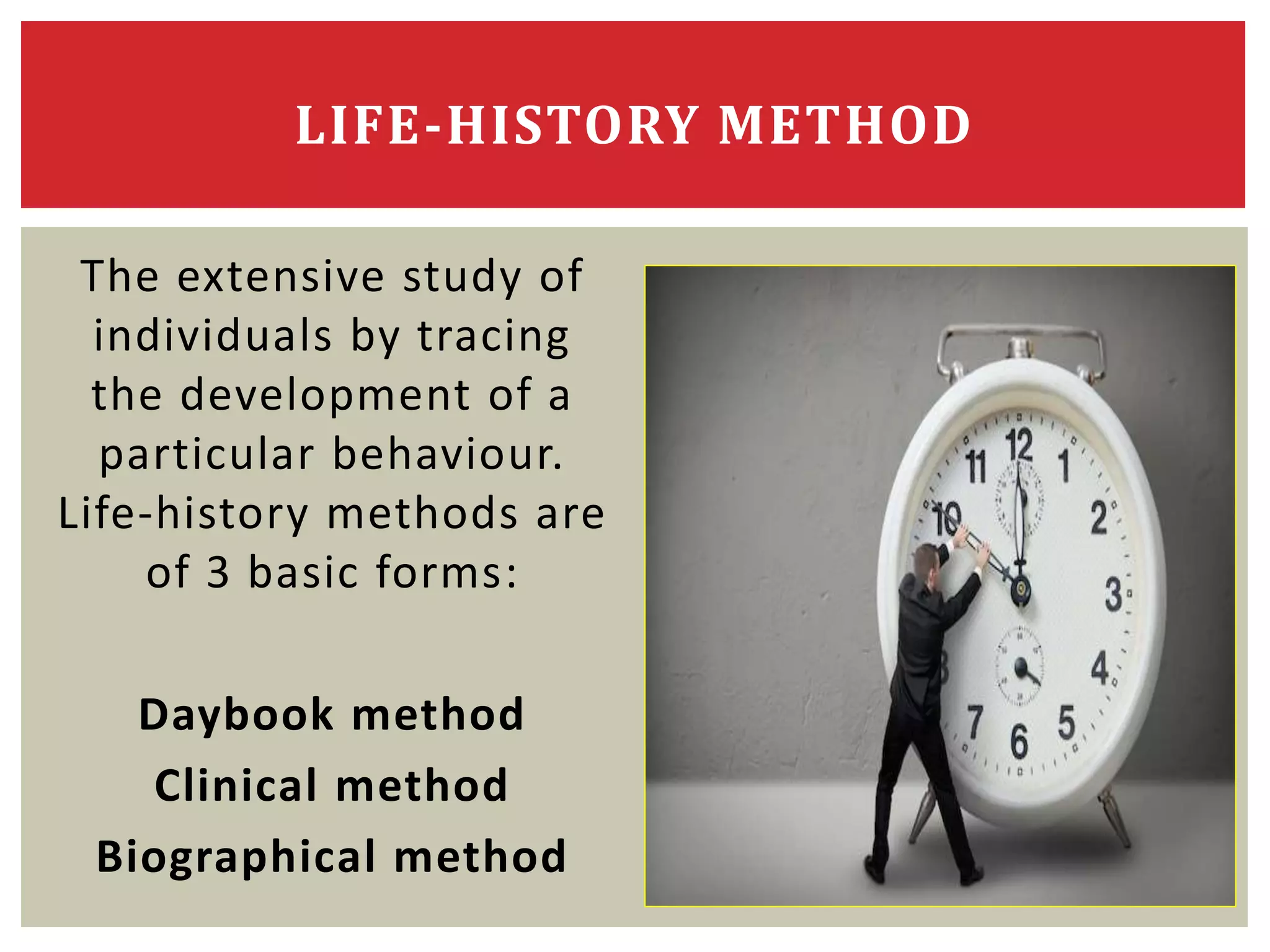
The extensive study of
individuals by tracing
the development of a
particular behaviour.
Life-history methods are
of 3 basic forms:
Daybook method
Clinical method
Biographical method
LIFE-HISTORY METHOD
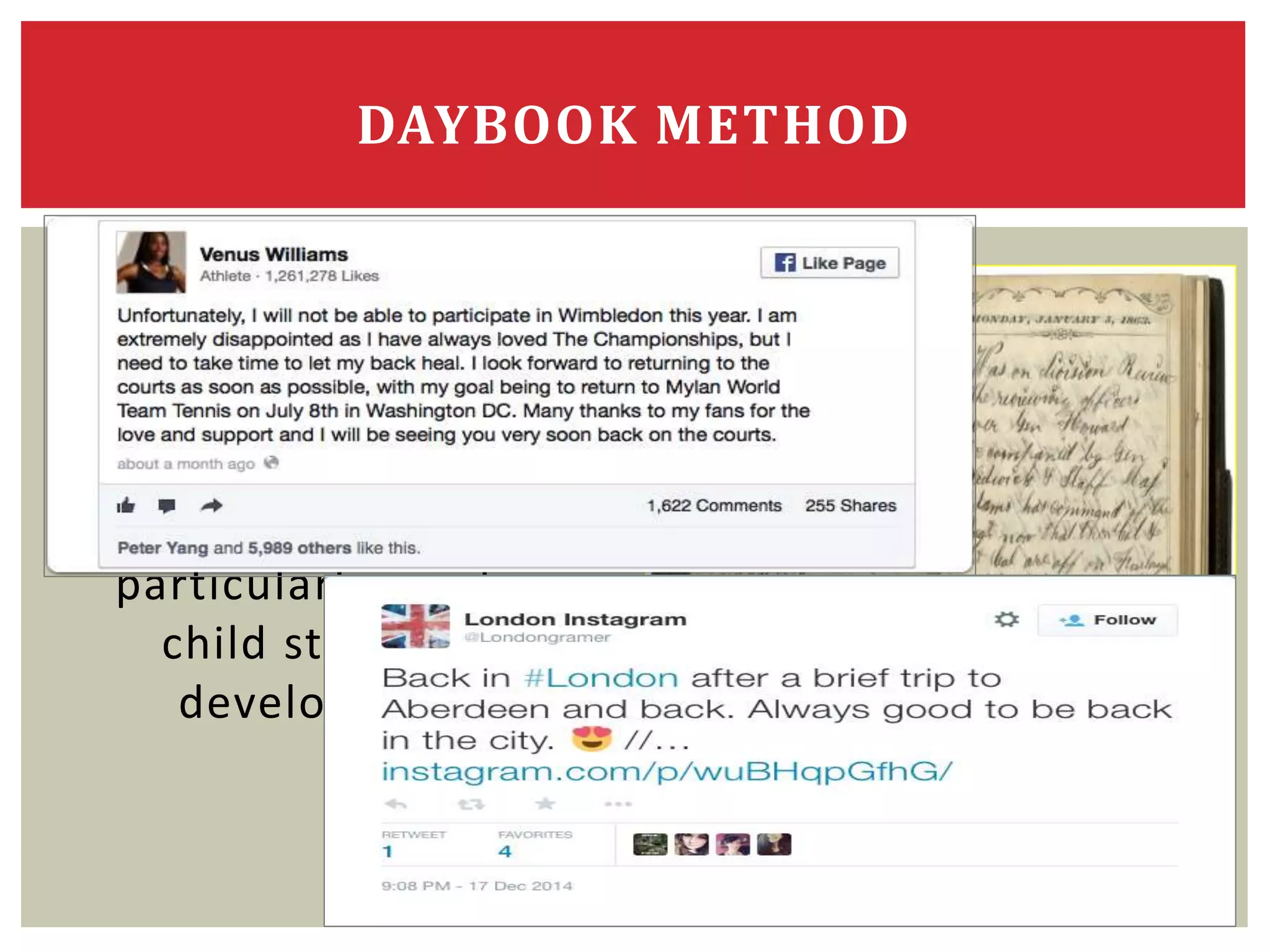
Sometimes called diary
of development, is a
careful recording of day
to day activities. This is
particularly used in
child study and
development.
DAYBOOK METHOD
Sometimes called diary
of development, is a
careful recording of day
to day activities. This is
particularly used in
child study and
development.
DAYBOOK METHOD
All possible data are
gathered from the
individual, the parents,
and others who knows the
person.
These are studied by the
clinical psychologist,
psychoanalyst,
psychiatrist or social
worker to discover the
cause of some social
adjustment problem and
how to solve it.
CLINICAL METHOD
The analysis of the
records of people’s lives
as written by
themselves or by others.
Biography
Autobiography
BIOGRAPHICAL METHOD
The analysis of the
records of people’s lives
as written by
themselves or by others.
Biography
Autobiography
BIOGRAPHICAL METHOD
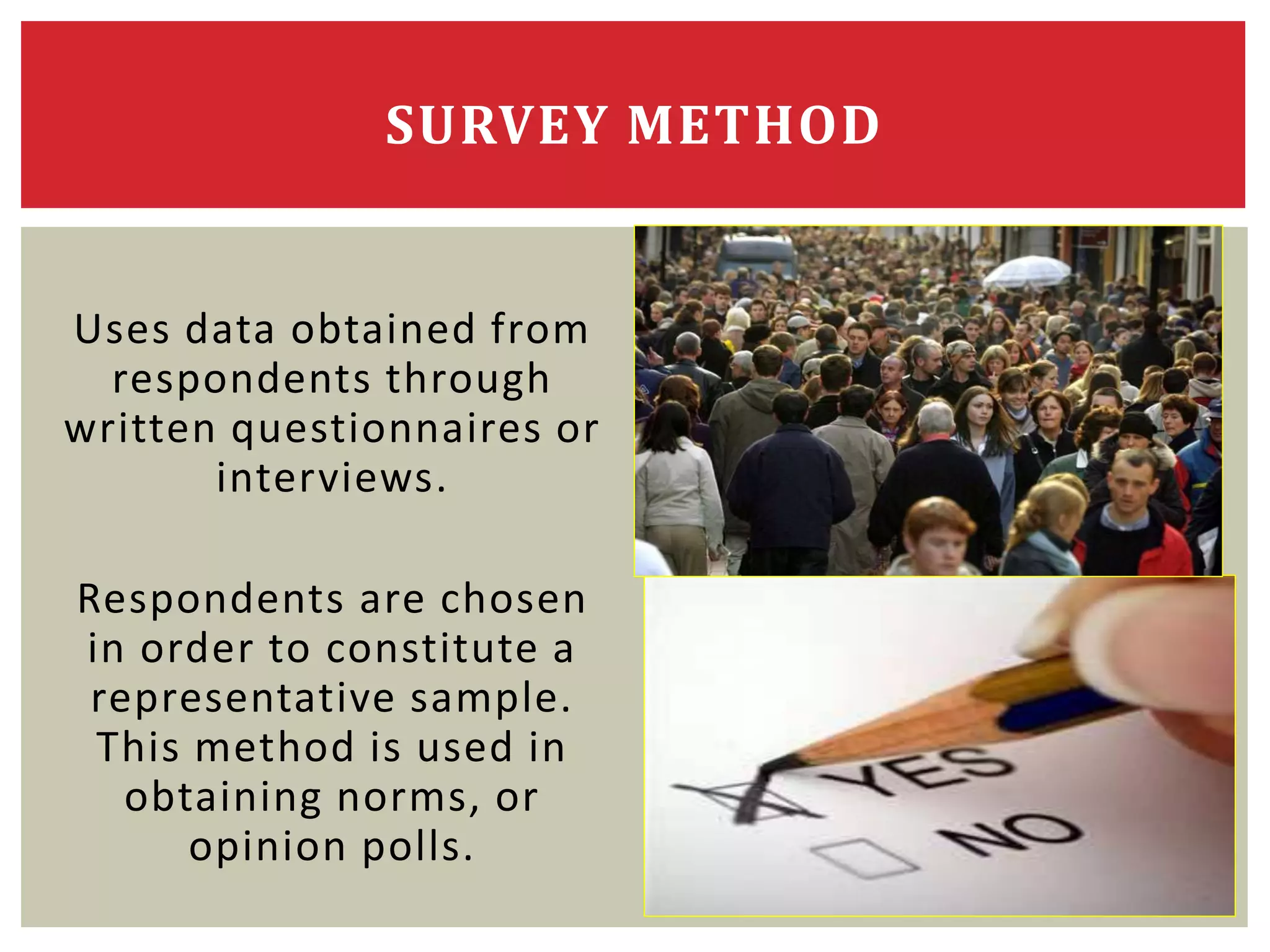
Uses data obtained from
respondents through
written questionnaires or
interviews.
Respondents are chosen
in order to constitute a
representative sample.
This method is used in
obtaining norms, or
opinion polls.
SURVEY METHOD
SURVEY METHOD
Involves variables which
can be either
independent or
dependent.
An independent variable
is a constant condition
which is selected by the
experimenter.
The dependent variable is
the subject’s behaviour
whose value depends in
the independent variable.
EXPERIMENTAL METHOD
“ The Effects of Internet Pornography on
Sexual Aggression of Sophomore Male
Criminology Students of Pamantasan ng
Lungsod ng Muntinlupa, AY 2010-2011. “
IDENTIFY THE VARIABLES:
Independent:
Internet Pornography
Constant
Dependent:
Sexual Aggression
Changing
Deals with the collecting
and handling of numerical
data and making
inferences from such
data.
Knowledge of statistical
method is needed in
order to appraise
individuality, such as in
intelligence tests,
personality tests, and
other kinds of appraisal
devices.
STATISTICAL METHOD
Introspection
Observation
Life-history method
Survey method
Experimental method
Statistical method
SO, WHAT ARE THE COMMON METHODS
USED IN PSYCHOLOGICAL RESEARCH?
Thank you for
paying attention.
COMMON METHODS USED IN RESEARCH

Common Methods used in Research (Psychology)

  • 1.
    Prepared by: Orlando A.Pistan, MAEd Psychology Instructor COMMON METHODS USED IN RESEARCH
  • 2.
    Psychological research refers to studiesthat psychologists conduct to analyze the experiences and behaviors of individuals or groups. Their research can have educational, occupational, and clinical applications. COMMON METHODS USED IN RESEARCH
  • 3.
    Introspection Observation Life-history method Survey method Experimentalmethod Statistical method COMMON METHODS USED IN RESEARCH
  • 4.
    A method ofmental self- analysis wherein the psychologist studies himself, records his feelings and experiences, analyses these, and later interprets them. Certain problems in psychology, particularly those concerned with the intra personal phenomena, can be studied only by introspection. Because the study is based on personal experiences, the results may not be very reliable. INTROSPECTION
  • 5.
    The most widelyused method in the study of behaviour. There are several kinds of observations: Uncontrolled Naturalistic Controlled OBSERVATION
  • 6.
    Does not followany particular scope of behaviour to be observed. It is casual, and the psychologist is free to observe any activity that arises without formally recording such behaviour. UNCONTROLLED
  • 7.
    The observation of thingsas they naturally happen. Other investigators call this field-study method, where critical observations are made from nature “in the raw”. NATURALISTIC
  • 8.
    Follows certain rules, factors,or control in gathering materials in order to draw the best conclusions. Certain requirements or specifications limit the activity of the observer. CONTROLLED
  • 9.
    COMPARISON Parameter Recording Uncontrolled NoNo Naturalistic No Yes Controlled Yes Yes
  • 10.
    The extensive studyof individuals by tracing the development of a particular behaviour. Life-history methods are of 3 basic forms: Daybook method Clinical method Biographical method LIFE-HISTORY METHOD
  • 11.
    Sometimes called diary ofdevelopment, is a careful recording of day to day activities. This is particularly used in child study and development. DAYBOOK METHOD
  • 12.
    Sometimes called diary ofdevelopment, is a careful recording of day to day activities. This is particularly used in child study and development. DAYBOOK METHOD
  • 13.
    All possible dataare gathered from the individual, the parents, and others who knows the person. These are studied by the clinical psychologist, psychoanalyst, psychiatrist or social worker to discover the cause of some social adjustment problem and how to solve it. CLINICAL METHOD
  • 14.
    The analysis ofthe records of people’s lives as written by themselves or by others. Biography Autobiography BIOGRAPHICAL METHOD
  • 15.
    The analysis ofthe records of people’s lives as written by themselves or by others. Biography Autobiography BIOGRAPHICAL METHOD
  • 16.
    Uses data obtainedfrom respondents through written questionnaires or interviews. Respondents are chosen in order to constitute a representative sample. This method is used in obtaining norms, or opinion polls. SURVEY METHOD
  • 17.
  • 18.
    Involves variables which canbe either independent or dependent. An independent variable is a constant condition which is selected by the experimenter. The dependent variable is the subject’s behaviour whose value depends in the independent variable. EXPERIMENTAL METHOD
  • 19.
    “ The Effectsof Internet Pornography on Sexual Aggression of Sophomore Male Criminology Students of Pamantasan ng Lungsod ng Muntinlupa, AY 2010-2011. “ IDENTIFY THE VARIABLES: Independent: Internet Pornography Constant Dependent: Sexual Aggression Changing
  • 20.
    Deals with thecollecting and handling of numerical data and making inferences from such data. Knowledge of statistical method is needed in order to appraise individuality, such as in intelligence tests, personality tests, and other kinds of appraisal devices. STATISTICAL METHOD
  • 21.
    Introspection Observation Life-history method Survey method Experimentalmethod Statistical method SO, WHAT ARE THE COMMON METHODS USED IN PSYCHOLOGICAL RESEARCH?
  • 22.
    Thank you for payingattention. COMMON METHODS USED IN RESEARCH