THEORY
CYCLICAL
G-1
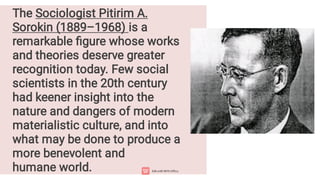
The Sociologist Pitirim A.
Sorokin (1889–1968) is a
remarkable figure whose works
and theories deserve greater
recognition today. Few social
scientists in the 20th century
had keener insight into the
nature and dangers of modern
materialistic culture, and into
what may be done to produce a
more benevolent and
humane world.
CYCLICAL
THEORY
Cyclical theory of social change
proposes that societies progress
through predictable life cycle stages of
birth, growth, maturity, and decline.
Theorists like Spengler analyzed the
rise and fall of ancient civilizations like
Egypt, Greece, and Rome and
concluded they all followed a similar
cyclical pattern.
TWO TYPES OF
CULTURE
1.
2.
IDEATIONAL
CULTURES
SENSATE
CULTURES
IDEATIONAL CULTURES
Ideational cultures are ones that
believe that things exist beyond
what you can see. Their belief
system is one set in the fact that
there is a metaphysical world that
the eye cannot behold. An example
of this type of culture would be one
based on Christianity.
SENSATE CULTURE
A sensate culture, also called a
materialistic culture, is a culture that
bases its beliefs on only what is
visible to the eye. Nothing exists
beyond what can be seen. It is a
culture based on science. An
ideational culture is the opposite of a
sensate culture.
THANK YOU
THANK YOU

CYCLICAL THEORY-WPS Office.pdfssssssssss

  • 1.
  • 2.
    The Sociologist PitirimA. Sorokin (1889–1968) is a remarkable figure whose works and theories deserve greater recognition today. Few social scientists in the 20th century had keener insight into the nature and dangers of modern materialistic culture, and into what may be done to produce a more benevolent and humane world.
  • 3.
    CYCLICAL THEORY Cyclical theory ofsocial change proposes that societies progress through predictable life cycle stages of birth, growth, maturity, and decline. Theorists like Spengler analyzed the rise and fall of ancient civilizations like Egypt, Greece, and Rome and concluded they all followed a similar cyclical pattern.
  • 4.
  • 5.
    IDEATIONAL CULTURES Ideational culturesare ones that believe that things exist beyond what you can see. Their belief system is one set in the fact that there is a metaphysical world that the eye cannot behold. An example of this type of culture would be one based on Christianity.
  • 6.
    SENSATE CULTURE A sensateculture, also called a materialistic culture, is a culture that bases its beliefs on only what is visible to the eye. Nothing exists beyond what can be seen. It is a culture based on science. An ideational culture is the opposite of a sensate culture.
  • 7.