Psychology : A Scientific
Discipline
Ms. Bushra Shaikh
Introduction
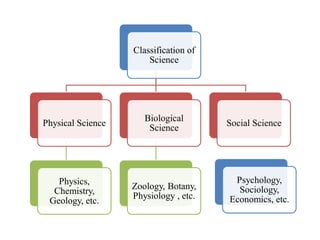
Classification of
Science
Physical Science
Physics,
Chemistry,
Geology, etc.
Biological
Science
Zoology, Botany,
Physiology , etc.
Social Science
Psychology,
Sociology,
Economics, etc.
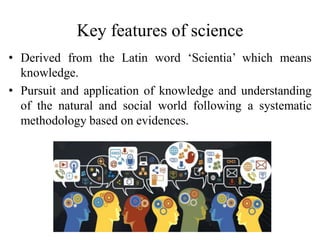
Key features of science
• Derived from the Latin word ‘Scientia’ which means
knowledge.
• Pursuit and application of knowledge and understanding
of the natural and social world following a systematic
methodology based on evidences.
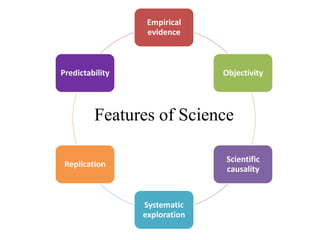
Features of Science
Empirical
evidence
Objectivity
Scientific
causality
Systematic
exploration
Replication
Predictability
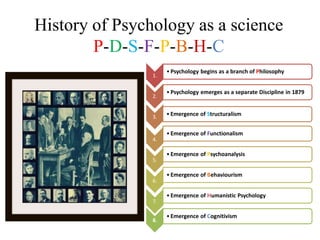
History of Psychology as a science
P-D-S-F-P-B-H-C
1.
• Psychology begins as a branch of Philosophy
2.
• Psychology emerges as a separate Discipline in 1879
3. • Emergence of Structuralism
4.
• Emergence of Functionalism
5.
• Emergence of Psychoanalysis
6.
• Emergence of Behaviourism
7.
• Emergence of Humanistic Psychology
8.
• Emergence of Cognitivism
Research methods in psychology
1.
• Experimental
method
2.
• Survey
method
3.
• Observation
method
4.
• Case study
method
5.
• Correlation
studies
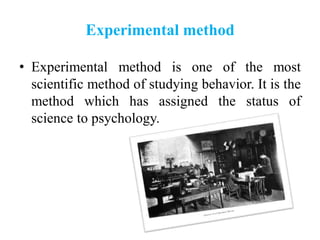
Experimental method
• Experimental method is one of the most
scientific method of studying behavior. It is the
method which has assigned the status of
science to psychology.
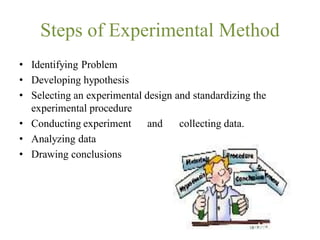
Steps of Experimental Method
• Identifying Problem
• Developing hypothesis
• Selecting an experimental design and standardizing the
experimental procedure
• Conducting experiment and collecting data.
• Analyzing data
• Drawing conclusions
Example of Experimental Method
Learn the Key Terms of experimental method with the help of given example :
• Problem: To study the effect of music on the level of blood Pressure.
• Hypothesis: The music will help in regulating the level of blood pressure.
• Independent variable: Music.
• Dependent variable: Level of blood pressure.
• Intervening variables: Age, gender, all other sounds other than music, etc.
• Experimenter : A person who will be conducting this experiment. (May be you or
your psychology teacher.)
• Participant : A person on whom this experiment will be conducted. (May be your
family member/ friend.)
Survey Method
• A survey is defined as a research method
used for collecting data from a pre-defined
group of respondents (sample) to gain
information and insights on various topics
of interest such as political opinion,
consumers’ preferences, etc.
• Survey method makes use of
questionnaires, checklists, rating scales,
inventories, interviews etc. to collect the
required information.
• The Survey method is largely used by
social psychologists, educational
psychologists, industrial psychologists etc.
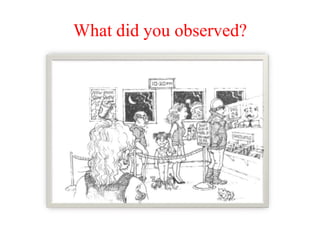
What did you observed?
Observation Method
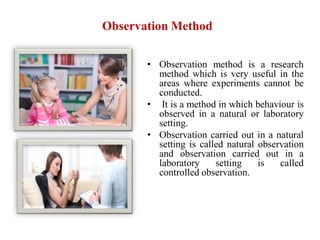
• Observation method is a research
method which is very useful in the
areas where experiments cannot be
conducted.
• It is a method in which behaviour is
observed in a natural or laboratory
setting.
• Observation carried out in a natural
setting is called natural observation
and observation carried out in a
laboratory setting is called
controlled observation.
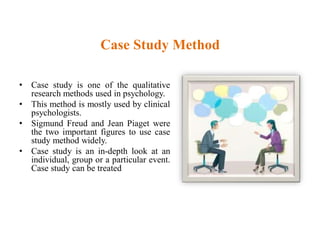
Case Study Method
• Case study is one of the qualitative
research methods used in psychology.
• This method is mostly used by clinical
psychologists.
• Sigmund Freud and Jean Piaget were
the two important figures to use case
study method widely.
• Case study is an in-depth look at an
individual, group or a particular event.
Case study can be treated
Correlation studies
• There are certain scientific studies which make use of correlation
as a statistical tool to understand the relation among variables.
Such studies are called correlational studies.
• Correlation is a statistical tool used to measure the relationship
between two or more variables. If the change in one variable
appears to be accompanied by a change in the other
• variable, the two variables are said to be correlated and this
interdependence is called correlation.
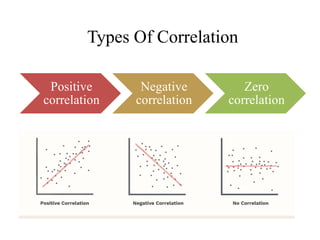
Types Of Correlation
Positive
correlation
Negative
correlation
Zero
correlation
Table of Correlation
Type of
correlation
Variable ‘X’ Variable ‘Y’
Positive
correlation
Rises Rises
Falls Falls
Negative
correlation
Rises Falls
Falls Rises
Zero
correlation
Rises
No significant
change
Falls
Challenges in
establishing
psychology as a
science
Pre-paradigmatic
state
Issues related to
objectivity and
validity
Issue s related to
Predictability
and Replicability
Objectifying
humans
Importance Of Rationality
1.
• Understanding self-interest and social interest
2.
• Self-direction
3.
• Tolerance
4.
• Flexibility
5.
• Self-acceptance and self-responsibility
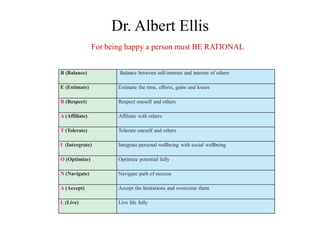
Dr. Albert Ellis
B (Balance) Balance between self-interest and interest of others
E (Estimate) Estimate the time, efforts, gains and losses
R (Respect) Respect oneself and others
A (Affiliate) Affiliate with others
T (Tolerate) Tolerate oneself and others
I (Intergrate) Integrate personal wellbeing with social wellbeing
O (Optimize) Optimize potential fully
N (Navigate) Navigate path of success
A (Accept) Accept the limitations and overcome them
L (Live) Live life fully
For being happy a person must BE RATIONAL
Conclusion
• Psychology is considered as a
science as it fulfils many
conditions of science.
• Psychology is a social science
that studies behaviour and
mental processes.
Psychology  a scientific discipline

Psychology a scientific discipline

  • 1.
    Psychology : AScientific Discipline Ms. Bushra Shaikh
  • 2.
  • 3.
    Classification of Science Physical Science Physics, Chemistry, Geology,etc. Biological Science Zoology, Botany, Physiology , etc. Social Science Psychology, Sociology, Economics, etc.
  • 4.
    Key features ofscience • Derived from the Latin word ‘Scientia’ which means knowledge. • Pursuit and application of knowledge and understanding of the natural and social world following a systematic methodology based on evidences.
  • 5.
  • 6.
    History of Psychologyas a science P-D-S-F-P-B-H-C 1. • Psychology begins as a branch of Philosophy 2. • Psychology emerges as a separate Discipline in 1879 3. • Emergence of Structuralism 4. • Emergence of Functionalism 5. • Emergence of Psychoanalysis 6. • Emergence of Behaviourism 7. • Emergence of Humanistic Psychology 8. • Emergence of Cognitivism
  • 7.
    Research methods inpsychology 1. • Experimental method 2. • Survey method 3. • Observation method 4. • Case study method 5. • Correlation studies
  • 8.
    Experimental method • Experimentalmethod is one of the most scientific method of studying behavior. It is the method which has assigned the status of science to psychology.
  • 9.
    Steps of ExperimentalMethod • Identifying Problem • Developing hypothesis • Selecting an experimental design and standardizing the experimental procedure • Conducting experiment and collecting data. • Analyzing data • Drawing conclusions
  • 10.
    Example of ExperimentalMethod Learn the Key Terms of experimental method with the help of given example : • Problem: To study the effect of music on the level of blood Pressure. • Hypothesis: The music will help in regulating the level of blood pressure. • Independent variable: Music. • Dependent variable: Level of blood pressure. • Intervening variables: Age, gender, all other sounds other than music, etc. • Experimenter : A person who will be conducting this experiment. (May be you or your psychology teacher.) • Participant : A person on whom this experiment will be conducted. (May be your family member/ friend.)
  • 11.
    Survey Method • Asurvey is defined as a research method used for collecting data from a pre-defined group of respondents (sample) to gain information and insights on various topics of interest such as political opinion, consumers’ preferences, etc. • Survey method makes use of questionnaires, checklists, rating scales, inventories, interviews etc. to collect the required information. • The Survey method is largely used by social psychologists, educational psychologists, industrial psychologists etc.
  • 12.
    What did youobserved?
  • 13.
    Observation Method • Observationmethod is a research method which is very useful in the areas where experiments cannot be conducted. • It is a method in which behaviour is observed in a natural or laboratory setting. • Observation carried out in a natural setting is called natural observation and observation carried out in a laboratory setting is called controlled observation.
  • 14.
    Case Study Method •Case study is one of the qualitative research methods used in psychology. • This method is mostly used by clinical psychologists. • Sigmund Freud and Jean Piaget were the two important figures to use case study method widely. • Case study is an in-depth look at an individual, group or a particular event. Case study can be treated
  • 15.
    Correlation studies • Thereare certain scientific studies which make use of correlation as a statistical tool to understand the relation among variables. Such studies are called correlational studies. • Correlation is a statistical tool used to measure the relationship between two or more variables. If the change in one variable appears to be accompanied by a change in the other • variable, the two variables are said to be correlated and this interdependence is called correlation.
  • 16.
  • 17.
    Table of Correlation Typeof correlation Variable ‘X’ Variable ‘Y’ Positive correlation Rises Rises Falls Falls Negative correlation Rises Falls Falls Rises Zero correlation Rises No significant change Falls
  • 18.
    Challenges in establishing psychology asa science Pre-paradigmatic state Issues related to objectivity and validity Issue s related to Predictability and Replicability Objectifying humans
  • 19.
    Importance Of Rationality 1. •Understanding self-interest and social interest 2. • Self-direction 3. • Tolerance 4. • Flexibility 5. • Self-acceptance and self-responsibility
  • 20.
    Dr. Albert Ellis B(Balance) Balance between self-interest and interest of others E (Estimate) Estimate the time, efforts, gains and losses R (Respect) Respect oneself and others A (Affiliate) Affiliate with others T (Tolerate) Tolerate oneself and others I (Intergrate) Integrate personal wellbeing with social wellbeing O (Optimize) Optimize potential fully N (Navigate) Navigate path of success A (Accept) Accept the limitations and overcome them L (Live) Live life fully For being happy a person must BE RATIONAL
  • 21.
    Conclusion • Psychology isconsidered as a science as it fulfils many conditions of science. • Psychology is a social science that studies behaviour and mental processes.