In this lesson, you will learn the
answer to these questions:
REVIEW: What are the principal parts
of verbs?
NEW: How do you use each of the
principal parts to express the 6
tenses of verbs?
Review:
The Principal Parts of Verbs
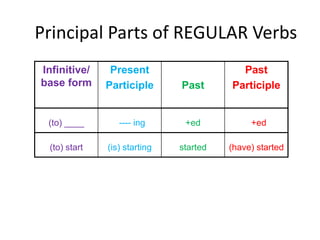
Principal Parts of REGULAR Verbs
Infinitive/
base form
Present
Participle Past
Past
Participle
(to) ____ ---- ing +ed +ed
(to) start (is) starting started (have) started
New Learning:
A verb’s principal parts
form the tenses.
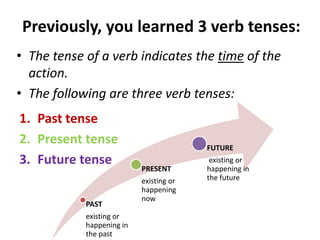
Previously, you learned 3 verb tenses:
• The tense of a verb indicates the time of the
action.
• The following are three verb tenses:
1. Past tense
2. Present tense
3. Future tense
PAST
existing or
happening in
the past
PRESENT
existing or
happening
now
FUTURE
existing or
happening in
the future
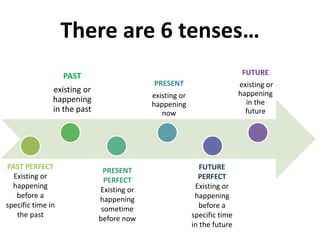
There are 6 tenses…
PAST
existing or
happening
in the past
PRESENT
existing or
happening
now
FUTURE
existing or
happening
in the
future
PAST PERFECT
Existing or
happening
before a
specific time in
the past
PRESENT
PERFECT
Existing or
happening
sometime
before now
FUTURE
PERFECT
Existing or
happening
before a
specific time
in the future
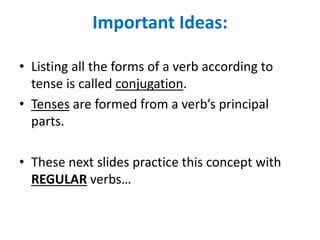
Important Ideas:
• Listing all the forms of a verb according to
tense is called conjugation.
• Tenses are formed from a verb’s principal
parts.
• These next slides practice this concept with
REGULAR verbs…
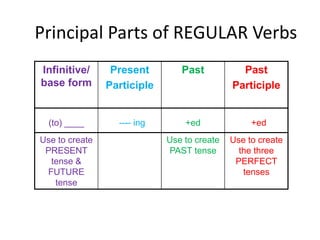
Principal Parts of REGULAR Verbs
Infinitive/
base form
Present
Participle
Past Past
Participle
(to) ____ ---- ing +ed +ed
Use to create
PRESENT
tense &
FUTURE
tense
Use to create
PAST tense
Use to create
the three
PERFECT
tenses
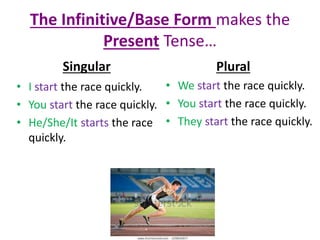
The Infinitive/Base Form makes the
Present Tense…
Singular
• I start the race quickly.
• You start the race quickly.
• He/She/It starts the race
quickly.
Plural
• We start the race quickly.
• You start the race quickly.
• They start the race quickly.
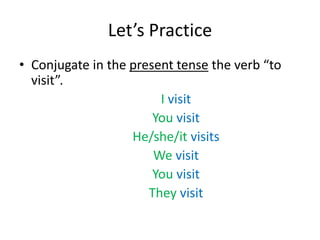
Let’s Practice
• Conjugate in the present tense the verb “to
visit”.
I visit
You visit
He/she/it visits
We visit
You visit
They visit
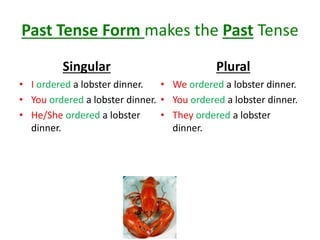
Past Tense Form makes the Past Tense
Singular
• I ordered a lobster dinner.
• You ordered a lobster dinner.
• He/She ordered a lobster
dinner.
Plural
• We ordered a lobster dinner.
• You ordered a lobster dinner.
• They ordered a lobster
dinner.
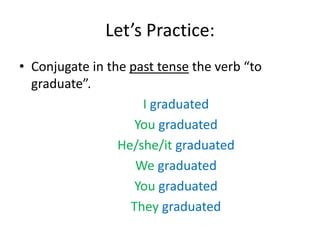
Let’s Practice:
• Conjugate in the past tense the verb “to
graduate”.
I graduated
You graduated
He/she/it graduated
We graduated
You graduated
They graduated
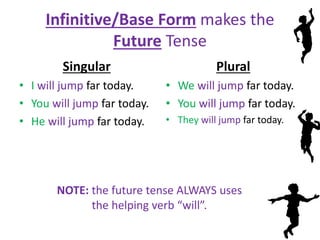
Infinitive/Base Form makes the
Future Tense
Singular
• I will jump far today.
• You will jump far today.
• He will jump far today.
Plural
• We will jump far today.
• You will jump far today.
• They will jump far today.
NOTE: the future tense ALWAYS uses
the helping verb “will”.
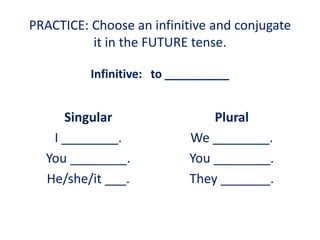
PRACTICE: Choose an infinitive and conjugate
it in the FUTURE tense.
Infinitive: to __________
Singular
I ________.
You ________.
He/she/it ___.
Plural
We ________.
You ________.
They _______.
Moving on to the Perfect
Tenses…
- Present Perfect
- Past Perfect
- Future Perfect
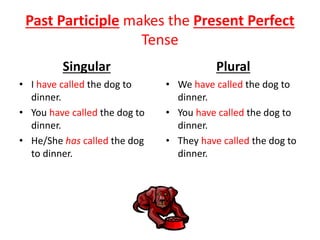
Past Participle makes the Present Perfect
Tense
Singular
• I have called the dog to
dinner.
• You have called the dog to
dinner.
• He/She has called the dog
to dinner.
Plural
• We have called the dog to
dinner.
• You have called the dog to
dinner.
• They have called the dog to
dinner.
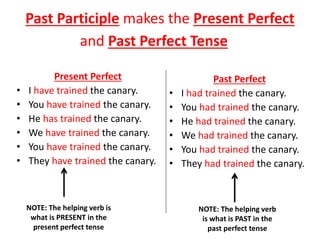
Past Participle makes the Present Perfect
and Past Perfect Tense
Present Perfect
• I have trained the canary.
• You have trained the canary.
• He has trained the canary.
• We have trained the canary.
• You have trained the canary.
• They have trained the canary.
Past Perfect
• I had trained the canary.
• You had trained the canary.
• He had trained the canary.
• We had trained the canary.
• You had trained the canary.
• They had trained the canary.
NOTE: The helping verb is
what is PRESENT in the
present perfect tense
NOTE: The helping verb
is what is PAST in the
past perfect tense
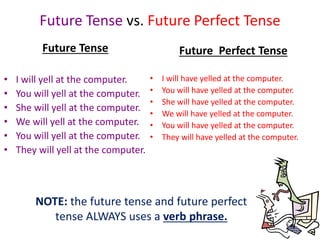
Future Tense vs. Future Perfect Tense
Future Tense
• I will yell at the computer.
• You will yell at the computer.
• She will yell at the computer.
• We will yell at the computer.
• You will yell at the computer.
• They will yell at the computer.
Future Perfect Tense
• I will have yelled at the computer.
• You will have yelled at the computer.
• She will have yelled at the computer.
• We will have yelled at the computer.
• You will have yelled at the computer.
• They will have yelled at the computer.
NOTE: the future tense and future perfect
tense ALWAYS uses a verb phrase.
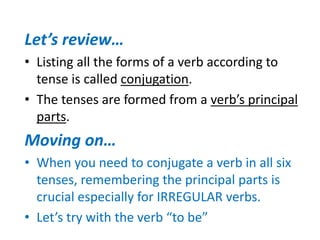
Let’s review…
• Listing all the forms of a verb according to
tense is called conjugation.
• The tenses are formed from a verb’s principal
parts.
Moving on…
• When you need to conjugate a verb in all six
tenses, remembering the principal parts is
crucial especially for IRREGULAR verbs.
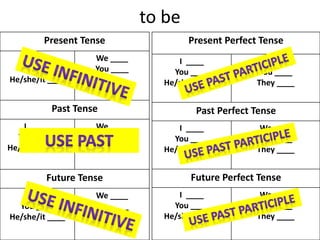
• Let’s try with the verb “to be”
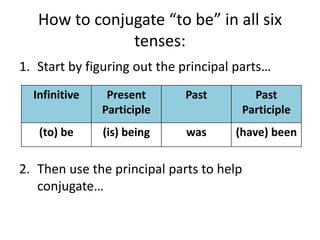
How to conjugate “to be” in all six
tenses:
1. Start by figuring out the principal parts…
2. Then use the principal parts to help
conjugate…
Infinitive Present
Participle
Past Past
Participle
(to) be (is) being was (have) been
to be
Present Tense
I ____
You ____
He/she/it ____
We ____
You ____
They ____
Past Tense
I _____
You _____
He/she/it _____
We ____
You ____
They ____
Future Tense
I ____
You ____
He/she/it ____
We ____
You ____
They ____
Present Perfect Tense
I ____
You ____
He/she/it ____
We ____
You ____
They ____
Past Perfect Tense
I ____
You ____
He/she/it ____
We ____
You ____
They ____
Future Perfect Tense
I ____
You ____
He/she/it ____
We ____
You ____
They ____
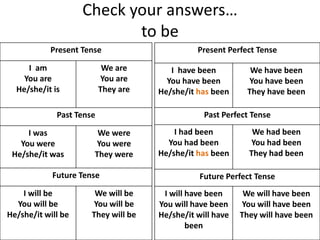
Check your answers…
to be
Present Tense
I am
You are
He/she/it is
We are
You are
They are
Past Tense
I was
You were
He/she/it was
We were
You were
They were
Future Tense
I will be
You will be
He/she/it will be
We will be
You will be
They will be
Present Perfect Tense
I have been
You have been
He/she/it has been
We have been
You have been
They have been
Past Perfect Tense
I had been
You had been
He/she/it has been
We had been
You had been
They had been
Future Perfect Tense
I will have been
You will have been
He/she/it will have
been
We will have been
You will have been
They will have been
Now it’s time to show what you
learned…
1. Write and label the principal parts for the verb
“to dance”.
2. Explain how principal parts determine that a
verb is regular.
3. Explain what tenses the infinitive and the past
tense create for all verbs.
4. Explain what tenses the past participle creates.
5. Conjugate the past perfect tense of the verb “to
fail”.
6. Conjugate “to go” in all six tenses.
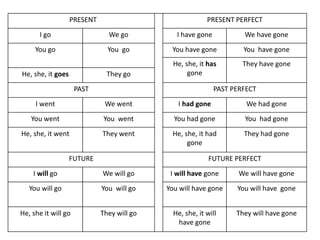
PRESENT PRESENT PERFECT
I go We go I have gone We have gone
You go You go You have gone You have gone
He, she, it has
gone
They have gone
He, she, it goes They go
PAST PAST PERFECT
I went We went I had gone We had gone
You went You went You had gone You had gone
He, she, it went They went He, she, it had
gone
They had gone
FUTURE FUTURE PERFECT
I will go We will go I will have gone We will have gone
You will go You will go You will have gone You will have gone
He, she it will go They will go He, she, it will
have gone
They will have gone
Extension:
The progressive form
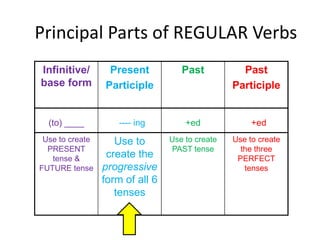
Principal Parts of REGULAR Verbs
Infinitive/
base form
Present
Participle
Past Past
Participle
(to) ____ ---- ing +ed +ed
Use to create
PRESENT
tense &
FUTURE tense
Use to
create the
progressive
form of all 6
tenses
Use to create
PAST tense
Use to create
the three
PERFECT
tenses
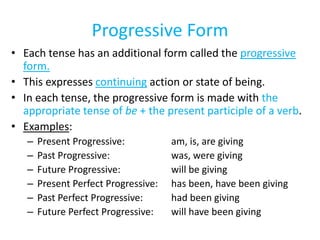
Progressive Form
• Each tense has an additional form called the progressive
form.
• This expresses continuing action or state of being.
• In each tense, the progressive form is made with the
appropriate tense of be + the present participle of a verb.
• Examples:
– Present Progressive: am, is, are giving
– Past Progressive: was, were giving
– Future Progressive: will be giving
– Present Perfect Progressive: has been, have been giving
– Past Perfect Progressive: had been giving
– Future Perfect Progressive: will have been giving
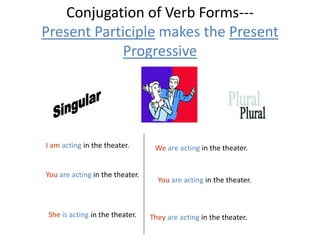
Conjugation of Verb Forms---
Present Participle makes the Present
Progressive
I am acting in the theater.
You are acting in the theater.
She is acting in the theater.
We are acting in the theater.
You are acting in the theater.
They are acting in the theater.
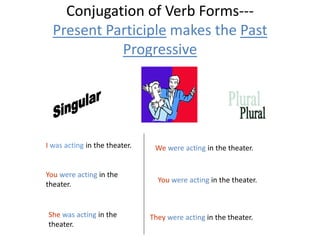
Conjugation of Verb Forms---
Present Participle makes the Past
Progressive
I was acting in the theater.
You were acting in the
theater.
She was acting in the
theater.
We were acting in the theater.
You were acting in the theater.
They were acting in the theater.

The-Principle-Parts-of-Verbs.ppt

  • 1.
    In this lesson,you will learn the answer to these questions: REVIEW: What are the principal parts of verbs? NEW: How do you use each of the principal parts to express the 6 tenses of verbs?
  • 2.
  • 3.
    Principal Parts ofREGULAR Verbs Infinitive/ base form Present Participle Past Past Participle (to) ____ ---- ing +ed +ed (to) start (is) starting started (have) started
  • 4.
    New Learning: A verb’sprincipal parts form the tenses.
  • 5.
    Previously, you learned3 verb tenses: • The tense of a verb indicates the time of the action. • The following are three verb tenses: 1. Past tense 2. Present tense 3. Future tense PAST existing or happening in the past PRESENT existing or happening now FUTURE existing or happening in the future
  • 6.
    There are 6tenses… PAST existing or happening in the past PRESENT existing or happening now FUTURE existing or happening in the future PAST PERFECT Existing or happening before a specific time in the past PRESENT PERFECT Existing or happening sometime before now FUTURE PERFECT Existing or happening before a specific time in the future
  • 7.
    Important Ideas: • Listingall the forms of a verb according to tense is called conjugation. • Tenses are formed from a verb’s principal parts. • These next slides practice this concept with REGULAR verbs…
  • 8.
    Principal Parts ofREGULAR Verbs Infinitive/ base form Present Participle Past Past Participle (to) ____ ---- ing +ed +ed Use to create PRESENT tense & FUTURE tense Use to create PAST tense Use to create the three PERFECT tenses
  • 9.
    The Infinitive/Base Formmakes the Present Tense… Singular • I start the race quickly. • You start the race quickly. • He/She/It starts the race quickly. Plural • We start the race quickly. • You start the race quickly. • They start the race quickly.
  • 10.
    Let’s Practice • Conjugatein the present tense the verb “to visit”. I visit You visit He/she/it visits We visit You visit They visit
  • 11.
    Past Tense Formmakes the Past Tense Singular • I ordered a lobster dinner. • You ordered a lobster dinner. • He/She ordered a lobster dinner. Plural • We ordered a lobster dinner. • You ordered a lobster dinner. • They ordered a lobster dinner.
  • 12.
    Let’s Practice: • Conjugatein the past tense the verb “to graduate”. I graduated You graduated He/she/it graduated We graduated You graduated They graduated
  • 13.
    Infinitive/Base Form makesthe Future Tense Singular • I will jump far today. • You will jump far today. • He will jump far today. Plural • We will jump far today. • You will jump far today. • They will jump far today. NOTE: the future tense ALWAYS uses the helping verb “will”.
  • 14.
    PRACTICE: Choose aninfinitive and conjugate it in the FUTURE tense. Infinitive: to __________ Singular I ________. You ________. He/she/it ___. Plural We ________. You ________. They _______.
  • 15.
    Moving on tothe Perfect Tenses… - Present Perfect - Past Perfect - Future Perfect
  • 16.
    Past Participle makesthe Present Perfect Tense Singular • I have called the dog to dinner. • You have called the dog to dinner. • He/She has called the dog to dinner. Plural • We have called the dog to dinner. • You have called the dog to dinner. • They have called the dog to dinner.
  • 17.
    Past Participle makesthe Present Perfect and Past Perfect Tense Present Perfect • I have trained the canary. • You have trained the canary. • He has trained the canary. • We have trained the canary. • You have trained the canary. • They have trained the canary. Past Perfect • I had trained the canary. • You had trained the canary. • He had trained the canary. • We had trained the canary. • You had trained the canary. • They had trained the canary. NOTE: The helping verb is what is PRESENT in the present perfect tense NOTE: The helping verb is what is PAST in the past perfect tense
  • 18.
    Future Tense vs.Future Perfect Tense Future Tense • I will yell at the computer. • You will yell at the computer. • She will yell at the computer. • We will yell at the computer. • You will yell at the computer. • They will yell at the computer. Future Perfect Tense • I will have yelled at the computer. • You will have yelled at the computer. • She will have yelled at the computer. • We will have yelled at the computer. • You will have yelled at the computer. • They will have yelled at the computer. NOTE: the future tense and future perfect tense ALWAYS uses a verb phrase.
  • 19.
    Let’s review… • Listingall the forms of a verb according to tense is called conjugation. • The tenses are formed from a verb’s principal parts. Moving on… • When you need to conjugate a verb in all six tenses, remembering the principal parts is crucial especially for IRREGULAR verbs. • Let’s try with the verb “to be”
  • 20.
    How to conjugate“to be” in all six tenses: 1. Start by figuring out the principal parts… 2. Then use the principal parts to help conjugate… Infinitive Present Participle Past Past Participle (to) be (is) being was (have) been
  • 21.
    to be Present Tense I____ You ____ He/she/it ____ We ____ You ____ They ____ Past Tense I _____ You _____ He/she/it _____ We ____ You ____ They ____ Future Tense I ____ You ____ He/she/it ____ We ____ You ____ They ____ Present Perfect Tense I ____ You ____ He/she/it ____ We ____ You ____ They ____ Past Perfect Tense I ____ You ____ He/she/it ____ We ____ You ____ They ____ Future Perfect Tense I ____ You ____ He/she/it ____ We ____ You ____ They ____
  • 22.
    Check your answers… tobe Present Tense I am You are He/she/it is We are You are They are Past Tense I was You were He/she/it was We were You were They were Future Tense I will be You will be He/she/it will be We will be You will be They will be Present Perfect Tense I have been You have been He/she/it has been We have been You have been They have been Past Perfect Tense I had been You had been He/she/it has been We had been You had been They had been Future Perfect Tense I will have been You will have been He/she/it will have been We will have been You will have been They will have been
  • 23.
    Now it’s timeto show what you learned… 1. Write and label the principal parts for the verb “to dance”. 2. Explain how principal parts determine that a verb is regular. 3. Explain what tenses the infinitive and the past tense create for all verbs. 4. Explain what tenses the past participle creates. 5. Conjugate the past perfect tense of the verb “to fail”. 6. Conjugate “to go” in all six tenses.
  • 24.
    PRESENT PRESENT PERFECT Igo We go I have gone We have gone You go You go You have gone You have gone He, she, it has gone They have gone He, she, it goes They go PAST PAST PERFECT I went We went I had gone We had gone You went You went You had gone You had gone He, she, it went They went He, she, it had gone They had gone FUTURE FUTURE PERFECT I will go We will go I will have gone We will have gone You will go You will go You will have gone You will have gone He, she it will go They will go He, she, it will have gone They will have gone
  • 25.
  • 26.
    Principal Parts ofREGULAR Verbs Infinitive/ base form Present Participle Past Past Participle (to) ____ ---- ing +ed +ed Use to create PRESENT tense & FUTURE tense Use to create the progressive form of all 6 tenses Use to create PAST tense Use to create the three PERFECT tenses
  • 27.
    Progressive Form • Eachtense has an additional form called the progressive form. • This expresses continuing action or state of being. • In each tense, the progressive form is made with the appropriate tense of be + the present participle of a verb. • Examples: – Present Progressive: am, is, are giving – Past Progressive: was, were giving – Future Progressive: will be giving – Present Perfect Progressive: has been, have been giving – Past Perfect Progressive: had been giving – Future Perfect Progressive: will have been giving
  • 28.
    Conjugation of VerbForms--- Present Participle makes the Present Progressive I am acting in the theater. You are acting in the theater. She is acting in the theater. We are acting in the theater. You are acting in the theater. They are acting in the theater.
  • 29.
    Conjugation of VerbForms--- Present Participle makes the Past Progressive I was acting in the theater. You were acting in the theater. She was acting in the theater. We were acting in the theater. You were acting in the theater. They were acting in the theater.