Different Ways and
Purposes for Using Linkers
A Presentation by:
Mrs. Mousmi Majumdar
Master Trainer
Department of English
D. A. V. Public School, Hehal, Ranchi
What are Linkers?
Linkers are words or phrases that we use to link (i.e. connect or join)
ideas. They relate one idea or sentence of the text with another. They
connect the ideas logically and give paragraphs coherence.
Linkers can be conjunctions, connectors, prepositions, adverbial
expressions or simply discourse markers.
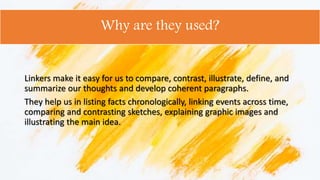
Why are they used?
Linkers make it easy for us to compare, contrast, illustrate, define, and
summarize our thoughts and develop coherent paragraphs.
They help us in listing facts chronologically, linking events across time,
comparing and contrasting sketches, explaining graphic images and
illustrating the main idea.
Main types of Linking Words
Conjunctions
Connectors
Prepositions
Adverbials
Discourse Markers
Note: The words used as linkers may appear in multiple categories. They overlap.
Conjunctions
• Conjunctions join sentences together and make them
more compact.
• Usually they appear in the middle of a sentence.
However, sometimes they appear at the beginning also.
Conjunctions
• Conjunctions may take a comma before them(if the
following clause is a long one; but never after.)
• The minister paused briefly before he started to speak.
• The results were disappointing for the third year
running, so it was decided to close three of the smaller
branches.
• They are also called subordinators if they introduce
subordinate clauses.
connectors
Connectors are words or phrases used to link
ideas from one sentence to the next and to give
paragraphs coherence.
Sentence connectors perform different functions
and are placed at the beginning of a sentence.
connectors
Connectors are followed by a comma. They are
used to introduce, order, contrast, sequence
ideas, theory, data etc.
Connectors are ,sometimes, taken as a sub
category of adverbs.
Difference between Conjunctions and
Connectors
• Clauses joined by Conjunctions
are together in the same
sentence.
• CONJUNCTION: Mount
Kilimanjaro is on the Equator,
but it has a covering of snow.
• Connector ones are separate.
• CONNECTOR : Mount
Kilimanjaro is on the Equator.
Nevertheless, it has a covering of
snow.
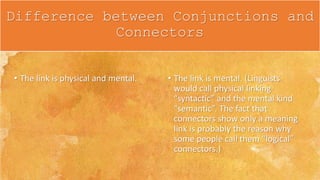
The main other differences concern punctuation and sentence positions.
• The link is physical and mental. • The link is mental. (Linguists
would call physical linking
“syntactic” and the mental kind
“semantic”. The fact that
connectors show only a meaning
link is probably the reason why
some people call them “logical”
connectors.)
Difference between Conjunctions and
Connectors
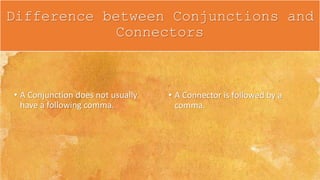
• A Conjunction does not usually
have a following comma.
• A Connector is followed by a
comma.
Difference between Conjunctions and
Connectors
• A Conjunction is always placed
before the subject of its verb.
• A Connector may, quite often,
come after the subject (but
never after the main verb), in
which case, it must be separated
by comma on either side.
Difference between Conjunctions and
Connectors
• Most Conjunctions may go
either before or between the
two verbs that they join (but is
actually one of the exceptional
conjunctions that cannot go
before the two verbs).
• Connectors must go between
the two verb they join….albeit
separate sentences.
Difference between Conjunctions and
Connectors
• Conjunctions have many
different meanings.
• but can express either “contrast”
or “concession”
• and can express not only addition
but also result
• if can show different types of
condition
• Connectors tend to have a more
precise meaning than
Conjunctions.
Difference between Conjunctions and
Connectors
Linking with Prepositions
• Some linkers are prepositions. They can link the same kinds of
ideas as conjunction and adverbs, but the grammar is different.
• They don’t link clauses or sentences. They show a link
between a word or phrase, usually a noun or noun phrase, and
the whole sentence.
• Example: After, before, Since, besides, etc.
Linking with Prepositions
• I went for a walk despite the rain.
In spite of her heavy cold, she managed to give a brilliant
presentation.
Note that the ideas following despite (the rain) and in spite of
(her heavy cold) are not clauses, they are nouns or noun
phrases.
Linking with Prepositions
• Due to the terrible weather we have cancelled the picnic.
Note that the idea following due to (the terrible weather) is a
noun phrase.
Linking with Prepositions
• Besides can be used as a preposition to add ideas (it can also
be used as an adverb).
Besides the problem with transport, we also had to deal with a
difficult financial situation.
Note how the idea following besides (the problem with
transport) is a noun phrase.
Linking with adverbials
• Some Linkers are adverbials.
• They can make meaning connections but not grammatical.
They do not join clauses in sentences. There is either a full stop
or a semi colon(careful writing) before it. They are followed by
a comma.
• Example: However, then, therefore, meanwhile, consequently,
in fact, also, as a result, on the other hand, indeed, etc.
Discourse Markers
• A discourse marker is a word or a phrase that plays a role in
managing the flow and structure of discourse.
• Since their main function is at the level of discourse (sequences of
utterances/sentences) rather than at the level of utterances or
sentences, discourse markers are relatively syntax-independent.
• Most of the discourse markers are adverbials. Some are conjunctions
also.
• Example: as a matter of fact, more importantly, at first, first of all, in
the first place, to begin with, in the beginning, once upon a time, in
conclusion, finally, to sum it up, in the end, lastly, in short, eventually,
etc.
Discourse Markers
• The term discourse marker was coined by Deborah Schiffrin in her
1988 book Discourse Markers.
[friends are talking]
A: So, I’ve decided I’m going to go to the bank and ask for a car loan.
B:That sounds like a good idea.
C:Well, you need a car.
B:Right.
A:Anyway, I was wondering if either of you would teach me how to drive.
The discourse markers in this extract have a number of uses:
so marks the beginning of a new part of the conversation.
well marks a change in the focus (from getting a car loan to needing a car).
right marks a response (B is agreeing with C).
anyway marks a shift in topic (from buying a new car to having driving
lessons).
Usage of Discourse Markers
Different Usages of Linkers
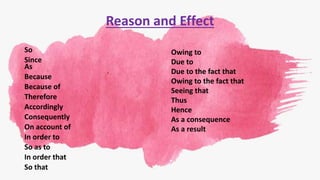
Reason and Effect
So
Since
As
Because
Because of
Therefore
Accordingly
Consequently
On account of
In order to
So as to
In order that
So that
Owing to
Due to
Due to the fact that
Owing to the fact that
Seeing that
Thus
Hence
As a consequence
As a result
Reason and Effect
It was raining(reason). I stayed at home(result).
It was raining, so I stayed at home. (conjunction)
It was raining. Therefore, I stayed at home. (connector)
We could also change the order and put the result before the reason and use a
linker such as because.
I stayed at home because it was raining. (conjunction)
The linkers so, because and therefore show a relationship of reason and result,
or cause and effect.
Because of / On account of / Owing to / Due to introduce a noun phrase.
Reason and Effect
Purpose
In order to / So as to Introduce an infinitive of purpose.
In order that / So that Introduce a sentence.
She opened the window in order that/so that the wind could come in.
Consequence
Consequently / As a consequence / As a result / Therefore
As a consequence of / As a result of is followed by a noun phrase.
Hundreds of people became sick as a consequence of/ as a result of the poor sanitary
conditions.
Giving a Reason
Due to / Owing to (must be followed by a noun)
Due to the fact that / Owing to the fact that
“Due to the fact that oil prices have risen, the inflation rate has gone up
by 1%25.”
“Owing to the fact that the workers have gone on strike, the company
has been unable to fulfill all its orders.”
Because (can be used at the beginning or the middle of a sentence)
Because of, on account of, owing to, due to(followed by a noun)
“Because of bad weather, the football match was postponed.”
Contrast
However
Nevertheless
Still
Even so
On the contrary
Otherwise
After all
For all of that
Notwithstanding
While
But
Although / even though
Despite / despite the fact that
In spite of / in spite of the fact that
Nonetheless
While
Whereas
Unlike
In theory… in practice…
Though
Instead of
alternatively
In contrast
On the one hand ... On the other hand.
In contrast to / Contrary to. (Followed by a noun phrase)
Whereas (Not separated by commas)
Yet
Since
So… that
Contrast
BUT/ALTHOUGH/HOWEVER
It was raining. I went for a walk.(Contrasting ideas)
It was raining, but I went for a walk.
Although it was raining, I went for a walk.
It was raining. However, I went for a walk.
BUT/ YET
I was born in England but I feel more Spanish
I was born in England yet I feel more Spanish.
Contrast
HOWEVER/NEVERTHELESS
I wanted lamb for my wedding dinner. Nevertheless, I agreed to pork.
I wanted lamb for my wedding dinner. However, there was none at the
butchers.
Contrast
THOUGH/ ALTHOUGH/ EVEN THOUGH
Although he looks innocent, he’s actually a complete trickster.
I’m going to buy you a present even though you didn’t buy me one.
Contrast
‘In spite of’ or ‘despite’ is always followed by a gerund or ‘the fact that’
or a noun + clause.
Despite arriving late, he acted like nothing was wrong.
I’m proceeding in spite of your objections.
Despite my misgivings, I agreed to hire him for the job.
Comparison
Similarly
While
Unlike
In theory… in practice…
Likewise
Whereas
But
On the other hand
Except
By comparison
When compared to
Equally
In the same way
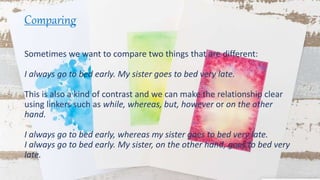
Comparing
Sometimes we want to compare two things that are different:
I always go to bed early. My sister goes to bed very late.
This is also a kind of contrast and we can make the relationship clear
using linkers such as while, whereas, but, however or on the other
hand.
I always go to bed early, whereas my sister goes to bed very late.
I always go to bed early. My sister, on the other hand, goes to bed very
late.
Time
Adding points
As well as
Too
Apart from
Besides
And
Also
Even
Again
Moreover
Further
Furthermore
Similarly
In addition
as well as
Adding points
One other common relationship between ideas is addition, when we
want to add ideas. These can be very simple:
I like seafood.
I like spicy food.
We could add these ideas with linkers such as and, also and too:
I like seafood and spicy food.
I like seafood. I also like spicy food.
I like seafood. I like spicy food too.
Adding points
Moreover / Furthermore / In addition / Besides / What's more
Used after a strong pause and separated from the sentences. They are
introduced by a comma.
As well as / In addition to / Besides
Used to add one more piece of information. Followed by a noun
phrase.
Adding points
In formal writing we can join ideas like these with linkers such as furthermore,
moreover, what is more, in addition and besides.
The cost of relocation would be very high.
There are no suitable premises currently available.
A move would be unpopular with staff.
The cost of relocation would be very high. Furthermore, there are no suitable
premises currently available and a move would be unpopular with staff.
Giving examples
For example
Such as
For instance
In this case
In another case
On this occasion
In this situation
In this manner
To illustrate
Namely
Giving examples
The most common way to give examples is by using for example or for
instance.
Namely refers to something by name.
“There are two problems: namely, the expense and the time.”
Exemplification
For example / For instance Introduces an example referring to
previously stated ideas.
Such as Introduces an example referring to the last idea.
Summarising
In short
In brief
In summary
To summarise
In a nutshell
To conclude
In conclusion
To sum up
Thus
On the whole
Sequencing ideas
The former, … the latter
Firstly, secondly, finally
The first point is
Lastly/ At last
Following/ The following
First of all / Firstly / To begin with / First ….
Second / Secondly / Then …
Third / Thirdly / After that...
Next/The next stage …
Finally / in short / to sum up / in conclusion / lastly / last but not least…
Then
Now
At this point
After this
Subsequently/Eventually/Previously
Order of Importance
Most / more importantly
Most significantly
Above all
Primarily
Essentially
Activity 2:
Identify the linking words / phrases
Do teams in organisations need leaders? How and why the leader
was selected also appears to affect the leader’s effectiveness.
Addison (1996), for instance, asserts that if a leader is elected
democratically by the team and from within the team, there is more
likelihood of an effective work relationship between team
members. However, Smith (1996) notes that more than 60% of 500
workplace teams studied operate with team leaders chosen by the
middle or upper management. Furthermore, in more than half of
these, the team leaders did not have the confidence of the team
members to the extent that effectiveness and efficiency was
compromised.
Activity 3:
Identify the linking words / phrases
Here is some advice for you to follow when doing grammar
exercises.
First, put everything you need on your desk: your book, a pencil
and an eraser. Then, read the instructions of the activity
carefully. After that, read the whole exercise and the grammar
rules and start writing the answers. Finally, check your answers
with the answer key or with your teacher
Activity 4:
Match the clauses and linkers.
Although I felt tired, I decided to go to the party.
She didn't go to the party because she felt tired.
Due to the bad weather the picnic was cancelled
Despite feeling tired I went to the party.
She felt tired after her long journey. Therefore she decided not to go to the party.
I felt tired after a long day at work. However, I went to the party because I wanted to see Janine.
Parties can be fun when you're in the right mood. On the other hand, when you're tired they can be a strain.
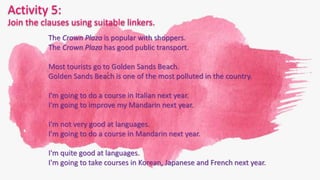
Activity 5:
Join the clauses using suitable linkers.
The Crown Plaza is popular with shoppers.
The Crown Plaza has good public transport.
Most tourists go to Golden Sands Beach.
Golden Sands Beach is one of the most polluted in the country.
I'm going to do a course in Italian next year.
I'm going to improve my Mandarin next year.
I'm not very good at languages.
I'm going to do a course in Mandarin next year.
I'm quite good at languages.
I'm going to take courses in Korean, Japanese and French next year.
Activity 5:
Join the clauses using suitable linkers.
The traffic was terrible this morning.
I managed to get to work on time.
The traffic was terrible this morning.
I was about 25 minutes late for work.
Smoking is bad for your health.
Smoking is antisocial because many people find it unpleasant.
Smoking is a waste of money.
I don't think Charlie Wong would be a good candidate for this job.
He is hard working and reliable.
He has no experience in this area.
He has never shown the slightest interest in this kind of work.
He is rather old.
Activity 6:
Write a story using linkers for coherence.
Linkers

Linkers

  • 1.
    Different Ways and Purposesfor Using Linkers A Presentation by: Mrs. Mousmi Majumdar Master Trainer Department of English D. A. V. Public School, Hehal, Ranchi
  • 2.
    What are Linkers? Linkersare words or phrases that we use to link (i.e. connect or join) ideas. They relate one idea or sentence of the text with another. They connect the ideas logically and give paragraphs coherence. Linkers can be conjunctions, connectors, prepositions, adverbial expressions or simply discourse markers.
  • 3.
    Why are theyused? Linkers make it easy for us to compare, contrast, illustrate, define, and summarize our thoughts and develop coherent paragraphs. They help us in listing facts chronologically, linking events across time, comparing and contrasting sketches, explaining graphic images and illustrating the main idea.
  • 4.
    Main types ofLinking Words Conjunctions Connectors Prepositions Adverbials Discourse Markers Note: The words used as linkers may appear in multiple categories. They overlap.
  • 5.
    Conjunctions • Conjunctions joinsentences together and make them more compact. • Usually they appear in the middle of a sentence. However, sometimes they appear at the beginning also.
  • 6.
    Conjunctions • Conjunctions maytake a comma before them(if the following clause is a long one; but never after.) • The minister paused briefly before he started to speak. • The results were disappointing for the third year running, so it was decided to close three of the smaller branches. • They are also called subordinators if they introduce subordinate clauses.
  • 8.
    connectors Connectors are wordsor phrases used to link ideas from one sentence to the next and to give paragraphs coherence. Sentence connectors perform different functions and are placed at the beginning of a sentence.
  • 9.
    connectors Connectors are followedby a comma. They are used to introduce, order, contrast, sequence ideas, theory, data etc. Connectors are ,sometimes, taken as a sub category of adverbs.
  • 11.
  • 12.
    • Clauses joinedby Conjunctions are together in the same sentence. • CONJUNCTION: Mount Kilimanjaro is on the Equator, but it has a covering of snow. • Connector ones are separate. • CONNECTOR : Mount Kilimanjaro is on the Equator. Nevertheless, it has a covering of snow. The main other differences concern punctuation and sentence positions.
  • 13.
    • The linkis physical and mental. • The link is mental. (Linguists would call physical linking “syntactic” and the mental kind “semantic”. The fact that connectors show only a meaning link is probably the reason why some people call them “logical” connectors.) Difference between Conjunctions and Connectors
  • 14.
    • A Conjunctiondoes not usually have a following comma. • A Connector is followed by a comma. Difference between Conjunctions and Connectors
  • 15.
    • A Conjunctionis always placed before the subject of its verb. • A Connector may, quite often, come after the subject (but never after the main verb), in which case, it must be separated by comma on either side. Difference between Conjunctions and Connectors
  • 16.
    • Most Conjunctionsmay go either before or between the two verbs that they join (but is actually one of the exceptional conjunctions that cannot go before the two verbs). • Connectors must go between the two verb they join….albeit separate sentences. Difference between Conjunctions and Connectors
  • 17.
    • Conjunctions havemany different meanings. • but can express either “contrast” or “concession” • and can express not only addition but also result • if can show different types of condition • Connectors tend to have a more precise meaning than Conjunctions. Difference between Conjunctions and Connectors
  • 18.
    Linking with Prepositions •Some linkers are prepositions. They can link the same kinds of ideas as conjunction and adverbs, but the grammar is different. • They don’t link clauses or sentences. They show a link between a word or phrase, usually a noun or noun phrase, and the whole sentence. • Example: After, before, Since, besides, etc.
  • 19.
    Linking with Prepositions •I went for a walk despite the rain. In spite of her heavy cold, she managed to give a brilliant presentation. Note that the ideas following despite (the rain) and in spite of (her heavy cold) are not clauses, they are nouns or noun phrases.
  • 20.
    Linking with Prepositions •Due to the terrible weather we have cancelled the picnic. Note that the idea following due to (the terrible weather) is a noun phrase.
  • 21.
    Linking with Prepositions •Besides can be used as a preposition to add ideas (it can also be used as an adverb). Besides the problem with transport, we also had to deal with a difficult financial situation. Note how the idea following besides (the problem with transport) is a noun phrase.
  • 22.
    Linking with adverbials •Some Linkers are adverbials. • They can make meaning connections but not grammatical. They do not join clauses in sentences. There is either a full stop or a semi colon(careful writing) before it. They are followed by a comma. • Example: However, then, therefore, meanwhile, consequently, in fact, also, as a result, on the other hand, indeed, etc.
  • 23.
    Discourse Markers • Adiscourse marker is a word or a phrase that plays a role in managing the flow and structure of discourse. • Since their main function is at the level of discourse (sequences of utterances/sentences) rather than at the level of utterances or sentences, discourse markers are relatively syntax-independent. • Most of the discourse markers are adverbials. Some are conjunctions also. • Example: as a matter of fact, more importantly, at first, first of all, in the first place, to begin with, in the beginning, once upon a time, in conclusion, finally, to sum it up, in the end, lastly, in short, eventually, etc.
  • 24.
    Discourse Markers • Theterm discourse marker was coined by Deborah Schiffrin in her 1988 book Discourse Markers.
  • 26.
    [friends are talking] A:So, I’ve decided I’m going to go to the bank and ask for a car loan. B:That sounds like a good idea. C:Well, you need a car. B:Right. A:Anyway, I was wondering if either of you would teach me how to drive. The discourse markers in this extract have a number of uses: so marks the beginning of a new part of the conversation. well marks a change in the focus (from getting a car loan to needing a car). right marks a response (B is agreeing with C). anyway marks a shift in topic (from buying a new car to having driving lessons). Usage of Discourse Markers
  • 27.
  • 28.
    Reason and Effect So Since As Because Becauseof Therefore Accordingly Consequently On account of In order to So as to In order that So that Owing to Due to Due to the fact that Owing to the fact that Seeing that Thus Hence As a consequence As a result
  • 29.
    Reason and Effect Itwas raining(reason). I stayed at home(result). It was raining, so I stayed at home. (conjunction) It was raining. Therefore, I stayed at home. (connector) We could also change the order and put the result before the reason and use a linker such as because. I stayed at home because it was raining. (conjunction) The linkers so, because and therefore show a relationship of reason and result, or cause and effect. Because of / On account of / Owing to / Due to introduce a noun phrase.
  • 30.
    Reason and Effect Purpose Inorder to / So as to Introduce an infinitive of purpose. In order that / So that Introduce a sentence. She opened the window in order that/so that the wind could come in. Consequence Consequently / As a consequence / As a result / Therefore As a consequence of / As a result of is followed by a noun phrase. Hundreds of people became sick as a consequence of/ as a result of the poor sanitary conditions.
  • 31.
    Giving a Reason Dueto / Owing to (must be followed by a noun) Due to the fact that / Owing to the fact that “Due to the fact that oil prices have risen, the inflation rate has gone up by 1%25.” “Owing to the fact that the workers have gone on strike, the company has been unable to fulfill all its orders.” Because (can be used at the beginning or the middle of a sentence) Because of, on account of, owing to, due to(followed by a noun) “Because of bad weather, the football match was postponed.”
  • 32.
    Contrast However Nevertheless Still Even so On thecontrary Otherwise After all For all of that Notwithstanding While But Although / even though Despite / despite the fact that In spite of / in spite of the fact that Nonetheless While Whereas Unlike In theory… in practice… Though Instead of alternatively In contrast On the one hand ... On the other hand. In contrast to / Contrary to. (Followed by a noun phrase) Whereas (Not separated by commas) Yet Since So… that
  • 33.
    Contrast BUT/ALTHOUGH/HOWEVER It was raining.I went for a walk.(Contrasting ideas) It was raining, but I went for a walk. Although it was raining, I went for a walk. It was raining. However, I went for a walk. BUT/ YET I was born in England but I feel more Spanish I was born in England yet I feel more Spanish.
  • 34.
    Contrast HOWEVER/NEVERTHELESS I wanted lambfor my wedding dinner. Nevertheless, I agreed to pork. I wanted lamb for my wedding dinner. However, there was none at the butchers.
  • 35.
    Contrast THOUGH/ ALTHOUGH/ EVENTHOUGH Although he looks innocent, he’s actually a complete trickster. I’m going to buy you a present even though you didn’t buy me one.
  • 36.
    Contrast ‘In spite of’or ‘despite’ is always followed by a gerund or ‘the fact that’ or a noun + clause. Despite arriving late, he acted like nothing was wrong. I’m proceeding in spite of your objections. Despite my misgivings, I agreed to hire him for the job.
  • 37.
    Comparison Similarly While Unlike In theory… inpractice… Likewise Whereas But On the other hand Except By comparison When compared to Equally In the same way
  • 38.
    Comparing Sometimes we wantto compare two things that are different: I always go to bed early. My sister goes to bed very late. This is also a kind of contrast and we can make the relationship clear using linkers such as while, whereas, but, however or on the other hand. I always go to bed early, whereas my sister goes to bed very late. I always go to bed early. My sister, on the other hand, goes to bed very late.
  • 39.
  • 40.
    Adding points As wellas Too Apart from Besides And Also Even Again Moreover Further Furthermore Similarly In addition as well as
  • 41.
    Adding points One othercommon relationship between ideas is addition, when we want to add ideas. These can be very simple: I like seafood. I like spicy food. We could add these ideas with linkers such as and, also and too: I like seafood and spicy food. I like seafood. I also like spicy food. I like seafood. I like spicy food too.
  • 42.
    Adding points Moreover /Furthermore / In addition / Besides / What's more Used after a strong pause and separated from the sentences. They are introduced by a comma. As well as / In addition to / Besides Used to add one more piece of information. Followed by a noun phrase.
  • 43.
    Adding points In formalwriting we can join ideas like these with linkers such as furthermore, moreover, what is more, in addition and besides. The cost of relocation would be very high. There are no suitable premises currently available. A move would be unpopular with staff. The cost of relocation would be very high. Furthermore, there are no suitable premises currently available and a move would be unpopular with staff.
  • 44.
    Giving examples For example Suchas For instance In this case In another case On this occasion In this situation In this manner To illustrate Namely
  • 45.
    Giving examples The mostcommon way to give examples is by using for example or for instance. Namely refers to something by name. “There are two problems: namely, the expense and the time.” Exemplification For example / For instance Introduces an example referring to previously stated ideas. Such as Introduces an example referring to the last idea.
  • 46.
    Summarising In short In brief Insummary To summarise In a nutshell To conclude In conclusion To sum up Thus On the whole
  • 47.
    Sequencing ideas The former,… the latter Firstly, secondly, finally The first point is Lastly/ At last Following/ The following First of all / Firstly / To begin with / First …. Second / Secondly / Then … Third / Thirdly / After that... Next/The next stage … Finally / in short / to sum up / in conclusion / lastly / last but not least… Then Now At this point After this Subsequently/Eventually/Previously
  • 48.
    Order of Importance Most/ more importantly Most significantly Above all Primarily Essentially
  • 53.
    Activity 2: Identify thelinking words / phrases Do teams in organisations need leaders? How and why the leader was selected also appears to affect the leader’s effectiveness. Addison (1996), for instance, asserts that if a leader is elected democratically by the team and from within the team, there is more likelihood of an effective work relationship between team members. However, Smith (1996) notes that more than 60% of 500 workplace teams studied operate with team leaders chosen by the middle or upper management. Furthermore, in more than half of these, the team leaders did not have the confidence of the team members to the extent that effectiveness and efficiency was compromised.
  • 54.
    Activity 3: Identify thelinking words / phrases Here is some advice for you to follow when doing grammar exercises. First, put everything you need on your desk: your book, a pencil and an eraser. Then, read the instructions of the activity carefully. After that, read the whole exercise and the grammar rules and start writing the answers. Finally, check your answers with the answer key or with your teacher
  • 55.
    Activity 4: Match theclauses and linkers. Although I felt tired, I decided to go to the party. She didn't go to the party because she felt tired. Due to the bad weather the picnic was cancelled Despite feeling tired I went to the party. She felt tired after her long journey. Therefore she decided not to go to the party. I felt tired after a long day at work. However, I went to the party because I wanted to see Janine. Parties can be fun when you're in the right mood. On the other hand, when you're tired they can be a strain.
  • 56.
    Activity 5: Join theclauses using suitable linkers. The Crown Plaza is popular with shoppers. The Crown Plaza has good public transport. Most tourists go to Golden Sands Beach. Golden Sands Beach is one of the most polluted in the country. I'm going to do a course in Italian next year. I'm going to improve my Mandarin next year. I'm not very good at languages. I'm going to do a course in Mandarin next year. I'm quite good at languages. I'm going to take courses in Korean, Japanese and French next year.
  • 57.
    Activity 5: Join theclauses using suitable linkers. The traffic was terrible this morning. I managed to get to work on time. The traffic was terrible this morning. I was about 25 minutes late for work. Smoking is bad for your health. Smoking is antisocial because many people find it unpleasant. Smoking is a waste of money. I don't think Charlie Wong would be a good candidate for this job. He is hard working and reliable. He has no experience in this area. He has never shown the slightest interest in this kind of work. He is rather old.
  • 58.
    Activity 6: Write astory using linkers for coherence.