LECTURE 1
Overview of Grammar: Deviant
Usage and Common Errors
Adika (2011); Bailey (2015, pages 142-146)
DEVIANT USAGE AND COMMON ERRORS
The use of words and expressions
that depart from accepted practice.
When such wrong usage become
persistent the quality of your writing
suffers.
This lecture seeks to draw your
attention to such errors with the view
to helping you to avoid them.
Outline
 Misplaced modifiers
 Dangling modifiers
 Comma splices
 Split infinitives
 Pronoun-antecedent agreement
 Rambling sentences
 Double subject
 Sentence fragments
 Parallel structures
 Subject-verb agreement
 Confusing words
Misplaced modifiers
 A misplaced modifier is a word, phrase
or clause that is improperly separated
from the word it modifies or describes.
 Simply put, a word or a phrase
apparently modifying an unintended
word because of its placement in a
sentence.
 Sentences with this error often sound
awkward and confusing.
Example:
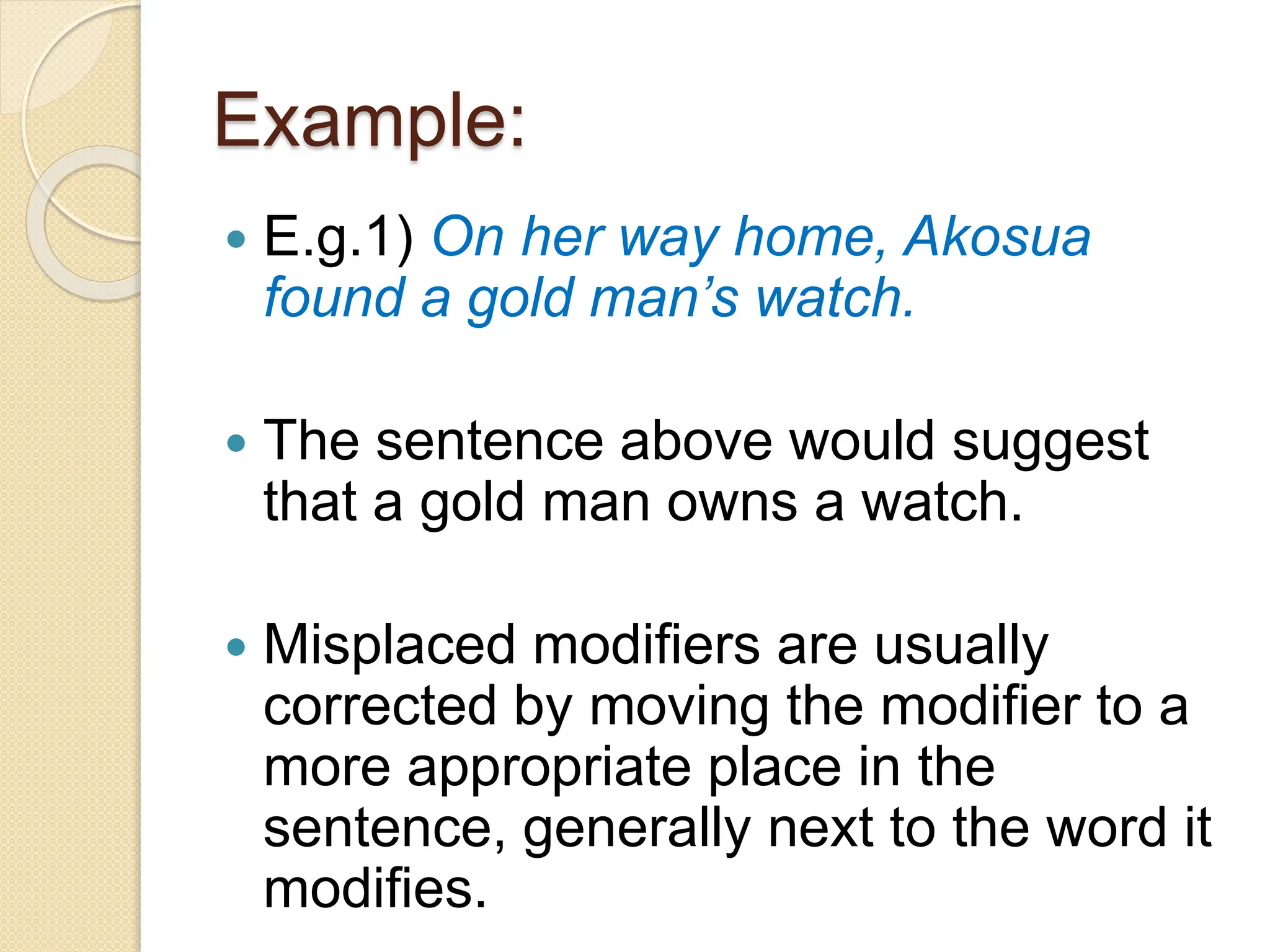
 E.g.1) On her way home, Akosua
found a gold man’s watch.
 The sentence above would suggest
that a gold man owns a watch.
 Misplaced modifiers are usually
corrected by moving the modifier to a
more appropriate place in the
sentence, generally next to the word it
modifies.
Example:
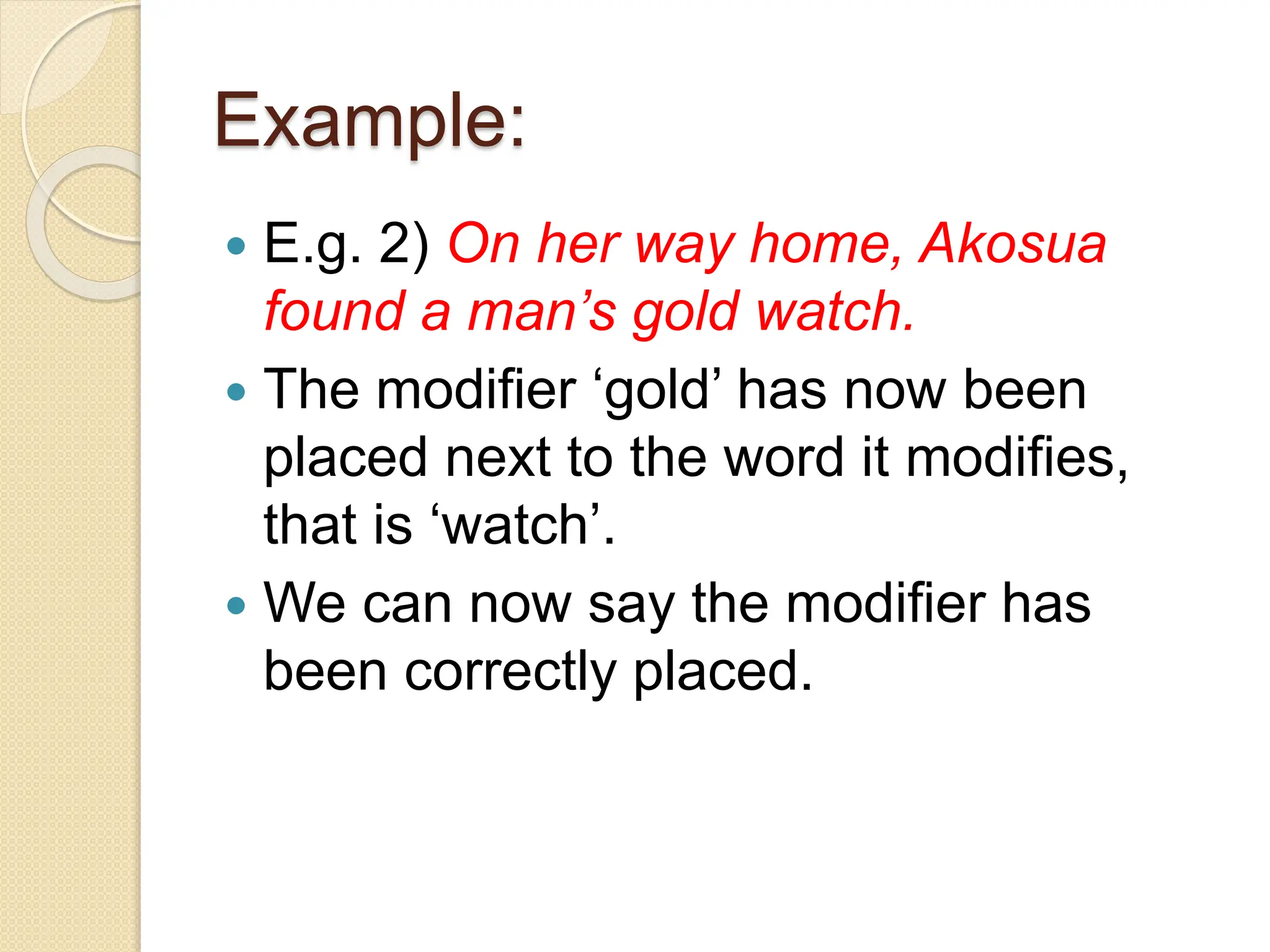
 E.g. 2) On her way home, Akosua
found a man’s gold watch.
 The modifier ‘gold’ has now been
placed next to the word it modifies,
that is ‘watch’.
 We can now say the modifier has
been correctly placed.
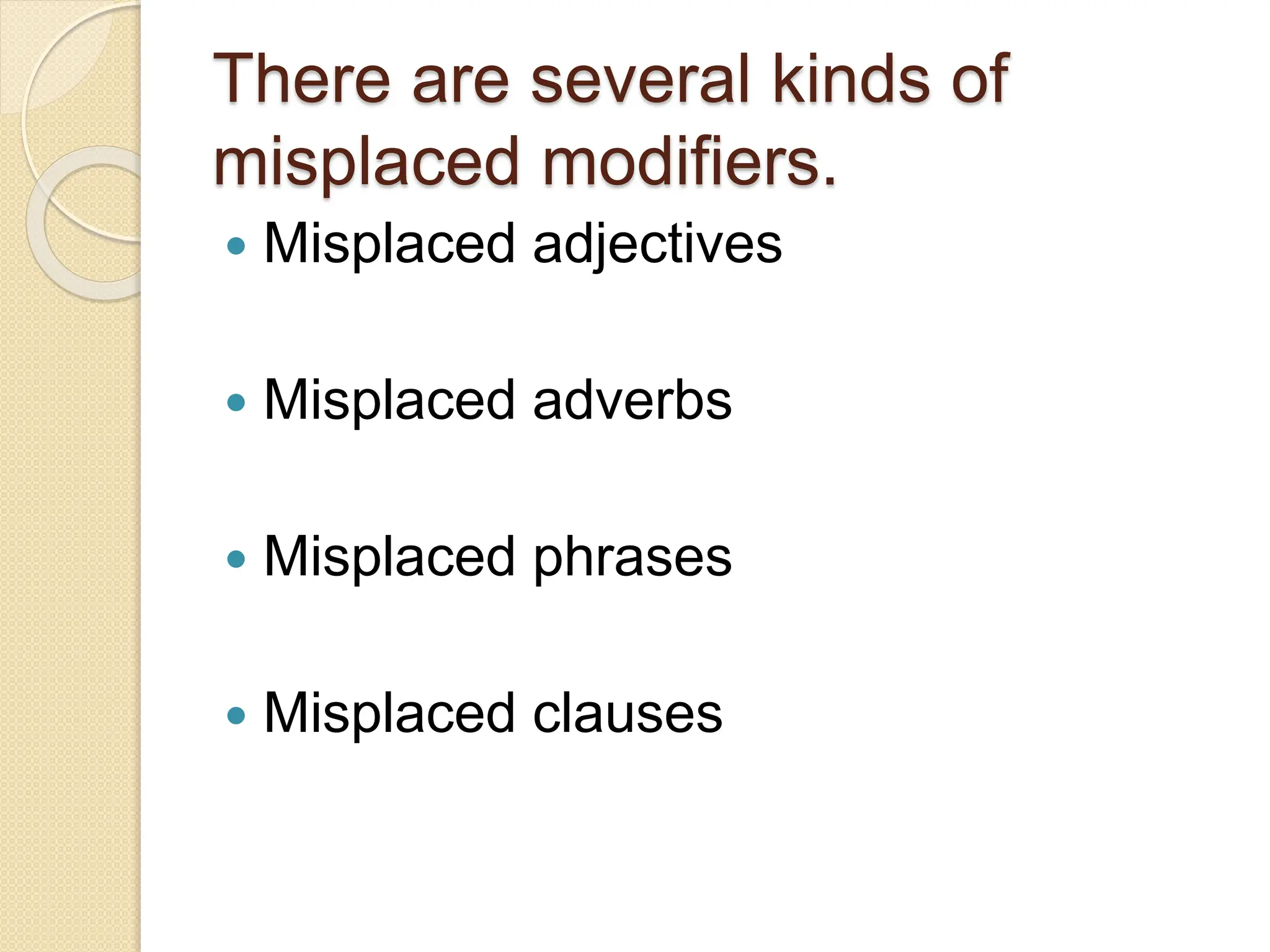
There are several kinds of
misplaced modifiers.
 Misplaced adjectives
 Misplaced adverbs
 Misplaced phrases
 Misplaced clauses
Misplaced adjectives
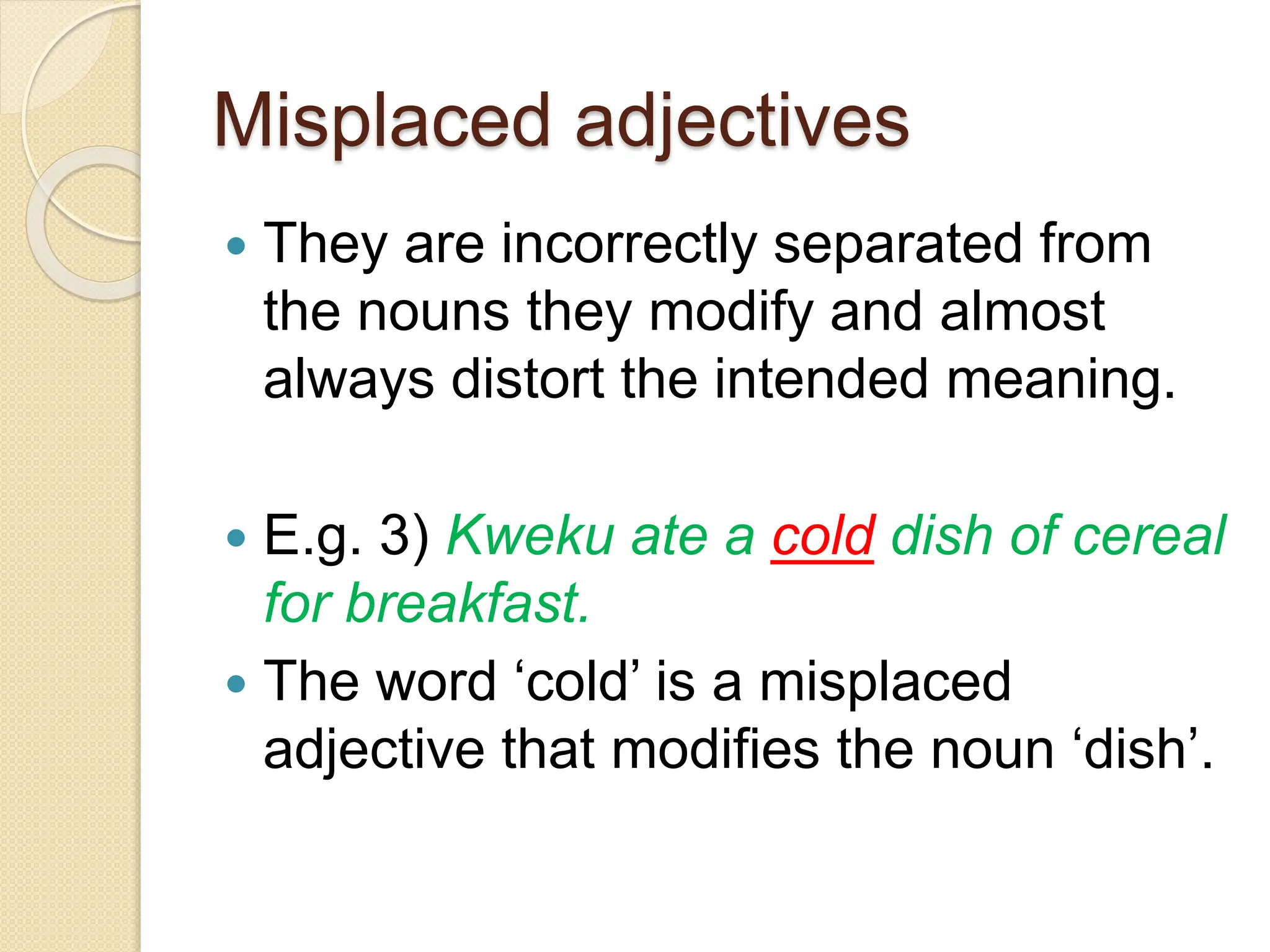
 They are incorrectly separated from
the nouns they modify and almost
always distort the intended meaning.
 E.g. 3) Kweku ate a cold dish of cereal
for breakfast.
 The word ‘cold’ is a misplaced
adjective that modifies the noun ‘dish’.
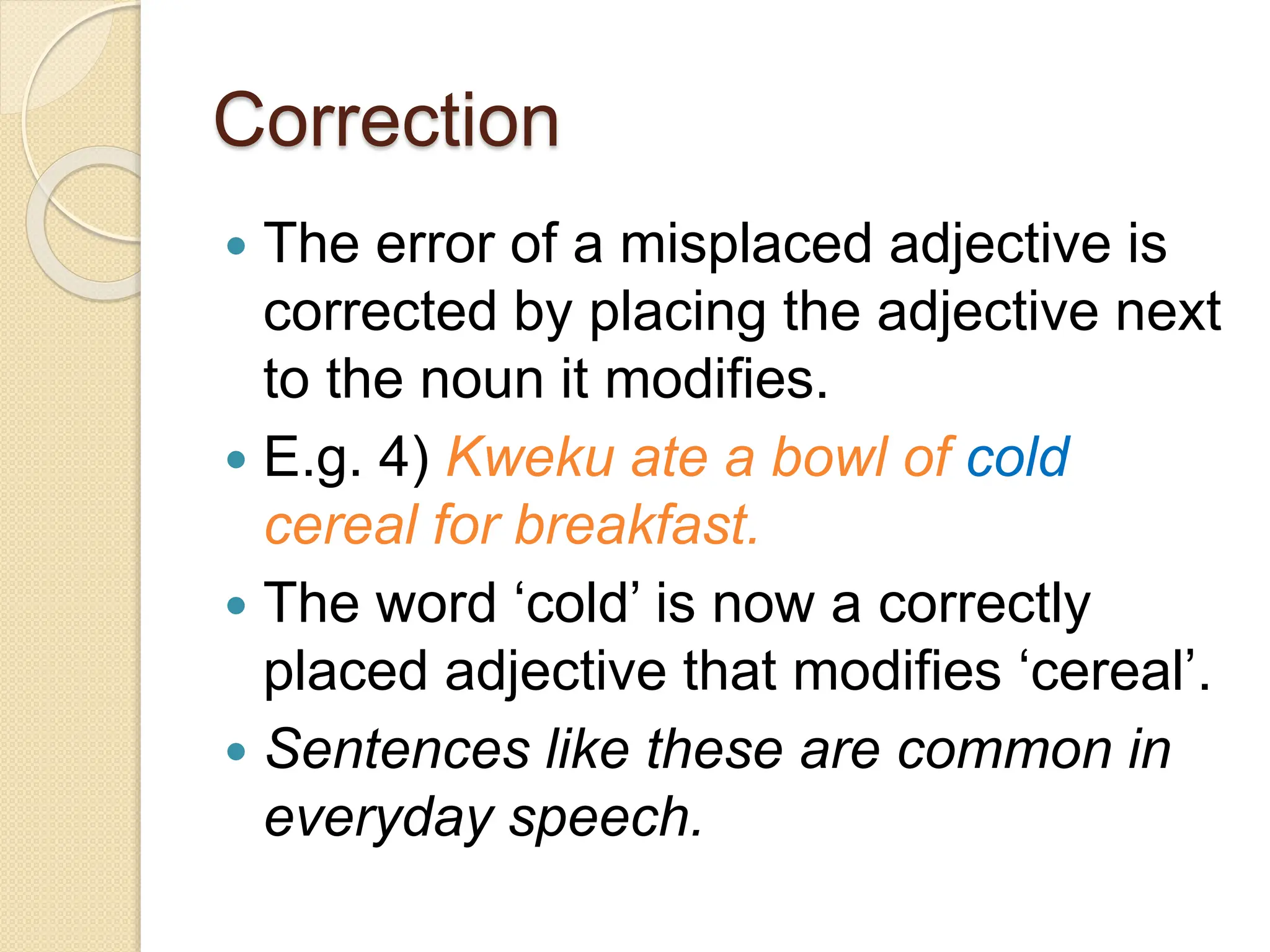
Correction
 The error of a misplaced adjective is
corrected by placing the adjective next
to the noun it modifies.
 E.g. 4) Kweku ate a bowl of cold
cereal for breakfast.
 The word ‘cold’ is now a correctly
placed adjective that modifies ‘cereal’.
 Sentences like these are common in
everyday speech.
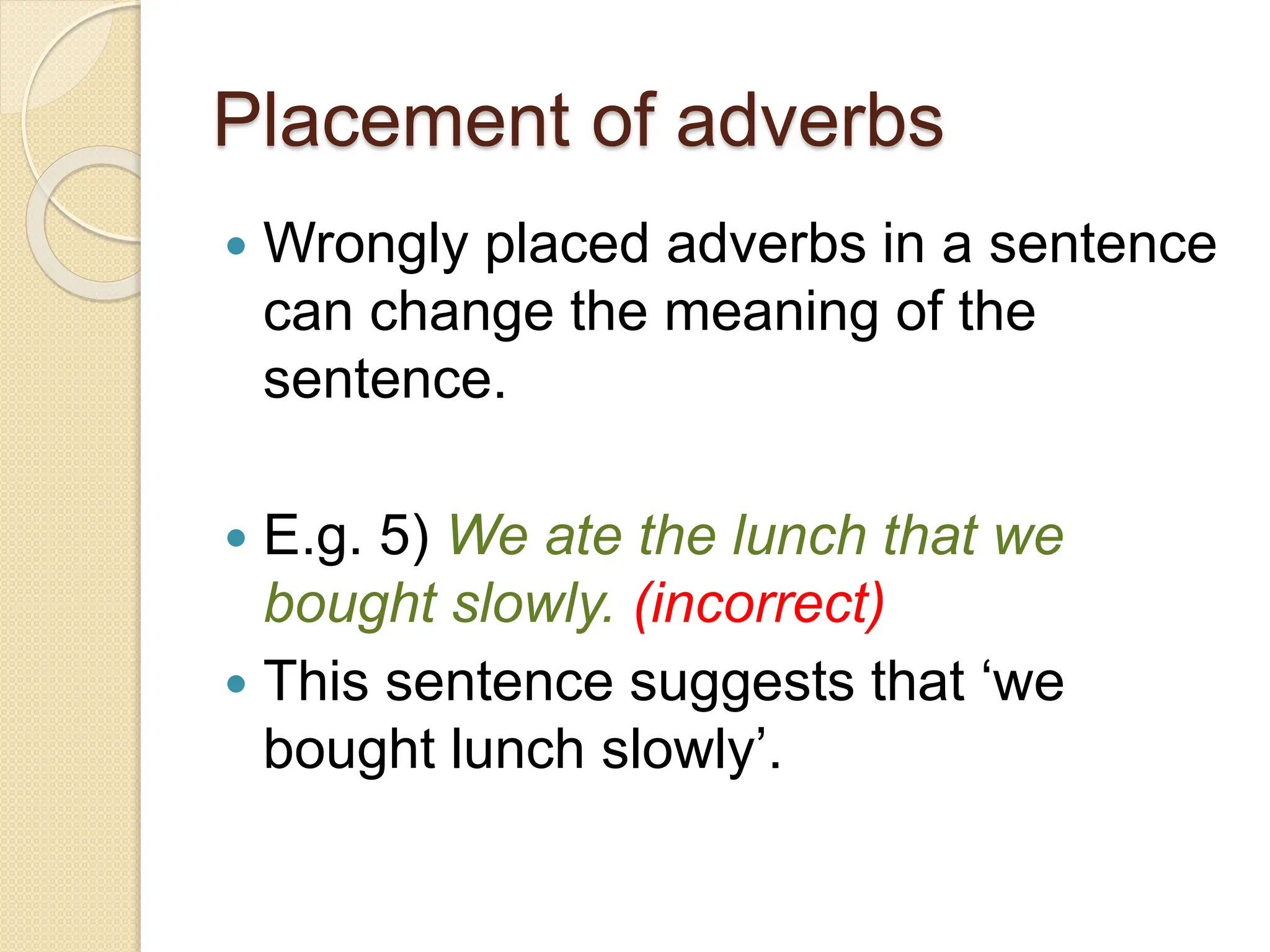
Placement of adverbs
 Wrongly placed adverbs in a sentence
can change the meaning of the
sentence.
 E.g. 5) We ate the lunch that we
bought slowly. (incorrect)
 This sentence suggests that ‘we
bought lunch slowly’.
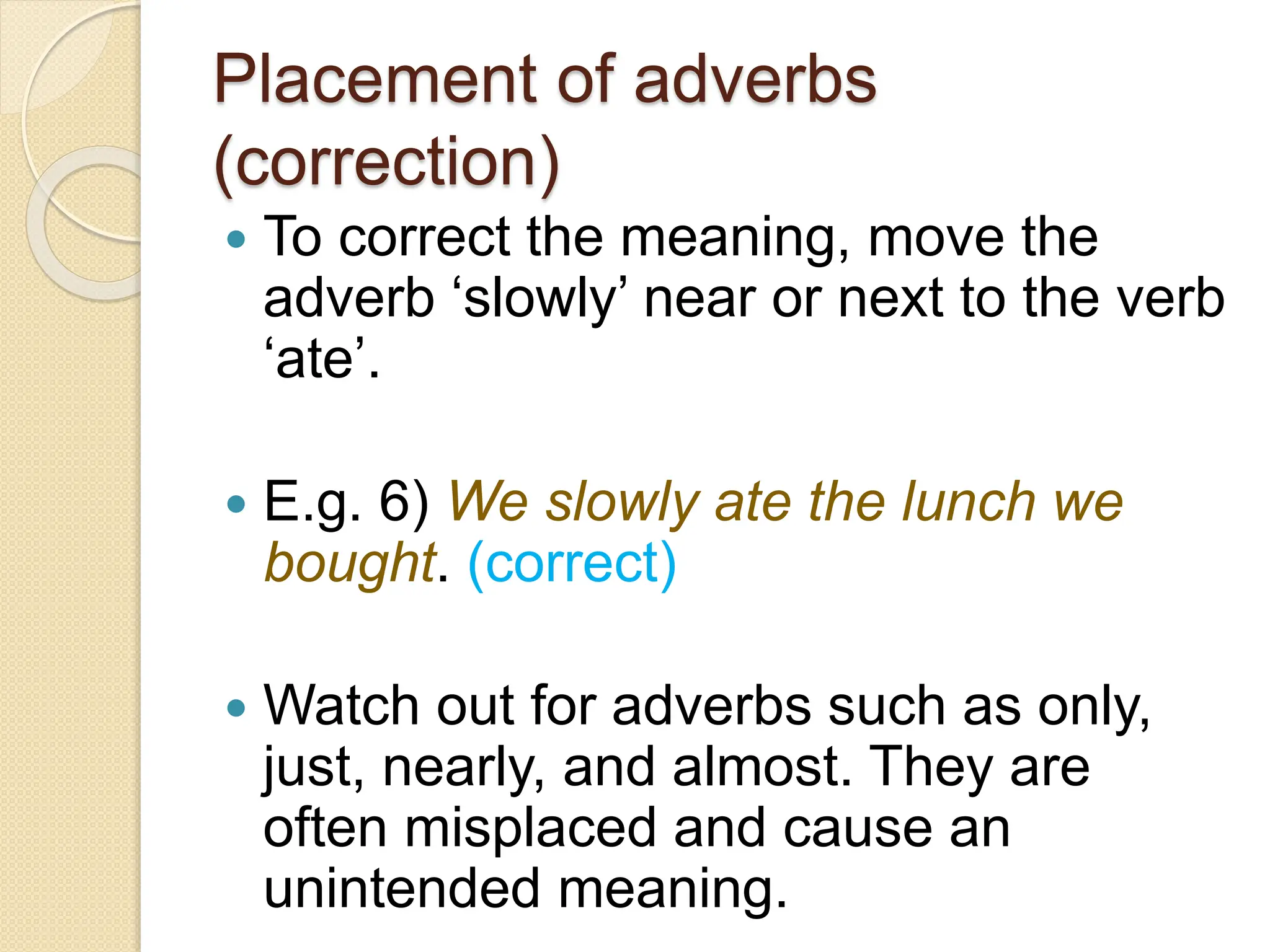
Placement of adverbs
(correction)
 To correct the meaning, move the
adverb ‘slowly’ near or next to the verb
‘ate’.
 E.g. 6) We slowly ate the lunch we
bought. (correct)
 Watch out for adverbs such as only,
just, nearly, and almost. They are
often misplaced and cause an
unintended meaning.
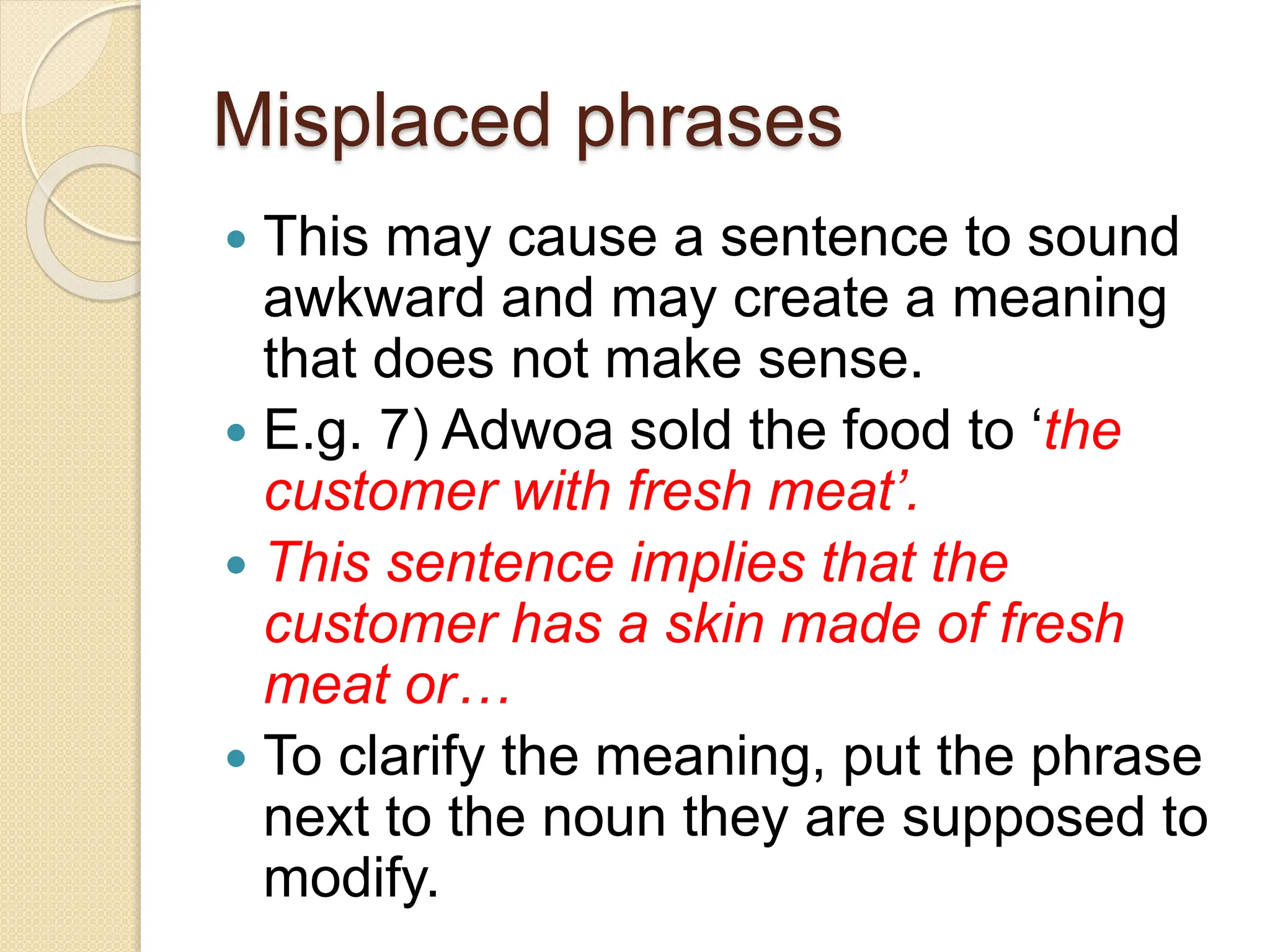
Misplaced phrases
 This may cause a sentence to sound
awkward and may create a meaning
that does not make sense.
 E.g. 7) Adwoa sold the food to ‘the
customer with fresh meat’.
 This sentence implies that the
customer has a skin made of fresh
meat or…
 To clarify the meaning, put the phrase
next to the noun they are supposed to
modify.
Misplaced phrases
(correction)
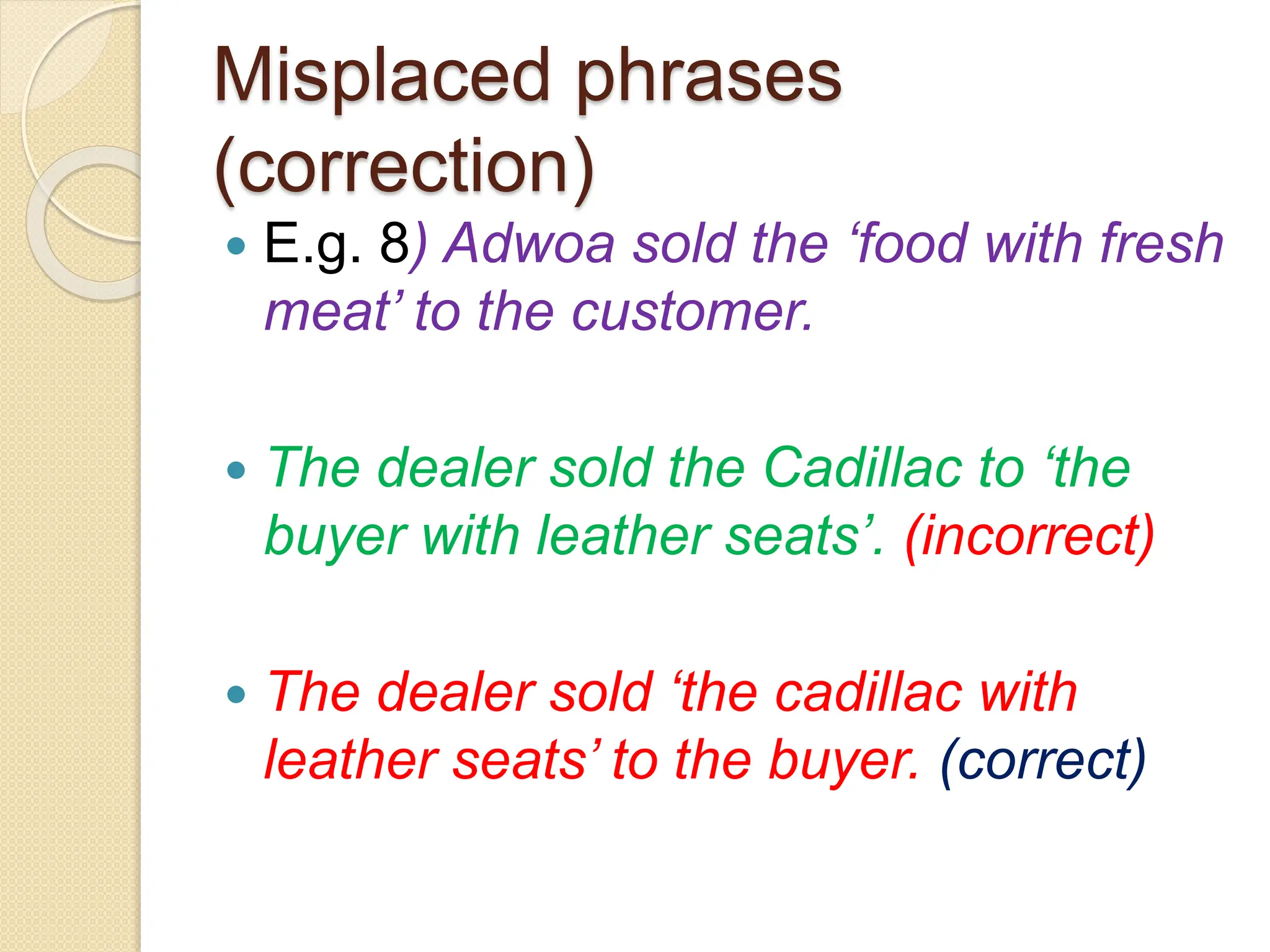
 E.g. 8) Adwoa sold the ‘food with fresh
meat’ to the customer.
 The dealer sold the Cadillac to ‘the
buyer with leather seats’. (incorrect)
 The dealer sold ‘the cadillac with
leather seats’ to the buyer. (correct)
Dangling modifiers
 When a modifier occurs without the
item that it modifies, it is referred to as
a dangling modifier.
 That is, the item to be modified is
missing from the clause or sentence.
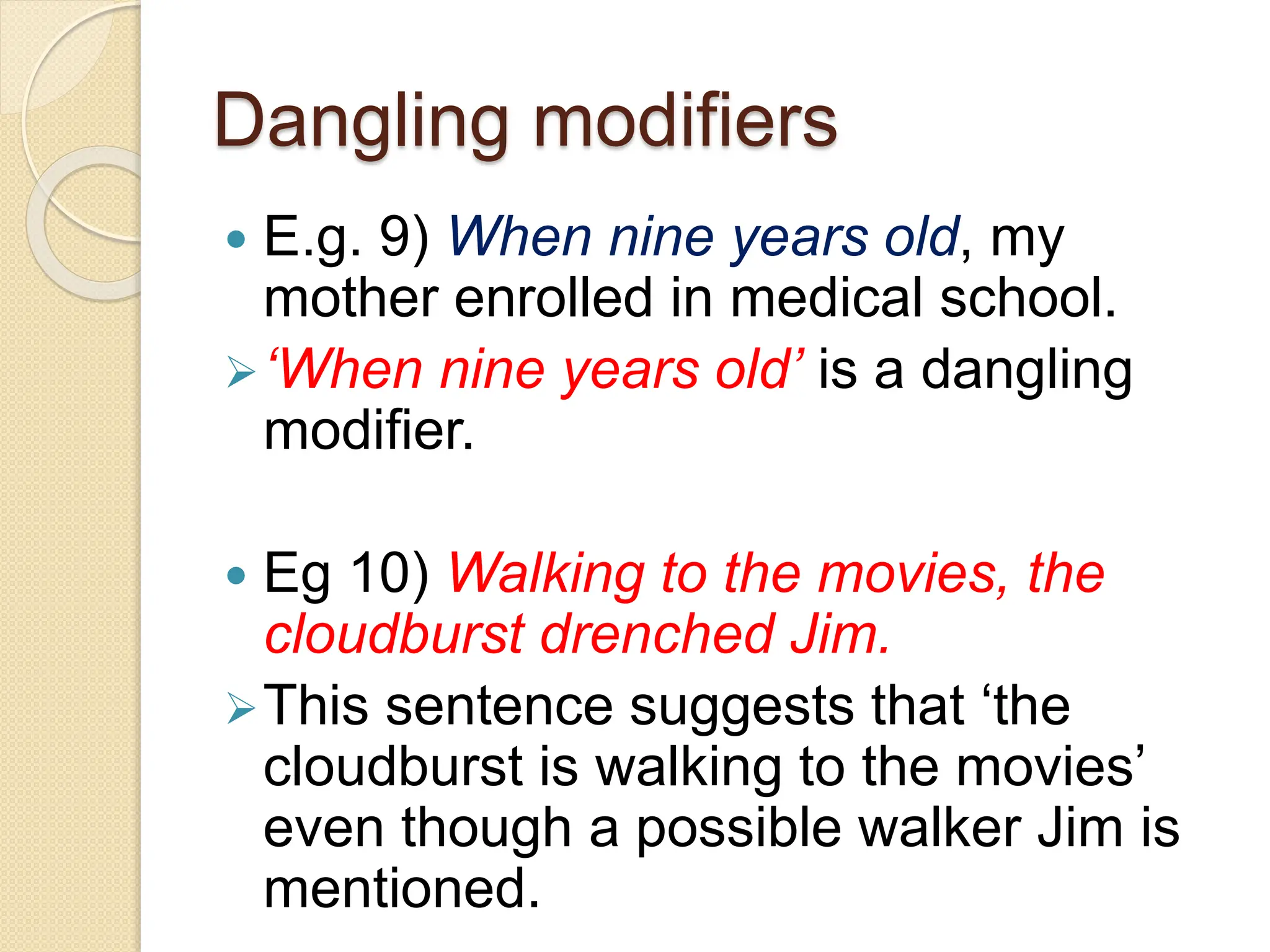
Dangling modifiers
 E.g. 9) When nine years old, my
mother enrolled in medical school.
‘When nine years old’ is a dangling
modifier.
 Eg 10) Walking to the movies, the
cloudburst drenched Jim.
This sentence suggests that ‘the
cloudburst is walking to the movies’
even though a possible walker Jim is
mentioned.
How to correct dangling
modifiers.
 Dangling modifiers can be corrected in
two general ways.
Correction method 1
 Leave the modifier as it is.
 Change the main part of the sentence
so that it begins with the term actually
modified.
 This change will put the modifier next
to the term it modifies.
Dangling modifiers
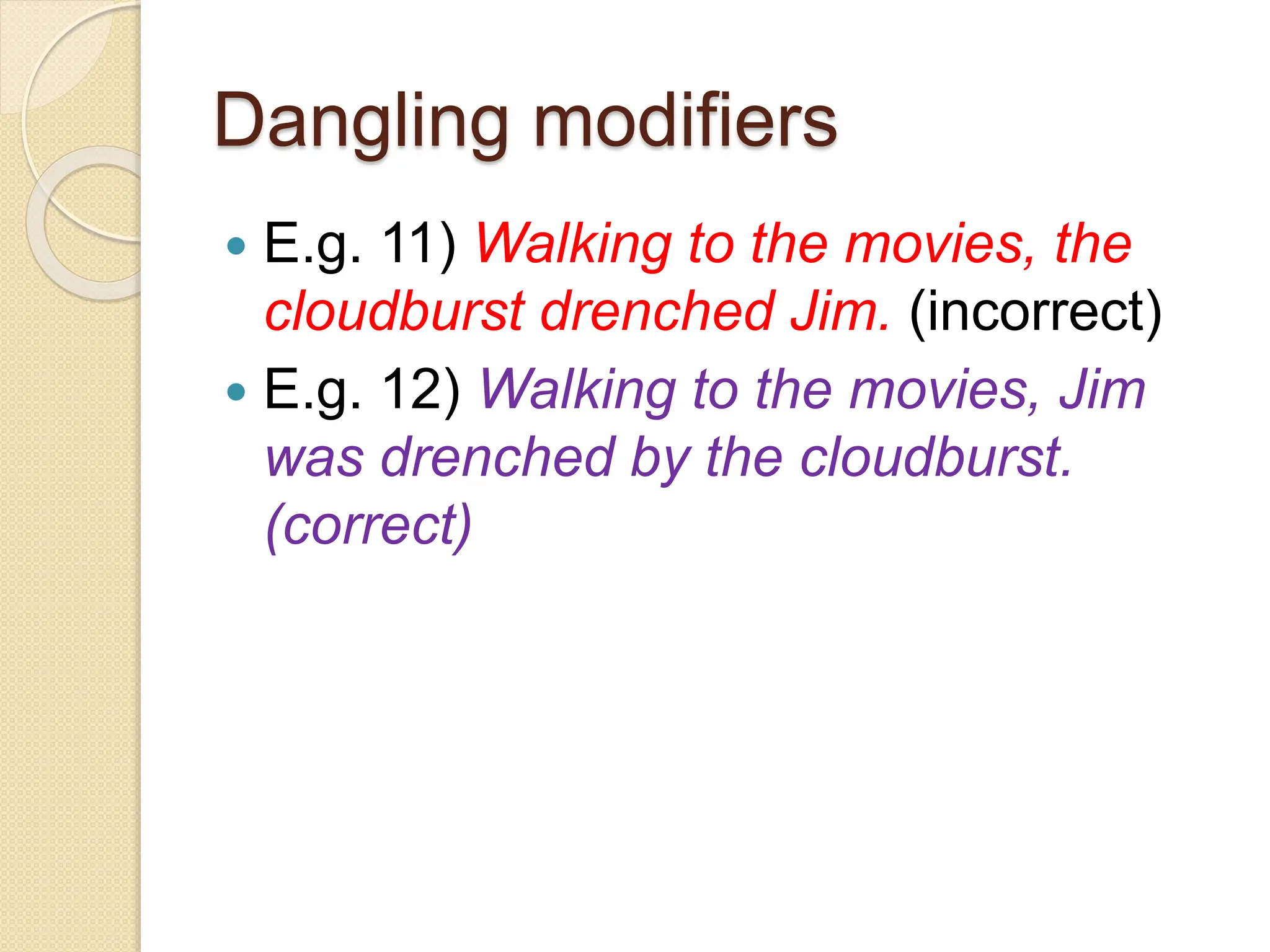
 E.g. 11) Walking to the movies, the
cloudburst drenched Jim. (incorrect)
 E.g. 12) Walking to the movies, Jim
was drenched by the cloudburst.
(correct)
Dangling modifiers
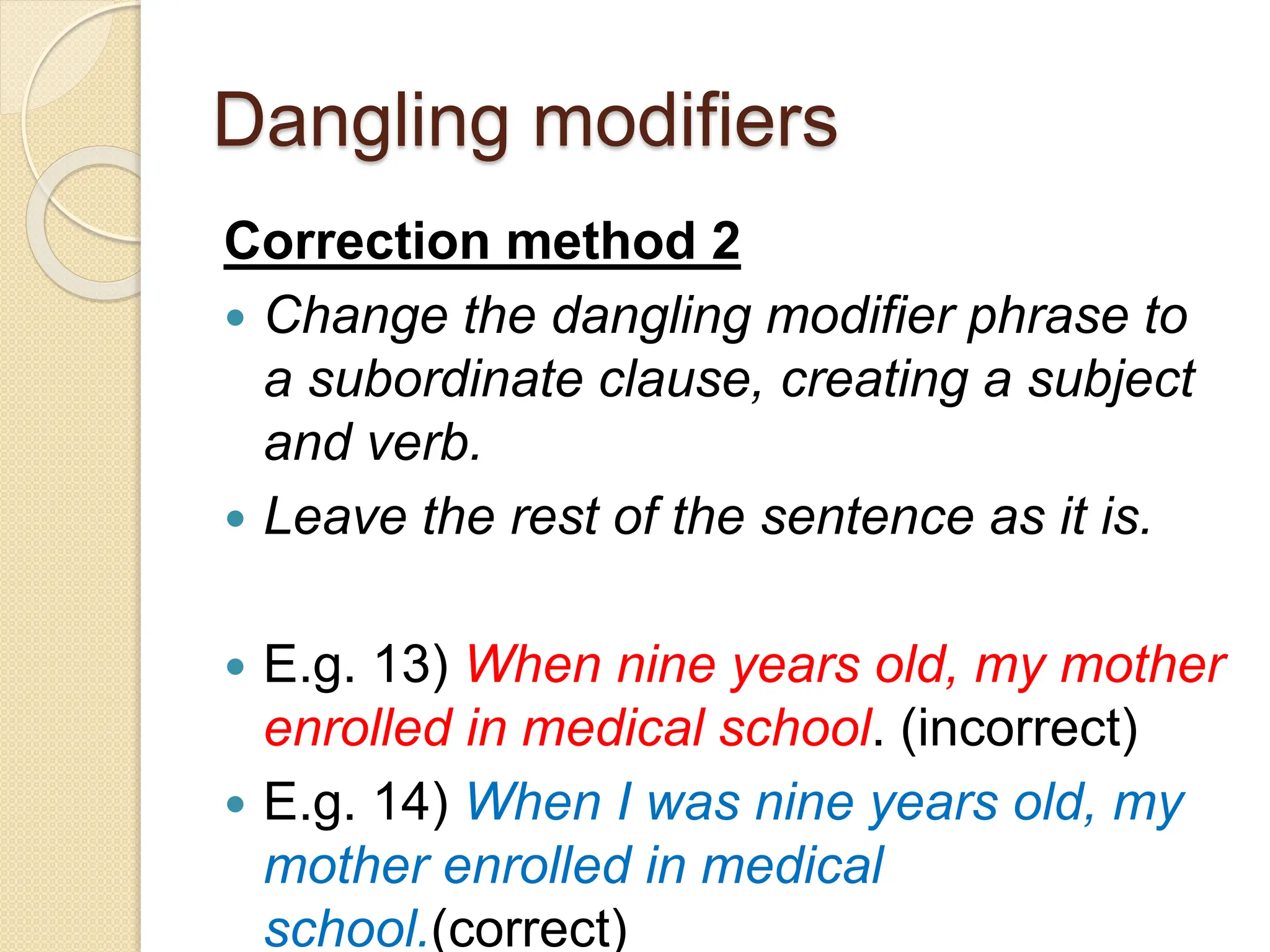
Correction method 2
 Change the dangling modifier phrase to
a subordinate clause, creating a subject
and verb.
 Leave the rest of the sentence as it is.
 E.g. 13) When nine years old, my mother
enrolled in medical school. (incorrect)
 E.g. 14) When I was nine years old, my
mother enrolled in medical
school.(correct)
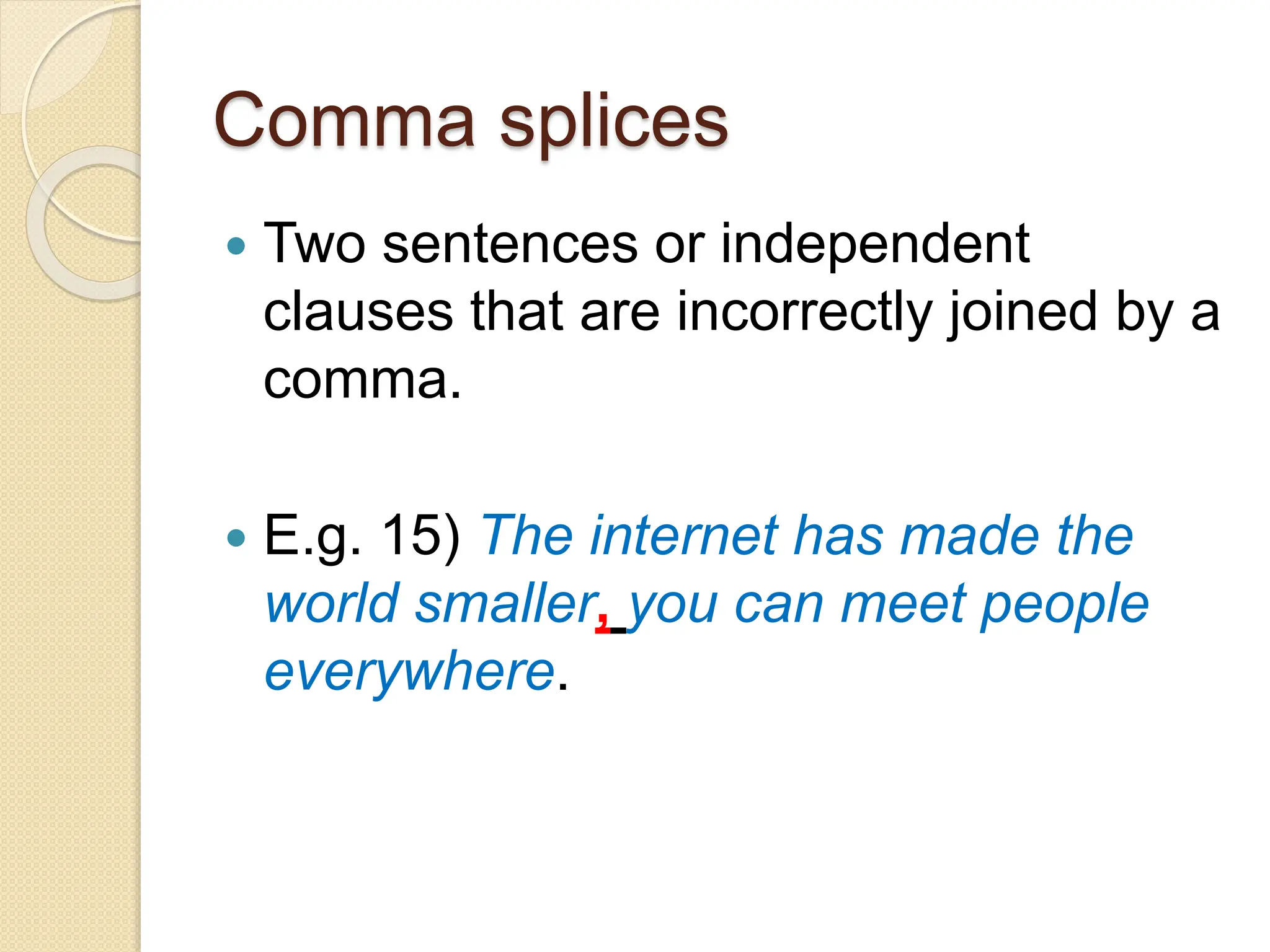
Comma splices
 Two sentences or independent
clauses that are incorrectly joined by a
comma.
 E.g. 15) The internet has made the
world smaller, you can meet people
everywhere.
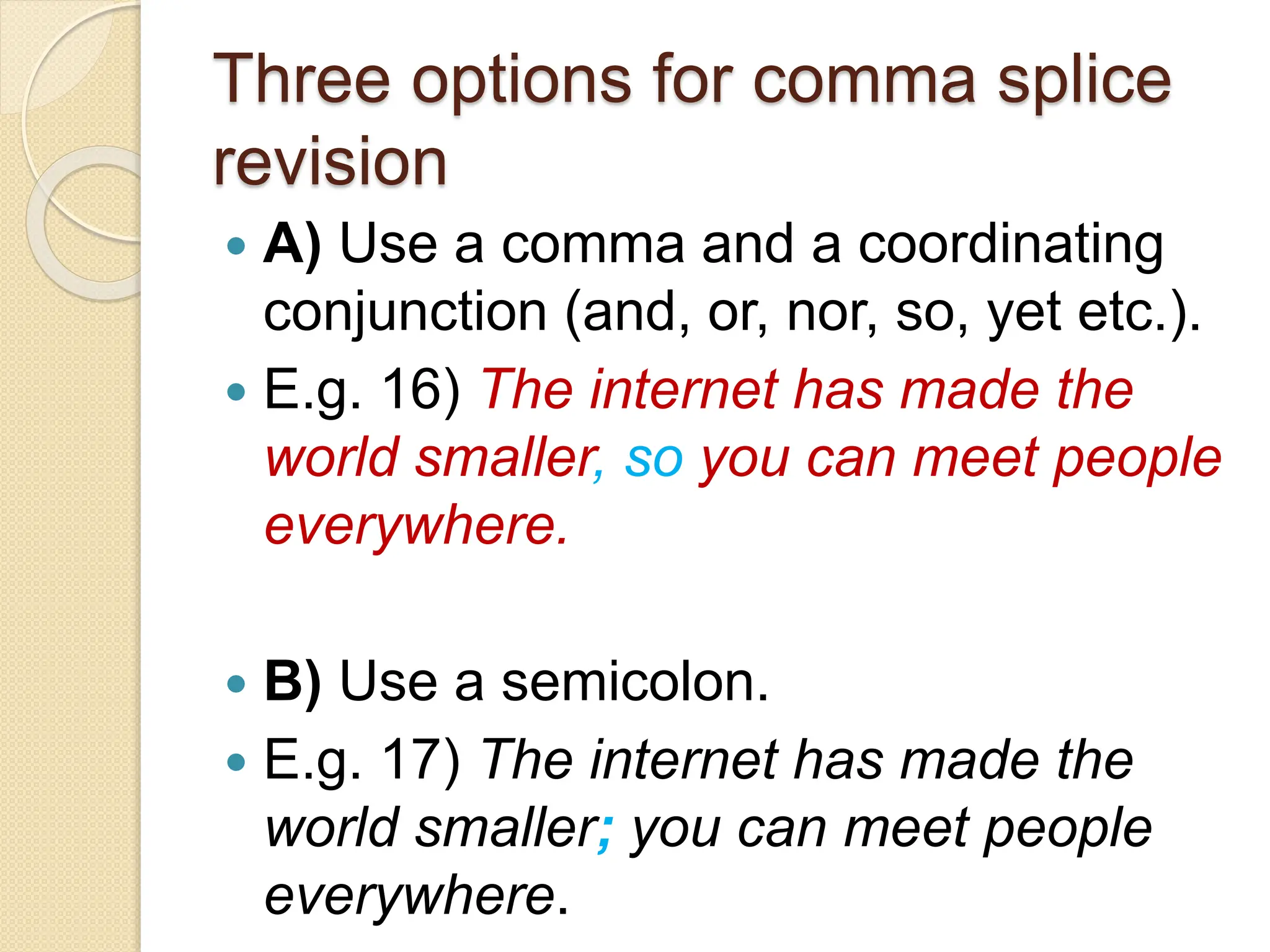
Three options for comma splice
revision
 A) Use a comma and a coordinating
conjunction (and, or, nor, so, yet etc.).
 E.g. 16) The internet has made the
world smaller, so you can meet people
everywhere.
 B) Use a semicolon.
 E.g. 17) The internet has made the
world smaller; you can meet people
everywhere.
Comma splices (
continuation)
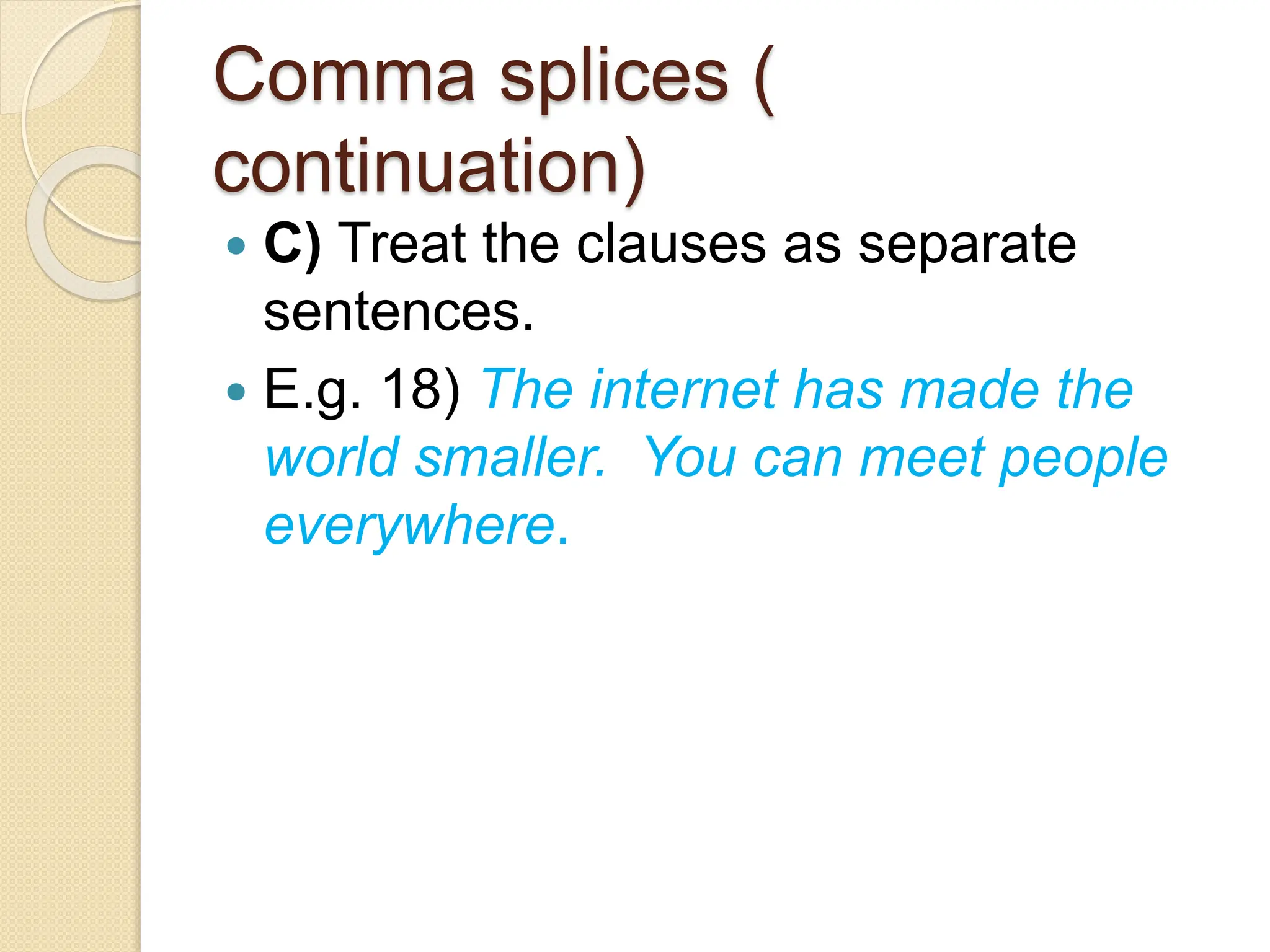
 C) Treat the clauses as separate
sentences.
 E.g. 18) The internet has made the
world smaller. You can meet people
everywhere.
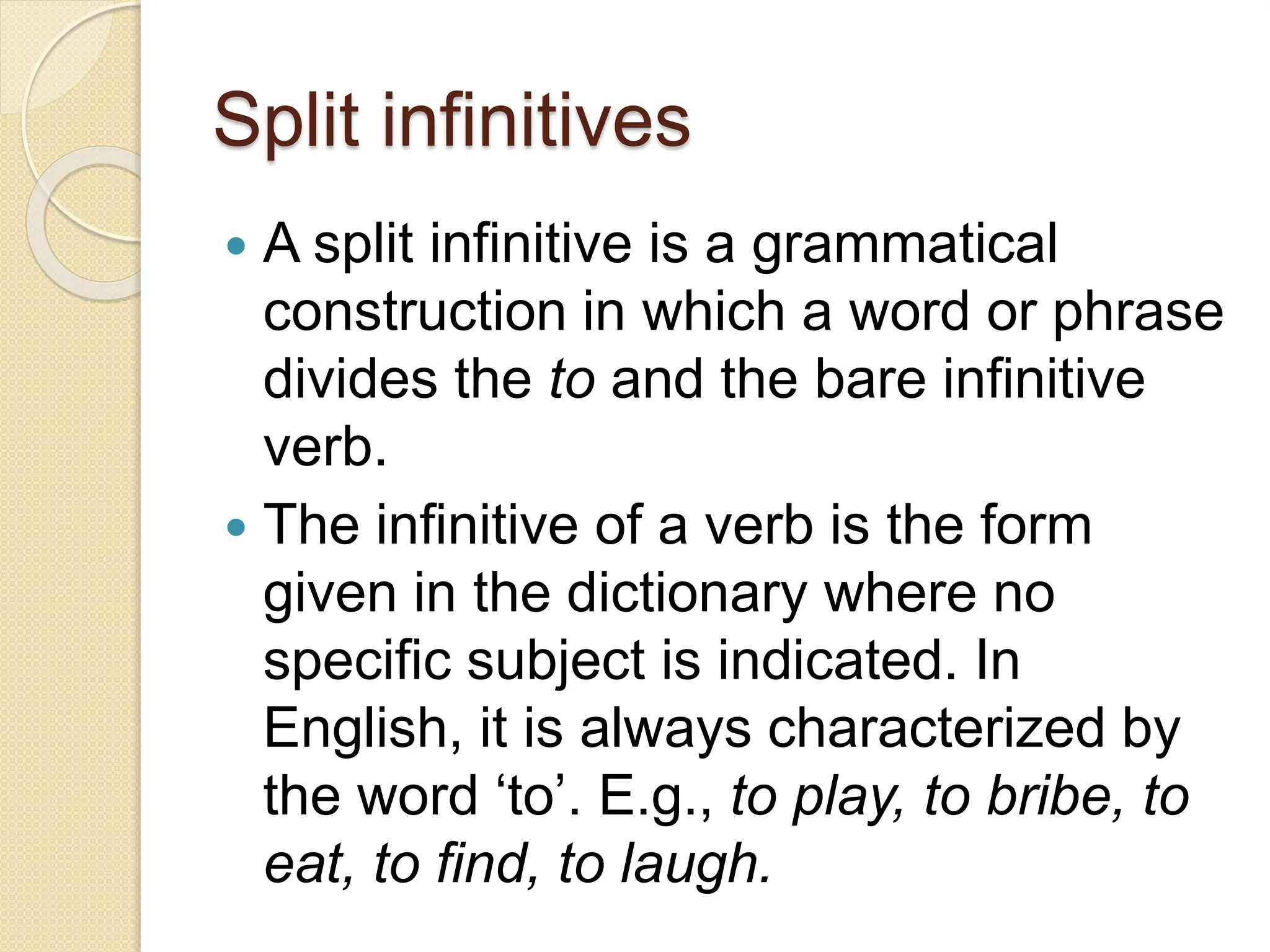
Split infinitives
 A split infinitive is a grammatical
construction in which a word or phrase
divides the to and the bare infinitive
verb.
 The infinitive of a verb is the form
given in the dictionary where no
specific subject is indicated. In
English, it is always characterized by
the word ‘to’. E.g., to play, to bribe, to
eat, to find, to laugh.
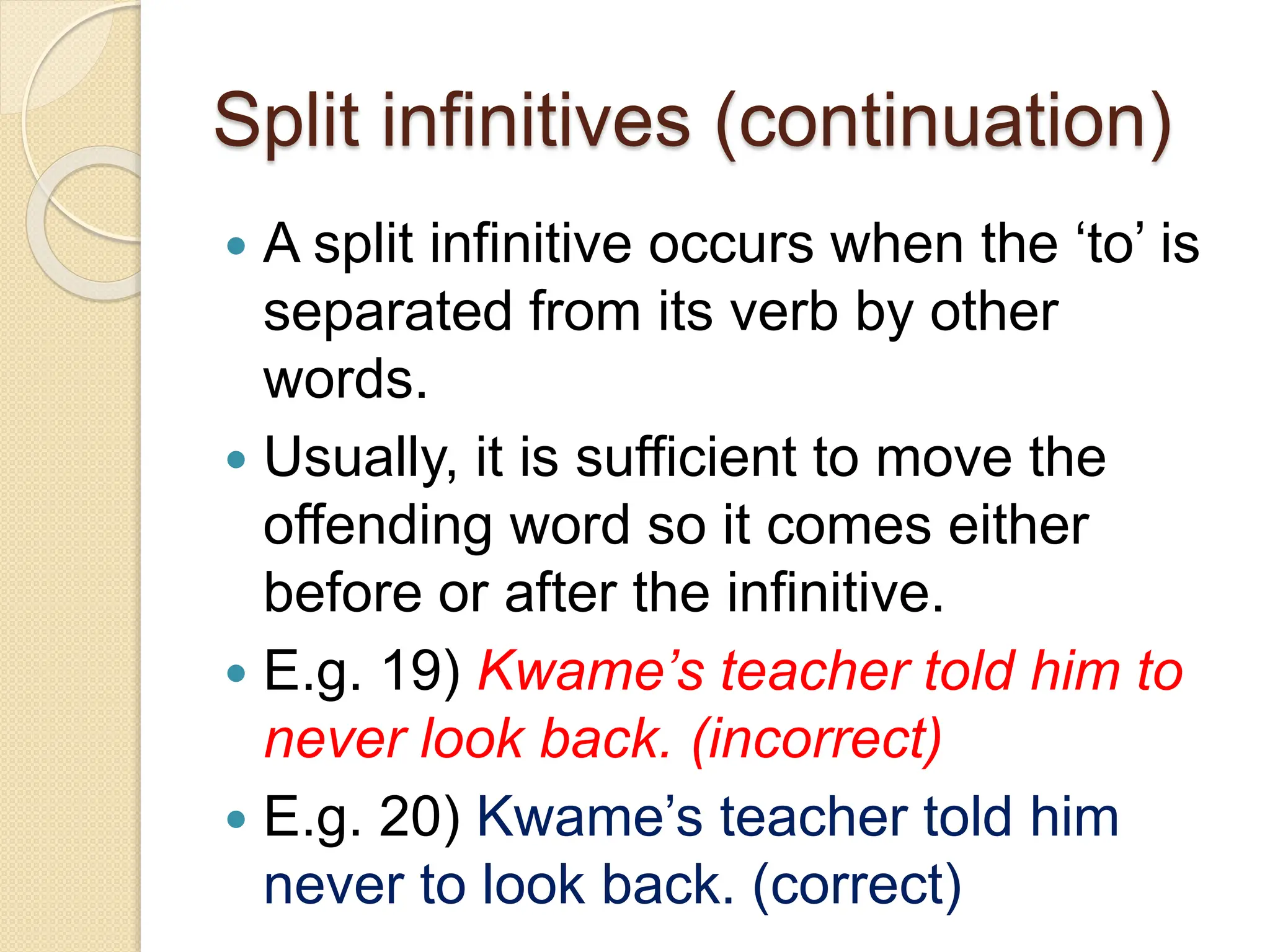
Split infinitives (continuation)
 A split infinitive occurs when the ‘to’ is
separated from its verb by other
words.
 Usually, it is sufficient to move the
offending word so it comes either
before or after the infinitive.
 E.g. 19) Kwame’s teacher told him to
never look back. (incorrect)
 E.g. 20) Kwame’s teacher told him
never to look back. (correct)
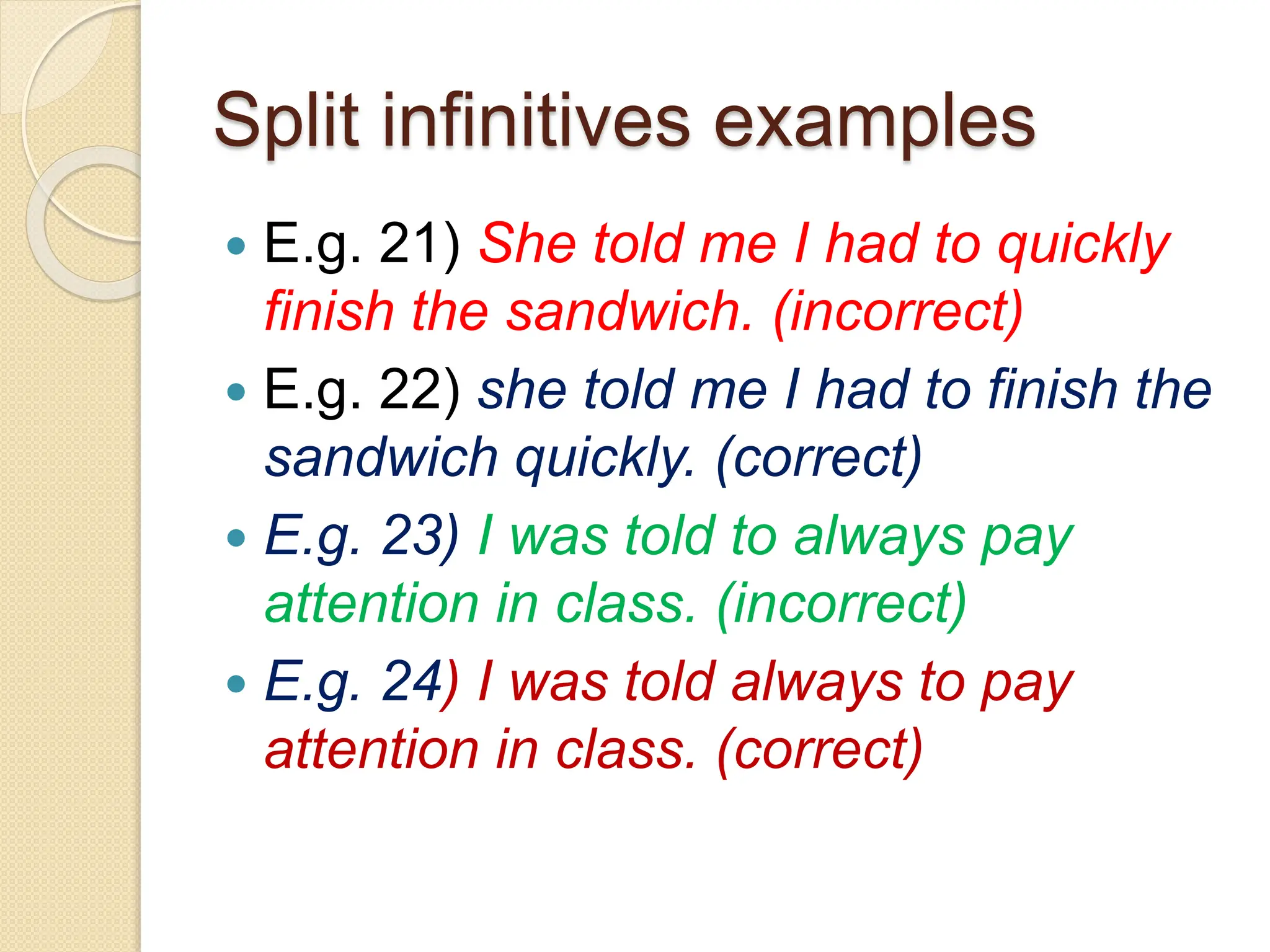
Split infinitives examples
 E.g. 21) She told me I had to quickly
finish the sandwich. (incorrect)
 E.g. 22) she told me I had to finish the
sandwich quickly. (correct)
 E.g. 23) I was told to always pay
attention in class. (incorrect)
 E.g. 24) I was told always to pay
attention in class. (correct)
Clear pronoun reference
 A pronoun is a word used to stand for
or take the place of a noun.
 A pronoun should refer clearly to one,
unmistakable noun coming before the
pronoun. This is called pronoun
antecedent.
 It is very easy to create a sentence
that uses a pronoun without a clear,
unmistakable noun antecedent.
Clear pronoun reference
(E.g.)
 E.g. 25) After putting the disk in the
cabinet, Kwame sold it.
 The pronoun ‘it’ does not have a clear
noun antecedent.
 As a result, the reader cannot know
for sure whether Kwame sold the disk
or the cabinet.
 Such errors, called faulty or vague
pronoun reference can confuse
readers and obscure intended
meaning.
Clear pronoun reference
 There are three major pronoun
reference errors:
Too many antecedents
Hidden antecedents
No antecedent at all.
Too many antecedents
 A pronoun should have only one
antecedent. The antecedent should be
clear and unmistakable.
 E.g. 25) Take the radio out of the car and
fix it.
 Anyone who reads this sentence would
not know exactly which item to be fixed.
 In the above example, faulty or vague
pronoun reference occurs because the
pronoun ‘it’ has two possible noun
antecedents.
Too many antecedents
To fix the problem:
A) Substitute a noun for the pronoun
and
B) Rephrase the sentence.
 E.g. 26) Take the radio out of the car
and fix the radio.
Or
 E.g. 27) Take the radio out of the car
and fix the car.
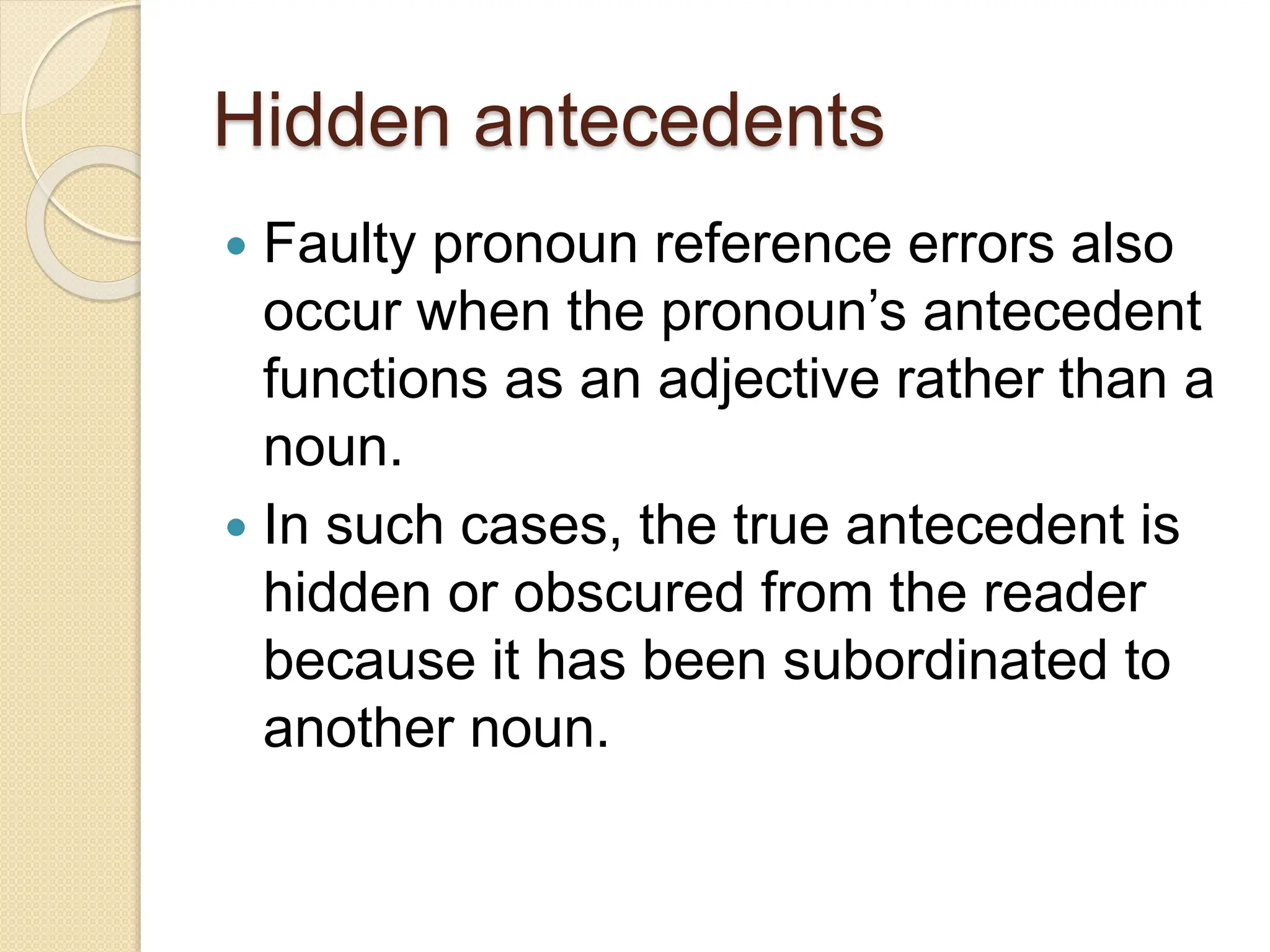
Hidden antecedents
 Faulty pronoun reference errors also
occur when the pronoun’s antecedent
functions as an adjective rather than a
noun.
 In such cases, the true antecedent is
hidden or obscured from the reader
because it has been subordinated to
another noun.
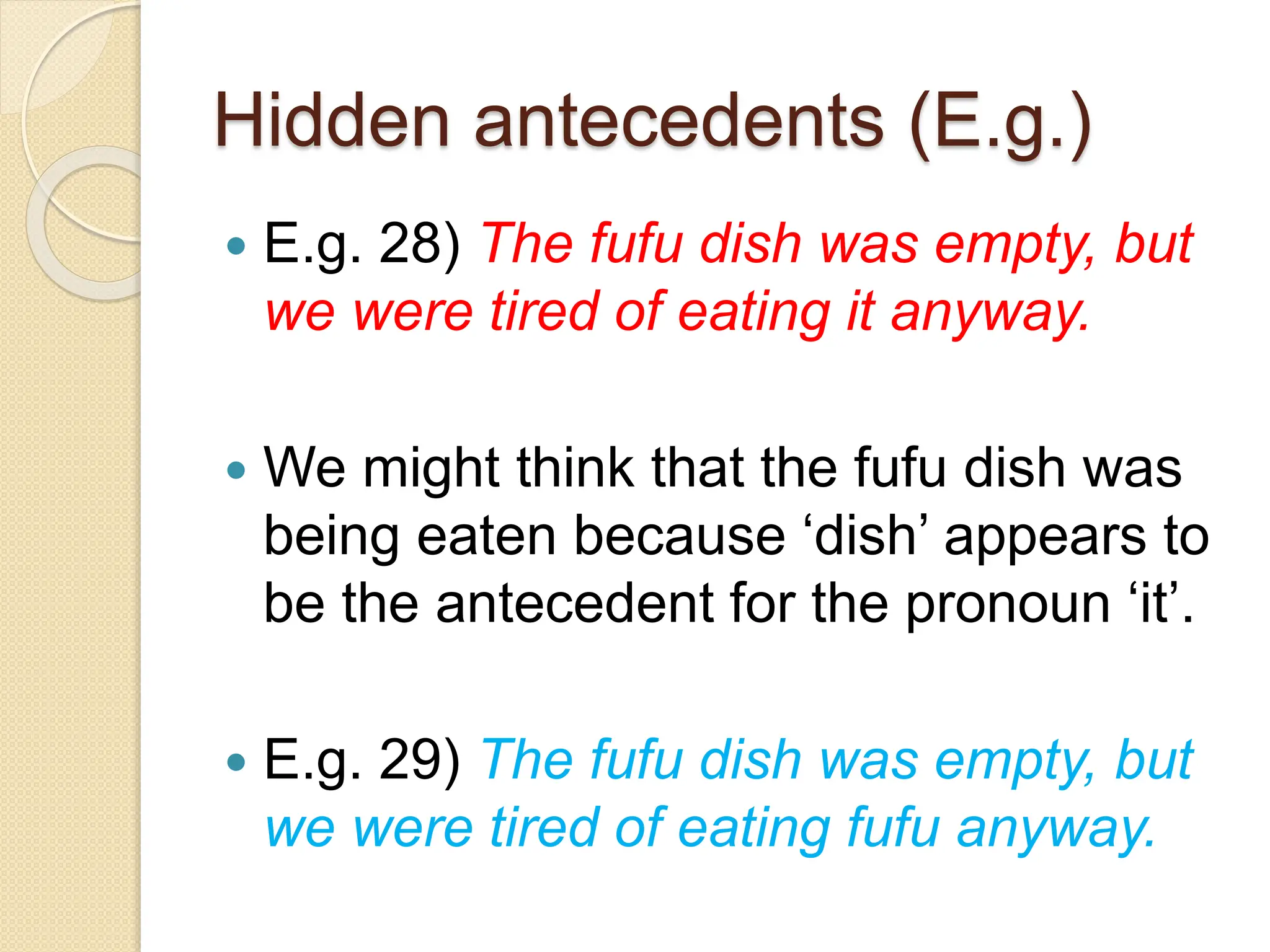
Hidden antecedents (E.g.)
 E.g. 28) The fufu dish was empty, but
we were tired of eating it anyway.
 We might think that the fufu dish was
being eaten because ‘dish’ appears to
be the antecedent for the pronoun ‘it’.
 E.g. 29) The fufu dish was empty, but
we were tired of eating fufu anyway.
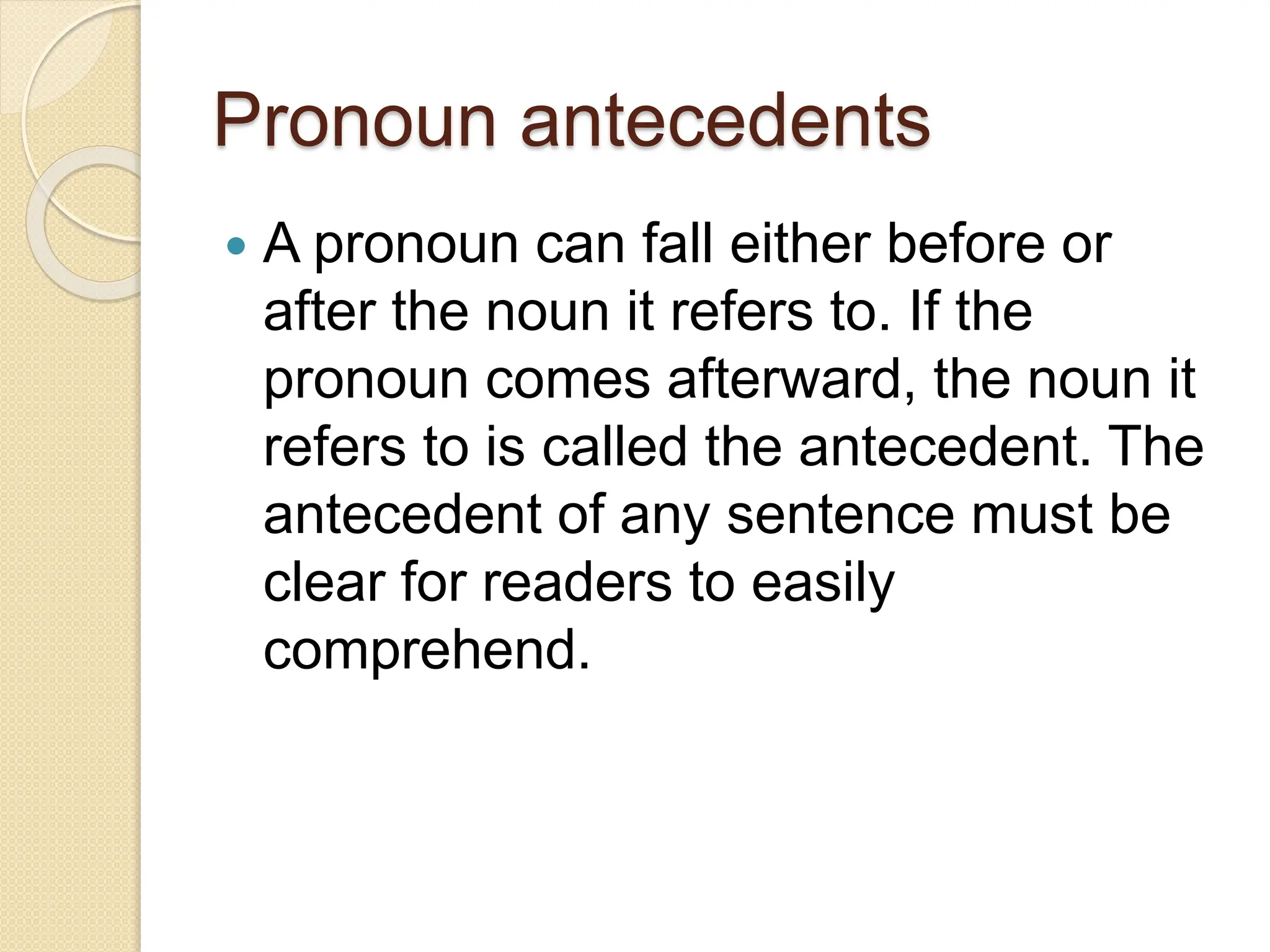
Pronoun antecedents
 A pronoun can fall either before or
after the noun it refers to. If the
pronoun comes afterward, the noun it
refers to is called the antecedent. The
antecedent of any sentence must be
clear for readers to easily
comprehend.
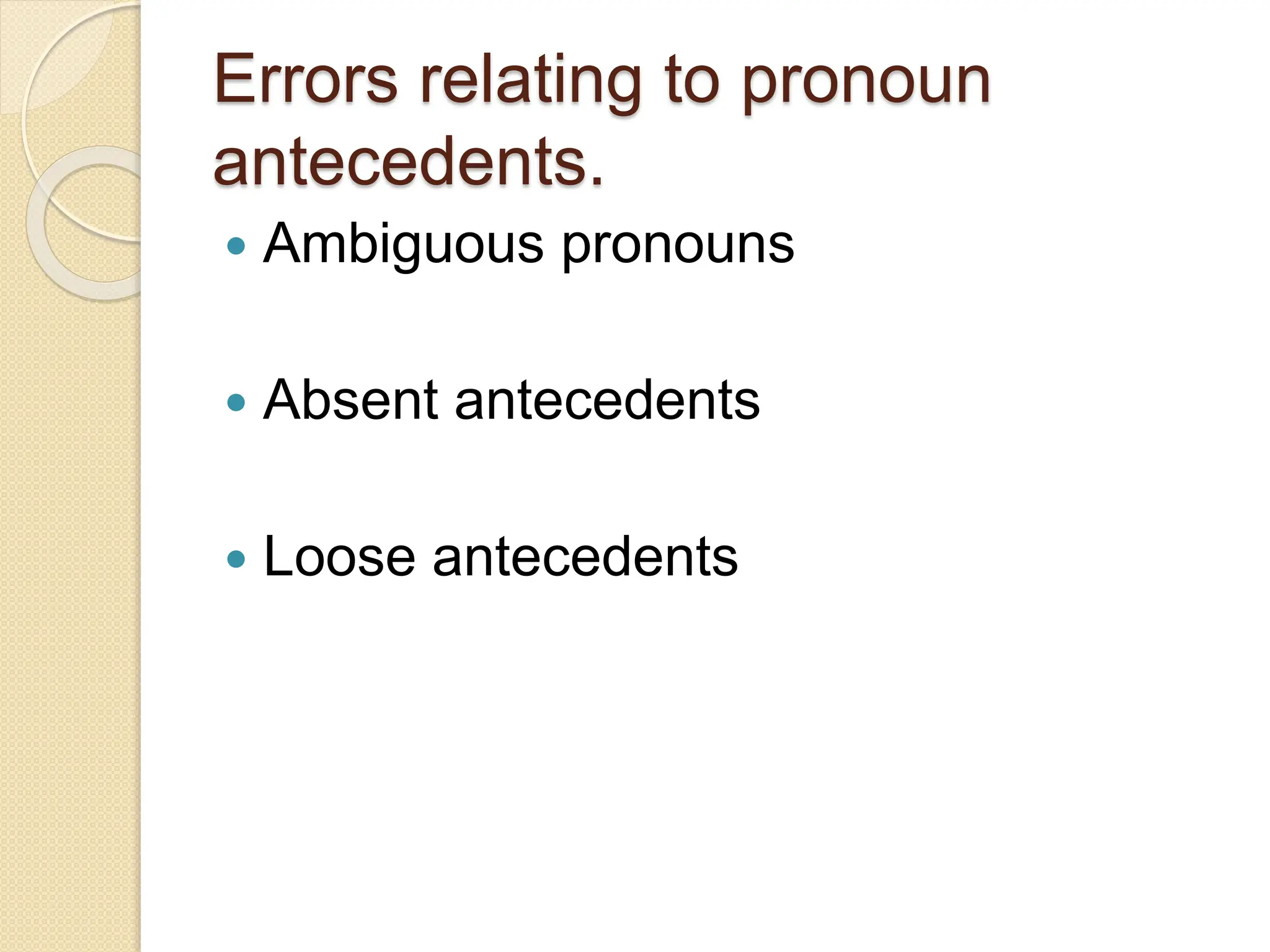
Errors relating to pronoun
antecedents.
 Ambiguous pronouns
 Absent antecedents
 Loose antecedents
Ambiguous pronouns
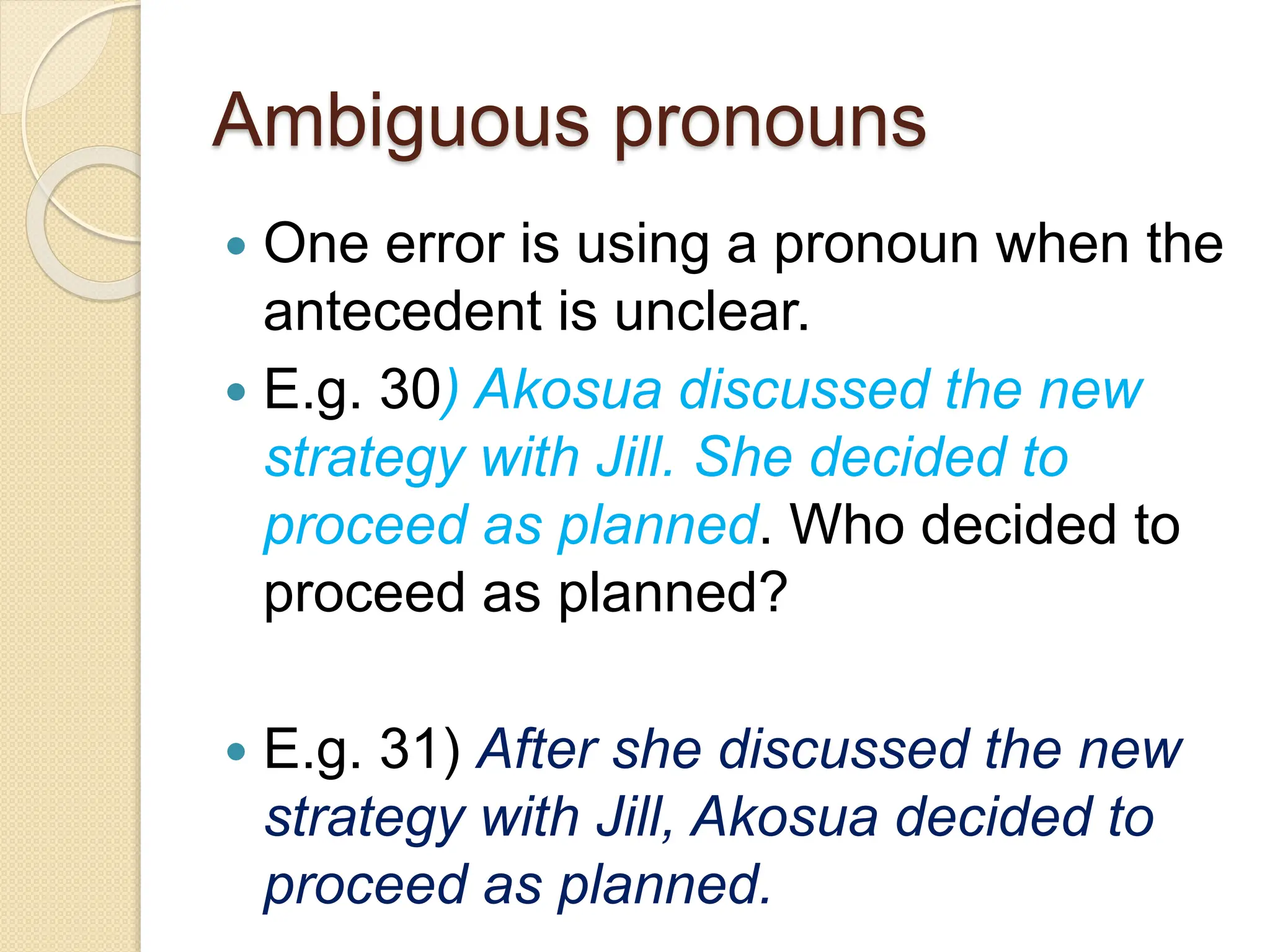
 One error is using a pronoun when the
antecedent is unclear.
 E.g. 30) Akosua discussed the new
strategy with Jill. She decided to
proceed as planned. Who decided to
proceed as planned?
 E.g. 31) After she discussed the new
strategy with Jill, Akosua decided to
proceed as planned.
Absent antecedents
 E.g. 32) Kojo says the course is fun to
teach because it’s small, and they are
motivated.
 ‘they’ presumably refers to students,
but the antecedent noun is absent.
 E.g. 33) Kojo says the course is fun to
teach, because it’s small and the
students are motivated. (correct)
Loose antecedents
 A common pronoun reference error is
having a pronoun such as ‘this’, ‘that’,
‘it’ or ‘which’, referring loosely to an
idea expressed, rather than to a
specific noun.
 E.g. 34) The company concealed
financial losses. This caused investors
to damp the stock.
 E.g. 35) The company concealed
financial losses. That caused investors
to dump the stock.
Loose antecedents
 E.g. 36) The company concealed
financial losses. It caused investors to
dump the stock.
 In these sentences, note the lack of
specific antecedent noun for ‘this’, ‘that’,
and ‘it’
 Corrected.
 The company concealed financial losses.
This accounting fraud caused investors
to dump the stock.
 The pronoun ‘this’ clearly refers to the
noun ‘fraud’.
Rambling sentences
 Rambling sentences are sentences
that contain several clauses
connected by coordinating
conjunctions such as ‘and’, ‘or’, ‘but’,
‘yet’, ‘nor’, and ‘so’.
 A rambling sentence may appear to
follow the technical rules of grammar
but the sentence as a whole is wrong
because it rambles or runs-on.
Rambling sentences
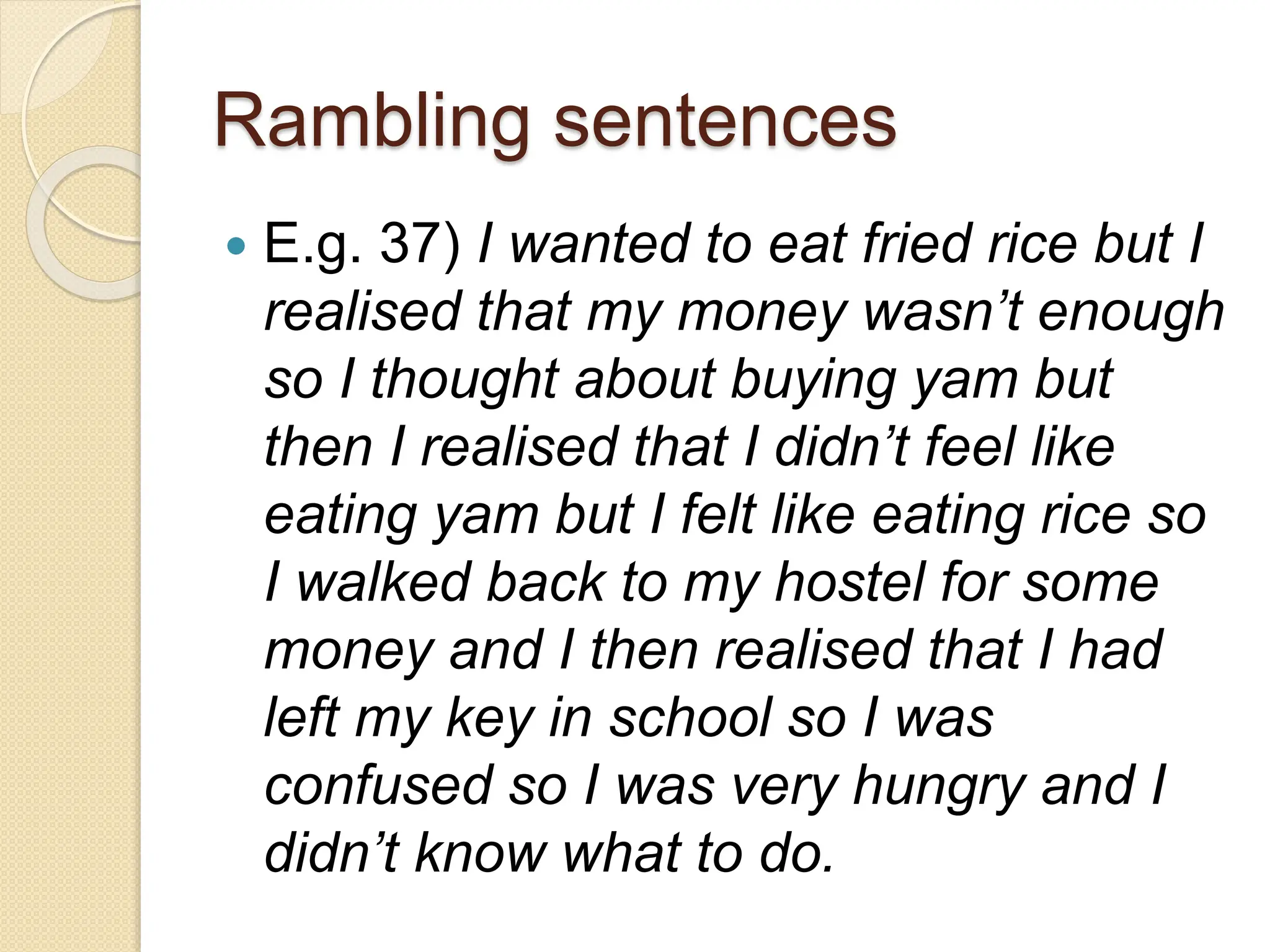
 E.g. 37) I wanted to eat fried rice but I
realised that my money wasn’t enough
so I thought about buying yam but
then I realised that I didn’t feel like
eating yam but I felt like eating rice so
I walked back to my hostel for some
money and I then realised that I had
left my key in school so I was
confused so I was very hungry and I
didn’t know what to do.
Rambling sentences
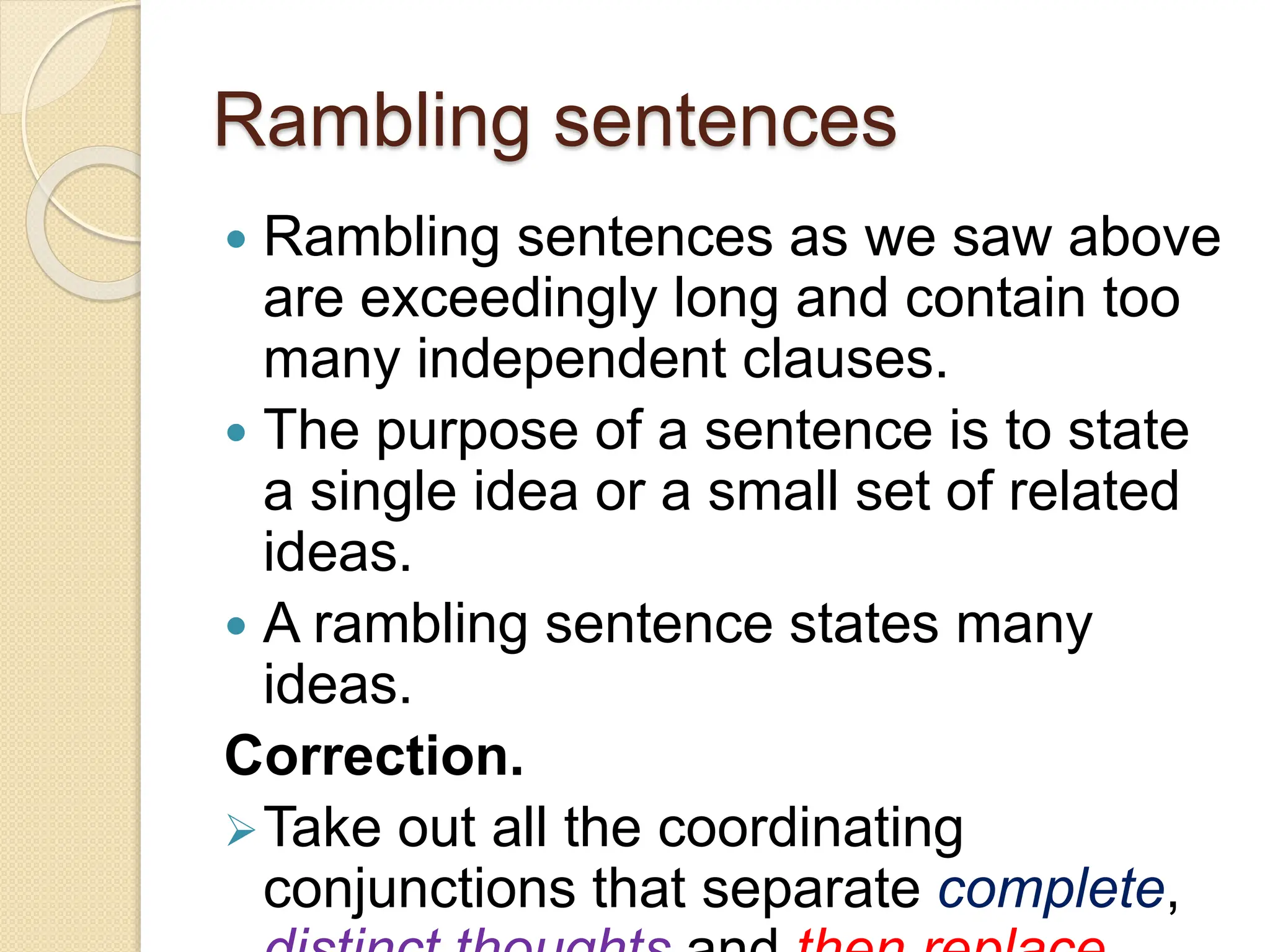
 Rambling sentences as we saw above
are exceedingly long and contain too
many independent clauses.
 The purpose of a sentence is to state
a single idea or a small set of related
ideas.
 A rambling sentence states many
ideas.
Correction.
Take out all the coordinating
conjunctions that separate complete,
Double subjects
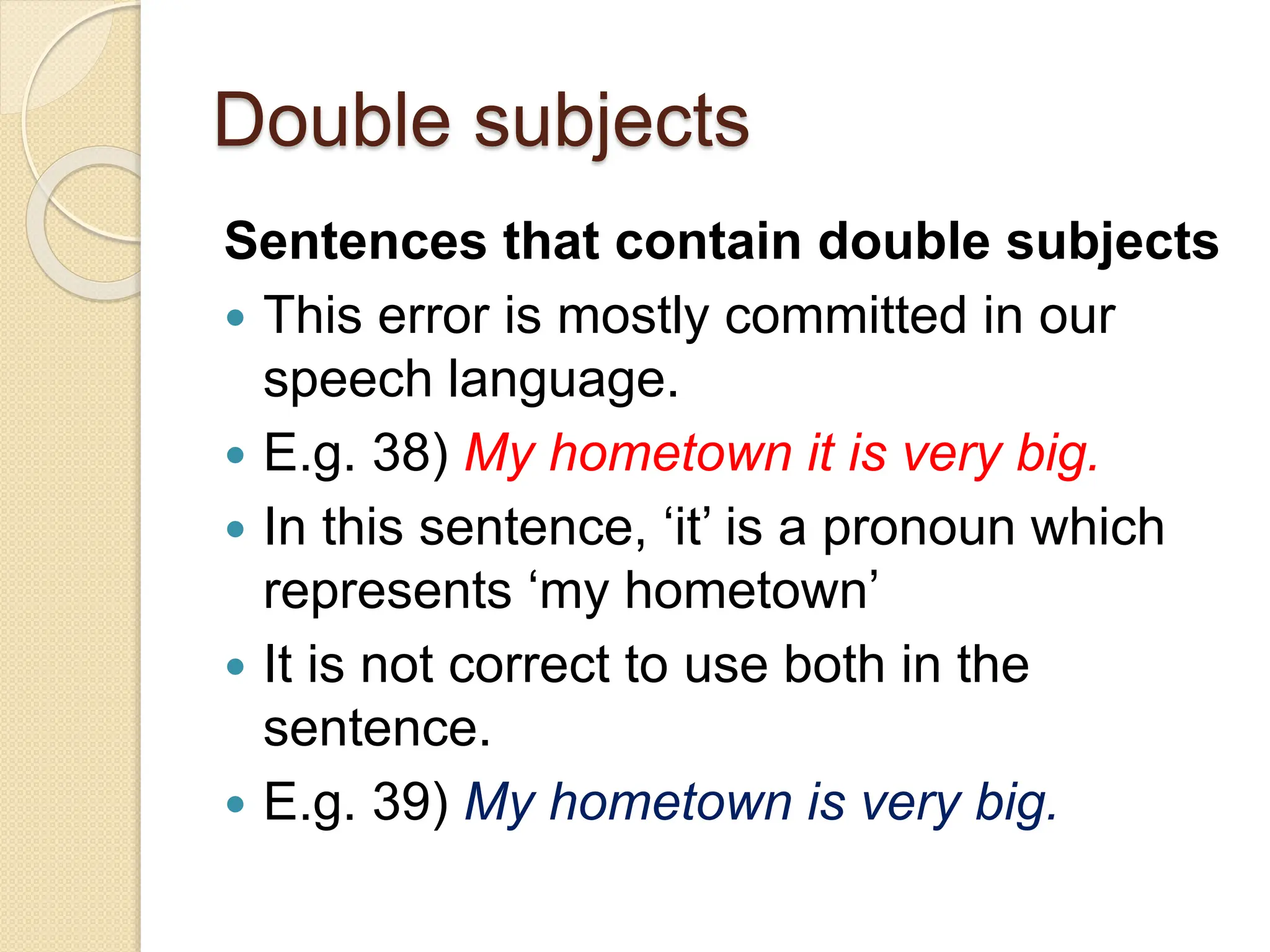
Sentences that contain double subjects
 This error is mostly committed in our
speech language.
 E.g. 38) My hometown it is very big.
 In this sentence, ‘it’ is a pronoun which
represents ‘my hometown’
 It is not correct to use both in the
sentence.
 E.g. 39) My hometown is very big.
Double subjects (Other
examples)
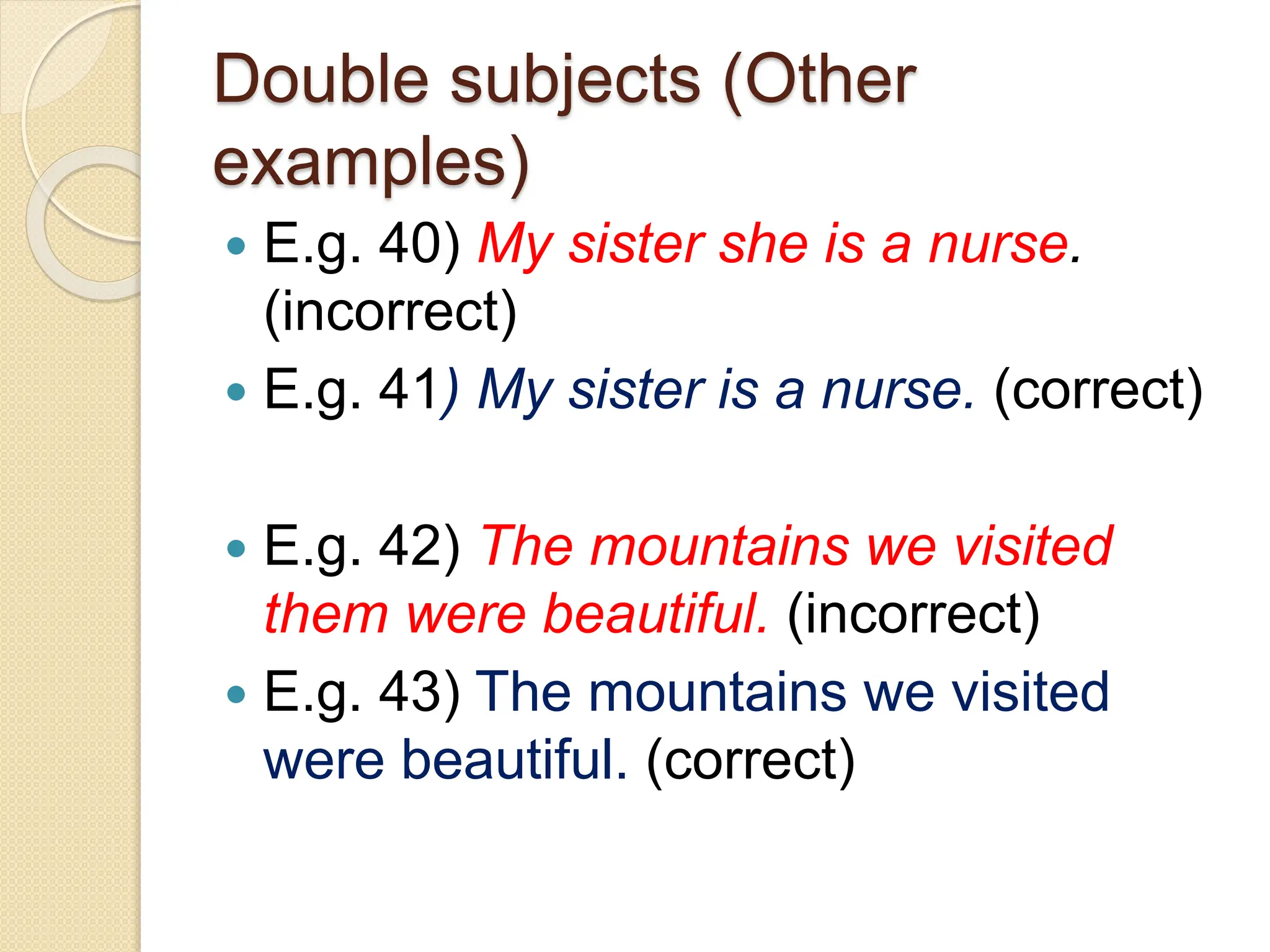
 E.g. 40) My sister she is a nurse.
(incorrect)
 E.g. 41) My sister is a nurse. (correct)
 E.g. 42) The mountains we visited
them were beautiful. (incorrect)
 E.g. 43) The mountains we visited
were beautiful. (correct)
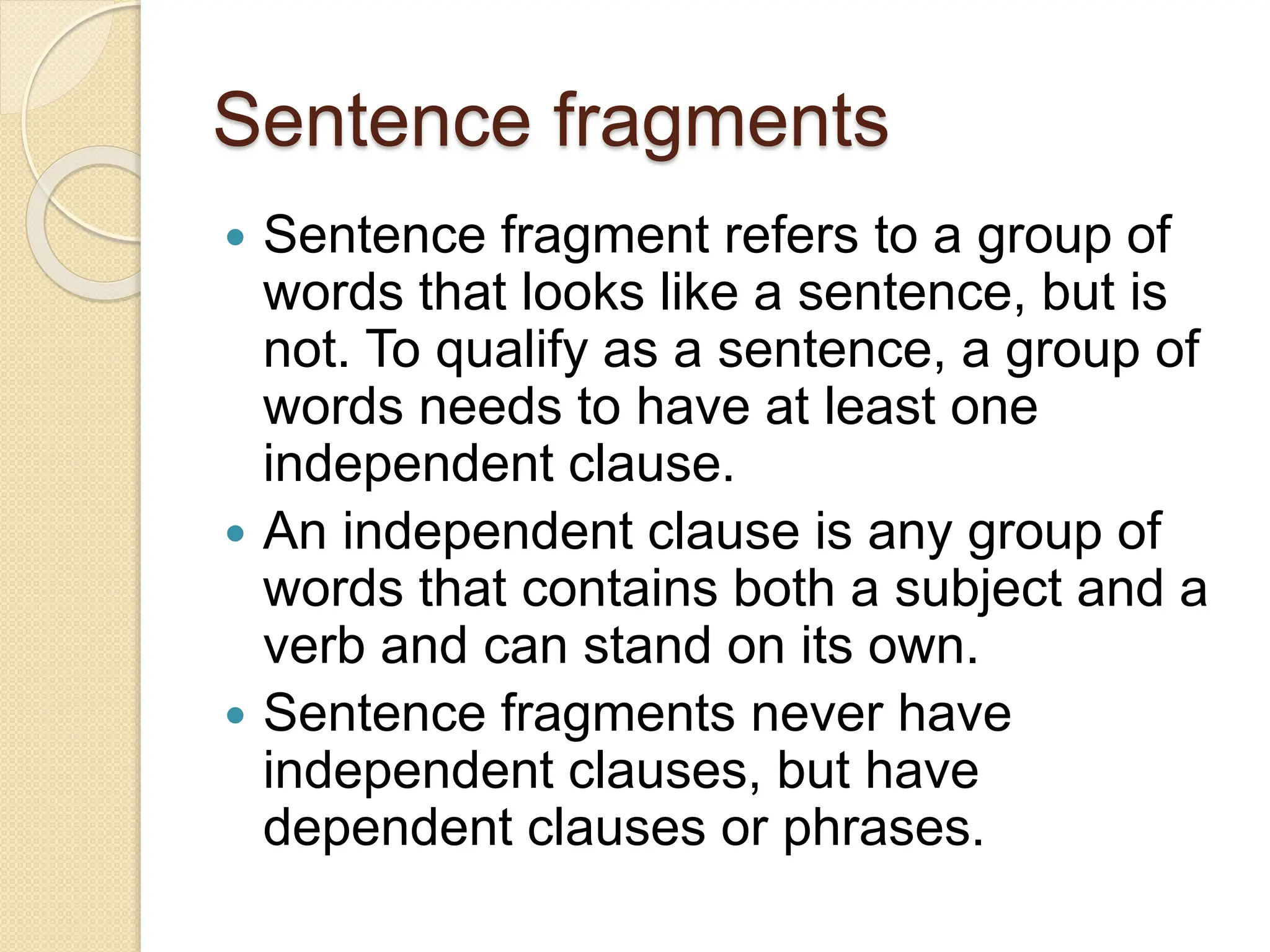
Sentence fragments
 Sentence fragment refers to a group of
words that looks like a sentence, but is
not. To qualify as a sentence, a group of
words needs to have at least one
independent clause.
 An independent clause is any group of
words that contains both a subject and a
verb and can stand on its own.
 Sentence fragments never have
independent clauses, but have
dependent clauses or phrases.
Sentence fragment
 They can look like real sentences
because they begin with a capital
letter and end with a period.
 Fragments do not form a complete
thought.
 A sentence fragment is like having
only half of the pieces to a puzzle.
Without all the pieces, you will not
have the whole picture.
Sentence fragment
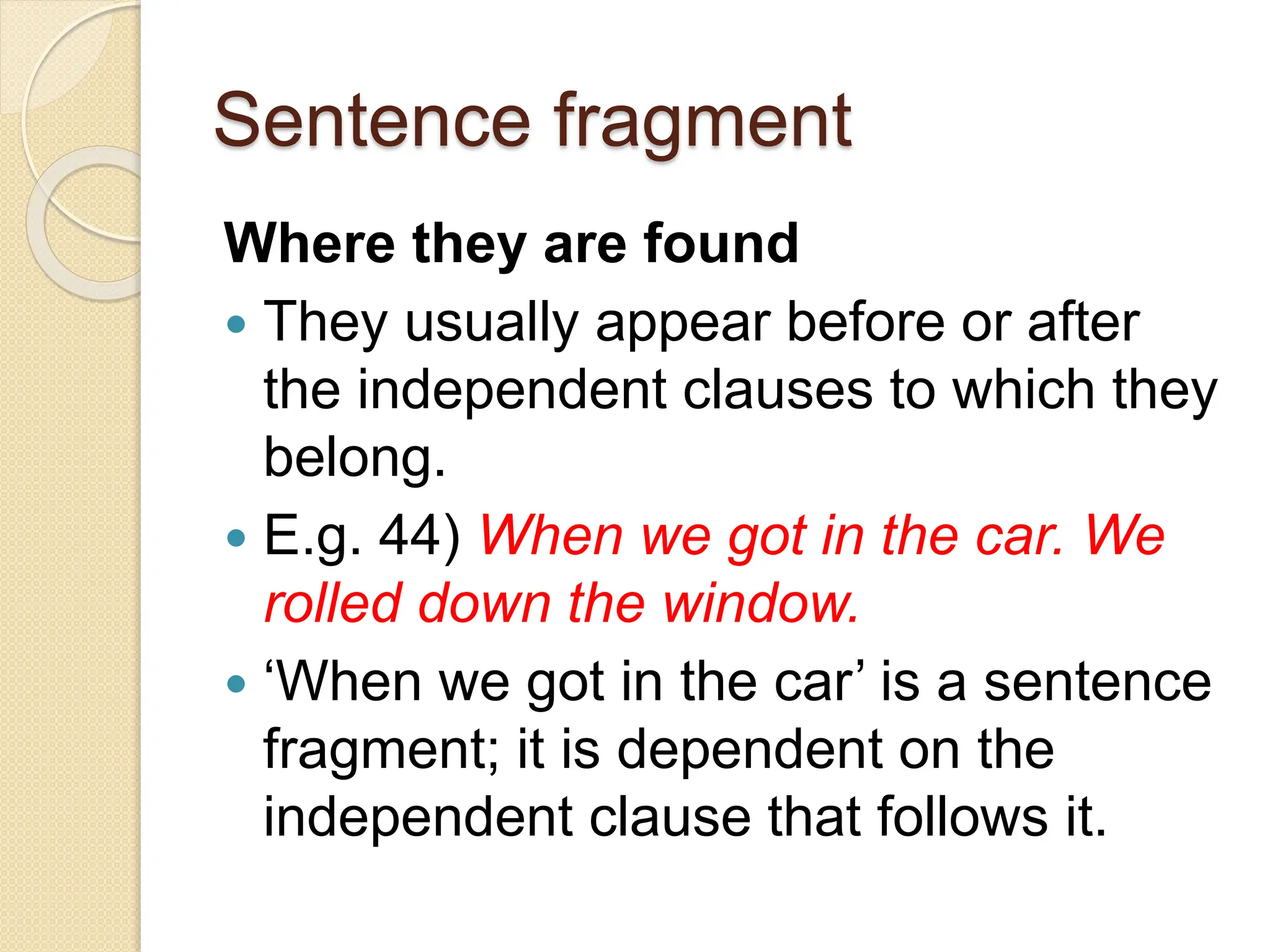
Where they are found
 They usually appear before or after
the independent clauses to which they
belong.
 E.g. 44) When we got in the car. We
rolled down the window.
 ‘When we got in the car’ is a sentence
fragment; it is dependent on the
independent clause that follows it.
Sentence fragment
Correction:
 E.g. 45) When we got in the car, we
rolled down the window. (correct)
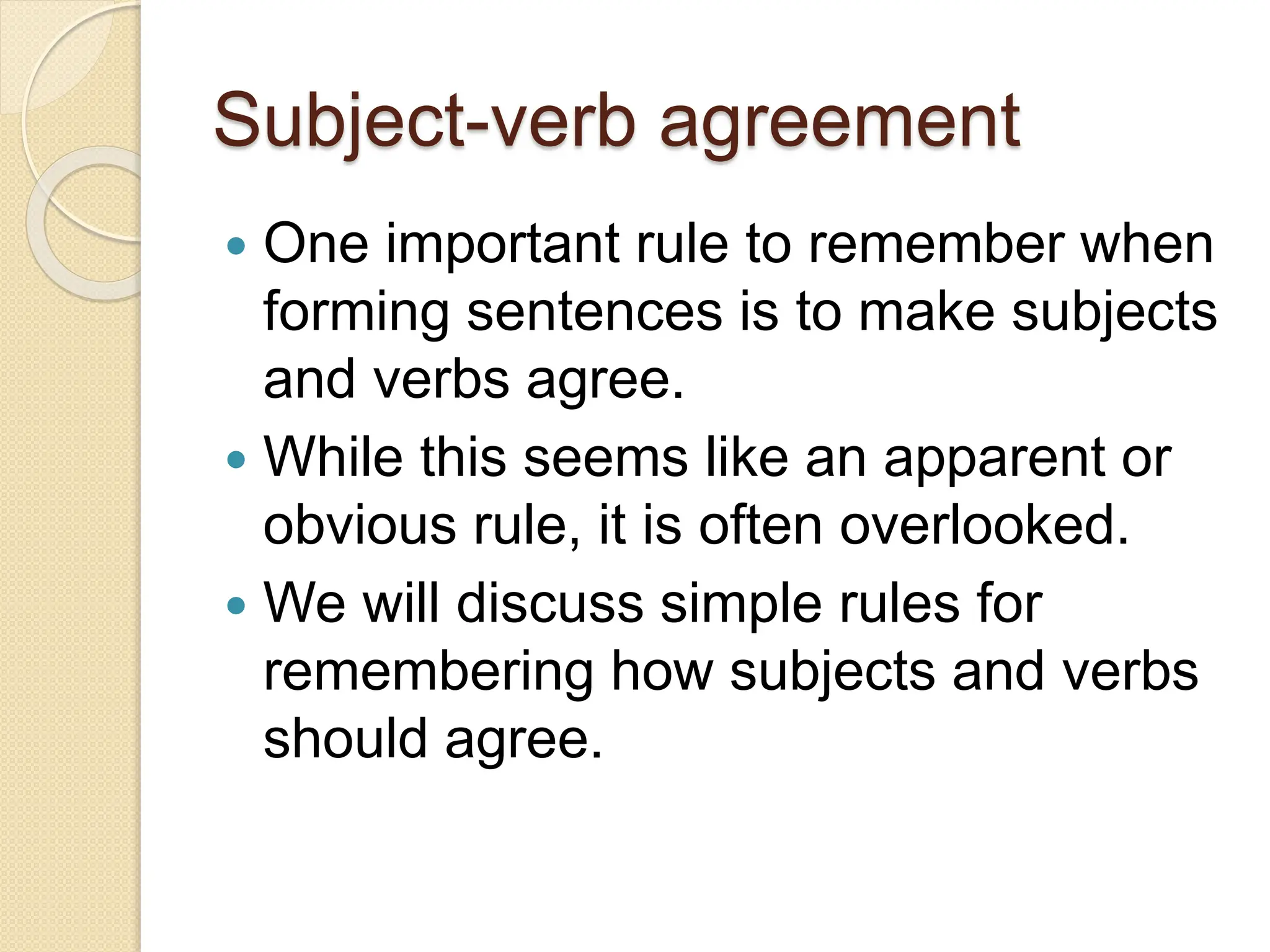
Subject-verb agreement
 One important rule to remember when
forming sentences is to make subjects
and verbs agree.
 While this seems like an apparent or
obvious rule, it is often overlooked.
 We will discuss simple rules for
remembering how subjects and verbs
should agree.
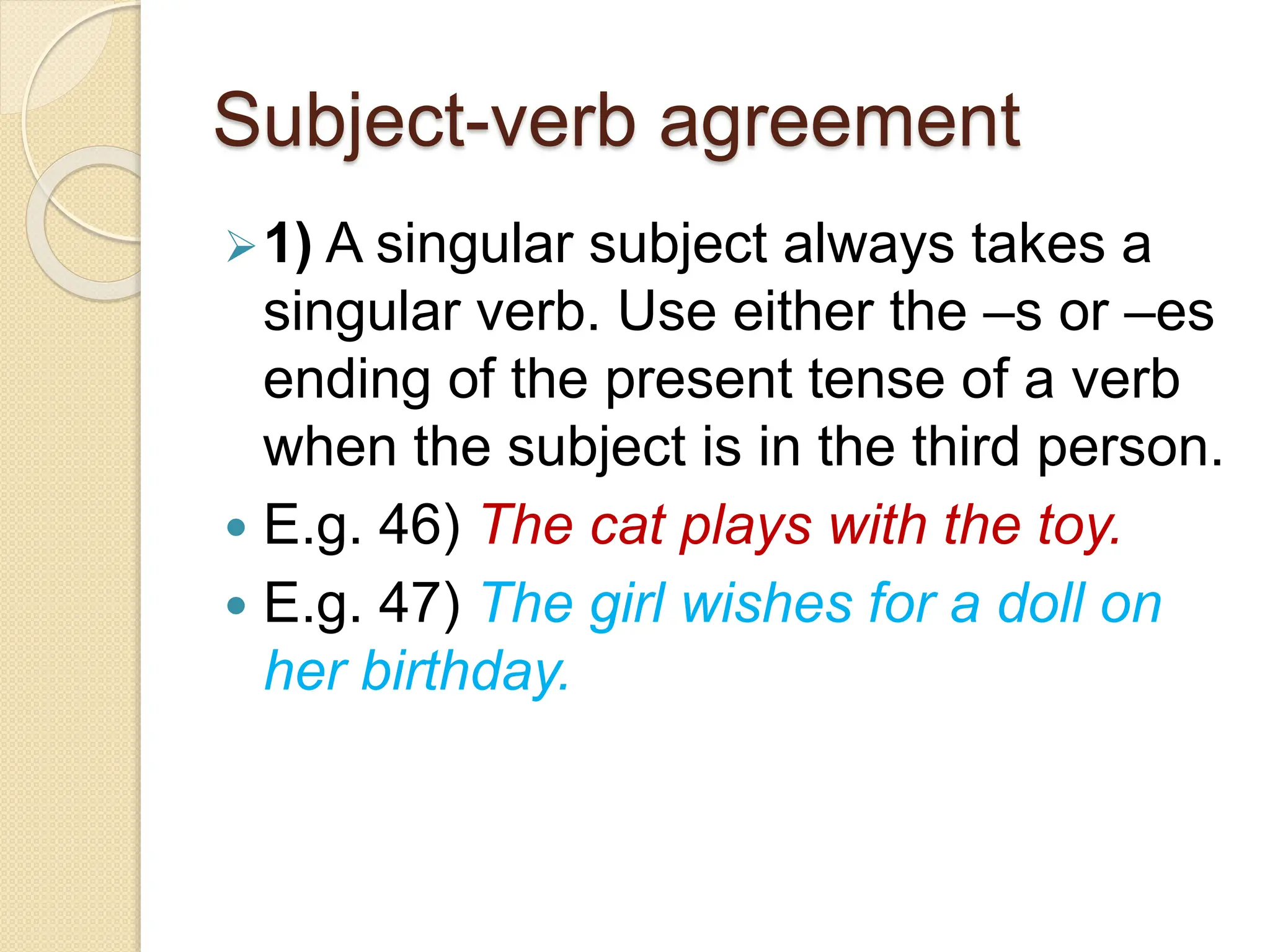
Subject-verb agreement
1) A singular subject always takes a
singular verb. Use either the –s or –es
ending of the present tense of a verb
when the subject is in the third person.
 E.g. 46) The cat plays with the toy.
 E.g. 47) The girl wishes for a doll on
her birthday.
Subject-verb agreement
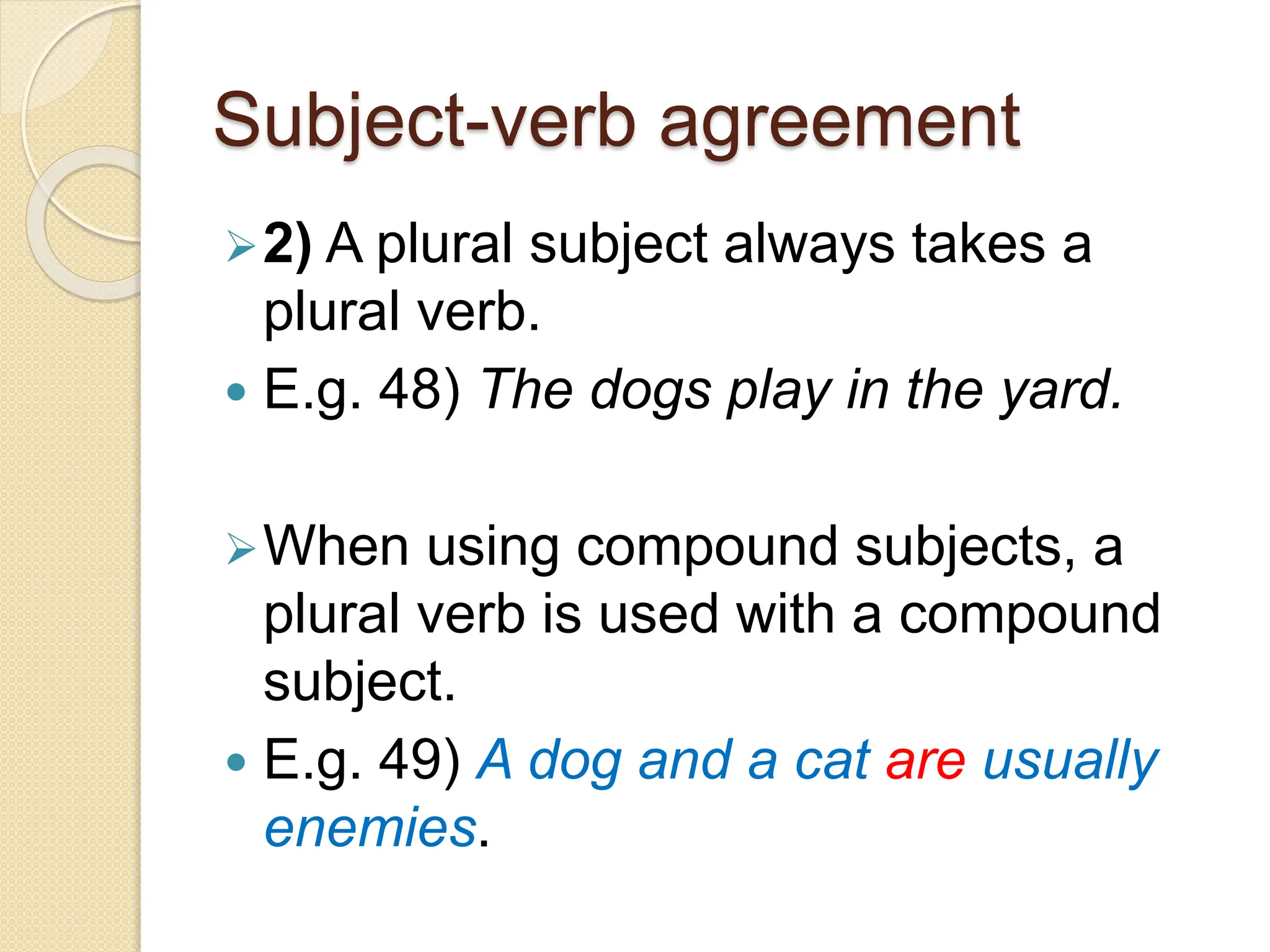
2) A plural subject always takes a
plural verb.
 E.g. 48) The dogs play in the yard.
When using compound subjects, a
plural verb is used with a compound
subject.
 E.g. 49) A dog and a cat are usually
enemies.
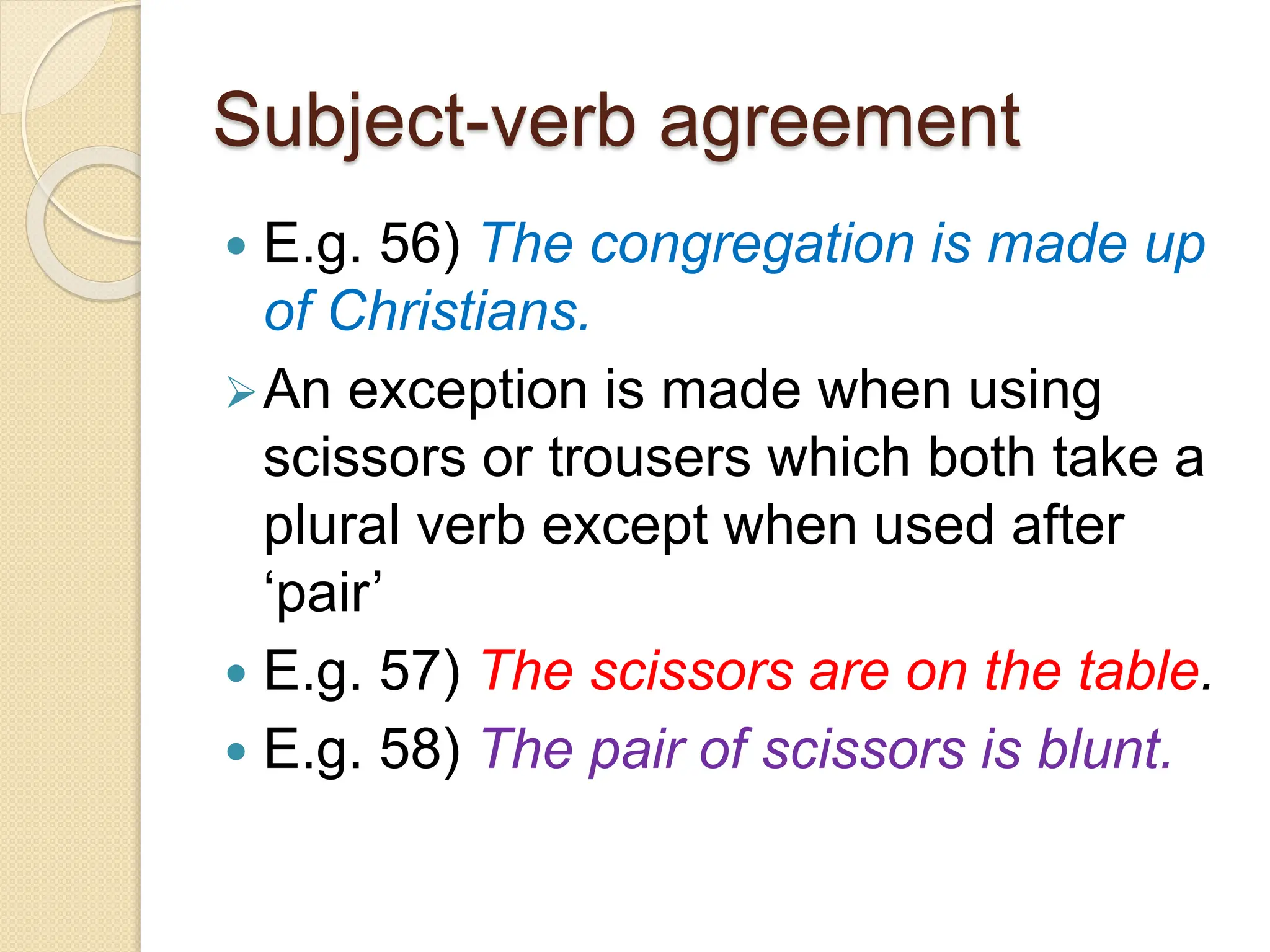
Subject-verb agreement
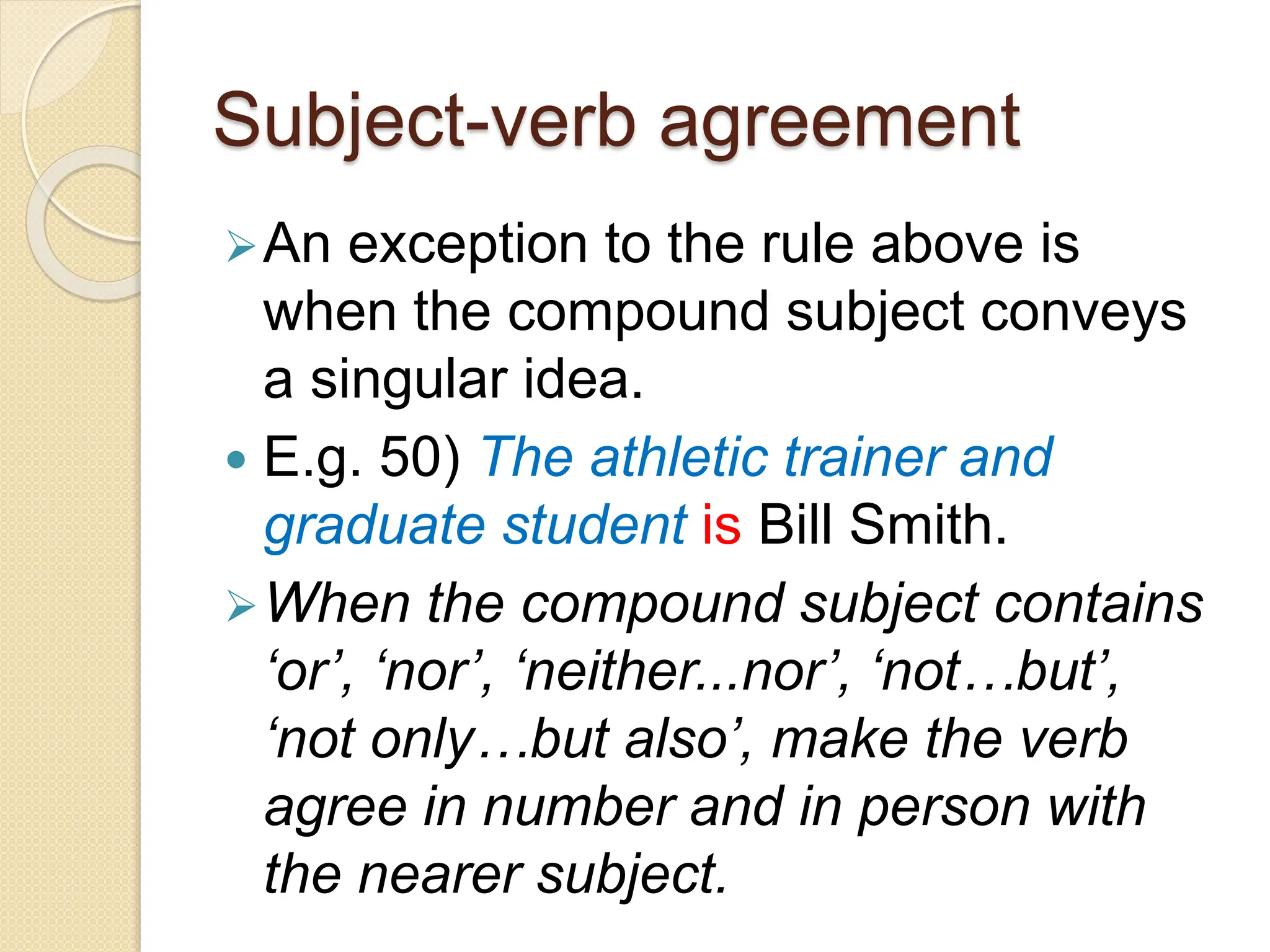
An exception to the rule above is
when the compound subject conveys
a singular idea.
 E.g. 50) The athletic trainer and
graduate student is Bill Smith.
When the compound subject contains
‘or’, ‘nor’, ‘neither...nor’, ‘not…but’,
‘not only…but also’, make the verb
agree in number and in person with
the nearer subject.
Subject-verb agreement
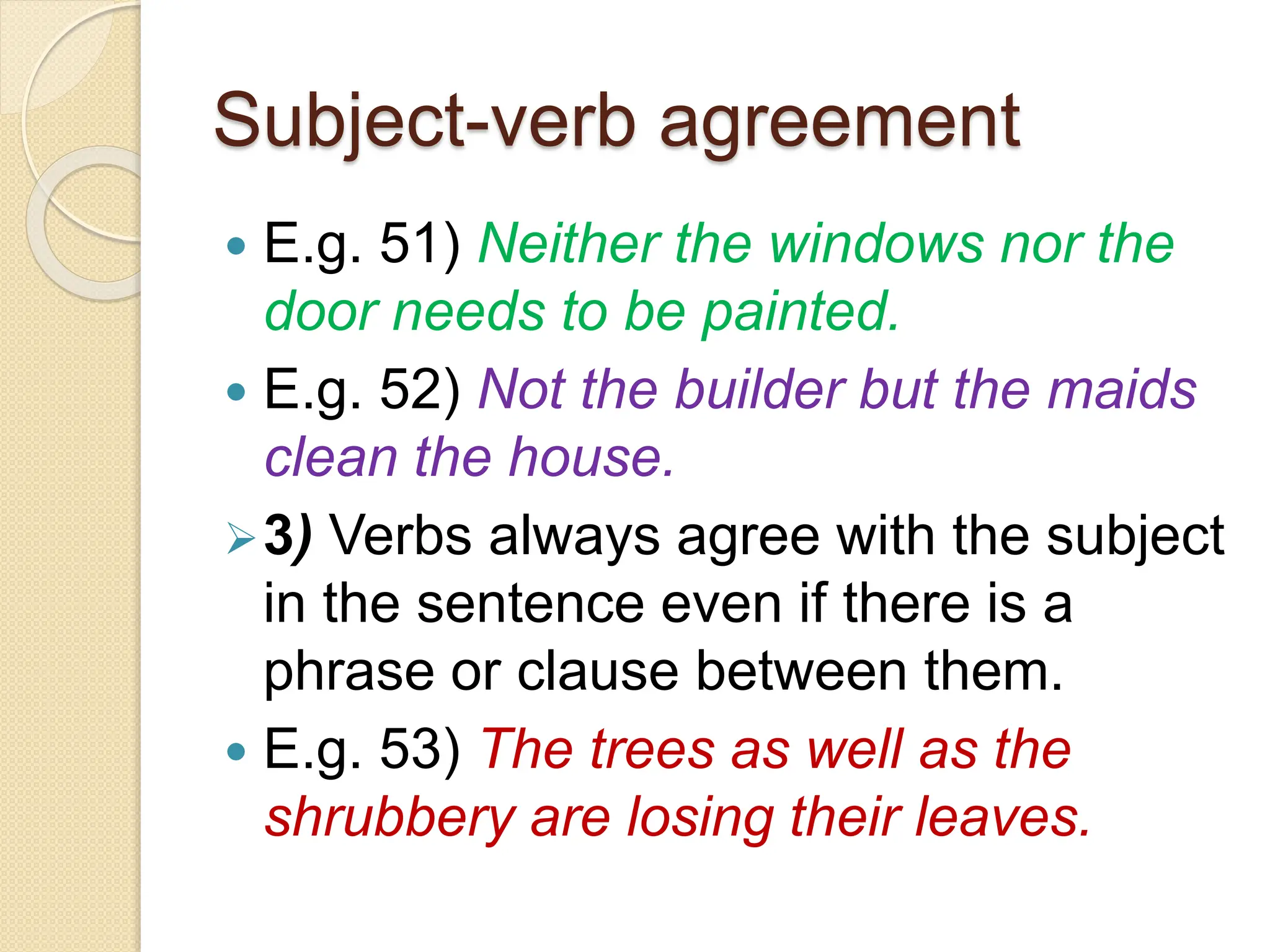
 E.g. 51) Neither the windows nor the
door needs to be painted.
 E.g. 52) Not the builder but the maids
clean the house.
3) Verbs always agree with the subject
in the sentence even if there is a
phrase or clause between them.
 E.g. 53) The trees as well as the
shrubbery are losing their leaves.
Subject-verb agreement
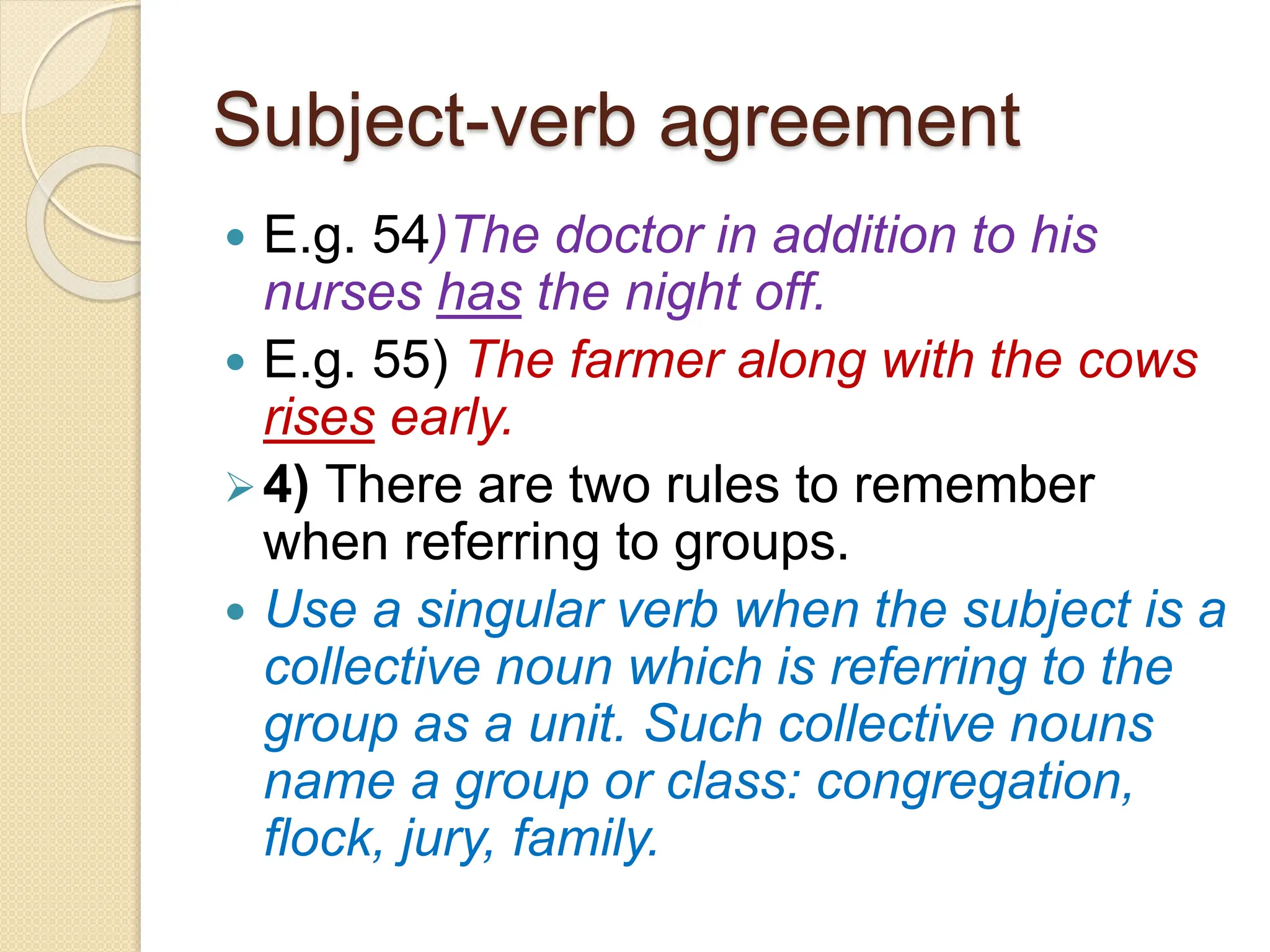
 E.g. 54)The doctor in addition to his
nurses has the night off.
 E.g. 55) The farmer along with the cows
rises early.
4) There are two rules to remember
when referring to groups.
 Use a singular verb when the subject is a
collective noun which is referring to the
group as a unit. Such collective nouns
name a group or class: congregation,
flock, jury, family.
Subject-verb agreement
 E.g. 56) The congregation is made up
of Christians.
An exception is made when using
scissors or trousers which both take a
plural verb except when used after
‘pair’
 E.g. 57) The scissors are on the table.
 E.g. 58) The pair of scissors is blunt.
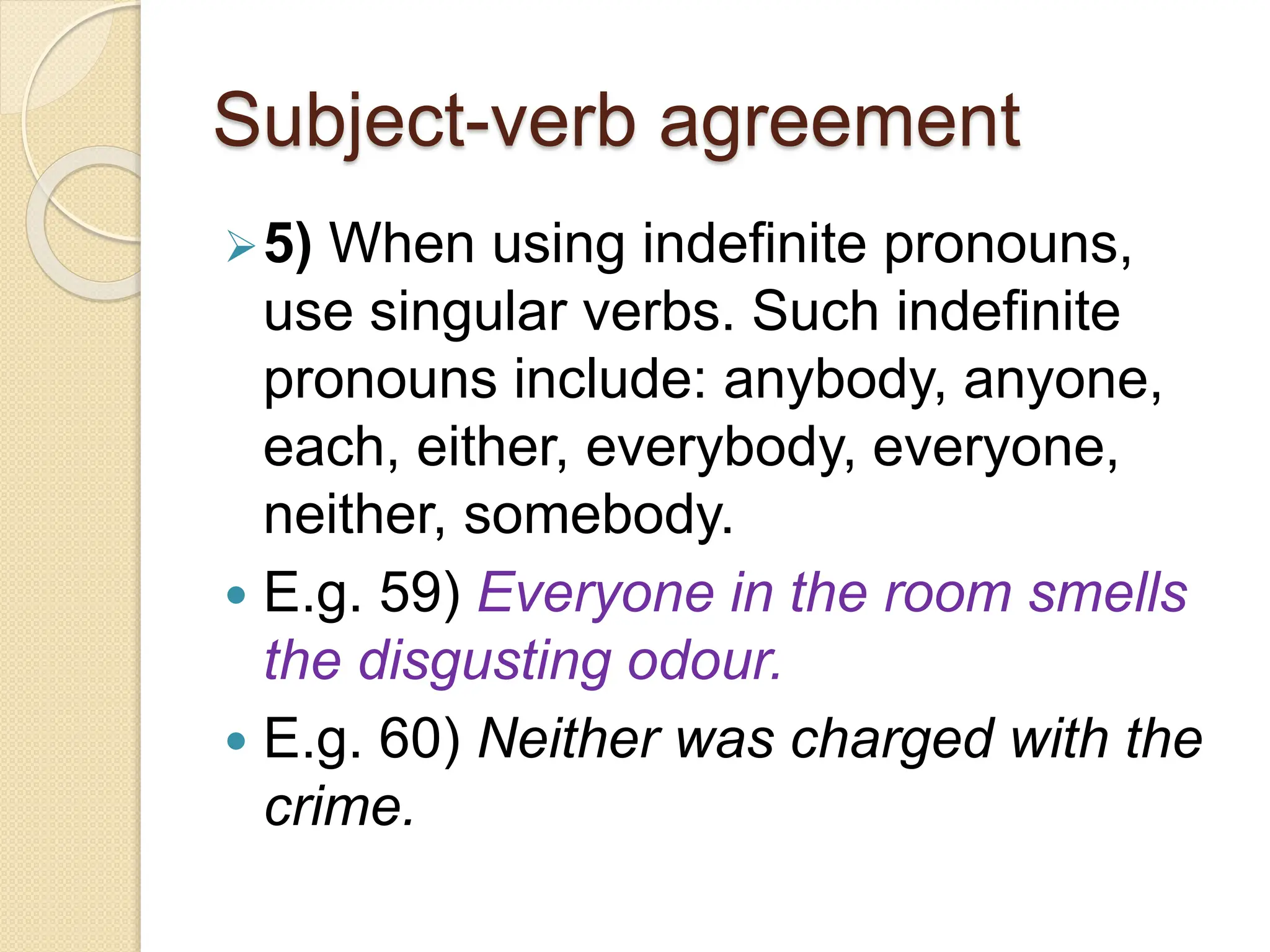
Subject-verb agreement
5) When using indefinite pronouns,
use singular verbs. Such indefinite
pronouns include: anybody, anyone,
each, either, everybody, everyone,
neither, somebody.
 E.g. 59) Everyone in the room smells
the disgusting odour.
 E.g. 60) Neither was charged with the
crime.
Parallel structure/parallelism
 The balance of two or more elements
in a sentence
 Elements in a sentence are parallel
when one construction (or one part of
speech) matches another: a phrase
and a phrase, a clause and a clause,
a verb and a verb, a noun and a noun
and so forth.
Parallel constructions
Parallel structures or constructions occur
with coordinating conjunctions. (and, or,
nor, but, yet)
Parallel constructions:
 E.g. 61) At University of Ghana, cheating
can result in suspension or even
expulsion from school.
Underlying Structure: At University of
Ghana, cheating can result in (noun) or
even (noun) from school.
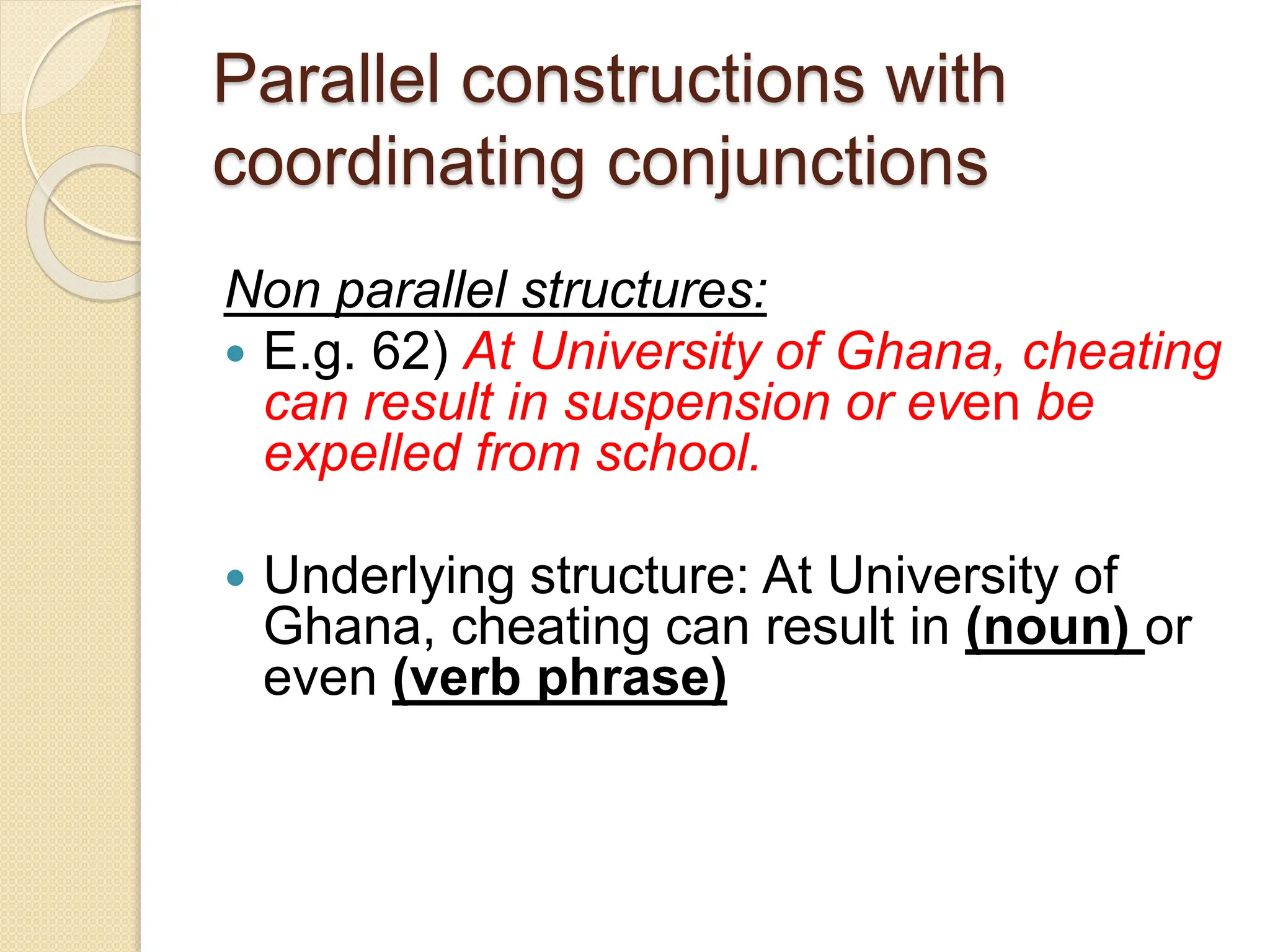
Parallel constructions with
coordinating conjunctions
Non parallel structures:
 E.g. 62) At University of Ghana, cheating
can result in suspension or even be
expelled from school.
 Underlying structure: At University of
Ghana, cheating can result in (noun) or
even (verb phrase)
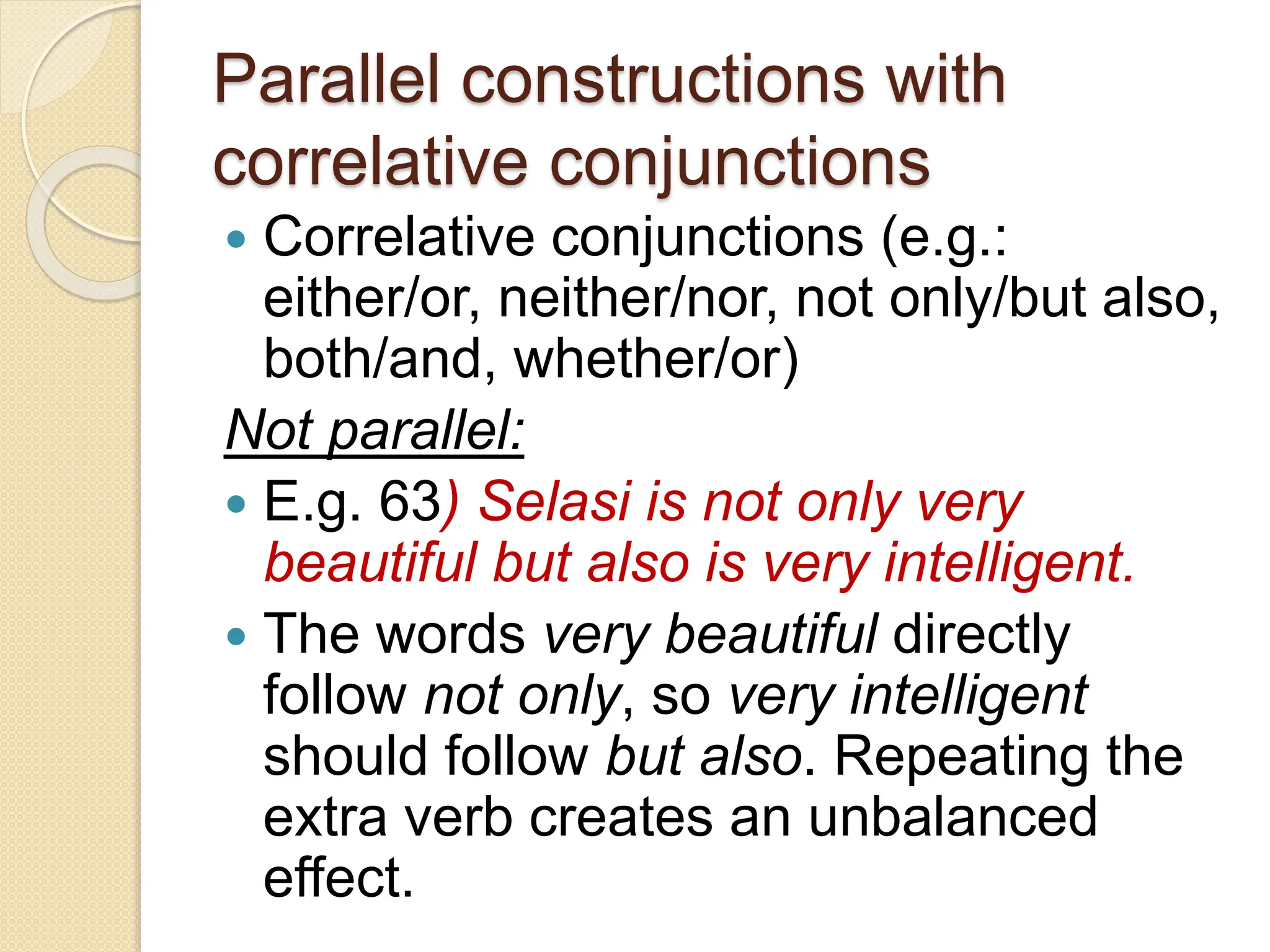
Parallel constructions with
correlative conjunctions
 Correlative conjunctions (e.g.:
either/or, neither/nor, not only/but also,
both/and, whether/or)
Not parallel:
 E.g. 63) Selasi is not only very
beautiful but also is very intelligent.
 The words very beautiful directly
follow not only, so very intelligent
should follow but also. Repeating the
extra verb creates an unbalanced
effect.
Parallel constructions with
correlative conjunctions
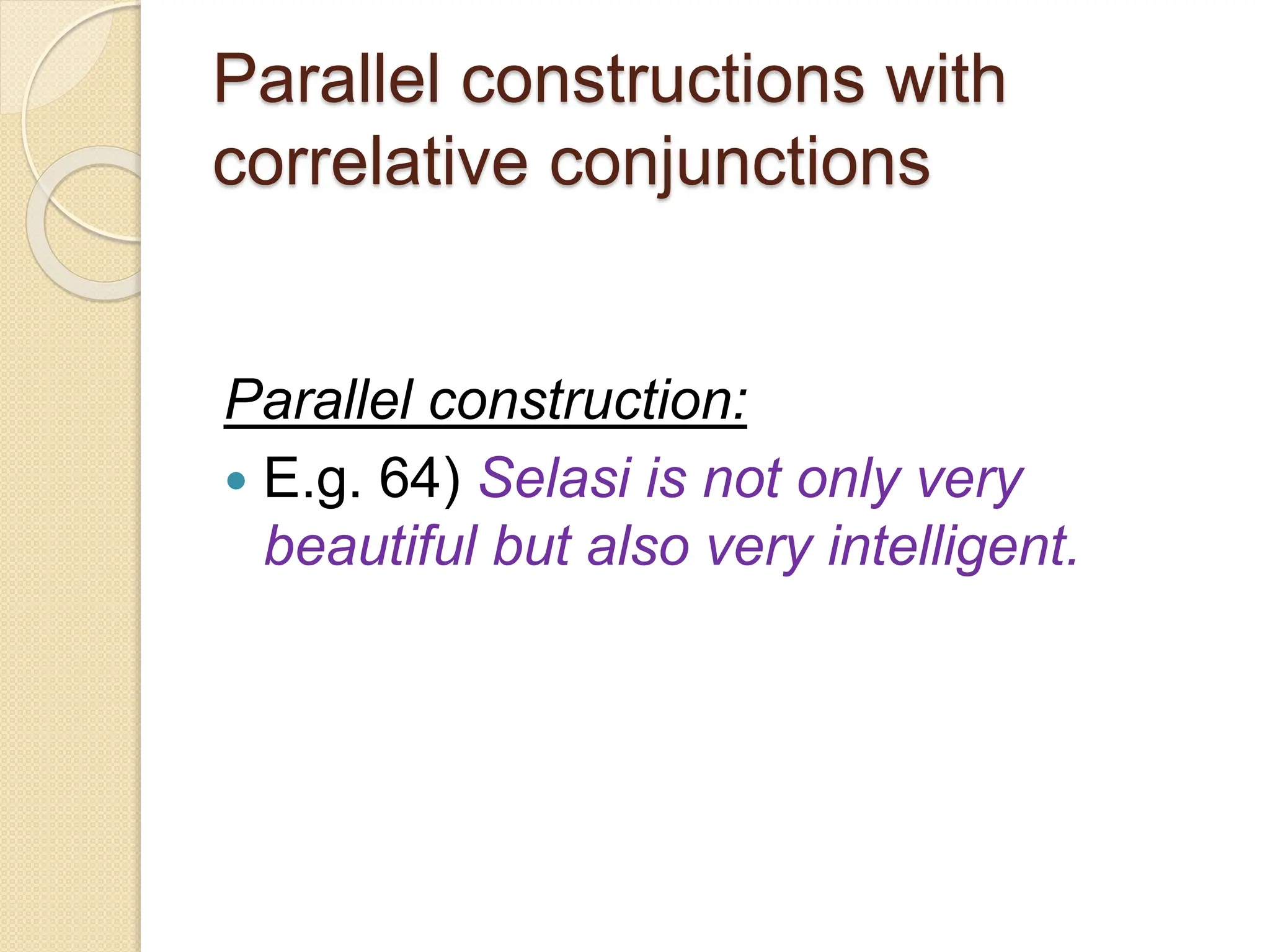
Parallel construction:
 E.g. 64) Selasi is not only very
beautiful but also very intelligent.
Parallel construction in a
series
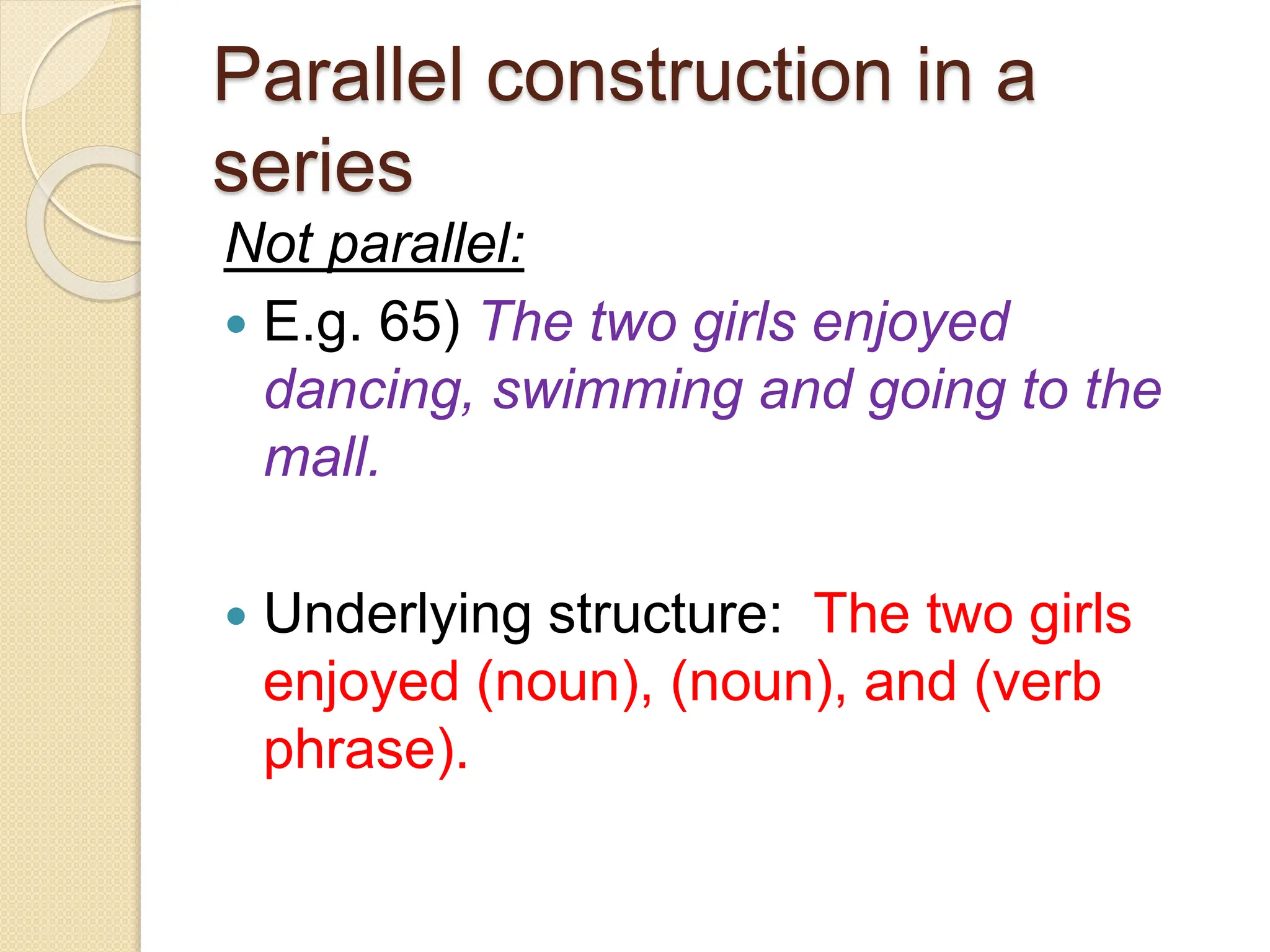
Not parallel:
 E.g. 65) The two girls enjoyed
dancing, swimming and going to the
mall.
 Underlying structure: The two girls
enjoyed (noun), (noun), and (verb
phrase).
Parallel construction in series
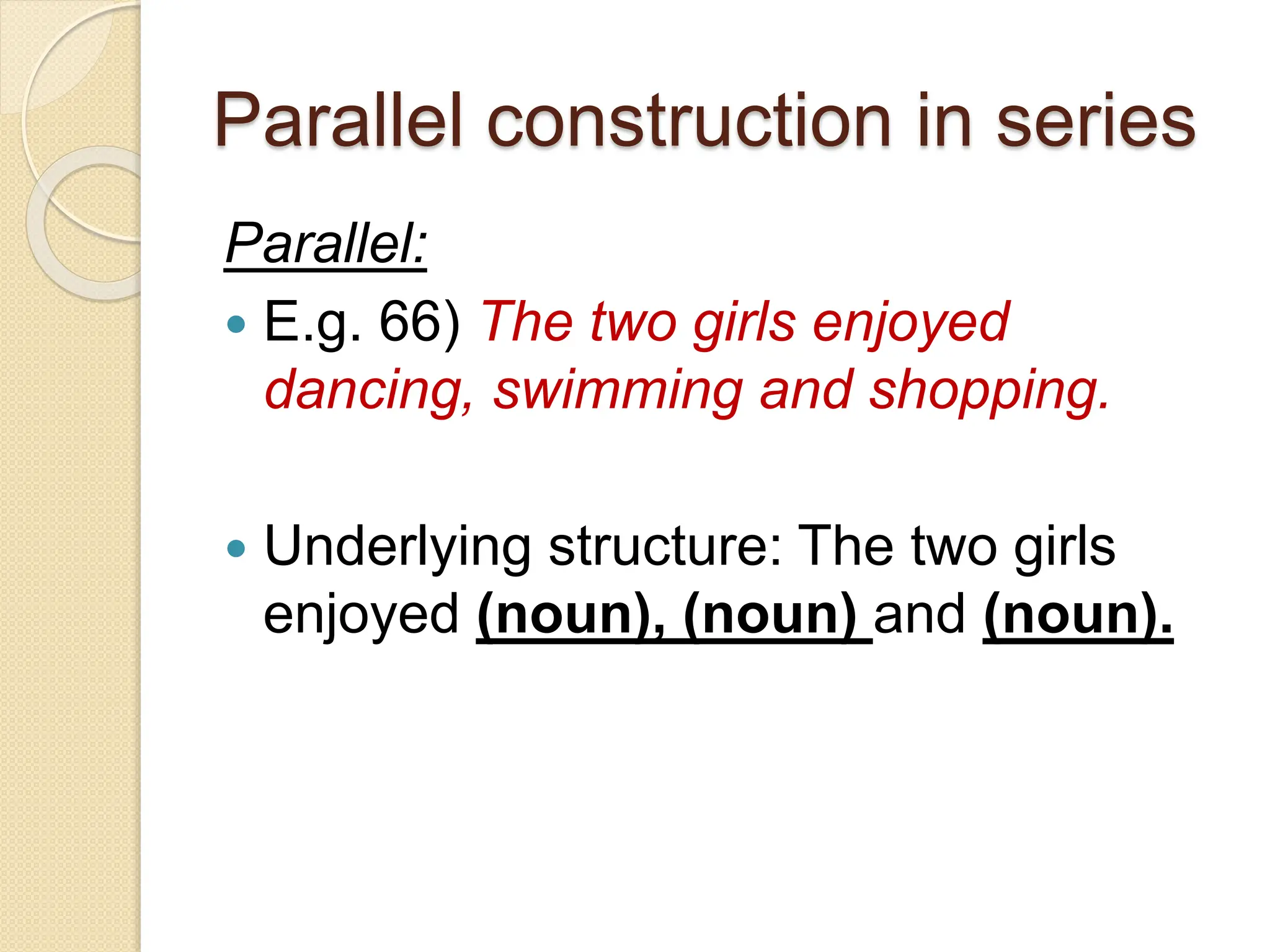
Parallel:
 E.g. 66) The two girls enjoyed
dancing, swimming and shopping.
 Underlying structure: The two girls
enjoyed (noun), (noun) and (noun).
Three-step method to parallelism
 What part of speech is being used? Is
it a noun, a verb or a phrase?
 In what form or tense does the part of
speech exist?
 How can I convert the items in the
sentence into the grammatical format?
Confusing words
Words that sound confusing
 Examples
 A) Accept / Except
 Accept is a verb meaning to receive.
 Except is usually a preposition that
denotes exclusion.
B) Affect / Effect
 Affect is a verb that means to influence
 Effect is either a noun meaning result or
it is a verb meaning to bring about.
Confusing words
(continuation)
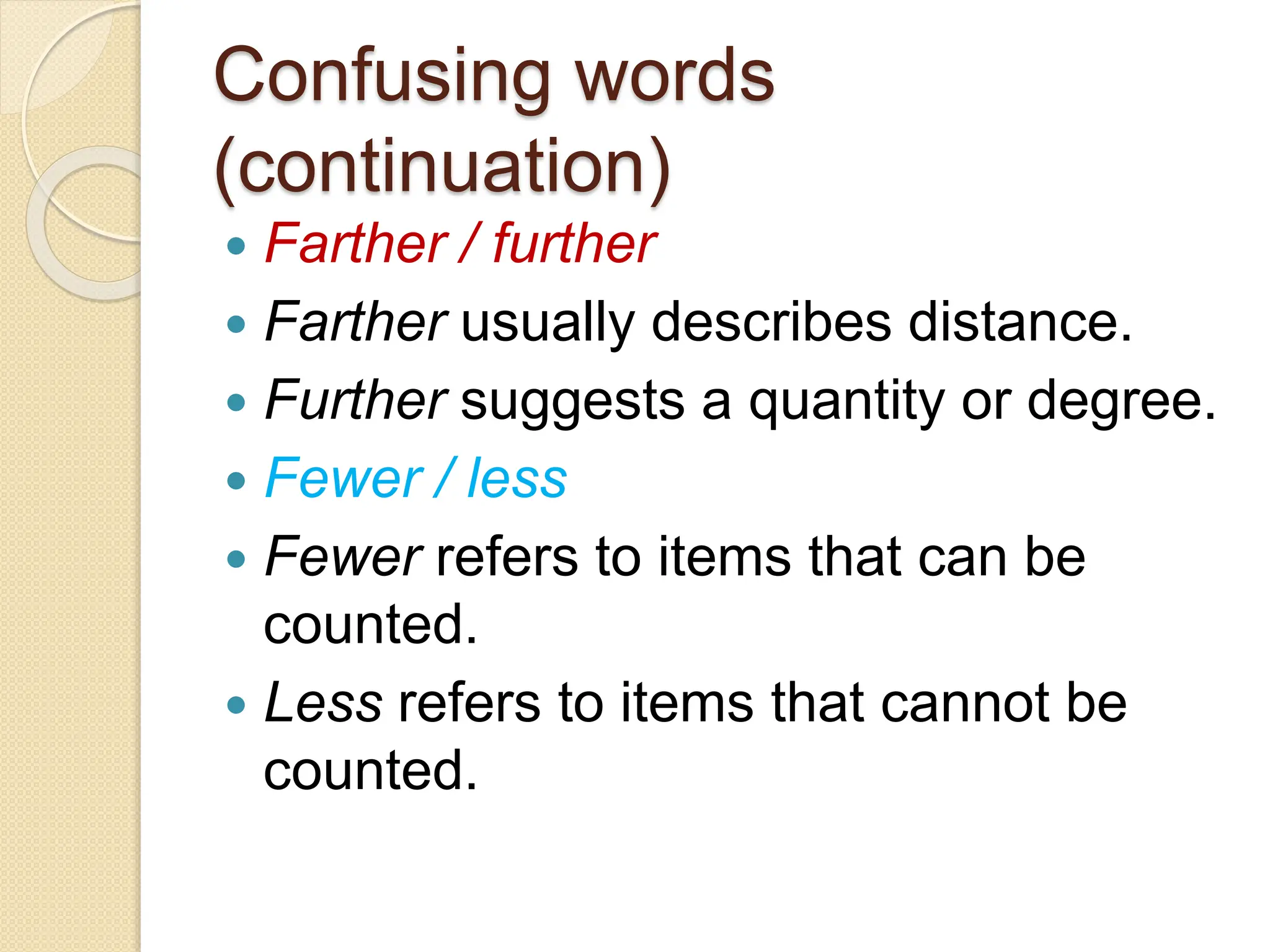
 Farther / further
 Farther usually describes distance.
 Further suggests a quantity or degree.
 Fewer / less
 Fewer refers to items that can be
counted.
 Less refers to items that cannot be
counted.
Confusing words
(continuation)
Who’s / whose
 Who’s is a contraction of ‘who is’.
 Whose is a possession pronoun.
Your / you’re
 Your is possessive
 You’re is a contraction of ‘you are’.
Loose / lose
 Loose is an adjective meaning ‘not
secure’.
 Lose is a verb meaning the opposite of
win. Lose also means ‘misplace’.
REFERENCES
 Adika, G. S. K. (2011). Deviant usage
and confusing words. Accra: Black
Mask.
 Quirk, R. & Greenbaum, S. (1973). A
university grammar of English.
Longman.
 http://www.canberra.edu.au/studyskills
/learningoral
 http://people.ucsc.edu/~pullum/golden
rules.html
 http://pne.people.si.umich.edu/PDF/ho

Academic writing and public speaking notes

  • 1.
    LECTURE 1 Overview ofGrammar: Deviant Usage and Common Errors Adika (2011); Bailey (2015, pages 142-146)
  • 2.
    DEVIANT USAGE ANDCOMMON ERRORS The use of words and expressions that depart from accepted practice. When such wrong usage become persistent the quality of your writing suffers. This lecture seeks to draw your attention to such errors with the view to helping you to avoid them.
  • 3.
    Outline  Misplaced modifiers Dangling modifiers  Comma splices  Split infinitives  Pronoun-antecedent agreement  Rambling sentences  Double subject  Sentence fragments  Parallel structures  Subject-verb agreement  Confusing words
  • 4.
    Misplaced modifiers  Amisplaced modifier is a word, phrase or clause that is improperly separated from the word it modifies or describes.  Simply put, a word or a phrase apparently modifying an unintended word because of its placement in a sentence.  Sentences with this error often sound awkward and confusing.
  • 5.
    Example:  E.g.1) Onher way home, Akosua found a gold man’s watch.  The sentence above would suggest that a gold man owns a watch.  Misplaced modifiers are usually corrected by moving the modifier to a more appropriate place in the sentence, generally next to the word it modifies.
  • 6.
    Example:  E.g. 2)On her way home, Akosua found a man’s gold watch.  The modifier ‘gold’ has now been placed next to the word it modifies, that is ‘watch’.  We can now say the modifier has been correctly placed.
  • 7.
    There are severalkinds of misplaced modifiers.  Misplaced adjectives  Misplaced adverbs  Misplaced phrases  Misplaced clauses
  • 8.
    Misplaced adjectives  Theyare incorrectly separated from the nouns they modify and almost always distort the intended meaning.  E.g. 3) Kweku ate a cold dish of cereal for breakfast.  The word ‘cold’ is a misplaced adjective that modifies the noun ‘dish’.
  • 9.
    Correction  The errorof a misplaced adjective is corrected by placing the adjective next to the noun it modifies.  E.g. 4) Kweku ate a bowl of cold cereal for breakfast.  The word ‘cold’ is now a correctly placed adjective that modifies ‘cereal’.  Sentences like these are common in everyday speech.
  • 10.
    Placement of adverbs Wrongly placed adverbs in a sentence can change the meaning of the sentence.  E.g. 5) We ate the lunch that we bought slowly. (incorrect)  This sentence suggests that ‘we bought lunch slowly’.
  • 11.
    Placement of adverbs (correction) To correct the meaning, move the adverb ‘slowly’ near or next to the verb ‘ate’.  E.g. 6) We slowly ate the lunch we bought. (correct)  Watch out for adverbs such as only, just, nearly, and almost. They are often misplaced and cause an unintended meaning.
  • 12.
    Misplaced phrases  Thismay cause a sentence to sound awkward and may create a meaning that does not make sense.  E.g. 7) Adwoa sold the food to ‘the customer with fresh meat’.  This sentence implies that the customer has a skin made of fresh meat or…  To clarify the meaning, put the phrase next to the noun they are supposed to modify.
  • 13.
    Misplaced phrases (correction)  E.g.8) Adwoa sold the ‘food with fresh meat’ to the customer.  The dealer sold the Cadillac to ‘the buyer with leather seats’. (incorrect)  The dealer sold ‘the cadillac with leather seats’ to the buyer. (correct)
  • 14.
    Dangling modifiers  Whena modifier occurs without the item that it modifies, it is referred to as a dangling modifier.  That is, the item to be modified is missing from the clause or sentence.
  • 15.
    Dangling modifiers  E.g.9) When nine years old, my mother enrolled in medical school. ‘When nine years old’ is a dangling modifier.  Eg 10) Walking to the movies, the cloudburst drenched Jim. This sentence suggests that ‘the cloudburst is walking to the movies’ even though a possible walker Jim is mentioned.
  • 16.
    How to correctdangling modifiers.  Dangling modifiers can be corrected in two general ways. Correction method 1  Leave the modifier as it is.  Change the main part of the sentence so that it begins with the term actually modified.  This change will put the modifier next to the term it modifies.
  • 17.
    Dangling modifiers  E.g.11) Walking to the movies, the cloudburst drenched Jim. (incorrect)  E.g. 12) Walking to the movies, Jim was drenched by the cloudburst. (correct)
  • 18.
    Dangling modifiers Correction method2  Change the dangling modifier phrase to a subordinate clause, creating a subject and verb.  Leave the rest of the sentence as it is.  E.g. 13) When nine years old, my mother enrolled in medical school. (incorrect)  E.g. 14) When I was nine years old, my mother enrolled in medical school.(correct)
  • 19.
    Comma splices  Twosentences or independent clauses that are incorrectly joined by a comma.  E.g. 15) The internet has made the world smaller, you can meet people everywhere.
  • 20.
    Three options forcomma splice revision  A) Use a comma and a coordinating conjunction (and, or, nor, so, yet etc.).  E.g. 16) The internet has made the world smaller, so you can meet people everywhere.  B) Use a semicolon.  E.g. 17) The internet has made the world smaller; you can meet people everywhere.
  • 21.
    Comma splices ( continuation) C) Treat the clauses as separate sentences.  E.g. 18) The internet has made the world smaller. You can meet people everywhere.
  • 22.
    Split infinitives  Asplit infinitive is a grammatical construction in which a word or phrase divides the to and the bare infinitive verb.  The infinitive of a verb is the form given in the dictionary where no specific subject is indicated. In English, it is always characterized by the word ‘to’. E.g., to play, to bribe, to eat, to find, to laugh.
  • 23.
    Split infinitives (continuation) A split infinitive occurs when the ‘to’ is separated from its verb by other words.  Usually, it is sufficient to move the offending word so it comes either before or after the infinitive.  E.g. 19) Kwame’s teacher told him to never look back. (incorrect)  E.g. 20) Kwame’s teacher told him never to look back. (correct)
  • 24.
    Split infinitives examples E.g. 21) She told me I had to quickly finish the sandwich. (incorrect)  E.g. 22) she told me I had to finish the sandwich quickly. (correct)  E.g. 23) I was told to always pay attention in class. (incorrect)  E.g. 24) I was told always to pay attention in class. (correct)
  • 25.
    Clear pronoun reference A pronoun is a word used to stand for or take the place of a noun.  A pronoun should refer clearly to one, unmistakable noun coming before the pronoun. This is called pronoun antecedent.  It is very easy to create a sentence that uses a pronoun without a clear, unmistakable noun antecedent.
  • 26.
    Clear pronoun reference (E.g.) E.g. 25) After putting the disk in the cabinet, Kwame sold it.  The pronoun ‘it’ does not have a clear noun antecedent.  As a result, the reader cannot know for sure whether Kwame sold the disk or the cabinet.  Such errors, called faulty or vague pronoun reference can confuse readers and obscure intended meaning.
  • 27.
    Clear pronoun reference There are three major pronoun reference errors: Too many antecedents Hidden antecedents No antecedent at all.
  • 28.
    Too many antecedents A pronoun should have only one antecedent. The antecedent should be clear and unmistakable.  E.g. 25) Take the radio out of the car and fix it.  Anyone who reads this sentence would not know exactly which item to be fixed.  In the above example, faulty or vague pronoun reference occurs because the pronoun ‘it’ has two possible noun antecedents.
  • 29.
    Too many antecedents Tofix the problem: A) Substitute a noun for the pronoun and B) Rephrase the sentence.  E.g. 26) Take the radio out of the car and fix the radio. Or  E.g. 27) Take the radio out of the car and fix the car.
  • 30.
    Hidden antecedents  Faultypronoun reference errors also occur when the pronoun’s antecedent functions as an adjective rather than a noun.  In such cases, the true antecedent is hidden or obscured from the reader because it has been subordinated to another noun.
  • 31.
    Hidden antecedents (E.g.) E.g. 28) The fufu dish was empty, but we were tired of eating it anyway.  We might think that the fufu dish was being eaten because ‘dish’ appears to be the antecedent for the pronoun ‘it’.  E.g. 29) The fufu dish was empty, but we were tired of eating fufu anyway.
  • 32.
    Pronoun antecedents  Apronoun can fall either before or after the noun it refers to. If the pronoun comes afterward, the noun it refers to is called the antecedent. The antecedent of any sentence must be clear for readers to easily comprehend.
  • 33.
    Errors relating topronoun antecedents.  Ambiguous pronouns  Absent antecedents  Loose antecedents
  • 34.
    Ambiguous pronouns  Oneerror is using a pronoun when the antecedent is unclear.  E.g. 30) Akosua discussed the new strategy with Jill. She decided to proceed as planned. Who decided to proceed as planned?  E.g. 31) After she discussed the new strategy with Jill, Akosua decided to proceed as planned.
  • 35.
    Absent antecedents  E.g.32) Kojo says the course is fun to teach because it’s small, and they are motivated.  ‘they’ presumably refers to students, but the antecedent noun is absent.  E.g. 33) Kojo says the course is fun to teach, because it’s small and the students are motivated. (correct)
  • 36.
    Loose antecedents  Acommon pronoun reference error is having a pronoun such as ‘this’, ‘that’, ‘it’ or ‘which’, referring loosely to an idea expressed, rather than to a specific noun.  E.g. 34) The company concealed financial losses. This caused investors to damp the stock.  E.g. 35) The company concealed financial losses. That caused investors to dump the stock.
  • 37.
    Loose antecedents  E.g.36) The company concealed financial losses. It caused investors to dump the stock.  In these sentences, note the lack of specific antecedent noun for ‘this’, ‘that’, and ‘it’  Corrected.  The company concealed financial losses. This accounting fraud caused investors to dump the stock.  The pronoun ‘this’ clearly refers to the noun ‘fraud’.
  • 38.
    Rambling sentences  Ramblingsentences are sentences that contain several clauses connected by coordinating conjunctions such as ‘and’, ‘or’, ‘but’, ‘yet’, ‘nor’, and ‘so’.  A rambling sentence may appear to follow the technical rules of grammar but the sentence as a whole is wrong because it rambles or runs-on.
  • 39.
    Rambling sentences  E.g.37) I wanted to eat fried rice but I realised that my money wasn’t enough so I thought about buying yam but then I realised that I didn’t feel like eating yam but I felt like eating rice so I walked back to my hostel for some money and I then realised that I had left my key in school so I was confused so I was very hungry and I didn’t know what to do.
  • 40.
    Rambling sentences  Ramblingsentences as we saw above are exceedingly long and contain too many independent clauses.  The purpose of a sentence is to state a single idea or a small set of related ideas.  A rambling sentence states many ideas. Correction. Take out all the coordinating conjunctions that separate complete,
  • 41.
    Double subjects Sentences thatcontain double subjects  This error is mostly committed in our speech language.  E.g. 38) My hometown it is very big.  In this sentence, ‘it’ is a pronoun which represents ‘my hometown’  It is not correct to use both in the sentence.  E.g. 39) My hometown is very big.
  • 42.
    Double subjects (Other examples) E.g. 40) My sister she is a nurse. (incorrect)  E.g. 41) My sister is a nurse. (correct)  E.g. 42) The mountains we visited them were beautiful. (incorrect)  E.g. 43) The mountains we visited were beautiful. (correct)
  • 43.
    Sentence fragments  Sentencefragment refers to a group of words that looks like a sentence, but is not. To qualify as a sentence, a group of words needs to have at least one independent clause.  An independent clause is any group of words that contains both a subject and a verb and can stand on its own.  Sentence fragments never have independent clauses, but have dependent clauses or phrases.
  • 44.
    Sentence fragment  Theycan look like real sentences because they begin with a capital letter and end with a period.  Fragments do not form a complete thought.  A sentence fragment is like having only half of the pieces to a puzzle. Without all the pieces, you will not have the whole picture.
  • 45.
    Sentence fragment Where theyare found  They usually appear before or after the independent clauses to which they belong.  E.g. 44) When we got in the car. We rolled down the window.  ‘When we got in the car’ is a sentence fragment; it is dependent on the independent clause that follows it.
  • 46.
    Sentence fragment Correction:  E.g.45) When we got in the car, we rolled down the window. (correct)
  • 47.
    Subject-verb agreement  Oneimportant rule to remember when forming sentences is to make subjects and verbs agree.  While this seems like an apparent or obvious rule, it is often overlooked.  We will discuss simple rules for remembering how subjects and verbs should agree.
  • 48.
    Subject-verb agreement 1) Asingular subject always takes a singular verb. Use either the –s or –es ending of the present tense of a verb when the subject is in the third person.  E.g. 46) The cat plays with the toy.  E.g. 47) The girl wishes for a doll on her birthday.
  • 49.
    Subject-verb agreement 2) Aplural subject always takes a plural verb.  E.g. 48) The dogs play in the yard. When using compound subjects, a plural verb is used with a compound subject.  E.g. 49) A dog and a cat are usually enemies.
  • 50.
    Subject-verb agreement An exceptionto the rule above is when the compound subject conveys a singular idea.  E.g. 50) The athletic trainer and graduate student is Bill Smith. When the compound subject contains ‘or’, ‘nor’, ‘neither...nor’, ‘not…but’, ‘not only…but also’, make the verb agree in number and in person with the nearer subject.
  • 51.
    Subject-verb agreement  E.g.51) Neither the windows nor the door needs to be painted.  E.g. 52) Not the builder but the maids clean the house. 3) Verbs always agree with the subject in the sentence even if there is a phrase or clause between them.  E.g. 53) The trees as well as the shrubbery are losing their leaves.
  • 52.
    Subject-verb agreement  E.g.54)The doctor in addition to his nurses has the night off.  E.g. 55) The farmer along with the cows rises early. 4) There are two rules to remember when referring to groups.  Use a singular verb when the subject is a collective noun which is referring to the group as a unit. Such collective nouns name a group or class: congregation, flock, jury, family.
  • 53.
    Subject-verb agreement  E.g.56) The congregation is made up of Christians. An exception is made when using scissors or trousers which both take a plural verb except when used after ‘pair’  E.g. 57) The scissors are on the table.  E.g. 58) The pair of scissors is blunt.
  • 54.
    Subject-verb agreement 5) Whenusing indefinite pronouns, use singular verbs. Such indefinite pronouns include: anybody, anyone, each, either, everybody, everyone, neither, somebody.  E.g. 59) Everyone in the room smells the disgusting odour.  E.g. 60) Neither was charged with the crime.
  • 55.
    Parallel structure/parallelism  Thebalance of two or more elements in a sentence  Elements in a sentence are parallel when one construction (or one part of speech) matches another: a phrase and a phrase, a clause and a clause, a verb and a verb, a noun and a noun and so forth.
  • 56.
    Parallel constructions Parallel structuresor constructions occur with coordinating conjunctions. (and, or, nor, but, yet) Parallel constructions:  E.g. 61) At University of Ghana, cheating can result in suspension or even expulsion from school. Underlying Structure: At University of Ghana, cheating can result in (noun) or even (noun) from school.
  • 57.
    Parallel constructions with coordinatingconjunctions Non parallel structures:  E.g. 62) At University of Ghana, cheating can result in suspension or even be expelled from school.  Underlying structure: At University of Ghana, cheating can result in (noun) or even (verb phrase)
  • 58.
    Parallel constructions with correlativeconjunctions  Correlative conjunctions (e.g.: either/or, neither/nor, not only/but also, both/and, whether/or) Not parallel:  E.g. 63) Selasi is not only very beautiful but also is very intelligent.  The words very beautiful directly follow not only, so very intelligent should follow but also. Repeating the extra verb creates an unbalanced effect.
  • 59.
    Parallel constructions with correlativeconjunctions Parallel construction:  E.g. 64) Selasi is not only very beautiful but also very intelligent.
  • 60.
    Parallel construction ina series Not parallel:  E.g. 65) The two girls enjoyed dancing, swimming and going to the mall.  Underlying structure: The two girls enjoyed (noun), (noun), and (verb phrase).
  • 61.
    Parallel construction inseries Parallel:  E.g. 66) The two girls enjoyed dancing, swimming and shopping.  Underlying structure: The two girls enjoyed (noun), (noun) and (noun).
  • 62.
    Three-step method toparallelism  What part of speech is being used? Is it a noun, a verb or a phrase?  In what form or tense does the part of speech exist?  How can I convert the items in the sentence into the grammatical format?
  • 63.
    Confusing words Words thatsound confusing  Examples  A) Accept / Except  Accept is a verb meaning to receive.  Except is usually a preposition that denotes exclusion. B) Affect / Effect  Affect is a verb that means to influence  Effect is either a noun meaning result or it is a verb meaning to bring about.
  • 64.
    Confusing words (continuation)  Farther/ further  Farther usually describes distance.  Further suggests a quantity or degree.  Fewer / less  Fewer refers to items that can be counted.  Less refers to items that cannot be counted.
  • 65.
    Confusing words (continuation) Who’s /whose  Who’s is a contraction of ‘who is’.  Whose is a possession pronoun. Your / you’re  Your is possessive  You’re is a contraction of ‘you are’. Loose / lose  Loose is an adjective meaning ‘not secure’.  Lose is a verb meaning the opposite of win. Lose also means ‘misplace’.
  • 66.
    REFERENCES  Adika, G.S. K. (2011). Deviant usage and confusing words. Accra: Black Mask.  Quirk, R. & Greenbaum, S. (1973). A university grammar of English. Longman.  http://www.canberra.edu.au/studyskills /learningoral  http://people.ucsc.edu/~pullum/golden rules.html  http://pne.people.si.umich.edu/PDF/ho