Concord (Subject-Verb
        Agreement)

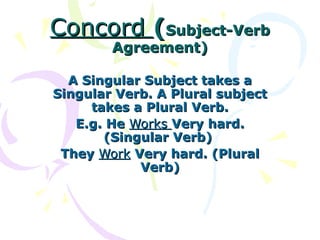
  A Singular Subject takes a
Singular Verb. A Plural subject
     takes a Plural Verb.
   E.g. He Works Very hard.
       (Singular Verb)
 They Work Very hard. (Plural
            Verb)
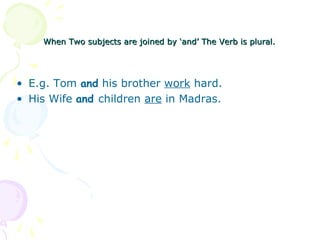
When Two subjects are joined by ‘and’ The Verb is plural.


• E.g. Tom and his brother work hard.
• His Wife and children are in Madras.
When two Singular Subjects are joined by ‘or’, ‘either…
      or’, ‘Neither…nor’ the subject is Singular.
When two plural subjects are joined by ‘or’ , ‘Neither…
        nor',' either…or’ the subject is plural.


• Singular Subjects              • Plural Subjects
• E.g. John or his               • Cows or Oxen are grazing
   brother goes home every         in the field.
  week.                          • Either Oranges or apples
• Either he or his wife has to     are required.
  help me.                       • Neither the boys nor the
• Neither the boy nor his          girls are reading now.
  sister has passed.
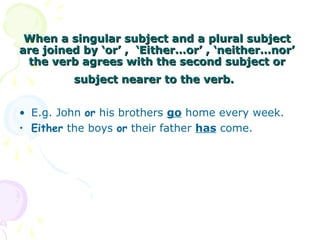
When a singular subject and a plural subject
are joined by ‘or’ , ‘Either…or’ , ‘neither…nor’
 the verb agrees with the second subject or
         subject nearer to the verb.


• E.g. John or his brothers go home every week.
• Either the boys or their father has come.
When two subjects are joined by ‘as well as’, ‘rather
 than’ , ‘more than’, ‘as much as’ the verb agrees
               with the first subject.

• E.g. The boys as well as their teacher have left.
• John rather than his brothers is involved in the
  activity.
When two subjects are joined by ‘with’ , ‘along
   with’, ‘together with’, ‘in the company of’ , ‘in
  addition to’, ‘accompanied by’, ‘besides’ etc the
           verb agrees with the first subject.

• E.g. My friend with all his children has returned.
• The Student along with his guardian is waiting outside the
  room .
A Sentence starts with One of, Each of,
 Either of, Everyone of, followed by a plural
         noun the Verb is singular.
• One of the boys has lost his pen.
• Neither of them has passed.
• Each of them is known to me.
Each, Every, Either, Neither followed
   by a noun take a singular verb.
• E.g. Each boy Works hard.
• Each girl has passed the Exam.
Expressions like Five pounds, Ten rupees, Two
   weeks, Three miles etc are singular and take
                  singular verb.

• E.g. Two Rupees is not a big sum.
• Two weeks is not a long time.
If a sentence begins with a word “There” it
may take the singular or plural verb according
         to the number of the subject.


• E.g. There is some coffee in the pot.
• There are some apples in the table.
Certain nouns like deer, sheep,counsel,and
nationality names like Indians ,Africans etc are both
                singular and plural.


•   E.g. A deer is grazing in the field.
•   A few Deer are grazing in the field.
•   A Chinese boy is waiting near the tree.
•   A few Chinese boys are waiting for the bus.
Numerical expressions like dozen, thousand, lakh,
million,etc have plural form when they are preceded
                by number words.

• E.g. Two dozen oranges are packed in this
  basket.
• Five hundred books have been ordered.
Nouns like Furniture, Machinery, equipment,
luggage etc are called Class collectives. They
      are followed by a singular verbs.

• E.g. The furniture was old and it has to be
  repaired.
• The luggage was carried by a boy.
Some nouns have plural endings but they are
         singular and take singular verb.
• E.g. The News is too good to be.
• Measles is not a dangerous disease.
Subject names ending in ‘-ics’ take singular
                  verb.

• E.g. Physics is easy to understand.
• Mathematics is hard to learn.
Things made of two equal parts are always
                   plural.


• E.g. My Scissors are old.
• His Trousers are torn.
• My Spectacles are broken.
Name of a book or is plural it takes singular
                    verb.

• E.g. The Arabian Nights is an interesting book.
• Gulliver’s Travels was written by Swift.
Thank You
  Satheesan Punyam

Concord

  • 1.
    Concord (Subject-Verb Agreement) A Singular Subject takes a Singular Verb. A Plural subject takes a Plural Verb. E.g. He Works Very hard. (Singular Verb) They Work Very hard. (Plural Verb)
  • 2.
    When Two subjectsare joined by ‘and’ The Verb is plural. • E.g. Tom and his brother work hard. • His Wife and children are in Madras.
  • 3.
    When two SingularSubjects are joined by ‘or’, ‘either… or’, ‘Neither…nor’ the subject is Singular. When two plural subjects are joined by ‘or’ , ‘Neither… nor',' either…or’ the subject is plural. • Singular Subjects • Plural Subjects • E.g. John or his • Cows or Oxen are grazing brother goes home every in the field. week. • Either Oranges or apples • Either he or his wife has to are required. help me. • Neither the boys nor the • Neither the boy nor his girls are reading now. sister has passed.
  • 4.
    When a singularsubject and a plural subject are joined by ‘or’ , ‘Either…or’ , ‘neither…nor’ the verb agrees with the second subject or subject nearer to the verb. • E.g. John or his brothers go home every week. • Either the boys or their father has come.
  • 5.
    When two subjectsare joined by ‘as well as’, ‘rather than’ , ‘more than’, ‘as much as’ the verb agrees with the first subject. • E.g. The boys as well as their teacher have left. • John rather than his brothers is involved in the activity.
  • 6.
    When two subjectsare joined by ‘with’ , ‘along with’, ‘together with’, ‘in the company of’ , ‘in addition to’, ‘accompanied by’, ‘besides’ etc the verb agrees with the first subject. • E.g. My friend with all his children has returned. • The Student along with his guardian is waiting outside the room .
  • 7.
    A Sentence startswith One of, Each of, Either of, Everyone of, followed by a plural noun the Verb is singular. • One of the boys has lost his pen. • Neither of them has passed. • Each of them is known to me.
  • 8.
    Each, Every, Either,Neither followed by a noun take a singular verb. • E.g. Each boy Works hard. • Each girl has passed the Exam.
  • 9.
    Expressions like Fivepounds, Ten rupees, Two weeks, Three miles etc are singular and take singular verb. • E.g. Two Rupees is not a big sum. • Two weeks is not a long time.
  • 10.
    If a sentencebegins with a word “There” it may take the singular or plural verb according to the number of the subject. • E.g. There is some coffee in the pot. • There are some apples in the table.
  • 11.
    Certain nouns likedeer, sheep,counsel,and nationality names like Indians ,Africans etc are both singular and plural. • E.g. A deer is grazing in the field. • A few Deer are grazing in the field. • A Chinese boy is waiting near the tree. • A few Chinese boys are waiting for the bus.
  • 12.
    Numerical expressions likedozen, thousand, lakh, million,etc have plural form when they are preceded by number words. • E.g. Two dozen oranges are packed in this basket. • Five hundred books have been ordered.
  • 13.
    Nouns like Furniture,Machinery, equipment, luggage etc are called Class collectives. They are followed by a singular verbs. • E.g. The furniture was old and it has to be repaired. • The luggage was carried by a boy.
  • 14.
    Some nouns haveplural endings but they are singular and take singular verb. • E.g. The News is too good to be. • Measles is not a dangerous disease.
  • 15.
    Subject names endingin ‘-ics’ take singular verb. • E.g. Physics is easy to understand. • Mathematics is hard to learn.
  • 16.
    Things made oftwo equal parts are always plural. • E.g. My Scissors are old. • His Trousers are torn. • My Spectacles are broken.
  • 17.
    Name of abook or is plural it takes singular verb. • E.g. The Arabian Nights is an interesting book. • Gulliver’s Travels was written by Swift.
  • 18.
    Thank You Satheesan Punyam