Commissioning Social Action Approaches 
People Helping People Conference 
3rd September 2014 
Peter Murray, Assistant Chief Executive – Transforming Rehabilitation Jayne Chadwick, Assistant Chief Executive – Communications, Engagement and Public Relations
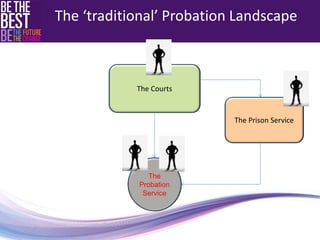
The 
Probation 
Service 
The Courts 
The Prison Service 
The ‘traditional’ Probation Landscape
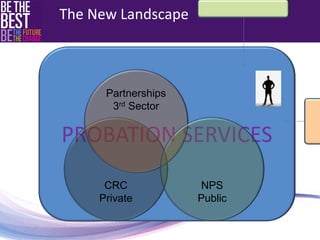
PROBATION SERVICES 
CRC 
Private 
Partnerships 
3rd Sector 
The New Landscape 
NPS 
Public
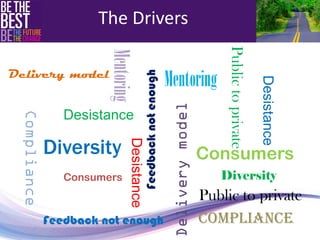
Desistance 
Diversity 
Mentoring 
Public to private 
Delivery model 
Consumers 
Compliance 
Feedback not enough 
Mentoring 
Desistance 
Feedback not enough 
Compliance 
Public to private 
Consumers 
The Drivers 
Desistance 
Diversity 
Delivery model
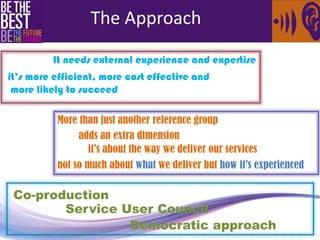
It needs external experience and expertise 
it’s more efficient, more cost effective and 
more likely to succeed 
More than just another reference group 
adds an extra dimension 
it’s about the way we deliver our services 
not so much about what we deliver but how it’s experienced 
Co-production 
Democratic approach 
Service User Council 
The Approach
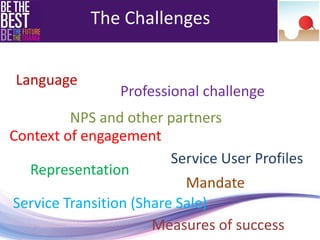
Language 
Professional challenge 
Context of engagement 
Representation 
Mandate 
Service Transition (Share Sale) 
Service User Profiles 
The Challenges 
NPS and other partners 
Measures of success
Stephen Boote Liverpool Youth Offending Team
8 
Nesta. People Helping People: 3 September 2014 
Commissioning Social Action Approaches. 
‘Streetdoctors’
9 
YOUTH CRIME 
ACTION PLAN 2008 
To develop and improve reparation to 
include Friday and Saturday evenings.
10 
The problems: 
• The culture of 9-5 working 
• The need for reparation to be both restorative and beneficial to 
young person 
• To develop notion of citizenship 
• To achieve ‘accreditation’ or certification 
• High student population with low perceived input to community 
• Low level of integration of young offenders into community
11 
The offer- 
‘medical students as a resource to deliver training’ 
What training? Accreditation/Learning. 
Will it be restorative? 
How do we support this? 
How can we ensure sustainability?
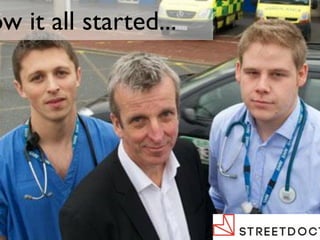
How it all started...
•Violence is the third leading cause of death of young people in Europe. Some of those deaths happen because the people present panic and don’t call for help. 
•Through fun interactive training sessions StreetDoctors volunteers give young people the skills and confidence to act when someone is bleeding or unconcious. 
•StreetDoctors is a network of medical volunteers with teams in major cities across England. We educate young people about the consequences of violence and discourage them from carrying weapons.
14 
What we offered; 
•Regular access to a high risk group of young people ensuring public health model met. 
•Safe environment 
•Data analysis-Police/YOIS 
•Success stories 
•Transportation 
•Safeguarding training 
•Input into Youth Justice Board and other YOT’s/Secure facility.
15 
Strengths: 
•Continual encounter with ‘high risk’ young people offering first hand experience of their lives 
•Peer mentoring 
•Constantly evolving (learning approaches) 
•Effective 
•Cheap 
•Support from judiciary 
•Restorative
16 
The difficulties: 
•Organisational Culture- (volunteers) 
•Press/media as drivers. 
•Regional success to national. 
•Adopting a strategic approach.
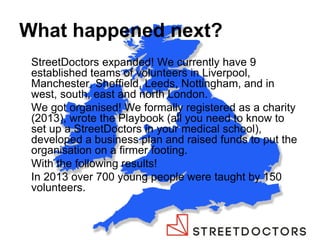
What happened next? 
StreetDoctors expanded! We currently have 9 established teams of volunteers in Liverpool, Manchester, Sheffield, Leeds, Nottingham, and in west, south, east and north London. 
We got organised! We formally registered as a charity (2013), wrote the Playbook (all you need to know to set up a StreetDoctors in your medical school), developed a business plan and raised funds to put the organisation on a firmer footing. 
With the following results! 
In 2013 over 700 young people were taught by 150 volunteers.
How it works – at a local level: 
•StreetDoctors ‘champions’ form a core group at a medical school. 
•Volunteers from existing branches provide support and mentoring. 
•Links are made with youth offending teams and other providers for at risk young people in the local area. 
•New volunteers are trained to deliver at our annual conference in October. 
•They begin teaching in October / November. 
•Local teams cover local expenses through fundraising, and making a small charge to local delivery partners.
How it works – nationally: 
•StreetDoctors is led by volunteers, working in partnership with StreetDoctors HQ and trustees. 
•HQ supports local team delivery across England – through strategy and training days, the annual conference, research and evaluation, and other core functions. 
•Local teams send reps to 4 national task forces to drive continuous improvement, development and expansion. 
•4 national taskforces oversee Teaching and Development; Training and Expansion; Research and Evaluation; and, Fundraising.
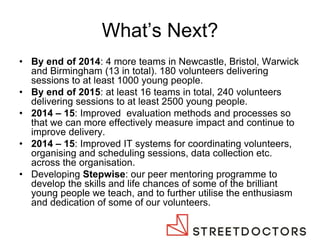
What’s Next? 
•By end of 2014: 4 more teams in Newcastle, Bristol, Warwick and Birmingham (13 in total). 180 volunteers delivering sessions to at least 1000 young people. 
•By end of 2015: at least 16 teams in total, 240 volunteers delivering sessions to at least 2500 young people. 
•2014 – 15: Improved evaluation methods and processes so that we can more effectively measure impact and continue to improve delivery. 
•2014 – 15: Improved IT systems for coordinating volunteers, organising and scheduling sessions, data collection etc. across the organisation. 
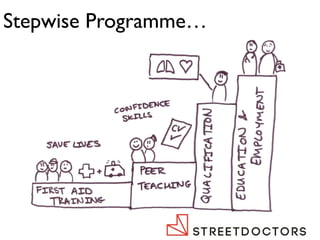
•Developing Stepwise: our peer mentoring programme to develop the skills and life chances of some of the brilliant young people we teach, and to further utilise the enthusiasm and dedication of some of our volunteers.
Stepwise Programme…
22 
Afterthought…. 
A typical session of reparation totaling four hours for four young people would cost around £180 for front line staff to deliver. 
In 2013 Streetdoctors delivered over 4,200 hours to 700 young people.
Chris Drinkwater 
Ways to Wellness 
Chair Newcastle West CCG Partnership Forum
Way to Wellness Scaling up social prescribing for long term conditions using a SIB Model 
Professor Chris Drinkwater 
Chair, Ways to Wellness
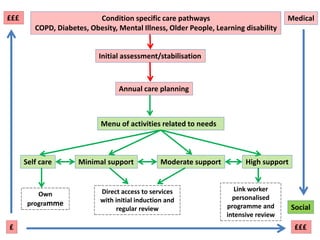
Condition specific care pathways COPD, Diabetes, Obesity, Mental Illness, Older People, Learning disability 
Initial assessment/stabilisation 
Annual care planning 
Social 
Medical 
Menu of activities related to needs 
Self care 
Minimal support 
Moderate support 
High support 
Own programme 
Direct access to services with initial induction and regular review 
Link worker personalised programme and intensive review 
£££ 
£ 
£££
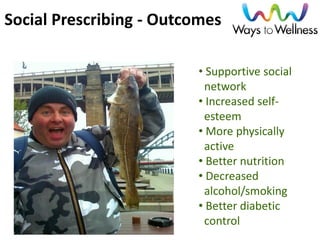
Social Prescribing - Outcomes 
• Supportive social network 
• Increased self- esteem 
• More physically active 
• Better nutrition 
• Decreased alcohol/smoking 
• Better diabetic control
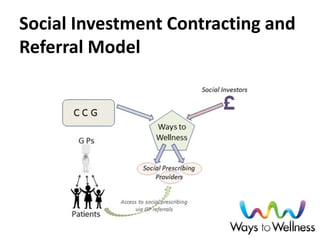
Social Investment Contracting and Referral Model
Where are we now? 
•“In principle agreement for funding” - Launch date – January 2015. 
•Contracts to be agreed and signed with investors, Big Lottery/Cabinet Office, CCG and four voluntary sector providers. 
•Board in place, CEO to be appointed. 
•Testing of IT systems 
•Social marketing/Better Care Fund
Challenges – Managing Risk 
•Social Impact/Investment Bond Model 
“…how savings are materialised and crystallised so WtW funded from savings …not an additional cost pressure for CCG?” 
•Metrics – for repayment, performance management & evaluation. 
•Procuring and managing providers using a shared management information system. 
•Consistency in training and delivery from Link Workers. 
•Marketing - ensuring referral push from GPs and stimulating a pull from patients
Thank you for listening 
Questions, suggestions, comments? 
Contact details: 
Chris.drinkwater@gofo2.co.uk 
http://www.vonne.org.uk/policy/waystowellness/ 
Sandra.king@vonne.org.uk

People Helping People - Commissioning social action in practice workshop 2

  • 1.
    Commissioning Social ActionApproaches People Helping People Conference 3rd September 2014 Peter Murray, Assistant Chief Executive – Transforming Rehabilitation Jayne Chadwick, Assistant Chief Executive – Communications, Engagement and Public Relations
  • 2.
    The Probation Service The Courts The Prison Service The ‘traditional’ Probation Landscape
  • 3.
    PROBATION SERVICES CRC Private Partnerships 3rd Sector The New Landscape NPS Public
  • 4.
    Desistance Diversity Mentoring Public to private Delivery model Consumers Compliance Feedback not enough Mentoring Desistance Feedback not enough Compliance Public to private Consumers The Drivers Desistance Diversity Delivery model
  • 5.
    It needs externalexperience and expertise it’s more efficient, more cost effective and more likely to succeed More than just another reference group adds an extra dimension it’s about the way we deliver our services not so much about what we deliver but how it’s experienced Co-production Democratic approach Service User Council The Approach
  • 6.
    Language Professional challenge Context of engagement Representation Mandate Service Transition (Share Sale) Service User Profiles The Challenges NPS and other partners Measures of success
  • 7.
    Stephen Boote LiverpoolYouth Offending Team
  • 8.
    8 Nesta. PeopleHelping People: 3 September 2014 Commissioning Social Action Approaches. ‘Streetdoctors’
  • 9.
    9 YOUTH CRIME ACTION PLAN 2008 To develop and improve reparation to include Friday and Saturday evenings.
  • 10.
    10 The problems: • The culture of 9-5 working • The need for reparation to be both restorative and beneficial to young person • To develop notion of citizenship • To achieve ‘accreditation’ or certification • High student population with low perceived input to community • Low level of integration of young offenders into community
  • 11.
    11 The offer- ‘medical students as a resource to deliver training’ What training? Accreditation/Learning. Will it be restorative? How do we support this? How can we ensure sustainability?
  • 12.
    How it allstarted...
  • 13.
    •Violence is thethird leading cause of death of young people in Europe. Some of those deaths happen because the people present panic and don’t call for help. •Through fun interactive training sessions StreetDoctors volunteers give young people the skills and confidence to act when someone is bleeding or unconcious. •StreetDoctors is a network of medical volunteers with teams in major cities across England. We educate young people about the consequences of violence and discourage them from carrying weapons.
  • 14.
    14 What weoffered; •Regular access to a high risk group of young people ensuring public health model met. •Safe environment •Data analysis-Police/YOIS •Success stories •Transportation •Safeguarding training •Input into Youth Justice Board and other YOT’s/Secure facility.
  • 15.
    15 Strengths: •Continualencounter with ‘high risk’ young people offering first hand experience of their lives •Peer mentoring •Constantly evolving (learning approaches) •Effective •Cheap •Support from judiciary •Restorative
  • 16.
    16 The difficulties: •Organisational Culture- (volunteers) •Press/media as drivers. •Regional success to national. •Adopting a strategic approach.
  • 17.
    What happened next? StreetDoctors expanded! We currently have 9 established teams of volunteers in Liverpool, Manchester, Sheffield, Leeds, Nottingham, and in west, south, east and north London. We got organised! We formally registered as a charity (2013), wrote the Playbook (all you need to know to set up a StreetDoctors in your medical school), developed a business plan and raised funds to put the organisation on a firmer footing. With the following results! In 2013 over 700 young people were taught by 150 volunteers.
  • 18.
    How it works– at a local level: •StreetDoctors ‘champions’ form a core group at a medical school. •Volunteers from existing branches provide support and mentoring. •Links are made with youth offending teams and other providers for at risk young people in the local area. •New volunteers are trained to deliver at our annual conference in October. •They begin teaching in October / November. •Local teams cover local expenses through fundraising, and making a small charge to local delivery partners.
  • 19.
    How it works– nationally: •StreetDoctors is led by volunteers, working in partnership with StreetDoctors HQ and trustees. •HQ supports local team delivery across England – through strategy and training days, the annual conference, research and evaluation, and other core functions. •Local teams send reps to 4 national task forces to drive continuous improvement, development and expansion. •4 national taskforces oversee Teaching and Development; Training and Expansion; Research and Evaluation; and, Fundraising.
  • 20.
    What’s Next? •Byend of 2014: 4 more teams in Newcastle, Bristol, Warwick and Birmingham (13 in total). 180 volunteers delivering sessions to at least 1000 young people. •By end of 2015: at least 16 teams in total, 240 volunteers delivering sessions to at least 2500 young people. •2014 – 15: Improved evaluation methods and processes so that we can more effectively measure impact and continue to improve delivery. •2014 – 15: Improved IT systems for coordinating volunteers, organising and scheduling sessions, data collection etc. across the organisation. •Developing Stepwise: our peer mentoring programme to develop the skills and life chances of some of the brilliant young people we teach, and to further utilise the enthusiasm and dedication of some of our volunteers.
  • 21.
  • 22.
    22 Afterthought…. Atypical session of reparation totaling four hours for four young people would cost around £180 for front line staff to deliver. In 2013 Streetdoctors delivered over 4,200 hours to 700 young people.
  • 23.
    Chris Drinkwater Waysto Wellness Chair Newcastle West CCG Partnership Forum
  • 24.
    Way to WellnessScaling up social prescribing for long term conditions using a SIB Model Professor Chris Drinkwater Chair, Ways to Wellness
  • 25.
    Condition specific carepathways COPD, Diabetes, Obesity, Mental Illness, Older People, Learning disability Initial assessment/stabilisation Annual care planning Social Medical Menu of activities related to needs Self care Minimal support Moderate support High support Own programme Direct access to services with initial induction and regular review Link worker personalised programme and intensive review £££ £ £££
  • 26.
    Social Prescribing -Outcomes • Supportive social network • Increased self- esteem • More physically active • Better nutrition • Decreased alcohol/smoking • Better diabetic control
  • 27.
  • 28.
    Where are wenow? •“In principle agreement for funding” - Launch date – January 2015. •Contracts to be agreed and signed with investors, Big Lottery/Cabinet Office, CCG and four voluntary sector providers. •Board in place, CEO to be appointed. •Testing of IT systems •Social marketing/Better Care Fund
  • 29.
    Challenges – ManagingRisk •Social Impact/Investment Bond Model “…how savings are materialised and crystallised so WtW funded from savings …not an additional cost pressure for CCG?” •Metrics – for repayment, performance management & evaluation. •Procuring and managing providers using a shared management information system. •Consistency in training and delivery from Link Workers. •Marketing - ensuring referral push from GPs and stimulating a pull from patients
  • 30.
    Thank you forlistening Questions, suggestions, comments? Contact details: Chris.drinkwater@gofo2.co.uk http://www.vonne.org.uk/policy/waystowellness/ Sandra.king@vonne.org.uk