© Behavioural Insights ltd
Thinking Behaviourally
For Realising the Value
© Behavioural Insights ltd
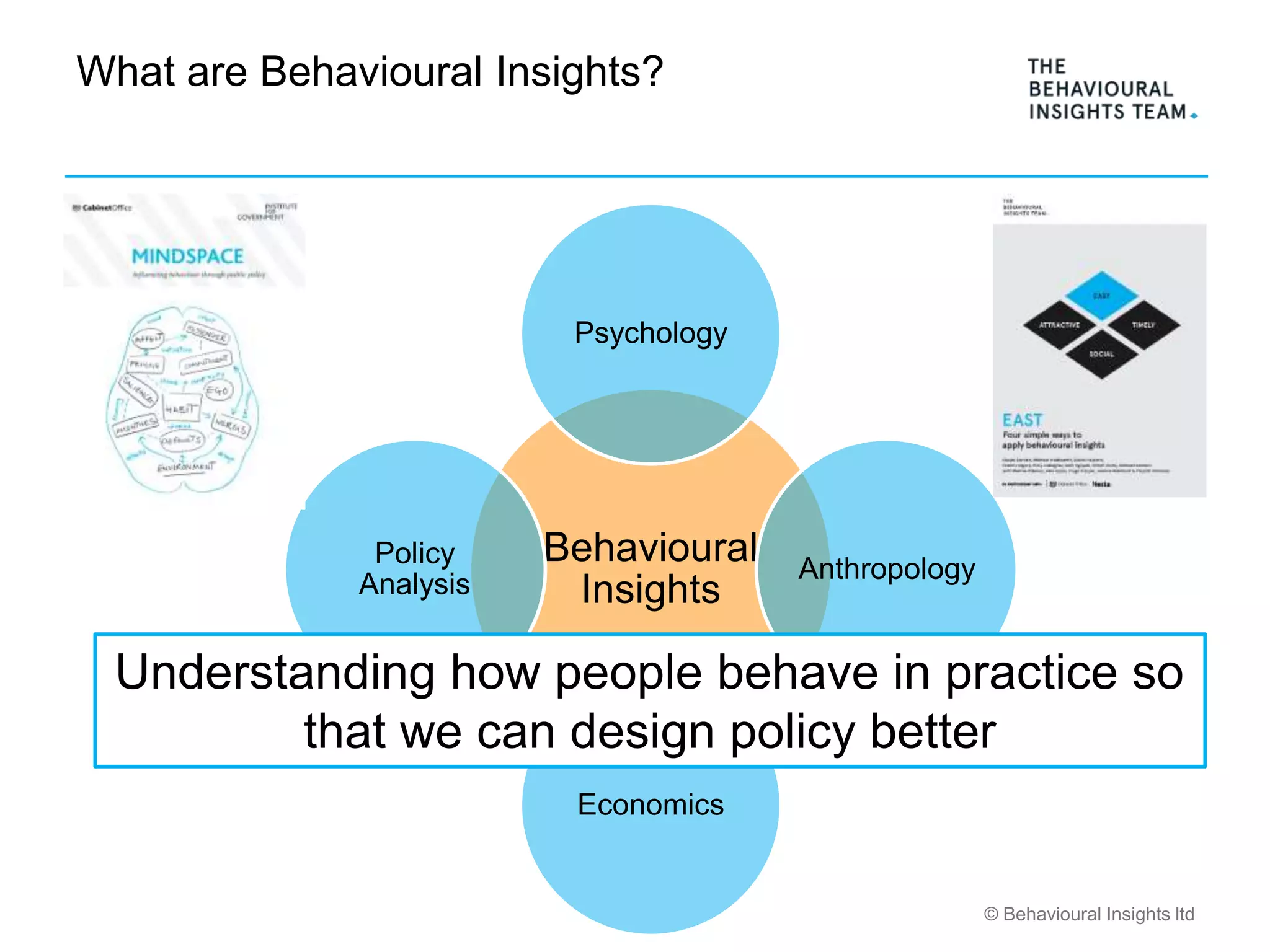
What are Behavioural Insights?
Behavioural
Insights
Psychology
Anthropology
Economics
Policy
Analysis
Understanding how people behave in practice so
that we can design policy better
© Behavioural Insights ltd
Aims of this session
1. To help you think about the behaviours involved with Realising the
Value
2. To help establish objectives for Realising the Value based on these
behaviours
© Behavioural Insights ltd
1. What behaviours?
© Behavioural Insights ltd
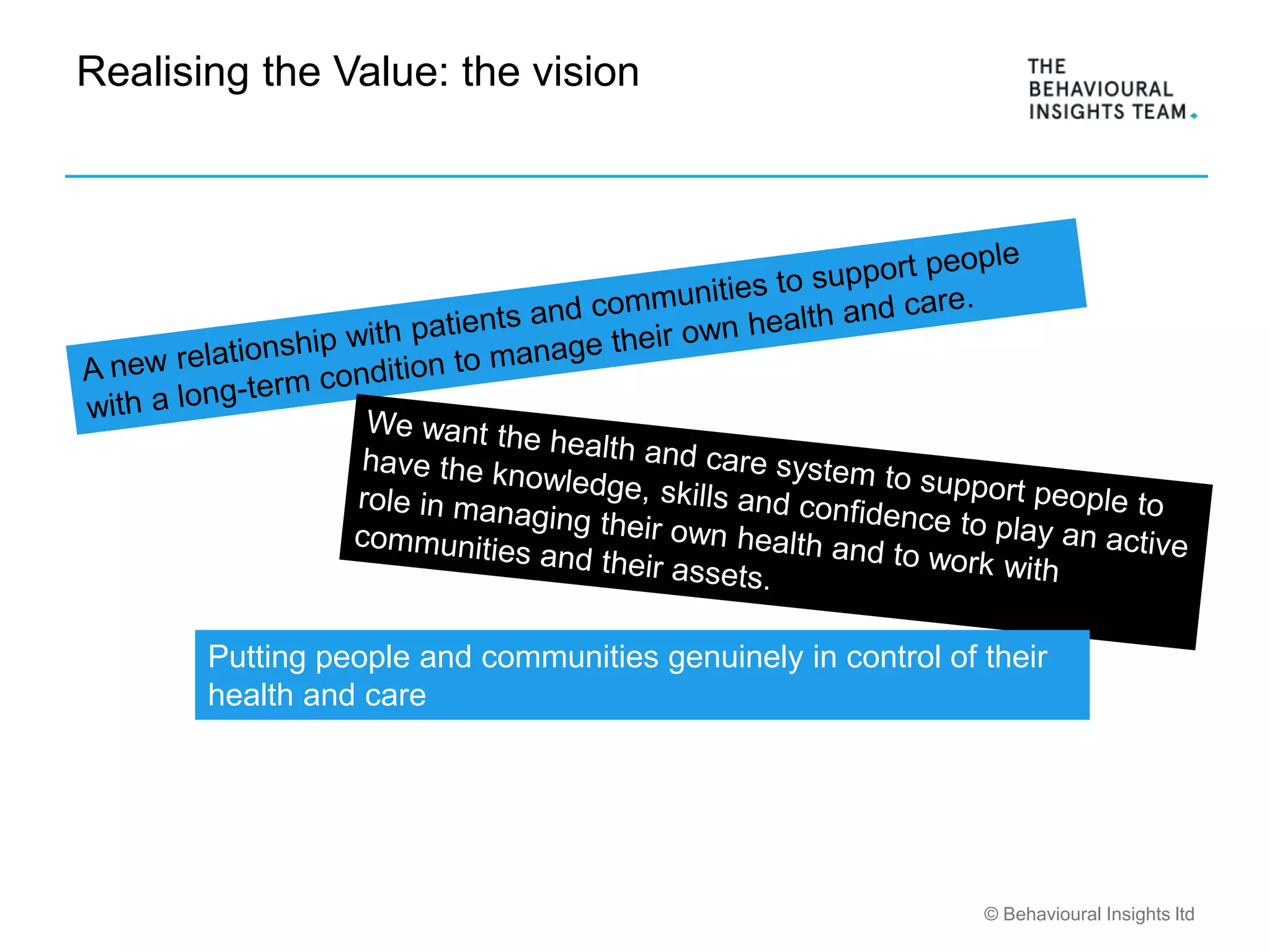
Realising the Value: the vision
Putting people and communities genuinely in control of their
health and care
© Behavioural Insights ltd
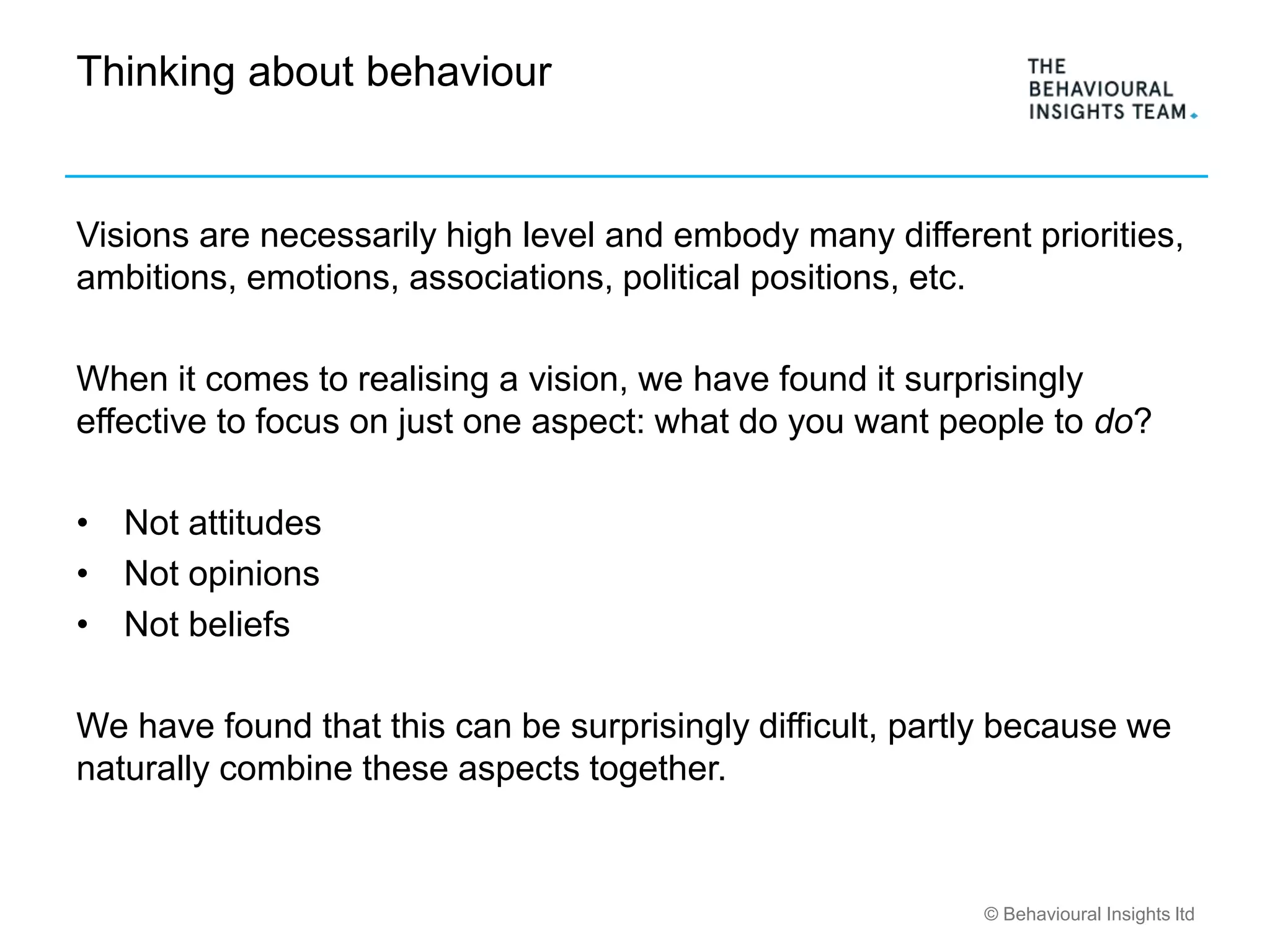
Thinking about behaviour
Visions are necessarily high level and embody many different priorities,
ambitions, emotions, associations, political positions, etc.
When it comes to realising a vision, we have found it surprisingly
effective to focus on just one aspect: what do you want people to do?
• Not attitudes
• Not opinions
• Not beliefs
We have found that this can be surprisingly difficult, partly because we
naturally combine these aspects together.
© Behavioural Insights ltd
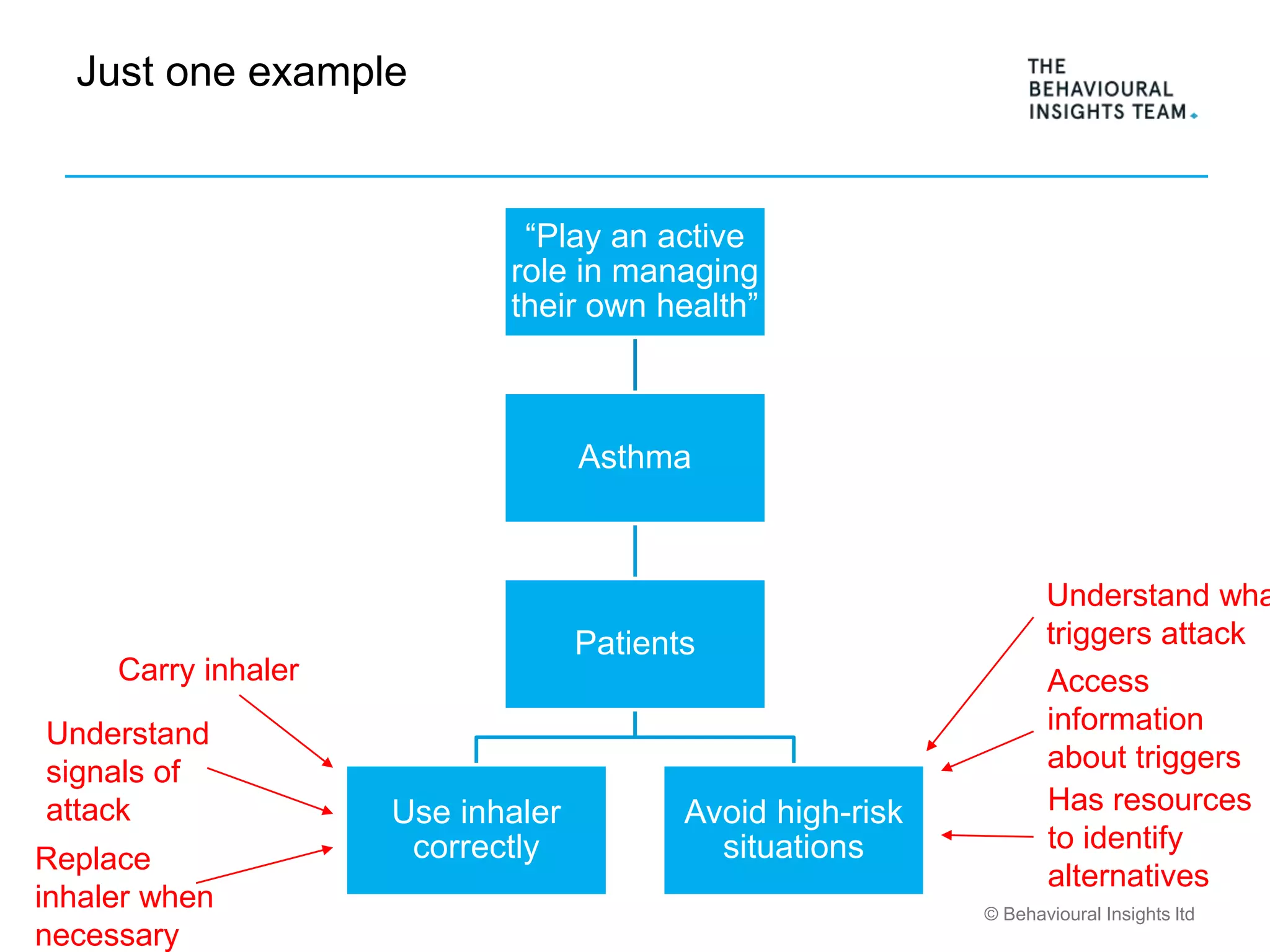
Just one example
“Play an active
role in managing
their own health”
Asthma
Patients
Use inhaler
correctly
Avoid high-risk
situations
Carry inhaler
Understand
signals of
attack
Replace
inhaler when
necessary
Understand wha
triggers attack
Access
information
about triggers
Has resources
to identify
alternatives
© Behavioural Insights ltd
2. What objectives?
© Behavioural Insights ltd
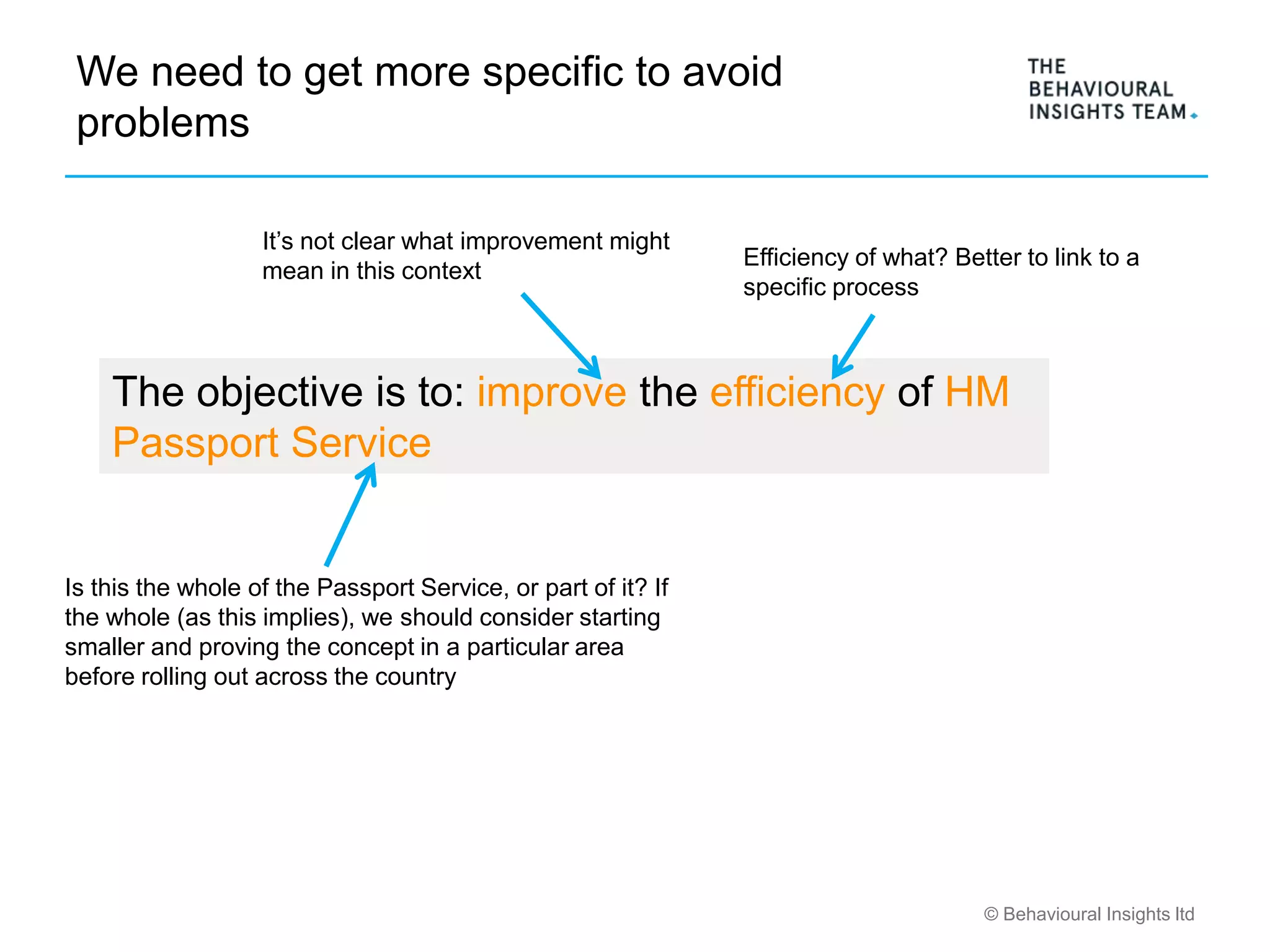
We need to get more specific to avoid
problems
The objective is to: improve the efficiency of HM
Passport Service
It’s not clear what improvement might
mean in this context
Is this the whole of the Passport Service, or part of it? If
the whole (as this implies), we should consider starting
smaller and proving the concept in a particular area
before rolling out across the country
Efficiency of what? Better to link to a
specific process
© Behavioural Insights ltd
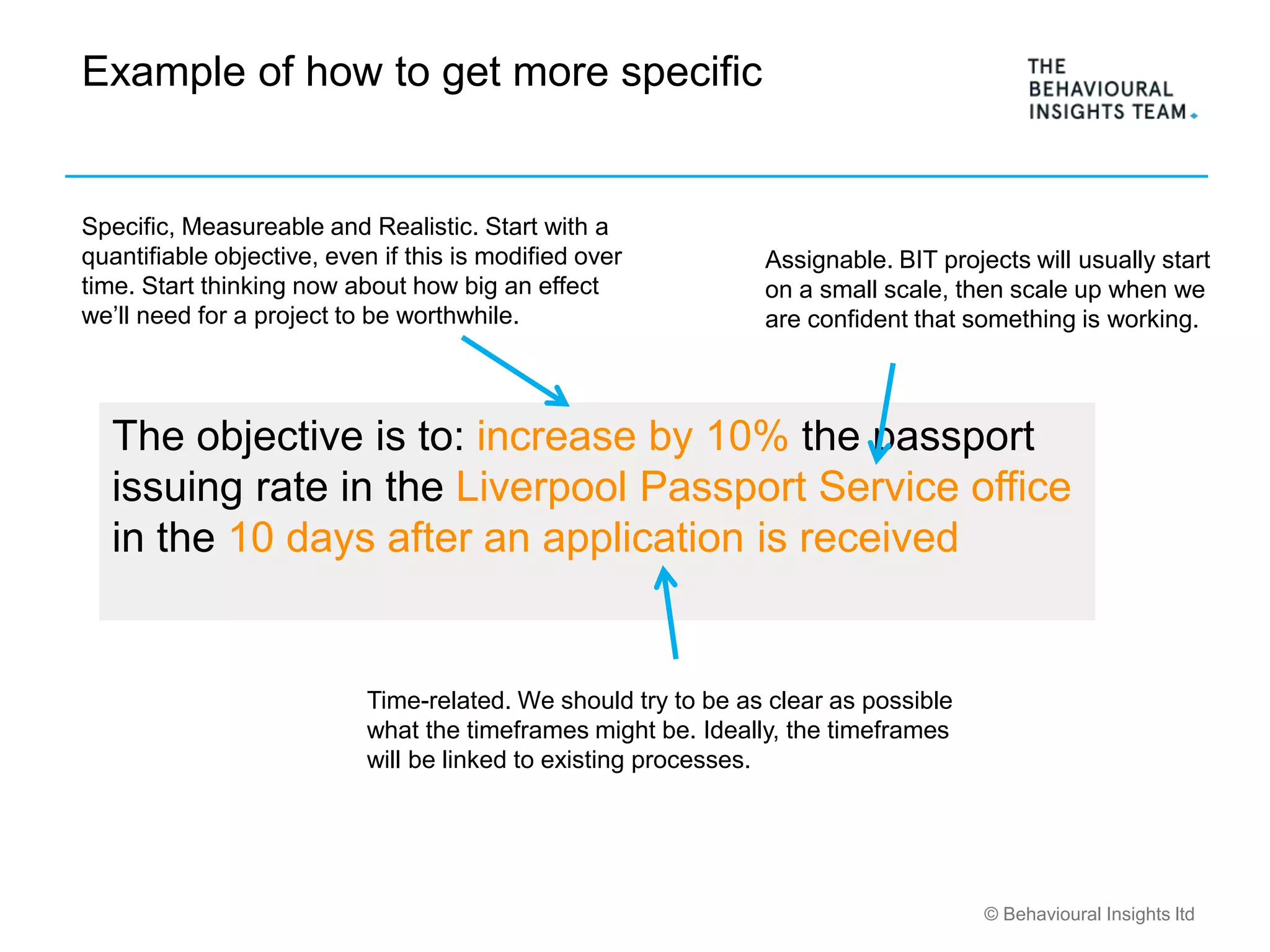
Example of how to get more specific
The objective is to: increase by 10% the passport
issuing rate in the Liverpool Passport Service office
in the 10 days after an application is received
Time-related. We should try to be as clear as possible
what the timeframes might be. Ideally, the timeframes
will be linked to existing processes.
Assignable. BIT projects will usually start
on a small scale, then scale up when we
are confident that something is working.
Specific, Measureable and Realistic. Start with a
quantifiable objective, even if this is modified over
time. Start thinking now about how big an effect
we’ll need for a project to be worthwhile.
© Behavioural Insights ltd
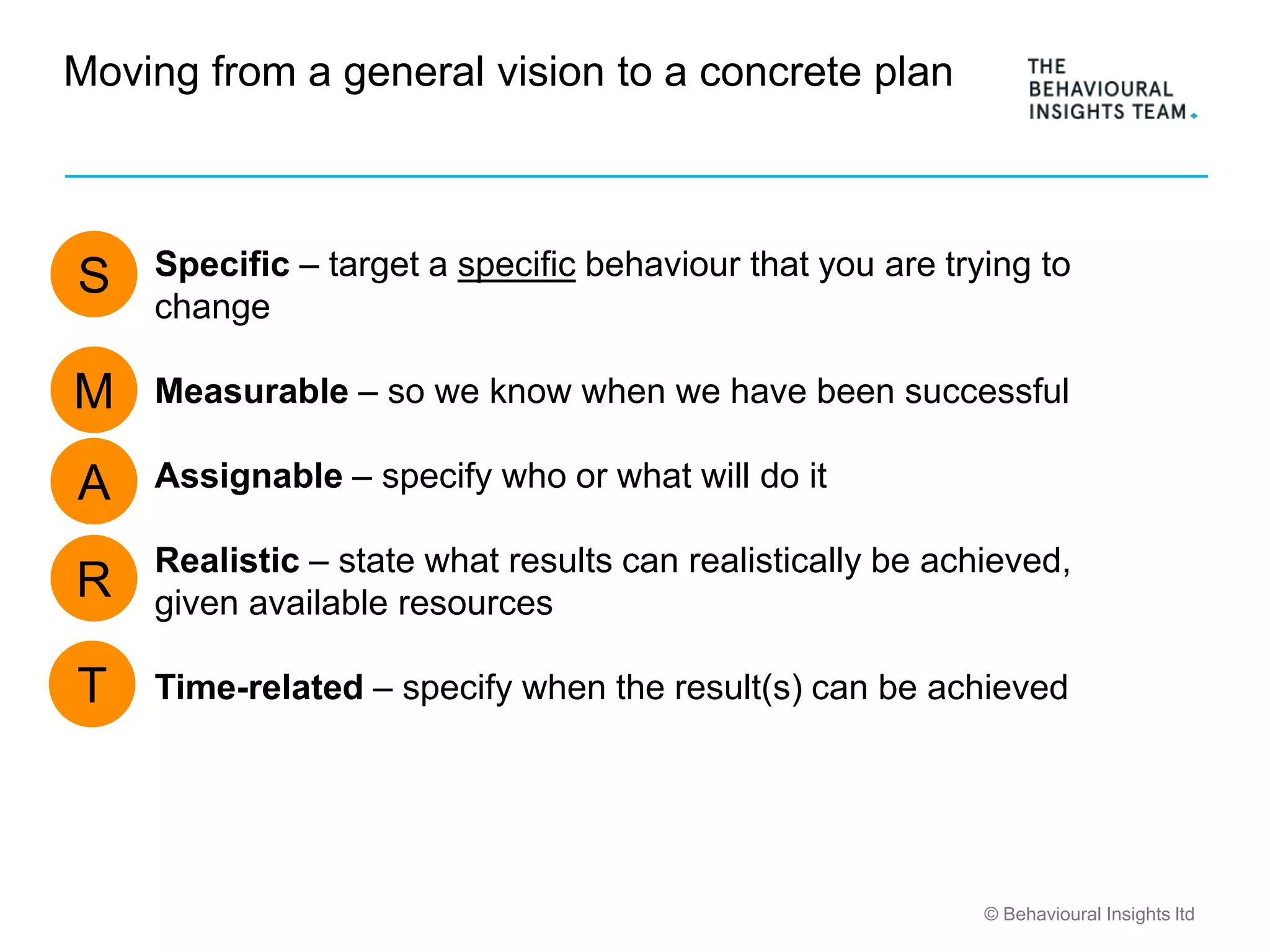
Moving from a general vision to a concrete plan
Specific – target a specific behaviour that you are trying to
change
Measurable – so we know when we have been successful
Assignable – specify who or what will do it
Realistic – state what results can realistically be achieved,
given available resources
Time-related – specify when the result(s) can be achieved
S
M
A
R
T
© Behavioural Insights ltd
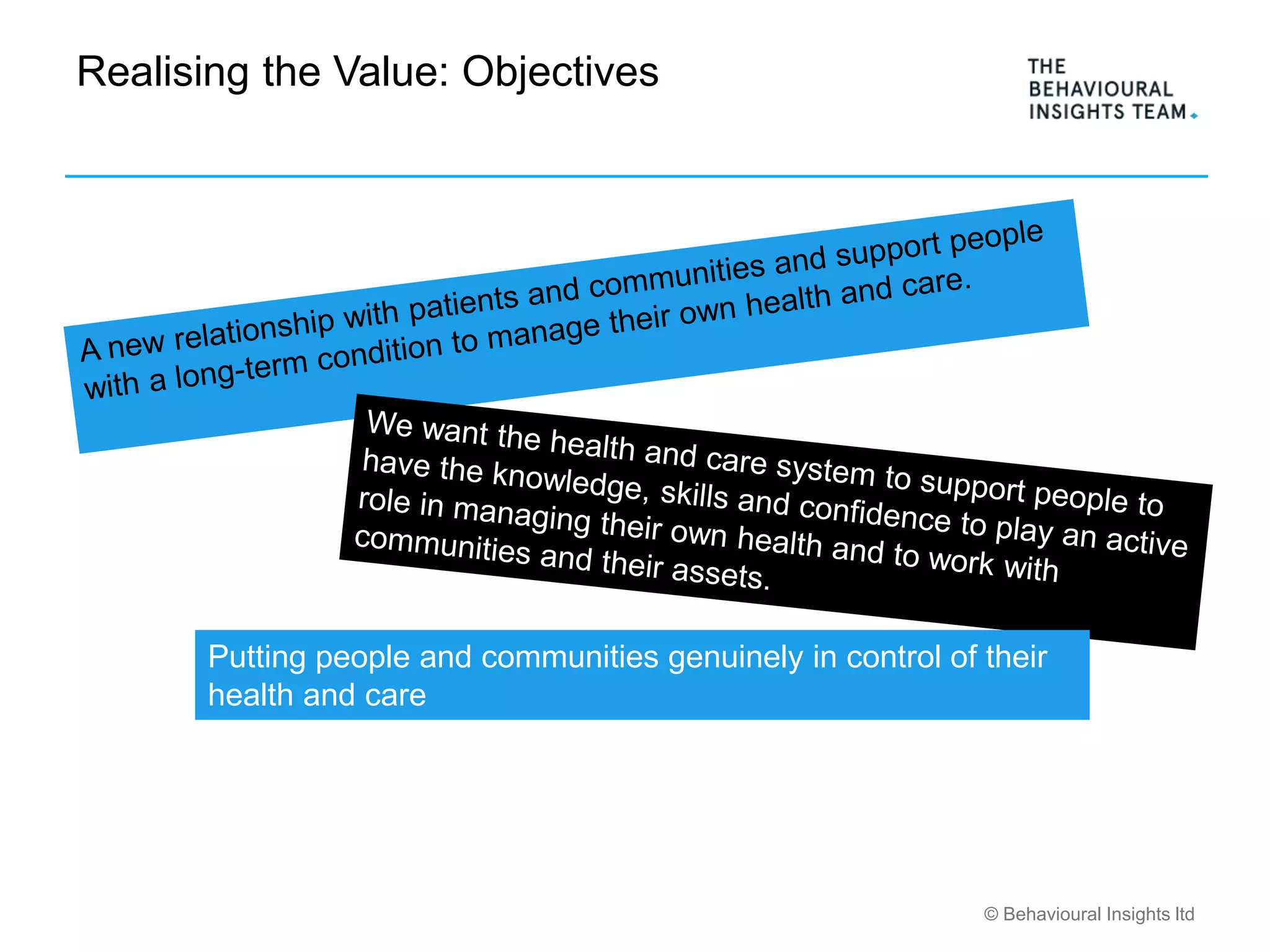
Realising the Value: Objectives
Putting people and communities genuinely in control of their
health and care
© Behavioural Insights ltd
Imagine a person-centred health and social
care system
What three behaviours will the following groups need to STOP and
START doing?
• People (in the community)
• Patients
• Practitioners
Focus on Long Term Conditions
You have 15 minutes
Write ideas on flipcharts
Identify a spokesperson to present back

Realising the Value Stakeholder Event - Workshop:Let's think in terms of behaviour: What changes do we want to see?

  • 1.
    © Behavioural Insightsltd Thinking Behaviourally For Realising the Value
  • 2.
    © Behavioural Insightsltd What are Behavioural Insights? Behavioural Insights Psychology Anthropology Economics Policy Analysis Understanding how people behave in practice so that we can design policy better
  • 3.
    © Behavioural Insightsltd Aims of this session 1. To help you think about the behaviours involved with Realising the Value 2. To help establish objectives for Realising the Value based on these behaviours
  • 4.
    © Behavioural Insightsltd 1. What behaviours?
  • 5.
    © Behavioural Insightsltd Realising the Value: the vision Putting people and communities genuinely in control of their health and care
  • 6.
    © Behavioural Insightsltd Thinking about behaviour Visions are necessarily high level and embody many different priorities, ambitions, emotions, associations, political positions, etc. When it comes to realising a vision, we have found it surprisingly effective to focus on just one aspect: what do you want people to do? • Not attitudes • Not opinions • Not beliefs We have found that this can be surprisingly difficult, partly because we naturally combine these aspects together.
  • 7.
    © Behavioural Insightsltd Just one example “Play an active role in managing their own health” Asthma Patients Use inhaler correctly Avoid high-risk situations Carry inhaler Understand signals of attack Replace inhaler when necessary Understand wha triggers attack Access information about triggers Has resources to identify alternatives
  • 8.
    © Behavioural Insightsltd 2. What objectives?
  • 9.
    © Behavioural Insightsltd We need to get more specific to avoid problems The objective is to: improve the efficiency of HM Passport Service It’s not clear what improvement might mean in this context Is this the whole of the Passport Service, or part of it? If the whole (as this implies), we should consider starting smaller and proving the concept in a particular area before rolling out across the country Efficiency of what? Better to link to a specific process
  • 10.
    © Behavioural Insightsltd Example of how to get more specific The objective is to: increase by 10% the passport issuing rate in the Liverpool Passport Service office in the 10 days after an application is received Time-related. We should try to be as clear as possible what the timeframes might be. Ideally, the timeframes will be linked to existing processes. Assignable. BIT projects will usually start on a small scale, then scale up when we are confident that something is working. Specific, Measureable and Realistic. Start with a quantifiable objective, even if this is modified over time. Start thinking now about how big an effect we’ll need for a project to be worthwhile.
  • 11.
    © Behavioural Insightsltd Moving from a general vision to a concrete plan Specific – target a specific behaviour that you are trying to change Measurable – so we know when we have been successful Assignable – specify who or what will do it Realistic – state what results can realistically be achieved, given available resources Time-related – specify when the result(s) can be achieved S M A R T
  • 12.
    © Behavioural Insightsltd Realising the Value: Objectives Putting people and communities genuinely in control of their health and care
  • 13.
    © Behavioural Insightsltd Imagine a person-centred health and social care system What three behaviours will the following groups need to STOP and START doing? • People (in the community) • Patients • Practitioners Focus on Long Term Conditions You have 15 minutes Write ideas on flipcharts Identify a spokesperson to present back