






Open Jobs
Helping individuals, organisations and government to take
more informed decisions on skills and jobs
Nesta is a global innovation foundation based in
the UK. We were established in 1998 and now
have over 200 staff. We have the status of an
Independent Research Organisation.
We back and develop new ideas to tackle the
big challenges of our time, from the pressures of
an ageing population to stretched public services
and a fast changing jobs market
Nesta has been working for several years on new
approaches to jobs and labour markets. We want
to ensure that everyone has better ways of
navigating their way from where they are to
where they want to be in jobs and careers—what
we have loosely called a ‘Google Maps for jobs
and skills’.
About Nesta
Introducing Open Jobs
Open Jobs is a unit within Nesta that aims to
help individuals, organisations and
governments to take more informed labour
market decisions.
The unit carries out data-driven research,
facilitates place-based pilots and advocates
for smarter labour market policies.
We all bear the
costs of opaque
labour markets and
poor skills matching
Current and future workers lack support
and guidance on how to develop skills
that meet employer demand. Many
face stagnant pay and low social
mobility.
Businesses are unable to find workers
with the right skills. The Open University
estimates that skill shortages cost the UK
£2bn a year in higher salaries,
recruitment costs and temporary staffing
bills.
At a national and regional level, the
lack of alignment between supply and
demand of skills contributes to poor
productivity growth. This has adverse
effect on living standards and
wellbeing.
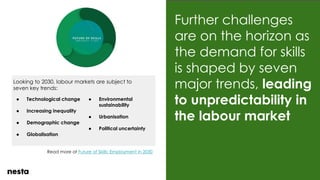
Further challenges
are on the horizon as
the demand for skills
is shaped by seven
major trends, leading
to unpredictability in
the labour market
Read more at Future of Skills: Employment in 2030
● Technological change
● Increasing inequality
● Demographic change
● Globalisation
● Environmental
sustainability
● Urbanisation
● Political uncertainty
Looking to 2030, labour markets are subject to
seven key trends:
Open Jobs responds
to these challenges
by combining three
approaches to
make labour
markets smarter,
fairer and more
efficient
Open Jobs Data
Through research we open up new data
and use machine learning to provide new
insights on the labour market of today and
tomorrow.
Open Jobs Pilots
We build partnerships with national and
local stakeholders to develop data-driven
solutions to the challenges of navigating
and shaping the labour market.
Open Jobs Policy
We advocate for more open and efficient
use of data to inform labour market policy.
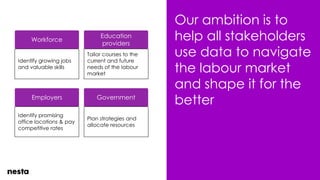
Our ambition is to
help all stakeholders
use data to navigate
the labour market
and shape it for the
better
Workforce
Identify growing jobs
and valuable skills
Education
providers
Tailor courses to the
current and future
needs of the labour
market
Employers
Identify promising
office locations & pay
competitive rates
Government
Plan strategies and
allocate resources
How Open Jobs works
Open Jobs Data
Open Jobs Data is the data and research
component of Open Jobs.
We use big data and machine learning to derive
insights from new and existing sources of labour
market information.
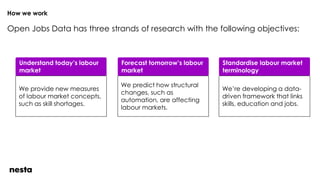
Understand today’s labour
market
We provide new measures
of labour market concepts,
such as skill shortages.
Forecast tomorrow’s labour
market
We predict how structural
changes, such as
automation, are affecting
labour markets.
Standardise labour market
terminology
We’re developing a data-
driven framework that links
skills, education and jobs.
How we work
Open Jobs Data has three strands of research with the following objectives:
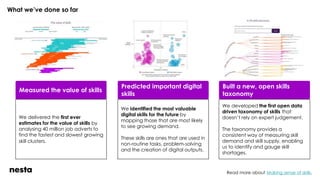
Measured the value of skills
We delivered the first ever
estimates for the value of skills by
analysing 40 million job adverts to
find the fastest and slowest growing
skill clusters.
Predicted important digital
skills
We identified the most valuable
digital skills for the future by
mapping those that are most likely
to see growing demand.
These skills are ones that are used in
non-routine tasks, problem-solving
and the creation of digital outputs.
Built a new, open skills
taxonomy
We developed the first open data
driven taxonomy of skills that
doesn’t rely on expert judgement.
The taxonomy provides a
consistent way of measuring skill
demand and skill supply, enabling
us to identify and gauge skill
shortages.
What we’ve done so far
Read more about Making sense of skills.
Open Jobs Pilots
We work with local and national partners to
improve the efficiency and inclusiveness of
their labour markets using data.
Through collaboration, we develop pilot tools
for job seekers, employers and educators
which help them to navigate the labour market
more effectively.
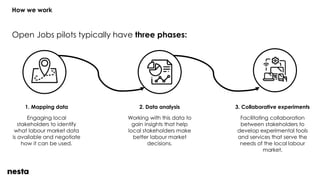
1. Mapping data
Engaging local
stakeholders to identify
what labour market data
is available and negotiate
how it can be used.
2. Data analysis
Working with this data to
gain insights that help
local stakeholders make
better labour market
decisions.
3. Collaborative experiments
Facilitating collaboration
between stakeholders to
develop experimental tools
and services that serve the
needs of the local labour
market.
How we work
Open Jobs pilots typically have three phases:
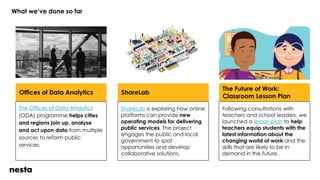
Offices of Data Analytics
The Offices of Data Analytics
(ODA) programme helps cities
and regions join up, analyse
and act upon data from multiple
sources to reform public
services.
ShareLab
ShareLab is exploring how online
platforms can provide new
operating models for delivering
public services. The project
engages the public and local
government to spot
opportunities and develop
collaborative solutions.
The Future of Work:
Classroom Lesson Plan
What we’ve done so far
Following consultations with
teachers and school leaders, we
launched a lesson plan to help
teachers equip students with the
latest information about the
changing world of work and the
skills that are likely to be in
demand in the future.
Open Jobs Policy
We advocate for more open and efficient use of
labour market data to show how data could be
used to inform individuals’ choices on skills, jobs
and careers.
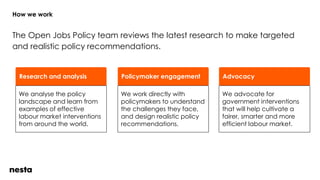
Research and analysis
We analyse the policy
landscape and learn from
examples of effective
labour market interventions
from around the world.
Policymaker engagement
We work directly with
policymakers to understand
the challenges they face,
and design realistic policy
recommendations.
Advocacy
We advocate for
government interventions
that will help cultivate a
fairer, smarter and more
efficient labour market.
How we work
The Open Jobs Policy team reviews the latest research to make targeted
and realistic policy recommendations.
What we’ve done so far
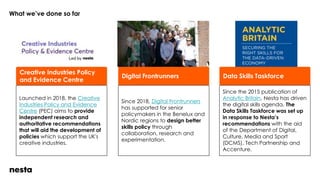
Creative Industries Policy
and Evidence Centre
Launched in 2018, the Creative
Industries Policy and Evidence
Centre (PEC) aims to provide
independent research and
authoritative recommendations
that will aid the development of
policies which support the UK's
creative industries.
Digital Frontrunners
Since 2018, Digital Frontrunners
has supported for senior
policymakers in the Benelux and
Nordic regions to design better
skills policy through
collaboration, research and
experimentation.
Data Skills Taskforce
Since the 2015 publication of
Analytic Britain, Nesta has driven
the digital skills agenda. The
Data Skills Taskforce was set up
in response to Nesta’s
recommendations with the aid
of the Department of Digital,
Culture, Media and Sport
(DCMS), Tech Partnership and
Accenture.
Investment
In addition to the Open Jobs projects,
Nesta is committed to investing in
ventures that help people to navigate
the labour market.
Some of the ventures we’ve invested in and awarded funding to:
We invested £500,000
into innovative job
search web platform
GetMyFirstJob
Read more about our Education Open Data Challenge Prize and our investments in GetMyFirstJob and Applied.
We led a £330,000
investment into fairer
recruitment platform
Applied
Our Education Open
Data Challenge
awarded £40,000 to
online skills service
Skills Route
Hasan Bakhshi MBE
Executive Director, Creative
Economy and Data Analytics
Dr Cath Sleeman
Quantitative Research
Fellow
Jack Orlik
Programme Manager
Geoff Mulgan CBE
Chief Executive Officer
Joysy John
Director of Education
Dr Jyldyz Djumalieva
Data Science
Research Fellow
Peter Baeck
Head of Collaborative
Economy Research
Team
Some of the organisations we’ve partnered with and received funding from:
We actively seek to work with others who share our vision for a smarter
labour market. We offer a range of collaboration options, from
funding to joint research.
• Explorative Our focus is on exploring new datasets and new methods
• Open Our charitable status compels us to be open and ensures we reach a broad
audience
• Independent Our independence allows us to work with a large range of organisations
• Ethical We take a responsible approach to collecting and processing data
• Rigorous We’re committed to producing transparent research that is academically
rigorous
Work with us
If you are interested in working with us:
● For general inquiries, you can reach us by emailing Jack Orlik at jack.orlik@nesta.org.uk
● For enquiries about:
● Open Jobs Data Contact Jyldyz Djumalieva at jyldyz.djumalieva@nesta.org.uk
● Open Jobs Pilots Contact Peter Baeck at peter.baeck@nesta.org.uk
● Open Jobs Policy Contact Jack Orlik at jack.orlik@nesta.org.uk
● If you have a venture that has the potential for social impact with a sound business
model, contact us at: impact investing@nesta.org.uk
Get in touch

Open Jobs

  • 1.
    Open Jobs Helping individuals,organisations and government to take more informed decisions on skills and jobs
  • 2.
    Nesta is aglobal innovation foundation based in the UK. We were established in 1998 and now have over 200 staff. We have the status of an Independent Research Organisation. We back and develop new ideas to tackle the big challenges of our time, from the pressures of an ageing population to stretched public services and a fast changing jobs market Nesta has been working for several years on new approaches to jobs and labour markets. We want to ensure that everyone has better ways of navigating their way from where they are to where they want to be in jobs and careers—what we have loosely called a ‘Google Maps for jobs and skills’. About Nesta
  • 3.
  • 4.
    Open Jobs isa unit within Nesta that aims to help individuals, organisations and governments to take more informed labour market decisions. The unit carries out data-driven research, facilitates place-based pilots and advocates for smarter labour market policies.
  • 5.
    We all bearthe costs of opaque labour markets and poor skills matching Current and future workers lack support and guidance on how to develop skills that meet employer demand. Many face stagnant pay and low social mobility. Businesses are unable to find workers with the right skills. The Open University estimates that skill shortages cost the UK £2bn a year in higher salaries, recruitment costs and temporary staffing bills. At a national and regional level, the lack of alignment between supply and demand of skills contributes to poor productivity growth. This has adverse effect on living standards and wellbeing.
  • 6.
    Further challenges are onthe horizon as the demand for skills is shaped by seven major trends, leading to unpredictability in the labour market Read more at Future of Skills: Employment in 2030 ● Technological change ● Increasing inequality ● Demographic change ● Globalisation ● Environmental sustainability ● Urbanisation ● Political uncertainty Looking to 2030, labour markets are subject to seven key trends:
  • 7.
    Open Jobs responds tothese challenges by combining three approaches to make labour markets smarter, fairer and more efficient Open Jobs Data Through research we open up new data and use machine learning to provide new insights on the labour market of today and tomorrow. Open Jobs Pilots We build partnerships with national and local stakeholders to develop data-driven solutions to the challenges of navigating and shaping the labour market. Open Jobs Policy We advocate for more open and efficient use of data to inform labour market policy.
  • 8.
    Our ambition isto help all stakeholders use data to navigate the labour market and shape it for the better Workforce Identify growing jobs and valuable skills Education providers Tailor courses to the current and future needs of the labour market Employers Identify promising office locations & pay competitive rates Government Plan strategies and allocate resources
  • 9.
  • 10.
    Open Jobs Data OpenJobs Data is the data and research component of Open Jobs. We use big data and machine learning to derive insights from new and existing sources of labour market information.
  • 11.
    Understand today’s labour market Weprovide new measures of labour market concepts, such as skill shortages. Forecast tomorrow’s labour market We predict how structural changes, such as automation, are affecting labour markets. Standardise labour market terminology We’re developing a data- driven framework that links skills, education and jobs. How we work Open Jobs Data has three strands of research with the following objectives:
  • 12.
    Measured the valueof skills We delivered the first ever estimates for the value of skills by analysing 40 million job adverts to find the fastest and slowest growing skill clusters. Predicted important digital skills We identified the most valuable digital skills for the future by mapping those that are most likely to see growing demand. These skills are ones that are used in non-routine tasks, problem-solving and the creation of digital outputs. Built a new, open skills taxonomy We developed the first open data driven taxonomy of skills that doesn’t rely on expert judgement. The taxonomy provides a consistent way of measuring skill demand and skill supply, enabling us to identify and gauge skill shortages. What we’ve done so far Read more about Making sense of skills.
  • 13.
    Open Jobs Pilots Wework with local and national partners to improve the efficiency and inclusiveness of their labour markets using data. Through collaboration, we develop pilot tools for job seekers, employers and educators which help them to navigate the labour market more effectively.
  • 14.
    1. Mapping data Engaginglocal stakeholders to identify what labour market data is available and negotiate how it can be used. 2. Data analysis Working with this data to gain insights that help local stakeholders make better labour market decisions. 3. Collaborative experiments Facilitating collaboration between stakeholders to develop experimental tools and services that serve the needs of the local labour market. How we work Open Jobs pilots typically have three phases:
  • 15.
    Offices of DataAnalytics The Offices of Data Analytics (ODA) programme helps cities and regions join up, analyse and act upon data from multiple sources to reform public services. ShareLab ShareLab is exploring how online platforms can provide new operating models for delivering public services. The project engages the public and local government to spot opportunities and develop collaborative solutions. The Future of Work: Classroom Lesson Plan What we’ve done so far Following consultations with teachers and school leaders, we launched a lesson plan to help teachers equip students with the latest information about the changing world of work and the skills that are likely to be in demand in the future.
  • 16.
    Open Jobs Policy Weadvocate for more open and efficient use of labour market data to show how data could be used to inform individuals’ choices on skills, jobs and careers.
  • 17.
    Research and analysis Weanalyse the policy landscape and learn from examples of effective labour market interventions from around the world. Policymaker engagement We work directly with policymakers to understand the challenges they face, and design realistic policy recommendations. Advocacy We advocate for government interventions that will help cultivate a fairer, smarter and more efficient labour market. How we work The Open Jobs Policy team reviews the latest research to make targeted and realistic policy recommendations.
  • 18.
    What we’ve doneso far Creative Industries Policy and Evidence Centre Launched in 2018, the Creative Industries Policy and Evidence Centre (PEC) aims to provide independent research and authoritative recommendations that will aid the development of policies which support the UK's creative industries. Digital Frontrunners Since 2018, Digital Frontrunners has supported for senior policymakers in the Benelux and Nordic regions to design better skills policy through collaboration, research and experimentation. Data Skills Taskforce Since the 2015 publication of Analytic Britain, Nesta has driven the digital skills agenda. The Data Skills Taskforce was set up in response to Nesta’s recommendations with the aid of the Department of Digital, Culture, Media and Sport (DCMS), Tech Partnership and Accenture.
  • 19.
    Investment In addition tothe Open Jobs projects, Nesta is committed to investing in ventures that help people to navigate the labour market.
  • 20.
    Some of theventures we’ve invested in and awarded funding to: We invested £500,000 into innovative job search web platform GetMyFirstJob Read more about our Education Open Data Challenge Prize and our investments in GetMyFirstJob and Applied. We led a £330,000 investment into fairer recruitment platform Applied Our Education Open Data Challenge awarded £40,000 to online skills service Skills Route
  • 21.
    Hasan Bakhshi MBE ExecutiveDirector, Creative Economy and Data Analytics Dr Cath Sleeman Quantitative Research Fellow Jack Orlik Programme Manager Geoff Mulgan CBE Chief Executive Officer Joysy John Director of Education Dr Jyldyz Djumalieva Data Science Research Fellow Peter Baeck Head of Collaborative Economy Research Team
  • 22.
    Some of theorganisations we’ve partnered with and received funding from:
  • 23.
    We actively seekto work with others who share our vision for a smarter labour market. We offer a range of collaboration options, from funding to joint research. • Explorative Our focus is on exploring new datasets and new methods • Open Our charitable status compels us to be open and ensures we reach a broad audience • Independent Our independence allows us to work with a large range of organisations • Ethical We take a responsible approach to collecting and processing data • Rigorous We’re committed to producing transparent research that is academically rigorous Work with us
  • 24.
    If you areinterested in working with us: ● For general inquiries, you can reach us by emailing Jack Orlik at jack.orlik@nesta.org.uk ● For enquiries about: ● Open Jobs Data Contact Jyldyz Djumalieva at jyldyz.djumalieva@nesta.org.uk ● Open Jobs Pilots Contact Peter Baeck at peter.baeck@nesta.org.uk ● Open Jobs Policy Contact Jack Orlik at jack.orlik@nesta.org.uk ● If you have a venture that has the potential for social impact with a sound business model, contact us at: impact investing@nesta.org.uk Get in touch

Editor's Notes

  • #6 What’s the proof?
  • #7 What’s the proof?
  • #8 https://www.nesta.org.uk/project/future-ready-fund/
  • #9 What’s the proof?