Beyond Youth Custody :
Effective resettlement for
care leavers leaving custody
Jacob Tas
Nacro Chief Executive
Tuesday 25 October
National Care Leavers Week Conference 2016
Nacro / Beyond Youth Custody (BYC)
Nacro
• Social justice charity, celebrating 50 years:
• Housing
• Education
• Justice
• Health
• Research and policy
Beyond Youth Custody
• Five year programme funded by the Big Lottery
• Exists to challenge, advance, and promote better thinking in policy
and practice for the effective resettlement of young people leaving
custody
• Partnership with Nacro, the university of Salford, university of
Bedfordshire and ARCS (UK)
Looked after children and the criminal justice system
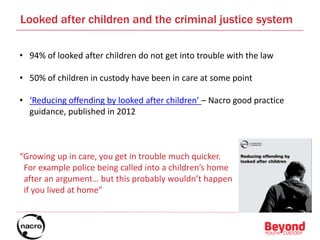
• 94% of looked after children do not get into trouble with the law
• 50% of children in custody have been in care at some point
• ‘Reducing offending by looked after children’ – Nacro good practice
guidance, published in 2012
“Growing up in care, you get in trouble much quicker.
For example police being called into a children’s home
after an argument… but this probably wouldn’t happen
if you lived at home”
• Sharp decline in number of young people in custody. In August
2016, 881 under 18s in custody
• This reduction is welcome but poses new and significant
challenges:
 67% reoffend within a year
 Entrenched pattern of offending, more serious offences
 Higher concentration of more complex needs
 Escalating levels of violence and gang related issues
 Over representation of Black Asian and Minority Ethnic
(BAME) and looked after children
 Young people held at greater distances away from home
Youth custody – current context
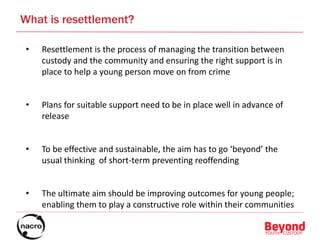
• Resettlement is the process of managing the transition between
custody and the community and ensuring the right support is in
place to help a young person move on from crime
• Plans for suitable support need to be in place well in advance of
release
• To be effective and sustainable, the aim has to go ‘beyond’ the
usual thinking of short-term preventing reoffending
• The ultimate aim should be improving outcomes for young people;
enabling them to play a constructive role within their communities
5
What is resettlement?
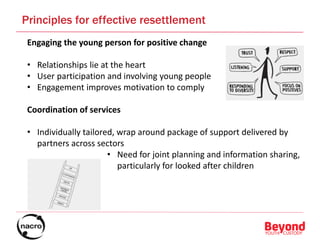
Engaging the young person for positive change
• Relationships lie at the heart
• User participation and involving young people
• Engagement improves motivation to comply
Coordination of services
• Individually tailored, wrap around package of support delivered by
partners across sectors
• Need for joint planning and information sharing,
particularly for looked after children
Principles for effective resettlement
Preparation for release needs to start early
• Should begin at point of entering custody
• Temporary release to meet providers of services, set-up employment or
education, refamiliarisation
• Securing stable and suitable accommodation is key
Sentence planning should focus on resettlement
• Continuous service needed between custody and community, with
sentence planning focused on resettlement throughout
• Work done in custody should carry on in the community
Principles for effective resettlement
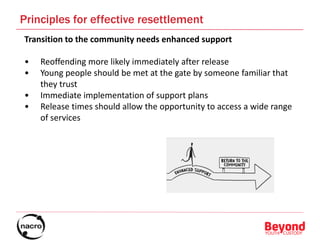
Transition to the community needs enhanced support
• Reoffending more likely immediately after release
• Young people should be met at the gate by someone familiar that
they trust
• Immediate implementation of support plans
• Release times should allow the opportunity to access a wide range
of services
Principles for effective resettlement
Looked after children and custody
• Looked after children in custody have more complex needs than their
peers
• Some report not receiving visits from social workers, making them
anxious about future plans, including where they would be living on
release
• Young people’s looked after status is not always properly identified
meaning they do not always receive statutory support they are entitled
to
“Aren't looked after children supposed to be looked after?”
• These factors can cause additional barriers to supporting young people
in custody and planning for their release
Discussion question
How can we provide effective support for care leavers
leaving custody?
• How might the young person be feeling
leading up to release/ what might their
needs be?
• How can individuals / agencies ensure these
needs are met?
More information
www.nacro.org.uk
www.beyondyouthcustody.net/
beyondyouthcustody@nacro.org.uk
Effective resettlement for care leavers

Effective resettlement for care leavers

  • 1.
    Beyond Youth Custody: Effective resettlement for care leavers leaving custody Jacob Tas Nacro Chief Executive Tuesday 25 October National Care Leavers Week Conference 2016
  • 2.
    Nacro / BeyondYouth Custody (BYC) Nacro • Social justice charity, celebrating 50 years: • Housing • Education • Justice • Health • Research and policy Beyond Youth Custody • Five year programme funded by the Big Lottery • Exists to challenge, advance, and promote better thinking in policy and practice for the effective resettlement of young people leaving custody • Partnership with Nacro, the university of Salford, university of Bedfordshire and ARCS (UK)
  • 3.
    Looked after childrenand the criminal justice system • 94% of looked after children do not get into trouble with the law • 50% of children in custody have been in care at some point • ‘Reducing offending by looked after children’ – Nacro good practice guidance, published in 2012 “Growing up in care, you get in trouble much quicker. For example police being called into a children’s home after an argument… but this probably wouldn’t happen if you lived at home”
  • 4.
    • Sharp declinein number of young people in custody. In August 2016, 881 under 18s in custody • This reduction is welcome but poses new and significant challenges:  67% reoffend within a year  Entrenched pattern of offending, more serious offences  Higher concentration of more complex needs  Escalating levels of violence and gang related issues  Over representation of Black Asian and Minority Ethnic (BAME) and looked after children  Young people held at greater distances away from home Youth custody – current context
  • 5.
    • Resettlement isthe process of managing the transition between custody and the community and ensuring the right support is in place to help a young person move on from crime • Plans for suitable support need to be in place well in advance of release • To be effective and sustainable, the aim has to go ‘beyond’ the usual thinking of short-term preventing reoffending • The ultimate aim should be improving outcomes for young people; enabling them to play a constructive role within their communities 5 What is resettlement?
  • 6.
    Engaging the youngperson for positive change • Relationships lie at the heart • User participation and involving young people • Engagement improves motivation to comply Coordination of services • Individually tailored, wrap around package of support delivered by partners across sectors • Need for joint planning and information sharing, particularly for looked after children Principles for effective resettlement
  • 7.
    Preparation for releaseneeds to start early • Should begin at point of entering custody • Temporary release to meet providers of services, set-up employment or education, refamiliarisation • Securing stable and suitable accommodation is key Sentence planning should focus on resettlement • Continuous service needed between custody and community, with sentence planning focused on resettlement throughout • Work done in custody should carry on in the community Principles for effective resettlement
  • 8.
    Transition to thecommunity needs enhanced support • Reoffending more likely immediately after release • Young people should be met at the gate by someone familiar that they trust • Immediate implementation of support plans • Release times should allow the opportunity to access a wide range of services Principles for effective resettlement
  • 9.
    Looked after childrenand custody • Looked after children in custody have more complex needs than their peers • Some report not receiving visits from social workers, making them anxious about future plans, including where they would be living on release • Young people’s looked after status is not always properly identified meaning they do not always receive statutory support they are entitled to “Aren't looked after children supposed to be looked after?” • These factors can cause additional barriers to supporting young people in custody and planning for their release
  • 10.
    Discussion question How canwe provide effective support for care leavers leaving custody? • How might the young person be feeling leading up to release/ what might their needs be? • How can individuals / agencies ensure these needs are met?
  • 11.

Editor's Notes

  • #3 Nacro delivers services across the country that support vulnerable young people and care leavers – you may wish to reference specific projects / your experiences Under the same ‘YIF’ funding stream, the Big Lottery also fund the Prince’s Trust to deliver ‘From Care to Independence’ programme that helps understand the support needs of care leavers and ‘what works’ in supporting them into education and employment. Thank them for organising this conference and inviting us here to speak This year is the final year of the Beyond Youth Custody programme, where we reflect on our learning about how to help young people resettle back into the community. Many of the key findings coming out of the research for custody leavers are just as applicable when looking at supporting young care leavers - the importance of fostering trusted relationships, continuity and proper co-ordination of services and listening to young people and hearing what they have to say – giving them opportunities to have their voice heard
  • #4 The statistics are from Prison Reform Trust ‘Keeping in care out of trouble’ a recent independent review led by Lord Laming. The exact figures of over-representation vary depending on the source– eg. recent Review of Residential Care conducted by Sir Martin Narey reports a figure of 28%. Other estimates are higher, others are lower. Regardless of which figures you look at. It must be agreed that it is too high and that opportunities are being missed. Nacro’s ‘Reducing offending by looked after children’ offers good practice guidance to local authorities and their partner agencies to help them improve outcomes for looked after children and reduce the likelihood of them offending Risk factors that may predict involvement in criminal activity are similar to those that may predict looked after status (backgrounds of deprivation, poor parenting, abuse and neglect) Systemic risks of criminalisation when protocols with the police (ie, to use non-criminal responses) are not observed. Quicker escalation into the criminal justice system
  • #5 Multiple reviews and changing political environment – Charlie Taylor (Youth Justice), Lord Laming Review (LAC), Lord Lammy Review (BAME), Martin Narey (children’s residential care)
  • #7 Proper co-ordination of services can be even more crucial for looked after children who are released from custody (even more agencies and individuals YOTs, Social Workers, Independent Reviewing Officers, Local Authority Managers etc). Plans and interventions provided by or carried out within the youth justice system should be integrated within pathway plans for children leaving care services.
  • #8 Early planning for release is crucial so that interventions start promptly on release and so a young person has time to prepare themselves for where they will be living and what they will be doing on release
  • #9 Uncertainty over future arrangements can cause anxiety and stress for young people in the run up to release. It’s very important that planning for release starts early, not only to ease young people’s anxiety but also so there is no gap in support between custody and the community. Stability can be a protective factor against offending, so it is important that this is considered
  • #10 Looked after children are more likely to report health problems on arrival to custody, have substance misuse issues and emotional and mental health problems Inspection reports have shown that half of those interviewed said they had not been visited by their social worker in custody or received financial support from their local authority. This made them anxious about their future plans and about where they would be living upon release .
  • #11 Encourage delegates to write down key ideas from discussions on the activity sheets on their tables. We will be collecting these and writing up. Alert delegates to the copies of Beyond Youth Custody report on their tables, which they are free to take away with them