#CILIPConf17
Sponsored by Media partners Organised by
Developing the
Workforce Briefing
#CILIPConf17
Sponsored by Media partners Organised by
Introducing the Public
Library Skills Strategy
Mandy Powell, Assistant Director of
Workforce Development, CILIP
Mandy Powell
Assistant Director Workforce Development
CILIP Conference July 2017, Manchester
Public Library Skills Strategy
2017-2030
Published jointly by the Society of Chief Librarians (SCL)
and the Chartered Institute of Library and Information
Professionals (CILIP)
The Public Library Skills Strategy (PLSS) will...
1. Guide the development of information and library skills, knowledge and
qualifications in the Public Library Sector in England between now and 2030
1. Support a future for Public Libraries as Digital, Creative & Cultural Centres of
Excellence - a thriving network of innovative civic spaces (virtual and physical)
offering freely-accessible services that support reading & literacy, develop skills, foster
creativity, promote health & wellbeing and provide a platform for community
participation
Scope
The Public Library Skills Strategy is focused on public libraries in England, however in
developing the strategy the Steering Group consulted with representatives from Scotland,
Wales and Northern Ireland and with experts from the wider Information, Library and
Knowledge sectors including Health Libraries, Schools Libraries, Government Libraries and
The British Library.
The Public Library Skills Strategy is intended as a pre-cursor to the wider UK Information
Skills Strategy, which will be developed in partnership between 2018-2020.
Working Group
CILIP and SCL joint lead the development of the strategy with the help of a working group
made up of library practitioners from across England, the group included frontline,
specialist and senior staff as well as student representation, with support from CILIP
staff who have a key role in workforce development.
Vision
The Vision which drives this Strategy is of a future for Public Libraries in England as Digital,
Creative & Cultural Centres of Excellence - a thriving network of innovative civic
spaces (virtual and physical) offering freely-accessible services that support reading &
literacy, develop skills, foster creativity, promote and support health & wellbeing and provide
a platform for community participation.
Our vision puts information and library skills and values at the heart of public
service delivery. We will ensure that the expertise of our profession is recognised and
valued by Local Authorities for its ability to develop and deliver quality services that meet
community needs.
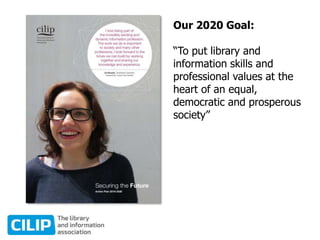
Our 2020 Goal:
“To put library and
information skills and
professional values at the
heart of an equal,
democratic and prosperous
society”
Public Library Sector in England
•3,000+ physical service points
•Embedded in communities, schools, hospitals
•Developing online offer- digital services
•Lead and supported by 11,000 skilled
library and information experts
Expert knowledge Skills Ethics
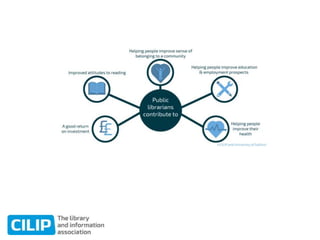
Public libraries are uniquely
positioned to harness the
power of technology,
creativity and
participation to deliver
measurable impact against
key local and national
government agendas
•Business and enterprise
•Skills and employability
•Health and wellbeing
•Learning and education
•Communities
Changes and Challenges
Ageing workforce
45% of current info and library workforce due to reach
retirement age buy 2030
Lack of ethnic representation
97% of UK info and library workforce self identify as white
(compared to 88% in the population)
Gender pay gap
Workforce is 79% female, 21% male, but 47% of top
earners in the profession are men
CILIP Workforce Mapping report
PLSS
•9 aims to guide the future development of the workforce
•10 Recommendations
•Local and National level
Guide employers- recognise and value skills of the
profession, support job creation
Support individuals- develop skills, plan careers, lead
1. Attracting, retaining and developing talent
2. Targeting inclusion, diversity, representation and equality
3. Investing in professional skills and ethics
4. Promoting leadership at every level
5. An open, inclusive approach to professionalism
6. Lowering the barriers to entry
7. A commitment to Continuing Professional Development
8. Valuing transferable skills
9. Looking beyond the sector
9 Aims
1. Attracting, retaining and developing talent
The sector needs to attract the best new talent, from diverse backgrounds, to work in
information and library services
2. Targeting inclusion, diversity, representation and equality
We need to ensure that the Public Library workforce represents and is inclusive of the full
range of communities we serve, proactively targeting exclusion and inequality
3. Investing in professional skills and ethics
The Public Library workforce combines skills and knowledge with professional ethics;
employers can be confident in the delivery of modern, relevant library services
4. Promoting leadership at every level
The sector needs to promote leadership at every level of the workforce, encouraging and
supporting staff at every level to contribute to the development of services
5. An open, inclusive approach to professionalism
While Public Libraries continue to need access to specialist library and information skills, we
will no longer assume that specialist expertise and skills are exclusively vested in the library
and information professional
6. Lowering the barriers to entry
Our approach to Workforce Development must offer multiple pathways into working in
Public Libraries, combining both academic and non-academic routes while continuing to
support Professional Registration and qualifications;
7. A commitment to Continuing Professional Development
We recognise the inherent professionalism offered by people joining at a variety of entry
levels, with varied ambitions for their own development, and are committed to supporting
lifelong learning and CPD for all Public Library staff;
8. Valuing transferable skills
We acknowledge and celebrate the fact that people will move into and out of the Public
Library sector, bringing with them a broad mix of skills and professional experience;
9. Looking beyond the sector
We need to identify and address the information and learning needs of wider stakeholders
beyond the Public Library sector.
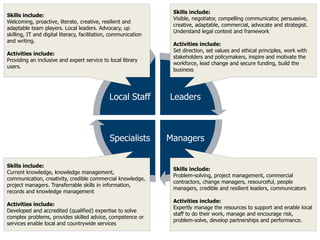
Towards a Skills Framework
Leaders
ManagersSpecialists
Local Staff
Skills include:
Visible, negotiator, compelling communicator, persuasive,
creative, adaptable, commercial, advocate and strategist.
Understand legal context and framework
Activities include:
Set direction, set values and ethical principles, work with
stakeholders and policymakers, inspire and motivate the
workforce, lead change and secure funding, build the
business
Skills include:
Problem-solving, project management, commercial
contractors, change managers, resourceful, people
managers, credible and resilient leaders, communicators
Activities include:
Expertly manage the resources to support and enable local
staff to do their work, manage and encourage risk,
problem-solve, develop partnerships and performance.
Skills include:
Current knowledge, knowledge management,
communication, creativity, credible commercial knowledge,
project managers. Transferrable skills in information,
records and knowledge management
Activities include:
Developed and accredited (qualified) expertise to solve
complex problems, provides skilled advice, competence or
services enable local and countrywide services
Skills include:
Welcoming, proactive, literate, creative, resilient and
adaptable team players. Local leaders. Advocacy, up
skilling, IT and digital literacy, facilitation, communication
and writing.
Activities include:
Providing an inclusive and expert service to local library
users.
Recommendations
Aim 1: Attracting, retaining and developing talent
Recommendation 1.1: A national advocacy campaign celebrating the
workforce
Advocate the skills of the sector
Create recognition and understating
Attract new generation
Recommendation 1.2: Development of an Employer Engagement Plan
SCL and CILIP working with employers
Highlight benefits of CPD programmes
Job creation
Aim 2: Targeting inclusion, diversity, representation and equality
Recommendation 2.1: A Diversity and Equality Plan for the Sector
CILIP Ethics Committee
Develop a diversity and equality plan for the profession
Celebrate and support diversity, inclusion and representation
Aim 3: Investing in professional skills and ethics
Recommendation 3.1: Revisiting the role of professional ethics in
Public Libraries
CILIP has launched an 18 month ethics review
Revise the Ethical Principles of librarianship
CILIP and SCL will work together to re-state the role of professional
ethics in public libraries
Aim 4: Promoting leadership at every level
Recommendation 4.1: Develop a Public Libraries Leadership
programme
CILIP and SCL work together to develop and implement
Help talented staff grow into roles of influence
Aim 5: An open, inclusive approach to professionalism
Recommendation 5.1: Changing the way we think about
‘professionalism’
CILIP adopting new, more open and inclusive approach
Recognising and celebrating professional attitude
Supported by Professional Registration
SCL and CILIP working together
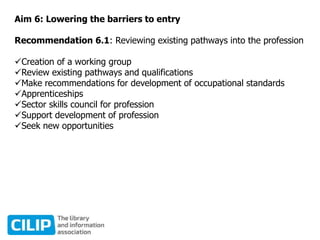
Aim 6: Lowering the barriers to entry
Recommendation 6.1: Reviewing existing pathways into the profession
Creation of a working group
Review existing pathways and qualifications
Make recommendations for development of occupational standards
Apprenticeships
Sector skills council for profession
Support development of profession
Seek new opportunities
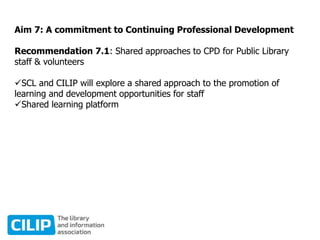
Aim 7: A commitment to Continuing Professional Development
Recommendation 7.1: Shared approaches to CPD for Public Library
staff & volunteers
SCL and CILIP will explore a shared approach to the promotion of
learning and development opportunities for staff
Shared learning platform
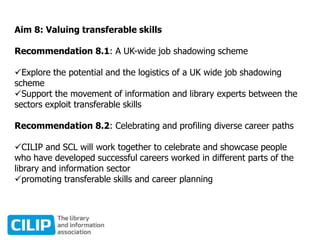
Aim 8: Valuing transferable skills
Recommendation 8.1: A UK-wide job shadowing scheme
Explore the potential and the logistics of a UK wide job shadowing
scheme
Support the movement of information and library experts between the
sectors exploit transferable skills
Recommendation 8.2: Celebrating and profiling diverse career paths
CILIP and SCL will work together to celebrate and showcase people
who have developed successful careers worked in different parts of the
library and information sector
promoting transferable skills and career planning
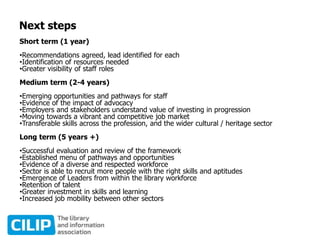
Next steps
Short term (1 year)
•Recommendations agreed, lead identified for each
•Identification of resources needed
•Greater visibility of staff roles
Medium term (2-4 years)
•Emerging opportunities and pathways for staff
•Evidence of the impact of advocacy
•Employers and stakeholders understand value of investing in progression
•Moving towards a vibrant and competitive job market
•Transferable skills across the profession, and the wider cultural / heritage sector
Long term (5 years +)
•Successful evaluation and review of the framework
•Established menu of pathways and opportunities
•Evidence of a diverse and respected workforce
•Sector is able to recruit more people with the right skills and aptitudes
•Emergence of Leaders from within the library workforce
•Retention of talent
•Greater investment in skills and learning
•Increased job mobility between other sectors
Thank You
PLSS working group
Alison Wheeler
Mandy Powell
Tracey Cox
Julie Griffiths
Sue Wills
Subnum Khan
Hannah Boroudjou
Zsuzsanna Nemeth
Sara Teers
Claire Back
Chris Fardon
Luke Stevens-Burt
Jo Cornish
Julia Chandler
Supported by
Nick Poole
Simon Berney-Edwards
Kate Arnold
Neil MacInnes
Libraries Taskforce
Mandy Powell
Assistant Director Workforce Development
07837 032 536
mandy.powell@cilip.org.uk
Introducing the Public Library Skills Strategy

Introducing the Public Library Skills Strategy

  • 1.
    #CILIPConf17 Sponsored by Mediapartners Organised by Developing the Workforce Briefing
  • 2.
    #CILIPConf17 Sponsored by Mediapartners Organised by Introducing the Public Library Skills Strategy Mandy Powell, Assistant Director of Workforce Development, CILIP
  • 3.
    Mandy Powell Assistant DirectorWorkforce Development CILIP Conference July 2017, Manchester
  • 4.
    Public Library SkillsStrategy 2017-2030 Published jointly by the Society of Chief Librarians (SCL) and the Chartered Institute of Library and Information Professionals (CILIP)
  • 5.
    The Public LibrarySkills Strategy (PLSS) will... 1. Guide the development of information and library skills, knowledge and qualifications in the Public Library Sector in England between now and 2030 1. Support a future for Public Libraries as Digital, Creative & Cultural Centres of Excellence - a thriving network of innovative civic spaces (virtual and physical) offering freely-accessible services that support reading & literacy, develop skills, foster creativity, promote health & wellbeing and provide a platform for community participation
  • 6.
    Scope The Public LibrarySkills Strategy is focused on public libraries in England, however in developing the strategy the Steering Group consulted with representatives from Scotland, Wales and Northern Ireland and with experts from the wider Information, Library and Knowledge sectors including Health Libraries, Schools Libraries, Government Libraries and The British Library. The Public Library Skills Strategy is intended as a pre-cursor to the wider UK Information Skills Strategy, which will be developed in partnership between 2018-2020.
  • 7.
    Working Group CILIP andSCL joint lead the development of the strategy with the help of a working group made up of library practitioners from across England, the group included frontline, specialist and senior staff as well as student representation, with support from CILIP staff who have a key role in workforce development.
  • 8.
    Vision The Vision whichdrives this Strategy is of a future for Public Libraries in England as Digital, Creative & Cultural Centres of Excellence - a thriving network of innovative civic spaces (virtual and physical) offering freely-accessible services that support reading & literacy, develop skills, foster creativity, promote and support health & wellbeing and provide a platform for community participation. Our vision puts information and library skills and values at the heart of public service delivery. We will ensure that the expertise of our profession is recognised and valued by Local Authorities for its ability to develop and deliver quality services that meet community needs.
  • 9.
    Our 2020 Goal: “Toput library and information skills and professional values at the heart of an equal, democratic and prosperous society”
  • 10.
    Public Library Sectorin England •3,000+ physical service points •Embedded in communities, schools, hospitals •Developing online offer- digital services •Lead and supported by 11,000 skilled library and information experts Expert knowledge Skills Ethics
  • 11.
    Public libraries areuniquely positioned to harness the power of technology, creativity and participation to deliver measurable impact against key local and national government agendas •Business and enterprise •Skills and employability •Health and wellbeing •Learning and education •Communities
  • 12.
    Changes and Challenges Ageingworkforce 45% of current info and library workforce due to reach retirement age buy 2030 Lack of ethnic representation 97% of UK info and library workforce self identify as white (compared to 88% in the population) Gender pay gap Workforce is 79% female, 21% male, but 47% of top earners in the profession are men CILIP Workforce Mapping report
  • 13.
    PLSS •9 aims toguide the future development of the workforce •10 Recommendations •Local and National level Guide employers- recognise and value skills of the profession, support job creation Support individuals- develop skills, plan careers, lead
  • 14.
    1. Attracting, retainingand developing talent 2. Targeting inclusion, diversity, representation and equality 3. Investing in professional skills and ethics 4. Promoting leadership at every level 5. An open, inclusive approach to professionalism 6. Lowering the barriers to entry 7. A commitment to Continuing Professional Development 8. Valuing transferable skills 9. Looking beyond the sector
  • 15.
    9 Aims 1. Attracting,retaining and developing talent The sector needs to attract the best new talent, from diverse backgrounds, to work in information and library services 2. Targeting inclusion, diversity, representation and equality We need to ensure that the Public Library workforce represents and is inclusive of the full range of communities we serve, proactively targeting exclusion and inequality 3. Investing in professional skills and ethics The Public Library workforce combines skills and knowledge with professional ethics; employers can be confident in the delivery of modern, relevant library services
  • 16.
    4. Promoting leadershipat every level The sector needs to promote leadership at every level of the workforce, encouraging and supporting staff at every level to contribute to the development of services 5. An open, inclusive approach to professionalism While Public Libraries continue to need access to specialist library and information skills, we will no longer assume that specialist expertise and skills are exclusively vested in the library and information professional 6. Lowering the barriers to entry Our approach to Workforce Development must offer multiple pathways into working in Public Libraries, combining both academic and non-academic routes while continuing to support Professional Registration and qualifications;
  • 17.
    7. A commitmentto Continuing Professional Development We recognise the inherent professionalism offered by people joining at a variety of entry levels, with varied ambitions for their own development, and are committed to supporting lifelong learning and CPD for all Public Library staff; 8. Valuing transferable skills We acknowledge and celebrate the fact that people will move into and out of the Public Library sector, bringing with them a broad mix of skills and professional experience; 9. Looking beyond the sector We need to identify and address the information and learning needs of wider stakeholders beyond the Public Library sector.
  • 19.
    Towards a SkillsFramework Leaders ManagersSpecialists Local Staff Skills include: Visible, negotiator, compelling communicator, persuasive, creative, adaptable, commercial, advocate and strategist. Understand legal context and framework Activities include: Set direction, set values and ethical principles, work with stakeholders and policymakers, inspire and motivate the workforce, lead change and secure funding, build the business Skills include: Problem-solving, project management, commercial contractors, change managers, resourceful, people managers, credible and resilient leaders, communicators Activities include: Expertly manage the resources to support and enable local staff to do their work, manage and encourage risk, problem-solve, develop partnerships and performance. Skills include: Current knowledge, knowledge management, communication, creativity, credible commercial knowledge, project managers. Transferrable skills in information, records and knowledge management Activities include: Developed and accredited (qualified) expertise to solve complex problems, provides skilled advice, competence or services enable local and countrywide services Skills include: Welcoming, proactive, literate, creative, resilient and adaptable team players. Local leaders. Advocacy, up skilling, IT and digital literacy, facilitation, communication and writing. Activities include: Providing an inclusive and expert service to local library users.
  • 20.
    Recommendations Aim 1: Attracting,retaining and developing talent Recommendation 1.1: A national advocacy campaign celebrating the workforce Advocate the skills of the sector Create recognition and understating Attract new generation Recommendation 1.2: Development of an Employer Engagement Plan SCL and CILIP working with employers Highlight benefits of CPD programmes Job creation
  • 21.
    Aim 2: Targetinginclusion, diversity, representation and equality Recommendation 2.1: A Diversity and Equality Plan for the Sector CILIP Ethics Committee Develop a diversity and equality plan for the profession Celebrate and support diversity, inclusion and representation
  • 22.
    Aim 3: Investingin professional skills and ethics Recommendation 3.1: Revisiting the role of professional ethics in Public Libraries CILIP has launched an 18 month ethics review Revise the Ethical Principles of librarianship CILIP and SCL will work together to re-state the role of professional ethics in public libraries
  • 23.
    Aim 4: Promotingleadership at every level Recommendation 4.1: Develop a Public Libraries Leadership programme CILIP and SCL work together to develop and implement Help talented staff grow into roles of influence
  • 24.
    Aim 5: Anopen, inclusive approach to professionalism Recommendation 5.1: Changing the way we think about ‘professionalism’ CILIP adopting new, more open and inclusive approach Recognising and celebrating professional attitude Supported by Professional Registration SCL and CILIP working together
  • 25.
    Aim 6: Loweringthe barriers to entry Recommendation 6.1: Reviewing existing pathways into the profession Creation of a working group Review existing pathways and qualifications Make recommendations for development of occupational standards Apprenticeships Sector skills council for profession Support development of profession Seek new opportunities
  • 26.
    Aim 7: Acommitment to Continuing Professional Development Recommendation 7.1: Shared approaches to CPD for Public Library staff & volunteers SCL and CILIP will explore a shared approach to the promotion of learning and development opportunities for staff Shared learning platform
  • 27.
    Aim 8: Valuingtransferable skills Recommendation 8.1: A UK-wide job shadowing scheme Explore the potential and the logistics of a UK wide job shadowing scheme Support the movement of information and library experts between the sectors exploit transferable skills Recommendation 8.2: Celebrating and profiling diverse career paths CILIP and SCL will work together to celebrate and showcase people who have developed successful careers worked in different parts of the library and information sector promoting transferable skills and career planning
  • 28.
    Next steps Short term(1 year) •Recommendations agreed, lead identified for each •Identification of resources needed •Greater visibility of staff roles Medium term (2-4 years) •Emerging opportunities and pathways for staff •Evidence of the impact of advocacy •Employers and stakeholders understand value of investing in progression •Moving towards a vibrant and competitive job market •Transferable skills across the profession, and the wider cultural / heritage sector Long term (5 years +) •Successful evaluation and review of the framework •Established menu of pathways and opportunities •Evidence of a diverse and respected workforce •Sector is able to recruit more people with the right skills and aptitudes •Emergence of Leaders from within the library workforce •Retention of talent •Greater investment in skills and learning •Increased job mobility between other sectors
  • 29.
    Thank You PLSS workinggroup Alison Wheeler Mandy Powell Tracey Cox Julie Griffiths Sue Wills Subnum Khan Hannah Boroudjou Zsuzsanna Nemeth Sara Teers Claire Back Chris Fardon Luke Stevens-Burt Jo Cornish Julia Chandler Supported by Nick Poole Simon Berney-Edwards Kate Arnold Neil MacInnes Libraries Taskforce
  • 30.
    Mandy Powell Assistant DirectorWorkforce Development 07837 032 536 mandy.powell@cilip.org.uk

Editor's Notes

  • #20 Skills to meet future needs