Alyson McGregor
Director
Altogether Better
Who are we?
National network organisation- hosted by the NHS
Working with experienced academics, researchers and clinicians
have developed an award winning, evidenced based approach to engaging
people and communities
Pioneered Community Health Champion model starting in 2008 working
with more than 21,000 health champions, gone on to develop champion
models tailored to specific groups and settings
Use a whole system approach which creates the conditions for
a new relationship between citizens and services which has
the potential to create a new model of general practice
• Changing role of the NHS - unprecedented challenge
• Paradigm shift away from the ‘medical model’
• Primary care no longer sustainable
• NHS 5YFV: need a “more engaged relationship with patients,
carers and citizens”
• Clinicians driven by desire for the best consultation – but need to
see the right patients
• Multidisciplinary team needed to see patterns
• Living well with LTC best achieved in community context
Why Change?
• Much talked about in the NHS but rarely achieved
• Altogether Better working with citizens and services discovered
the potential to transform services
• Radical attempt at system change designed to enable the
practice and population they serve to co-evolve
• Looks at the system as a whole
• More than a shift in boundaries from one practitioner to
another
System Change
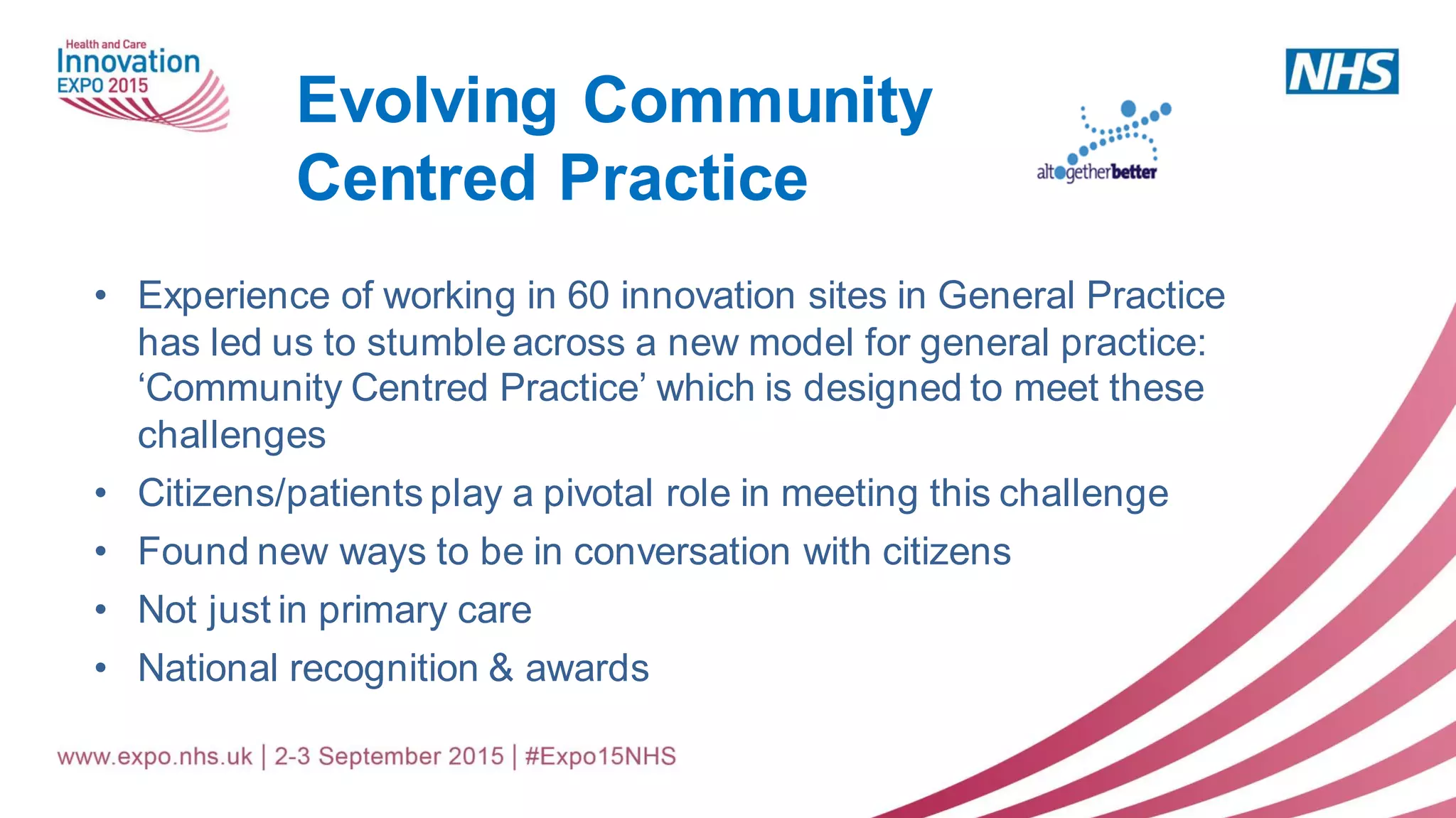
• Experience of working in 60 innovation sites in General Practice
has led us to stumble across a new model for general practice:
‘Community Centred Practice’ which is designed to meet these
challenges
• Citizens/patients play a pivotal role in meeting this challenge
• Found new ways to be in conversation with citizens
• Not just in primary care
• National recognition & awards
Evolving Community
Centred Practice
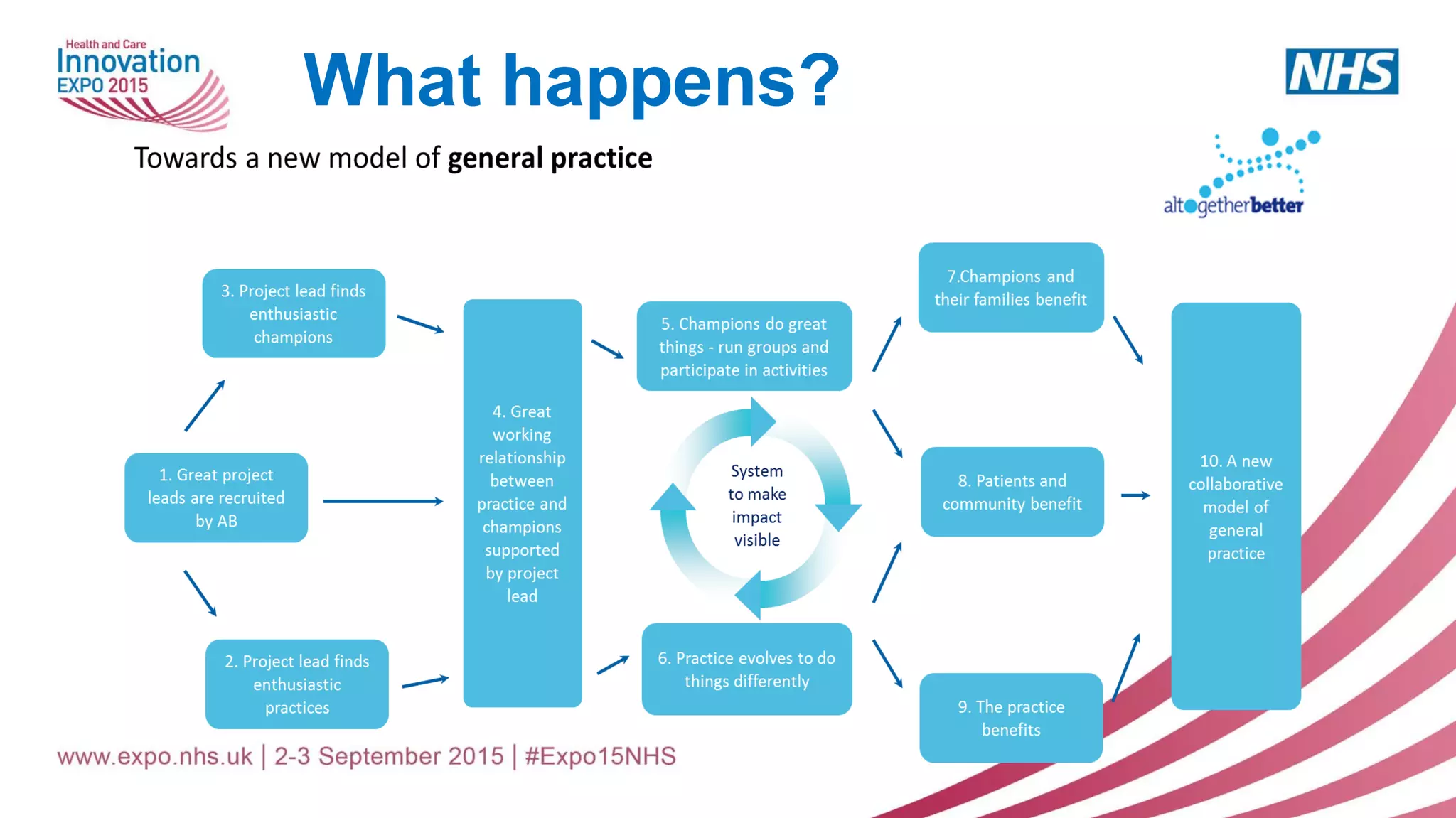
What happens?
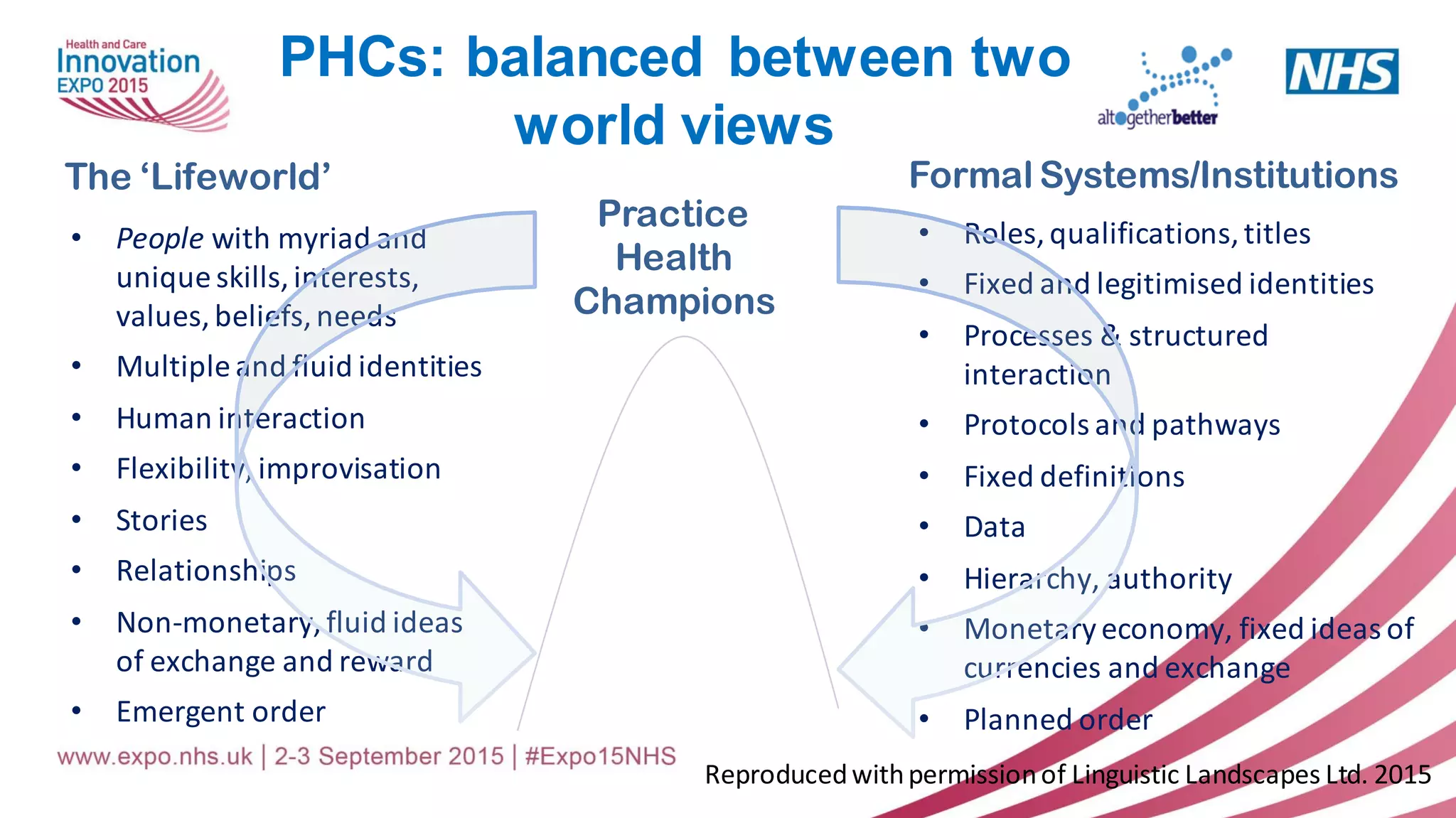
• People with myriad and
unique skills,interests,
values,beliefs,needs
• Multiple and fluid identities
• Human interaction
• Flexibility,improvisation
• Stories
• Relationships
• Non-monetary,fluid ideas
of exchange and reward
• Emergent order
• Roles,qualifications,titles
• Fixed and legitimised identities
• Processes & structured
interaction
• Protocols and pathways
• Fixed definitions
• Data
• Hierarchy, authority
• Monetaryeconomy, fixed ideas of
currencies and exchange
• Planned order
The ‘Lifeworld’
Practice
Health
Champions
Formal Systems/Institutions
PHCs: balanced between two
world views
Reproducedwithpermissionof Linguistic Landscapes Ltd. 2015
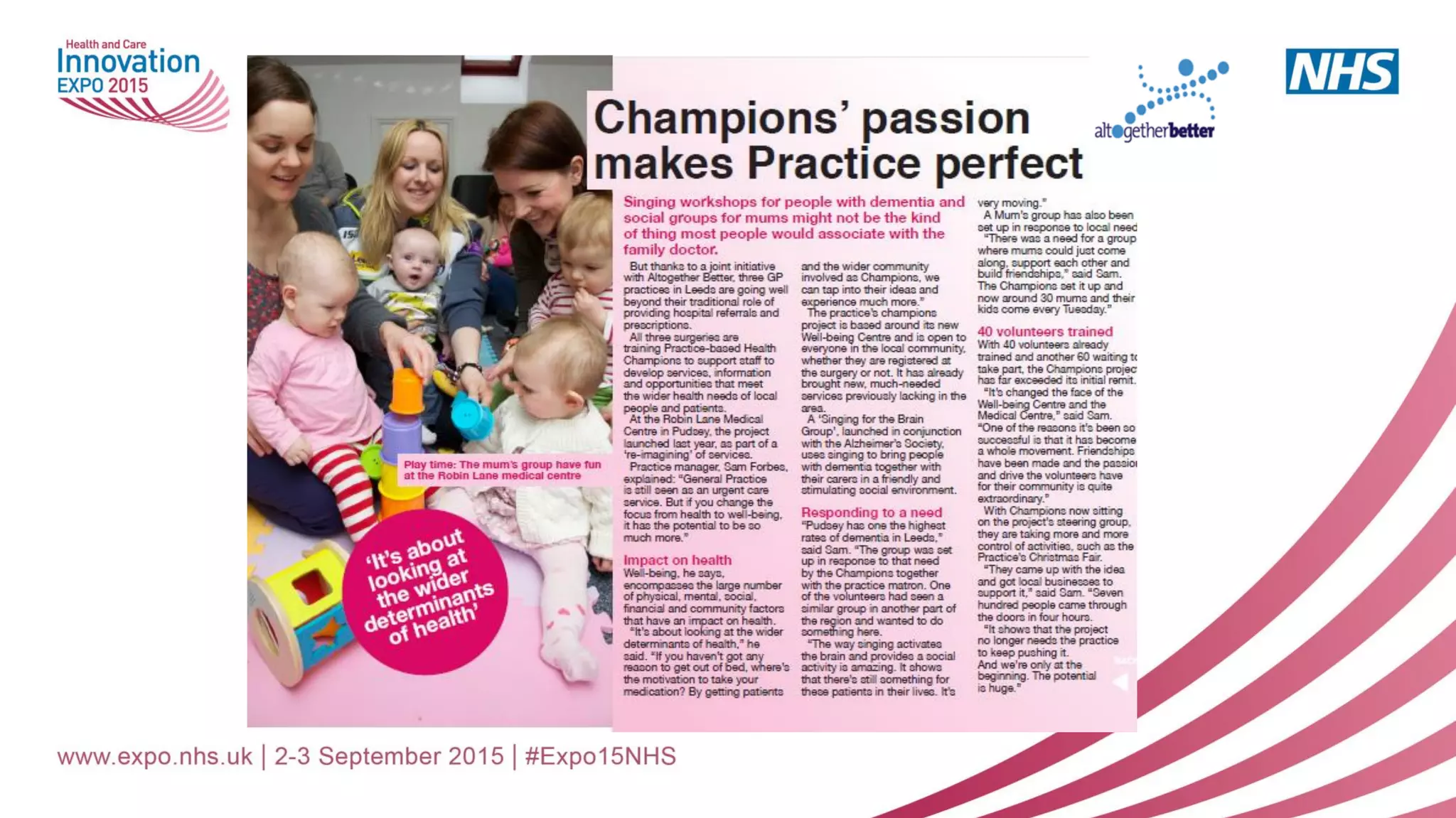
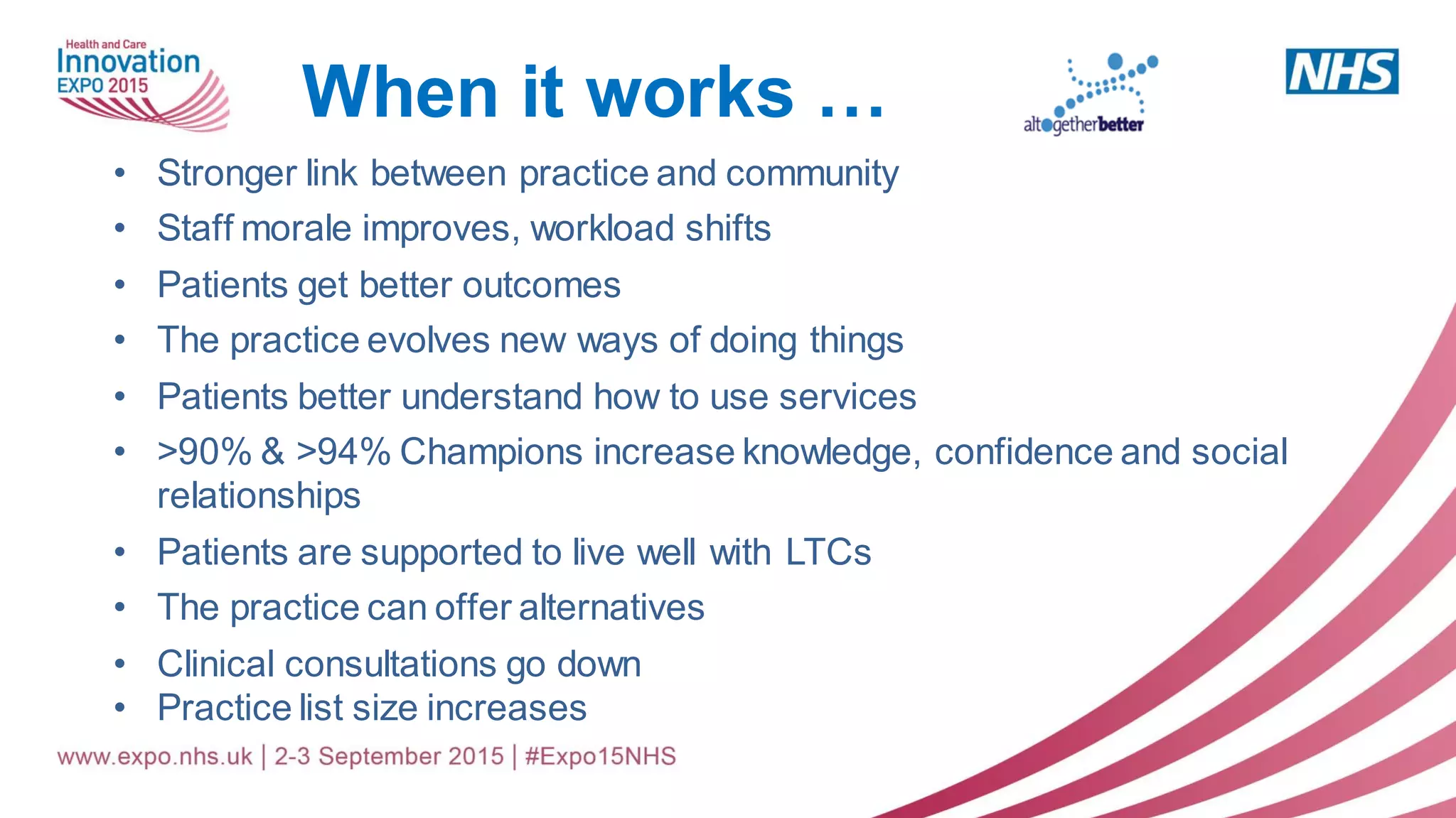
• Stronger link between practice and community
• Staff morale improves, workload shifts
• Patients get better outcomes
• The practice evolves new ways of doing things
• Patients better understand how to use services
• >90% & >94% Champions increase knowledge, confidence and social
relationships
• Patients are supported to live well with LTCs
• The practice can offer alternatives
• Clinical consultations go down
• Practice list size increases
When it works …
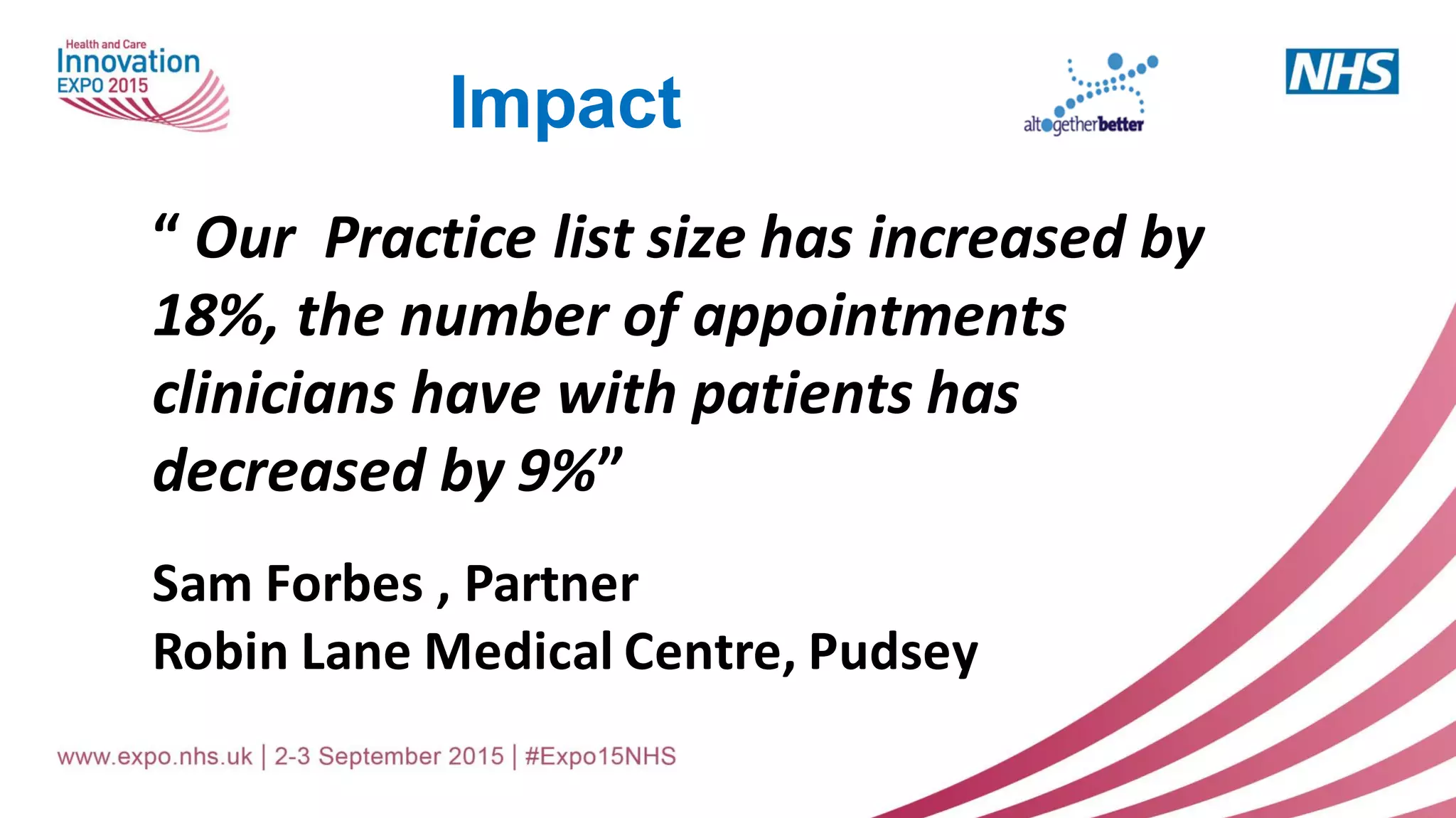
“ Our Practice list size has increased by
18%, the number of appointments
clinicians have with patients has
decreased by 9%”
Sam Forbes , Partner
Robin Lane Medical Centre, Pudsey
Impact
Valuing and Encouraging Community Volunteering in Health and Care
Reducing Pressures on Hospitals Fund
Ravneet Virdi, Cabinet Office
Ravneet.Virdi@cabinetoffice.gov.uk
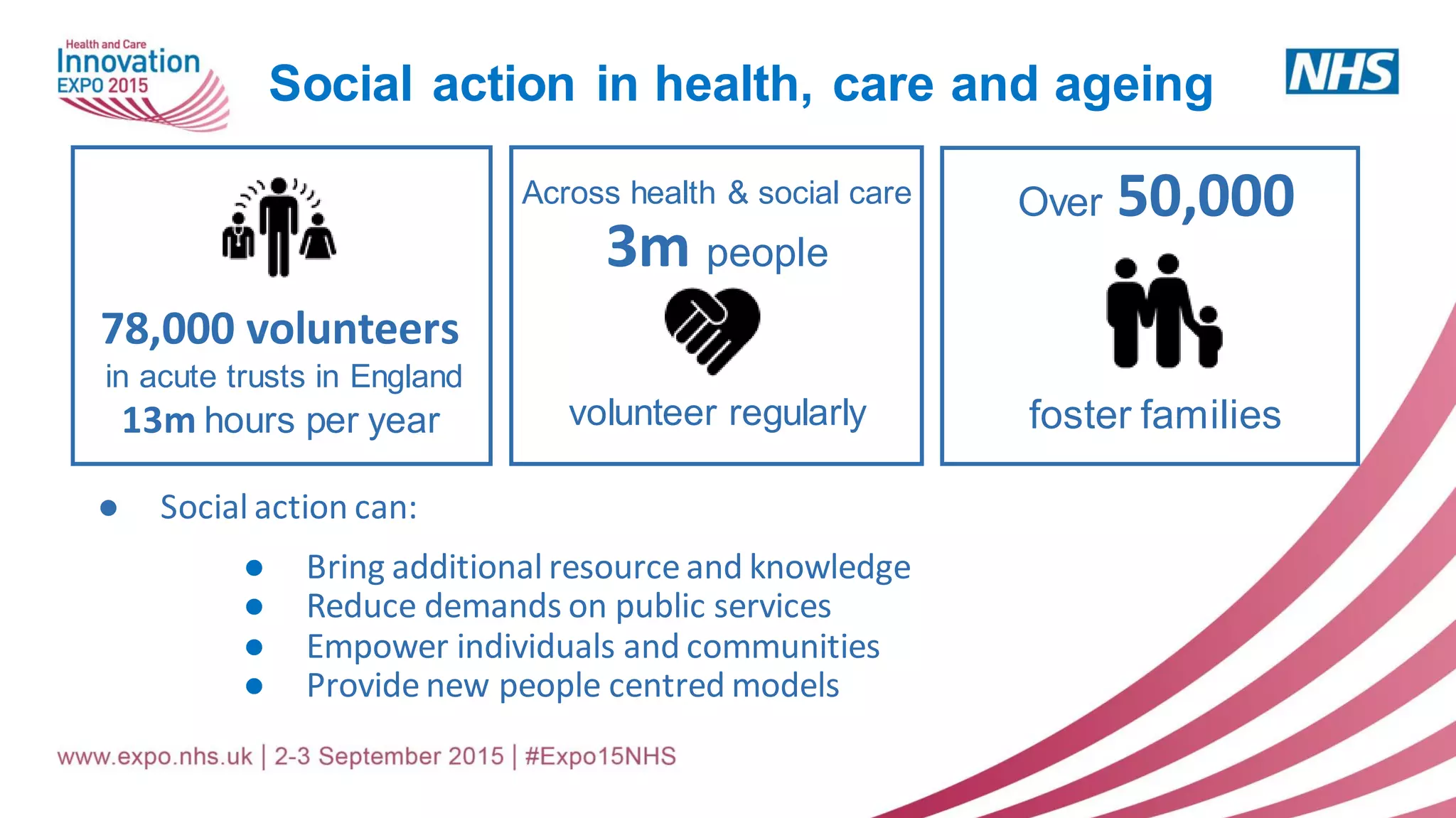
Social action in health, care and ageing
● Social action can:
● Bring additional resource and knowledge
● Reduce demands on public services
● Empower individuals and communities
● Provide new people centred models
78,000 volunteers
in acute trusts in England
13m hours per year foster families
3m people
volunteer regularly
Over 50,000Across health & social care
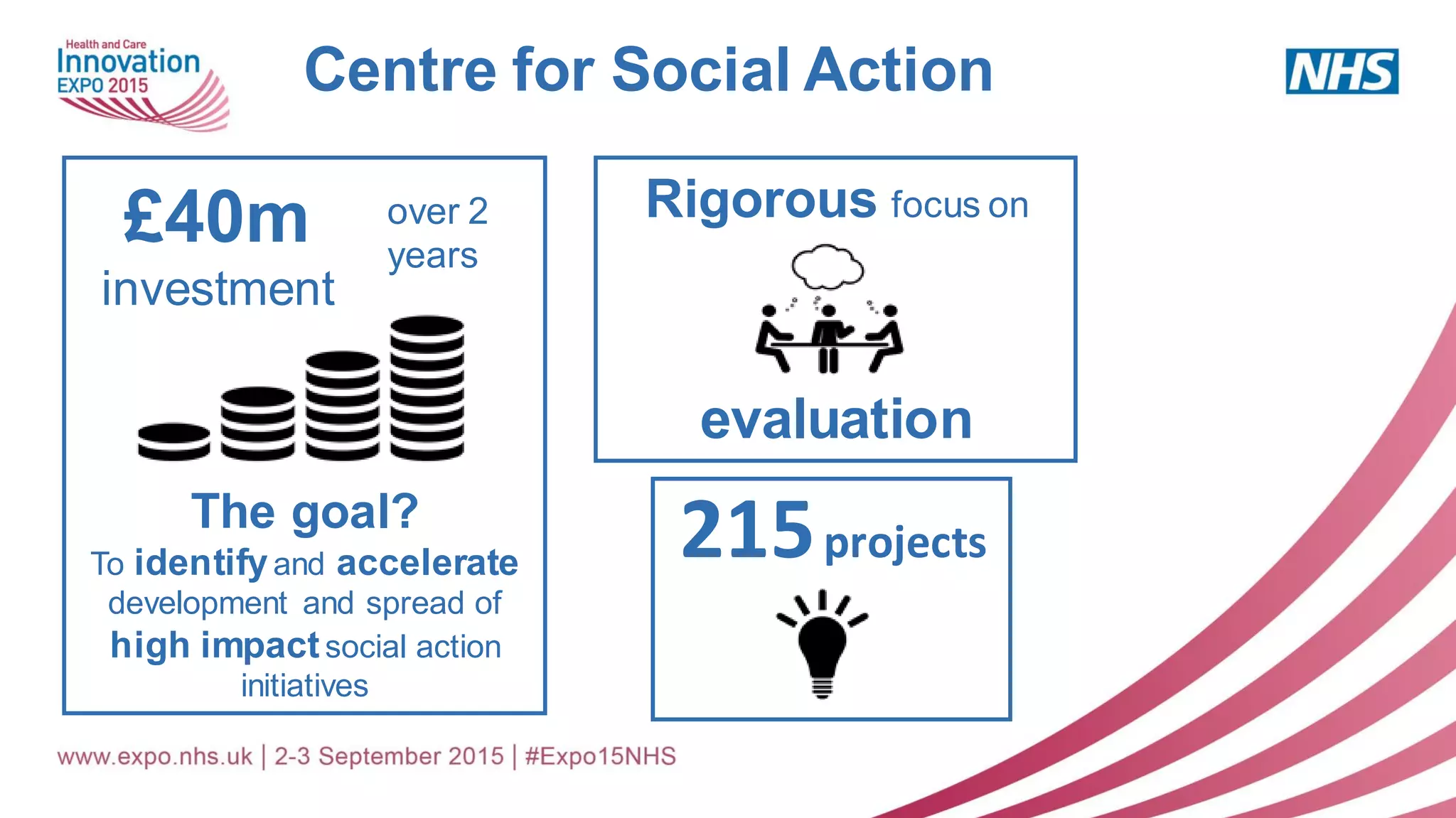
Centre for Social Action
£40m
investment
Rigorous focus on
evaluation
215projects
over 2
years
The goal?
To identifyand accelerate
development and spread of
high impactsocial action
initiatives
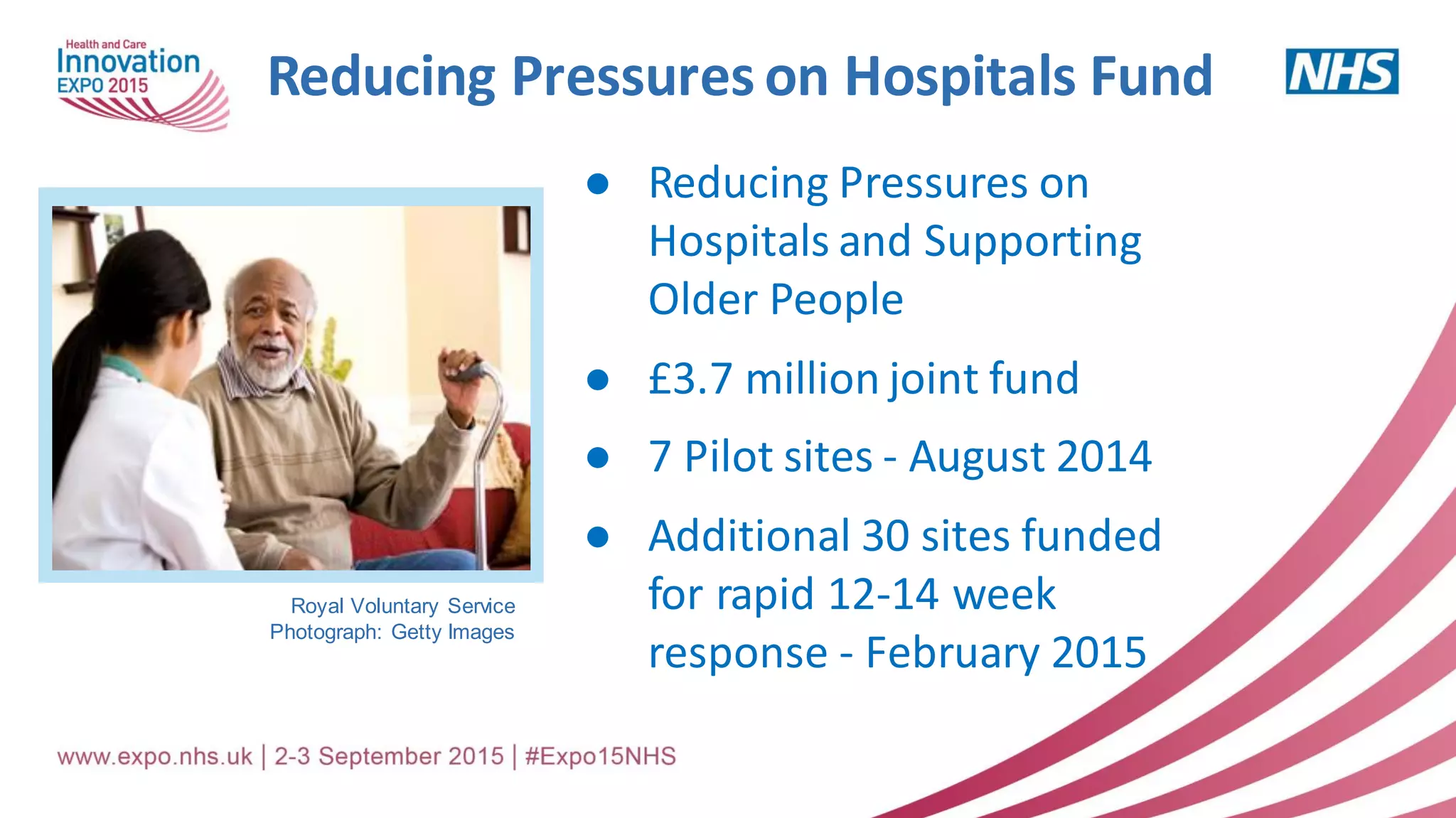
● Reducing Pressures on
Hospitals and Supporting
Older People
● £3.7 million joint fund
● 7 Pilot sites - August 2014
● Additional 30 sites funded
for rapid 12-14 week
response - February 2015
Reducing Pressures on Hospitals Fund
Royal Voluntary Service
Photograph: Getty Images
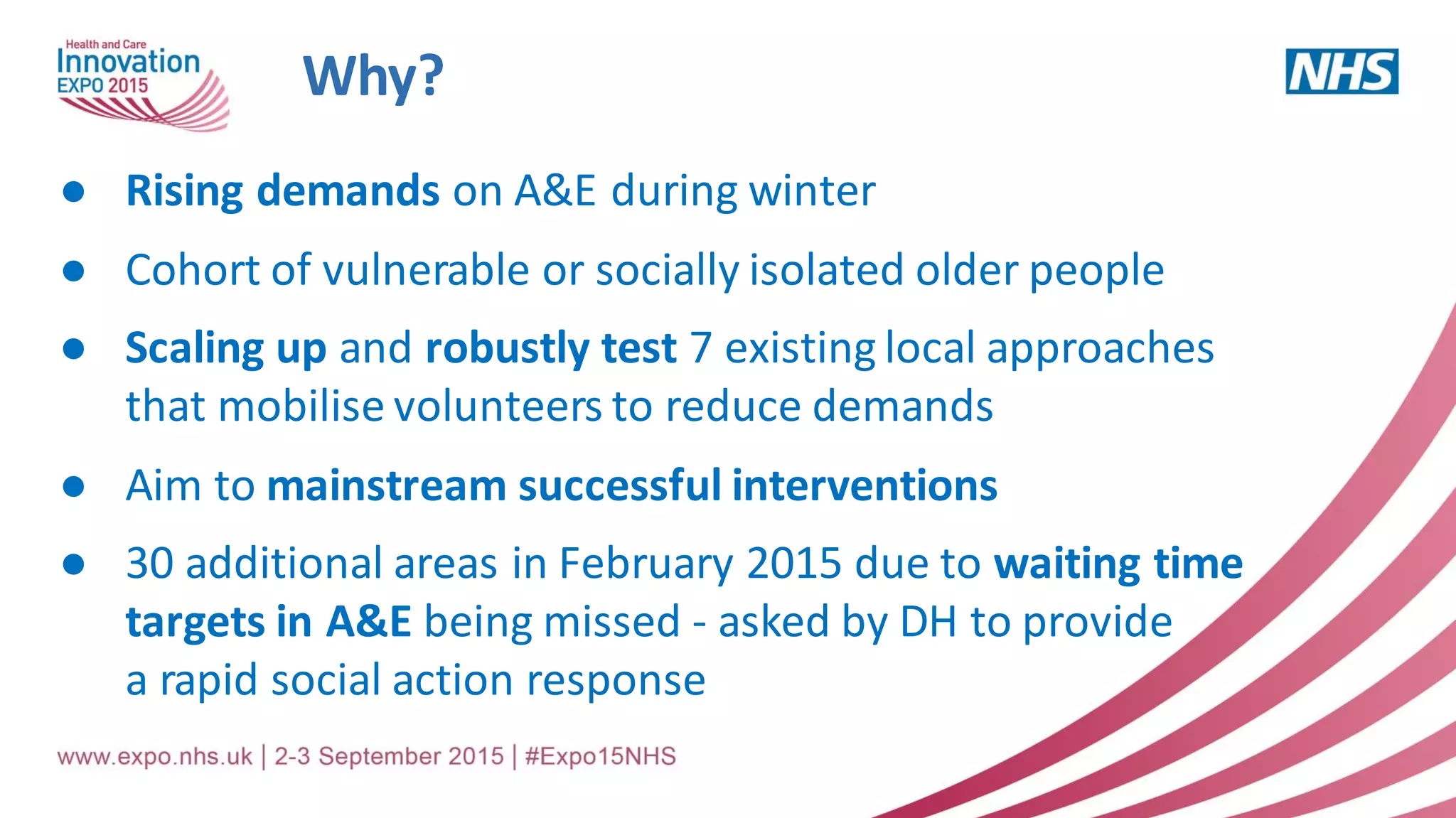
Why?
● Rising demands on A&E during winter
● Cohort of vulnerable or socially isolated older people
● Scaling up and robustly test 7 existing local approaches
that mobilise volunteers to reduce demands
● Aim to mainstream successful interventions
● 30 additional areas in February 2015 due to waiting time
targets in A&E being missed - asked by DH to provide
a rapid social action response
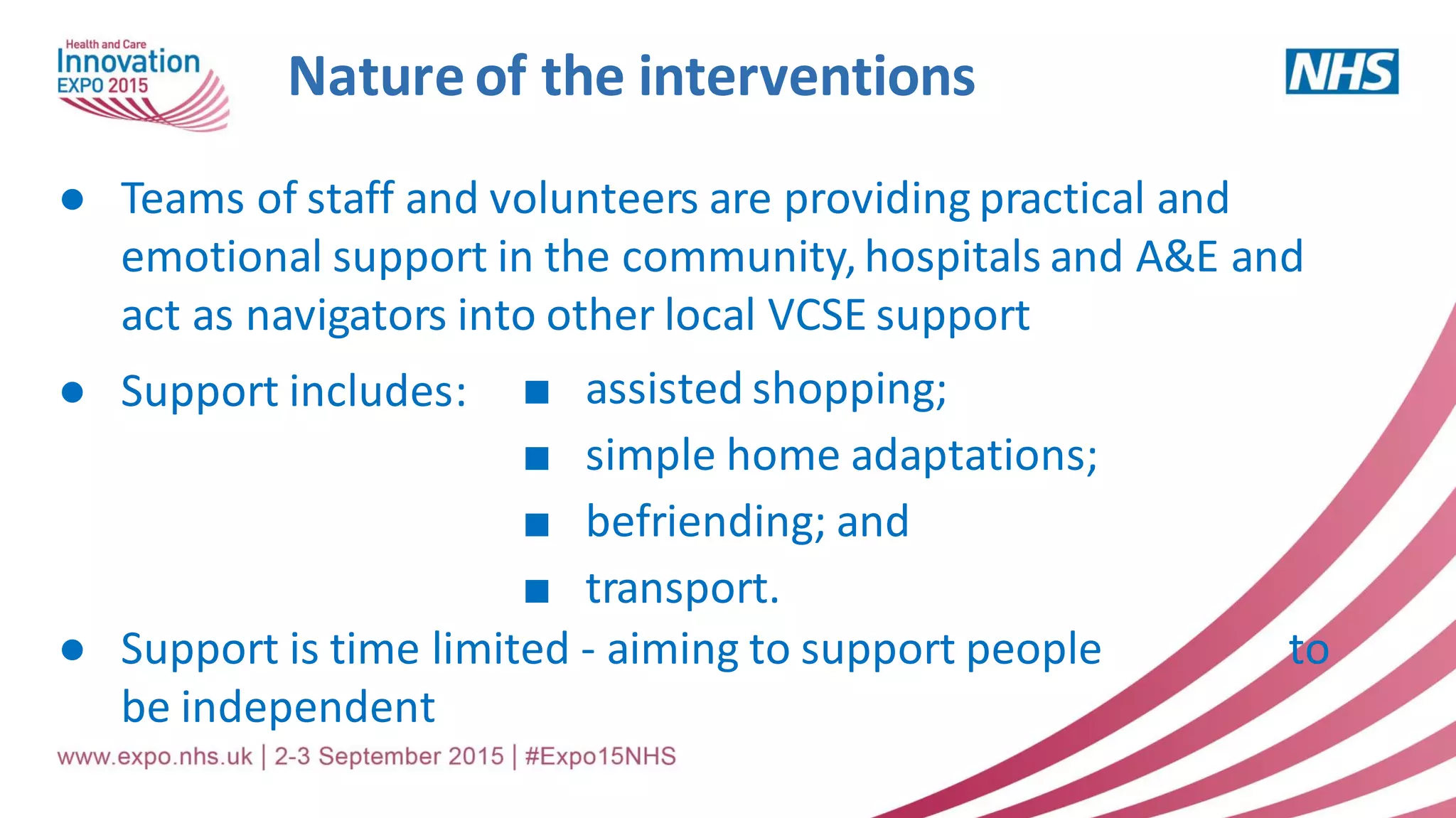
Nature of the interventions
● Teams of staff and volunteers are providing practical and
emotional support in the community,hospitals and A&E and
act as navigators into other local VCSE support
● Support includes:
● Support is time limited - aiming to support people to
be independent
■ assisted shopping;
■ simple home adaptations;
■ befriending; and
■ transport.
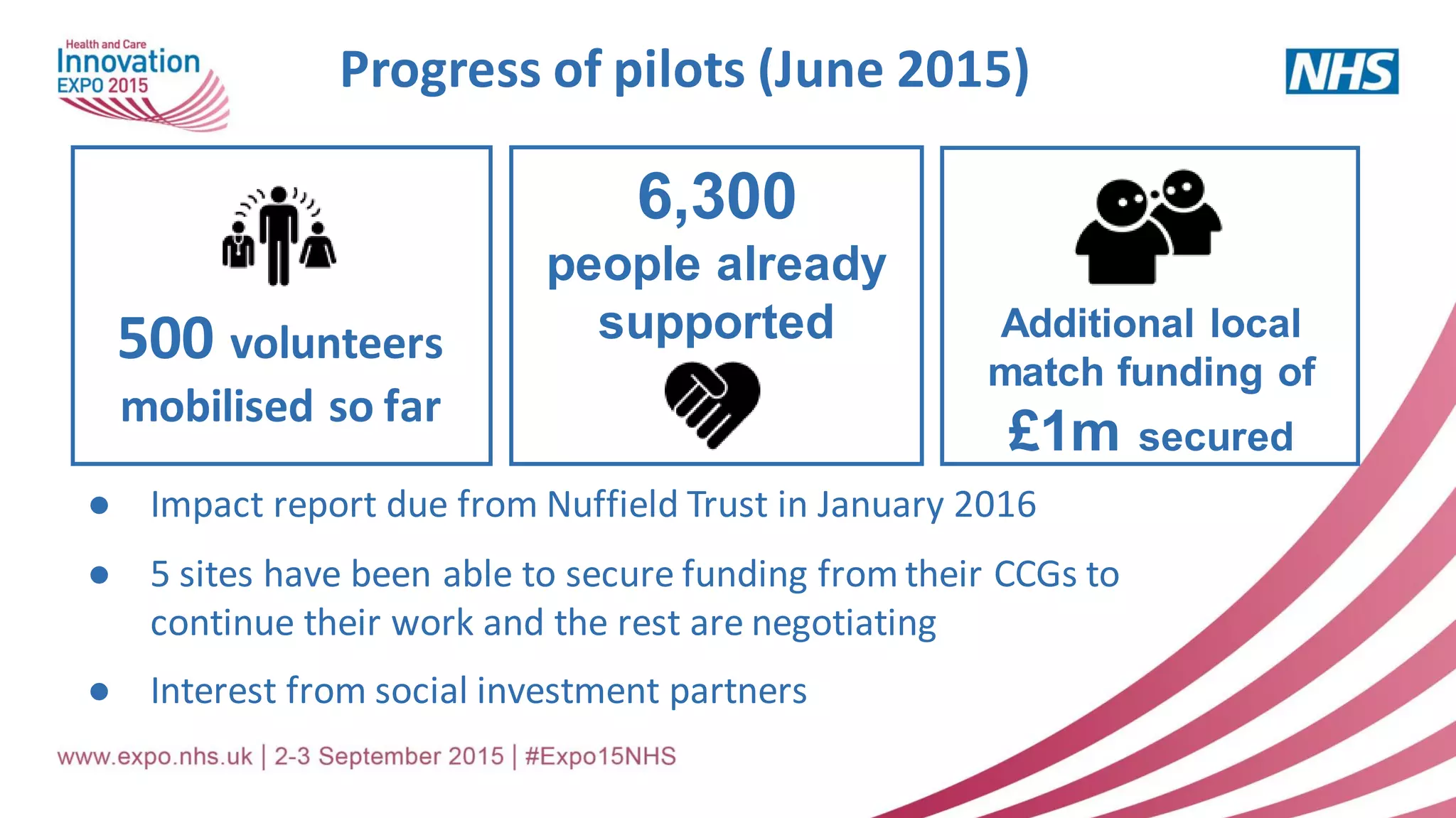
Progress of pilots (June 2015)
500 volunteers
mobilised so far
Additional local
match funding of
£1m secured
6,300
people already
supported
● Impact report due from Nuffield Trust in January 2016
● 5 sites have been able to secure funding from their CCGs to
continue their work and the rest are negotiating
● Interest from social investment partners
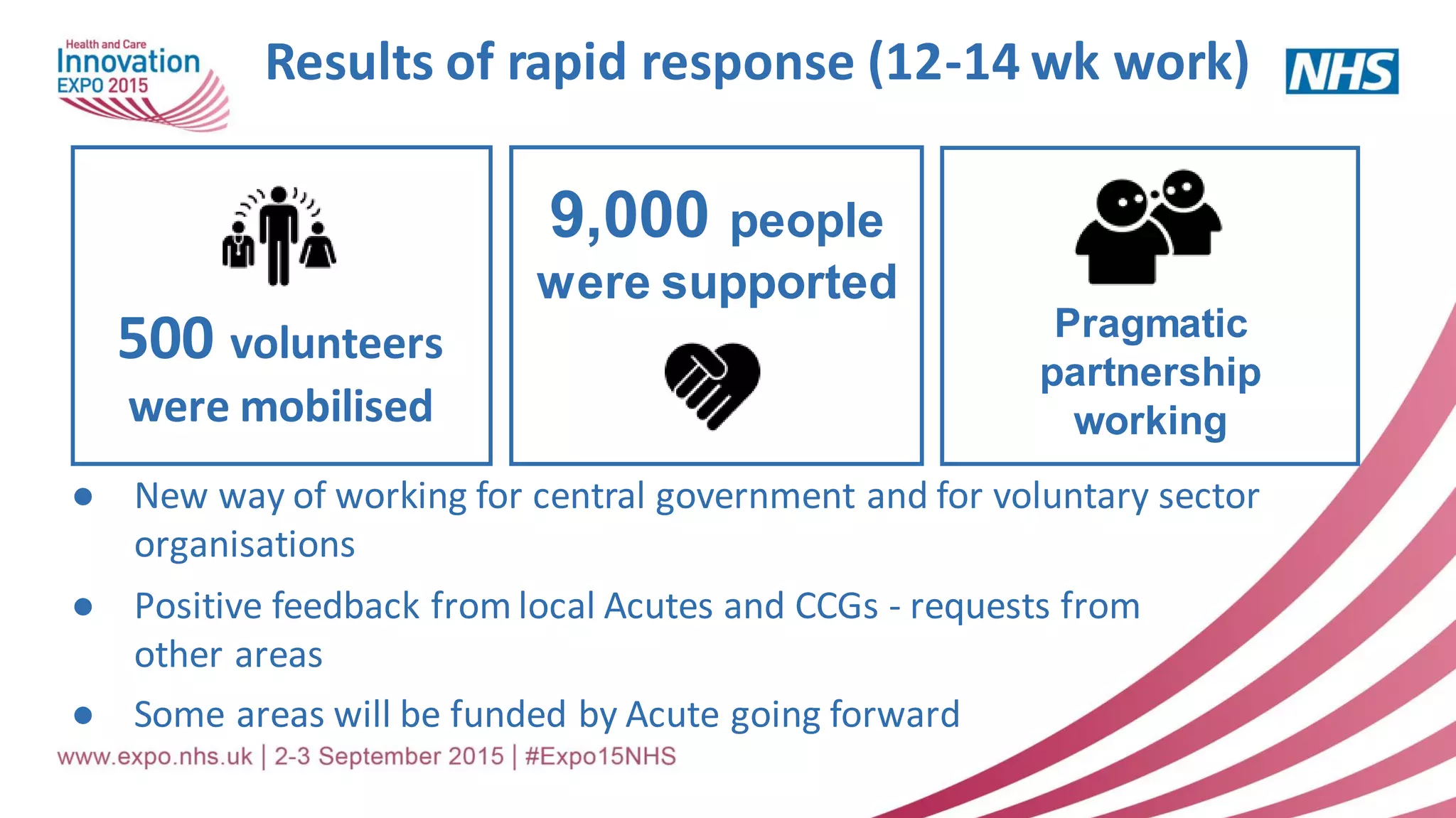
Results of rapid response (12-14 wk work)
500 volunteers
were mobilised
Pragmatic
partnership
working
9,000 people
were supported
● New way of working for central government and for voluntary sector
organisations
● Positive feedback from local Acutes and CCGs - requests from
other areas
● Some areas will be funded by Acute going forward
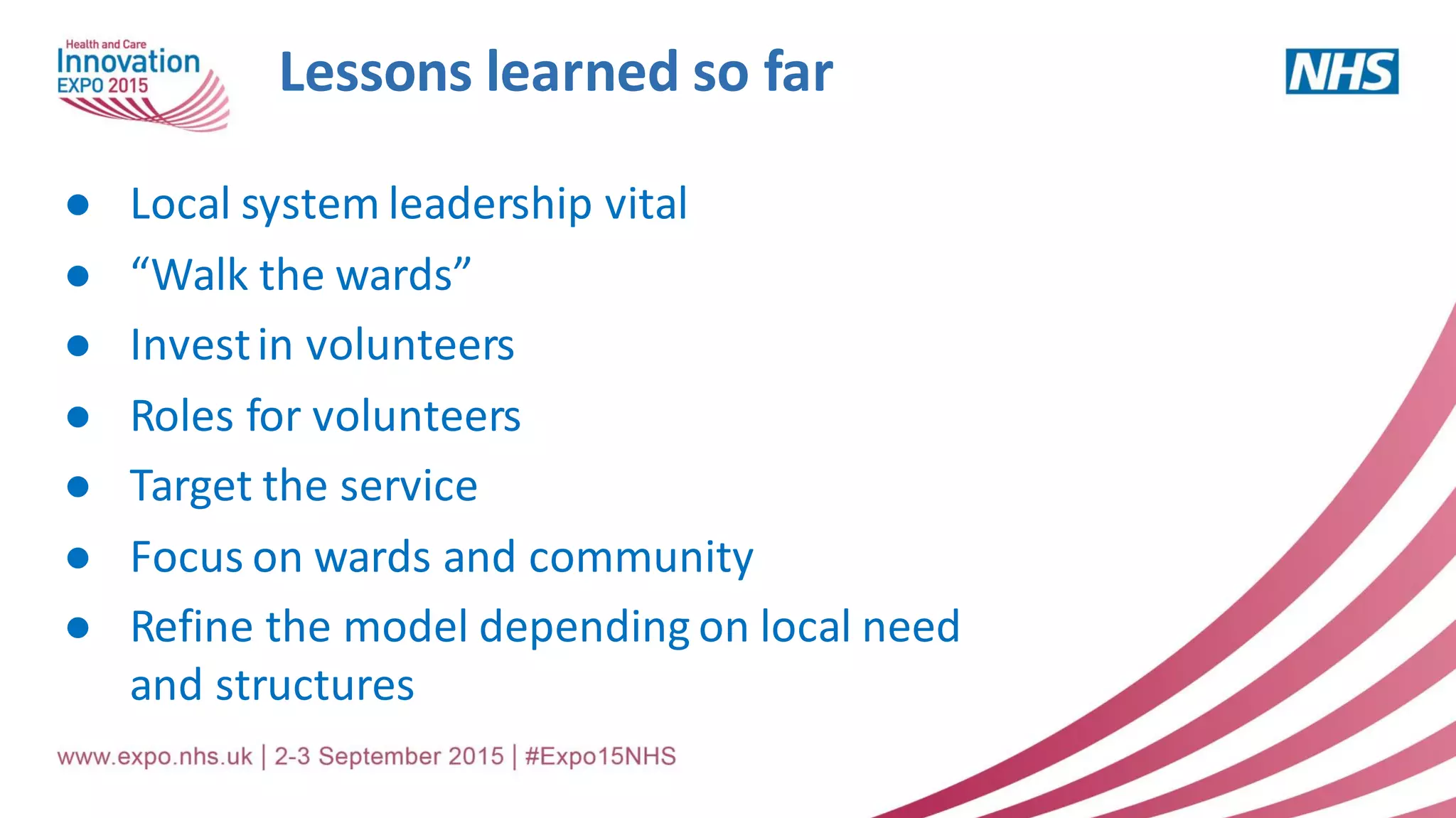
Lessons learned so far
● Local system leadership vital
● “Walk the wards”
● Investin volunteers
● Roles for volunteers
● Target the service
● Focus on wards and community
● Refine the model depending on local need
and structures
Opening the doors to citizen
engagement:empowered
volunteers,quality care
NHS EXPO
September 2015
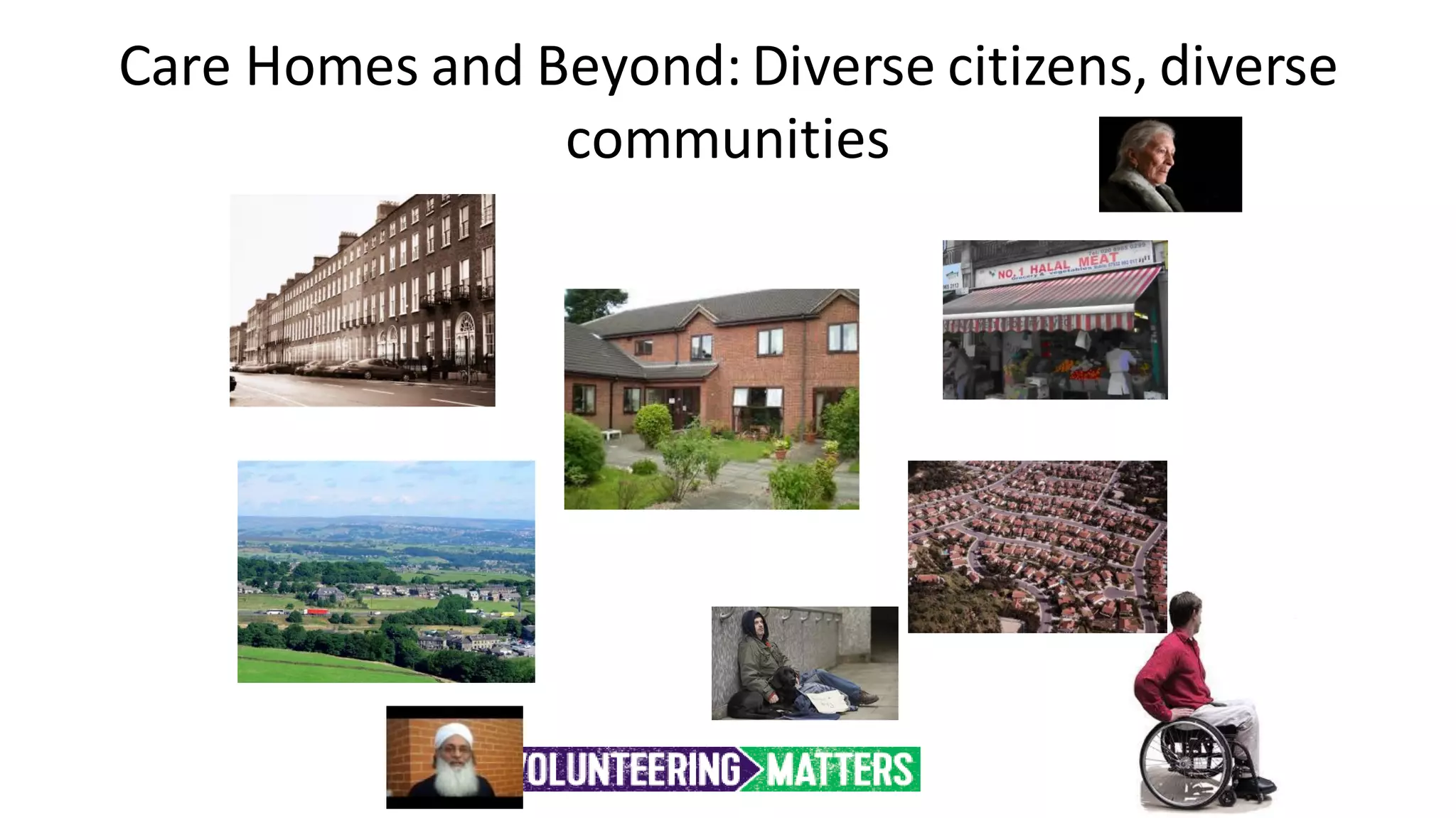
Care Homes and Beyond: Diverse citizens, diverse
communities
Our
hypothesis
That there exists a reservoir of social capital
among volunteers to be deployedin health and
social care. Some of these people already work
in the sector, many in quite limited roles; our
hypothesis is that if fully utilized and well-
supported this group of volunteers has the
potential to improve outcomes for citizens in
radical ways.
The challenge
“There are huge opportunities for volunteering to help transform
health and social care services and bring about real
improvements for patients and the wider public. The challenge
now is to ensure that the system can make the most of these
opportunities. Many organisations lack a strategic vision for the
role of volunteering within their workforce, and so miss the
opportunities that exist.” (Kings Fund, 2013)
How will volunteers do this?
• By taking time to get to know people and build relationships
• By helping people build connectionsbeyond services
• By looking and listening
• By advocating; and by passing on intelligence
Our questions
• What do volunteers do today?
• How might volunteers be supported?
• How might they pass on information?
• What about confidentialityand ethical issues?
• How do we see volunteers improving the quality of life for
people in various caring situations?
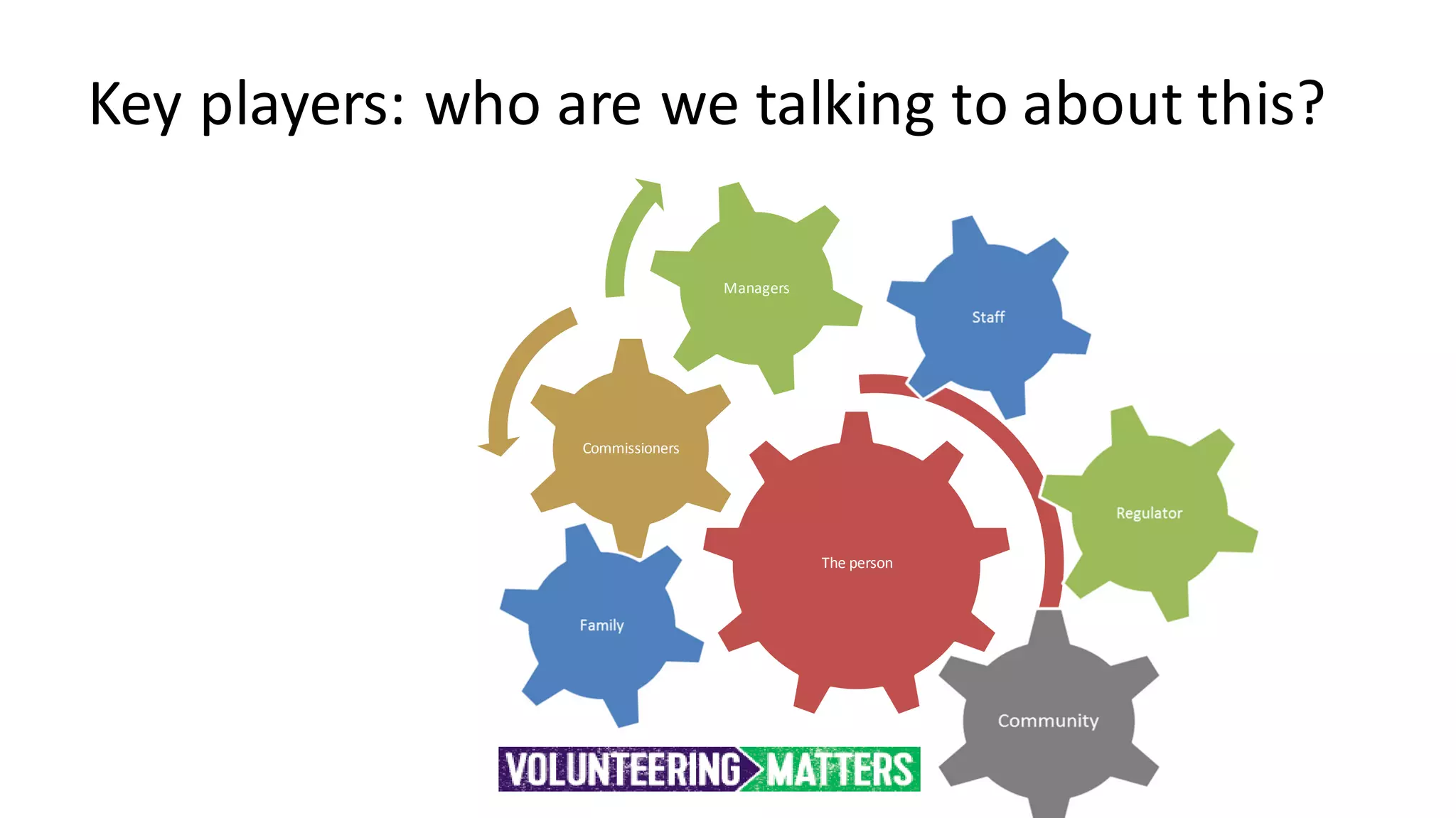
Key players: who are we talking to about this?
The person
Commissioners
Managers
Emerging issues/what people have told us
• The Care Act: wellbeing, prevention,integration…
• Not about job substitution
• Some good practice exists today…
• Nevertheless:we need to test ourthinking in diversesettingsand
situations
• Think about the full range of volunteersand volunteering
arrangements
• Think more about volunteeringaround the person…matching
• Think more about peoplewho use servicesas volunteers
Our next steps
• Consult with volunteering infrastructure organisations
• Continue discussionswith CQC
• Think more about commissioning: engage TLAP and ADASS
• Develop a top-tips guide for providers
• Find providers to test out our tips
• An updated discussion paper and publicity
……..and talk to people using services, ULOs and carers’ groups;
co-productionin all
Today
• Continue to debate the role of volunteering in promoting
quality
• Identify more allies
• Be clear about the challenges

A new model of care for general practice, pop up uni, 10am, 2 september 2015

  • 1.
  • 2.
    Who are we? Nationalnetwork organisation- hosted by the NHS Working with experienced academics, researchers and clinicians have developed an award winning, evidenced based approach to engaging people and communities Pioneered Community Health Champion model starting in 2008 working with more than 21,000 health champions, gone on to develop champion models tailored to specific groups and settings Use a whole system approach which creates the conditions for a new relationship between citizens and services which has the potential to create a new model of general practice
  • 3.
    • Changing roleof the NHS - unprecedented challenge • Paradigm shift away from the ‘medical model’ • Primary care no longer sustainable • NHS 5YFV: need a “more engaged relationship with patients, carers and citizens” • Clinicians driven by desire for the best consultation – but need to see the right patients • Multidisciplinary team needed to see patterns • Living well with LTC best achieved in community context Why Change?
  • 4.
    • Much talkedabout in the NHS but rarely achieved • Altogether Better working with citizens and services discovered the potential to transform services • Radical attempt at system change designed to enable the practice and population they serve to co-evolve • Looks at the system as a whole • More than a shift in boundaries from one practitioner to another System Change
  • 5.
    • Experience ofworking in 60 innovation sites in General Practice has led us to stumble across a new model for general practice: ‘Community Centred Practice’ which is designed to meet these challenges • Citizens/patients play a pivotal role in meeting this challenge • Found new ways to be in conversation with citizens • Not just in primary care • National recognition & awards Evolving Community Centred Practice
  • 7.
  • 8.
    • People withmyriad and unique skills,interests, values,beliefs,needs • Multiple and fluid identities • Human interaction • Flexibility,improvisation • Stories • Relationships • Non-monetary,fluid ideas of exchange and reward • Emergent order • Roles,qualifications,titles • Fixed and legitimised identities • Processes & structured interaction • Protocols and pathways • Fixed definitions • Data • Hierarchy, authority • Monetaryeconomy, fixed ideas of currencies and exchange • Planned order The ‘Lifeworld’ Practice Health Champions Formal Systems/Institutions PHCs: balanced between two world views Reproducedwithpermissionof Linguistic Landscapes Ltd. 2015
  • 9.
    • Stronger linkbetween practice and community • Staff morale improves, workload shifts • Patients get better outcomes • The practice evolves new ways of doing things • Patients better understand how to use services • >90% & >94% Champions increase knowledge, confidence and social relationships • Patients are supported to live well with LTCs • The practice can offer alternatives • Clinical consultations go down • Practice list size increases When it works …
  • 10.
    “ Our Practicelist size has increased by 18%, the number of appointments clinicians have with patients has decreased by 9%” Sam Forbes , Partner Robin Lane Medical Centre, Pudsey Impact
  • 11.
    Valuing and EncouragingCommunity Volunteering in Health and Care Reducing Pressures on Hospitals Fund Ravneet Virdi, Cabinet Office Ravneet.Virdi@cabinetoffice.gov.uk
  • 12.
    Social action inhealth, care and ageing ● Social action can: ● Bring additional resource and knowledge ● Reduce demands on public services ● Empower individuals and communities ● Provide new people centred models 78,000 volunteers in acute trusts in England 13m hours per year foster families 3m people volunteer regularly Over 50,000Across health & social care
  • 13.
    Centre for SocialAction £40m investment Rigorous focus on evaluation 215projects over 2 years The goal? To identifyand accelerate development and spread of high impactsocial action initiatives
  • 14.
    ● Reducing Pressureson Hospitals and Supporting Older People ● £3.7 million joint fund ● 7 Pilot sites - August 2014 ● Additional 30 sites funded for rapid 12-14 week response - February 2015 Reducing Pressures on Hospitals Fund Royal Voluntary Service Photograph: Getty Images
  • 15.
    Why? ● Rising demandson A&E during winter ● Cohort of vulnerable or socially isolated older people ● Scaling up and robustly test 7 existing local approaches that mobilise volunteers to reduce demands ● Aim to mainstream successful interventions ● 30 additional areas in February 2015 due to waiting time targets in A&E being missed - asked by DH to provide a rapid social action response
  • 16.
    Nature of theinterventions ● Teams of staff and volunteers are providing practical and emotional support in the community,hospitals and A&E and act as navigators into other local VCSE support ● Support includes: ● Support is time limited - aiming to support people to be independent ■ assisted shopping; ■ simple home adaptations; ■ befriending; and ■ transport.
  • 17.
    Progress of pilots(June 2015) 500 volunteers mobilised so far Additional local match funding of £1m secured 6,300 people already supported ● Impact report due from Nuffield Trust in January 2016 ● 5 sites have been able to secure funding from their CCGs to continue their work and the rest are negotiating ● Interest from social investment partners
  • 18.
    Results of rapidresponse (12-14 wk work) 500 volunteers were mobilised Pragmatic partnership working 9,000 people were supported ● New way of working for central government and for voluntary sector organisations ● Positive feedback from local Acutes and CCGs - requests from other areas ● Some areas will be funded by Acute going forward
  • 19.
    Lessons learned sofar ● Local system leadership vital ● “Walk the wards” ● Investin volunteers ● Roles for volunteers ● Target the service ● Focus on wards and community ● Refine the model depending on local need and structures
  • 20.
    Opening the doorsto citizen engagement:empowered volunteers,quality care NHS EXPO September 2015
  • 22.
    Care Homes andBeyond: Diverse citizens, diverse communities
  • 23.
    Our hypothesis That there existsa reservoir of social capital among volunteers to be deployedin health and social care. Some of these people already work in the sector, many in quite limited roles; our hypothesis is that if fully utilized and well- supported this group of volunteers has the potential to improve outcomes for citizens in radical ways.
  • 24.
    The challenge “There arehuge opportunities for volunteering to help transform health and social care services and bring about real improvements for patients and the wider public. The challenge now is to ensure that the system can make the most of these opportunities. Many organisations lack a strategic vision for the role of volunteering within their workforce, and so miss the opportunities that exist.” (Kings Fund, 2013)
  • 25.
    How will volunteersdo this? • By taking time to get to know people and build relationships • By helping people build connectionsbeyond services • By looking and listening • By advocating; and by passing on intelligence
  • 26.
    Our questions • Whatdo volunteers do today? • How might volunteers be supported? • How might they pass on information? • What about confidentialityand ethical issues? • How do we see volunteers improving the quality of life for people in various caring situations?
  • 27.
    Key players: whoare we talking to about this? The person Commissioners Managers
  • 28.
    Emerging issues/what peoplehave told us • The Care Act: wellbeing, prevention,integration… • Not about job substitution • Some good practice exists today… • Nevertheless:we need to test ourthinking in diversesettingsand situations • Think about the full range of volunteersand volunteering arrangements • Think more about volunteeringaround the person…matching • Think more about peoplewho use servicesas volunteers
  • 29.
    Our next steps •Consult with volunteering infrastructure organisations • Continue discussionswith CQC • Think more about commissioning: engage TLAP and ADASS • Develop a top-tips guide for providers • Find providers to test out our tips • An updated discussion paper and publicity ……..and talk to people using services, ULOs and carers’ groups; co-productionin all
  • 30.
    Today • Continue todebate the role of volunteering in promoting quality • Identify more allies • Be clear about the challenges