Assignment
On
Course code:-PGS-502
Course title:-communication skill and technical
writing
Credit hour:-1(0+1)
College of agriculture,OUAT
BBSR
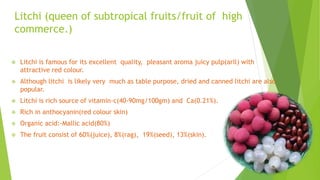
Litchi (queen of subtropical fruits/fruit of high
commerce.)
 Litchi is famous for its excellent quality, pleasant aroma juicy pulp(aril) with
attractive red colour.
 Although litchi is likely very much as table purpose, dried and canned litchi are also
popular.
 Litchi is rich source of vitamin-c(40-90mg/100gm) and Ca(0.21%).
 Rich in anthocyanin(red colour skin)
 Organic acid:-Mallic acid(80%)
 The fruit consist of 60%(juice), 8%(rag), 19%(seed), 13%(skin).
Botanical description
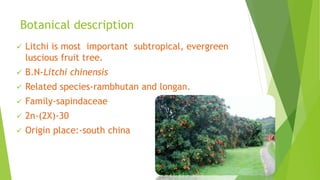
 Litchi is most important subtropical, evergreen
luscious fruit tree.
 B.N-Litchi chinensis
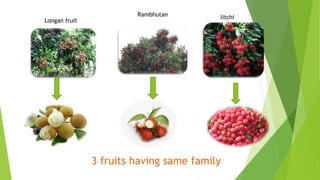
 Related species-rambhutan and longan.
 Family-sapindaceae
 2n-(2X)-30
 Origin place:-south china
Longan fruit
Rambhutan litchi
3 fruits having same family
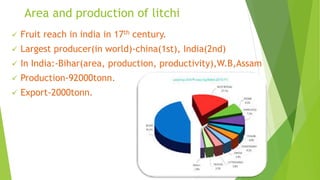
Area and production of litchi
 Fruit reach in india in 17th century.
 Largest producer(in world)-china(1st), India(2nd)
 In India:-Bihar(area, production, productivity),W.B,Assam
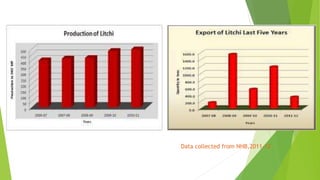
 Production-92000tonn.
 Export-2000tonn.
Data collected from NHB,2011-12
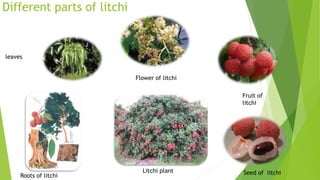
Different parts of litchi
Litchi plant
Roots of litchi Seed of litchi
Fruit of
litchi
Flower of litchi
leaves
Climate
Grows well in moist atmosphere
 TEMPERETURE
a) For growth-30 degree Celsius
b) During flowering and fruit dev-21 degree Celsius.
c) Wet spring, dry summer, light winter is desirable.
soil
 Fairly deep, well drained,loam soil rich in organic matter-
best soil
 Soil type-sandy loam or clay loam
 pH-5.5-7
 Soil testing should be done first(pH and nutrient analysis).
 High lime require for good litchi cultivation
propagation
 Seed propagated-7-12 years for bearing
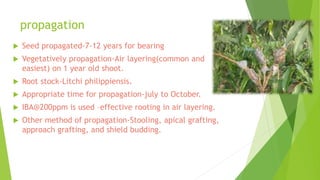
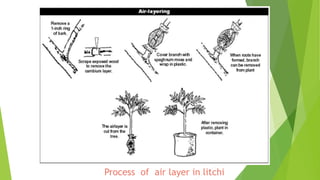
 Vegetatively propagation-Air layering(common and
easiest) on 1 year old shoot.
 Root stock-Litchi philippiensis.
 Appropriate time for propagation-july to October.
 IBA@200ppm is used –effective rooting in air layering.
 Other method of propagation-Stooling, apical grafting,
approach grafting, and shield budding.
Process of air layer in litchi
cultivation
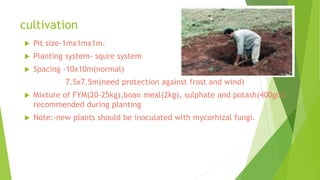
 Pit size-1mx1mx1m.
 Planting system- squre system
 Spacing -10x10m(normal)
7.5x7.5m(need protection against frost and wind)
 Mixture of FYM(20-25kg),boan meal(2kg), sulphate and potash(400gm)
recommended during planting
 Note:-new plants should be inoculated with mycorhizal fungi.
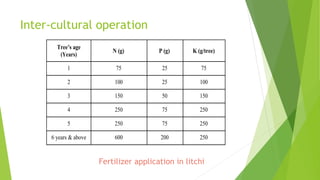
Inter-cultural operation
Tree’s age
N (g) P (g) K (g/tree)
(Years)
1 75 25 75
2 100 25 100
3 150 50 150
4 250 75 250
5 250 75 250
6 years & above 600 200 250
Fertilizer application in litchi
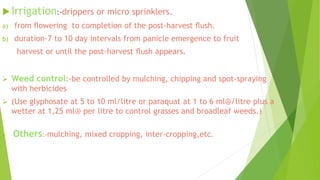
Irrigation:-drippers or micro sprinklers.
a) from flowering to completion of the post-harvest flush.
b) duration-7 to 10 day intervals from panicle emergence to fruit
harvest or until the post-harvest flush appears.
 Weed control:-be controlled by mulching, chipping and spot-spraying
with herbicides
 (Use glyphosate at 5 to 10 ml/litre or paraquat at 1 to 6 ml@/litre plus a
wetter at 1,25 ml@ per litre to control grasses and broadleaf weeds.)
 -Others:-mulching, mixed cropping, inter-cropping,etc.
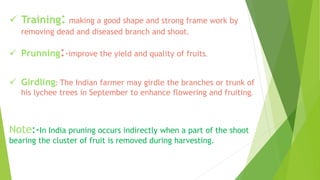
 Training: making a good shape and strong frame work by
removing dead and diseased branch and shoot.
 Prunning:-improve the yield and quality of fruits.
 Girdling: The Indian farmer may girdle the branches or trunk of
his lychee trees in September to enhance flowering and fruiting.
Note:-In India pruning occurs indirectly when a part of the shoot
bearing the cluster of fruit is removed during harvesting.
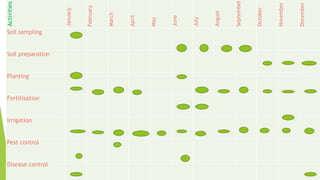
Activities
January
February
March
April
May
June
July
August
September
October
November
December
Soil sampling
Soil preparation
Planting
Fertilisation
Irrigation
Pest control
Disease control
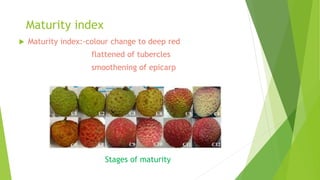
Maturity index
 Maturity index:-colour change to deep red
flattened of tubercles
smoothening of epicarp
Stages of maturity
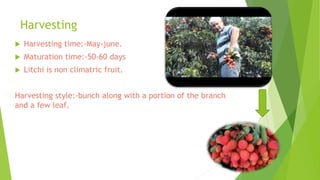
Harvesting
 Harvesting time:-May-june.
 Maturation time:-50-60 days
 Litchi is non climatric fruit.
Harvesting style:-bunch along with a portion of the branch
and a few leaf.
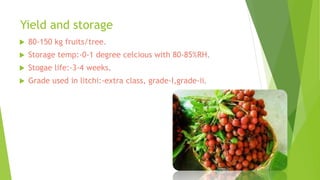
Yield and storage
 80-150 kg fruits/tree.
 Storage temp:-0-1 degree celcious with 80-85%RH.
 Stogae life:-3-4 weeks.
 Grade used in litchi:-extra class, grade-I,grade-ii.
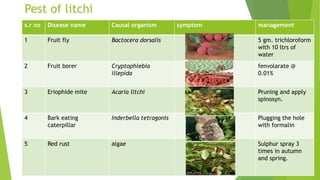
Pest of litchi
s.r no Disease name Causal organism symptom management
1 Fruit fly Bactocera dorsalis 5 gm. trichloroform
with 10 ltrs of
water
2 Fruit borer Cryptophlebia
illepida
fenvolarate @
0.01%
3 Eriophide mite Acaria litchi Pruning and apply
spinosyn.
4 Bark eating
caterpillar
Inderbella tetragonis Plugging the hole
with formalin
5 Red rust algae Sulphur spray 3
times in autumn
and spring.
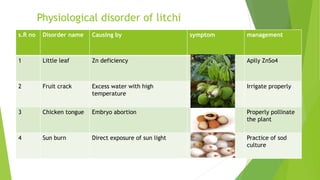
Physiological disorder of litchi
s.R no Disorder name Causing by symptom management
1 Little leaf Zn deficiency Aplly ZnSo4
2 Fruit crack Excess water with high
temperature
Irrigate properly
3 Chicken tongue Embryo abortion Properly pollinate
the plant
4 Sun burn Direct exposure of sun light Practice of sod
culture
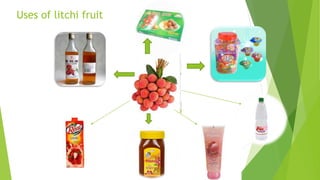
Uses of litchi fruit
Future thrust
 Hybrid should be developed against different pest and
physiological disorder
 Tissue culture should be adopt for commercial plant
production
 HDP should be adopted for getting more yield per unit
area
 Subsidy should be provided for cultivation
 Cold storage facility require for keeping the produce
 Easy market and export market should be develop for this
unique crop
Litchi cultivation

Litchi cultivation

  • 1.
    Assignment On Course code:-PGS-502 Course title:-communicationskill and technical writing Credit hour:-1(0+1) College of agriculture,OUAT BBSR
  • 2.
    Litchi (queen ofsubtropical fruits/fruit of high commerce.)  Litchi is famous for its excellent quality, pleasant aroma juicy pulp(aril) with attractive red colour.  Although litchi is likely very much as table purpose, dried and canned litchi are also popular.  Litchi is rich source of vitamin-c(40-90mg/100gm) and Ca(0.21%).  Rich in anthocyanin(red colour skin)  Organic acid:-Mallic acid(80%)  The fruit consist of 60%(juice), 8%(rag), 19%(seed), 13%(skin).
  • 3.
    Botanical description  Litchiis most important subtropical, evergreen luscious fruit tree.  B.N-Litchi chinensis  Related species-rambhutan and longan.  Family-sapindaceae  2n-(2X)-30  Origin place:-south china
  • 4.
    Longan fruit Rambhutan litchi 3fruits having same family
  • 5.
    Area and productionof litchi  Fruit reach in india in 17th century.  Largest producer(in world)-china(1st), India(2nd)  In India:-Bihar(area, production, productivity),W.B,Assam  Production-92000tonn.  Export-2000tonn.
  • 6.
  • 7.
    Different parts oflitchi Litchi plant Roots of litchi Seed of litchi Fruit of litchi Flower of litchi leaves
  • 8.
    Climate Grows well inmoist atmosphere  TEMPERETURE a) For growth-30 degree Celsius b) During flowering and fruit dev-21 degree Celsius. c) Wet spring, dry summer, light winter is desirable.
  • 9.
    soil  Fairly deep,well drained,loam soil rich in organic matter- best soil  Soil type-sandy loam or clay loam  pH-5.5-7  Soil testing should be done first(pH and nutrient analysis).  High lime require for good litchi cultivation
  • 10.
    propagation  Seed propagated-7-12years for bearing  Vegetatively propagation-Air layering(common and easiest) on 1 year old shoot.  Root stock-Litchi philippiensis.  Appropriate time for propagation-july to October.  IBA@200ppm is used –effective rooting in air layering.  Other method of propagation-Stooling, apical grafting, approach grafting, and shield budding.
  • 11.
    Process of airlayer in litchi
  • 12.
    cultivation  Pit size-1mx1mx1m. Planting system- squre system  Spacing -10x10m(normal) 7.5x7.5m(need protection against frost and wind)  Mixture of FYM(20-25kg),boan meal(2kg), sulphate and potash(400gm) recommended during planting  Note:-new plants should be inoculated with mycorhizal fungi.
  • 13.
    Inter-cultural operation Tree’s age N(g) P (g) K (g/tree) (Years) 1 75 25 75 2 100 25 100 3 150 50 150 4 250 75 250 5 250 75 250 6 years & above 600 200 250 Fertilizer application in litchi
  • 14.
    Irrigation:-drippers or microsprinklers. a) from flowering to completion of the post-harvest flush. b) duration-7 to 10 day intervals from panicle emergence to fruit harvest or until the post-harvest flush appears.  Weed control:-be controlled by mulching, chipping and spot-spraying with herbicides  (Use glyphosate at 5 to 10 ml/litre or paraquat at 1 to 6 ml@/litre plus a wetter at 1,25 ml@ per litre to control grasses and broadleaf weeds.)  -Others:-mulching, mixed cropping, inter-cropping,etc.
  • 15.
     Training: makinga good shape and strong frame work by removing dead and diseased branch and shoot.  Prunning:-improve the yield and quality of fruits.  Girdling: The Indian farmer may girdle the branches or trunk of his lychee trees in September to enhance flowering and fruiting. Note:-In India pruning occurs indirectly when a part of the shoot bearing the cluster of fruit is removed during harvesting.
  • 16.
  • 17.
    Maturity index  Maturityindex:-colour change to deep red flattened of tubercles smoothening of epicarp Stages of maturity
  • 18.
    Harvesting  Harvesting time:-May-june. Maturation time:-50-60 days  Litchi is non climatric fruit. Harvesting style:-bunch along with a portion of the branch and a few leaf.
  • 19.
    Yield and storage 80-150 kg fruits/tree.  Storage temp:-0-1 degree celcious with 80-85%RH.  Stogae life:-3-4 weeks.  Grade used in litchi:-extra class, grade-I,grade-ii.
  • 20.
    Pest of litchi s.rno Disease name Causal organism symptom management 1 Fruit fly Bactocera dorsalis 5 gm. trichloroform with 10 ltrs of water 2 Fruit borer Cryptophlebia illepida fenvolarate @ 0.01% 3 Eriophide mite Acaria litchi Pruning and apply spinosyn. 4 Bark eating caterpillar Inderbella tetragonis Plugging the hole with formalin 5 Red rust algae Sulphur spray 3 times in autumn and spring.
  • 21.
    Physiological disorder oflitchi s.R no Disorder name Causing by symptom management 1 Little leaf Zn deficiency Aplly ZnSo4 2 Fruit crack Excess water with high temperature Irrigate properly 3 Chicken tongue Embryo abortion Properly pollinate the plant 4 Sun burn Direct exposure of sun light Practice of sod culture
  • 22.
  • 23.
    Future thrust  Hybridshould be developed against different pest and physiological disorder  Tissue culture should be adopt for commercial plant production  HDP should be adopted for getting more yield per unit area  Subsidy should be provided for cultivation  Cold storage facility require for keeping the produce  Easy market and export market should be develop for this unique crop