Electrical & Computer Engineering: An International Journal (ECIJ) Volume 4, Number 2, June 2015
DOI : 10.14810/ecij.2015.4201 1
COMBINED SKEWED CMOS RING OSCILLATOR
Sadegh Biabanifard1
, S. Mehdi Hosseini Largani2
and Shahrouz Asadi3
1,2
Microelectronic Lab, Shahid Beheshti University, G. C, Tehran
3
Faculty of Electrical Engineering, Shahid Beheshti University, G.C, Tehran
ABSTRACT
A combined skewed ring oscillator by different type of delay stages is presented. This paper aims to drive a
high stable and relatively high frequency but still use a full transistor circuit for ring oscillator with
combined delay stages and skewed connections. First we propose two types of common inverters then
calculate their delay time and analysis their dependence of delay time to variation of power supply voltage.
The simulation results verify that delay time of these two CMOS inverters show opposite behaviour versus
power supply changing. So a combined structure can obtain more appropriate frequency stability versus
power supply noise. Also in order to increase oscillation frequency we have used the negative skewed delay
connections. The simulation results using HSPICE for 0.18 µm CMOS shows a good agreement with
analysis results. In addition in this paper the mathematical justification for improved functioning of this
combined skewed ring oscillator has been proved. This justification shows appropriate agreement with the
simulation results. From mathematical point of view the proposed ring oscillator has better frequency
stability in comparison with other types of ring oscillators. In fact, the oscillation frequency sensitivity to
supply voltage noise is reduced considerably.
KEYWORDS
CMOS, ring oscillator, frequency stability, delay time
1. INTRODUCTION
Oscillators are the essential part of any digital and analog systems [1, 11]. And ring oscillator is a
circuit usually uses transistors without using passive elements [4]. The main reason of the
tendency to design full transistor CMOS circuits is the ability of easy integration with absence of
passive elements which reduces the die area [12-20]. The most significant feature of a ring
oscillator is lower cost due to lower die area and design simplicity [1, 4, 5]. However the highest
possible oscillation frequency is lower for ring oscillators than LC oscillator, negative skewed
delay connections can improve the speed of ring type oscillators.
Several designs for ring oscillator have been reported in literature. In [1], a frequency stable
oscillator is designed based on the opposite direction of delay time changing, which increase
frequency stability but oscillation frequency reduce due to using current starved inverter. In [6] a
method to enhance frequency operation of ring oscillators by negative skewed delay connections
presented. Overall, most of the reported ring oscillators cannot improve both frequency stability
and oscillation frequency. In this paper a novel design as combined skewed ring oscillator is
presented to improve frequency stability an oscillation frequency simultaneously.
Usually a single ended ring oscillator can be implement using odd number of delay stages (Fig.1).
Considering oscillation criterion the loop gain must be equal or bigger than unity and also the
Electrical & Computer Engineering: An International Journal (ECIJ) Volume 4, Number 2, June 2015
2
loop gain must be negative which odd number of inverters can satisfy these conditions. By
assuming that all stages are similar we can extract oscillation frequency from (1).
( ) ( ) ( )1 2
1
m
N
g R
A j A j A j
j RC
ω ω ω
ω
−
= =…= =
+
(1)( ) ( ) ( )1 2. . . 1NA j A j A jω ω ω… =
( ) ( )1 2
A1 jω θ tan ωRC
K
RC
π−
∠ = = =
Fig.1. A typical ring oscillator by odd number of inverters [2]
Fig.2. general linear model of a ring oscillator [1]
The above equation can leads us to estimate oscillation frequency in initial stage of oscillation but
the stable oscillation frequency can be obtain from large signal analysis not from small signal
mode in fig.2, since the start oscillation frequency is different with stable oscillation frequency.
A stage is an inverter and has td seconds delay. Since the similarity between stages is assumed,
oscillation frequency can be obtained as (2).
(2)
0
1
2 d
f
Nt
=
In (2) we assume that N is an odd number and illustrates the number of delay stages. In fact the
starting frequency of oscillation is determined by Barkhausen criteria and stable oscillation
frequency specified by inverters delay time [2]. According to (2) oscillation frequency strongly
depends on delay time of delay stages. Also knowing that the number stages in a fixed structure is
constant then the most significant parameters for oscillation frequency calculation is delay time.
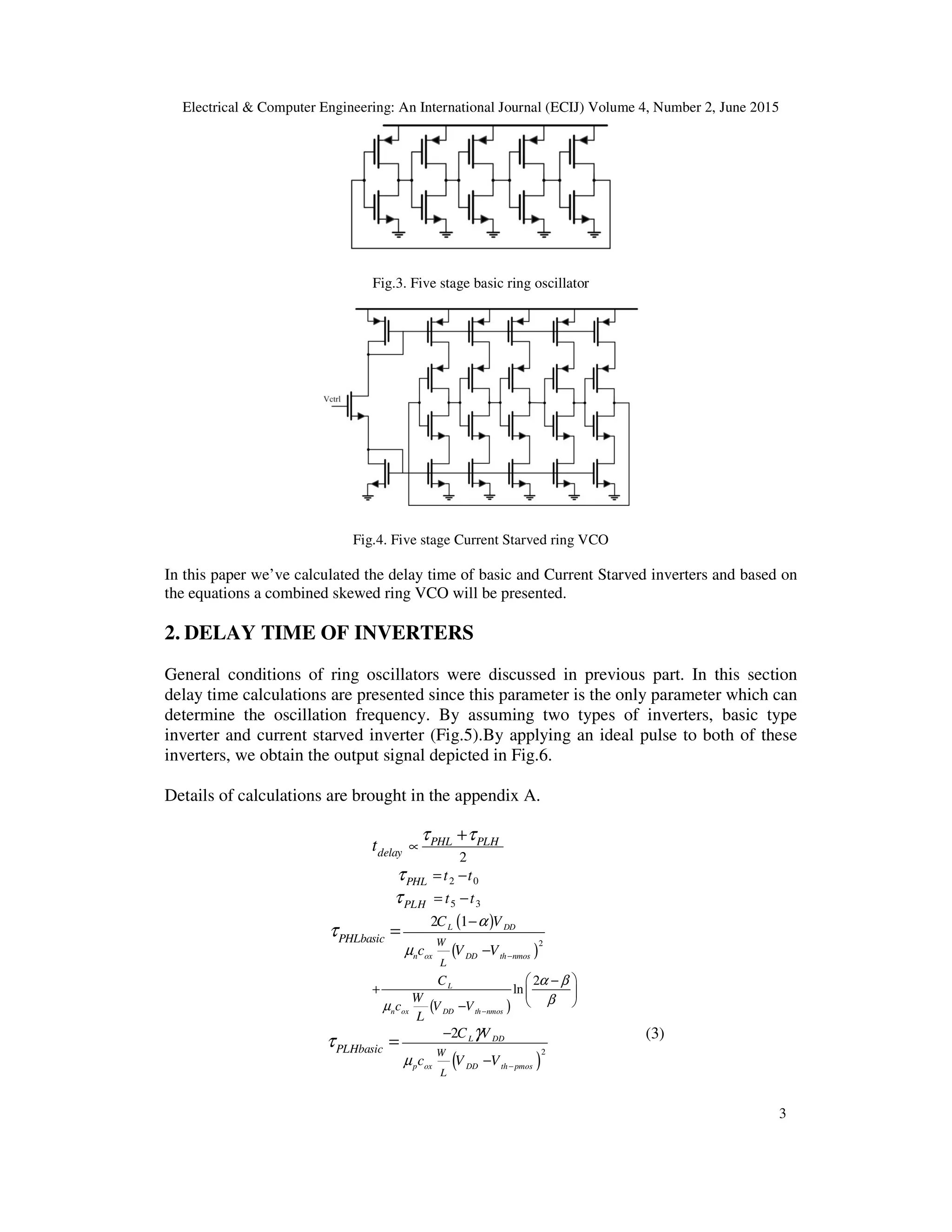
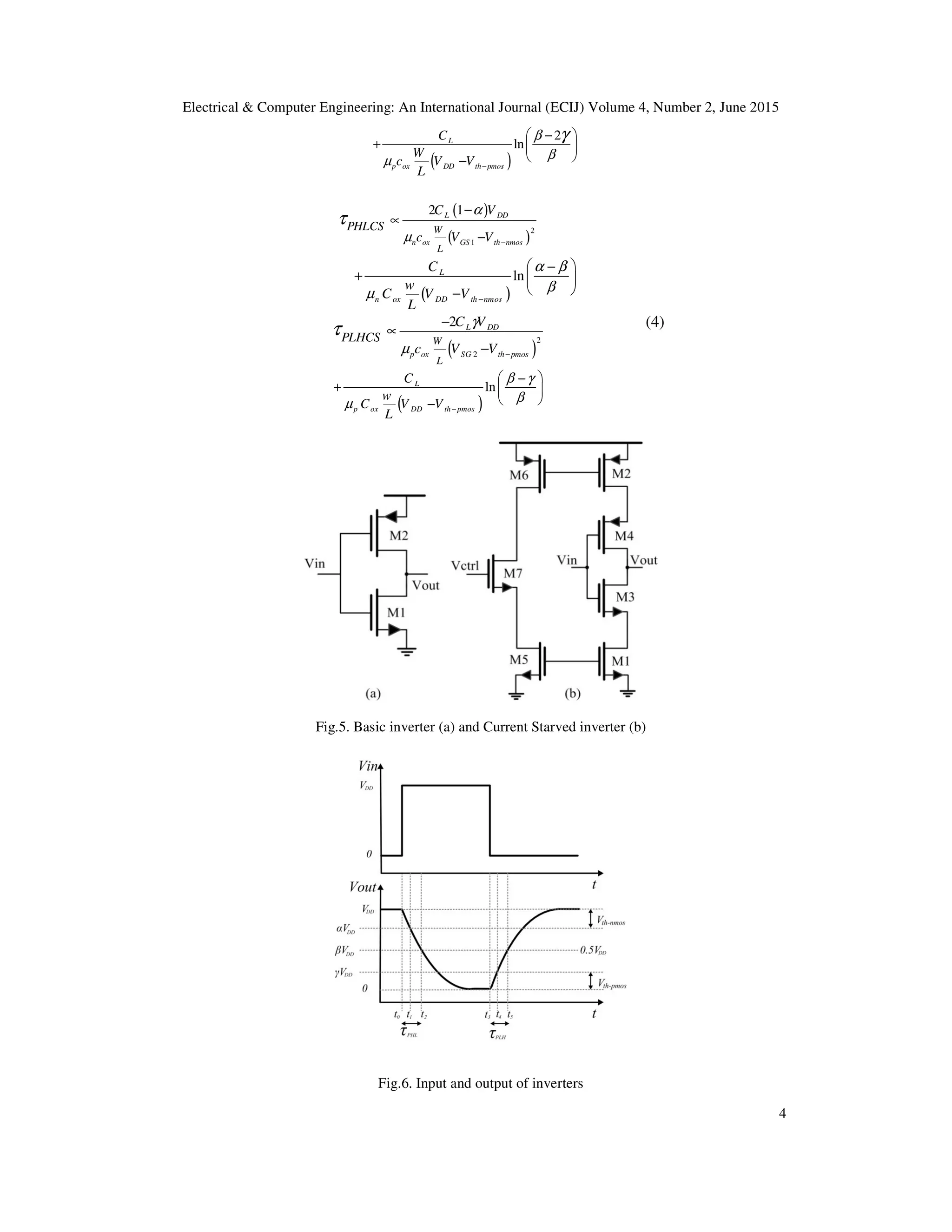
Two configurations for five stage conventional ring oscillator are shown in fig.3 and fig.4.
According to fig.4 we have an option to change the oscillation frequency by adjusting Vctrl, so by
using current starved inverter, voltage controlled oscillator can be designed.
Electrical & Computer Engineering: An International Journal (ECIJ) Volume 4, Number 2, June 2015
3
Fig.3. Five stage basic ring oscillator
Fig.4. Five stage Current Starved ring VCO
In this paper we’ve calculated the delay time of basic and Current Starved inverters and based on
the equations a combined skewed ring VCO will be presented.
2. DELAY TIME OF INVERTERS
General conditions of ring oscillators were discussed in previous part. In this section
delay time calculations are presented since this parameter is the only parameter which can
determine the oscillation frequency. By assuming two types of inverters, basic type
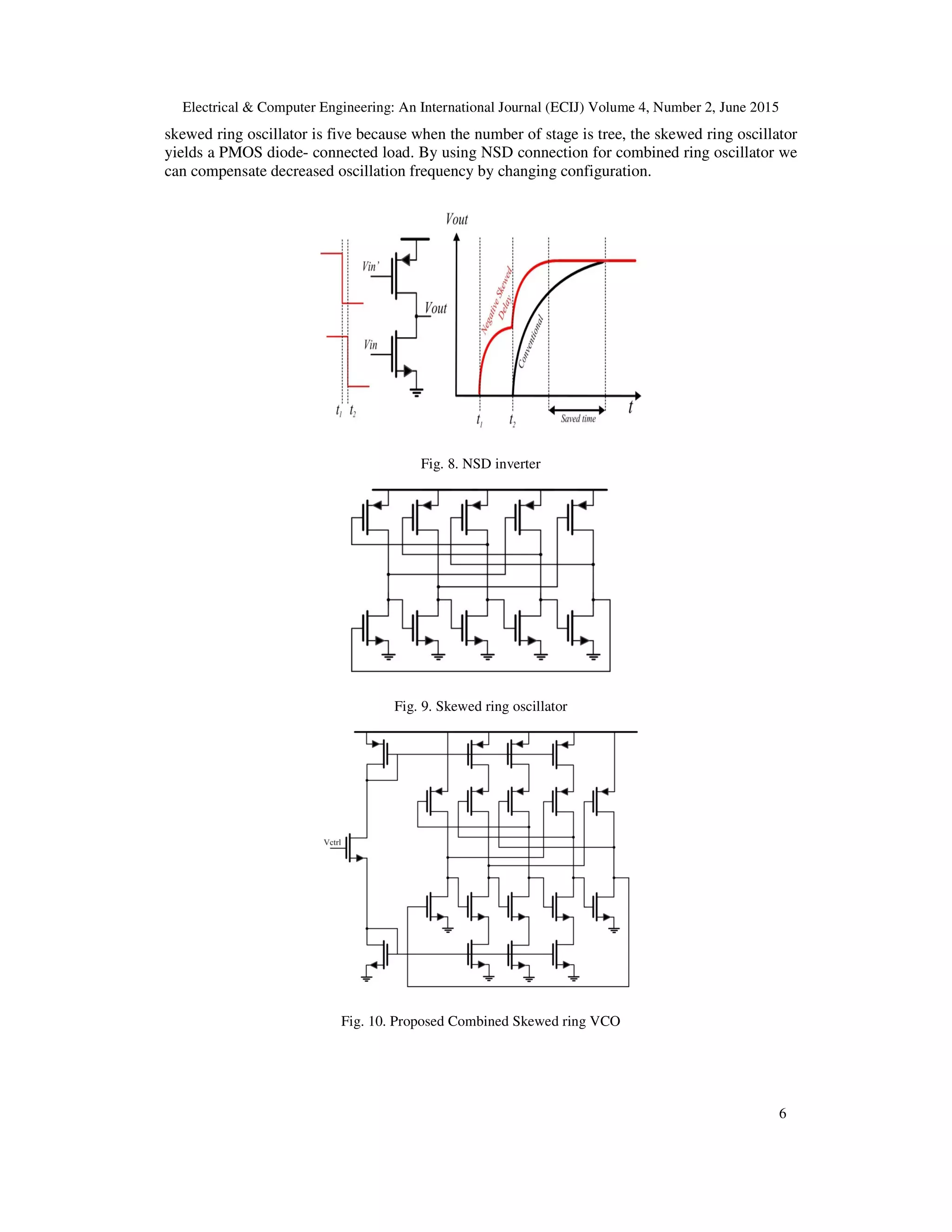
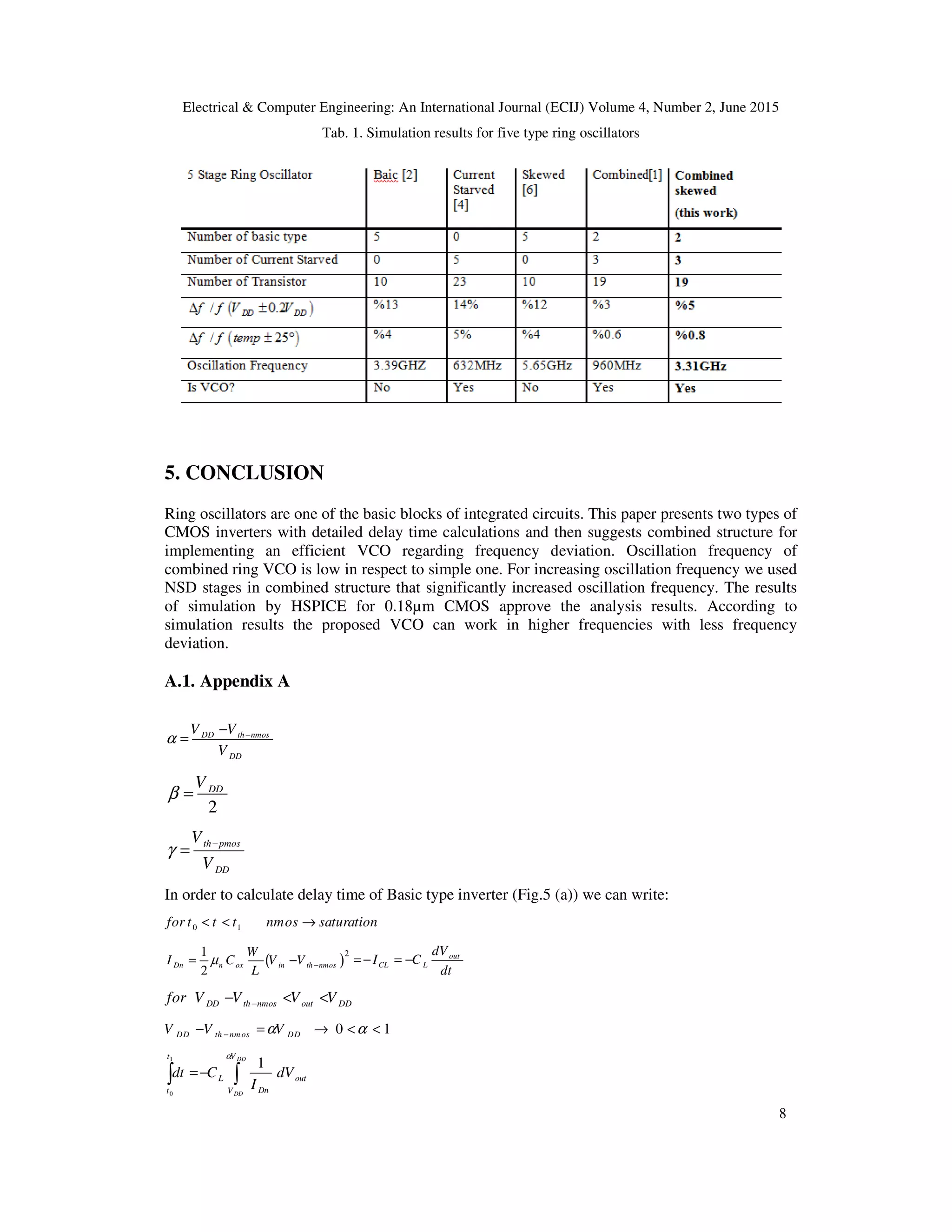
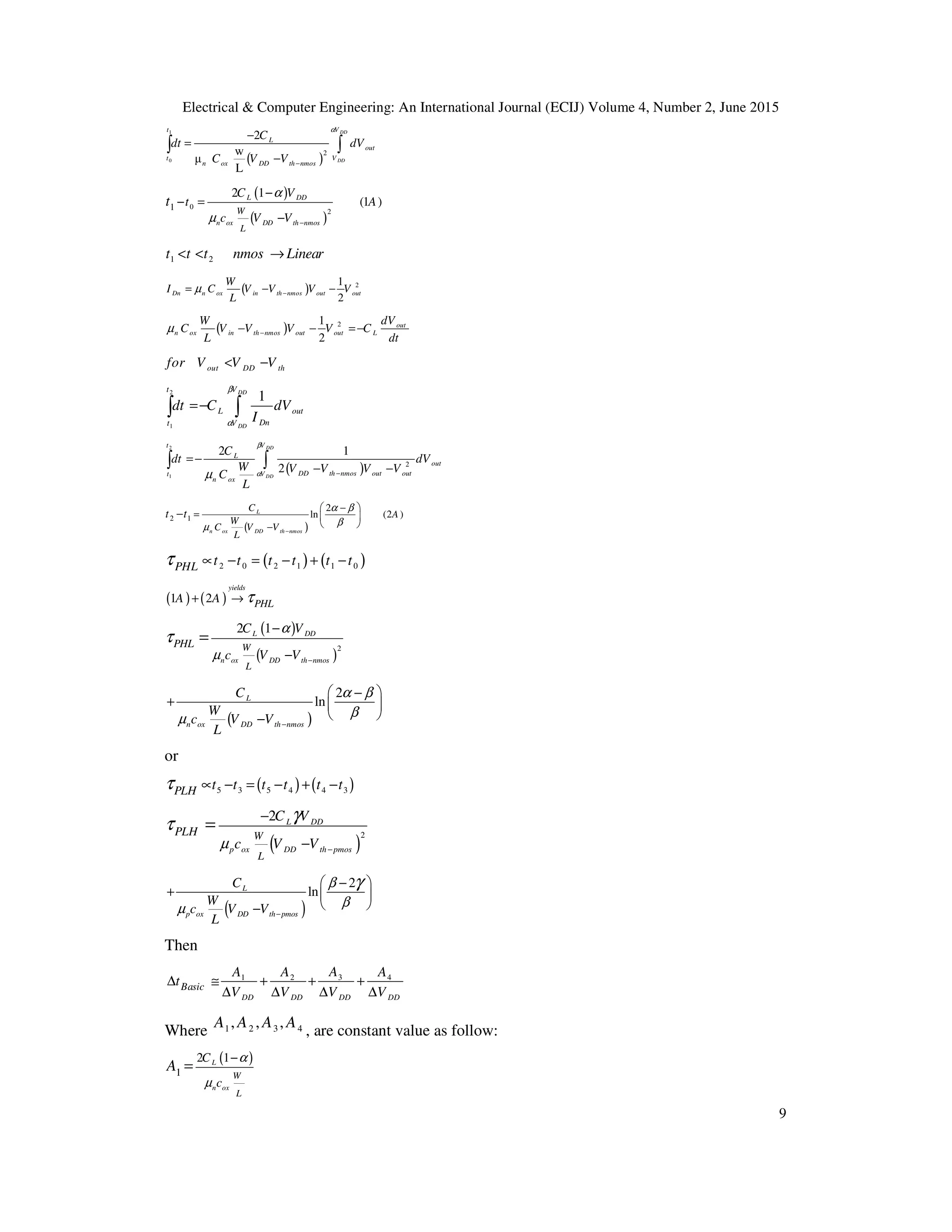
inverter and current starved inverter (Fig.5).By applying an ideal pulse to both of these
inverters, we obtain the output signal depicted in Fig.6.
Details of calculations are brought in the appendix A.
2
PHL PLH
delayt
τ τ
∝
+
2 0PHL t tτ = −
5 3PLH t tτ = −
( )
( )
2
2 1L DD
n ox DD th nmos
W
L
PHLbasic
C V
c V V
α
µ
τ
−
−
−
=
( )
2
lnL
n ox DD th nmos
C
W
c V V
L
α β
βµ −
 −
+  
 −
(3)
( )
2
2 L DD
p ox DD th pmos
W
L
PLHbasic
C V
c V Vµ
γτ
−
−
−
=
Electrical & Computer Engineering: An International Journal (ECIJ) Volume 4, Number 2, June 2015
4
( )
2
lnL
p ox DD th pmos
C
W
c V V
L
β
βµ
γ
−
 −
+  
 −
( )
( )
2
1
2 1L DD
n ox GS th nmos
W
L
PHLCS
C V
c V V
α
µ
τ
−
−
∝
−
( )
lnL
n ox DD th nmos
C
w
C V V
L
α β
βµ −
 −
 
 −
+
(4)
( )
2
2
2 L DD
p ox SG th pmos
W
L
PLHCS
C V
c V V
γ
µ
τ
−
−
∝
−
( )
lnL
ox DD th pmosp
C
w
C V V
L
β γ
βµ −
 −
+

 
 −
Fig.5. Basic inverter (a) and Current Starved inverter (b)
Fig.6. Input and output of inverters
Electrical & Computer Engineering: An International Journal (ECIJ) Volume 4, Number 2, June 2015
5
In the other word:
1
DD
Basict
V
∆ ∝
∆
& CurrentStarved DDt V∆ ∝ ∆
As can be seen we can conclude that delay time of these two inverters show different
behaviour versus power supply changing. According to (3) and (4) delay time of basic
inverter depends on power supply changing in opposite direction which delay time of
current starved inverter depends on power supply changing. By considering this fact it is
obvious that combined ring oscillator depicted in fig.7 can provide more stable oscillation
frequency versus power supply variation. The whole loop delay in this type of oscillator
can be introduce as sum of all delay times. In this case first and fifth stages are basic type
inverters and other stages are current starved inverters. By summing these delay times the
total delay time is less sensitive to power supply variation in comparison with basic type
inverter delay time or current starved inverter delay time.
)5(
1 2 3 4 5d d d d dd t t t t tt = + + + +
Fig.7. Combined ring VCO
Then, if all inverters are the same type , … , will have the same variation. Meaning
that all become smaller or bigger. In the other words changing oscillation frequency is
inevitable. But in combined structure two types of inverters show opposite behaviours to
power supply changing which considerably reduces the dependence of whole circuit to
power supply noise. However combined ring VCO has the lower oscillation frequency
compared with simple ring oscillators. By using NSD stages we can increase oscillation
frequency of combined ring VCO.
3. NEGATIVE SKEWED DELAY SCHEME
In conventional inverters both PMOS and NMOS have the same input signals. NSD is a
technique that reduces delay of inverters. Fig.8 shows the concept of NSD. In fact in NSD
inverter input signal to PMOS arrives earlier than to the NMOS and output changing become
faster as illustrated in fig.8.[6].
By using NSD stage to design a ring oscillator we need to modify the connections as shown fig.9.
Also for combined ring VCO the circuit of fig.10 is suggested. The minimum number of stages in
Electrical & Computer Engineering: An International Journal (ECIJ) Volume 4, Number 2, June 2015
6
skewed ring oscillator is five because when the number of stage is tree, the skewed ring oscillator
yields a PMOS diode- connected load. By using NSD connection for combined ring oscillator we
can compensate decreased oscillation frequency by changing configuration.
Fig. 8. NSD inverter
Fig. 9. Skewed ring oscillator
Fig. 10. Proposed Combined Skewed ring VCO
Electrical & Computer Engineering: An International Journal (ECIJ) Volume 4, Number 2, June 2015
7
4. SIMULATION RESULTS
In order to validate the previous discussion, five structures in fig.3, fig.4, fig.7, fig.9 and fig.10
have been simulated with HSPICE using TSMC 180 nm technology. The nominal supply voltage
and Vctrl have been selected equal to 1.8 V and 1.5 V respectively. Also a factor as frequency
deviation is defined in [1] to compare operational performance of simulated circuits. This factor is
described in (6).
)6(
( ) ( )
( )
DD DD DD
DD
f V V f Vf
f f V
+ ∆ −∆
=
In this definition f (VDD+∆VDD) is the oscillation frequency when supply voltage is VDD+∆VDD
[1].
Fig. 11 shows frequency deviation factor for five ring oscillator that obtained from simulation.
And table.1 presents a comparison between these five type ring oscillators. The simulation results
verify the analysis and mathematical justifications since simple combined structure and combined
structure with NDS connections show considerable reduction in frequency deviation factor. In
addition using NDS connection increases the oscillation frequency for combined ring oscillator
from 960MHz to 3.31GHz. The proposed combined skewed ring oscillator is a VCO due to using
current starved inverter. Table.1 reports the important parameters for simulated oscillators.
According to this table the proposed ring oscillator can work in higher frequencies with lower
frequency deviation in compared with simple structures.
Fig. 11. Frequency deviation factor of five ring oscillators.
Electrical & Computer Engineering: An International Journal (ECIJ) Volume 4, Number 2, June 2015
8
Tab. 1. Simulation results for five type ring oscillators
5. CONCLUSION
Ring oscillators are one of the basic blocks of integrated circuits. This paper presents two types of
CMOS inverters with detailed delay time calculations and then suggests combined structure for
implementing an efficient VCO regarding frequency deviation. Oscillation frequency of
combined ring VCO is low in respect to simple one. For increasing oscillation frequency we used
NSD stages in combined structure that significantly increased oscillation frequency. The results
of simulation by HSPICE for 0.18µm CMOS approve the analysis results. According to
simulation results the proposed VCO can work in higher frequencies with less frequency
deviation.
A.1. Appendix A
DD th nmos
DD
V V
V
α −−
=
2
DDV
β =
th pmos
DD
V
V
γ −
=
In order to calculate delay time of Basic type inverter (Fig.5 (a)) we can write:
0 1for t t t nmos saturation< < →
( )
21
2
Dn n ox in th nmos
W
I C V V
L
µ −= − out
CL L
dV
I C
dt
=− = −
DD th nmos out DDfor V V V V−− < <
0 1DD th nmos DDV V Vα α−− = → < <
1
0
1DD
DD
t V
L out
Dnt V
dt C dV
I
α
=−∫ ∫
Electrical & Computer Engineering: An International Journal (ECIJ) Volume 4, Number 2, June 2015
9
( )
1
0
2
2
w
µ
L
DD
DD
t V
L
out
t V
n ox DD th nmos
C
dt dV
C V V
α
−
−
=
−
∫ ∫
( )
( )
0
2
1
2 1
(1 )L DD
n ox DD th nmos
W
L
C V
t A
c V V
t
α
µ −
−
− =
−
1 2t t t nmos Linear< < →
( ) 21
2
Dn n ox in th nmos out out
W
I C V V V V
L
µ −= − −
( ) 21
2
out
n ox in th nmos out out L
dVW
C V V V V C
L dt
µ −− − =−
out DD thfor V V V< −
2
1
1DD
DD
t V
L out
Dnt V
dt C dV
I
β
α
=−∫ ∫
( )
2
1
2
2 1
2
DD
DD
t V
L
out
DD th nmos out outt V
n ox
C
dt dV
W V V V VC
L
β
αµ −
=−
− −∫ ∫
( )
2 1
2
ln (2 )L
n ox DD th nmos
C
A
W
C V V
L
t t
α β
βµ −
 −
=  
 −
−
( ) ( )2 0 2 1 1 0PHL t t t t t tτ ∝ − = − + −
( ) ( )1 2
yields
PHLA A τ+ →
( )
( )
2
2 1L DD
n ox DD th nmos
W
L
PHL
C V
c V V
α
µ
τ
−
−
−
=
( )
2
lnL
n ox DD th nmos
C
W
c V V
L
α β
βµ −
 −
+  
 −
or
( ) ( )5 3 5 4 4 3PLH t t t t t tτ ∝ − = − + −
( )
2
2 L DD
p ox DD th pmos
W
L
PLH
C V
c V Vµ
γτ
−
−
−
=
( )
2
lnL
p ox DD th pmos
C
W
c V V
L
β
βµ
γ
−
 −
+  
 −
Then
31 2 4
DD DD DD DD
Basic
AAA
t
V V V
A
V
∆ ≅ + + +
∆ ∆ ∆ ∆
Where 1 2 3 4, , ,A A A A
, are constant value as follow:
( )
1
2 1L
n ox
W
L
C
c
A
α
µ
−
=
Electrical & Computer Engineering: An International Journal (ECIJ) Volume 4, Number 2, June 2015
10
2
2
lnL
n ox
C
W
c
L
A
α β
βµ
 −
=  
 
3
2 L
p ox
W
L
C
c
A
µ
γ−
=
4
2
lnL
p ox
C
A
W
c
L
β
βµ
γ −
=  
 
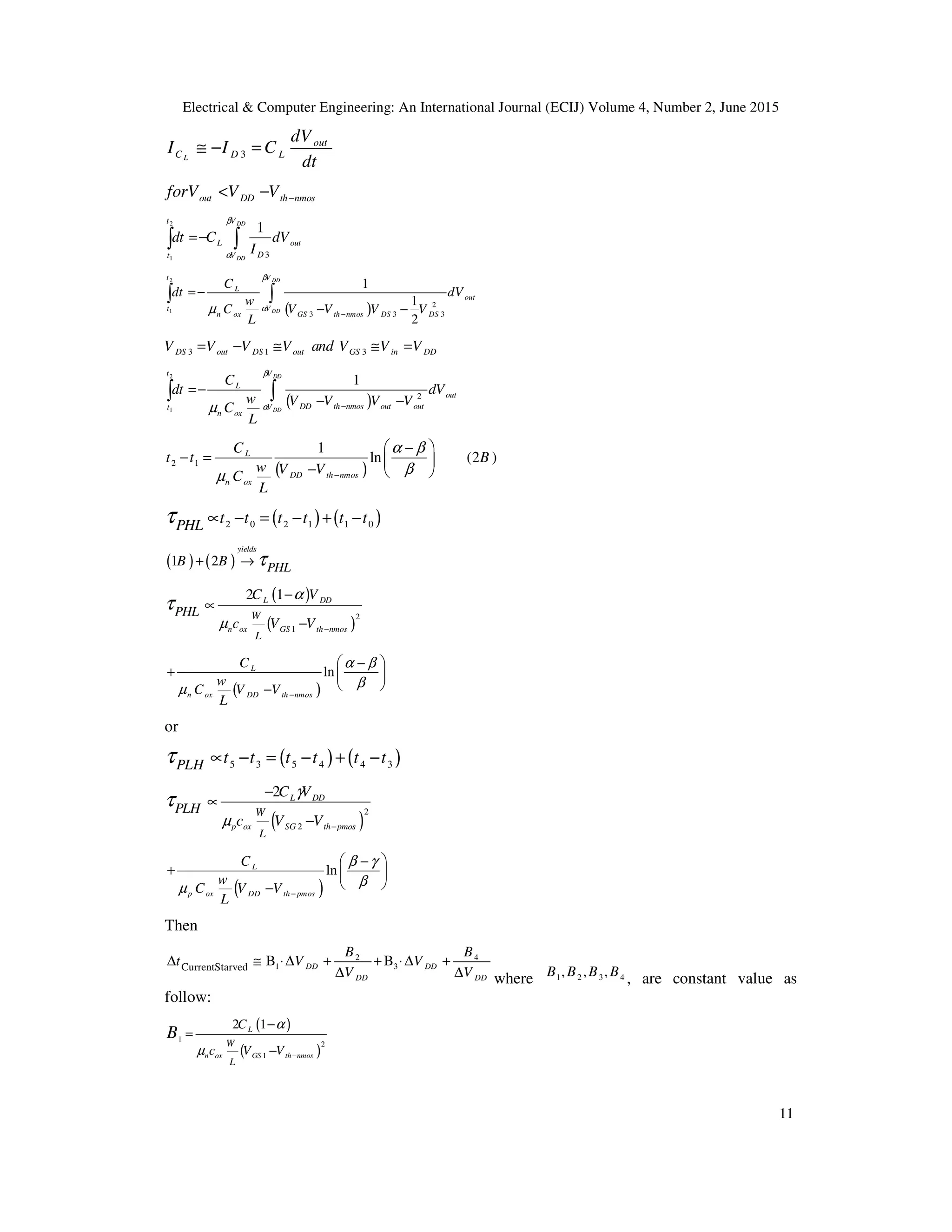
to calculate delay time of Current Starved inverter (Fig.5(b)) we can write equally.
0 1t t t< <
[ ], ,in DD out DD DD thV V V V V V∈= −
3 , 1M saturation M saturation→ →
4M cut off→
DD th nmos out DDfor V V V V−− < <
( )
2
1 1
1
2
D n ox GS th nmos
W
I C V V
L
µ −= −
( )
2
1
1
2
L
out
n ox GS th nmos
C
dt dV
w
C V V
L
µ −
= −
−
1
0
1DD
DD
t V
L out
Dnt V
dt C dV
I
α
=−∫ ∫
( )1GS th nmosKnow that V V cte−− =
( )
1
0
2
1
2
w
L
DD
DD
GS
t V
L
out
t V
n ox th nmos
C
dt dV
C V V
α
µ −
−
=
−
∫ ∫
( )
( )
1 0
2
1
2 1
(1 )L DD
n ox GS th nmos
C V
t t B
w
C V V
L
α
µ −
−
− =
−
1 2for t t t< <
3 , 1M linear M saturation→ →
( ) 2
3 3 3 3
1
2
D n ox GS th nmos DS DS
w
I C V V V V
L
µ −= − −
( )
2
1 1
1
2
D n ox GS th nmos
w
I C V V
L
µ −= −
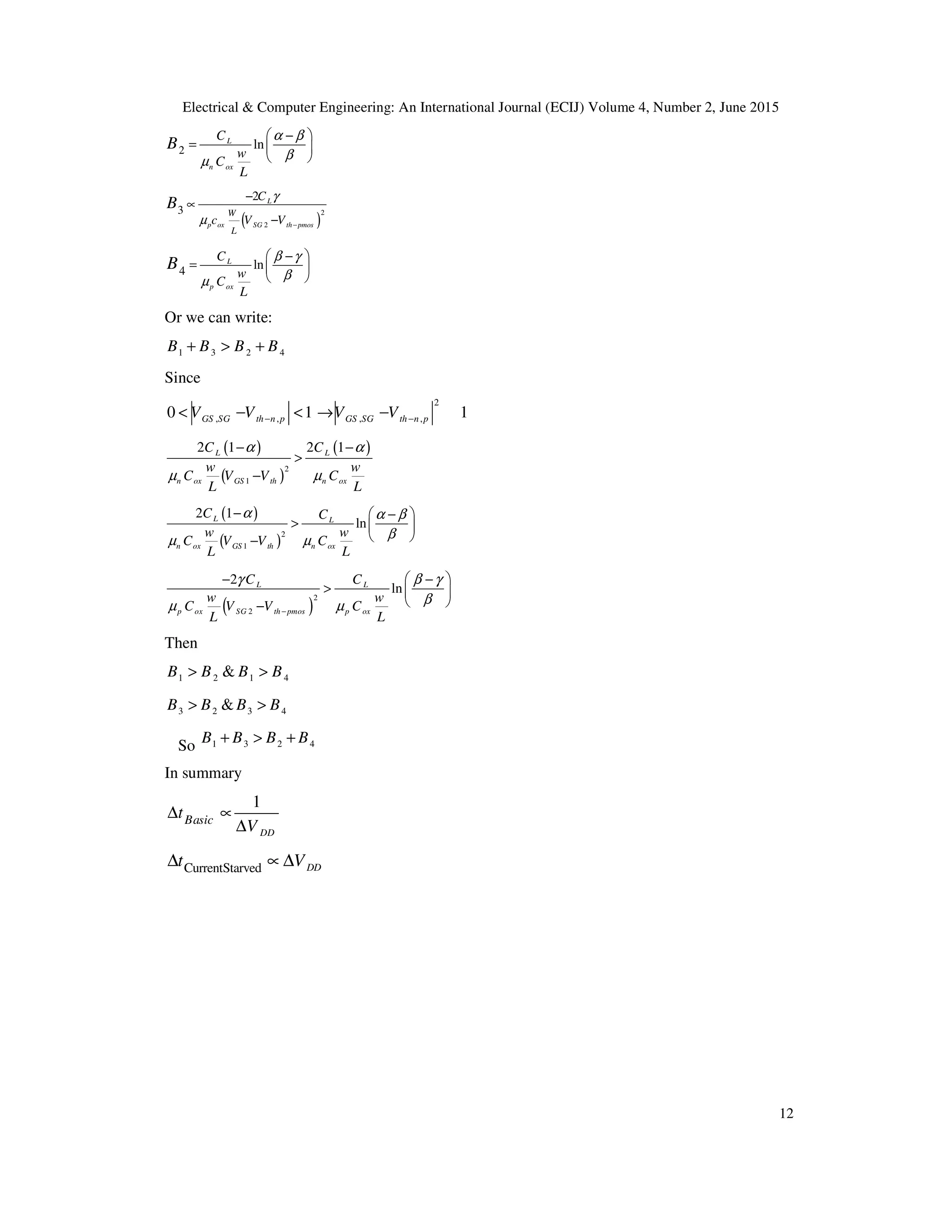
Electrical & Computer Engineering: An International Journal (ECIJ) Volume 4, Number 2, June 2015
11
3L
out
C D L
dV
I I C
dt
≅ − =
out DD th nmosforV V V −< −
2
1 3
1DD
DD
t V
L out
Dt V
dt C dV
I
β
α
=−∫ ∫
( )
2
1
2
3 3 3
1
1
2
DD
DD
t V
L
out
t V
n ox GS th nmos DS DS
C
dt dV
w
C V V V V
L
β
αµ −
=−
− −
∫ ∫
3 1 3DS out DS out GS in DDV V V V and V V V= − ≅ ≅ =
( )
2
1
2
1DD
DD
t V
L
out
DD th nmos out outt V
n ox
C
dt dV
w V V V VC
L
β
αµ −
=−
− −∫ ∫
( )2 1
1
ln (2 )L
DD th nmos
n ox
C
t t B
w V VC
L
α β
βµ −
 −
− =  
−  
( ) ( )2 0 2 1 1 0PHL t t t t t tτ ∝ − = − + −
( ) ( )1 2
yields
PHLB B τ+ →
( )
( )
2
1
2 1L DD
n ox GS th nmos
W
L
PHL
C V
c V V
α
µ
τ
−
−
∝
−
( )
lnL
n ox DD th nmos
C
w
C V V
L
α β
βµ −
 −
 
 −
+
or
( ) ( )5 3 5 4 4 3PLH t t t t t tτ ∝ − = − + −
( )
2
2
2 L DD
p ox SG th pmos
W
L
PLH
C V
c V V
γ
µ
τ
−
−
∝
−
( )
lnL
ox DD th pmosp
C
w
C V V
L
β γ
βµ −
 −
+

 
 −
Then
2 4
1 3CurrentStarved B BDD DD
DD DD
t V V
V V
B B
∆ ≅ ⋅∆ + + ⋅∆ +
∆ ∆ where 1 2 3 4, , ,B B B B , are constant value as
follow:
( )
( )
1
2
1
2 1L
n ox GS th nmos
W
L
C
c V V
B
α
µ −
−
=
−
Electrical & Computer Engineering: An International Journal (ECIJ) Volume 4, Number 2, June 2015
12
2 lnL
n ox
C
w
C
L
B
α β
βµ
 −
 
 
=
( )
2
2
3
2 L
p ox SG th pmos
W
L
C
c V V
B γ
µ −
−
∝
−
4 ln
p
L
ox
C
w
C
L
B β γ
βµ
 −
 
 
=
Or we can write:
1 3 2 4B B B B+ > +
Since
2
, , , ,0 1 1GS SG th n p GS SG th n pV V V V− −< − < → −
( )
( )
( )
2
1
2 1 2 1L L
n ox GS th n ox
C C
w w
C V V C
L L
α α
µ µ
− −
>
−
( )
( )
2
1
2 1
lnL L
n ox GS th n ox
C C
w w
C V V C
L L
α α β
βµ µ
−  −
>  
 −
( )2
2
2
lnL L
p ox th pmos oxSG p
C C
w w
C V V C
L L
γ β γ
βµ µ−
 − −
>  
 −
Then
1 2 1 4&B B B B> >
3 2 3 4&B B B B> >
So 1 3 2 4B B B B+ > +
In summary
1
DD
Basict
V
∆ ∝
∆
CurrentStarved DDt V∆ ∝ ∆
Electrical & Computer Engineering: An International Journal (ECIJ) Volume 4, Number 2, June 2015
13
REFERENCES
[1] G. G. Jovanovi´c, M. Stojˇcev, Z. Stamenkovic. A CMOS Voltage Controlled Ring Oscillator
with Improved Frequency Stability. Scientific Publication of the State University of NOVI PAZAR
ser. A: APPL. MATH. INFORM. AND MECH. vol. 2, 2010.
[2] B.Razavi. RF Microelectronics. Prentice Hall PTR, 1997.
[3] B. Razavi. Design of Analog CMOS Integrated Circuits. MacGraw-Hill,2001
[4] G. Jovanovi´c, M. Stojˇcev. Current starved delay element with symmetric load. International Journal
of Electronics, Vol. 93, 3, 2006.
[5] Yao WANG, Jiaxin LIU, Liangbo XIE, Guangjun WEN. An Ultra-Low-Power Oscillator with
Temperature and Process Compensation for UHF RFID Transponder. RADIOENGINEERING, VOL.
22, NO. 2, JUNE 2013, 505-510.
[6] Aimad El Mourabita, Guo-Neng Lub, Patrick Pittetb, A new method to enhance frequency operation
of CMOS ring oscillators, International Journal of Electronics, Vol. 99, Issue 3, 2012, 351-360.
[7] Won-tae Leea, Jaemin Shima, Jichai Jeongb, Design of a three-stage ring-type voltage-controlled
oscillator with a wide tuning range by controlling the current level in an embedded delay cell.
Microelectronics Journal, Volume 44, Issue 12, December 2013, 1328–1335.
[8] Seungjin Kim ; In-Young Lee ; Seok-Kyun Han, A Low-Noise Four-Stage Voltage-Controlled Ring
Oscillator in Deep-Submicrometer CMOS Technology. IEEE Transactions on Circuits and Systems.
2013, Vol.60, 71-75.
[9] S. Docking, M. Sachdev. An Analytical Equation for the Oscillation Frequency of High-Frequency
Ring Oscillators. IEEE Journal of Solid State Circuits, vol.39, 3, 2004, 533-537.
[10] Yalcin Alper Eken and John P. Uyemura, "A 5.9-GHz voltage-controlled ring oscillator in 0.18- µm
CMOS" IEEE J. Solid-State Circuits, vol. 39 no. 1, Jan. 2004.
[11] Ramazani A, Biabani S, Hadidi G, CMOS ring oscillator with combined delay stages. Int J Electron
Commun (AEÜ) (2014).
[12] Akbari, M., Biabanifard, S., Asadi, S., & Yagoub, M. C. (2014). Design and analysis of DC gain and
transconductance boosted recycling folded cascode OTA. AEU-International Journal of Electronics
and Communications, 68(11), 1047-1052.
[13] Largani, H., Mehdi, S., Shahsavari, S., Biabanifard, S., & Jalali, A. (2014). A new frequency
compensation technique for three stages OTA by differential feedback path. International Journal of
Numerical Modelling: Electronic Networks, Devices and Fields.
[14] Shahsavari, S., Biabanifard, S., Largani, S. M. H., & Hashemipour, O. (2015). DCCII based
frequency compensation method for three stage amplifiers. AEU-International Journal of Electronics
and Communications, 69(1), 176-181.
[15] Shahsavari, S., Biabanifard, S., Largani, S., & Hashemipour, O. (2014, May). A new frequency
compensation method based on differential current conveyor. InElectrical Engineering (ICEE), 2014
22nd Iranian Conference on (pp. 361-365). IEEE.
[16] Akbari, M., Biabanifard, S., Asadi, S., & Yagoub, M. C. (2015). High performance folded cascode
OTA using positive feedback and recycling structure. Analog Integrated Circuits and Signal
Processing, 82(1), 217-227.
[17] Biabanifard, S., Aghaee, T., & Asadi, S. Adesign GUIDE FOR COMPARATOR-BASED
SWITCHED-CAPACITOR INTEGRATOR.
[18] Biabanifard, S., Largani, S. M. H., & Asadi, S. DELAY TIME ANALYSIS OF COMBINED CMOS
RING OSCILLATOR.
[19] Largani, S., Shahsavari, S., Biabanifard, S., & Jalali, A. (2014, May). A new SMC compensation
strategy for three stage amplifiers based on differential feedback path. In Electrical Engineering
(ICEE), 2014 22nd Iranian Conference on (pp. 185-189). IEEE.
[20] Akbari, M., Biabanifard, S., & Hashemipour, O. (2014, May). Design of ultra-low-power CMOS
amplifiers based on flicker noise reduction. In Electrical Engineering (ICEE), 2014 22nd Iranian
Conference on (pp. 403-406). IEEE.
Electrical & Computer Engineering: An International Journal (ECIJ) Volume 4, Number 2, June 2015
14
AUTHORS
Sadegh Biabanifard was born in Tehran, Iran in 1989. He received the B.Sc. degree in
Electronics Engineering from Imam Reza International University, Mashhad, Iran in
2011and M.Sc. degree in Analog Electronics from Shahid Beheshti University, G.C.,
Tehran, Iran, in 2014. His research interests are RFIC design, analog and mixed mode
integrated circuits design for Ultra-Low-Power Ultra-Low-Voltage applications, OTA,
current conveyer and data converter.
S. Mehdi Hosseini Largani was born in Tonekabon, Iran in 1989. He received the B.S.
degree in Control Engineering from K.N.Toosi University of Technology, Tehran, Iran in
2011 and M.S. degree in Analog Electronic from Shahid Beheshti University (National
University of Iran) G.C., Tehran, Iran, in 2014. His research interests are analog and mixed
mode circuit theory, integrated circuit design for Ultra-Low-Power Ultra-Low-Voltage
applications. His is currently with Electrical Engineering Department and Microelectronic
Research Laboratory in Shahid Beheshti University, G.C, Tehran, Iran.
Shahrooz Asadi received the B.Sc. degree in Electrical Engineering and the M.Sc. degree
in Electronics both from Amirkabir University, Tehran, Iran, in 2003 and 2007,
respectively and the Ph.D. degree in Electronics in the School of Information Technology
and Engineering (SITE), University of Ottawa, Ottawa, ON, Canada. He joined shahid
Beheshti University in 2011 where he is an assistant professor. His research interests
include linear and nonlinear time-domain modeling of millimeter-wave transistors, RF
design of active and passive devices, design and optimization of solid state devices and
multiconductor transmission lines and printed circuit board.

COMBINED SKEWED CMOS RING OSCILLATOR

  • 1.
    Electrical & ComputerEngineering: An International Journal (ECIJ) Volume 4, Number 2, June 2015 DOI : 10.14810/ecij.2015.4201 1 COMBINED SKEWED CMOS RING OSCILLATOR Sadegh Biabanifard1 , S. Mehdi Hosseini Largani2 and Shahrouz Asadi3 1,2 Microelectronic Lab, Shahid Beheshti University, G. C, Tehran 3 Faculty of Electrical Engineering, Shahid Beheshti University, G.C, Tehran ABSTRACT A combined skewed ring oscillator by different type of delay stages is presented. This paper aims to drive a high stable and relatively high frequency but still use a full transistor circuit for ring oscillator with combined delay stages and skewed connections. First we propose two types of common inverters then calculate their delay time and analysis their dependence of delay time to variation of power supply voltage. The simulation results verify that delay time of these two CMOS inverters show opposite behaviour versus power supply changing. So a combined structure can obtain more appropriate frequency stability versus power supply noise. Also in order to increase oscillation frequency we have used the negative skewed delay connections. The simulation results using HSPICE for 0.18 µm CMOS shows a good agreement with analysis results. In addition in this paper the mathematical justification for improved functioning of this combined skewed ring oscillator has been proved. This justification shows appropriate agreement with the simulation results. From mathematical point of view the proposed ring oscillator has better frequency stability in comparison with other types of ring oscillators. In fact, the oscillation frequency sensitivity to supply voltage noise is reduced considerably. KEYWORDS CMOS, ring oscillator, frequency stability, delay time 1. INTRODUCTION Oscillators are the essential part of any digital and analog systems [1, 11]. And ring oscillator is a circuit usually uses transistors without using passive elements [4]. The main reason of the tendency to design full transistor CMOS circuits is the ability of easy integration with absence of passive elements which reduces the die area [12-20]. The most significant feature of a ring oscillator is lower cost due to lower die area and design simplicity [1, 4, 5]. However the highest possible oscillation frequency is lower for ring oscillators than LC oscillator, negative skewed delay connections can improve the speed of ring type oscillators. Several designs for ring oscillator have been reported in literature. In [1], a frequency stable oscillator is designed based on the opposite direction of delay time changing, which increase frequency stability but oscillation frequency reduce due to using current starved inverter. In [6] a method to enhance frequency operation of ring oscillators by negative skewed delay connections presented. Overall, most of the reported ring oscillators cannot improve both frequency stability and oscillation frequency. In this paper a novel design as combined skewed ring oscillator is presented to improve frequency stability an oscillation frequency simultaneously. Usually a single ended ring oscillator can be implement using odd number of delay stages (Fig.1). Considering oscillation criterion the loop gain must be equal or bigger than unity and also the
  • 2.
    Electrical & ComputerEngineering: An International Journal (ECIJ) Volume 4, Number 2, June 2015 2 loop gain must be negative which odd number of inverters can satisfy these conditions. By assuming that all stages are similar we can extract oscillation frequency from (1). ( ) ( ) ( )1 2 1 m N g R A j A j A j j RC ω ω ω ω − = =…= = + (1)( ) ( ) ( )1 2. . . 1NA j A j A jω ω ω… = ( ) ( )1 2 A1 jω θ tan ωRC K RC π− ∠ = = = Fig.1. A typical ring oscillator by odd number of inverters [2] Fig.2. general linear model of a ring oscillator [1] The above equation can leads us to estimate oscillation frequency in initial stage of oscillation but the stable oscillation frequency can be obtain from large signal analysis not from small signal mode in fig.2, since the start oscillation frequency is different with stable oscillation frequency. A stage is an inverter and has td seconds delay. Since the similarity between stages is assumed, oscillation frequency can be obtained as (2). (2) 0 1 2 d f Nt = In (2) we assume that N is an odd number and illustrates the number of delay stages. In fact the starting frequency of oscillation is determined by Barkhausen criteria and stable oscillation frequency specified by inverters delay time [2]. According to (2) oscillation frequency strongly depends on delay time of delay stages. Also knowing that the number stages in a fixed structure is constant then the most significant parameters for oscillation frequency calculation is delay time. Two configurations for five stage conventional ring oscillator are shown in fig.3 and fig.4. According to fig.4 we have an option to change the oscillation frequency by adjusting Vctrl, so by using current starved inverter, voltage controlled oscillator can be designed.
  • 3.
    Electrical & ComputerEngineering: An International Journal (ECIJ) Volume 4, Number 2, June 2015 3 Fig.3. Five stage basic ring oscillator Fig.4. Five stage Current Starved ring VCO In this paper we’ve calculated the delay time of basic and Current Starved inverters and based on the equations a combined skewed ring VCO will be presented. 2. DELAY TIME OF INVERTERS General conditions of ring oscillators were discussed in previous part. In this section delay time calculations are presented since this parameter is the only parameter which can determine the oscillation frequency. By assuming two types of inverters, basic type inverter and current starved inverter (Fig.5).By applying an ideal pulse to both of these inverters, we obtain the output signal depicted in Fig.6. Details of calculations are brought in the appendix A. 2 PHL PLH delayt τ τ ∝ + 2 0PHL t tτ = − 5 3PLH t tτ = − ( ) ( ) 2 2 1L DD n ox DD th nmos W L PHLbasic C V c V V α µ τ − − − = ( ) 2 lnL n ox DD th nmos C W c V V L α β βµ −  − +    − (3) ( ) 2 2 L DD p ox DD th pmos W L PLHbasic C V c V Vµ γτ − − − =
  • 4.
    Electrical & ComputerEngineering: An International Journal (ECIJ) Volume 4, Number 2, June 2015 4 ( ) 2 lnL p ox DD th pmos C W c V V L β βµ γ −  − +    − ( ) ( ) 2 1 2 1L DD n ox GS th nmos W L PHLCS C V c V V α µ τ − − ∝ − ( ) lnL n ox DD th nmos C w C V V L α β βµ −  −    − + (4) ( ) 2 2 2 L DD p ox SG th pmos W L PLHCS C V c V V γ µ τ − − ∝ − ( ) lnL ox DD th pmosp C w C V V L β γ βµ −  − +     − Fig.5. Basic inverter (a) and Current Starved inverter (b) Fig.6. Input and output of inverters
  • 5.
    Electrical & ComputerEngineering: An International Journal (ECIJ) Volume 4, Number 2, June 2015 5 In the other word: 1 DD Basict V ∆ ∝ ∆ & CurrentStarved DDt V∆ ∝ ∆ As can be seen we can conclude that delay time of these two inverters show different behaviour versus power supply changing. According to (3) and (4) delay time of basic inverter depends on power supply changing in opposite direction which delay time of current starved inverter depends on power supply changing. By considering this fact it is obvious that combined ring oscillator depicted in fig.7 can provide more stable oscillation frequency versus power supply variation. The whole loop delay in this type of oscillator can be introduce as sum of all delay times. In this case first and fifth stages are basic type inverters and other stages are current starved inverters. By summing these delay times the total delay time is less sensitive to power supply variation in comparison with basic type inverter delay time or current starved inverter delay time. )5( 1 2 3 4 5d d d d dd t t t t tt = + + + + Fig.7. Combined ring VCO Then, if all inverters are the same type , … , will have the same variation. Meaning that all become smaller or bigger. In the other words changing oscillation frequency is inevitable. But in combined structure two types of inverters show opposite behaviours to power supply changing which considerably reduces the dependence of whole circuit to power supply noise. However combined ring VCO has the lower oscillation frequency compared with simple ring oscillators. By using NSD stages we can increase oscillation frequency of combined ring VCO. 3. NEGATIVE SKEWED DELAY SCHEME In conventional inverters both PMOS and NMOS have the same input signals. NSD is a technique that reduces delay of inverters. Fig.8 shows the concept of NSD. In fact in NSD inverter input signal to PMOS arrives earlier than to the NMOS and output changing become faster as illustrated in fig.8.[6]. By using NSD stage to design a ring oscillator we need to modify the connections as shown fig.9. Also for combined ring VCO the circuit of fig.10 is suggested. The minimum number of stages in
  • 6.
    Electrical & ComputerEngineering: An International Journal (ECIJ) Volume 4, Number 2, June 2015 6 skewed ring oscillator is five because when the number of stage is tree, the skewed ring oscillator yields a PMOS diode- connected load. By using NSD connection for combined ring oscillator we can compensate decreased oscillation frequency by changing configuration. Fig. 8. NSD inverter Fig. 9. Skewed ring oscillator Fig. 10. Proposed Combined Skewed ring VCO
  • 7.
    Electrical & ComputerEngineering: An International Journal (ECIJ) Volume 4, Number 2, June 2015 7 4. SIMULATION RESULTS In order to validate the previous discussion, five structures in fig.3, fig.4, fig.7, fig.9 and fig.10 have been simulated with HSPICE using TSMC 180 nm technology. The nominal supply voltage and Vctrl have been selected equal to 1.8 V and 1.5 V respectively. Also a factor as frequency deviation is defined in [1] to compare operational performance of simulated circuits. This factor is described in (6). )6( ( ) ( ) ( ) DD DD DD DD f V V f Vf f f V + ∆ −∆ = In this definition f (VDD+∆VDD) is the oscillation frequency when supply voltage is VDD+∆VDD [1]. Fig. 11 shows frequency deviation factor for five ring oscillator that obtained from simulation. And table.1 presents a comparison between these five type ring oscillators. The simulation results verify the analysis and mathematical justifications since simple combined structure and combined structure with NDS connections show considerable reduction in frequency deviation factor. In addition using NDS connection increases the oscillation frequency for combined ring oscillator from 960MHz to 3.31GHz. The proposed combined skewed ring oscillator is a VCO due to using current starved inverter. Table.1 reports the important parameters for simulated oscillators. According to this table the proposed ring oscillator can work in higher frequencies with lower frequency deviation in compared with simple structures. Fig. 11. Frequency deviation factor of five ring oscillators.
  • 8.
    Electrical & ComputerEngineering: An International Journal (ECIJ) Volume 4, Number 2, June 2015 8 Tab. 1. Simulation results for five type ring oscillators 5. CONCLUSION Ring oscillators are one of the basic blocks of integrated circuits. This paper presents two types of CMOS inverters with detailed delay time calculations and then suggests combined structure for implementing an efficient VCO regarding frequency deviation. Oscillation frequency of combined ring VCO is low in respect to simple one. For increasing oscillation frequency we used NSD stages in combined structure that significantly increased oscillation frequency. The results of simulation by HSPICE for 0.18µm CMOS approve the analysis results. According to simulation results the proposed VCO can work in higher frequencies with less frequency deviation. A.1. Appendix A DD th nmos DD V V V α −− = 2 DDV β = th pmos DD V V γ − = In order to calculate delay time of Basic type inverter (Fig.5 (a)) we can write: 0 1for t t t nmos saturation< < → ( ) 21 2 Dn n ox in th nmos W I C V V L µ −= − out CL L dV I C dt =− = − DD th nmos out DDfor V V V V−− < < 0 1DD th nmos DDV V Vα α−− = → < < 1 0 1DD DD t V L out Dnt V dt C dV I α =−∫ ∫
  • 9.
    Electrical & ComputerEngineering: An International Journal (ECIJ) Volume 4, Number 2, June 2015 9 ( ) 1 0 2 2 w µ L DD DD t V L out t V n ox DD th nmos C dt dV C V V α − − = − ∫ ∫ ( ) ( ) 0 2 1 2 1 (1 )L DD n ox DD th nmos W L C V t A c V V t α µ − − − = − 1 2t t t nmos Linear< < → ( ) 21 2 Dn n ox in th nmos out out W I C V V V V L µ −= − − ( ) 21 2 out n ox in th nmos out out L dVW C V V V V C L dt µ −− − =− out DD thfor V V V< − 2 1 1DD DD t V L out Dnt V dt C dV I β α =−∫ ∫ ( ) 2 1 2 2 1 2 DD DD t V L out DD th nmos out outt V n ox C dt dV W V V V VC L β αµ − =− − −∫ ∫ ( ) 2 1 2 ln (2 )L n ox DD th nmos C A W C V V L t t α β βµ −  − =    − − ( ) ( )2 0 2 1 1 0PHL t t t t t tτ ∝ − = − + − ( ) ( )1 2 yields PHLA A τ+ → ( ) ( ) 2 2 1L DD n ox DD th nmos W L PHL C V c V V α µ τ − − − = ( ) 2 lnL n ox DD th nmos C W c V V L α β βµ −  − +    − or ( ) ( )5 3 5 4 4 3PLH t t t t t tτ ∝ − = − + − ( ) 2 2 L DD p ox DD th pmos W L PLH C V c V Vµ γτ − − − = ( ) 2 lnL p ox DD th pmos C W c V V L β βµ γ −  − +    − Then 31 2 4 DD DD DD DD Basic AAA t V V V A V ∆ ≅ + + + ∆ ∆ ∆ ∆ Where 1 2 3 4, , ,A A A A , are constant value as follow: ( ) 1 2 1L n ox W L C c A α µ − =
  • 10.
    Electrical & ComputerEngineering: An International Journal (ECIJ) Volume 4, Number 2, June 2015 10 2 2 lnL n ox C W c L A α β βµ  − =     3 2 L p ox W L C c A µ γ− = 4 2 lnL p ox C A W c L β βµ γ − =     to calculate delay time of Current Starved inverter (Fig.5(b)) we can write equally. 0 1t t t< < [ ], ,in DD out DD DD thV V V V V V∈= − 3 , 1M saturation M saturation→ → 4M cut off→ DD th nmos out DDfor V V V V−− < < ( ) 2 1 1 1 2 D n ox GS th nmos W I C V V L µ −= − ( ) 2 1 1 2 L out n ox GS th nmos C dt dV w C V V L µ − = − − 1 0 1DD DD t V L out Dnt V dt C dV I α =−∫ ∫ ( )1GS th nmosKnow that V V cte−− = ( ) 1 0 2 1 2 w L DD DD GS t V L out t V n ox th nmos C dt dV C V V α µ − − = − ∫ ∫ ( ) ( ) 1 0 2 1 2 1 (1 )L DD n ox GS th nmos C V t t B w C V V L α µ − − − = − 1 2for t t t< < 3 , 1M linear M saturation→ → ( ) 2 3 3 3 3 1 2 D n ox GS th nmos DS DS w I C V V V V L µ −= − − ( ) 2 1 1 1 2 D n ox GS th nmos w I C V V L µ −= −
  • 11.
    Electrical & ComputerEngineering: An International Journal (ECIJ) Volume 4, Number 2, June 2015 11 3L out C D L dV I I C dt ≅ − = out DD th nmosforV V V −< − 2 1 3 1DD DD t V L out Dt V dt C dV I β α =−∫ ∫ ( ) 2 1 2 3 3 3 1 1 2 DD DD t V L out t V n ox GS th nmos DS DS C dt dV w C V V V V L β αµ − =− − − ∫ ∫ 3 1 3DS out DS out GS in DDV V V V and V V V= − ≅ ≅ = ( ) 2 1 2 1DD DD t V L out DD th nmos out outt V n ox C dt dV w V V V VC L β αµ − =− − −∫ ∫ ( )2 1 1 ln (2 )L DD th nmos n ox C t t B w V VC L α β βµ −  − − =   −   ( ) ( )2 0 2 1 1 0PHL t t t t t tτ ∝ − = − + − ( ) ( )1 2 yields PHLB B τ+ → ( ) ( ) 2 1 2 1L DD n ox GS th nmos W L PHL C V c V V α µ τ − − ∝ − ( ) lnL n ox DD th nmos C w C V V L α β βµ −  −    − + or ( ) ( )5 3 5 4 4 3PLH t t t t t tτ ∝ − = − + − ( ) 2 2 2 L DD p ox SG th pmos W L PLH C V c V V γ µ τ − − ∝ − ( ) lnL ox DD th pmosp C w C V V L β γ βµ −  − +     − Then 2 4 1 3CurrentStarved B BDD DD DD DD t V V V V B B ∆ ≅ ⋅∆ + + ⋅∆ + ∆ ∆ where 1 2 3 4, , ,B B B B , are constant value as follow: ( ) ( ) 1 2 1 2 1L n ox GS th nmos W L C c V V B α µ − − = −
  • 12.
    Electrical & ComputerEngineering: An International Journal (ECIJ) Volume 4, Number 2, June 2015 12 2 lnL n ox C w C L B α β βµ  −     = ( ) 2 2 3 2 L p ox SG th pmos W L C c V V B γ µ − − ∝ − 4 ln p L ox C w C L B β γ βµ  −     = Or we can write: 1 3 2 4B B B B+ > + Since 2 , , , ,0 1 1GS SG th n p GS SG th n pV V V V− −< − < → − ( ) ( ) ( ) 2 1 2 1 2 1L L n ox GS th n ox C C w w C V V C L L α α µ µ − − > − ( ) ( ) 2 1 2 1 lnL L n ox GS th n ox C C w w C V V C L L α α β βµ µ −  − >    − ( )2 2 2 lnL L p ox th pmos oxSG p C C w w C V V C L L γ β γ βµ µ−  − − >    − Then 1 2 1 4&B B B B> > 3 2 3 4&B B B B> > So 1 3 2 4B B B B+ > + In summary 1 DD Basict V ∆ ∝ ∆ CurrentStarved DDt V∆ ∝ ∆
  • 13.
    Electrical & ComputerEngineering: An International Journal (ECIJ) Volume 4, Number 2, June 2015 13 REFERENCES [1] G. G. Jovanovi´c, M. Stojˇcev, Z. Stamenkovic. A CMOS Voltage Controlled Ring Oscillator with Improved Frequency Stability. Scientific Publication of the State University of NOVI PAZAR ser. A: APPL. MATH. INFORM. AND MECH. vol. 2, 2010. [2] B.Razavi. RF Microelectronics. Prentice Hall PTR, 1997. [3] B. Razavi. Design of Analog CMOS Integrated Circuits. MacGraw-Hill,2001 [4] G. Jovanovi´c, M. Stojˇcev. Current starved delay element with symmetric load. International Journal of Electronics, Vol. 93, 3, 2006. [5] Yao WANG, Jiaxin LIU, Liangbo XIE, Guangjun WEN. An Ultra-Low-Power Oscillator with Temperature and Process Compensation for UHF RFID Transponder. RADIOENGINEERING, VOL. 22, NO. 2, JUNE 2013, 505-510. [6] Aimad El Mourabita, Guo-Neng Lub, Patrick Pittetb, A new method to enhance frequency operation of CMOS ring oscillators, International Journal of Electronics, Vol. 99, Issue 3, 2012, 351-360. [7] Won-tae Leea, Jaemin Shima, Jichai Jeongb, Design of a three-stage ring-type voltage-controlled oscillator with a wide tuning range by controlling the current level in an embedded delay cell. Microelectronics Journal, Volume 44, Issue 12, December 2013, 1328–1335. [8] Seungjin Kim ; In-Young Lee ; Seok-Kyun Han, A Low-Noise Four-Stage Voltage-Controlled Ring Oscillator in Deep-Submicrometer CMOS Technology. IEEE Transactions on Circuits and Systems. 2013, Vol.60, 71-75. [9] S. Docking, M. Sachdev. An Analytical Equation for the Oscillation Frequency of High-Frequency Ring Oscillators. IEEE Journal of Solid State Circuits, vol.39, 3, 2004, 533-537. [10] Yalcin Alper Eken and John P. Uyemura, "A 5.9-GHz voltage-controlled ring oscillator in 0.18- µm CMOS" IEEE J. Solid-State Circuits, vol. 39 no. 1, Jan. 2004. [11] Ramazani A, Biabani S, Hadidi G, CMOS ring oscillator with combined delay stages. Int J Electron Commun (AEÜ) (2014). [12] Akbari, M., Biabanifard, S., Asadi, S., & Yagoub, M. C. (2014). Design and analysis of DC gain and transconductance boosted recycling folded cascode OTA. AEU-International Journal of Electronics and Communications, 68(11), 1047-1052. [13] Largani, H., Mehdi, S., Shahsavari, S., Biabanifard, S., & Jalali, A. (2014). A new frequency compensation technique for three stages OTA by differential feedback path. International Journal of Numerical Modelling: Electronic Networks, Devices and Fields. [14] Shahsavari, S., Biabanifard, S., Largani, S. M. H., & Hashemipour, O. (2015). DCCII based frequency compensation method for three stage amplifiers. AEU-International Journal of Electronics and Communications, 69(1), 176-181. [15] Shahsavari, S., Biabanifard, S., Largani, S., & Hashemipour, O. (2014, May). A new frequency compensation method based on differential current conveyor. InElectrical Engineering (ICEE), 2014 22nd Iranian Conference on (pp. 361-365). IEEE. [16] Akbari, M., Biabanifard, S., Asadi, S., & Yagoub, M. C. (2015). High performance folded cascode OTA using positive feedback and recycling structure. Analog Integrated Circuits and Signal Processing, 82(1), 217-227. [17] Biabanifard, S., Aghaee, T., & Asadi, S. Adesign GUIDE FOR COMPARATOR-BASED SWITCHED-CAPACITOR INTEGRATOR. [18] Biabanifard, S., Largani, S. M. H., & Asadi, S. DELAY TIME ANALYSIS OF COMBINED CMOS RING OSCILLATOR. [19] Largani, S., Shahsavari, S., Biabanifard, S., & Jalali, A. (2014, May). A new SMC compensation strategy for three stage amplifiers based on differential feedback path. In Electrical Engineering (ICEE), 2014 22nd Iranian Conference on (pp. 185-189). IEEE. [20] Akbari, M., Biabanifard, S., & Hashemipour, O. (2014, May). Design of ultra-low-power CMOS amplifiers based on flicker noise reduction. In Electrical Engineering (ICEE), 2014 22nd Iranian Conference on (pp. 403-406). IEEE.
  • 14.
    Electrical & ComputerEngineering: An International Journal (ECIJ) Volume 4, Number 2, June 2015 14 AUTHORS Sadegh Biabanifard was born in Tehran, Iran in 1989. He received the B.Sc. degree in Electronics Engineering from Imam Reza International University, Mashhad, Iran in 2011and M.Sc. degree in Analog Electronics from Shahid Beheshti University, G.C., Tehran, Iran, in 2014. His research interests are RFIC design, analog and mixed mode integrated circuits design for Ultra-Low-Power Ultra-Low-Voltage applications, OTA, current conveyer and data converter. S. Mehdi Hosseini Largani was born in Tonekabon, Iran in 1989. He received the B.S. degree in Control Engineering from K.N.Toosi University of Technology, Tehran, Iran in 2011 and M.S. degree in Analog Electronic from Shahid Beheshti University (National University of Iran) G.C., Tehran, Iran, in 2014. His research interests are analog and mixed mode circuit theory, integrated circuit design for Ultra-Low-Power Ultra-Low-Voltage applications. His is currently with Electrical Engineering Department and Microelectronic Research Laboratory in Shahid Beheshti University, G.C, Tehran, Iran. Shahrooz Asadi received the B.Sc. degree in Electrical Engineering and the M.Sc. degree in Electronics both from Amirkabir University, Tehran, Iran, in 2003 and 2007, respectively and the Ph.D. degree in Electronics in the School of Information Technology and Engineering (SITE), University of Ottawa, Ottawa, ON, Canada. He joined shahid Beheshti University in 2011 where he is an assistant professor. His research interests include linear and nonlinear time-domain modeling of millimeter-wave transistors, RF design of active and passive devices, design and optimization of solid state devices and multiconductor transmission lines and printed circuit board.