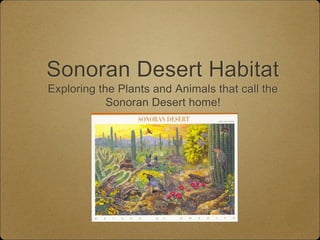



Sonoran Desert Habitat
Exploring the Plants and Animals that call the
Sonoran Desert home!
Learning Goals…
Describe what a habitat is.
Identity where the Sonoran Desert is, and it’s
characteristics as a habitat.
Describe how plants and animals within a habitat
are dependent on each other.
Explain how specific adaptations of plants and
animals allow them to live in specific habitats.
Think, Pair,
Share…
What is a Habitat?
Where in the world is the
Sonoran Desert?
How do you describe the
habitat of the Sonoran
Desert?
What makes a desert
so… desert-like?
There is less than 15 inches
of rain a year.
Generally has some types of
trees, shrubs, and grasses.
Plants and animals have
adapted to survive the dry,
hot season.
May have a short rainy
season.
Sonoran Desert
The Sonoran Desert is an arid (dry)
region covering 120,000 square
miles in southwestern Arizona and
California, as well as most of Baja,
California, and the western half of
the state of Sonora, Mexico.
The Sonoran Desert is a subtropical
desert receiving most of its
moisture during the Monsoon
season, but also gets a good
amount of moisture from the rains.
They have 2 (TWO!!) distinct rainy
seasons!!!
The Sonoran Desert includes 60 mammal species,
350 bird species, 20 amphibian species, 100+
reptile species, 30 native fish species, and more
than 2000 native plant species. The Sonoran
Desert is also home to Jaguars and the Saguaro
cactus.
https://vimeo.com/55016996
The Saguaro cactus is one of the world’s largest.
They are also very old.
With the right
conditions, they can
live to be 150-200
years old.
They are very slow
growing.
A 10 year old
saguaro may
only be 1.5
INCHES tall.
But they can grow up to 40-60 feet tall
and weigh between 3,200 and 4,800
pounds!!!
I can…
Create a relief drawing of
a Saguaro with glue and
chalk.
Observe the
characteristics of the Gila
Woodpecker and Elf Owl
in order to create a
drawing of each.
Jenny Willigrod
From Prescott, AZ
Works in chalk pastel.
Inspired by the bursts of color often seen in the desert.
Gila Woodpecker:
Life inside of a Saguaro
Both female and male Gila
Woodpeckers have a brown
face and a black and white
zebra striped back. Adult
males have a red cap of
feathers on their head.
They have adapted to pecking
into saguaros by having a
strong head and neck, a long,
pointed beak and a long,
sticky tongue to reach food.
Woodpeckers nest in
saguaros by digging holes into
the cactus with their beaks.
These holes are called
“boots.”
The boots provide a safe, cool
place for woodpeckers to live
and raise their young.
They often have 3-4 eggs from
early April until late May.
Gila Woodpecker:
Life inside of a Saguaro
The Elf Owl:
Moving in :)
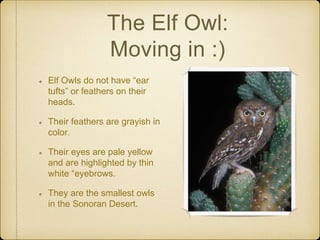
Elf Owls do not have “ear
tufts” or feathers on their
heads.
Their feathers are grayish in
color.
Their eyes are pale yellow
and are highlighted by thin
white “eyebrows.
They are the smallest owls
in the Sonoran Desert.
Elf owls are very adapted to living in the desert.
They have excellent night vision and hearing.
They catch their prey by hearing it instead of
seeing it.
They have “silent flight” which means they don’t
make any noise when they approach their prey.
When a predator approaches, the elf owl will
usually play dead until all danger has passed.
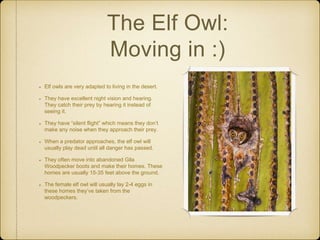
They often move into abandoned Gila
Woodpecker boots and make their homes. These
homes are usually 15-35 feet above the ground.
The female elf owl will usually lay 2-4 eggs in
these homes they’ve taken from the
woodpeckers.
The Elf Owl:
Moving in :)

2nd saguaro

  • 1.
    Sonoran Desert Habitat Exploringthe Plants and Animals that call the Sonoran Desert home!
  • 2.
    Learning Goals… Describe whata habitat is. Identity where the Sonoran Desert is, and it’s characteristics as a habitat. Describe how plants and animals within a habitat are dependent on each other. Explain how specific adaptations of plants and animals allow them to live in specific habitats.
  • 3.
    Think, Pair, Share… What isa Habitat? Where in the world is the Sonoran Desert? How do you describe the habitat of the Sonoran Desert?
  • 4.
    What makes adesert so… desert-like? There is less than 15 inches of rain a year. Generally has some types of trees, shrubs, and grasses. Plants and animals have adapted to survive the dry, hot season. May have a short rainy season.
  • 5.
    Sonoran Desert The SonoranDesert is an arid (dry) region covering 120,000 square miles in southwestern Arizona and California, as well as most of Baja, California, and the western half of the state of Sonora, Mexico. The Sonoran Desert is a subtropical desert receiving most of its moisture during the Monsoon season, but also gets a good amount of moisture from the rains. They have 2 (TWO!!) distinct rainy seasons!!!
  • 6.
    The Sonoran Desertincludes 60 mammal species, 350 bird species, 20 amphibian species, 100+ reptile species, 30 native fish species, and more than 2000 native plant species. The Sonoran Desert is also home to Jaguars and the Saguaro cactus. https://vimeo.com/55016996
  • 7.
    The Saguaro cactusis one of the world’s largest. They are also very old. With the right conditions, they can live to be 150-200 years old. They are very slow growing. A 10 year old saguaro may only be 1.5 INCHES tall. But they can grow up to 40-60 feet tall and weigh between 3,200 and 4,800 pounds!!!
  • 9.
    I can… Create arelief drawing of a Saguaro with glue and chalk. Observe the characteristics of the Gila Woodpecker and Elf Owl in order to create a drawing of each.
  • 10.
    Jenny Willigrod From Prescott,AZ Works in chalk pastel. Inspired by the bursts of color often seen in the desert.
  • 11.
    Gila Woodpecker: Life insideof a Saguaro Both female and male Gila Woodpeckers have a brown face and a black and white zebra striped back. Adult males have a red cap of feathers on their head. They have adapted to pecking into saguaros by having a strong head and neck, a long, pointed beak and a long, sticky tongue to reach food.
  • 12.
    Woodpeckers nest in saguarosby digging holes into the cactus with their beaks. These holes are called “boots.” The boots provide a safe, cool place for woodpeckers to live and raise their young. They often have 3-4 eggs from early April until late May. Gila Woodpecker: Life inside of a Saguaro
  • 13.
    The Elf Owl: Movingin :) Elf Owls do not have “ear tufts” or feathers on their heads. Their feathers are grayish in color. Their eyes are pale yellow and are highlighted by thin white “eyebrows. They are the smallest owls in the Sonoran Desert.
  • 15.
    Elf owls arevery adapted to living in the desert. They have excellent night vision and hearing. They catch their prey by hearing it instead of seeing it. They have “silent flight” which means they don’t make any noise when they approach their prey. When a predator approaches, the elf owl will usually play dead until all danger has passed. They often move into abandoned Gila Woodpecker boots and make their homes. These homes are usually 15-35 feet above the ground. The female elf owl will usually lay 2-4 eggs in these homes they’ve taken from the woodpeckers. The Elf Owl: Moving in :)