Color
BY HASHMI SAFWAN
What is color ?
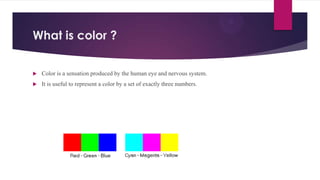
 Color is a sensation produced by the human eye and nervous system.
 It is useful to represent a color by a set of exactly three numbers.
Color is Human Sensation
 Cone and rod receptors in the retina
 Rod receptor is mostly for luminance perception
 3 different types of cone receptors in the fovea of retina, responsible for
color representation. Each type is sensitive to different wavelengths
Color model
 A color model is an orderly system for creating a whole range of colors from a small set
of primary colors.
Types of Color model
 Subtractive Color
 Additive Color
 Additive color models use light to display color
 subtractive models use printing inks.
The Two Most Common Color Models
 RGB model
 For computer
 CMYK model
 For printing
 YCbCr model
RGB Color Model:
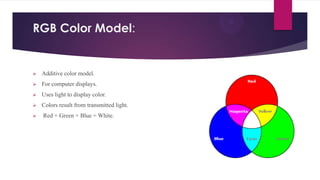
 Additive color model.
 For computer displays.
 Uses light to display color.
 Colors result from transmitted light.
 Red + Green + Blue = White.
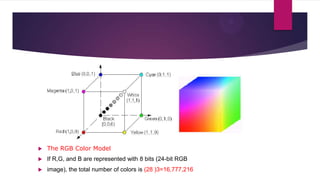
 The RGB Color Model
 If R,G, and B are represented with 8 bits (24-bit RGB
 image), the total number of colors is (28 )3=16,777,216
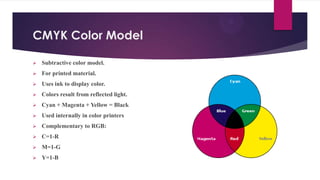
CMYK Color Model
 Subtractive color model.
 For printed material.
 Uses ink to display color.
 Colors result from reflected light.
 Cyan + Magenta + Yellow = Black
 Used internally in color printers
 Complementary to RGB:
 C=1-R
 M=1-G
 Y=1-B
Color Models
 the color model RGB is used in hardware applications like PC monitors, cameras and scanners, the CMY
color model is used in color printers,
 Each color can be a point in the RGB color model cube. Red, green and blue are known as the primary
colors. These colors can be added to produce secondary colors which are:
 magenta = red + blue
 cyan = green +blue
 yellow = red + green
 Other possible combinations:
 white = blue (primary) + yellow (secondary)
 white = green (primary) + magenta (secondary)
 white = red (primary) + cyan (secondary)
Additive vs. Subtractive Color Models
 Since additive color models display color as a result of light being transmitted (added) the total absence of
light would be perceived as black. Subtractive color models display color as a result of light being absorbed
(subtracted) by the printing inks. As more ink is added, less and less light is reflected. Where there is a total
absence of ink the resulting light being reflected (from a white surface) would be perceived as white.
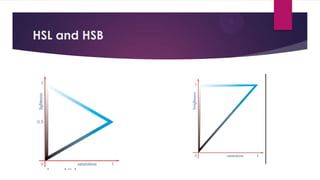
HSL and HSB
 Hue Hue is what most people think of when we say "color".
 Saturation Saturation is the "purity" of the color. It refers to the amount of gray paint mixed
with the hue.
 Lightness Value refers to the intensity of light present.
HSL and HSB
Dithering
 Dithering is often used for displaying monochrome images
 creating the illusion of new colors and shades by varying the pattern of
dots.
 Sometime call halftoning.
YCbCr
 YCbCr Color Space is used in MPEG video compression standards
 • Y is luminance
 • Cb is blue chromaticity
 • Cr is red chromaticity
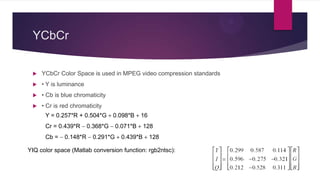
Y = 0.257*R + 0.504*G 0.098*B 16
Cr = 0.439*R 0.368*G 0.071*B 128
Cb = 0.148*R 0.291*G 0.439*B 128
YIQ color space (Matlab conversion function: rgb2ntsc):

Color and color models

  • 1.
  • 2.
    What is color?  Color is a sensation produced by the human eye and nervous system.  It is useful to represent a color by a set of exactly three numbers.
  • 3.
    Color is HumanSensation  Cone and rod receptors in the retina  Rod receptor is mostly for luminance perception  3 different types of cone receptors in the fovea of retina, responsible for color representation. Each type is sensitive to different wavelengths
  • 4.
    Color model  Acolor model is an orderly system for creating a whole range of colors from a small set of primary colors.
  • 5.
    Types of Colormodel  Subtractive Color  Additive Color  Additive color models use light to display color  subtractive models use printing inks.
  • 6.
    The Two MostCommon Color Models  RGB model  For computer  CMYK model  For printing  YCbCr model
  • 7.
    RGB Color Model: Additive color model.  For computer displays.  Uses light to display color.  Colors result from transmitted light.  Red + Green + Blue = White.
  • 8.
     The RGBColor Model  If R,G, and B are represented with 8 bits (24-bit RGB  image), the total number of colors is (28 )3=16,777,216
  • 9.
    CMYK Color Model Subtractive color model.  For printed material.  Uses ink to display color.  Colors result from reflected light.  Cyan + Magenta + Yellow = Black  Used internally in color printers  Complementary to RGB:  C=1-R  M=1-G  Y=1-B
  • 10.
    Color Models  thecolor model RGB is used in hardware applications like PC monitors, cameras and scanners, the CMY color model is used in color printers,  Each color can be a point in the RGB color model cube. Red, green and blue are known as the primary colors. These colors can be added to produce secondary colors which are:  magenta = red + blue  cyan = green +blue  yellow = red + green  Other possible combinations:  white = blue (primary) + yellow (secondary)  white = green (primary) + magenta (secondary)  white = red (primary) + cyan (secondary)
  • 11.
    Additive vs. SubtractiveColor Models  Since additive color models display color as a result of light being transmitted (added) the total absence of light would be perceived as black. Subtractive color models display color as a result of light being absorbed (subtracted) by the printing inks. As more ink is added, less and less light is reflected. Where there is a total absence of ink the resulting light being reflected (from a white surface) would be perceived as white.
  • 12.
    HSL and HSB Hue Hue is what most people think of when we say "color".  Saturation Saturation is the "purity" of the color. It refers to the amount of gray paint mixed with the hue.  Lightness Value refers to the intensity of light present.
  • 13.
  • 14.
    Dithering  Dithering isoften used for displaying monochrome images  creating the illusion of new colors and shades by varying the pattern of dots.  Sometime call halftoning.
  • 15.
    YCbCr  YCbCr ColorSpace is used in MPEG video compression standards  • Y is luminance  • Cb is blue chromaticity  • Cr is red chromaticity Y = 0.257*R + 0.504*G 0.098*B 16 Cr = 0.439*R 0.368*G 0.071*B 128 Cb = 0.148*R 0.291*G 0.439*B 128 YIQ color space (Matlab conversion function: rgb2ntsc):