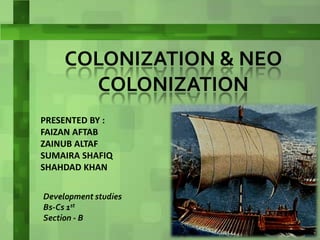
COLONIZATION & NEO
       COLONIZATION
PRESENTED BY :
FAIZAN AFTAB
ZAINUB ALTAF
SUMAIRA SHAFIQ
SHAHDAD KHAN

Development studies
Bs-Cs 1st
Section - B
COLONIZATION

• Colonization comes from Latin word colere. It is the act
of colonizing; the establishment of colonies .

• Colonization is the extension of political and economic
control over an area by a state, whose nationals have
occupied the area and usually possesses organizational
or technological superiority over the native population.
MOTIVES OF COLONIZATION:

Colonization has occurred through out the history in Europe. Three
most influential colonizers work British, Spanish, French. These
three countries had three basic motives:

1. Material gain
2. Desire to spread religion.
3. Desire expend territory.

Using these motives they created long term effects in the culture
religion and economy of areas that they colonize.
COLONIZATION

• As early as the 10th cent.   • The Greeks, from a desire
B.C., the Phoenicians          for wealth or as a result of
founded trading posts          the expulsion of a political
throughout               the   faction or the defeated
Mediterranean area and         inhabitants of a city,
later exercised political      established colonies in
dominion over these            Asia Minor and Italy,
commercial colonies.           spreading Hellenic culture
                               and stimulating trade.
MAP OF GREEK & PHEONICIANS COLONIZATION
COLONIZATION
Biggest colonization of history:
• Colonization of India
• Colonization of Africa
• Colonization of America
COLONIZATION IN AFRICA

• From the seventh century, Arab trade with sub-Saharan Africa led to a
gradual colonization of East Africa, around Zanzibar and other bases.

• After that Africa remained colonized under French, British & Portuguese.
 French established equality, interracial marriages, rights & support.

• Britishers didn’t support equality they considered others lower & didn’t liked
it if they adopted British culture.

• Portuguese allowed interracial marriages but considered blood related
Portuguese as superior.

• Finally struggle was made by Africans to gain independence & get rid off
colonization.
COLONIZATION IN AMERICA

• During the sixteenth century the work of colonizing America was
left almost entirely to the people of Spain.

• Colonies were established on the coasts of South and Central
America.

• In 1519 Cortez began that memorable expedition which soon
subjected the Aztec empire of Mexico to his sway.

• In a comparatively short time the whole of western South America
from the lower boundary of Chili to the Caribbean coast was Spanish
territory.
COLONIZATION IN INDIA
• When the British colonize India they modernized and make
conveniences only for themselves.

• India suffered, destruction of education system, economies ancient
monuments and lively hood of people.

• Living standards, sanitation, water resources and other facilities
were barely provided.

• The East India Company established trading posts on different
parts along the India coast.
IMPACT OF COLONIZATION

• SELF IMAGE & IDENTITY:
        New cultures & religion was introduced but tradition culture was
destroyed. Example : British brought English language but destroyed traditions.

• DECISION MAKING & LEADERSHIP:
         Colonization weakens decision making & leaders. Example: Tribal
leadership system in Africa was destroyed.

• RIGHTS:
         No equality or rights were given to the natives. Example: Indians were
forced to labor on constructions of road & buildings but were kept from benefiting
from such.

• WEALTH & RESOURCES:
         Exploitation of resources occurred. Example: Tons of silver & gold were
transported from America to Spain. Similarly British took valuable jewels from India
etc.
NEO COLONIZATION
NEO COLONIZATION
• "As long as imperialism exists it will, by
definition, exert its domination over other
countries. Today that domination is called
neocolonialism."
— Che Guevara, Marxist revolutionary, 1965

• Neo Colonization is used for the exploitation
rather than for development of less developed
parts of world.

• Kwame Nkrumah, who in 1957 became leader of
newly independent Ghana, was one of the most
notable figures to use the term
NEO COLONIZATION
HOW NEO-COLONIZATION OCCURS
          TODAY

• Reality of independence.

• Reality of economic system and
political system. [Directed from
outside]
NEO COLONIZATION

METHODS AND FORMS OF NEO COLONIZATION:


• Military invasion

• Financial means

• Control over government policy
NEO COLONIZATION

RESULT OF NEO -COLONIZATION:

• The result of neo-colonialism is that foreign
capital is used for the exploitation rather than for
the development of the less developed parts of
the world.

• Neo-colonialism increases rather than decreases
the GAP between the rich and the poor countries
of the world.
NEO COLONIZATION

STRUGGLES AGAINST NEO COLONIZATION:
• Aim of struggle against neo- colonization is to
prevent     weakening of the less developed
countries.

EXAMPLE:
        Non-alignment, as practiced by Ghana and many
other countries, is based on co-operation with all States.
Such a policy, therefore, involves foreign investment from
capitalist countries, but it must be invested in accordance
with a national plan drawn up by the government of the non-
aligned State.
NEO COLONIZATION

NEO COLONIZISM – A THREAT:

• The growth of nuclear weapons
• Old-fashioned balance of power out dated.
•Historically the mutual mass destruction prevented countries from
threatening each other. But now the case is different. Rich and
technologically developed countries aim to have better and more dangerous
nuclear power, whereas poor countries may be low at these resources and
may not be able to compete with the richer developed states.
• The evil of neo-colonialism is that it prevents the formation of those large
units which would make impossible ‘limited war’.
Example: If Africa was united, no major power community would attempt to
control it by limited war.
NEO COLONIZATION

• Neo-colonialism is also the worst form of imperialism. For
those who practice it, it means power without responsibility and
for those who suffer from it, it means exploitation without
redress. In the days of old-fashioned colonialism, the imperial
power had at least to explain and justify at home the actions it
was taking abroad.

• Neo-colonialism is based upon the principle of breaking up
former large united states into a number of small non workable
States which are incapable of independent development and
must rely upon the former imperial power for defense and even
internal security.
NEO COLONIZATION


THE DIFFERENCE BETWEEN THE OLD IMPERIALISM AND
THE NEW GLOBALIZATION PROCESS:

•knife on the back. (historically)

•In globalization you are captive and unaware. When
the prisoners are unaware of their handcuffs then it’s
hopeless.
NEO COLONIZATION

CONCLUSIONS

• Destruction of developed countries. Case of America, e.g. Iraq

• In the U.S. it has touched the lives of African-Americans who
have had lives caught in street violence and are fighting for their
lives. Suddenly Islam comes to them and they find peace,
dignity and a faith they can believe in.

• Globally, the numbers of the poor are increasing fast.

• The reality of U.S. government (domination and exploitation)
THANK YOU

Calunization

  • 1.
    COLONIZATION & NEO COLONIZATION PRESENTED BY : FAIZAN AFTAB ZAINUB ALTAF SUMAIRA SHAFIQ SHAHDAD KHAN Development studies Bs-Cs 1st Section - B
  • 2.
    COLONIZATION • Colonization comesfrom Latin word colere. It is the act of colonizing; the establishment of colonies . • Colonization is the extension of political and economic control over an area by a state, whose nationals have occupied the area and usually possesses organizational or technological superiority over the native population.
  • 3.
    MOTIVES OF COLONIZATION: Colonizationhas occurred through out the history in Europe. Three most influential colonizers work British, Spanish, French. These three countries had three basic motives: 1. Material gain 2. Desire to spread religion. 3. Desire expend territory. Using these motives they created long term effects in the culture religion and economy of areas that they colonize.
  • 4.
    COLONIZATION • As earlyas the 10th cent. • The Greeks, from a desire B.C., the Phoenicians for wealth or as a result of founded trading posts the expulsion of a political throughout the faction or the defeated Mediterranean area and inhabitants of a city, later exercised political established colonies in dominion over these Asia Minor and Italy, commercial colonies. spreading Hellenic culture and stimulating trade.
  • 5.
    MAP OF GREEK& PHEONICIANS COLONIZATION
  • 6.
    COLONIZATION Biggest colonization ofhistory: • Colonization of India • Colonization of Africa • Colonization of America
  • 7.
    COLONIZATION IN AFRICA •From the seventh century, Arab trade with sub-Saharan Africa led to a gradual colonization of East Africa, around Zanzibar and other bases. • After that Africa remained colonized under French, British & Portuguese. French established equality, interracial marriages, rights & support. • Britishers didn’t support equality they considered others lower & didn’t liked it if they adopted British culture. • Portuguese allowed interracial marriages but considered blood related Portuguese as superior. • Finally struggle was made by Africans to gain independence & get rid off colonization.
  • 8.
    COLONIZATION IN AMERICA •During the sixteenth century the work of colonizing America was left almost entirely to the people of Spain. • Colonies were established on the coasts of South and Central America. • In 1519 Cortez began that memorable expedition which soon subjected the Aztec empire of Mexico to his sway. • In a comparatively short time the whole of western South America from the lower boundary of Chili to the Caribbean coast was Spanish territory.
  • 10.
    COLONIZATION IN INDIA •When the British colonize India they modernized and make conveniences only for themselves. • India suffered, destruction of education system, economies ancient monuments and lively hood of people. • Living standards, sanitation, water resources and other facilities were barely provided. • The East India Company established trading posts on different parts along the India coast.
  • 11.
    IMPACT OF COLONIZATION •SELF IMAGE & IDENTITY: New cultures & religion was introduced but tradition culture was destroyed. Example : British brought English language but destroyed traditions. • DECISION MAKING & LEADERSHIP: Colonization weakens decision making & leaders. Example: Tribal leadership system in Africa was destroyed. • RIGHTS: No equality or rights were given to the natives. Example: Indians were forced to labor on constructions of road & buildings but were kept from benefiting from such. • WEALTH & RESOURCES: Exploitation of resources occurred. Example: Tons of silver & gold were transported from America to Spain. Similarly British took valuable jewels from India etc.
  • 12.
  • 13.
    NEO COLONIZATION • "Aslong as imperialism exists it will, by definition, exert its domination over other countries. Today that domination is called neocolonialism." — Che Guevara, Marxist revolutionary, 1965 • Neo Colonization is used for the exploitation rather than for development of less developed parts of world. • Kwame Nkrumah, who in 1957 became leader of newly independent Ghana, was one of the most notable figures to use the term
  • 14.
    NEO COLONIZATION HOW NEO-COLONIZATIONOCCURS TODAY • Reality of independence. • Reality of economic system and political system. [Directed from outside]
  • 15.
    NEO COLONIZATION METHODS ANDFORMS OF NEO COLONIZATION: • Military invasion • Financial means • Control over government policy
  • 16.
    NEO COLONIZATION RESULT OFNEO -COLONIZATION: • The result of neo-colonialism is that foreign capital is used for the exploitation rather than for the development of the less developed parts of the world. • Neo-colonialism increases rather than decreases the GAP between the rich and the poor countries of the world.
  • 17.
    NEO COLONIZATION STRUGGLES AGAINSTNEO COLONIZATION: • Aim of struggle against neo- colonization is to prevent weakening of the less developed countries. EXAMPLE: Non-alignment, as practiced by Ghana and many other countries, is based on co-operation with all States. Such a policy, therefore, involves foreign investment from capitalist countries, but it must be invested in accordance with a national plan drawn up by the government of the non- aligned State.
  • 18.
    NEO COLONIZATION NEO COLONIZISM– A THREAT: • The growth of nuclear weapons • Old-fashioned balance of power out dated. •Historically the mutual mass destruction prevented countries from threatening each other. But now the case is different. Rich and technologically developed countries aim to have better and more dangerous nuclear power, whereas poor countries may be low at these resources and may not be able to compete with the richer developed states. • The evil of neo-colonialism is that it prevents the formation of those large units which would make impossible ‘limited war’. Example: If Africa was united, no major power community would attempt to control it by limited war.
  • 19.
    NEO COLONIZATION • Neo-colonialismis also the worst form of imperialism. For those who practice it, it means power without responsibility and for those who suffer from it, it means exploitation without redress. In the days of old-fashioned colonialism, the imperial power had at least to explain and justify at home the actions it was taking abroad. • Neo-colonialism is based upon the principle of breaking up former large united states into a number of small non workable States which are incapable of independent development and must rely upon the former imperial power for defense and even internal security.
  • 20.
    NEO COLONIZATION THE DIFFERENCEBETWEEN THE OLD IMPERIALISM AND THE NEW GLOBALIZATION PROCESS: •knife on the back. (historically) •In globalization you are captive and unaware. When the prisoners are unaware of their handcuffs then it’s hopeless.
  • 21.
    NEO COLONIZATION CONCLUSIONS • Destructionof developed countries. Case of America, e.g. Iraq • In the U.S. it has touched the lives of African-Americans who have had lives caught in street violence and are fighting for their lives. Suddenly Islam comes to them and they find peace, dignity and a faith they can believe in. • Globally, the numbers of the poor are increasing fast. • The reality of U.S. government (domination and exploitation)
  • 22.