Simposio IMEXNueva opción en elQueratoconoDr. Rafael I. BarraquerTitular de la Cátedra “J. Barraquer”IUB - UAB - Barcelona
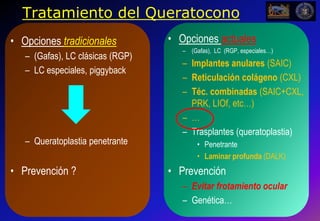
Tratamiento del QueratoconoOpciones actuales(Gafas),  LC  (RGP, especiales…)Implantes anulares (SAIC)Reticulación colágeno (CXL)Téc. combinadas (SAIC+CXL, PRK, LIOf, etc…)…Trasplantes (queratoplastia)PenetranteLaminar profunda (DALK)PrevenciónEvitar frotamiento ocularGenética…Opciones tradicionales(Gafas), LC clásicas (RGP)LC especiales, piggybackQueratoplastia penetrantePrevención ?
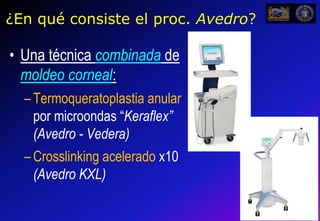
3¿En quéconsiste el proc. Avedro?Una técnica combinada de moldeo corneal:Termoqueratoplastia anular por microondas “Keraflex” (Avedro - Vedera)Crosslinking acelerado x10 (Avedro KXL)
4La Termoqueratoplstia…Una técnica clásica…Con cauterio (1975…)Radiofrecuencia (“Queratoplastia conductiva”)Láser de Holmio…Microondas    Keraflex
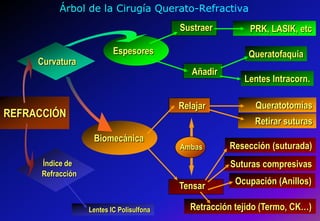
Árbol de la Cirugía Querato-RefractivaAmbasSustraerPRK, LASIK, etcEspesoresCurvaturaQueratofaquiaAñadirLentes Intracorn.REFRACCIÓNQueratotomíasRelajarRetirar suturasBiomecánicaResección (suturada)Índice deRefracciónSuturas compresivasOcupación (Anillos)TensarRetracción tejido (Termo, CK…)Lentes IC Polisulfona
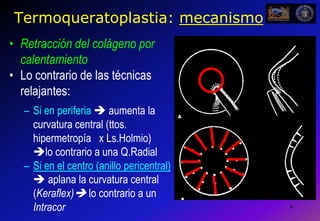
6Termoqueratoplastia: mecanismoRetracción del colágeno por calentamientoLo contrario de las técnicas relajantes:Si en periferia  aumenta la curvatura central (ttos. hipermetropía   x Ls.Holmio)        lo contrario a una Q.RadialSi en el centro (anillo pericentral)  aplana la curvatura central (Keraflex) lo contrario a un Intracor
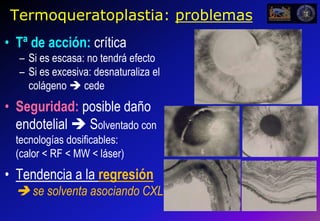
7Termoqueratoplastia: problemasTª de acción: críticaSi es escasa: no tendrá efectoSi es excesiva: desnaturaliza el colágeno  cedeSeguridad: posible daño endotelial  Solventado con tecnologías dosificables:                 (calor < RF < MW < láser)Tendencia a la regresión se solventa asociando CXL
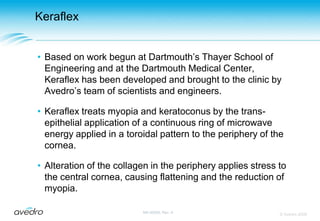
KeraflexBased on work begun at Dartmouth’s Thayer School of Engineering and at the Dartmouth Medical Center, Keraflex has been developed and brought to the clinic by Avedro’s team of scientists and engineers.
Keraflex treats myopia and keratoconus by the trans-epithelial application of a continuous ring of microwave energy applied in a toroidal pattern to the periphery of the cornea.
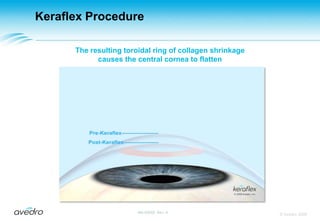
Alteration of the collagen in the periphery applies stress to the central cornea, causing flattening and the reduction of myopia.© Avedro 2009MA-00005, Rev. A
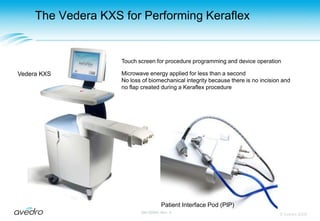
The Vedera KXS for Performing KeraflexTouch screen for procedure programming and device operation Microwave energy applied for less than a secondNo loss of biomechanical integrity because there is no incision and no flap created during a Keraflex procedureVedera KXSPatient Interface Pod (PIP)© Avedro 2009MA-00005, Rev. A
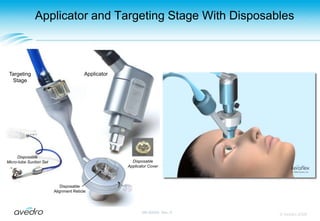
Applicator and Targeting Stage With DisposablesApplicatorTargeting StageDisposable Micro-tube Suction SetDisposable Applicator CoverDisposable Alignment Reticle© Avedro 2009MA-00005, Rev. A
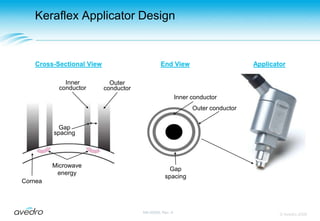
Cross-Sectional ViewApplicatorEnd ViewInner conductorOuter conductorInner conductorOuter conductorGapspacingMicrowaveenergyGapspacingCorneaKeraflex Applicator Design© Avedro 2009MA-00005, Rev. A
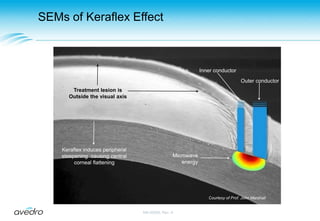
Inner conductorOuter conductorTreatment lesion isOutside the visual axisKeraflex induces peripheral steepening  causing central corneal flatteningMicrowaveenergyCourtesy of Prof. John MarshallSEMs of Keraflex EffectMA-00005, Rev. A
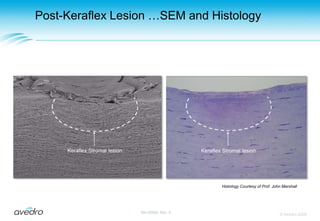
Keraflex Stromal lesionKeraflex Stromal lesionPost-Keraflex Lesion …SEM and HistologyHistology Courtesy of Prof. John Marshall © Avedro 2009MA-00005, Rev. A
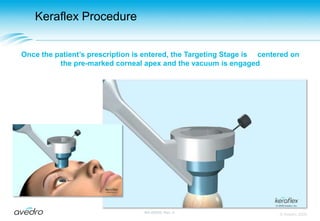
Keraflex ProcedureOnce the patient’s prescription is entered, the Targeting Stage is     centered on the pre-marked corneal apex and the vacuum is engaged© Avedro 2009MA-00005, Rev. A
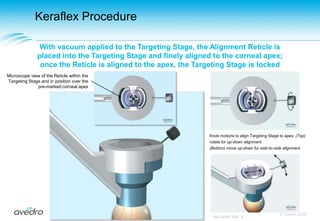
Keraflex ProcedureWith vacuum applied to the Targeting Stage, the Alignment Reticle is placed into the Targeting Stage and finely aligned to the corneal apex; once the Reticle is aligned to the apex, the Targeting Stage is locked  Microscope view of the Reticle within the Targeting Stage and in position over the pre-marked corneal apex Knob motions to align Targeting Stage to apex: (Top) rotate for up-down alignment(Bottom) move up-down for side-to-side alignment© Avedro 2009MA-00005, Rev. A
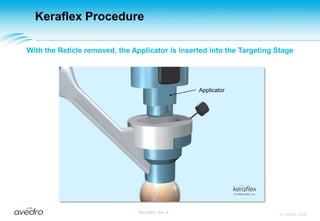
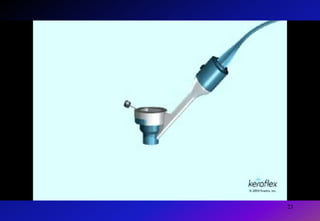
Keraflex ProcedureWith the Reticle removed, the Applicator is inserted into the Targeting StageApplicator© Avedro 2009MA-00005, Rev. A
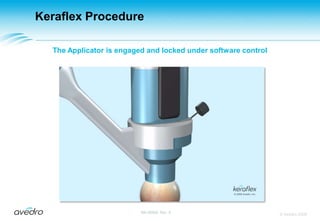
Keraflex ProcedureThe Applicator is engaged and locked under software control© Avedro 2009MA-00005, Rev. A
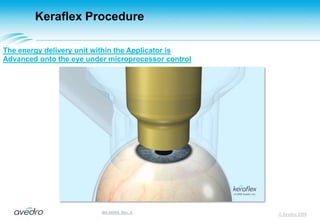
Keraflex ProcedureThe energy delivery unit within the Applicator is Advanced onto the eye under microprocessor control© Avedro 2009MA-00005, Rev. A
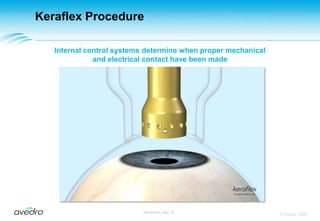
Keraflex ProcedureInternal control systems determine when proper mechanicaland electrical contact have been made© Avedro 2009MA-00005, Rev. A
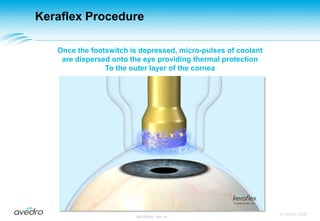
Keraflex ProcedureOnce the footswitch is depressed, micro-pulses of coolant are dispersed onto the eye providing thermal protection To the outer layer of the cornea© Avedro 2009MA-00005, Rev. A
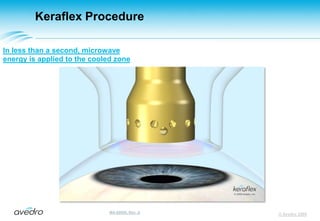
Keraflex ProcedureIn less than a second, microwave                                                                                     energy is applied to the cooled zone© Avedro 2009MA-00005, Rev. A
Keraflex ProcedureThe resulting toroidal ring of collagen shrinkage                                                                 causes the central cornea to flatten© Avedro 2009MA-00005, Rev. A
23
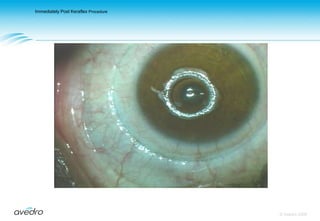
Immediately Post Keraflex Procedure © Avedro 2009
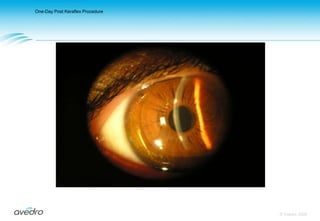
One-Day Post Keraflex Procedure © Avedro 2009
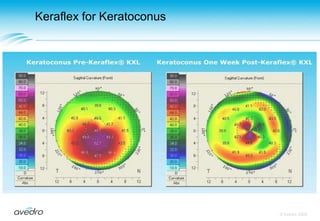
Keraflex for Keratoconus© Avedro 2009
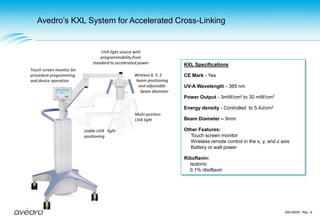
Avedro’s KXL System for Accelerated Cross-LinkingUVA light source with programmability from standard to accelerated powerKXL SpecificationsCE Mark - YesUV-A Wavelength - 365 nm Power Output - 3mW/cm2 to 30 mW/cm2Energy density - Controlled  to 5.4J/cm2Beam Diameter – 9mmOther Features:     Touch screen monitor     Wireless remote control in the x, y, and z axis     Battery or wall powerRiboflavin:Isotonic 0.1% riboflavin Touch screen monitor for procedure programming              and device operationWireless X, Y, Z   beam positioning    and adjustable             beam diameterMulti-position UVA lightstable UVA   light positioningMA-00057, Rev. A
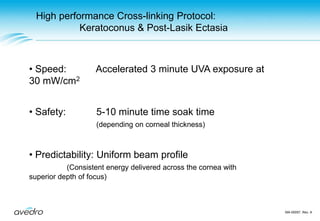
High performance Cross-linking Protocol:                Keratoconus & Post-Lasik Ectasia Speed: 	   Accelerated 3 minute UVA exposure at		             30 mW/cm2
 Safety: 	   5-10 minute time soak time                                                            		   (depending on corneal thickness)
 Predictability: Uniform beam profile                				   (Consistent energy delivered across the cornea with		      superior depth of focus)MA-00057, Rev. A
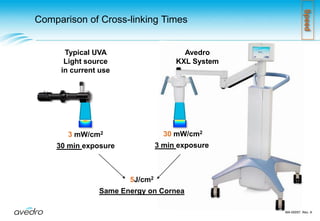
Comparison of Cross-linking TimesSpeedTypical UVA Light sourcein current useAvedro KXL System 30 mW/cm23 min exposure 3 mW/cm230 min exposure5J/cm2Same Energy on CorneaMA-00057, Rev. A
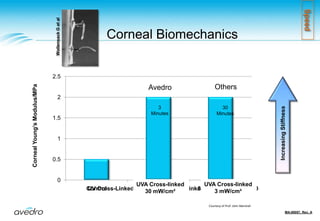
Speed   Corneal BiomechanicsWollensack G et alOthersAvedroIncreasing StiffnessCorneal Young’s Modulus/MPaUVA Cross-linked 3 mW/cm² UVA Cross-linked 30 mW/cm² Courtesy of Prof. John MarshallMA-00057, Rev. A
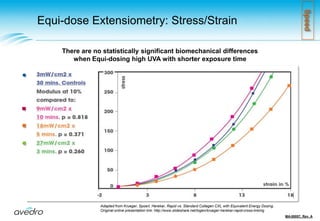
Equi-dose Extensiometry: Stress/StrainSpeedThere are no statistically significant biomechanical differenceswhen Equi-dosing high UVA with shorter exposure timeAdapted from Krueger, Spoerl, Herekar, Rapid vs. Standard Collagen CXL with Equivalent Energy Dosing.Original online presentation link: http://www.slideshare.net/Iogen/krueger-herekar-rapid-cross-linkingMA-00057, Rev. A
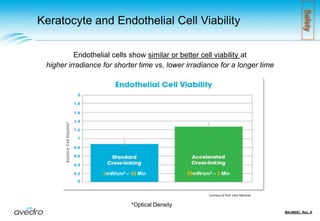
Keratocyte and Endothelial Cell ViabilitySafetyEndothelial cells show similar or better cell viability athigher irradiance for shorter time vs. lower irradiance for a longer time30mW/cm2 – 3 Min3mW/cm2 – 30 MinCourtesy of Prof. John MarshallCourtesy of Prof. John Marshall*Optical Density MA-00057, Rev. A
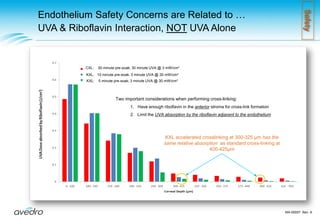
Endothelium Safety Concerns are Related to …       UVA & Riboflavin Interaction, NOT UVA AloneSafetyCXL:    30 minute pre-soak; 30 minute UVA @ 3 mW/cm²KXL:   10 minute pre-soak; 3 minute UVA @ 30 mW/cm²KXL:    5 minute pre-soak; 3 minute UVA @ 30 mW/cm²Two important considerations when performing cross-linking:Have enough riboflavin in the anterior stroma for cross-link formation 2.   Limit the UVA absorption by the riboflavin adjacent to the endotheliumKXL accelerated crosslinking at 300-325 μm has the same relative absorption  as standard cross-linking at 400-425μmMA-00057, Rev. A
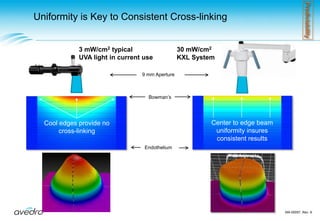
Uniformity is Key to Consistent Cross-linkingPredictability3 mW/cm2 typicalUVA light in current use30 mW/cm2KXLSystem9 mm ApertureBowman’sCenter to edge beam uniformity insures consistent resultsCool edges provide no cross-linkingEndotheliumMA-00057, Rev. A
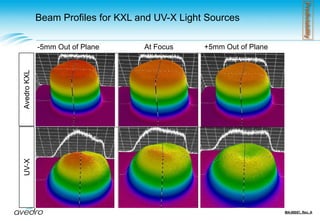
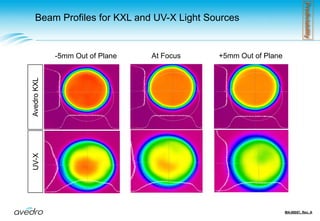
Beam Profiles for KXL and UV-X Light SourcesPredictability+5mm Out of PlaneAt Focus-5mm Out of PlaneAvedro KXLUV-XMA-00057, Rev. A
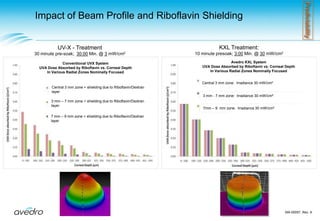
Impact of Beam Profile and Riboflavin ShieldingPredictabilityUV-X - Treatment30 minute pre-soak;  30:00 Min. @ 3mW/cm2KXL Treatment:10 minute presoak; 3:00Min. @ 30 mW/cm2Avedro KXL SystemUVA Dose Absorbed by Riboflavin vs. Corneal Depth In Various Radial Zones Nominally Focused Conventional UVX SystemUVA Dose Absorbed by Riboflavin vs. Corneal Depth In Various Radial Zones Nominally Focused Central 3 mm zone:  Irradiance 30 mW/cm² Central 3 mm zone + shielding due to Riboflavin/Dextran layer3 mm - 7 mm zone:  Irradiance 30 mW/cm² 3 mm – 7 mm zone + shielding due to Riboflavin/Dextran layer7mm – 9  mm zone:  Irradiance 30 mW/cm² 7 mm – 9 mm zone + shielding due to Riboflavin/Dextran layer MA-00057, Rev. A
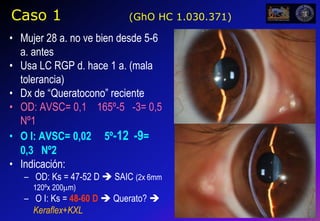
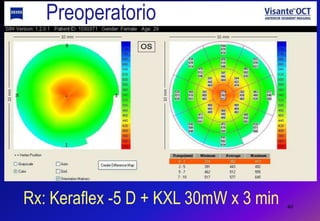
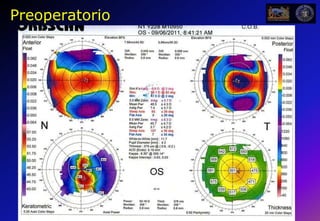
38 Caso 1             (GhO HC 1.030.371)Mujer 28 a. no ve bien desde 5-6 a. antesUsa LC RGP d. hace 1 a. (mala tolerancia)Dx de “Queratocono” recienteOD: AVSC= 0,1    165º-5   -3= 0,5    Nº1O I: AVSC= 0,02     5º-12-9= 0,3   Nº2Indicación:OD: Ks = 47-52 D  SAIC (2x 6mm 120ºx 200mm) O I: Ks = 48-60 D Querato?  Keraflex+KXL
39Preoperatorio
40PreoperatorioCRx: Keraflex -5 D + KXL 30mW x 3 min
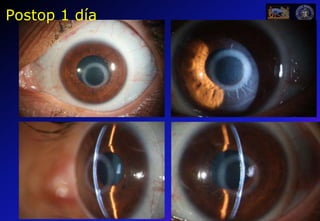
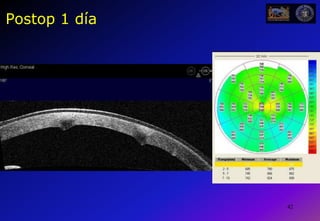
41Postop 1 día
42Postop 1 día
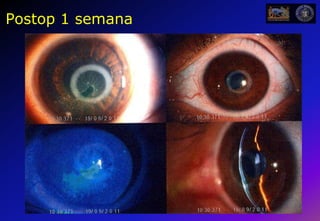
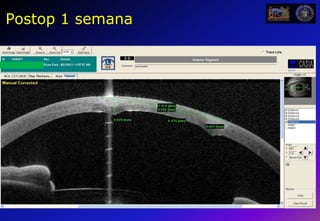
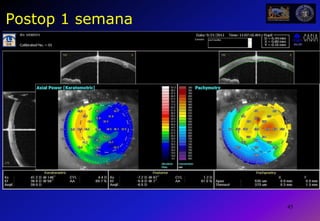
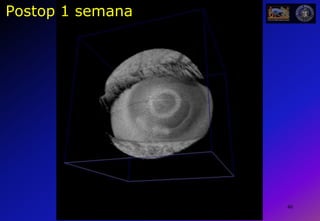
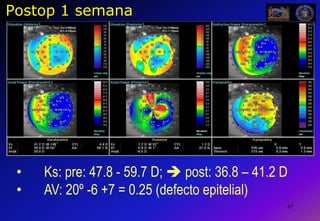
43Postop 1 semana
44Postop 1 semana
45Postop 1 semana
46Postop 1 semana
47Postop 1 semanaKs: pre: 47.8 - 59.7 D;  post: 36.8 – 41.2 D

Avedro Barraquer S E O\'11

  • 1.
    Simposio IMEXNueva opciónen elQueratoconoDr. Rafael I. BarraquerTitular de la Cátedra “J. Barraquer”IUB - UAB - Barcelona
  • 2.
    Tratamiento del QueratoconoOpcionesactuales(Gafas), LC (RGP, especiales…)Implantes anulares (SAIC)Reticulación colágeno (CXL)Téc. combinadas (SAIC+CXL, PRK, LIOf, etc…)…Trasplantes (queratoplastia)PenetranteLaminar profunda (DALK)PrevenciónEvitar frotamiento ocularGenética…Opciones tradicionales(Gafas), LC clásicas (RGP)LC especiales, piggybackQueratoplastia penetrantePrevención ?
  • 3.
    3¿En quéconsiste elproc. Avedro?Una técnica combinada de moldeo corneal:Termoqueratoplastia anular por microondas “Keraflex” (Avedro - Vedera)Crosslinking acelerado x10 (Avedro KXL)
  • 4.
    4La Termoqueratoplstia…Una técnicaclásica…Con cauterio (1975…)Radiofrecuencia (“Queratoplastia conductiva”)Láser de Holmio…Microondas  Keraflex
  • 5.
    Árbol de laCirugía Querato-RefractivaAmbasSustraerPRK, LASIK, etcEspesoresCurvaturaQueratofaquiaAñadirLentes Intracorn.REFRACCIÓNQueratotomíasRelajarRetirar suturasBiomecánicaResección (suturada)Índice deRefracciónSuturas compresivasOcupación (Anillos)TensarRetracción tejido (Termo, CK…)Lentes IC Polisulfona
  • 6.
    6Termoqueratoplastia: mecanismoRetracción delcolágeno por calentamientoLo contrario de las técnicas relajantes:Si en periferia  aumenta la curvatura central (ttos. hipermetropía x Ls.Holmio) lo contrario a una Q.RadialSi en el centro (anillo pericentral)  aplana la curvatura central (Keraflex) lo contrario a un Intracor
  • 7.
    7Termoqueratoplastia: problemasTª deacción: críticaSi es escasa: no tendrá efectoSi es excesiva: desnaturaliza el colágeno  cedeSeguridad: posible daño endotelial  Solventado con tecnologías dosificables: (calor < RF < MW < láser)Tendencia a la regresión se solventa asociando CXL
  • 8.
    KeraflexBased on workbegun at Dartmouth’s Thayer School of Engineering and at the Dartmouth Medical Center, Keraflex has been developed and brought to the clinic by Avedro’s team of scientists and engineers.
  • 9.
    Keraflex treats myopiaand keratoconus by the trans-epithelial application of a continuous ring of microwave energy applied in a toroidal pattern to the periphery of the cornea.
  • 10.
    Alteration of thecollagen in the periphery applies stress to the central cornea, causing flattening and the reduction of myopia.© Avedro 2009MA-00005, Rev. A
  • 11.
    The Vedera KXSfor Performing KeraflexTouch screen for procedure programming and device operation Microwave energy applied for less than a secondNo loss of biomechanical integrity because there is no incision and no flap created during a Keraflex procedureVedera KXSPatient Interface Pod (PIP)© Avedro 2009MA-00005, Rev. A
  • 12.
    Applicator and TargetingStage With DisposablesApplicatorTargeting StageDisposable Micro-tube Suction SetDisposable Applicator CoverDisposable Alignment Reticle© Avedro 2009MA-00005, Rev. A
  • 13.
    Cross-Sectional ViewApplicatorEnd ViewInnerconductorOuter conductorInner conductorOuter conductorGapspacingMicrowaveenergyGapspacingCorneaKeraflex Applicator Design© Avedro 2009MA-00005, Rev. A
  • 14.
    Inner conductorOuter conductorTreatmentlesion isOutside the visual axisKeraflex induces peripheral steepening causing central corneal flatteningMicrowaveenergyCourtesy of Prof. John MarshallSEMs of Keraflex EffectMA-00005, Rev. A
  • 15.
    Keraflex Stromal lesionKeraflexStromal lesionPost-Keraflex Lesion …SEM and HistologyHistology Courtesy of Prof. John Marshall © Avedro 2009MA-00005, Rev. A
  • 16.
    Keraflex ProcedureOnce thepatient’s prescription is entered, the Targeting Stage is centered on the pre-marked corneal apex and the vacuum is engaged© Avedro 2009MA-00005, Rev. A
  • 17.
    Keraflex ProcedureWith vacuumapplied to the Targeting Stage, the Alignment Reticle is placed into the Targeting Stage and finely aligned to the corneal apex; once the Reticle is aligned to the apex, the Targeting Stage is locked Microscope view of the Reticle within the Targeting Stage and in position over the pre-marked corneal apex Knob motions to align Targeting Stage to apex: (Top) rotate for up-down alignment(Bottom) move up-down for side-to-side alignment© Avedro 2009MA-00005, Rev. A
  • 18.
    Keraflex ProcedureWith theReticle removed, the Applicator is inserted into the Targeting StageApplicator© Avedro 2009MA-00005, Rev. A
  • 19.
    Keraflex ProcedureThe Applicatoris engaged and locked under software control© Avedro 2009MA-00005, Rev. A
  • 20.
    Keraflex ProcedureThe energydelivery unit within the Applicator is Advanced onto the eye under microprocessor control© Avedro 2009MA-00005, Rev. A
  • 21.
    Keraflex ProcedureInternal controlsystems determine when proper mechanicaland electrical contact have been made© Avedro 2009MA-00005, Rev. A
  • 22.
    Keraflex ProcedureOnce thefootswitch is depressed, micro-pulses of coolant are dispersed onto the eye providing thermal protection To the outer layer of the cornea© Avedro 2009MA-00005, Rev. A
  • 23.
    Keraflex ProcedureIn lessthan a second, microwave energy is applied to the cooled zone© Avedro 2009MA-00005, Rev. A
  • 24.
    Keraflex ProcedureThe resultingtoroidal ring of collagen shrinkage causes the central cornea to flatten© Avedro 2009MA-00005, Rev. A
  • 25.
  • 26.
    Immediately Post KeraflexProcedure © Avedro 2009
  • 27.
    One-Day Post KeraflexProcedure © Avedro 2009
  • 28.
  • 29.
    Avedro’s KXL Systemfor Accelerated Cross-LinkingUVA light source with programmability from standard to accelerated powerKXL SpecificationsCE Mark - YesUV-A Wavelength - 365 nm Power Output - 3mW/cm2 to 30 mW/cm2Energy density - Controlled to 5.4J/cm2Beam Diameter – 9mmOther Features: Touch screen monitor Wireless remote control in the x, y, and z axis Battery or wall powerRiboflavin:Isotonic 0.1% riboflavin Touch screen monitor for procedure programming and device operationWireless X, Y, Z beam positioning and adjustable beam diameterMulti-position UVA lightstable UVA light positioningMA-00057, Rev. A
  • 30.
    High performance Cross-linkingProtocol: Keratoconus & Post-Lasik Ectasia Speed: Accelerated 3 minute UVA exposure at 30 mW/cm2
  • 31.
    Safety: 5-10 minute time soak time (depending on corneal thickness)
  • 32.
    Predictability: Uniformbeam profile (Consistent energy delivered across the cornea with superior depth of focus)MA-00057, Rev. A
  • 33.
    Comparison of Cross-linkingTimesSpeedTypical UVA Light sourcein current useAvedro KXL System 30 mW/cm23 min exposure 3 mW/cm230 min exposure5J/cm2Same Energy on CorneaMA-00057, Rev. A
  • 34.
    Speed Corneal BiomechanicsWollensack G et alOthersAvedroIncreasing StiffnessCorneal Young’s Modulus/MPaUVA Cross-linked 3 mW/cm² UVA Cross-linked 30 mW/cm² Courtesy of Prof. John MarshallMA-00057, Rev. A
  • 35.
    Equi-dose Extensiometry: Stress/StrainSpeedThereare no statistically significant biomechanical differenceswhen Equi-dosing high UVA with shorter exposure timeAdapted from Krueger, Spoerl, Herekar, Rapid vs. Standard Collagen CXL with Equivalent Energy Dosing.Original online presentation link: http://www.slideshare.net/Iogen/krueger-herekar-rapid-cross-linkingMA-00057, Rev. A
  • 36.
    Keratocyte and EndothelialCell ViabilitySafetyEndothelial cells show similar or better cell viability athigher irradiance for shorter time vs. lower irradiance for a longer time30mW/cm2 – 3 Min3mW/cm2 – 30 MinCourtesy of Prof. John MarshallCourtesy of Prof. John Marshall*Optical Density MA-00057, Rev. A
  • 37.
    Endothelium Safety Concernsare Related to … UVA & Riboflavin Interaction, NOT UVA AloneSafetyCXL: 30 minute pre-soak; 30 minute UVA @ 3 mW/cm²KXL: 10 minute pre-soak; 3 minute UVA @ 30 mW/cm²KXL: 5 minute pre-soak; 3 minute UVA @ 30 mW/cm²Two important considerations when performing cross-linking:Have enough riboflavin in the anterior stroma for cross-link formation 2. Limit the UVA absorption by the riboflavin adjacent to the endotheliumKXL accelerated crosslinking at 300-325 μm has the same relative absorption as standard cross-linking at 400-425μmMA-00057, Rev. A
  • 38.
    Uniformity is Keyto Consistent Cross-linkingPredictability3 mW/cm2 typicalUVA light in current use30 mW/cm2KXLSystem9 mm ApertureBowman’sCenter to edge beam uniformity insures consistent resultsCool edges provide no cross-linkingEndotheliumMA-00057, Rev. A
  • 39.
    Beam Profiles forKXL and UV-X Light SourcesPredictability+5mm Out of PlaneAt Focus-5mm Out of PlaneAvedro KXLUV-XMA-00057, Rev. A
  • 40.
    Beam Profiles forKXL and UV-X Light SourcesPredictability+5mm Out of PlaneAt Focus-5mm Out of PlaneAvedro KXLUV-XMA-00057, Rev. A
  • 41.
    Impact of BeamProfile and Riboflavin ShieldingPredictabilityUV-X - Treatment30 minute pre-soak; 30:00 Min. @ 3mW/cm2KXL Treatment:10 minute presoak; 3:00Min. @ 30 mW/cm2Avedro KXL SystemUVA Dose Absorbed by Riboflavin vs. Corneal Depth In Various Radial Zones Nominally Focused Conventional UVX SystemUVA Dose Absorbed by Riboflavin vs. Corneal Depth In Various Radial Zones Nominally Focused Central 3 mm zone: Irradiance 30 mW/cm² Central 3 mm zone + shielding due to Riboflavin/Dextran layer3 mm - 7 mm zone: Irradiance 30 mW/cm² 3 mm – 7 mm zone + shielding due to Riboflavin/Dextran layer7mm – 9 mm zone: Irradiance 30 mW/cm² 7 mm – 9 mm zone + shielding due to Riboflavin/Dextran layer MA-00057, Rev. A
  • 42.
    38 Caso 1 (GhO HC 1.030.371)Mujer 28 a. no ve bien desde 5-6 a. antesUsa LC RGP d. hace 1 a. (mala tolerancia)Dx de “Queratocono” recienteOD: AVSC= 0,1 165º-5 -3= 0,5 Nº1O I: AVSC= 0,02 5º-12-9= 0,3 Nº2Indicación:OD: Ks = 47-52 D  SAIC (2x 6mm 120ºx 200mm) O I: Ks = 48-60 D Querato?  Keraflex+KXL
  • 43.
  • 44.
  • 45.
  • 46.
  • 47.
  • 48.
  • 49.
  • 50.
  • 51.
    47Postop 1 semanaKs:pre: 47.8 - 59.7 D;  post: 36.8 – 41.2 D

Editor's Notes

  • #30 This beam profile represents the majority of competitive systems now in the field. In addition, no competitive system currently in the field is significantly better than that represented here.
  • #35 This beam profile represents the majority of competitive systems now in the field. In addition, no competitive system currently in the field is significantly better than that represented here.
  • #36 Since the KXL and UV-X devices operate in different power intensities (30 mW/cm2 vs. 3 mW/cm2), this is not a scaled comparison between devices.
  • #37 Since the KXL and UV-X devices operate in different power intensities (30 mW/cm2 vs. 3 mW/cm2), this is not a scaled comparison between devices.
  • #38 The Top-Hat beam of the KXL provides uniform distribution of UV energy across the treatment area.Rinsing the Corneal surface eliminates riboflavin shielding, typical of other treatment methodsDelivering the energy in a short, high power treatment, insures proper energy distribution across the treatment area.Due to the generally cone-shaped beam profile, the UV-X device delivers a dose higher than intended in the central 3-mm, and well below intended in the periphery of the treatment area. One may expect higher treatment energy in the center of the eye, however, the application of riboflavin throughout the 30 minute treatment attenuates the incident light, reducing treatment dose, even in the central 3-mm, and below therapeutic doses beyond 7-mm.