Korean War By: Kierra Ivy June 25, 1950-July 27, 1953
What Is The Korean War? The Korean War is when North Korea invaded South Korea. This happened south of the 38 th  parallel. The U.S. aided South Korea. China and the Soviet Union helped North Korea. Another name for the war in South Korea is 6.25 war. In North Korea another name would be Fatherland Liberation War.
Causes There were two different political governments in Korea. During the elections for The Republic of Korea there were protests who feared that the elections would kill the chances for unification. The North held their own elections. The elections and the dividing of Korea.
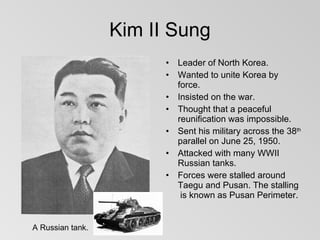
How It Started North Korean leader, Kim II Sung, wanted to unite Korea by force. The U.S. and the Soviet Union differences  prevented the North and South to negotiate a unification treaty.
Kim II Sung Leader of North Korea. Wanted to unite Korea by force. Insisted on the war. Thought that a peaceful reunification was impossible. Sent his military across the 38 th  parallel on June 25, 1950. Attacked with many WWII Russian tanks. Forces were stalled around Taegu and Pusan. The stalling  is known as Pusan Perimeter. A Russian tank.
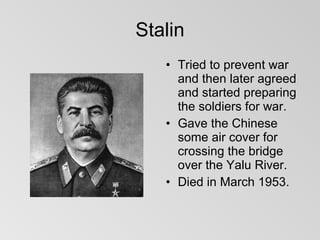
Stalin Tried to prevent war and then later agreed and started preparing the soldiers for war. Gave the Chinese some air cover for crossing the bridge over the Yalu River. Died in March 1953.
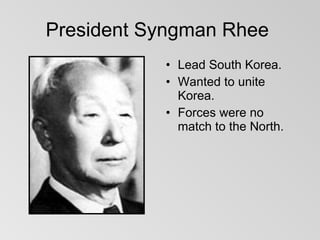
President Syngman Rhee  Lead South Korea. Wanted to unite Korea. Forces were no match to the North.
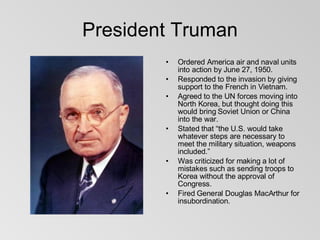
President Truman Ordered America air and naval units into action by June 27, 1950. Responded to the invasion by giving support to the French in Vietnam. Agreed to the UN forces moving into North Korea, but thought doing this would bring Soviet Union or China into the war. Stated that “the U.S. would take whatever steps are necessary to meet the military situation, weapons included.” Was criticized for making a lot of mistakes such as sending troops to Korea without the approval of Congress. Fired General Douglas MacArthur for insubordination.
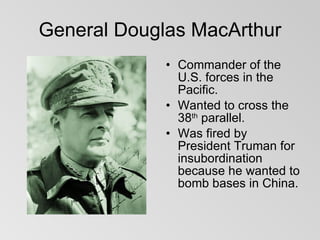
General Douglas MacArthur Commander of the U.S. forces in the Pacific. Wanted to cross the 38 th  parallel. Was fired by President Truman for insubordination because he wanted to bomb bases in China.
Lasting Effects Approximately 10 million people were killed during the war. North Korea lose. The population went up in both North and South Korea. South Korea has become one of the world’s economic success stories.
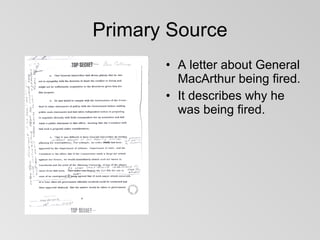
Primary Source A letter about General MacArthur being fired. It describes why he was being fired.
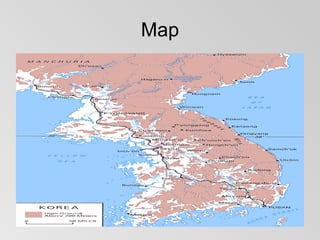
Map
Timeline 1947 Two different political governments emerged in Korea Soviet leaders believed Korea would unify together and refused to sign a treaty with Kim II Sung 1948 South Korea held its first general election The Republic of Korea was established and was known as the government of Korea Communist countries recognized the DPKR as the government of North Korea Korea becomes permanently divided along the 38 th  parallel 1949 Stalin tries to prevent war and then later start preparing soldiers for war 1950 War starts Communists forces captured Seoul, South Korea’s capital President Truman ordered America air and naval units into action. Soviet Union joins the war against Kim’s invasion.
Timeline Continued B-26 Bomber aircraft struck against North’s airfield China massed four armies and three artillery divisions on the Yalu River Russians shot down 23 U.S. aircraft. The Battle of Chongchon 1951 Front lines stabilized near where war started Chinese enters war and attack Americans  Americans landed more troops and drove the Chinese back 1953 Dwight Eisenhower becomes American president Americans threatened to use Atomic bomb if China didn’t stop fighting An armistice was signed on July 27 (South Korea did not sign the armistice) War ended with the help of the new President, Eisenhower.
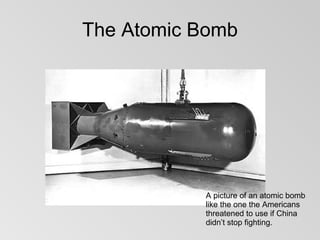
The Atomic Bomb A picture of an atomic bomb like the one the Americans threatened to use if China didn’t stop fighting.
Bibliography &quot;Learn Korean Language.&quot;  Facts About the Korean War . 24 Apr. 2008 <http://www.learnkoreanlanguage.com/facts-about-the-korean-war.html>. &quot;Korean War.&quot;  Naval Historical Center . 1 May 2008 <http://www.history.navy.mil/photos/events/kowar/kowar.htm>.  &quot;KoreanWar.Com.&quot;  Welcome to KoreanWar.Com . 1 May 2008 <http://www.koreanwar.com/>.  Bajanov, Dr. Evgueni. &quot;The Origins of the Korean War.&quot;  Alternative Insight . June 2000. 6 May 2008 <http://www.alternativeinsight.com/Korean_War.html>.  Smitha, Frank E. &quot;The Korean War.&quot;  Macrohistory and World Report . 2001. 6 May 2008 http://www.fsmitha.com/h2/ch24kor.html>.