Cohort Studies
Prepared by
NIKHNA JAYAN
Introduction
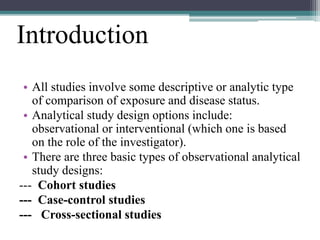
• All studies involve some descriptive or analytic type
of comparison of exposure and disease status.
• Analytical study design options include:
observational or interventional (which one is based
on the role of the investigator).
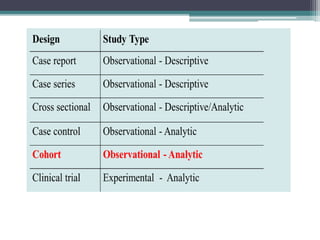
• There are three basic types of observational analytical
study designs:
--- Cohort studies
--- Case-control studies
--- Cross-sectional studies
Choice of study design depends on:
What is the research question/objective (to
describe or to test a hypothesis) descriptive versus
analytic designs
Available knowledge about the condition
If new condition with little information; Case-
control
Disease incidence
If Rare choose Case-control
If Common choose Prospective cohort
Time span between exposure and outcome
If long latency choose Case-control
If Short choose Prospective cohort
Resources and Time available for study
if yes (Prospective cohort)
Quality of data from various sources
Uniformly available and objective data are available
(e. g. birth weight for premature babies)
choose case-control
Often there are multiple approaches which will all
work
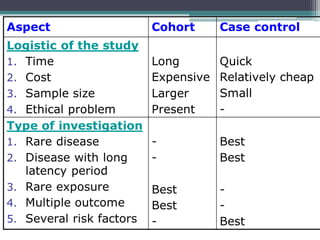
Case controlCohortAspect
Always present
Present
Not certain
Little
Not a problem
-
-
Certain
Problematic
Problematic
Problems
1. Selection bias
2. Recall bias
3. Temporal
relationship
4. Attrition problem
5. Change in
environment,
behaviour
Can not be calculated
Approximation (OR)
Can not be calculated
Can not be
determined
Can be calculated
Can be calculated
Can be calculated
Can be determined
Measurements
1. Incidence rate
2. Relative risk
3. Attributable risk
4. Dose-response
relationship
What is a Cohort ?
• Cohort: group of individual with a common
characteristic who are followed over a period of time
e.g. A smoker’s cohort means all are smokers in that
group
• Selection of cohorts based on exposed and unexposed
individuals to follow in specified time or until
development of outcome (disease/death)
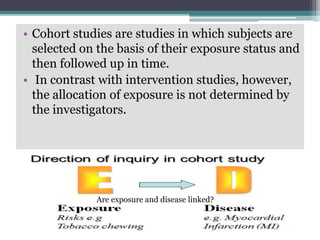
• Cohort studies are studies in which subjects are
selected on the basis of their exposure status and
then followed up in time.
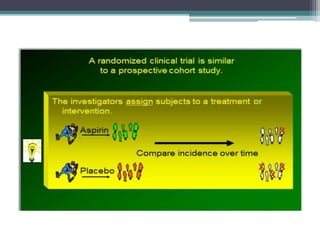
• In contrast with intervention studies, however,
the allocation of exposure is not determined by
the investigators.
Are exposure and disease linked?
Cohort study design
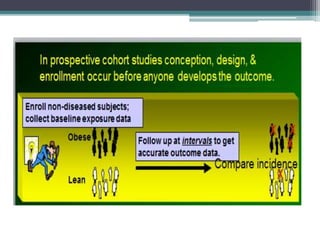
• A cohort, which is exposed to a suspected factor
but not yet developed the disease, is observed
and followed over time.
• Then, the incidence of the disease is measured
directly.
Measuring occurrence of disease
• Comparison of incidence proportion in both
groups
• Conceptually longitudinal to determine possible
causal association between risk (exposure) and
disease (outcome)
Types of Cohort Studies
•Prospective (concurrent)
•Retrospective (historical)
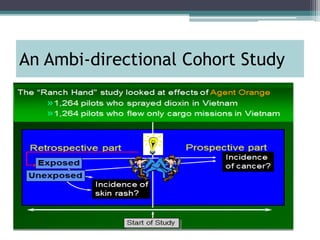
•Ambi-directional Cohort Study
• Prospective -cohort characterized by
determination of exposure levels (exposed vs.
not exposed) at baseline (present) and followed
for occurrence of disease in future .Groups move
through time as they age
• Retrospective - makes use of historical data to
determine exposure level at some baseline in the
past and then determine subsequent disease
status in the present.
• Restricted - limited exposure, narrow behavior
(military, long shore men)
Prospective Studies
• Also called
▫ longitudinal
▫ concurrent
▫ incidence studies
• Looking into the future
• Example:
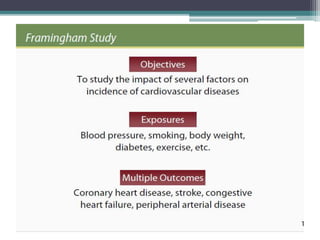
▫ Framingham Study of coronary heart disease
(CHD)
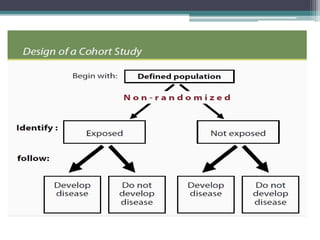
Design of a Cohort Experiment
• The essential characteristic in the design of
cohort studies is the comparison of outcome in
an exposed group and a nonexposed group (or a
group with a certain characteristic and a group
w/o that characteristic).
• A study population can be chosen by selecting
groups for inclusion in the study on the basis of
whether or not they were exposed
Selection of Cohort Groups
• There are two basic ways to generate cohort
groups.
 Select a cohort (defined population) BEFORE any of
its members become exposed or before the exposures
are identified.
 Select a cohort on the basis of some factor (e.g.,
where they live) and take histories (e.g., blood tests)
on the entire population to separate into exposed and
non-exposed groups.
• Regardless of which selection approach is used, we
are comparing exposed and non-exposed persons.
• Population was 28,000
• Study design called for a random
sample of 6,500
• Enrollment questionnaire form
targeted age range 30-59 years
• No clinical evidence of atherosclerotic
cardiovascular disease
• Cohort re-examined every two years
• Problems: white, middle class
1. Examine people over their life times for
contraction of diseases. In meantime, ask
questions concerning diet, lifestyle,habits, work,
etc.
2. Take blood and do lab tests (as many as
possible).
3. Do same tests every year for a period of years.
Potential Sources of Data in a
Prospective Cohort Study
Data collected specifically for a
prospective cohort study will be of higher
quality than that obtained from pre-
existing records, but it is more expensive
to do a large, prospective cohort study.
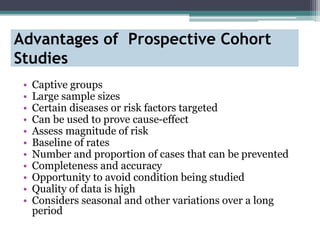
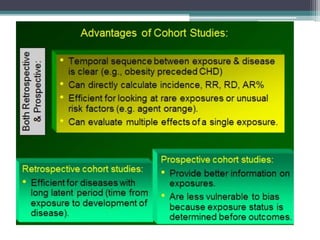
Advantages of Prospective Cohort
Studies
• Captive groups
• Large sample sizes
• Certain diseases or risk factors targeted
• Can be used to prove cause-effect
• Assess magnitude of risk
• Baseline of rates
• Number and proportion of cases that can be prevented
• Completeness and accuracy
• Opportunity to avoid condition being studied
• Quality of data is high
• Considers seasonal and other variations over a long
period
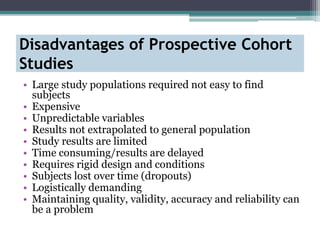
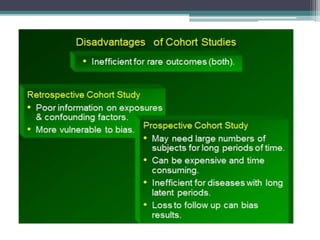
Disadvantages of Prospective Cohort
Studies
• Large study populations required not easy to find
subjects
• Expensive
• Unpredictable variables
• Results not extrapolated to general population
• Study results are limited
• Time consuming/results are delayed
• Requires rigid design and conditions
• Subjects lost over time (dropouts)
• Logistically demanding
• Maintaining quality, validity, accuracy and reliability can
be a problem
RETROSPECTIVE
• Go back and determine exposure status based on
historical information and then classify subjects
according to their current disease status.
Rate= a/ n 1
Rate= c/ n 0
• Retrospective cohort studies are useful for unusual
exposures and they are efficient for diseases with long
latent periods (time between exposure & disease).
• Questionnaires
• Employee records
• Medical records
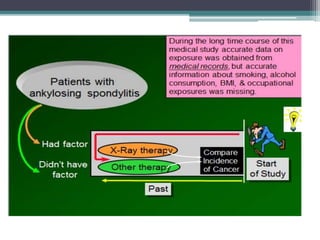
However, accurate information on the main exposure and
confounding factors is often missing because the data source
was not designed for the purpose of conducting the study.
Data Sources for Retrospective
Cohort Studies
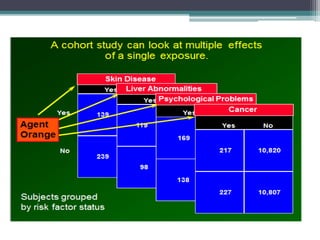
An Ambi-directional Cohort Study
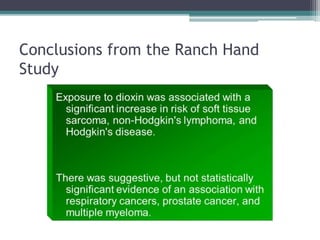
Conclusions from the Ranch Hand
Study
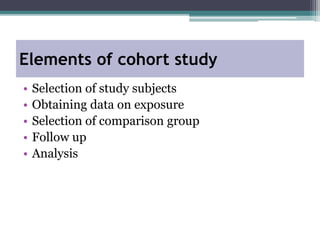
• Selection of study subjects
• Obtaining data on exposure
• Selection of comparison group
• Follow up
• Analysis
Elements of cohort study
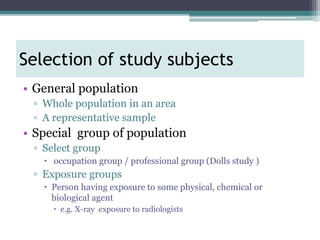
• General population
▫ Whole population in an area
▫ A representative sample
• Special group of population
▫ Select group
 occupation group / professional group (Dolls study )
▫ Exposure groups
 Person having exposure to some physical, chemical or
biological agent
 e.g. X-ray exposure to radiologists
Selection of study subjects
• Personal interviews / mailed questionnaire
• Reviews of records
▫ Dose of drug, radiation, type of surgery etc
• Medical examination or special test
▫ Blood pressure, serum cholesterol
• Environmental survey
• By obtaining the data of exposure we can classify
cohorts as
▫ Exposed and non exposed and
▫ By degree exposure we can sub classify cohorts
Obtaining data on exposure
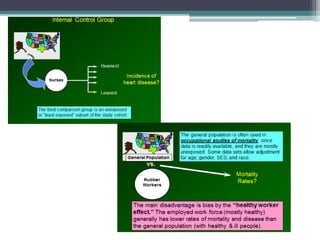
• Internal comparison
▫ Only one cohort involved in study
▫ Sub classified and internal comparison done
• External comparison
▫ More than one cohort in the study for the purpose of
comparison
▫ e.g. Cohort of radiologist compared with ophthalmologists
• Comparison with general population rates
▫ If no comparison group is available we can compare the
rates of study cohort with general population.
▫ Cancer rate of uranium miners with cancer in general
population
Selection of comparison group
• To obtain data about outcome to be determined
(morbidity or death)
▫ Mailed questionnaire, telephone calls, personal interviews
▫ Periodic medical examination
▫ Reviewing records
▫ Surveillance of death records
▫ Follow up is the most critical part of the study
• Some loss to follow up is inevitable due to death
change of address, migration, change of occupation.
• Loss to follow-up is one of the draw-back of the
cohort study.
Follow-up
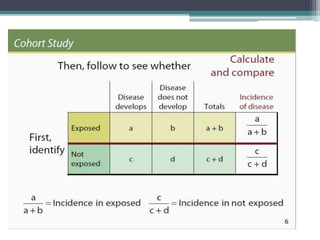
• Calculation of incidence rates among exposed
and non exposed groups
• Estimation of risk
ANALYSIS
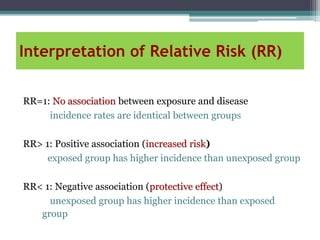
RR=1: No association between exposure and disease
incidence rates are identical between groups
RR> 1: Positive association (increased risk)
exposed group has higher incidence than unexposed group
RR< 1: Negative association (protective effect)
unexposed group has higher incidence than exposed
group
Interpretation of Relative Risk (RR)
Types of Potential Bias in Cohort Studies
• Selection bias
Select participants into exposed and not exposed groups
based on some characteristics that may affect the outcome
• Information bias
Collect different quality and extent of information from
exposed and not exposed groups.Loss to follow-up differs
between exposed and not exposed (or between disease and
no disease)
• Misclassification bias
Misclassify exposure status or disease status
THANK YOU

Cohort studies..NIKHNA JAYAN

  • 1.
  • 2.
    Introduction • All studiesinvolve some descriptive or analytic type of comparison of exposure and disease status. • Analytical study design options include: observational or interventional (which one is based on the role of the investigator). • There are three basic types of observational analytical study designs: --- Cohort studies --- Case-control studies --- Cross-sectional studies
  • 4.
    Choice of studydesign depends on: What is the research question/objective (to describe or to test a hypothesis) descriptive versus analytic designs Available knowledge about the condition If new condition with little information; Case- control Disease incidence If Rare choose Case-control If Common choose Prospective cohort
  • 5.
    Time span betweenexposure and outcome If long latency choose Case-control If Short choose Prospective cohort Resources and Time available for study if yes (Prospective cohort) Quality of data from various sources Uniformly available and objective data are available (e. g. birth weight for premature babies) choose case-control Often there are multiple approaches which will all work
  • 7.
    Case controlCohortAspect Always present Present Notcertain Little Not a problem - - Certain Problematic Problematic Problems 1. Selection bias 2. Recall bias 3. Temporal relationship 4. Attrition problem 5. Change in environment, behaviour Can not be calculated Approximation (OR) Can not be calculated Can not be determined Can be calculated Can be calculated Can be calculated Can be determined Measurements 1. Incidence rate 2. Relative risk 3. Attributable risk 4. Dose-response relationship
  • 9.
    What is aCohort ? • Cohort: group of individual with a common characteristic who are followed over a period of time e.g. A smoker’s cohort means all are smokers in that group • Selection of cohorts based on exposed and unexposed individuals to follow in specified time or until development of outcome (disease/death)
  • 10.
    • Cohort studiesare studies in which subjects are selected on the basis of their exposure status and then followed up in time. • In contrast with intervention studies, however, the allocation of exposure is not determined by the investigators. Are exposure and disease linked?
  • 11.
    Cohort study design •A cohort, which is exposed to a suspected factor but not yet developed the disease, is observed and followed over time. • Then, the incidence of the disease is measured directly.
  • 12.
    Measuring occurrence ofdisease • Comparison of incidence proportion in both groups • Conceptually longitudinal to determine possible causal association between risk (exposure) and disease (outcome)
  • 15.
    Types of CohortStudies •Prospective (concurrent) •Retrospective (historical) •Ambi-directional Cohort Study
  • 16.
    • Prospective -cohortcharacterized by determination of exposure levels (exposed vs. not exposed) at baseline (present) and followed for occurrence of disease in future .Groups move through time as they age • Retrospective - makes use of historical data to determine exposure level at some baseline in the past and then determine subsequent disease status in the present. • Restricted - limited exposure, narrow behavior (military, long shore men)
  • 17.
    Prospective Studies • Alsocalled ▫ longitudinal ▫ concurrent ▫ incidence studies • Looking into the future • Example: ▫ Framingham Study of coronary heart disease (CHD)
  • 20.
    Design of aCohort Experiment • The essential characteristic in the design of cohort studies is the comparison of outcome in an exposed group and a nonexposed group (or a group with a certain characteristic and a group w/o that characteristic). • A study population can be chosen by selecting groups for inclusion in the study on the basis of whether or not they were exposed
  • 21.
    Selection of CohortGroups • There are two basic ways to generate cohort groups.  Select a cohort (defined population) BEFORE any of its members become exposed or before the exposures are identified.  Select a cohort on the basis of some factor (e.g., where they live) and take histories (e.g., blood tests) on the entire population to separate into exposed and non-exposed groups. • Regardless of which selection approach is used, we are comparing exposed and non-exposed persons.
  • 25.
    • Population was28,000 • Study design called for a random sample of 6,500 • Enrollment questionnaire form targeted age range 30-59 years • No clinical evidence of atherosclerotic cardiovascular disease • Cohort re-examined every two years • Problems: white, middle class
  • 26.
    1. Examine peopleover their life times for contraction of diseases. In meantime, ask questions concerning diet, lifestyle,habits, work, etc. 2. Take blood and do lab tests (as many as possible). 3. Do same tests every year for a period of years.
  • 28.
    Potential Sources ofData in a Prospective Cohort Study Data collected specifically for a prospective cohort study will be of higher quality than that obtained from pre- existing records, but it is more expensive to do a large, prospective cohort study.
  • 29.
    Advantages of ProspectiveCohort Studies • Captive groups • Large sample sizes • Certain diseases or risk factors targeted • Can be used to prove cause-effect • Assess magnitude of risk • Baseline of rates • Number and proportion of cases that can be prevented • Completeness and accuracy • Opportunity to avoid condition being studied • Quality of data is high • Considers seasonal and other variations over a long period
  • 30.
    Disadvantages of ProspectiveCohort Studies • Large study populations required not easy to find subjects • Expensive • Unpredictable variables • Results not extrapolated to general population • Study results are limited • Time consuming/results are delayed • Requires rigid design and conditions • Subjects lost over time (dropouts) • Logistically demanding • Maintaining quality, validity, accuracy and reliability can be a problem
  • 31.
    RETROSPECTIVE • Go backand determine exposure status based on historical information and then classify subjects according to their current disease status. Rate= a/ n 1 Rate= c/ n 0
  • 33.
    • Retrospective cohortstudies are useful for unusual exposures and they are efficient for diseases with long latent periods (time between exposure & disease). • Questionnaires • Employee records • Medical records However, accurate information on the main exposure and confounding factors is often missing because the data source was not designed for the purpose of conducting the study. Data Sources for Retrospective Cohort Studies
  • 35.
  • 37.
    Conclusions from theRanch Hand Study
  • 38.
    • Selection ofstudy subjects • Obtaining data on exposure • Selection of comparison group • Follow up • Analysis Elements of cohort study
  • 39.
    • General population ▫Whole population in an area ▫ A representative sample • Special group of population ▫ Select group  occupation group / professional group (Dolls study ) ▫ Exposure groups  Person having exposure to some physical, chemical or biological agent  e.g. X-ray exposure to radiologists Selection of study subjects
  • 40.
    • Personal interviews/ mailed questionnaire • Reviews of records ▫ Dose of drug, radiation, type of surgery etc • Medical examination or special test ▫ Blood pressure, serum cholesterol • Environmental survey • By obtaining the data of exposure we can classify cohorts as ▫ Exposed and non exposed and ▫ By degree exposure we can sub classify cohorts Obtaining data on exposure
  • 41.
    • Internal comparison ▫Only one cohort involved in study ▫ Sub classified and internal comparison done • External comparison ▫ More than one cohort in the study for the purpose of comparison ▫ e.g. Cohort of radiologist compared with ophthalmologists • Comparison with general population rates ▫ If no comparison group is available we can compare the rates of study cohort with general population. ▫ Cancer rate of uranium miners with cancer in general population Selection of comparison group
  • 43.
    • To obtaindata about outcome to be determined (morbidity or death) ▫ Mailed questionnaire, telephone calls, personal interviews ▫ Periodic medical examination ▫ Reviewing records ▫ Surveillance of death records ▫ Follow up is the most critical part of the study • Some loss to follow up is inevitable due to death change of address, migration, change of occupation. • Loss to follow-up is one of the draw-back of the cohort study. Follow-up
  • 44.
    • Calculation ofincidence rates among exposed and non exposed groups • Estimation of risk ANALYSIS
  • 50.
    RR=1: No associationbetween exposure and disease incidence rates are identical between groups RR> 1: Positive association (increased risk) exposed group has higher incidence than unexposed group RR< 1: Negative association (protective effect) unexposed group has higher incidence than exposed group Interpretation of Relative Risk (RR)
  • 51.
    Types of PotentialBias in Cohort Studies • Selection bias Select participants into exposed and not exposed groups based on some characteristics that may affect the outcome • Information bias Collect different quality and extent of information from exposed and not exposed groups.Loss to follow-up differs between exposed and not exposed (or between disease and no disease) • Misclassification bias Misclassify exposure status or disease status
  • 54.