Seminar on โ€œCritical analysis
of Asava aristas in
Bhrihatrayeesโ€
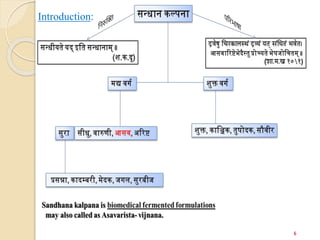
Introduction:
๏‚— Definitions:
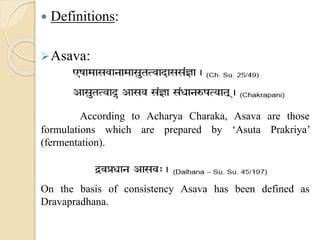
๏ƒ˜Asava:
According to Acharya Charaka, Asava are those
formulations which are prepared by โ€˜Asuta Prakriyaโ€™
(fermentation).
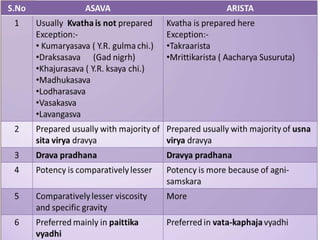
On the basis of consistency Asava has been defined as
Dravapradhana.
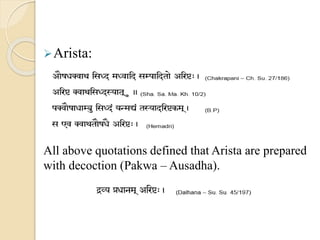
๏ƒ˜Arista:
All above quotations defined that Arista are prepared
with decoction (Pakwa โ€“ Ausadha).
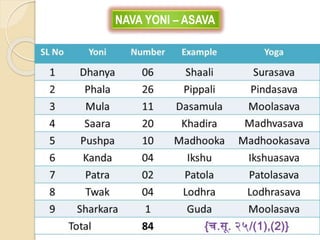
NAVA YONI โ€“ ASAVA
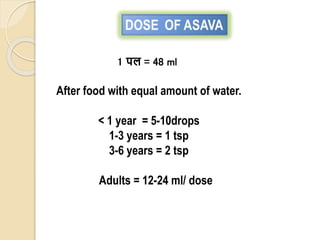
1 เคชเคฒ = 48 ml
After food with equal amount of water.
< 1 year = 5-10drops
1-3 years = 1 tsp
3-6 years = 2 tsp
Adults = 12-24 ml/ dose
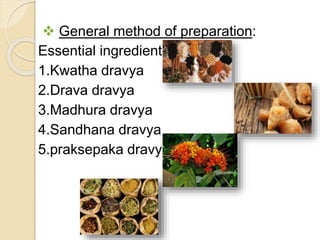
๏ถ General method of preparation:
Essential ingredients
1.Kwatha dravya
2.Drava dravya
3.Madhura dravya
4.Sandhana dravya
5.praksepaka dravya
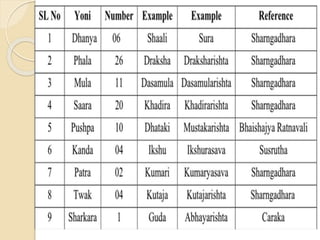
๏‚— Dravya : The drugs in asava are usually
mridu, volatile in nature i.e., chandana, ushira
etc & these are made hima/phanta/swarasa etc
๏‚— The drugs commonly used for arista are
twak,, mula which are kathina or madhyama
varga which are used for decoction . On the
basis of fermentation property achayra
mentioned 9 yoniโ€™s and total 84 drugs
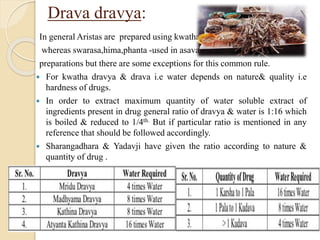
Drava dravya:
In general Aristas are prepared using kwatha
whereas swarasa,hima,phanta -used in asava
preparations but there are some exceptions for this common rule.
๏‚— For kwatha dravya & drava i.e water depends on nature& quality i.e
hardness of drugs.
๏‚— In order to extract maximum quantity of water soluble extract of
ingredients present in drug general ratio of dravya & water is 1:16 which
is boiled & reduced to 1/4th. But if particular ratio is mentioned in any
reference that should be followed accordingly.
๏‚— Sharangadhara & Yadavji have given the ratio according to nature &
quantity of drug .
๏ƒ˜ The liquid media is the main source of fermentation. It is
specifically needed for the growth of favorable
microorganism of fermentation. Thus preparation of the
liquid material is an essential part of each and every
Asava-Arishta The use of Sura, Manda, Takra, Souviraka,
Tushodaka, and Kanji are also recomended for the
preparations of Sandhan Kalpana.
๏‚— Out of these Kwatha is the commonest
media used in various classics for the
preparation of various Asava-Arishta,
although the quantity of water taken for
various preparations is specific.
๏‚— Proper aseptic measures should always be
considered during preparation of liquid
media, especially during Swarasa
preparation. If only water is employed for
fermentation reaction then it should be first
boiled and self cooled up to room
temperature before use.
There are exceptions for this
common rule encountered in the manufacture
of arishta and asava for eg:1 - in takrarishta
even though it is named as arishta, no kashaya
(decoction) is prepared. Here a vishesha
samskara is followed as the formulation 75%
of drugs which are volatile and mridu nature.
ex-2: kumaryasava though, Kashaya is used
even then it is named as asava. In this
formulation abhaya (Terminalia chebula) being
comparatively kathina dravya is made into
kashaya and samanya nirmana vidhi is
followed for the remaining ingredients.
๏‚— There is a special method of preparing
kashaya by soaking the drug in water for
duration of 8hrs before keeping on fire,
this facilitates the better extraction of
active principles into kashaya and increase
in potency.
Precaution during kwatha preparation :
๏‚— It should be prepared on mild heat, as
vigorous heating may cause the hydrolysis of
most of the active constituents of the drug.
๏‚— Continuous stirring is also needed to
facilitate evaporation even on mild heat and
to avoid excessive heating.
๏‚— Boiling also fulfil the criteria of medium
sterilization which is also an essential part of
fermentation. That might be the reason why
Acharya prefer Kwatha more than that of
other liquid media.
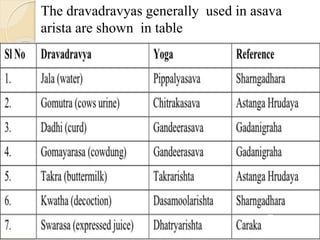
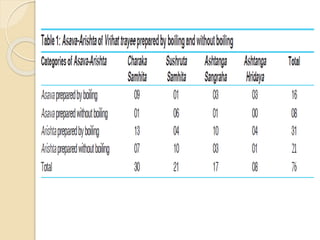
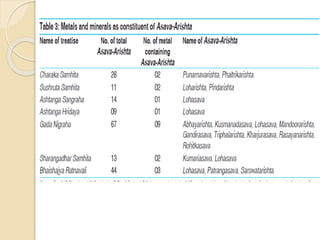
The dravadravyas generally used in asava
arista are shown in table
๏‚— MADHURA DRAVYA:
๏ƒ˜Acharyas have used Madhura Dravya of
Ikshuvarga or Madhuvarga as the media for
fermentation.They not only for provide
nutritive media but also to facilitate specific
microorganism to work out.
๏ƒ˜Major sweetening agents are from herbal
media like guda, phanita,sharkara,sitopala &
also from animal source i.e madhu used
independently or with sharkara or guda.
๏ƒ˜1year guda & 40% of sharkara are best for
fermentation.
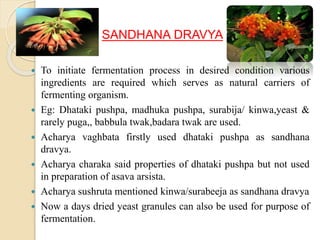
SANDHANA DRAVYA
๏‚— To initiate fermentation process in desired condition various
ingredients are required which serves as natural carriers of
fermenting organism.
๏‚— Eg: Dhataki pushpa, madhuka pushpa, surabija/ kinwa,yeast &
rarely puga,, babbula twak,badara twak are used.
๏‚— Acharya vaghbata firstly used dhataki pushpa as sandhana
dravya.
๏‚— Acharya charaka said properties of dhataki pushpa but not used
in preparation of asava arsista.
๏‚— Acharya sushruta mentioned kinwa/surabeeja as sandhana dravya
๏‚— Now a days dried yeast granules can also be used for purpose of
fermentation.
PRAKSHEPAKA DRAVYA
๏ƒ˜ various types of adjuvant are used in the preparation as Asava-Arishta. It
not only provide essential nitrogenous source to the media but also have
medicinal importance to potentiate the effect of main drug, contribute
pleasant colour, taste and aroma to the Asava-Arishta The prakeshpaka
dravya are coarsely powdered & added to sandhanapatra whereas in other
formulations very fine powder is used
Eg:lavanga, ela, twak patra, nagkeshara,trikatu etc
๏ƒ˜ Classification of Prakshepa Dravya: two types depending on their source.
(i) Kasthaushadhi
(ii) Rasaushadhi
๏ƒ˜ Acharya Sushruta clearly indicates that for the preparation of Loharishta,
Pippalyadi Gana to be used as Prakshepa. Beside this Eladi, Haridradi,
Priyanguvadi etc Gana are also in common use due to their specific
medicinal properties.
๏ƒ˜ Pipplyadi Gana is indicated as Kaphhara, Ama pachaka etc.
๏ƒ˜ Eladi gana have Vata- Kapha nashka, Vishahara properties.
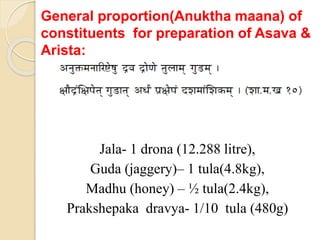
General proportion(Anuktha maana) of
constituents for preparation of Asava &
Arista:
Jala- 1 drona (12.288 litre),
Guda (jaggery)โ€“ 1 tula(4.8kg),
Madhu (honey) โ€“ ยฝ tula(2.4kg),
Prakshepaka dravya- 1/10 tula (480g)
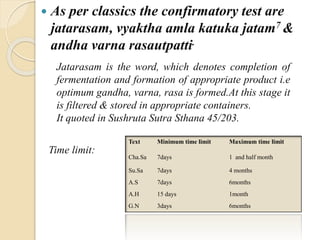
๏‚— As per classics the confirmatory test are
jatarasam, vyaktha amla katuka jatam7 &
andha varna rasautpatti.
Jatarasam is the word, which denotes completion of
fermentation and formation of appropriate product i.e
optimum gandha, varna, rasa is formed.At this stage it
is filtered & stored in appropriate containers.
It quoted in Sushruta Sutra Sthana 45/203.
Text Minimum time limit Maximum time limit
Cha.Sa 7days 1 and half month
Su.Sa 7days 4 months
A.S 7days 6months
A.H 15 days 1month
G.N 3days 6months
Time limit:
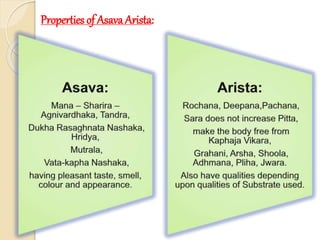
Properties of Asava Arista:
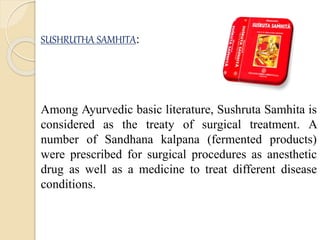
SUSHRUTHA SAMHITA:
Among Ayurvedic basic literature, Sushruta Samhita is
considered as the treaty of surgical treatment. A
number of Sandhana kalpana (fermented products)
were prescribed for surgical procedures as anesthetic
drug as well as a medicine to treat different disease
conditions.
๏‚— A total of 21 fermented drugs such as
Asavaโ€“Arishta and 46 Madya products
named as Madya, Sura, Prasanna, Jagala,
Surasava, Madhvasava, Shukta,
Dhanyamla are well documented in this
classical text.Sushruta Samhita may be
credited for addition of botanical
ash(Apamarga, Palasha ash) as ingredients
of Asavaโ€“Arishta. These formulations are
prescribed for certain therapeutic
purposes.
๏ƒ˜ Madya Varga of Sutrasthana in 45th chapter deals
with the 27 types of fermented preparations.
Commentator Dalhana has classified the fermented.
๏‚— Preparations in โ€˜Madyaโ€™ and โ€˜Shuktaโ€™ groups on the
basis of their alcoholic and acidic contents
respectively. He has also defined the Asava Arista on
the basis of consistency. In this text, 21 Asava Arista
Yoga are mentioned, but the detail description
regarding the contents and the method of preparation
is found only for 7 Yoga. Guda is used in Phanita
form.
Asava:
๏ƒ˜ Dwipanchamuladi asava- arsha chikitsa
๏ƒ˜ Khadirasara asava- kushta chikitsa
๏ƒ˜ Kushtaharasava โ€“kushta chikitsa
Arista:
๏ถLoharista- prameha pidika chikitsa
๏ถDhatryarista- arsha chikitsa
CHARAKA SAMHITA:
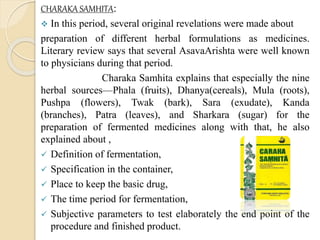
๏ถ In this period, several original revelations were made about
preparation of different herbal formulations as medicines.
Literary review says that several AsavaArishta were well known
to physicians during that period.
Charaka Samhita explains that especially the nine
herbal sourcesโ€”Phala (fruits), Dhanya(cereals), Mula (roots),
Pushpa (flowers), Twak (bark), Sara (exudate), Kanda
(branches), Patra (leaves), and Sharkara (sugar) for the
preparation of fermented medicines along with that, he also
explained about ,
๏ƒผ Definition of fermentation,
๏ƒผ Specification in the container,
๏ƒผ Place to keep the basic drug,
๏ƒผ The time period for fermentation,
๏ƒผ Subjective parameters to test elaborately the end point of the
procedure and finished product.
๏‚— The application of the prepared medicines
(Asavaโ€“Arista) is recommended in
different disease conditions.
๏‚— The basic concepts of these specific
arrangements are responsible for better
yield and quality production of Asavaโ€“
Arista even today. This indicates that the
fermentation technology was well known
in that period.
Asava:
๏ƒผ Duralabhasava
๏ƒผ Mulasava
๏ƒผ Pindasava(grahani chikitsa)
Arista:
๏ƒ˜ Gandeeradhyatista
๏ƒ˜ Ashtashato-arista
๏ƒ˜ Punarnavadhyarista
๏ƒ˜ Phalatrikadhyarista(shwayatu chikitsa)
๏ƒ˜ Abhayarista
๏ƒ˜ Dantyarista
๏ƒ˜ Phalarista
๏ƒ˜ Kanakarista(arsha chikitsa)
๏ƒ˜ Madhvarista (grahani)
๏ƒ˜ Dhatryarista
๏ƒ˜ Beejakarista(pandu)
ASHTANGA HRIDAYA AND SANGRAHA:
Herbal medicine stream was fully developed in this
period; this is reflected in the formulation of different Sandhana
kalpana. Along with other ingredients, the use of Dhataki Pushpa
(Woodfordia fruticosa) as a fermentation initiator is documented
for the first time in Ashtanga Hridaya. This could be considered as
one of the innovatory steps in pharmaceutical practice to formulate
Sandhana kalpana.
Physicians were well aware of the fermentation
techniques, as the container, the place, duration and criteria for
testing the product are clearly mentioned in various formulations
usually in accordance with previous classics. Draksha (grapes),
Ikshu (sugar cane), Makshika (honey), Shali (rice), Vrihi (grains)
are the five source materials found to be used to prepare Madya
and Sandhana kalpana. Draksha is the most acclaimed source
material.
๏‚— A total of 17 Asavaโ€“Arishta are quoted in
Ashtanga Sangraha and 8 in Ashtanga
Hridaya. This may also be an inference after
going through Brihat trayee that in this
period, sharp difference in preparations of
Asava โ€“ Arishta on the basis of Kwatha and
Swarasa used as source was not clearly
established.
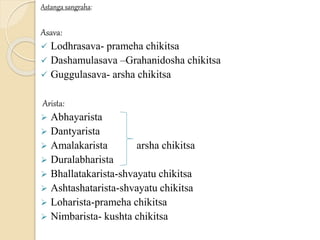
Astanga sangraha:
Asava:
๏ƒผ Lodhrasava- prameha chikitsa
๏ƒผ Dashamulasava โ€“Grahanidosha chikitsa
๏ƒผ Guggulasava- arsha chikitsa
Arista:
๏ƒ˜ Abhayarista
๏ƒ˜ Dantyarista
๏ƒ˜ Amalakarista arsha chikitsa
๏ƒ˜ Duralabharista
๏ƒ˜ Bhallatakarista-shvayatu chikitsa
๏ƒ˜ Ashtashatarista-shvayatu chikitsa
๏ƒ˜ Loharista-prameha chikitsa
๏ƒ˜ Nimbarista- kushta chikitsa
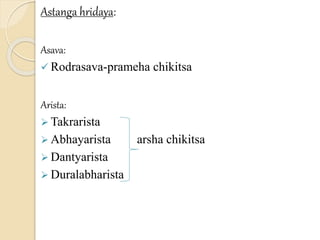
Astanga hridaya:
Asava:
๏ƒผ Rodrasava-prameha chikitsa
Arista:
๏ƒ˜ Takrarista
๏ƒ˜ Abhayarista arsha chikitsa
๏ƒ˜ Dantyarista
๏ƒ˜ Duralabharista
About the contribution of Brihat trayee, it is concluded that
according to Sushruta, Asava has a predominance of drava
(liquid) while Arishta has a predominance of dravya (drugs)
(Dalhana on Sushruta Sutra Sthana 45/197). Asavaโ€“ Arishta
preparation consists of liquids, medicinal material (as main
ingredient of formulation), sweet substances and prakshepa
dravya (additional medicinal/palatable substances) as their
important constituent. No definite proportion of these
constituents could be worked out on the basis of the present
study of the text of Brihat trayee. The fermenting pots are made
of the either soil or metal and should be smeared and fumigated
first with the recommended drugs and is then used for
fermentation. Further, these texts mention that the fermentation
process is faster in summer and slow in winter. It needs a
minimum of seven days and may be extended up to six months.
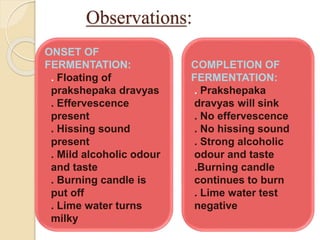
Observations:
ONSET OF
FERMENTATION:
. Floating of
prakshepaka dravyas
. Effervescence
present
. Hissing sound
present
. Mild alcoholic odour
and taste
. Burning candle is
put off
. Lime water turns
milky
COMPLETION OF
FERMENTATION:
. Prakshepaka
dravyas will sink
. No effervescence
. No hissing sound
. Strong alcoholic
odour and taste
.Burning candle
continues to burn
. Lime water test
negative
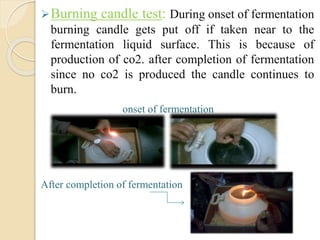
๏ƒ˜Burning candle test: During onset of fermentation
burning candle gets put off if taken near to the
fermentation liquid surface. This is because of
production of co2. after completion of fermentation
since no co2 is produced the candle continues to
burn.
onset of fermentation
After completion of fermentation
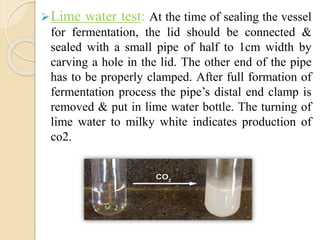
๏ƒ˜Lime water test: At the time of sealing the vessel
for fermentation, the lid should be connected &
sealed with a small pipe of half to 1cm width by
carving a hole in the lid. The other end of the pipe
has to be properly clamped. After full formation of
fermentation process the pipeโ€™s distal end clamp is
removed & put in lime water bottle. The turning of
lime water to milky white indicates production of
co2.
๏‚— Asava &arista are two popular Ayurvedic formulations
which are widely used for therapeutic purpose of
various disorders they posses self generated alcohol
which acts as self preservative. because of the virtue
of properties like palatability, quick in action, easy
dosage form with most important long shelf life, these
preparations are appreciated by consumers.
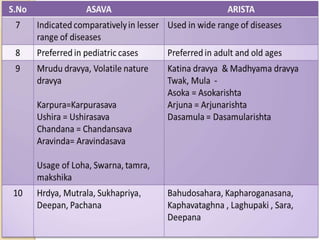
๏‚— These preparations come under the umbrella of
sandhana kalpana, with major difference in asava
which is prepared without boiling drug in water but
using mridu dravya and volatile in nature where in
arista use of kathina & madhyama dravya with some
exceptions in takrarista & kumaryasava.
๏‚— It is concluded that according to Sushruta, Asava has a
predominance of drava (liquid) while Arishta has a
predominance of dravya (drugs) (Dalhana on Sushruta
Sutra Sthana 45/197).
C
O
N
C
L
U
S
I
O
n
asava aristha in bruhatrayee.pptx

asava aristha in bruhatrayee.pptx

  • 1.
    Seminar on โ€œCriticalanalysis of Asava aristas in Bhrihatrayeesโ€
  • 2.
  • 3.
    ๏‚— Definitions: ๏ƒ˜Asava: According toAcharya Charaka, Asava are those formulations which are prepared by โ€˜Asuta Prakriyaโ€™ (fermentation). On the basis of consistency Asava has been defined as Dravapradhana.
  • 4.
    ๏ƒ˜Arista: All above quotationsdefined that Arista are prepared with decoction (Pakwa โ€“ Ausadha).
  • 7.
  • 8.
    1 เคชเคฒ =48 ml After food with equal amount of water. < 1 year = 5-10drops 1-3 years = 1 tsp 3-6 years = 2 tsp Adults = 12-24 ml/ dose
  • 9.
    ๏ถ General methodof preparation: Essential ingredients 1.Kwatha dravya 2.Drava dravya 3.Madhura dravya 4.Sandhana dravya 5.praksepaka dravya
  • 10.
    ๏‚— Dravya :The drugs in asava are usually mridu, volatile in nature i.e., chandana, ushira etc & these are made hima/phanta/swarasa etc ๏‚— The drugs commonly used for arista are twak,, mula which are kathina or madhyama varga which are used for decoction . On the basis of fermentation property achayra mentioned 9 yoniโ€™s and total 84 drugs
  • 12.
    Drava dravya: In generalAristas are prepared using kwatha whereas swarasa,hima,phanta -used in asava preparations but there are some exceptions for this common rule. ๏‚— For kwatha dravya & drava i.e water depends on nature& quality i.e hardness of drugs. ๏‚— In order to extract maximum quantity of water soluble extract of ingredients present in drug general ratio of dravya & water is 1:16 which is boiled & reduced to 1/4th. But if particular ratio is mentioned in any reference that should be followed accordingly. ๏‚— Sharangadhara & Yadavji have given the ratio according to nature & quantity of drug .
  • 13.
    ๏ƒ˜ The liquidmedia is the main source of fermentation. It is specifically needed for the growth of favorable microorganism of fermentation. Thus preparation of the liquid material is an essential part of each and every Asava-Arishta The use of Sura, Manda, Takra, Souviraka, Tushodaka, and Kanji are also recomended for the preparations of Sandhan Kalpana.
  • 14.
    ๏‚— Out ofthese Kwatha is the commonest media used in various classics for the preparation of various Asava-Arishta, although the quantity of water taken for various preparations is specific. ๏‚— Proper aseptic measures should always be considered during preparation of liquid media, especially during Swarasa preparation. If only water is employed for fermentation reaction then it should be first boiled and self cooled up to room temperature before use.
  • 15.
    There are exceptionsfor this common rule encountered in the manufacture of arishta and asava for eg:1 - in takrarishta even though it is named as arishta, no kashaya (decoction) is prepared. Here a vishesha samskara is followed as the formulation 75% of drugs which are volatile and mridu nature. ex-2: kumaryasava though, Kashaya is used even then it is named as asava. In this formulation abhaya (Terminalia chebula) being comparatively kathina dravya is made into kashaya and samanya nirmana vidhi is followed for the remaining ingredients.
  • 16.
    ๏‚— There isa special method of preparing kashaya by soaking the drug in water for duration of 8hrs before keeping on fire, this facilitates the better extraction of active principles into kashaya and increase in potency.
  • 17.
    Precaution during kwathapreparation : ๏‚— It should be prepared on mild heat, as vigorous heating may cause the hydrolysis of most of the active constituents of the drug. ๏‚— Continuous stirring is also needed to facilitate evaporation even on mild heat and to avoid excessive heating. ๏‚— Boiling also fulfil the criteria of medium sterilization which is also an essential part of fermentation. That might be the reason why Acharya prefer Kwatha more than that of other liquid media.
  • 18.
    The dravadravyas generallyused in asava arista are shown in table
  • 19.
    ๏‚— MADHURA DRAVYA: ๏ƒ˜Acharyashave used Madhura Dravya of Ikshuvarga or Madhuvarga as the media for fermentation.They not only for provide nutritive media but also to facilitate specific microorganism to work out. ๏ƒ˜Major sweetening agents are from herbal media like guda, phanita,sharkara,sitopala & also from animal source i.e madhu used independently or with sharkara or guda. ๏ƒ˜1year guda & 40% of sharkara are best for fermentation.
  • 20.
    SANDHANA DRAVYA ๏‚— Toinitiate fermentation process in desired condition various ingredients are required which serves as natural carriers of fermenting organism. ๏‚— Eg: Dhataki pushpa, madhuka pushpa, surabija/ kinwa,yeast & rarely puga,, babbula twak,badara twak are used. ๏‚— Acharya vaghbata firstly used dhataki pushpa as sandhana dravya. ๏‚— Acharya charaka said properties of dhataki pushpa but not used in preparation of asava arsista. ๏‚— Acharya sushruta mentioned kinwa/surabeeja as sandhana dravya ๏‚— Now a days dried yeast granules can also be used for purpose of fermentation.
  • 21.
    PRAKSHEPAKA DRAVYA ๏ƒ˜ varioustypes of adjuvant are used in the preparation as Asava-Arishta. It not only provide essential nitrogenous source to the media but also have medicinal importance to potentiate the effect of main drug, contribute pleasant colour, taste and aroma to the Asava-Arishta The prakeshpaka dravya are coarsely powdered & added to sandhanapatra whereas in other formulations very fine powder is used Eg:lavanga, ela, twak patra, nagkeshara,trikatu etc ๏ƒ˜ Classification of Prakshepa Dravya: two types depending on their source. (i) Kasthaushadhi (ii) Rasaushadhi ๏ƒ˜ Acharya Sushruta clearly indicates that for the preparation of Loharishta, Pippalyadi Gana to be used as Prakshepa. Beside this Eladi, Haridradi, Priyanguvadi etc Gana are also in common use due to their specific medicinal properties. ๏ƒ˜ Pipplyadi Gana is indicated as Kaphhara, Ama pachaka etc. ๏ƒ˜ Eladi gana have Vata- Kapha nashka, Vishahara properties.
  • 22.
    General proportion(Anuktha maana)of constituents for preparation of Asava & Arista: Jala- 1 drona (12.288 litre), Guda (jaggery)โ€“ 1 tula(4.8kg), Madhu (honey) โ€“ ยฝ tula(2.4kg), Prakshepaka dravya- 1/10 tula (480g)
  • 23.
    ๏‚— As perclassics the confirmatory test are jatarasam, vyaktha amla katuka jatam7 & andha varna rasautpatti. Jatarasam is the word, which denotes completion of fermentation and formation of appropriate product i.e optimum gandha, varna, rasa is formed.At this stage it is filtered & stored in appropriate containers. It quoted in Sushruta Sutra Sthana 45/203. Text Minimum time limit Maximum time limit Cha.Sa 7days 1 and half month Su.Sa 7days 4 months A.S 7days 6months A.H 15 days 1month G.N 3days 6months Time limit:
  • 24.
  • 25.
    SUSHRUTHA SAMHITA: Among Ayurvedicbasic literature, Sushruta Samhita is considered as the treaty of surgical treatment. A number of Sandhana kalpana (fermented products) were prescribed for surgical procedures as anesthetic drug as well as a medicine to treat different disease conditions.
  • 26.
    ๏‚— A totalof 21 fermented drugs such as Asavaโ€“Arishta and 46 Madya products named as Madya, Sura, Prasanna, Jagala, Surasava, Madhvasava, Shukta, Dhanyamla are well documented in this classical text.Sushruta Samhita may be credited for addition of botanical ash(Apamarga, Palasha ash) as ingredients of Asavaโ€“Arishta. These formulations are prescribed for certain therapeutic purposes.
  • 27.
    ๏ƒ˜ Madya Vargaof Sutrasthana in 45th chapter deals with the 27 types of fermented preparations. Commentator Dalhana has classified the fermented. ๏‚— Preparations in โ€˜Madyaโ€™ and โ€˜Shuktaโ€™ groups on the basis of their alcoholic and acidic contents respectively. He has also defined the Asava Arista on the basis of consistency. In this text, 21 Asava Arista Yoga are mentioned, but the detail description regarding the contents and the method of preparation is found only for 7 Yoga. Guda is used in Phanita form.
  • 28.
    Asava: ๏ƒ˜ Dwipanchamuladi asava-arsha chikitsa ๏ƒ˜ Khadirasara asava- kushta chikitsa ๏ƒ˜ Kushtaharasava โ€“kushta chikitsa Arista: ๏ถLoharista- prameha pidika chikitsa ๏ถDhatryarista- arsha chikitsa
  • 29.
    CHARAKA SAMHITA: ๏ถ Inthis period, several original revelations were made about preparation of different herbal formulations as medicines. Literary review says that several AsavaArishta were well known to physicians during that period. Charaka Samhita explains that especially the nine herbal sourcesโ€”Phala (fruits), Dhanya(cereals), Mula (roots), Pushpa (flowers), Twak (bark), Sara (exudate), Kanda (branches), Patra (leaves), and Sharkara (sugar) for the preparation of fermented medicines along with that, he also explained about , ๏ƒผ Definition of fermentation, ๏ƒผ Specification in the container, ๏ƒผ Place to keep the basic drug, ๏ƒผ The time period for fermentation, ๏ƒผ Subjective parameters to test elaborately the end point of the procedure and finished product.
  • 30.
    ๏‚— The applicationof the prepared medicines (Asavaโ€“Arista) is recommended in different disease conditions. ๏‚— The basic concepts of these specific arrangements are responsible for better yield and quality production of Asavaโ€“ Arista even today. This indicates that the fermentation technology was well known in that period.
  • 31.
    Asava: ๏ƒผ Duralabhasava ๏ƒผ Mulasava ๏ƒผPindasava(grahani chikitsa) Arista: ๏ƒ˜ Gandeeradhyatista ๏ƒ˜ Ashtashato-arista ๏ƒ˜ Punarnavadhyarista ๏ƒ˜ Phalatrikadhyarista(shwayatu chikitsa) ๏ƒ˜ Abhayarista ๏ƒ˜ Dantyarista ๏ƒ˜ Phalarista ๏ƒ˜ Kanakarista(arsha chikitsa) ๏ƒ˜ Madhvarista (grahani) ๏ƒ˜ Dhatryarista ๏ƒ˜ Beejakarista(pandu)
  • 32.
    ASHTANGA HRIDAYA ANDSANGRAHA: Herbal medicine stream was fully developed in this period; this is reflected in the formulation of different Sandhana kalpana. Along with other ingredients, the use of Dhataki Pushpa (Woodfordia fruticosa) as a fermentation initiator is documented for the first time in Ashtanga Hridaya. This could be considered as one of the innovatory steps in pharmaceutical practice to formulate Sandhana kalpana. Physicians were well aware of the fermentation techniques, as the container, the place, duration and criteria for testing the product are clearly mentioned in various formulations usually in accordance with previous classics. Draksha (grapes), Ikshu (sugar cane), Makshika (honey), Shali (rice), Vrihi (grains) are the five source materials found to be used to prepare Madya and Sandhana kalpana. Draksha is the most acclaimed source material.
  • 33.
    ๏‚— A totalof 17 Asavaโ€“Arishta are quoted in Ashtanga Sangraha and 8 in Ashtanga Hridaya. This may also be an inference after going through Brihat trayee that in this period, sharp difference in preparations of Asava โ€“ Arishta on the basis of Kwatha and Swarasa used as source was not clearly established.
  • 34.
    Astanga sangraha: Asava: ๏ƒผ Lodhrasava-prameha chikitsa ๏ƒผ Dashamulasava โ€“Grahanidosha chikitsa ๏ƒผ Guggulasava- arsha chikitsa Arista: ๏ƒ˜ Abhayarista ๏ƒ˜ Dantyarista ๏ƒ˜ Amalakarista arsha chikitsa ๏ƒ˜ Duralabharista ๏ƒ˜ Bhallatakarista-shvayatu chikitsa ๏ƒ˜ Ashtashatarista-shvayatu chikitsa ๏ƒ˜ Loharista-prameha chikitsa ๏ƒ˜ Nimbarista- kushta chikitsa
  • 35.
    Astanga hridaya: Asava: ๏ƒผ Rodrasava-pramehachikitsa Arista: ๏ƒ˜ Takrarista ๏ƒ˜ Abhayarista arsha chikitsa ๏ƒ˜ Dantyarista ๏ƒ˜ Duralabharista
  • 36.
    About the contributionof Brihat trayee, it is concluded that according to Sushruta, Asava has a predominance of drava (liquid) while Arishta has a predominance of dravya (drugs) (Dalhana on Sushruta Sutra Sthana 45/197). Asavaโ€“ Arishta preparation consists of liquids, medicinal material (as main ingredient of formulation), sweet substances and prakshepa dravya (additional medicinal/palatable substances) as their important constituent. No definite proportion of these constituents could be worked out on the basis of the present study of the text of Brihat trayee. The fermenting pots are made of the either soil or metal and should be smeared and fumigated first with the recommended drugs and is then used for fermentation. Further, these texts mention that the fermentation process is faster in summer and slow in winter. It needs a minimum of seven days and may be extended up to six months.
  • 39.
    Observations: ONSET OF FERMENTATION: . Floatingof prakshepaka dravyas . Effervescence present . Hissing sound present . Mild alcoholic odour and taste . Burning candle is put off . Lime water turns milky COMPLETION OF FERMENTATION: . Prakshepaka dravyas will sink . No effervescence . No hissing sound . Strong alcoholic odour and taste .Burning candle continues to burn . Lime water test negative
  • 40.
    ๏ƒ˜Burning candle test:During onset of fermentation burning candle gets put off if taken near to the fermentation liquid surface. This is because of production of co2. after completion of fermentation since no co2 is produced the candle continues to burn. onset of fermentation After completion of fermentation
  • 41.
    ๏ƒ˜Lime water test:At the time of sealing the vessel for fermentation, the lid should be connected & sealed with a small pipe of half to 1cm width by carving a hole in the lid. The other end of the pipe has to be properly clamped. After full formation of fermentation process the pipeโ€™s distal end clamp is removed & put in lime water bottle. The turning of lime water to milky white indicates production of co2.
  • 42.
    ๏‚— Asava &aristaare two popular Ayurvedic formulations which are widely used for therapeutic purpose of various disorders they posses self generated alcohol which acts as self preservative. because of the virtue of properties like palatability, quick in action, easy dosage form with most important long shelf life, these preparations are appreciated by consumers. ๏‚— These preparations come under the umbrella of sandhana kalpana, with major difference in asava which is prepared without boiling drug in water but using mridu dravya and volatile in nature where in arista use of kathina & madhyama dravya with some exceptions in takrarista & kumaryasava. ๏‚— It is concluded that according to Sushruta, Asava has a predominance of drava (liquid) while Arishta has a predominance of dravya (drugs) (Dalhana on Sushruta Sutra Sthana 45/197). C O N C L U S I O n