COHORT STUDY
Dr Stefi m s,1st
year pg.,
Dept of community medicine
Mentor : Dr Suchita, Associate professor
Dept of community medicine
ESICMC,Hyderabad.
LEARNING OBJECTIVES
o Understand concepts of cohort study.
o Understand the elements of cohort study.
o Learn about types of cohort study.
o Identify the potential biases and ways to overcome these.
o Learn advantages and limitations of cohort studies.
o Special types of studies
INTRODUCTION
Study
designs
Non-experimental
(Observational)
Experimental
(Interventional)
Observational
study
Descriptive
Case
study
Case
series
Cross
sectional
study
Ecological
study
Analytical
Ecological
study
Cross
sectional
study
Case
control
study
Cohort
study
 The term "cohort" is derived from
the Latin word " Cohors" - "a group of soldiers.
 The term “cohort” in modern epidemiology
refers to “a group of people with defined
characteristics”
CONCEPT OF COHORT
WHAT IS A COHORT STUDY
o In a cohort study, the investigator selects a group of exposed
individuals and a group of unexposed individuals and follows
both groups over time to compare the incidence of disease in
the two groups
FEATURES OF COHORT STUDY
 Cohort study is an observational analytical study.
 No experimental manipulation involved.
 Study groups are observed over a period of time to determine the outcome.
 Comparison between exposed and non exposed group is the hallmark of the cohort
design.
 Best information about causation of disease.
 Most direct measurement of the risk of developing the disease.
INDICATIONS OF COHORT STUDY
 Disease a reasonably common
 Has some amount of evidence regarding the association between exposure and
outcome.
 When the subjects are reasonably likely to continue in the study(decreased attrition)
 When ample funds are available.
 Cohort studies are generally easier to conduct when the interval between the
exposure and the development of disease is short.
ELEMENTS OF COHORT STUDY
1. Selection of study subjects
2. Obtaining data on exposure
3. Selection of comparison groups
4. Follow-up
5. Analysis
SELECTION OF STUDY SUBJECTS
Start the study with:
1. Exposed and non exposed groups
2. We can select a defined population before any of its members become exposed or
before their exposures are identified.
GRAPHICAL REPRESENTATION
Defined
population
Exposed
Disease No disease
Not
exposed
Disease No disease
Exposed
Disease No disease
Not Exposed
Disease No disease
Starting with exposed and unexposed
group
Example:
o “Neurodevelopmental Disorders after Prenatal Famine: The Story of the Dutch Famine Study.”
• The study started with cohort of people who were exposed and not exposed to perinatal
famine.
o A cohort study that begins with an exposed and an unexposed group focuses often on only one
specific exposure.
Starting with exposed and unexposed
group
Starting with a defined population
o We can select a defined population before any of its members become exposed.
o Based on some characteristic unrelated to the exposure in question.
o Using histories or tests, population is separated into exposed and unexposed groups.
o length of follow-up required is greater.
o a cohort study that begins with a defined population can explore the roles of many exposures
to the study outcome(s)
Starting with a defined population
Example:
o The Collaborative Perinatal Project, also known as the National Collaborative
Perinatal Project (or NCPP)
o Identify the effects of complications during either pregnancy or the perinatal period
on birth and child outcomes, especially neurological disorders such as cerebral palsy.
Starting with a defined population
o 55,000 pregnant mothers were enrolled from across the
United States from 1959 to 1965 .The offspring were followed
until age 7.
o Gestational Diabetes and Subsequent Growth Patterns of
Offspring: The National Collaborative Perinatal Project.
o Prospective analysis of 28,358 mother-infant pairs who
enrolled in the NCPP.
o The offspring of mothers with GDM were larger at age 7
compared to the offspring of mothers without GDM at
that age
SELECTION OF STUDY SUBJECTS
o Points to consider while selecting cohorts
The cohorts must be free from the disease under study
Both the groups should be equally susceptible to the disease under study
Both the groups should be comparable in respect to all the possible variables that
may influence the outcome
The diagnostic and eligibility criteria should be defined before the start of study.
OBTAINING DATA ON EXPOSURE
Data on exposure can be collected from:
a) Cohort members: personal interviews/mailed questionnaires
b) Review of records: treatment details, type of surgery.
c) Medical examination: physical examination, special tests
d) Environmental surveys: to collect data on environmental exposures.
e) Also collect data on demographic variables, which might affect the frequency of disease
under investigation.
SELECTION OF COMPARISON GROUPS
o Internal comparison: While starting the study with defined population, the
population itself provides the comparison group. i.e., the unexposed.
o External comparison group: When internal comparison group not available.
• E.g. smokers and non smokers, Dutch famine study.
o Comparisons with general population rates: sometimes it is required to compare
the exposure rates with that of the general population.
• E.g. Comparison of frequency of cancer among asbestos workers with the rate
in general population in the same geographic area.
FOLLOW-UP
Method of follow up should be decided at the start of study according to the expected outcome.
Procedures for follow-up are:
o Periodic medical examination
o Review of medical records
o Routine surveillance of death records
o Mailed questionnaires, telephone calls, periodic home visits.
TYPES OF COHORT STUDY
Prospective cohort study
Retrospective cohort study
Combination of both
PROSPECTIVE COHORT STUDY
o Concurrent cohort or longitudinal study
o Exposure and non exposure are ascertained as they occur during the study.
o The groups are then followed for several years into the future and incidence
is measured.
o Hypothetical example: study of the relationship of smoking to lung cancer.
PROSPECTIVE COHORT STUDY
Defined population
Exposed
Disease No disease
Not exposed
Disease No disease
2032(future)
2022(present)
2052(future)
FRAMINGHAM HEART STUDY
o Started in 1948, a sample of 5209 men and women
aged 30 to 62 years were studied.
o Followed up biennially for the development of
cardiovascular disease.
o National Heart, Lung, and Blood Institute, USA.
FRAMINGHAM HEART STUDY
o Why Framingham?
o Had fairly stable population(migration low)
o Enthusiastic response of area physicians.
o Geographical proximity to the many cardiologists at Harvard Medical School.
o One major hospital was used by most of the residents of the city.
FRAMINGHAM HEART STUDY
o Populations of Framingham study
FRAMINGHAM HEART STUDY
o The first major study findings were published in
1957,
o “Coronary Heart Disease in the Framingham Study”
o Nearly 4 fold increase in coronary heart disease
incidence per 1000 persons among hypertensive
participants
FRAMINGHAM HEART STUDY
o The term “risk factor” was popularized in the medical
world by Thomas Dawber and William Kannel by their
1961 publication, “Factors of Risk in the Development of
Coronary Heart Disease.”
o Higher mean cholesterol levels, high blood pressure was
found to be risk factors for development of CHD.
o High incidence among young men.
FRAMINGHAM HEART STUDY
o Over 3,500 scientific papers have been published related to the Framingham
Heart Study.
o It is generally accepted that the work is outstanding in its scope and duration, and
overall is considered very useful.
RETROSPECTIVE COHORT STUDY
o Historical cohort study or nonconcurrent prospective study.
o Exposure is ascertained from past records and the outcome (development or no development
of disease) is determined.
o Outcomes have all occurred before the start of investigation.
o The study design same as that of the prospective cohort design—we are still comparing
exposed and unexposed groups.
o Only difference between prospective and retrospective is calendar time.
o Hypothetical example: study of the relationship of smoking to lung cancer.
RETROSPECTIVE COHORT STUDY
Defined population
Exposed
Disease No disease
Not exposed
Disease No disease
2002
2022(present)
1992(past)
RETROSPECTIVE COHORT STUDY
o Effect of nuclear test on mortality.
o Study started in 1992.
o Exposed group was the participants in the crossroads nuclear test in 1946.
o Rosters of crossroads participants were obtained from federal register.
o These participants were followed through time to assess:
• all-cause mortality, all-cancer mortality, leukemia mortality.
o Compared to a group of non participants of operation crossroads.
o Results: statistically significant higher mortality among exposed group.
Mortality of Veteran Participants in the Crossroads Nuclear Test.
RETROSPECTIVE COHORT STUDY
COMBINATION OF BOTH COHORT
STUDIES
o Cohort is identified from past records. (as in a historical cohort study)
o Same cohort is followed up prospectively into the future for outcome(as in
prospective cohort study).
COMBINATION OF BOTH COHORT
STUDIES
Leukaemia and aplastic anaemia in patients irradiated for ankylosing
spondylitis
o Study started in 1955.
o Exposed group: All patients who underwent treatment with ionising radiations for
ankylosing spondylitis during 1935 to 1954
o Data on exposure was collected from 8 radiotherapy centres in Britain.
o Compared with mortality data of general population (expected number of deaths derived
from Registrars-general)
o Exposure groups followed up till 1960.
o Mortality rate from all causes combined was 80% higher than that of the generalpopulation
COMBINATION OF BOTH COHORT
STUDIES
1955(start of study)
Followed up till
1960
1935-1954 Exposure group identified from old
records
Study starts. Some outcome have already
occurred.
Exposure group followed up. End of
study.
POTENTIAL BIASES IN COHORT STUDIES
o Two major categories are commonly used to classify biases in cohort studies:
 selection bias
Measurement bias.
SELECTION BIASES
o Systematic difference between the characteristics of the people selected for study and those
who are not.
Nonparticipation and nonresponse:
• When there is an invitation to participate in a study to evaluate the effects of
smoking, heavy smokers may not join and this might affect the association
• Sexually active women are more likely to seek medical attention than those who are
not, cervical cancer is likely to be more frequently diagnosed in this group. Hence, the
measured association between being sexually active and cervical cancer will
be overestimated .
SELECTION BIASES
‘Loss to follow up’ bias:
• Some subjects in any case are likely to be lost to follow up / drop out. It is generally
accepted that if more than 30% of the study subjects are lost to follow up, then the
results of the study are to be viewed sceptically
• This bias can be reduced by
 Making periodic contacts with participants,
 Giving incentives.
 Taking detailed addresses of the subjects as also of their friends and relatives;
contact them and make best of efforts to trace those who have been lost to follow
up.
 In case of migration, try to get information through a mailed questionnaire.
 Healthy worker effect:
o In occupational epidemiology, when workers represent exposed group and non-workers
represent unexposed group. In order to work some amount of health is required. For e.g., if
we are studying the effect of formaldehyde exposure, those who suffer most are most likely
to leave their job. This bias can be minimized by proper follow-up.
o Also , sometimes workers tend to be healthier than general population. Their jobs are
physically demanding, requiring a relatively high level of physical health. These workers may
be in better health than an age/gender/ethnic matched comparison group from same
community. To avoid this kind of bias, a better comparison group should be taken.e.g..
workers at another manufacturing plant who are not exposed to exposure under study.
MEASUREMENT BIAS
 If the quality and extent of information obtained is different for exposed persons
than for the unexposed persons
 Can be minimised by ensuring that both the groups are examined by observers
who have similar type of training and using similar type of instruments and
techniques
MEASUREMENT BIASES
o Cross over bias:
 those having the exposure (e.g. smokers) may cross over to the non exposed
group (i.e. become non smokers) and vice versa.
 Periodic evaluation of both the groups as regards level of exposure, making
record entries and subsequent adjustments in the data analysis can help
overcoming this problem
MEASUREMENT BIASES
o Observer bias
 investigator is aware about which subject is ‘exposed’ and who is not exposed.
 can be reduced by ‘blinding’
o epidemiologists and statisticians who are analysing the data have strong
preconceptions, they may unintentionally introduce their biases into their data
analyses. Can be reduced by triple blinding.
CONFOUNDING FACTOR
 One which is associated with both exposure and outcome and is distributed
unequally in study and control groups. Although associated with exposure under
study itself, independently is a risk factor for the disease/outcome.
 Hypothetical example: effect of birth order on occurrence of Downs syndrome.
Maternal age
Downs syndrome
Birth order
ANALYSIS IN COHORT STUDY.
o Can be done with the help of a two by two table.
Diseased No Disease
Exposed a
exposed cases
b
eexposed non-
cases
a + b
Total exposed
Non
Exposed
c
non-exposed cases
d
non-exposed non-
cases
c + d
Total non-exposed
a + c
total cases
b + d
Total non-cases
Analysis in cohort study.
• Hypothetical example:
• Effect of hypertension on coronary heart disease
CHD No CHD
Hypertensive 60 40 100
Total exposed
Normotensive 30 70 100
Total non-exposed
90
total cases
110
Total non-cases
Analysis in cohort study.
◦ Incidence rates among exposed and non exposed
◦ Estimation of risk
Relative risk
Attributable risk
Population attributable risk
Analysis in cohort study.
◦ Incidence rates among exposed and non exposed
 If it’s found that the incidence of the disease in the exposed group is significantly
higher than in the non-exposed group, it would suggest that the disease and
suspected cause, are associated.
 Incidence among exposed: a/a+b (60/100=0.6)
 Incidence among unexposed: c/c+d(30/100=0.3)
CHD No CHD
Hypertensiv
e
60 40
100
Total
exposed
Normotensi
ve
30 70
100
Total non-
exposed
Analysis in cohort study.
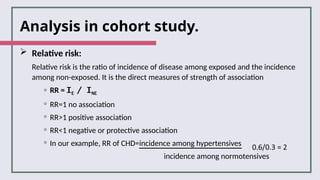
 Relative risk:
Relative risk is the ratio of incidence of disease among exposed and the incidence
among non-exposed. It is the direct measures of strength of association
◦ RR = IE / INE
◦ RR=1 no association
◦ RR>1 positive association
◦ RR<1 negative or protective association
◦ In our example, RR of CHD=incidence among hypertensives
incidence among normotensives
Analysis in cohort study.
Attributable risk:
• Attributable risk is the difference in the incidence rates of disease between
exposed and non exposed group. Indicates to what extend the disease under
study can be attributed to the exposure.
• Expressed as percentage.
• AR = IE- INE / IE
• Indicates to what extend the disease under study can be attributed to the
exposure.
Analysis in cohort study.
Attributable risk:
• In our hypothetical example,0.6-0.3/0.6 * 100= 50%
• 50% of the CHD among hypertensives was due to hypertension.
CHD No CHD
Hypertensive 60 40
100
Total
exposed
Normotensive 30 70
100
Total non-
exposed
Analysis in cohort study.
Population attributable risk:
• Incidence of disease in total population minus incidence of disease among
non-exposed.
• ITP - INE / ITP
• Indicates amount by which the disease could be reduced if the suspected
factor was eliminated .
Q. A study is conducted to evaluate the relationship between cholesterol levels
and the occurrence of myocardial infraction in women. Study 500 women with
high serum cholesterols and 500 women with normal serum cholesterol were
followed up 10 years.During the study 40 women with high serum cholesterol
levels and 15 women with normal serum cholesterol levels develops newly
diagnosed myocardial infection.
 IE = 40/500=80 PER 1000
 INE = 15/500=30 PER 1000
 RR = 80/30 = 2.66
 AR = (80-30/80)= 62.5%
 ITP= 55/1000=55 PER 1000
 PAR= (55-30/55)*100=45.45%
MI NO MI
High
cholesterol
40 450 500
Normal
cholesterol
15 485 500
STRENGTHS OF COHORT STUDY
o Incidence can be calculated
o Investigate multiple outcome simultaneously
o Temporal relationship between exposure and disease can be explored
o Direct estimate of relative risk
o Cohort studies are used to investigate late or chronic effects of acute events.
LIMITATIONS OF COHORT STUDY
 Unsuitable for investigating a rare diseases.
 Require long periods of follow-up and hence costly
 Loss of staff, loss of funding
 Extensive record keeping
 Changes in diagnostic criteria over time
 Study itself might alter peoples behaviour: Hawthorn bias
 Ethical issues
Case-control Studies Within A Defined
Cohort
o advantage of both case-control and cohort study designs
o combining some elements of both into a single study
o hybrid design in which a case-control study is initiated within a cohort study.
o a population is identified and followed over time and outcomes are assessed.
o A case-control study is then carried out.
o Cases- developed the disease and controls- who did not develop the disease.
Case-control Studies Within A Defined
Cohort
o Classified into two types
o Based on how controls are selected
 NESTED CASE-CONTROL STUDIES
 CASE-COHORT STUDIES
NESTED CASE CONTROL STUDIES
o The controls are a sample of individuals who are at risk for the disease at the time
each case of the disease develops.
o As each case or cases develop, the same number of matched controls is selected.
o Control is selected each time a case develops, a control who is selected early in the
study could later develop the disease and become a case in the same study.
NESTED CASE CONTROL STUDIES
Helicobacter pylori infection and the risk of gastric carcinoma
o Whether H. pylori infection increases the risk of gastric carcinoma.
o Original cohort:1,28,992 people whose serum samples were stored as a
part of Kaiser Permanente medical program.(sample collected between
1964-1969)
o This cohort was followed up through instances of hospitalization and
tumour registry reports. Cancer outcomes were recorded.
o Followed up till 1989.
o 246 patients were given diagnosis of gastric carcinoma.
o 200 cases were randomly selected. Each case was matched according to
age,sex,race,date of serum donation.
Helicobacter pylori infection and the risk of gastric carcinoma
o Of the 200 eligible pairs, 186 had banked serum samples of both cases and controls.
o They were included in the analysis.
o Serum samples were tested by ELISA for H.Pylori IgG.
o All the biopsy reports and tissue specimen of cases were reviewed for
histopathological analysis.
o Analysis was done.
o H.pylori infection was a risk factor for the development of adenocarcinoma of
stomach.
CASE COHORT STUDIES
• The control group is selected from all cohort participants at baseline.
• This means that controls are selected randomly.
CASE COHORT STUDIES
REFERENCES
1.Setia M. Methodology Series Module 1: Cohort Studies. Indian J Dermatol. 2016 Jan
1;61:21.
2.Merrill RM. Introduction to Epidemiology. Jones & Bartlett Publishers; 2015. 359 p.
3.Bonita R, Beaglehole R, Kjellström T. Basic epidemiology. 2nd ed. Geneva: World health
Organisation; 2014. 212 p.
4.Celentano DD, Szklo M. Gordis epidemiology. 6th ed. New Delhi: RELIX india pvt ltd,
Elsevier; 2020. 420 p.
5.Park K. Park’s textbook pf preventive and social medicine. 26th ed. Jabalpur: M/s
Banarsidas Bhanot publishers; 2021.
6.Bhalwar R. Cohort studies. In: Textbook of community medicine. 3rd ed. New Delhi: Wolters
Kluwer Pvt Ltd; 2019. p. 172–7.
REFERENCES
7.Susser E, Hoek HW, Brown A. Neurodevelopmental Disorders after Prenatal Famine: The
Story of the Dutch Famine Study. Am J Epidemiol. 1998 Feb 1;147(3):213–6.
8.Hardy JB. The Collaborative Perinatal Project: Lessons and Legacy. Ann Epidemiol. 2003 May
1;13(5):303–11.
9.Baptiste-Roberts K, Nicholson WK, Wang NY, Brancati FL. Gestational Diabetes and
Subsequent Growth Patterns of Offspring: The National Collaborative Perinatal Project.
Matern Child Health J. 2012 Jan 1;16(1):125–32.
10.Kannel WB. Some lessons in cardiovascular epidemiology from Framingham. Am J Cardiol.
1976 Feb;37(2):269–82.
11.The Framingham Heart Study and the Epidemiology of Cardiovascular Diseases: A
Historical Perspective - PMC [Internet]. [cited 2022 Dec 20]. Available from:
https://www.ncbi.nlm.nih.gov/pmc/articles/PMC4159698/
REFERENCES
12.Kannel WB, Dawber TR, Kagan A, Revotskie N, Stokes J. Factors of Risk in the Development
of Coronary Heart Disease—Six-Year Follow-up Experience. Ann Intern Med. 1961 Jul;55(1):33–
50.
13.II. Coronary Heart Disease in the Framingham Study | AJPH | Vol. 47 Issue 4_Pt_2
[Internet]. [cited 2022 Dec 26]. Available from:
https://ajph.aphapublications.org/doi/abs/10.2105/AJPH.47.4_Pt_2.4
14.Framingham at 70: Celebrating a Landmark Heart Study | NIH Intramural Research Program
[Internet]. [cited 2022 Dec 28]. Available from:
https://irp.nih.gov/blog/post/2018/02/framingham-at-70-celebrating-a-landmark-heart-study
15.Johnson JC, Thaul S, Page WF, Crawford H, Institute of Medicine (US) Committee on the
CROSSROADS Nuclear Test. Mortality of Veteran Participants in the Crossroads Nuclear Test
[Internet]. Washington (DC): National Academies Press (US); 1996 [cited 2022 Dec 28].
Available from: http://www.ncbi.nlm.nih.gov/books/NBK233200/
REFERENCES
16.Court-Brown WM, Doll R. Leukaemia and aplastic anaemia in patients irradiated for
ankylosing spondylitis. J Radiol Prot. 2007 Dec;27(4B):B15.
17.Helicobacter pylori Infection and the Risk of Gastric Carcinoma | NEJM [Internet]. [cited
2022 Dec 28]. Available from:
https://www.nejm.org/doi/full/10.1056/NEJM199110173251603
THANKYOU
epidemiological study design: cohort study design

epidemiological study design: cohort study design

  • 1.
    COHORT STUDY Dr Stefim s,1st year pg., Dept of community medicine Mentor : Dr Suchita, Associate professor Dept of community medicine ESICMC,Hyderabad.
  • 2.
    LEARNING OBJECTIVES o Understandconcepts of cohort study. o Understand the elements of cohort study. o Learn about types of cohort study. o Identify the potential biases and ways to overcome these. o Learn advantages and limitations of cohort studies. o Special types of studies
  • 3.
  • 4.
  • 5.
  • 6.
     The term"cohort" is derived from the Latin word " Cohors" - "a group of soldiers.  The term “cohort” in modern epidemiology refers to “a group of people with defined characteristics” CONCEPT OF COHORT
  • 7.
    WHAT IS ACOHORT STUDY o In a cohort study, the investigator selects a group of exposed individuals and a group of unexposed individuals and follows both groups over time to compare the incidence of disease in the two groups
  • 8.
    FEATURES OF COHORTSTUDY  Cohort study is an observational analytical study.  No experimental manipulation involved.  Study groups are observed over a period of time to determine the outcome.  Comparison between exposed and non exposed group is the hallmark of the cohort design.  Best information about causation of disease.  Most direct measurement of the risk of developing the disease.
  • 9.
    INDICATIONS OF COHORTSTUDY  Disease a reasonably common  Has some amount of evidence regarding the association between exposure and outcome.  When the subjects are reasonably likely to continue in the study(decreased attrition)  When ample funds are available.  Cohort studies are generally easier to conduct when the interval between the exposure and the development of disease is short.
  • 10.
    ELEMENTS OF COHORTSTUDY 1. Selection of study subjects 2. Obtaining data on exposure 3. Selection of comparison groups 4. Follow-up 5. Analysis
  • 11.
    SELECTION OF STUDYSUBJECTS Start the study with: 1. Exposed and non exposed groups 2. We can select a defined population before any of its members become exposed or before their exposures are identified.
  • 12.
    GRAPHICAL REPRESENTATION Defined population Exposed Disease Nodisease Not exposed Disease No disease Exposed Disease No disease Not Exposed Disease No disease
  • 13.
    Starting with exposedand unexposed group Example: o “Neurodevelopmental Disorders after Prenatal Famine: The Story of the Dutch Famine Study.” • The study started with cohort of people who were exposed and not exposed to perinatal famine. o A cohort study that begins with an exposed and an unexposed group focuses often on only one specific exposure.
  • 14.
    Starting with exposedand unexposed group
  • 15.
    Starting with adefined population o We can select a defined population before any of its members become exposed. o Based on some characteristic unrelated to the exposure in question. o Using histories or tests, population is separated into exposed and unexposed groups. o length of follow-up required is greater. o a cohort study that begins with a defined population can explore the roles of many exposures to the study outcome(s)
  • 16.
    Starting with adefined population Example: o The Collaborative Perinatal Project, also known as the National Collaborative Perinatal Project (or NCPP) o Identify the effects of complications during either pregnancy or the perinatal period on birth and child outcomes, especially neurological disorders such as cerebral palsy.
  • 17.
    Starting with adefined population o 55,000 pregnant mothers were enrolled from across the United States from 1959 to 1965 .The offspring were followed until age 7. o Gestational Diabetes and Subsequent Growth Patterns of Offspring: The National Collaborative Perinatal Project. o Prospective analysis of 28,358 mother-infant pairs who enrolled in the NCPP. o The offspring of mothers with GDM were larger at age 7 compared to the offspring of mothers without GDM at that age
  • 18.
    SELECTION OF STUDYSUBJECTS o Points to consider while selecting cohorts The cohorts must be free from the disease under study Both the groups should be equally susceptible to the disease under study Both the groups should be comparable in respect to all the possible variables that may influence the outcome The diagnostic and eligibility criteria should be defined before the start of study.
  • 19.
    OBTAINING DATA ONEXPOSURE Data on exposure can be collected from: a) Cohort members: personal interviews/mailed questionnaires b) Review of records: treatment details, type of surgery. c) Medical examination: physical examination, special tests d) Environmental surveys: to collect data on environmental exposures. e) Also collect data on demographic variables, which might affect the frequency of disease under investigation.
  • 20.
    SELECTION OF COMPARISONGROUPS o Internal comparison: While starting the study with defined population, the population itself provides the comparison group. i.e., the unexposed. o External comparison group: When internal comparison group not available. • E.g. smokers and non smokers, Dutch famine study. o Comparisons with general population rates: sometimes it is required to compare the exposure rates with that of the general population. • E.g. Comparison of frequency of cancer among asbestos workers with the rate in general population in the same geographic area.
  • 21.
    FOLLOW-UP Method of followup should be decided at the start of study according to the expected outcome. Procedures for follow-up are: o Periodic medical examination o Review of medical records o Routine surveillance of death records o Mailed questionnaires, telephone calls, periodic home visits.
  • 22.
    TYPES OF COHORTSTUDY Prospective cohort study Retrospective cohort study Combination of both
  • 23.
    PROSPECTIVE COHORT STUDY oConcurrent cohort or longitudinal study o Exposure and non exposure are ascertained as they occur during the study. o The groups are then followed for several years into the future and incidence is measured. o Hypothetical example: study of the relationship of smoking to lung cancer.
  • 24.
    PROSPECTIVE COHORT STUDY Definedpopulation Exposed Disease No disease Not exposed Disease No disease 2032(future) 2022(present) 2052(future)
  • 25.
    FRAMINGHAM HEART STUDY oStarted in 1948, a sample of 5209 men and women aged 30 to 62 years were studied. o Followed up biennially for the development of cardiovascular disease. o National Heart, Lung, and Blood Institute, USA.
  • 26.
    FRAMINGHAM HEART STUDY oWhy Framingham? o Had fairly stable population(migration low) o Enthusiastic response of area physicians. o Geographical proximity to the many cardiologists at Harvard Medical School. o One major hospital was used by most of the residents of the city.
  • 27.
    FRAMINGHAM HEART STUDY oPopulations of Framingham study
  • 28.
    FRAMINGHAM HEART STUDY oThe first major study findings were published in 1957, o “Coronary Heart Disease in the Framingham Study” o Nearly 4 fold increase in coronary heart disease incidence per 1000 persons among hypertensive participants
  • 29.
    FRAMINGHAM HEART STUDY oThe term “risk factor” was popularized in the medical world by Thomas Dawber and William Kannel by their 1961 publication, “Factors of Risk in the Development of Coronary Heart Disease.” o Higher mean cholesterol levels, high blood pressure was found to be risk factors for development of CHD. o High incidence among young men.
  • 30.
    FRAMINGHAM HEART STUDY oOver 3,500 scientific papers have been published related to the Framingham Heart Study. o It is generally accepted that the work is outstanding in its scope and duration, and overall is considered very useful.
  • 31.
    RETROSPECTIVE COHORT STUDY oHistorical cohort study or nonconcurrent prospective study. o Exposure is ascertained from past records and the outcome (development or no development of disease) is determined. o Outcomes have all occurred before the start of investigation. o The study design same as that of the prospective cohort design—we are still comparing exposed and unexposed groups. o Only difference between prospective and retrospective is calendar time. o Hypothetical example: study of the relationship of smoking to lung cancer.
  • 32.
    RETROSPECTIVE COHORT STUDY Definedpopulation Exposed Disease No disease Not exposed Disease No disease 2002 2022(present) 1992(past)
  • 33.
    RETROSPECTIVE COHORT STUDY oEffect of nuclear test on mortality. o Study started in 1992. o Exposed group was the participants in the crossroads nuclear test in 1946. o Rosters of crossroads participants were obtained from federal register. o These participants were followed through time to assess: • all-cause mortality, all-cancer mortality, leukemia mortality. o Compared to a group of non participants of operation crossroads. o Results: statistically significant higher mortality among exposed group. Mortality of Veteran Participants in the Crossroads Nuclear Test.
  • 34.
  • 35.
    COMBINATION OF BOTHCOHORT STUDIES o Cohort is identified from past records. (as in a historical cohort study) o Same cohort is followed up prospectively into the future for outcome(as in prospective cohort study).
  • 36.
    COMBINATION OF BOTHCOHORT STUDIES Leukaemia and aplastic anaemia in patients irradiated for ankylosing spondylitis o Study started in 1955. o Exposed group: All patients who underwent treatment with ionising radiations for ankylosing spondylitis during 1935 to 1954 o Data on exposure was collected from 8 radiotherapy centres in Britain. o Compared with mortality data of general population (expected number of deaths derived from Registrars-general) o Exposure groups followed up till 1960. o Mortality rate from all causes combined was 80% higher than that of the generalpopulation
  • 37.
    COMBINATION OF BOTHCOHORT STUDIES 1955(start of study) Followed up till 1960 1935-1954 Exposure group identified from old records Study starts. Some outcome have already occurred. Exposure group followed up. End of study.
  • 39.
    POTENTIAL BIASES INCOHORT STUDIES o Two major categories are commonly used to classify biases in cohort studies:  selection bias Measurement bias.
  • 40.
    SELECTION BIASES o Systematicdifference between the characteristics of the people selected for study and those who are not. Nonparticipation and nonresponse: • When there is an invitation to participate in a study to evaluate the effects of smoking, heavy smokers may not join and this might affect the association • Sexually active women are more likely to seek medical attention than those who are not, cervical cancer is likely to be more frequently diagnosed in this group. Hence, the measured association between being sexually active and cervical cancer will be overestimated .
  • 41.
    SELECTION BIASES ‘Loss tofollow up’ bias: • Some subjects in any case are likely to be lost to follow up / drop out. It is generally accepted that if more than 30% of the study subjects are lost to follow up, then the results of the study are to be viewed sceptically • This bias can be reduced by  Making periodic contacts with participants,  Giving incentives.  Taking detailed addresses of the subjects as also of their friends and relatives; contact them and make best of efforts to trace those who have been lost to follow up.  In case of migration, try to get information through a mailed questionnaire.
  • 42.
     Healthy workereffect: o In occupational epidemiology, when workers represent exposed group and non-workers represent unexposed group. In order to work some amount of health is required. For e.g., if we are studying the effect of formaldehyde exposure, those who suffer most are most likely to leave their job. This bias can be minimized by proper follow-up. o Also , sometimes workers tend to be healthier than general population. Their jobs are physically demanding, requiring a relatively high level of physical health. These workers may be in better health than an age/gender/ethnic matched comparison group from same community. To avoid this kind of bias, a better comparison group should be taken.e.g.. workers at another manufacturing plant who are not exposed to exposure under study.
  • 43.
    MEASUREMENT BIAS  Ifthe quality and extent of information obtained is different for exposed persons than for the unexposed persons  Can be minimised by ensuring that both the groups are examined by observers who have similar type of training and using similar type of instruments and techniques
  • 44.
    MEASUREMENT BIASES o Crossover bias:  those having the exposure (e.g. smokers) may cross over to the non exposed group (i.e. become non smokers) and vice versa.  Periodic evaluation of both the groups as regards level of exposure, making record entries and subsequent adjustments in the data analysis can help overcoming this problem
  • 45.
    MEASUREMENT BIASES o Observerbias  investigator is aware about which subject is ‘exposed’ and who is not exposed.  can be reduced by ‘blinding’ o epidemiologists and statisticians who are analysing the data have strong preconceptions, they may unintentionally introduce their biases into their data analyses. Can be reduced by triple blinding.
  • 46.
    CONFOUNDING FACTOR  Onewhich is associated with both exposure and outcome and is distributed unequally in study and control groups. Although associated with exposure under study itself, independently is a risk factor for the disease/outcome.  Hypothetical example: effect of birth order on occurrence of Downs syndrome. Maternal age Downs syndrome Birth order
  • 47.
    ANALYSIS IN COHORTSTUDY. o Can be done with the help of a two by two table. Diseased No Disease Exposed a exposed cases b eexposed non- cases a + b Total exposed Non Exposed c non-exposed cases d non-exposed non- cases c + d Total non-exposed a + c total cases b + d Total non-cases
  • 48.
    Analysis in cohortstudy. • Hypothetical example: • Effect of hypertension on coronary heart disease CHD No CHD Hypertensive 60 40 100 Total exposed Normotensive 30 70 100 Total non-exposed 90 total cases 110 Total non-cases
  • 49.
    Analysis in cohortstudy. ◦ Incidence rates among exposed and non exposed ◦ Estimation of risk Relative risk Attributable risk Population attributable risk
  • 50.
    Analysis in cohortstudy. ◦ Incidence rates among exposed and non exposed  If it’s found that the incidence of the disease in the exposed group is significantly higher than in the non-exposed group, it would suggest that the disease and suspected cause, are associated.  Incidence among exposed: a/a+b (60/100=0.6)  Incidence among unexposed: c/c+d(30/100=0.3) CHD No CHD Hypertensiv e 60 40 100 Total exposed Normotensi ve 30 70 100 Total non- exposed
  • 51.
    Analysis in cohortstudy.  Relative risk: Relative risk is the ratio of incidence of disease among exposed and the incidence among non-exposed. It is the direct measures of strength of association ◦ RR = IE / INE ◦ RR=1 no association ◦ RR>1 positive association ◦ RR<1 negative or protective association ◦ In our example, RR of CHD=incidence among hypertensives incidence among normotensives
  • 52.
    Analysis in cohortstudy. Attributable risk: • Attributable risk is the difference in the incidence rates of disease between exposed and non exposed group. Indicates to what extend the disease under study can be attributed to the exposure. • Expressed as percentage. • AR = IE- INE / IE • Indicates to what extend the disease under study can be attributed to the exposure.
  • 53.
    Analysis in cohortstudy. Attributable risk: • In our hypothetical example,0.6-0.3/0.6 * 100= 50% • 50% of the CHD among hypertensives was due to hypertension. CHD No CHD Hypertensive 60 40 100 Total exposed Normotensive 30 70 100 Total non- exposed
  • 54.
    Analysis in cohortstudy. Population attributable risk: • Incidence of disease in total population minus incidence of disease among non-exposed. • ITP - INE / ITP • Indicates amount by which the disease could be reduced if the suspected factor was eliminated .
  • 55.
    Q. A studyis conducted to evaluate the relationship between cholesterol levels and the occurrence of myocardial infraction in women. Study 500 women with high serum cholesterols and 500 women with normal serum cholesterol were followed up 10 years.During the study 40 women with high serum cholesterol levels and 15 women with normal serum cholesterol levels develops newly diagnosed myocardial infection.  IE = 40/500=80 PER 1000  INE = 15/500=30 PER 1000  RR = 80/30 = 2.66  AR = (80-30/80)= 62.5%  ITP= 55/1000=55 PER 1000  PAR= (55-30/55)*100=45.45% MI NO MI High cholesterol 40 450 500 Normal cholesterol 15 485 500
  • 56.
    STRENGTHS OF COHORTSTUDY o Incidence can be calculated o Investigate multiple outcome simultaneously o Temporal relationship between exposure and disease can be explored o Direct estimate of relative risk o Cohort studies are used to investigate late or chronic effects of acute events.
  • 57.
    LIMITATIONS OF COHORTSTUDY  Unsuitable for investigating a rare diseases.  Require long periods of follow-up and hence costly  Loss of staff, loss of funding  Extensive record keeping  Changes in diagnostic criteria over time  Study itself might alter peoples behaviour: Hawthorn bias  Ethical issues
  • 58.
    Case-control Studies WithinA Defined Cohort o advantage of both case-control and cohort study designs o combining some elements of both into a single study o hybrid design in which a case-control study is initiated within a cohort study. o a population is identified and followed over time and outcomes are assessed. o A case-control study is then carried out. o Cases- developed the disease and controls- who did not develop the disease.
  • 59.
    Case-control Studies WithinA Defined Cohort o Classified into two types o Based on how controls are selected  NESTED CASE-CONTROL STUDIES  CASE-COHORT STUDIES
  • 60.
    NESTED CASE CONTROLSTUDIES o The controls are a sample of individuals who are at risk for the disease at the time each case of the disease develops. o As each case or cases develop, the same number of matched controls is selected. o Control is selected each time a case develops, a control who is selected early in the study could later develop the disease and become a case in the same study.
  • 61.
  • 62.
  • 63.
  • 65.
    Helicobacter pylori infectionand the risk of gastric carcinoma o Whether H. pylori infection increases the risk of gastric carcinoma. o Original cohort:1,28,992 people whose serum samples were stored as a part of Kaiser Permanente medical program.(sample collected between 1964-1969) o This cohort was followed up through instances of hospitalization and tumour registry reports. Cancer outcomes were recorded. o Followed up till 1989. o 246 patients were given diagnosis of gastric carcinoma. o 200 cases were randomly selected. Each case was matched according to age,sex,race,date of serum donation.
  • 66.
    Helicobacter pylori infectionand the risk of gastric carcinoma o Of the 200 eligible pairs, 186 had banked serum samples of both cases and controls. o They were included in the analysis. o Serum samples were tested by ELISA for H.Pylori IgG. o All the biopsy reports and tissue specimen of cases were reviewed for histopathological analysis. o Analysis was done. o H.pylori infection was a risk factor for the development of adenocarcinoma of stomach.
  • 68.
    CASE COHORT STUDIES •The control group is selected from all cohort participants at baseline. • This means that controls are selected randomly.
  • 69.
  • 70.
    REFERENCES 1.Setia M. MethodologySeries Module 1: Cohort Studies. Indian J Dermatol. 2016 Jan 1;61:21. 2.Merrill RM. Introduction to Epidemiology. Jones & Bartlett Publishers; 2015. 359 p. 3.Bonita R, Beaglehole R, Kjellström T. Basic epidemiology. 2nd ed. Geneva: World health Organisation; 2014. 212 p. 4.Celentano DD, Szklo M. Gordis epidemiology. 6th ed. New Delhi: RELIX india pvt ltd, Elsevier; 2020. 420 p. 5.Park K. Park’s textbook pf preventive and social medicine. 26th ed. Jabalpur: M/s Banarsidas Bhanot publishers; 2021. 6.Bhalwar R. Cohort studies. In: Textbook of community medicine. 3rd ed. New Delhi: Wolters Kluwer Pvt Ltd; 2019. p. 172–7.
  • 71.
    REFERENCES 7.Susser E, HoekHW, Brown A. Neurodevelopmental Disorders after Prenatal Famine: The Story of the Dutch Famine Study. Am J Epidemiol. 1998 Feb 1;147(3):213–6. 8.Hardy JB. The Collaborative Perinatal Project: Lessons and Legacy. Ann Epidemiol. 2003 May 1;13(5):303–11. 9.Baptiste-Roberts K, Nicholson WK, Wang NY, Brancati FL. Gestational Diabetes and Subsequent Growth Patterns of Offspring: The National Collaborative Perinatal Project. Matern Child Health J. 2012 Jan 1;16(1):125–32. 10.Kannel WB. Some lessons in cardiovascular epidemiology from Framingham. Am J Cardiol. 1976 Feb;37(2):269–82. 11.The Framingham Heart Study and the Epidemiology of Cardiovascular Diseases: A Historical Perspective - PMC [Internet]. [cited 2022 Dec 20]. Available from: https://www.ncbi.nlm.nih.gov/pmc/articles/PMC4159698/
  • 72.
    REFERENCES 12.Kannel WB, DawberTR, Kagan A, Revotskie N, Stokes J. Factors of Risk in the Development of Coronary Heart Disease—Six-Year Follow-up Experience. Ann Intern Med. 1961 Jul;55(1):33– 50. 13.II. Coronary Heart Disease in the Framingham Study | AJPH | Vol. 47 Issue 4_Pt_2 [Internet]. [cited 2022 Dec 26]. Available from: https://ajph.aphapublications.org/doi/abs/10.2105/AJPH.47.4_Pt_2.4 14.Framingham at 70: Celebrating a Landmark Heart Study | NIH Intramural Research Program [Internet]. [cited 2022 Dec 28]. Available from: https://irp.nih.gov/blog/post/2018/02/framingham-at-70-celebrating-a-landmark-heart-study 15.Johnson JC, Thaul S, Page WF, Crawford H, Institute of Medicine (US) Committee on the CROSSROADS Nuclear Test. Mortality of Veteran Participants in the Crossroads Nuclear Test [Internet]. Washington (DC): National Academies Press (US); 1996 [cited 2022 Dec 28]. Available from: http://www.ncbi.nlm.nih.gov/books/NBK233200/
  • 73.
    REFERENCES 16.Court-Brown WM, DollR. Leukaemia and aplastic anaemia in patients irradiated for ankylosing spondylitis. J Radiol Prot. 2007 Dec;27(4B):B15. 17.Helicobacter pylori Infection and the Risk of Gastric Carcinoma | NEJM [Internet]. [cited 2022 Dec 28]. Available from: https://www.nejm.org/doi/full/10.1056/NEJM199110173251603
  • 74.

Editor's Notes

  • #8 No experimental manipulation: we investigate exposures among study participants and observe their outcome.
  • #9 Some idea of which exposure leads to which outcome..evidence obtained from clinical observations/case control studies. So that we can conveniently complete the study within the time frame.
  • #11 We can start the study with either of following ways:
  • #15 Characteristics like: common residents of an area. Exposure itself might take long time to occur, even for many years after the population has been defined.
  • #20 Gestational Diabetes and Subsequent Growth Patterns of Offspring: The National Collaborative Perinatal Project: the study population itself provided the comparison External comparison group: while starting the disease with an exposed group.to evaluate the experience of the exposed group we need an external comparison group. The study and comparison groups should be similar in demographic and other important variables other than exposure under study.
  • #23 concurrent because the investigator identifies the original population at the beginning of the study and, in effect, follows the subjects concurrently through calendar time until the point at which the disease develops or does not develop.
  • #24  Presently at 2022, We identify a population of students of 2nd std and follow them;10 years later in 2032, when they are in high school, we identify those who smoke and those who do not. Exposure status (smoker or non-smoker) will be ascertained in 2032. For purposes of this example, let us assume that the average period from beginning of smoking to development of lung disease is 20 years. Therefore development of lung cancer will be ascertained 20 years later, in 2052.
  • #25  People less than 30yrs were less likely to develop cardiovascular disease during the proposed 20-year follow-up. People more than 62years of age would have already developed cardiovascular disease
  • #31 Historical :use historical data so that we can reduce the frame of calendar time for the study and obtain our results sooner
  • #32 we again begin our study in 2022, at present. but now we find that an old roster of 2nd std school children from 1992 is available in our community and that they had been surveyed in college regarding their smoking habits in 2002(after 10 years). Using these data in 2022, we can begin to determine who in this population developed lung cancer and who has not.
  • #33 Comparison group: assembled to be similar to the participants in all ways (age, paygrade, military service, time of service, location of service)
  • #36 the mortality rate from all causes combined was about 80% higher than that of the general population
  • #41 Incentives like free medical checkup/ advice/ medicines.
  • #46 Basic epidemiology 2nd edition
  • #51 Higher the relative risk higher is the strength of association.RR=3 indicates that the incidence rate of disease is two times higher in the exposed group than with the unexposed. RR=0.25 indicates a 75% reduced incidence rates among the exposed individuals as compared to the unexposed. POSITIVE association between hypertension and CHD. Incidence of chd is 2 times more among hypertensives.
  • #53 AR = IE- INE / IE
  • #55 INTERPRETATION: I exp a/a+b, inc non exp c/c+d ..relative risk is inc exp/inc non exp. ..2.66 implies that there is positive association between high cholerstrol and mi and the risk of mi is two times in high cholesterol women than in normal cholesterol levels. Ar= incidence among exp-non exp/inc exposed. 62.5% of the mi among exposure group can be attributed to high cholesterol levels par= ITP - INE / ITP= 45.45% indicates that 45.45% of MI coud have been reduced if the cholesterol levels are controlled.
  • #56 Temporal relationship: certain that the exposure preceeds the disease.
  • #57 Ethical issues when evidence accumulates about the etilogical factor we are obliged to interviene.
  • #65 Infection with H. pylori is associated with an increased risk of gastric carcinoma
  • #66 Infection with H. pylori is associated with an increased risk of gastric carcinoma
  • #67 Infection with H. pylori is associated with an increased risk of gastric carcinoma
  • #68 When an exposure X results in outcomes a,b,c, in nested case control study we have to take matched controls for each case.but in case cohort study we use a random subsample of the cohort to compare all the cases to.
  • #69 When an exposure X results in outcomes a,b,c, in nested case control study we have to take matched controls for each case.but in case cohort study we use a random subsample of the cohort to compare all the cases to. Advantages : no recall bias as in case control study, not as expensive as cohort.