Parents evening

Take this time to prepare for the Age
 and EWT 12 marker in a moment.
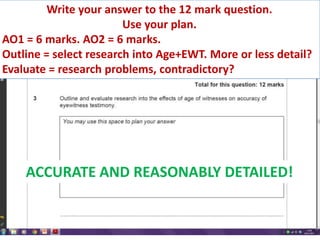
Write your answer to the 12 mark question.
                        Use your plan.
AO1 = 6 marks. AO2 = 6 marks.
Outline = select research into Age+EWT. More or less detail?
Evaluate = research problems, contradictory?


    ACCURATE AND REASONABLY DETAILED!
L/Os:
                                1. To be able to describe the
    The                            four techniques used in
                                   cognitive interviews.
 Cognitive                      2. To be able to explain how
                                   the cognitive interview
 Interview                         differs from a standard
                                   interview.

A method developed to improve the amount of accurate recall
from witnesses.

Waddington and Bull (2007): the cognitive interview encourages
accurate and thorough recall of specific events.

Starter: Using what you know about cognitions and memory,
               any ideas how this might work?
L/Os:
To be able to describe the four techniques used in cognitive
interviews.

The cognitive interview is based on two principles
of memory:

Organisation of memory – can be accessed via
many routes.

Context of memory – cues present at the time of
storage aid retrieval.
L/Os:
To be able to describe the four techniques used in cognitive
interviews.


 • No standardised questions.
 • No time-limit.
 • Interviewer remains silent.
 • Interviewer can take notes.
 • Clarification and elaboration is only asked for
   after recall is complete.
 • Only open-ended and non-leading questions.
You need a piece of paper and a pen.

Choose someone in the room that you
           know well.

Look down at your paper and describe
their face in as much detail as you can,
                in words.

Try drawing their face, without looking.
L/Os:
To be able to describe the four techniques used in cognitive
interviews.

 You are going to work in pairs/threes.
 You will be given one of the four techniques for
 cognitive interview.
 You should read about it, get your head around
 it then find a way of presenting it to the class.

 - A short role play would be fabulous
   (interviewer and interviewee).
L/Os:
To be able to describe the four techniques used in cognitive
interviews.

Four techniques:
1. Reinstate the context
Principle: return the interviewee to the situation /
context to aid memory retrieval.

How?
- Recreating the original mood.
- Ask interviewee to think back to where they were,
  what they were doing.
L/Os:
To be able to describe the four techniques used in cognitive
interviews.

Four techniques:
2. Change sequence
Principle: to encourage not skipping details in
retrieval.

How?
- Asked to recall events in any order (not
  chronological).
- Begin at any point.
- Asked to repeat the account, reversing the order of
  events.
L/Os:
To be able to describe the four techniques used in cognitive
interviews.

 Four techniques:
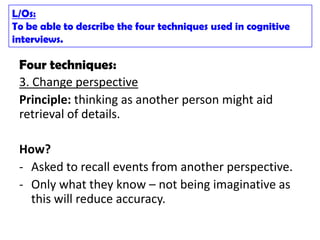
 3. Change perspective
 Principle: thinking as another person might aid
 retrieval of details.

 How?
 - Asked to recall events from another perspective.
 - Only what they know – not being imaginative as
   this will reduce accuracy.
L/Os:
To be able to describe the four techniques used in cognitive
interviews.

Four techniques:
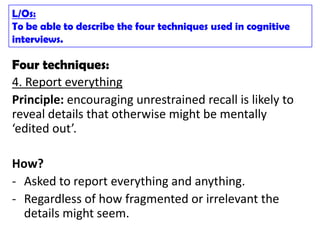
4. Report everything
Principle: encouraging unrestrained recall is likely to
reveal details that otherwise might be mentally
‘edited out’.

How?
- Asked to report everything and anything.
- Regardless of how fragmented or irrelevant the
  details might seem.
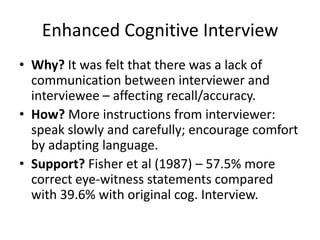
Enhanced Cognitive Interview
• Why? It was felt that there was a lack of
  communication between interviewer and
  interviewee – affecting recall/accuracy.
• How? More instructions from interviewer:
  speak slowly and carefully; encourage comfort
  by adapting language.
• Support? Fisher et al (1987) – 57.5% more
  correct eye-witness statements compared
  with 39.6% with original cog. Interview.
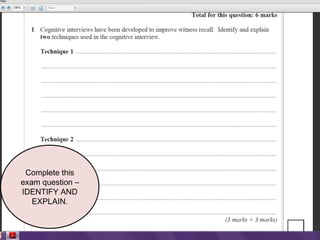
Complete this
exam question –
IDENTIFY AND
   EXPLAIN.
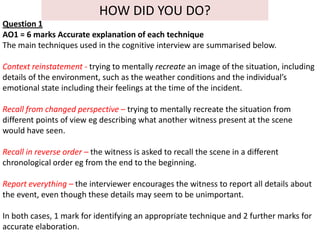
HOW DID YOU DO?
Question 1
AO1 = 6 marks Accurate explanation of each technique
The main techniques used in the cognitive interview are summarised below.

Context reinstatement - trying to mentally recreate an image of the situation, including
details of the environment, such as the weather conditions and the individual’s
emotional state including their feelings at the time of the incident.

Recall from changed perspective – trying to mentally recreate the situation from
different points of view eg describing what another witness present at the scene
would have seen.

Recall in reverse order – the witness is asked to recall the scene in a different
chronological order eg from the end to the beginning.

Report everything – the interviewer encourages the witness to report all details about
the event, even though these details may seem to be unimportant.

In both cases, 1 mark for identifying an appropriate technique and 2 further marks for
accurate elaboration.
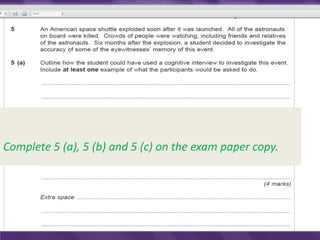
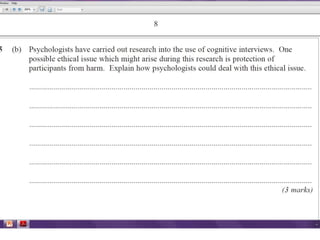
Complete 5 (a), 5 (b) and 5 (c) on the exam paper copy.
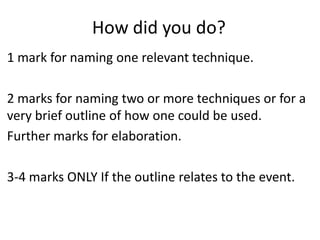
How did you do?
1 mark for naming one relevant technique.

2 marks for naming two or more techniques or for a
very brief outline of how one could be used.
Further marks for elaboration.

3-4 marks ONLY If the outline relates to the event.
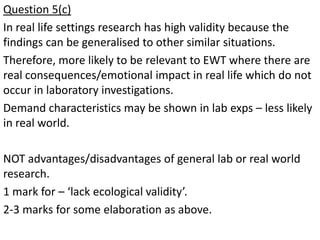
Question 5(c)
In real life settings research has high validity because the
findings can be generalised to other similar situations.
Therefore, more likely to be relevant to EWT where there are
real consequences/emotional impact in real life which do not
occur in laboratory investigations.
Demand characteristics may be shown in lab exps – less likely
in real world.

NOT advantages/disadvantages of general lab or real world
research.
1 mark for – ‘lack ecological validity’.
2-3 marks for some elaboration as above.
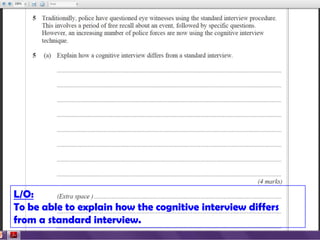
L/O:
To be able to explain how the cognitive interview differs
from a standard interview.
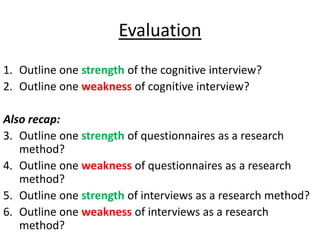
Evaluation
1. Outline one strength of the cognitive interview?
2. Outline one weakness of cognitive interview?

Also recap:
3. Outline one strength of questionnaires as a research
   method?
4. Outline one weakness of questionnaires as a research
   method?
5. Outline one strength of interviews as a research method?
6. Outline one weakness of interviews as a research
   method?
Self - Study
1. Remind yourself of the MEAN, MEDIAN and
MODE (pages 46-47 textbook).

2. Use the self-study guide to recap and fill in any
gaps in your notes about the Cognitive Interview
(pg.50 + Apply Your Knowledge qu).


Due Monday 3rd December.

Ewt the cognitive interview

  • 1.
    Parents evening Take thistime to prepare for the Age and EWT 12 marker in a moment.
  • 2.
    Write your answerto the 12 mark question. Use your plan. AO1 = 6 marks. AO2 = 6 marks. Outline = select research into Age+EWT. More or less detail? Evaluate = research problems, contradictory? ACCURATE AND REASONABLY DETAILED!
  • 3.
    L/Os: 1. To be able to describe the The four techniques used in cognitive interviews. Cognitive 2. To be able to explain how the cognitive interview Interview differs from a standard interview. A method developed to improve the amount of accurate recall from witnesses. Waddington and Bull (2007): the cognitive interview encourages accurate and thorough recall of specific events. Starter: Using what you know about cognitions and memory, any ideas how this might work?
  • 4.
    L/Os: To be ableto describe the four techniques used in cognitive interviews. The cognitive interview is based on two principles of memory: Organisation of memory – can be accessed via many routes. Context of memory – cues present at the time of storage aid retrieval.
  • 5.
    L/Os: To be ableto describe the four techniques used in cognitive interviews. • No standardised questions. • No time-limit. • Interviewer remains silent. • Interviewer can take notes. • Clarification and elaboration is only asked for after recall is complete. • Only open-ended and non-leading questions.
  • 6.
    You need apiece of paper and a pen. Choose someone in the room that you know well. Look down at your paper and describe their face in as much detail as you can, in words. Try drawing their face, without looking.
  • 7.
    L/Os: To be ableto describe the four techniques used in cognitive interviews. You are going to work in pairs/threes. You will be given one of the four techniques for cognitive interview. You should read about it, get your head around it then find a way of presenting it to the class. - A short role play would be fabulous (interviewer and interviewee).
  • 8.
    L/Os: To be ableto describe the four techniques used in cognitive interviews. Four techniques: 1. Reinstate the context Principle: return the interviewee to the situation / context to aid memory retrieval. How? - Recreating the original mood. - Ask interviewee to think back to where they were, what they were doing.
  • 9.
    L/Os: To be ableto describe the four techniques used in cognitive interviews. Four techniques: 2. Change sequence Principle: to encourage not skipping details in retrieval. How? - Asked to recall events in any order (not chronological). - Begin at any point. - Asked to repeat the account, reversing the order of events.
  • 10.
    L/Os: To be ableto describe the four techniques used in cognitive interviews. Four techniques: 3. Change perspective Principle: thinking as another person might aid retrieval of details. How? - Asked to recall events from another perspective. - Only what they know – not being imaginative as this will reduce accuracy.
  • 11.
    L/Os: To be ableto describe the four techniques used in cognitive interviews. Four techniques: 4. Report everything Principle: encouraging unrestrained recall is likely to reveal details that otherwise might be mentally ‘edited out’. How? - Asked to report everything and anything. - Regardless of how fragmented or irrelevant the details might seem.
  • 12.
    Enhanced Cognitive Interview •Why? It was felt that there was a lack of communication between interviewer and interviewee – affecting recall/accuracy. • How? More instructions from interviewer: speak slowly and carefully; encourage comfort by adapting language. • Support? Fisher et al (1987) – 57.5% more correct eye-witness statements compared with 39.6% with original cog. Interview.
  • 13.
    Complete this exam question– IDENTIFY AND EXPLAIN.
  • 14.
    HOW DID YOUDO? Question 1 AO1 = 6 marks Accurate explanation of each technique The main techniques used in the cognitive interview are summarised below. Context reinstatement - trying to mentally recreate an image of the situation, including details of the environment, such as the weather conditions and the individual’s emotional state including their feelings at the time of the incident. Recall from changed perspective – trying to mentally recreate the situation from different points of view eg describing what another witness present at the scene would have seen. Recall in reverse order – the witness is asked to recall the scene in a different chronological order eg from the end to the beginning. Report everything – the interviewer encourages the witness to report all details about the event, even though these details may seem to be unimportant. In both cases, 1 mark for identifying an appropriate technique and 2 further marks for accurate elaboration.
  • 15.
    Complete 5 (a),5 (b) and 5 (c) on the exam paper copy.
  • 16.
    How did youdo? 1 mark for naming one relevant technique. 2 marks for naming two or more techniques or for a very brief outline of how one could be used. Further marks for elaboration. 3-4 marks ONLY If the outline relates to the event.
  • 17.
    Question 5(c) In reallife settings research has high validity because the findings can be generalised to other similar situations. Therefore, more likely to be relevant to EWT where there are real consequences/emotional impact in real life which do not occur in laboratory investigations. Demand characteristics may be shown in lab exps – less likely in real world. NOT advantages/disadvantages of general lab or real world research. 1 mark for – ‘lack ecological validity’. 2-3 marks for some elaboration as above.
  • 18.
    L/O: To be ableto explain how the cognitive interview differs from a standard interview.
  • 20.
    Evaluation 1. Outline onestrength of the cognitive interview? 2. Outline one weakness of cognitive interview? Also recap: 3. Outline one strength of questionnaires as a research method? 4. Outline one weakness of questionnaires as a research method? 5. Outline one strength of interviews as a research method? 6. Outline one weakness of interviews as a research method?
  • 21.
    Self - Study 1.Remind yourself of the MEAN, MEDIAN and MODE (pages 46-47 textbook). 2. Use the self-study guide to recap and fill in any gaps in your notes about the Cognitive Interview (pg.50 + Apply Your Knowledge qu). Due Monday 3rd December.