Code Mixing
• When a fluent bilingual talking to another fluent
bilingual changes language without any change at
all in the situation. This kind of alternation is
called CODE-MIXING (or CONVERSATIONAL CODE-
SWITCHING).
• To get the right effect the speakers balance the
two languages against each other as a kind of
linguistic cocktail - a few words of one language,
then a few words of the other, then back to the
first for a few more words and so on.
• Difference:
• Code-mixing is the placing or mixing of various
linguistic units (affixes, words, phrases, clauses)
from two different grammatical systems within
the same sentence and speech context, while
code-switching is the placing or mixing of units
(words, phrases, sentences) from two codes
within the same speech context.
• The structural difference between code-switching
and code-mixing is the position of the altered
elements—for code-switching, the modification
of the codes occurs intersententially, while for
code-mixing, it occurs intrasententially.
• In inter-sentential code, the language switch is
done at sentence boundaries. This is seen
most often between fluent bilingual speakers.
For Example:
Me tu yahan hoon. What happened?
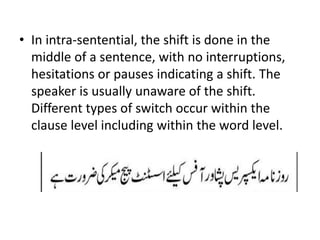
• In intra-sentential, the shift is done in the
middle of a sentence, with no interruptions,
hesitations or pauses indicating a shift. The
speaker is usually unaware of the shift.
Different types of switch occur within the
clause level including within the word level.
More examples – Urdu <> English :
• Kitna khoobsoorat SCENE ha. (noun)
• Yeh ONE-SIDED report ha. (noun phrase)
• Ye barra NICE COLOUR ha. (adjective)
• In dono ko COMPARE kro. (verb)
• Aaj me ne barray TASTY kabab khaye hain.
(Adj.)
• I did breakfast with tea and PRATHAS.
• BHAI G! Get up please.
• The changes generally take place more or less
randomly as far as subject-matter is
concerned, but they seem to be limited by the
sentence-structure.
• The following is an extract from the speech of
a Puerto-Rican speaker living in New York,
quoted by William Labov (1971). The stretches
in Spanish are translated in brackets.
• Por eso cada [therefore each . . . ], you know
it's nothing to be proud of, porque yo no estoy
[because I'm not] proud of it, as a matter of
fact I hate it, pero viene Vierne y Sabado yo
estoy, tu me ve hacia mi, sola [but come (?)
Friday and Saturday I am, you see me, you
look at me, alone] with a, aqui solita, a veces
que Frankie me deja [here alone, sometimes
Frankie leaves me], you know a stick or
something . . .
• Syntactic categories used in classifying
linguistic items may be independent of their
social descriptions.
• For instance, in the above extract the Spanish
verb estoy 'am‘ needs to be followed by an
adjective, but in this case it is an English
adjective (proud). This supports the view that
at least some syntactic (and other) categories
used in analysing language are universal
rather than tied to particular languages.
• Gillian Sankoff gave an interesting example. Here
the languages concerned are a language called
Buang and Neo-Melanesian Pidgin, or Tok Pisin.
In Buang, negation is marked by using su before
the predicate (i.e. the verb and its objects), and re
after it; but in one sentence the predicate was
mostly in English, but was enclosed within the
Buang su . . . re construction.
• Again we may conclude that items from
languages even as different as Buang and Neo-
Melanesian Pidgin are classified, by speakers as
well as by linguists, in terms of a common set of
syntactic categories (in this case something like
the category 'predicate').
• What syntactic constraints apply to code mixing?
• There is no doubt that there are syntactic
constraints; people who belong to code-mixing
communities can judge whether particular
constructed code-mixed examples are permitted
or not.
• For example, both Spanish and English have a
word which is used just before an infinitive (to in
English, a in Spanish), and language-change is
possible after either - to can be followed by a
Spanish infinitive, and a by an English one.
• Give at least 5 examples from your own
languages ( English, Urdu or any regional
language) to exemplify code-mixing and to
support the view that at least some syntactic
(and other) categories used in analysing
language are universal rather than tied to
particular languages.
• Explain what syntactic constraints apply
during the process of code-mixing.
Thanks

Code Mixing.pptx

  • 1.
    Code Mixing • Whena fluent bilingual talking to another fluent bilingual changes language without any change at all in the situation. This kind of alternation is called CODE-MIXING (or CONVERSATIONAL CODE- SWITCHING). • To get the right effect the speakers balance the two languages against each other as a kind of linguistic cocktail - a few words of one language, then a few words of the other, then back to the first for a few more words and so on.
  • 2.
    • Difference: • Code-mixingis the placing or mixing of various linguistic units (affixes, words, phrases, clauses) from two different grammatical systems within the same sentence and speech context, while code-switching is the placing or mixing of units (words, phrases, sentences) from two codes within the same speech context. • The structural difference between code-switching and code-mixing is the position of the altered elements—for code-switching, the modification of the codes occurs intersententially, while for code-mixing, it occurs intrasententially.
  • 3.
    • In inter-sententialcode, the language switch is done at sentence boundaries. This is seen most often between fluent bilingual speakers. For Example: Me tu yahan hoon. What happened?
  • 4.
    • In intra-sentential,the shift is done in the middle of a sentence, with no interruptions, hesitations or pauses indicating a shift. The speaker is usually unaware of the shift. Different types of switch occur within the clause level including within the word level.
  • 5.
    More examples –Urdu <> English : • Kitna khoobsoorat SCENE ha. (noun) • Yeh ONE-SIDED report ha. (noun phrase) • Ye barra NICE COLOUR ha. (adjective) • In dono ko COMPARE kro. (verb) • Aaj me ne barray TASTY kabab khaye hain. (Adj.) • I did breakfast with tea and PRATHAS. • BHAI G! Get up please.
  • 6.
    • The changesgenerally take place more or less randomly as far as subject-matter is concerned, but they seem to be limited by the sentence-structure. • The following is an extract from the speech of a Puerto-Rican speaker living in New York, quoted by William Labov (1971). The stretches in Spanish are translated in brackets.
  • 7.
    • Por esocada [therefore each . . . ], you know it's nothing to be proud of, porque yo no estoy [because I'm not] proud of it, as a matter of fact I hate it, pero viene Vierne y Sabado yo estoy, tu me ve hacia mi, sola [but come (?) Friday and Saturday I am, you see me, you look at me, alone] with a, aqui solita, a veces que Frankie me deja [here alone, sometimes Frankie leaves me], you know a stick or something . . .
  • 8.
    • Syntactic categoriesused in classifying linguistic items may be independent of their social descriptions. • For instance, in the above extract the Spanish verb estoy 'am‘ needs to be followed by an adjective, but in this case it is an English adjective (proud). This supports the view that at least some syntactic (and other) categories used in analysing language are universal rather than tied to particular languages.
  • 9.
    • Gillian Sankoffgave an interesting example. Here the languages concerned are a language called Buang and Neo-Melanesian Pidgin, or Tok Pisin. In Buang, negation is marked by using su before the predicate (i.e. the verb and its objects), and re after it; but in one sentence the predicate was mostly in English, but was enclosed within the Buang su . . . re construction. • Again we may conclude that items from languages even as different as Buang and Neo- Melanesian Pidgin are classified, by speakers as well as by linguists, in terms of a common set of syntactic categories (in this case something like the category 'predicate').
  • 10.
    • What syntacticconstraints apply to code mixing? • There is no doubt that there are syntactic constraints; people who belong to code-mixing communities can judge whether particular constructed code-mixed examples are permitted or not. • For example, both Spanish and English have a word which is used just before an infinitive (to in English, a in Spanish), and language-change is possible after either - to can be followed by a Spanish infinitive, and a by an English one.
  • 11.
    • Give atleast 5 examples from your own languages ( English, Urdu or any regional language) to exemplify code-mixing and to support the view that at least some syntactic (and other) categories used in analysing language are universal rather than tied to particular languages. • Explain what syntactic constraints apply during the process of code-mixing.
  • 12.