Coccidia Life Cycle
1
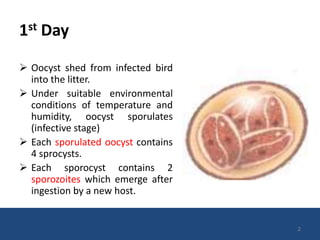
1st Day
 Oocyst shed from infected bird
into the litter.
 Under suitable environmental
conditions of temperature and
humidity, oocyst sporulates
(infective stage)
 Each sporulated oocyst contains
4 sprocysts.
 Each sporocyst contains 2
sporozoites which emerge after
ingestion by a new host.
2
2nd Day
 The sporozoites separates and
enter an epithelial intestinal cell.
 It becomes trophozoite
 It grows rounds up and becomes
an immature schizont.
3
3rd Day
 This schizont produces a large
number of first generation
merozoites.
4
4th Day
 Merozoites leave the intestinal
cell
 Penetrate a new intestinal cell
 Grow to second generation
schizonts.
5
5th Day
 Second generation schizonts,
present in the lamina propria of
the intestinal wall produce
masses of second-generation
merozoites.
 They leave the intestinal cell.
 This process of regeneration can
occur a third time according to
species.
6
6th Day
 Part of the second and third
generation merozoites become
microgametocytes.
– Microgametocytes produce large
numbers of flagellated
microgametes.
 The other merozoites become
uninucleate macrogametocytes,
which grow to macrogametes.
7
7th Day
 The macrogametes are
fertilized.
 The microgametes, become
zygotes and grow into young
unsporulated oocysts.
 These oocysts leave the cell,
come into the intestinal lumen
and leave the host via feces.
8
9
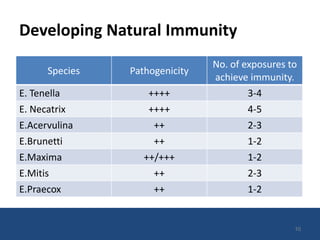
Developing Natural Immunity
Species Pathogenicity
No. of exposures to
achieve immunity.
E. Tenella ++++ 3-4
E. Necatrix ++++ 4-5
E.Acervulina ++ 2-3
E.Brunetti ++ 1-2
E.Maxima ++/+++ 1-2
E.Mitis ++ 2-3
E.Praecox ++ 1-2
10

Coccidial Life Cycle

  • 1.
  • 2.
    1st Day  Oocystshed from infected bird into the litter.  Under suitable environmental conditions of temperature and humidity, oocyst sporulates (infective stage)  Each sporulated oocyst contains 4 sprocysts.  Each sporocyst contains 2 sporozoites which emerge after ingestion by a new host. 2
  • 3.
    2nd Day  Thesporozoites separates and enter an epithelial intestinal cell.  It becomes trophozoite  It grows rounds up and becomes an immature schizont. 3
  • 4.
    3rd Day  Thisschizont produces a large number of first generation merozoites. 4
  • 5.
    4th Day  Merozoitesleave the intestinal cell  Penetrate a new intestinal cell  Grow to second generation schizonts. 5
  • 6.
    5th Day  Secondgeneration schizonts, present in the lamina propria of the intestinal wall produce masses of second-generation merozoites.  They leave the intestinal cell.  This process of regeneration can occur a third time according to species. 6
  • 7.
    6th Day  Partof the second and third generation merozoites become microgametocytes. – Microgametocytes produce large numbers of flagellated microgametes.  The other merozoites become uninucleate macrogametocytes, which grow to macrogametes. 7
  • 8.
    7th Day  Themacrogametes are fertilized.  The microgametes, become zygotes and grow into young unsporulated oocysts.  These oocysts leave the cell, come into the intestinal lumen and leave the host via feces. 8
  • 9.
  • 10.
    Developing Natural Immunity SpeciesPathogenicity No. of exposures to achieve immunity. E. Tenella ++++ 3-4 E. Necatrix ++++ 4-5 E.Acervulina ++ 2-3 E.Brunetti ++ 1-2 E.Maxima ++/+++ 1-2 E.Mitis ++ 2-3 E.Praecox ++ 1-2 10