Department of Medical Laboratory Technology, UIAHS.
Course Code: 20MLB-308 Course Name:Advance Clinical Chemistry
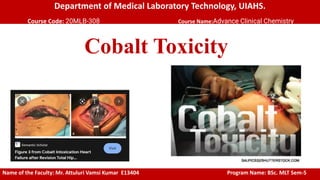
Cobalt Toxicity
Name of the Faculty: Mr. Attuluri Vamsi Kumar E13404 Program Name: BSc. MLT Sem-5
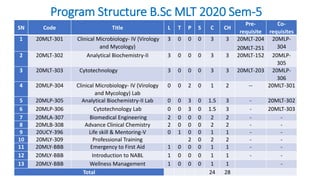
Program Structure B.Sc MLT 2020 Sem-5
SN Code Title L T P S C CH
Pre-
requisite
Co-
requisites
1 20MLT-301 Clinical Microbiology- IV (Virology
and Mycology)
3 0 0 0 3 3 20MLT-204
20MLT-251
20MLP-
304
2 20MLT-302 Analytical Biochemistry-II 3 0 0 0 3 3 20MLT-152 20MLP-
305
3 20MLT-303 Cytotechnology 3 0 0 0 3 3 20MLT-203 20MLP-
306
4 20MLP-304 Clinical Microbiology- IV (Virology
and Mycology) Lab
0 0 2 0 1 2 -- 20MLT-301
5 20MLP-305 Analytical Biochemistry-II Lab 0 0 3 0 1.5 3 - 20MLT-302
6 20MLP-306 Cytotechnology Lab 0 0 3 0 1.5 3 - 20MLT-303
7 20MLA-307 Biomedical Engineering 2 0 0 0 2 2 - -
8 20MLB-308 Advance Clinical Chemistry 2 0 0 0 2 2 - -
9 20UCY-396 Life skill & Mentoring-V 0 1 0 0 1 1 - -
10 20MLY-309 Professional Training 2 0 2 2 - -
11 20MLY-BBB Emergency to First Aid 1 0 0 0 1 1 - -
12 20MLY-BBB Introduction to NABL 1 0 0 0 1 1 - -
13 20MLY-BBB Wellness Management 1 0 0 0 1 1 -
Total 24 28
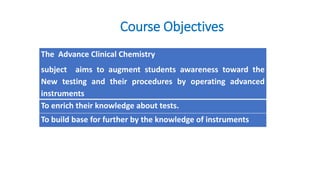
Course Objectives
The Advance Clinical Chemistry
subject aims to augment students awareness toward the
New testing and their procedures by operating advanced
instruments
To enrich their knowledge about tests.
To build base for further by the knowledge of instruments
Course outcomes
Subject Outcome
1 The student would be able to produce
knowledge of testing procedure
2 Students would be able to reproduce
instrument knowledge.
Syllabus overview
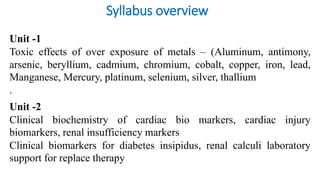
Unit -1
Toxic effects of over exposure of metals – (Aluminum, antimony,
arsenic, beryllium, cadmium, chromium, cobalt, copper, iron, lead,
Manganese, Mercury, platinum, selenium, silver, thallium
.
Unit -2
Clinical biochemistry of cardiac bio markers, cardiac injury
biomarkers, renal insufficiency markers
Clinical biomarkers for diabetes insipidus, renal calculi laboratory
support for replace therapy
Reference material
Suggested Readings/ Books:
• S.C. Cobbold, “Transducers for Biomedical Instruments”, Prentice Hall.
• Carr & Brown, Introduction to Biomedical Equipment Technology PearsonEdn, Asia.
• Rao &Guha,”Principles of Medical Electronics & Biomedical Instrumentation”, University Press, India.
• R. S. Khandpur “Handbook of Bio-Medical Instrumentation”, 2nd Edition, Tata McGraw Hill.
Syllabus overview
Unit -1
Toxic effects of over exposure of metals – (Aluminum, antimony,
arsenic, beryllium, cadmium, chromium, cobalt, copper, iron, lead,
Manganese, Mercury, platinum, selenium, silver, thallium
.
Unit -2
Clinical biochemistry of cardiac bio markers, cardiac injury
biomarkers, renal insufficiency markers
Clinical biomarkers for diabetes insipidus, renal calculi laboratory
support for replace therapy
For any heavy metal toxicity the following
need to be addressed
1. Introduction/General
characteristic/properties of Heavy metal
2. Sources of heavy metal – Mode of intake
3. Patho physiological effects – mechanism
4. Toxic effects – signs and symptoms in the
person exposed
5. Lab Diagnosis of heavy metal exposed
person
6. Treatment
7. Preventive measures
1) Aluminum,
2) antimony,
3) arsenic,
4) beryllium,
5) cadmium,
6) chromium,
7) cobalt,
8) copper,
9) iron,
10) lead,
11) Manganese,
12) Mercury,
13) platinum,
14) selenium,
15) silver,
16) thallium
Cobalt toxicity
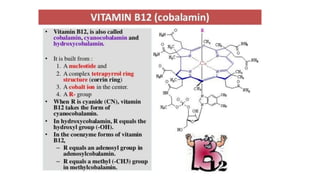
A grey metal mined from the Earth’s crust, cobalt is a vital
trace mineral required by the human body, predominantly as
a part of cobalamin i.e. vitamin B12.
Even though only trivial amounts of cobalt are needed by the
system and a safe RDA (recommended dietary allowance) for
daily intake has not yet been established, this valuable
element is involved in numerous key bodily operations. Some
of these crucial functions comprise the proper synthesis of
red blood cells, ensuring elevated nervous system activity,
breakdown of sugars and energy metabolism, preserving
thyroid hormone regulation, as well as guaranteeing optimal
iron absorption by cells.
Cobalt
1.Intro/General
characteristics/
properties of
Heavy metal
2. Sources of
heavy metal –
Mode of intake
3. Patho
physiological
effects –
mechanism
4. Toxic effects –
signs and
symptoms in the
person exposed
5. Complications
6. Lab Diagnosis
of heavy metal
exposed person
7. Treatment
8. Preventive
measures
Cobalt
1.Intro/General
characteristics/
properties of
Heavy metal
2. Sources of
heavy metal –
Mode of intake
3. Patho
physiological
effects –
mechanism
4. Toxic effects –
signs and
symptoms in the
person exposed
5. Complications
6. Lab Diagnosis
of heavy metal
exposed person
7. Treatment
8. Preventive
measures
Cobalt
1.Intro/General
characteristics/
properties of
Heavy metal
2. Sources of
heavy metal –
Mode of intake
3. Patho
physiological
effects –
mechanism
4. Toxic effects –
signs and
symptoms in the
person exposed
5. Complications
6. Lab Diagnosis
of heavy metal
exposed person
7. Treatment
8. Preventive
measures
Cobalt
1.Intro/General
characteristics/p
roperties of
Heavy metal
2. Sources of
heavy metal –
Mode of intake
3. Patho
physiological
effects –
mechanism
4. Toxic effects –
signs and
symptoms in the
person exposed
5. Complications
6. Lab Diagnosis
of heavy metal
exposed person
7. Treatment
8. Preventive
measures
Cobalt
1.Intro/General
characteristics/p
roperties of
Heavy metal
2. Sources of
heavy metal –
Mode of intake
3. Patho
physiological
effects –
mechanism
4. Toxic effects –
signs and
symptoms in the
person exposed
5. Complications
6. Lab Diagnosis
of heavy metal
exposed person
7. Treatment
8. Preventive
measures
Cobalt
1.Intro/General
characteristics/pro
perties of Heavy
metal
2. Sources of
heavy metal –
Mode of intake
3. Patho
physiological
effects –
mechanism
4. Toxic effects –
signs and
symptoms in the
person exposed
5. Complications
6. Lab Diagnosis of
heavy metal
exposed person
7. Treatment
8. Preventive
measures
Cobalt
1.Intro/General
characteristics/pro
perties of Heavy
metal
2. Sources of
heavy metal –
Mode of intake
3. Patho
physiological
effects –
mechanism
4. Toxic effects –
signs and
symptoms in the
person exposed
5. Complications
6. Lab Diagnosis of
heavy metal
exposed person
7. Treatment
8. Preventive
measures
Cobalt
1.Intro/General
characteristics/p
roperties of
Heavy metal
2. Sources of
heavy metal –
Mode of intake
3. Patho
physiological
effects –
mechanism
4. Toxic effects –
signs and
symptoms in the
person exposed
5. Complications
6. Lab Diagnosis
of heavy metal
exposed person
7. Treatment
8. Preventive
measures
Cobalt
1.Intro/General
characteristics/p
roperties of
Heavy metal
2. Sources of
heavy metal –
Mode of intake
3. Patho
physiological
effects –
mechanism
4. Toxic effects –
signs and
symptoms in the
person exposed
5. Complications
6. Lab Diagnosis
of heavy metal
exposed person
7. Treatment
8. Preventive
measures
Cobalt
1.Intro/General
characteristics/p
roperties of
Heavy metal
2. Sources of
heavy metal –
Mode of intake
3. Patho
physiological
effects –
mechanism
4. Toxic effects –
signs and
symptoms in the
person exposed
5. Complications
6. Lab Diagnosis
of heavy metal
exposed person
7. Treatment
8. Preventive
measures
Cobalt
1.Intro/General
characteristics/p
roperties of
Heavy metal
2. Sources of
heavy metal –
Mode of intake
3. Patho
physiological
effects –
mechanism
4. Toxic effects –
signs and
symptoms in the
person exposed
5. Complications
6. Lab Diagnosis
of heavy metal
exposed person
7. Treatment
8. Preventive
measures
The main treatment of systemic cobalt toxicity is
the revision or removal of the metallic hip prosthesis.
Chelation with NAC can be temporarily used until surgery is
performed.
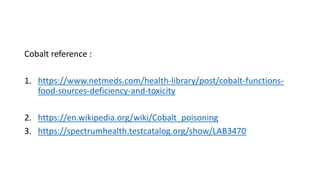
Cobalt reference :
1. https://www.netmeds.com/health-library/post/cobalt-functions-
food-sources-deficiency-and-toxicity
2. https://en.wikipedia.org/wiki/Cobalt_poisoning
3. https://spectrumhealth.testcatalog.org/show/LAB3470
Cobalt  toxicity.pdf

Cobalt toxicity.pdf

  • 1.
    Department of MedicalLaboratory Technology, UIAHS. Course Code: 20MLB-308 Course Name:Advance Clinical Chemistry Cobalt Toxicity Name of the Faculty: Mr. Attuluri Vamsi Kumar E13404 Program Name: BSc. MLT Sem-5
  • 2.
    Program Structure B.ScMLT 2020 Sem-5 SN Code Title L T P S C CH Pre- requisite Co- requisites 1 20MLT-301 Clinical Microbiology- IV (Virology and Mycology) 3 0 0 0 3 3 20MLT-204 20MLT-251 20MLP- 304 2 20MLT-302 Analytical Biochemistry-II 3 0 0 0 3 3 20MLT-152 20MLP- 305 3 20MLT-303 Cytotechnology 3 0 0 0 3 3 20MLT-203 20MLP- 306 4 20MLP-304 Clinical Microbiology- IV (Virology and Mycology) Lab 0 0 2 0 1 2 -- 20MLT-301 5 20MLP-305 Analytical Biochemistry-II Lab 0 0 3 0 1.5 3 - 20MLT-302 6 20MLP-306 Cytotechnology Lab 0 0 3 0 1.5 3 - 20MLT-303 7 20MLA-307 Biomedical Engineering 2 0 0 0 2 2 - - 8 20MLB-308 Advance Clinical Chemistry 2 0 0 0 2 2 - - 9 20UCY-396 Life skill & Mentoring-V 0 1 0 0 1 1 - - 10 20MLY-309 Professional Training 2 0 2 2 - - 11 20MLY-BBB Emergency to First Aid 1 0 0 0 1 1 - - 12 20MLY-BBB Introduction to NABL 1 0 0 0 1 1 - - 13 20MLY-BBB Wellness Management 1 0 0 0 1 1 - Total 24 28
  • 3.
    Course Objectives The AdvanceClinical Chemistry subject aims to augment students awareness toward the New testing and their procedures by operating advanced instruments To enrich their knowledge about tests. To build base for further by the knowledge of instruments
  • 4.
    Course outcomes Subject Outcome 1The student would be able to produce knowledge of testing procedure 2 Students would be able to reproduce instrument knowledge.
  • 5.
    Syllabus overview Unit -1 Toxiceffects of over exposure of metals – (Aluminum, antimony, arsenic, beryllium, cadmium, chromium, cobalt, copper, iron, lead, Manganese, Mercury, platinum, selenium, silver, thallium . Unit -2 Clinical biochemistry of cardiac bio markers, cardiac injury biomarkers, renal insufficiency markers Clinical biomarkers for diabetes insipidus, renal calculi laboratory support for replace therapy
  • 6.
    Reference material Suggested Readings/Books: • S.C. Cobbold, “Transducers for Biomedical Instruments”, Prentice Hall. • Carr & Brown, Introduction to Biomedical Equipment Technology PearsonEdn, Asia. • Rao &Guha,”Principles of Medical Electronics & Biomedical Instrumentation”, University Press, India. • R. S. Khandpur “Handbook of Bio-Medical Instrumentation”, 2nd Edition, Tata McGraw Hill.
  • 7.
    Syllabus overview Unit -1 Toxiceffects of over exposure of metals – (Aluminum, antimony, arsenic, beryllium, cadmium, chromium, cobalt, copper, iron, lead, Manganese, Mercury, platinum, selenium, silver, thallium . Unit -2 Clinical biochemistry of cardiac bio markers, cardiac injury biomarkers, renal insufficiency markers Clinical biomarkers for diabetes insipidus, renal calculi laboratory support for replace therapy
  • 8.
    For any heavymetal toxicity the following need to be addressed 1. Introduction/General characteristic/properties of Heavy metal 2. Sources of heavy metal – Mode of intake 3. Patho physiological effects – mechanism 4. Toxic effects – signs and symptoms in the person exposed 5. Lab Diagnosis of heavy metal exposed person 6. Treatment 7. Preventive measures 1) Aluminum, 2) antimony, 3) arsenic, 4) beryllium, 5) cadmium, 6) chromium, 7) cobalt, 8) copper, 9) iron, 10) lead, 11) Manganese, 12) Mercury, 13) platinum, 14) selenium, 15) silver, 16) thallium
  • 9.
  • 12.
    A grey metalmined from the Earth’s crust, cobalt is a vital trace mineral required by the human body, predominantly as a part of cobalamin i.e. vitamin B12. Even though only trivial amounts of cobalt are needed by the system and a safe RDA (recommended dietary allowance) for daily intake has not yet been established, this valuable element is involved in numerous key bodily operations. Some of these crucial functions comprise the proper synthesis of red blood cells, ensuring elevated nervous system activity, breakdown of sugars and energy metabolism, preserving thyroid hormone regulation, as well as guaranteeing optimal iron absorption by cells. Cobalt 1.Intro/General characteristics/ properties of Heavy metal 2. Sources of heavy metal – Mode of intake 3. Patho physiological effects – mechanism 4. Toxic effects – signs and symptoms in the person exposed 5. Complications 6. Lab Diagnosis of heavy metal exposed person 7. Treatment 8. Preventive measures
  • 13.
    Cobalt 1.Intro/General characteristics/ properties of Heavy metal 2.Sources of heavy metal – Mode of intake 3. Patho physiological effects – mechanism 4. Toxic effects – signs and symptoms in the person exposed 5. Complications 6. Lab Diagnosis of heavy metal exposed person 7. Treatment 8. Preventive measures
  • 14.
    Cobalt 1.Intro/General characteristics/ properties of Heavy metal 2.Sources of heavy metal – Mode of intake 3. Patho physiological effects – mechanism 4. Toxic effects – signs and symptoms in the person exposed 5. Complications 6. Lab Diagnosis of heavy metal exposed person 7. Treatment 8. Preventive measures
  • 15.
    Cobalt 1.Intro/General characteristics/p roperties of Heavy metal 2.Sources of heavy metal – Mode of intake 3. Patho physiological effects – mechanism 4. Toxic effects – signs and symptoms in the person exposed 5. Complications 6. Lab Diagnosis of heavy metal exposed person 7. Treatment 8. Preventive measures
  • 16.
    Cobalt 1.Intro/General characteristics/p roperties of Heavy metal 2.Sources of heavy metal – Mode of intake 3. Patho physiological effects – mechanism 4. Toxic effects – signs and symptoms in the person exposed 5. Complications 6. Lab Diagnosis of heavy metal exposed person 7. Treatment 8. Preventive measures
  • 17.
    Cobalt 1.Intro/General characteristics/pro perties of Heavy metal 2.Sources of heavy metal – Mode of intake 3. Patho physiological effects – mechanism 4. Toxic effects – signs and symptoms in the person exposed 5. Complications 6. Lab Diagnosis of heavy metal exposed person 7. Treatment 8. Preventive measures
  • 18.
    Cobalt 1.Intro/General characteristics/pro perties of Heavy metal 2.Sources of heavy metal – Mode of intake 3. Patho physiological effects – mechanism 4. Toxic effects – signs and symptoms in the person exposed 5. Complications 6. Lab Diagnosis of heavy metal exposed person 7. Treatment 8. Preventive measures
  • 19.
    Cobalt 1.Intro/General characteristics/p roperties of Heavy metal 2.Sources of heavy metal – Mode of intake 3. Patho physiological effects – mechanism 4. Toxic effects – signs and symptoms in the person exposed 5. Complications 6. Lab Diagnosis of heavy metal exposed person 7. Treatment 8. Preventive measures
  • 20.
    Cobalt 1.Intro/General characteristics/p roperties of Heavy metal 2.Sources of heavy metal – Mode of intake 3. Patho physiological effects – mechanism 4. Toxic effects – signs and symptoms in the person exposed 5. Complications 6. Lab Diagnosis of heavy metal exposed person 7. Treatment 8. Preventive measures
  • 21.
    Cobalt 1.Intro/General characteristics/p roperties of Heavy metal 2.Sources of heavy metal – Mode of intake 3. Patho physiological effects – mechanism 4. Toxic effects – signs and symptoms in the person exposed 5. Complications 6. Lab Diagnosis of heavy metal exposed person 7. Treatment 8. Preventive measures
  • 22.
    Cobalt 1.Intro/General characteristics/p roperties of Heavy metal 2.Sources of heavy metal – Mode of intake 3. Patho physiological effects – mechanism 4. Toxic effects – signs and symptoms in the person exposed 5. Complications 6. Lab Diagnosis of heavy metal exposed person 7. Treatment 8. Preventive measures The main treatment of systemic cobalt toxicity is the revision or removal of the metallic hip prosthesis. Chelation with NAC can be temporarily used until surgery is performed.
  • 23.
    Cobalt reference : 1.https://www.netmeds.com/health-library/post/cobalt-functions- food-sources-deficiency-and-toxicity 2. https://en.wikipedia.org/wiki/Cobalt_poisoning 3. https://spectrumhealth.testcatalog.org/show/LAB3470