TRYPANOSOMA
PRESENTED BY:
Manish Gautam (Roll no 15)
B.V.Sc & AH
IAAS, Paklihawa
1
Classification
Phylum: Sarcomastigophora (with flagella, pseudopodia or both)
Class: Zoomastigophorea( chromatophores absent, 1 to many flagella)
Order: Kinetoplastida (1-4 flagella, kinetophore present)
Family: Trypanosomatidae (leaf like, may be rounded)
Genus: Trypanosoma
Species: lewisi, theileri, avium, cruzi
2
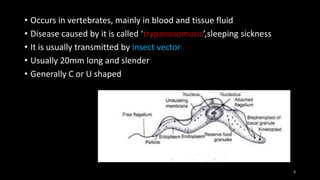
• Occurs in vertebrates, mainly in blood and tissue fluid
• Disease caused by it is called ‘trypanosomosis’,sleeping sickness
• It is usually transmitted by insect vector
• Usually 20mm long and slender
• Generally C or U shaped
3
Have various morphological forms
Amastigote:
present within cells, vertebrates
generally round, central nucleus
Flagellum nearly unapparent
Promastigote:
Present in invertebrate
Leaf like elongated
Flagellum +nt, undulating membrane –nt
Nucleus located middly
4
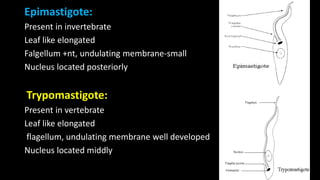
Epimastigote:
Present in invertebrate
Leaf like elongated
Falgellum +nt, undulating membrane-small
Nucleus located posteriorly
Trypomastigote:
Present in vertebrate
Leaf like elongated
flagellum, undulating membrane well developed
Nucleus located middly
5
6
Life cycle
7
Pathogenesis & symptoms
• Bite of insect or fly causes small papillae formation in skin
• Multiplication of Trypanosoma in blood causes:
pyrexia
progressive anaemia
paleness of visible mucous membrane
oedema of dependent part
emaciation
8
Changes in blood:
decrease in Hb and RBC by 25%, decrease in pH(5.5), decrease in K
Changes in the nervous system:
encephalomeningitis
Postmortem changes:
enlargement of spleen, liver, lymph gland
congested bone marrow
gelatinous infiltration of the subcutaneous tissue
9
Diagnosis:
Microscopic: blood, serous fluid, CSF
Animal inoculation
Culture
Serological test
Treatment:
Naganol @1-2mg/100kg b.wt IV
Antrycide methyl sulfate @5mg/kg b.wt SC
Antimosan @3mg/kg b.wt SC
10
11

Trypanosoma

  • 1.
    TRYPANOSOMA PRESENTED BY: Manish Gautam(Roll no 15) B.V.Sc & AH IAAS, Paklihawa 1
  • 2.
    Classification Phylum: Sarcomastigophora (withflagella, pseudopodia or both) Class: Zoomastigophorea( chromatophores absent, 1 to many flagella) Order: Kinetoplastida (1-4 flagella, kinetophore present) Family: Trypanosomatidae (leaf like, may be rounded) Genus: Trypanosoma Species: lewisi, theileri, avium, cruzi 2
  • 3.
    • Occurs invertebrates, mainly in blood and tissue fluid • Disease caused by it is called ‘trypanosomosis’,sleeping sickness • It is usually transmitted by insect vector • Usually 20mm long and slender • Generally C or U shaped 3
  • 4.
    Have various morphologicalforms Amastigote: present within cells, vertebrates generally round, central nucleus Flagellum nearly unapparent Promastigote: Present in invertebrate Leaf like elongated Flagellum +nt, undulating membrane –nt Nucleus located middly 4
  • 5.
    Epimastigote: Present in invertebrate Leaflike elongated Falgellum +nt, undulating membrane-small Nucleus located posteriorly Trypomastigote: Present in vertebrate Leaf like elongated flagellum, undulating membrane well developed Nucleus located middly 5
  • 6.
  • 7.
  • 8.
    Pathogenesis & symptoms •Bite of insect or fly causes small papillae formation in skin • Multiplication of Trypanosoma in blood causes: pyrexia progressive anaemia paleness of visible mucous membrane oedema of dependent part emaciation 8
  • 9.
    Changes in blood: decreasein Hb and RBC by 25%, decrease in pH(5.5), decrease in K Changes in the nervous system: encephalomeningitis Postmortem changes: enlargement of spleen, liver, lymph gland congested bone marrow gelatinous infiltration of the subcutaneous tissue 9
  • 10.
    Diagnosis: Microscopic: blood, serousfluid, CSF Animal inoculation Culture Serological test Treatment: Naganol @1-2mg/100kg b.wt IV Antrycide methyl sulfate @5mg/kg b.wt SC Antimosan @3mg/kg b.wt SC 10
  • 11.