Starter:
Mind-map all the different things people use coast
lines for.
What are
Coasts used
for?
Some coastlines are under threat of erosion
causing cliffs to retreat and beach material to be
lost. Others are at risk from coastal flooding.
In many cases the decision has been made to
try and reduce the erosion to protect the
coastline. This is called COASTAL
MANAGEMENT.
Coastal Management = The attempt by
people to maintain the natural features of
the coast for their own advantage
Types of
Coastal
Management
HARD ENGINEERING
Hard engineering
options tend to be
expensive and short-
term options. They
may also have a high
impact on the
landscape or
environment.
SOFT ENGINEERING
Soft engineering options
are often less expensive
than hard engineering
options. They are usually
also more long-term
and sustainable, with
less impact on the
environment.
 One of the most frequently
used protection types used to
stabilize the coast.
 They are help build up beach
material by preventing
longshore drift.
 Groynes build up beaches at a
small scale & are cheaper than
sea walls.
 Groynes can reduce the amount
of sediment downcoast, which
may have an effect on areas
elsewhere (as these areas might
get starved of material and their
beaches get smaller).
 They also have a short lifespan.
GROYNES – Wooden/concrete barriers built at
right angles to the beach.
 Vertical or sloping structures, built along the
shoreline in an attempt to stop erosion
 Can be constructed from any type of material-
e.g. from sand-filled bags to reinforced
concrete structures.
 Often controversial as they are ugly and can
be destroyed eventually.
 Waves scour at the bases of the walls &
eventually undermine them, causing failure.
As a result, seawalls only provide temporary
protection before needing replacement.
 They are expensive.
 The object of defence work is to dissipate
wave energy (beaches do this very well)
whereas sea walls have the opposite effect-
walls concentrate wave energy and reflects
it back at the sea.
 The wall receives maximum impact which
weakens the structure.
SEA WALLS
 Often situated away from the cliffs and attempt to reduce the energy of the
waves before they reach the cliffs/ coastline
 Designed to allow
sediment to pass
through them, which
means that
longshore drift is
not hindered.
 The structures
absorb the energy
of the waves before
they reach the cliffs.
This method
prevents wave scour.
 They are also very
cheap, but they do
need to be replaced
quite often & can be
regarded as ugly.
REVETMENTS
• Large boulders that work in a
similar way to seawalls, but they are
permeable structures.
• They are able to dissipate wave
energy by absorbing the impact of
the waves.
• Rip-rap structures do not suffer from
the wave scour that afflict the
seawalls.
• Clearly, masses of boulders are much
cheaper than sea walls & are
longer lasting.
• However, they are pretty unappealing
to the eye & can reduce the
recreational value of the beach.
• They can also act as groynes & can
prevent downdrift movement of
sediment.
Rock Armour
(Rip-Rap)
• The principle of gabions is
similar to the Rip-rap method
of protection (i.e. dissipation of
wave energy etc).
• However, gabions use smaller
rocks and are encased in a
wire mesh; this means that
local beach material could be
used, which enables the
structures to blend in more
with its surroundings.
• Potential problems arise when
the wire mesh breaks (risk of
injury) and one could also
argue that they are pretty
ugly.
• Gabions may not last for a
long period of time (5-10
years)
GABIONS
 Replacement of sand/pebbles on
eroding beaches.
 The best example is the
nourishment of beaches at Miami
Beach where 17.7 million m³ of
sediment was dredged & moved to
the beach to provide an area for
recreation & also to protect the
expensive properties that were
found in the location.
 The problem with beach
nourishment is that one severe
storm event may remove vast
amounts of the expensive
sediment.
BeachBeach
NourishmentNourishment
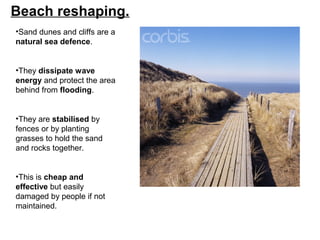
Beach reshaping.
•Sand dunes and cliffs are a
natural sea defence.
•They dissipate wave
energy and protect the area
behind from flooding.
•They are stabilised by
fences or by planting
grasses to hold the sand
and rocks together.
•This is cheap and
effective but easily
damaged by people if not
maintained.
MANAGED RETREAT/ COASTAL REALIGNMENT
•This is where in certain areas, the
sea is allowed to reclaim (flood)
the land that was once covered
by the sea.
•This often means that farmland
is lost, but the pressure of floods
are reduced because it creates
salt marshes that can be flooded
and can absorb the energy.
•A natural and long-term
sustainable solution.
•Does require compensation for
land that is lost.
Positive
 Cheaper in the long term as
structures not having to be
maintained
 Sea levels rising- can’t expect to
keep position of the current
coastline
 Will produce wetland, which
would have huge wildlife
potential
 Salt marshes absorb tidal/wave
energy and reduce the impact of
flooding
 Only giving back what naturally
belongs to the sea
Negative
 Farmland and livelihoods lost
 People’s homes will be
sacrificed
 Coastal realignment, but for how
long? Where do you draw the
boundary? Can you keep
retreating?
 Cost of compensation will be
extremely high
 Can’t be adopted in built-up
areas
 Some farmers unwilling to sell
their land
MANAGED RETREAT/ COASTAL REALIGNMENT
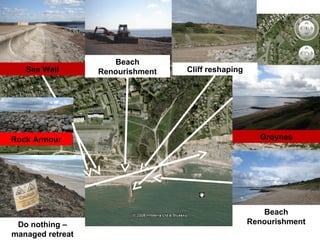
Sea Wall
Do nothing –
managed retreat
Beach
Renourishment
Groynes
Cliff reshaping
Beach
Renourishment
Rock Armour
Method How does it work? Advantages Disadvantages
Groynes
Sea Wall
Revetments
Rock Armour
Gabions
Beach
renourishment
Beach reshaping
Managed Retreat

Coastalmanagement 091201103809-phpapp02

  • 2.
    Starter: Mind-map all thedifferent things people use coast lines for. What are Coasts used for?
  • 3.
    Some coastlines areunder threat of erosion causing cliffs to retreat and beach material to be lost. Others are at risk from coastal flooding. In many cases the decision has been made to try and reduce the erosion to protect the coastline. This is called COASTAL MANAGEMENT. Coastal Management = The attempt by people to maintain the natural features of the coast for their own advantage
  • 4.
    Types of Coastal Management HARD ENGINEERING Hardengineering options tend to be expensive and short- term options. They may also have a high impact on the landscape or environment. SOFT ENGINEERING Soft engineering options are often less expensive than hard engineering options. They are usually also more long-term and sustainable, with less impact on the environment.
  • 6.
     One ofthe most frequently used protection types used to stabilize the coast.  They are help build up beach material by preventing longshore drift.  Groynes build up beaches at a small scale & are cheaper than sea walls.  Groynes can reduce the amount of sediment downcoast, which may have an effect on areas elsewhere (as these areas might get starved of material and their beaches get smaller).  They also have a short lifespan. GROYNES – Wooden/concrete barriers built at right angles to the beach.
  • 7.
     Vertical orsloping structures, built along the shoreline in an attempt to stop erosion  Can be constructed from any type of material- e.g. from sand-filled bags to reinforced concrete structures.  Often controversial as they are ugly and can be destroyed eventually.  Waves scour at the bases of the walls & eventually undermine them, causing failure. As a result, seawalls only provide temporary protection before needing replacement.  They are expensive.  The object of defence work is to dissipate wave energy (beaches do this very well) whereas sea walls have the opposite effect- walls concentrate wave energy and reflects it back at the sea.  The wall receives maximum impact which weakens the structure. SEA WALLS
  • 8.
     Often situatedaway from the cliffs and attempt to reduce the energy of the waves before they reach the cliffs/ coastline  Designed to allow sediment to pass through them, which means that longshore drift is not hindered.  The structures absorb the energy of the waves before they reach the cliffs. This method prevents wave scour.  They are also very cheap, but they do need to be replaced quite often & can be regarded as ugly. REVETMENTS
  • 9.
    • Large bouldersthat work in a similar way to seawalls, but they are permeable structures. • They are able to dissipate wave energy by absorbing the impact of the waves. • Rip-rap structures do not suffer from the wave scour that afflict the seawalls. • Clearly, masses of boulders are much cheaper than sea walls & are longer lasting. • However, they are pretty unappealing to the eye & can reduce the recreational value of the beach. • They can also act as groynes & can prevent downdrift movement of sediment. Rock Armour (Rip-Rap)
  • 10.
    • The principleof gabions is similar to the Rip-rap method of protection (i.e. dissipation of wave energy etc). • However, gabions use smaller rocks and are encased in a wire mesh; this means that local beach material could be used, which enables the structures to blend in more with its surroundings. • Potential problems arise when the wire mesh breaks (risk of injury) and one could also argue that they are pretty ugly. • Gabions may not last for a long period of time (5-10 years) GABIONS
  • 12.
     Replacement ofsand/pebbles on eroding beaches.  The best example is the nourishment of beaches at Miami Beach where 17.7 million m³ of sediment was dredged & moved to the beach to provide an area for recreation & also to protect the expensive properties that were found in the location.  The problem with beach nourishment is that one severe storm event may remove vast amounts of the expensive sediment. BeachBeach NourishmentNourishment
  • 13.
    Beach reshaping. •Sand dunesand cliffs are a natural sea defence. •They dissipate wave energy and protect the area behind from flooding. •They are stabilised by fences or by planting grasses to hold the sand and rocks together. •This is cheap and effective but easily damaged by people if not maintained.
  • 14.
    MANAGED RETREAT/ COASTALREALIGNMENT •This is where in certain areas, the sea is allowed to reclaim (flood) the land that was once covered by the sea. •This often means that farmland is lost, but the pressure of floods are reduced because it creates salt marshes that can be flooded and can absorb the energy. •A natural and long-term sustainable solution. •Does require compensation for land that is lost.
  • 15.
    Positive  Cheaper inthe long term as structures not having to be maintained  Sea levels rising- can’t expect to keep position of the current coastline  Will produce wetland, which would have huge wildlife potential  Salt marshes absorb tidal/wave energy and reduce the impact of flooding  Only giving back what naturally belongs to the sea Negative  Farmland and livelihoods lost  People’s homes will be sacrificed  Coastal realignment, but for how long? Where do you draw the boundary? Can you keep retreating?  Cost of compensation will be extremely high  Can’t be adopted in built-up areas  Some farmers unwilling to sell their land MANAGED RETREAT/ COASTAL REALIGNMENT
  • 16.
    Sea Wall Do nothing– managed retreat Beach Renourishment Groynes Cliff reshaping Beach Renourishment Rock Armour
  • 17.
    Method How doesit work? Advantages Disadvantages Groynes Sea Wall Revetments Rock Armour Gabions Beach renourishment Beach reshaping Managed Retreat

Editor's Notes

  • #18 Methods of protection