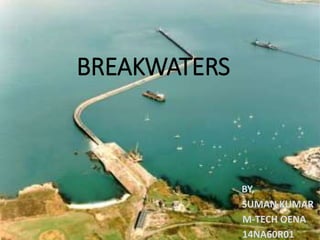
BREAKWATERS 
BY, 
SUMAN KUMAR 
M-TECH OENA 
14NA60R01
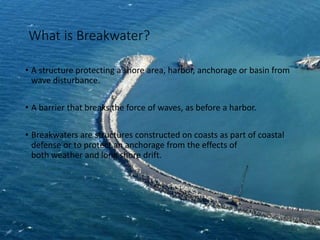
What is Breakwater? 
• A structure protecting a shore area, harbor, anchorage or basin from 
wave disturbance. 
• A barrier that breaks the force of waves, as before a harbor. 
• Breakwaters are structures constructed on coasts as part of coastal 
defense or to protect an anchorage from the effects of 
both weather and long shore drift.
What’s the Need of Breakwater? 
• To provide shelter from waves. 
• Through this shelter, to manipulate the littoral/sand transport 
conditions and thereby to trap some sand entrance inside the 
Anchorage Area.
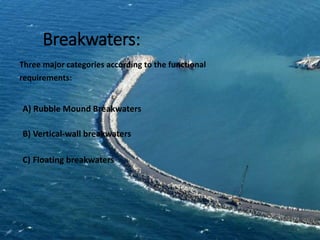
Breakwaters: 
Three major categories according to the functional 
requirements: 
A) Rubble Mound Breakwaters 
B) Vertical-wall breakwaters 
C) Floating breakwaters
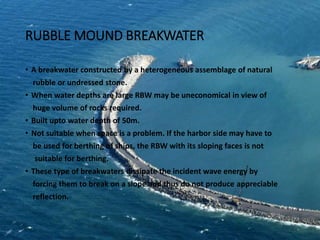
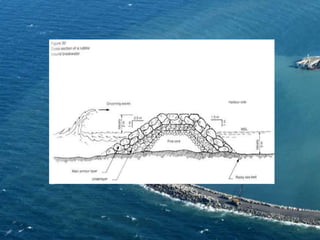
RUBBLE MOUND BREAKWATER 
• A breakwater constructed by a heterogeneous assemblage of natural 
rubble or undressed stone. 
• When water depths are large RBW may be uneconomical in view of 
huge volume of rocks required. 
• Built upto water depth of 50m. 
• Not suitable when space is a problem. If the harbor side may have to 
be used for berthing of ships, the RBW with its sloping faces is not 
suitable for berthing. 
• These type of breakwaters dissipate the incident wave energy by 
forcing them to break on a slope and thus do not produce appreciable 
reflection.
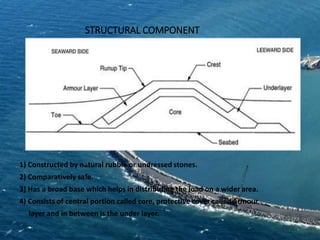
STRUCTURAL COMPONENT 
1) Constructed by natural rubble or undressed stones. 
2) Comparatively safe. 
3) Has a broad base which helps in distributing the load on a wider area. 
4) Consists of central portion called core, protective cover called Armour 
layer and in between is the under layer.
ADVANTAGES OF RMBW 
• Use of natural material 
• Reduces material cost 
• Use of small construction equipment 
• Less environmental impact 
• Most widely used in Indian ports 
• Easy to construct 
• Failure is mainly due to poor interlocking capacity between 
individual blocks 
• Unavailability of large size natural rocks leads to artificial armour 
blocks .
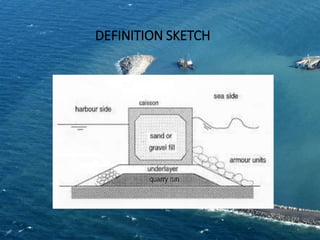
VERTICAL BREAKWATER 
• A breakwater formed by the construction in a regular and 
systematic manner of a vertical wall of masonry concrete blocks or 
mass concrete, with vertical and seaward face. 
• Reflect the incident waves without dissipating much wave energy. 
• Normally it is constructed in locations where the depth of the sea is 
greater than twice the design wave height.
Preferred to RMBW for following reasons: 
• saving in material due to smaller body width. 
• Rapidity in construction. 
• Non availability of large quantities of stones. 
• Occupies less space.
DEFINITION SKETCH
Disadvantages of vertical wall break water 
• Sea bottom has to be leveled and prepared for placements of large 
blocks or caissons. 
• Foundations made of fine sand may cause erosion and settlement. 
• Erosion may cause tilting or displacement of large monoliths. 
• Difficult and expensive to repair. 
• Building of caissons and launching or towing them into position require 
special land and water areas beside involvement of heavy construction 
equipments. 
• Require form work, quality concrete, skilled labour, batching plants and 
floating crafts.
FLOATING BREAKWATER 
• A removable breakwater constructed by caissons or 
pontoons with valves for trimming whilst afloat and 
for sinking when is position and pump connections for 
refloating, moored to the sea bed. 
• inexpensive, easily moved from site to site, often very 
quickly fabricated. 
• ineffective to long waves, must be anchored.
TYPICAL FLOATING BREAKWATERS
THANK YOU

Breakwaters

  • 1.
    BREAKWATERS BY, SUMANKUMAR M-TECH OENA 14NA60R01
  • 2.
    What is Breakwater? • A structure protecting a shore area, harbor, anchorage or basin from wave disturbance. • A barrier that breaks the force of waves, as before a harbor. • Breakwaters are structures constructed on coasts as part of coastal defense or to protect an anchorage from the effects of both weather and long shore drift.
  • 3.
    What’s the Needof Breakwater? • To provide shelter from waves. • Through this shelter, to manipulate the littoral/sand transport conditions and thereby to trap some sand entrance inside the Anchorage Area.
  • 4.
    Breakwaters: Three majorcategories according to the functional requirements: A) Rubble Mound Breakwaters B) Vertical-wall breakwaters C) Floating breakwaters
  • 5.
    RUBBLE MOUND BREAKWATER • A breakwater constructed by a heterogeneous assemblage of natural rubble or undressed stone. • When water depths are large RBW may be uneconomical in view of huge volume of rocks required. • Built upto water depth of 50m. • Not suitable when space is a problem. If the harbor side may have to be used for berthing of ships, the RBW with its sloping faces is not suitable for berthing. • These type of breakwaters dissipate the incident wave energy by forcing them to break on a slope and thus do not produce appreciable reflection.
  • 6.
    STRUCTURAL COMPONENT 1)Constructed by natural rubble or undressed stones. 2) Comparatively safe. 3) Has a broad base which helps in distributing the load on a wider area. 4) Consists of central portion called core, protective cover called Armour layer and in between is the under layer.
  • 8.
    ADVANTAGES OF RMBW • Use of natural material • Reduces material cost • Use of small construction equipment • Less environmental impact • Most widely used in Indian ports • Easy to construct • Failure is mainly due to poor interlocking capacity between individual blocks • Unavailability of large size natural rocks leads to artificial armour blocks .
  • 9.
    VERTICAL BREAKWATER •A breakwater formed by the construction in a regular and systematic manner of a vertical wall of masonry concrete blocks or mass concrete, with vertical and seaward face. • Reflect the incident waves without dissipating much wave energy. • Normally it is constructed in locations where the depth of the sea is greater than twice the design wave height.
  • 10.
    Preferred to RMBWfor following reasons: • saving in material due to smaller body width. • Rapidity in construction. • Non availability of large quantities of stones. • Occupies less space.
  • 11.
  • 12.
    Disadvantages of verticalwall break water • Sea bottom has to be leveled and prepared for placements of large blocks or caissons. • Foundations made of fine sand may cause erosion and settlement. • Erosion may cause tilting or displacement of large monoliths. • Difficult and expensive to repair. • Building of caissons and launching or towing them into position require special land and water areas beside involvement of heavy construction equipments. • Require form work, quality concrete, skilled labour, batching plants and floating crafts.
  • 13.
    FLOATING BREAKWATER •A removable breakwater constructed by caissons or pontoons with valves for trimming whilst afloat and for sinking when is position and pump connections for refloating, moored to the sea bed. • inexpensive, easily moved from site to site, often very quickly fabricated. • ineffective to long waves, must be anchored.
  • 14.
  • 15.