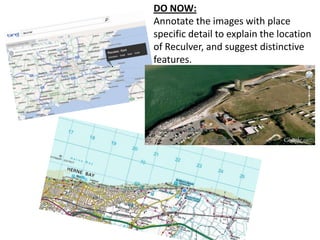
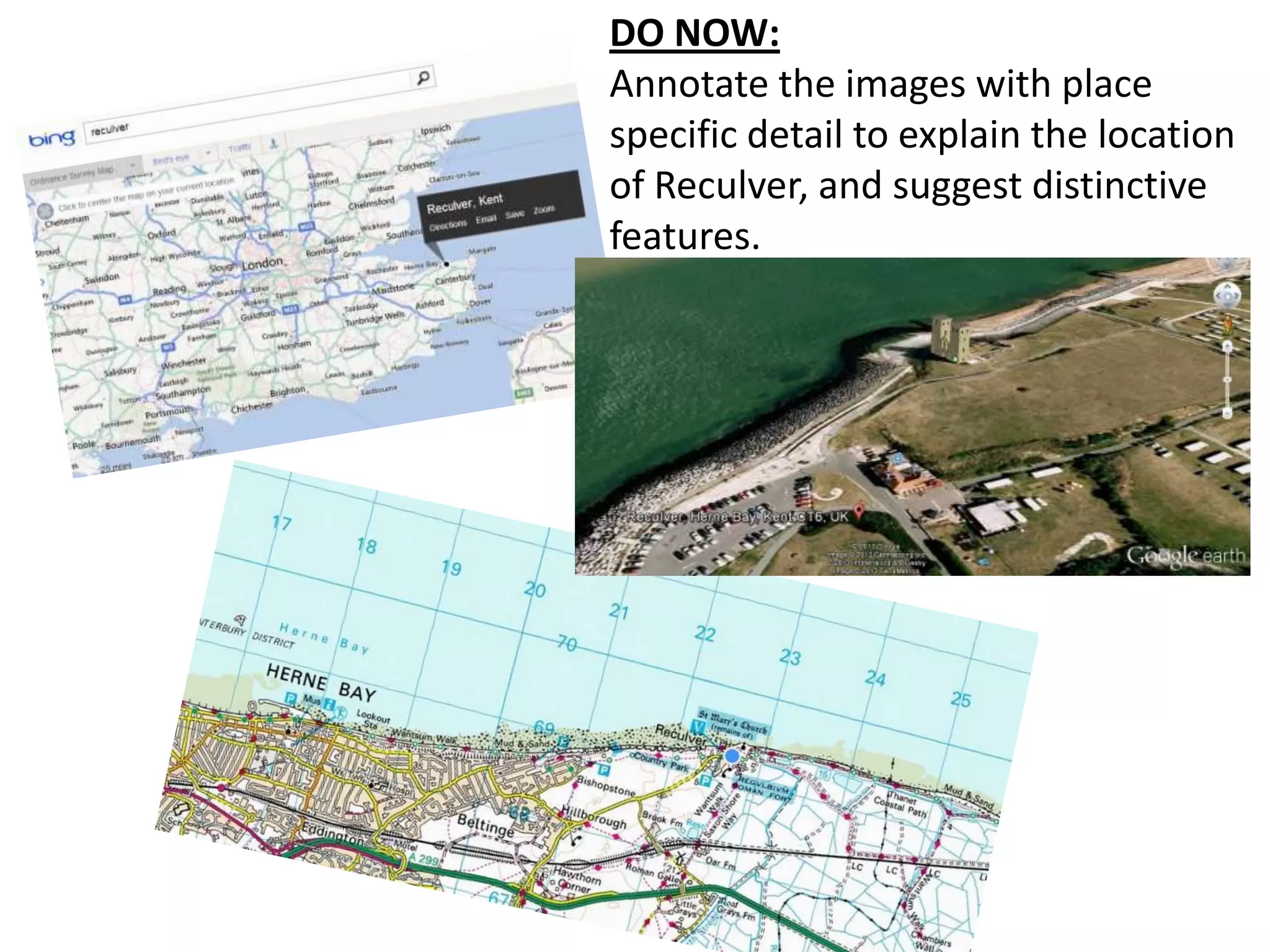
DO NOW:
Annotate the images with place
specific detail to explain the location
of Reculver, and suggest distinctive
features.
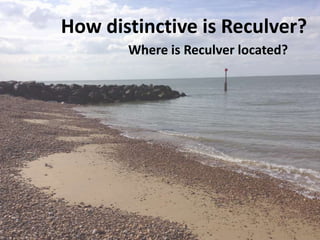
How distinctive is Reculver?
Where is Reculver located?
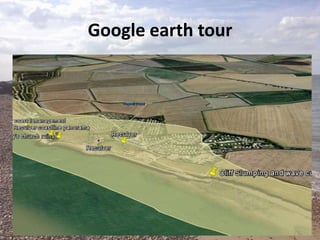
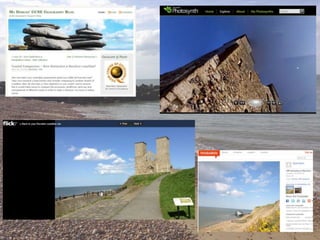
Google earth tour
Keyword jenga!
Your enquiry
• Using the resources, identify evidence and make
predictions of distinctive features at Reculver
• Record:
1) your predictions (what you expect to find that is
distinctive, or not)
2) evidence of landforms, processes, land-use
3) descriptions of the location
www.geogdebens.wordpress.com
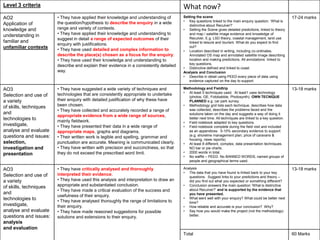
Level 3 criteria What now?
AO2
Application of
knowledge and
understanding in
familiar and
unfamiliar contexts
• They have applied their knowledge and understanding of
the question/hypothesis to describe the enquiry in a wide
range and variety of contexts.
• They have applied their knowledge and understanding to
suggest in detail a range of expected outcomes of their
enquiry with justifications.
• They have used detailed and complex information to
describe the place(s) chosen as a focus for the enquiry.
• They have used their knowledge and understanding to
describe and explain their evidence in a consistently detailed
way.
Setting the scene
• Key questions linked to the main enquiry question: ‘What is
distinctive about Reculver?’
• Setting the Scene gives detailed predictions, linked to theory
and map / satellite image evidence and knowledge of
Reculver, E.g. LSD theory, coastal management, land use
linked to leisure and tourism. What do you expect to find
out?
• Location described in writing, including co-ordinates.
Annotated OS map and annotated satellite image describing
location and making predictions. All annotations linked to
key questions.
• Distinctive defined and linked to coast.
Analysis and Conclusion
• Describe in detail using PEED every piece of data using
evidence captured on the day to support.
17-24 marks
AO3
Selection and use of
a variety
of skills, techniques
and
technologies to
investigate,
analyse and evaluate
questions and issues:
selection,
investigation and
presentation
• They have suggested a wide variety of techniques and
technologies that are consistently appropriate to undertake
their enquiry with detailed justification of why these have
been chosen.
• They have collected and accurately recorded a range of
appropriate evidence from a wide range of sources,
mainly fieldwork.
• They have presented their data in a wide range of
appropriate maps, graphs and diagrams.
• Their written work is legible and spelling, grammar and
punctuation are accurate. Meaning is communicated clearly.
• They have written with precision and succinctness, so that
they do not exceed the prescribed word limit.
Methodology and Fieldtrip
• At least 5 techniques used. At least1 uses technology
(photos, GE, Fotobabble, Photosynth). OWN TECNIQUE
PLANNED e.g. car park survey.
• Methodology grid lists each technique, describes how data
was collected, describes the problems faced and the
solutions taken on the day and suggests a way of doing it
better next time. All techniques are linked to a key question.
• Field notebook adapted to key questions.
• Field notebook complete during the field visit and included
as an appendices. 5-10% secondary evidence to support
(e.g. shoreline management plan; price of caravans &
housing, news reports)
• At least 8 different, complex, data presentation techniques.
NO bar or pie charts.
• 2000 words in total.
• No waffle – PEED. No BANNED WORDS, named groups of
people and geographical terms used.
13-18 marks
AO3
Selection and use of
a variety
of skills, techniques
and
technologies to
investigate,
analyse and evaluate
questions and issues:
analysis
and evaluation
• They have critically analysed and thoroughly
interpreted their evidence.
• They have used this analysis and interpretation to draw an
appropriate and substantiated conclusion.
• They have made a critical evaluation of the success and
usefulness of their enquiry.
• They have analysed thoroughly the range of limitations to
their enquiry.
• They have made reasoned suggestions for possible
solutions and extensions to their enquiry.
Analysis
• The data that you have found is linked back to your key
questions. Suggest links to your predictions and theory –
did you find out what you expected or something different?
• Conclusion answers the main question ‘What is distinctive
about Reculver?’ and is supported by the evidence that
you have presented.
• What went well with your enquiry? What could be better next
time?
• How reliable and accurate is your conclusion? Why?
• Say how you would make the project (not the methodology)
better.
13-18 marks
Total 60 Marks
Finally…sum up your findings
• I predict that the distinctive features of
Reculver are likely to be………………..whereas I
expect……………………will not be distinctive
because…………………….

How distinctive is Reculver

  • 1.
    DO NOW: Annotate theimages with place specific detail to explain the location of Reculver, and suggest distinctive features.
  • 2.
    How distinctive isReculver? Where is Reculver located?
  • 3.
  • 4.
  • 5.
    Your enquiry • Usingthe resources, identify evidence and make predictions of distinctive features at Reculver • Record: 1) your predictions (what you expect to find that is distinctive, or not) 2) evidence of landforms, processes, land-use 3) descriptions of the location
  • 6.
  • 8.
    Level 3 criteriaWhat now? AO2 Application of knowledge and understanding in familiar and unfamiliar contexts • They have applied their knowledge and understanding of the question/hypothesis to describe the enquiry in a wide range and variety of contexts. • They have applied their knowledge and understanding to suggest in detail a range of expected outcomes of their enquiry with justifications. • They have used detailed and complex information to describe the place(s) chosen as a focus for the enquiry. • They have used their knowledge and understanding to describe and explain their evidence in a consistently detailed way. Setting the scene • Key questions linked to the main enquiry question: ‘What is distinctive about Reculver?’ • Setting the Scene gives detailed predictions, linked to theory and map / satellite image evidence and knowledge of Reculver, E.g. LSD theory, coastal management, land use linked to leisure and tourism. What do you expect to find out? • Location described in writing, including co-ordinates. Annotated OS map and annotated satellite image describing location and making predictions. All annotations linked to key questions. • Distinctive defined and linked to coast. Analysis and Conclusion • Describe in detail using PEED every piece of data using evidence captured on the day to support. 17-24 marks AO3 Selection and use of a variety of skills, techniques and technologies to investigate, analyse and evaluate questions and issues: selection, investigation and presentation • They have suggested a wide variety of techniques and technologies that are consistently appropriate to undertake their enquiry with detailed justification of why these have been chosen. • They have collected and accurately recorded a range of appropriate evidence from a wide range of sources, mainly fieldwork. • They have presented their data in a wide range of appropriate maps, graphs and diagrams. • Their written work is legible and spelling, grammar and punctuation are accurate. Meaning is communicated clearly. • They have written with precision and succinctness, so that they do not exceed the prescribed word limit. Methodology and Fieldtrip • At least 5 techniques used. At least1 uses technology (photos, GE, Fotobabble, Photosynth). OWN TECNIQUE PLANNED e.g. car park survey. • Methodology grid lists each technique, describes how data was collected, describes the problems faced and the solutions taken on the day and suggests a way of doing it better next time. All techniques are linked to a key question. • Field notebook adapted to key questions. • Field notebook complete during the field visit and included as an appendices. 5-10% secondary evidence to support (e.g. shoreline management plan; price of caravans & housing, news reports) • At least 8 different, complex, data presentation techniques. NO bar or pie charts. • 2000 words in total. • No waffle – PEED. No BANNED WORDS, named groups of people and geographical terms used. 13-18 marks AO3 Selection and use of a variety of skills, techniques and technologies to investigate, analyse and evaluate questions and issues: analysis and evaluation • They have critically analysed and thoroughly interpreted their evidence. • They have used this analysis and interpretation to draw an appropriate and substantiated conclusion. • They have made a critical evaluation of the success and usefulness of their enquiry. • They have analysed thoroughly the range of limitations to their enquiry. • They have made reasoned suggestions for possible solutions and extensions to their enquiry. Analysis • The data that you have found is linked back to your key questions. Suggest links to your predictions and theory – did you find out what you expected or something different? • Conclusion answers the main question ‘What is distinctive about Reculver?’ and is supported by the evidence that you have presented. • What went well with your enquiry? What could be better next time? • How reliable and accurate is your conclusion? Why? • Say how you would make the project (not the methodology) better. 13-18 marks Total 60 Marks
  • 9.
    Finally…sum up yourfindings • I predict that the distinctive features of Reculver are likely to be………………..whereas I expect……………………will not be distinctive because…………………….