Mentorship Virtual Training for
Biomedical Engineers
Jhpiego - Health Workforce for the 21st
Century Project
August 2020
Endris Mekonnen, HW21 Project Manager
Session Outline
• Introduction
• Mentoring definition and concepts
• Models and relationships of mentoring
• Phases of mentoring and process skills to
facilitate mentoring
• Mentoring ethics and potential problems in
mentoring
• Approaches of mentoring
• Summary
2
Session Objectives
• Discuss mentoring as a mutual relationship to foster
career development and psychosocial support
• Identify the key tasks and processes for enhancing the
mentoring relationship
• Recognize the principles, tools and strategies for
implementing mentoring
• Identify the special challenges and opportunities in
mentoring
• Apply technology-mediated strategies to conduct
mentoring
3
Introduction
Reflection
• What do we mean by mentoring?
• How is it different from
coaching?
4
Introduction
• Definitions – many and contextual
• "Mentoring is to support and encourage people to
manage their own learning in order that they may
maximize their potential, develop their skills, improve
their performance and become the person they want
to be." (Eric Parsloe)
• “intense caring relationship in which persons with
more experience work with less experienced
persons to promote both professional and personal
development.” (Caffarella 1992)
5
Mentoring
• Intentional process – you have purpose doing it
• Nurturing process – that fosters the development of
the mentee towards their full potential
• Insightful process – in which the wisdom of the
mentor is acquired and applied by the mentee
• Mentees develop and learn through conversations
with more experienced mentors who share K&S
• The relationship could be a development opportunity
for both mentors and mentees
• What benefits can mentors get from the relationship?
6
Mentoring
• A powerful personal development and empowerment
tool
• It is an effective way of helping people to progress
in their careers
• It is a partnership between two people (mentor and
mentee) normally working in a similar field or sharing
similar experiences
• It is a helpful relationship based upon mutual trust
and respect
7
Mentor
• Who is a mentor?
• A guide who can help the mentee to find the right
direction and reach to the right solutions
• Rely upon having had similar experiences to gain
an empathy with the mentee and an understanding
of their issues
• Helps the mentee to believe in oneself and boost
their confidence – psychosocial support
• A mentor is often superior in status and power
• Some mentors may be peers and others may even
be subordinate to the mentee
8
Coaching versus Mentoring?
• In coaching: the relationship is more of a trainer-
trainee, the coach is superior than the trainee
• Coach is experienced, the other has little or no
• Usually occurs in a teaching/training environment
• In mentoring: the relationship is more of a
partnership, both having similar experience
• A senior/wiser colleague transferring knowledge and
experience to a junior colleague
• Usually occurs in a working setting
9
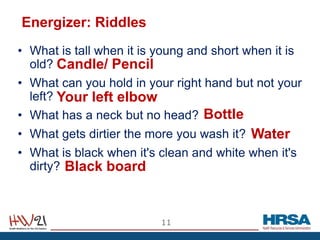
Energizer: Riddles
• What is tall when it is young and short when it is
old?
• What can you hold in your right hand but not your
left?
• What has a neck but no head?
• What gets dirtier the more you wash it?
• What is black when it's clean and white when it's
dirty?
11
Candle/ Pencil
Your left elbow
Bottle
Water
Black board
The 3 Models of Mentoring
• Apprentice model - the mentee observes the
mentor and learns
• Competency model - the mentor gives mentee
systematic feedback about performance and
progress
• Reflective model – the mentor helps the mentee
become a reflective practitioner
• Intentional, nurturing and insightful process that
provides a powerful growth experience for both the
mentor and mentee
11
Mentoring Relationships
• Mentoring relationships can be formal or informal
• Formal - usually organized in the workplace where
an organization matches mentors to mentees for
developing careers
• Informal - usually occur spontaneously and are
largely psychosocial;
• help to enhance the mentee’s self-esteem and
confidence by providing emotional support and
discovery of common interests
• What benefits can mentors get from the
relationship?
13
Four Phases of Mentoring
• 1. Preparing – Mentors assess their own motivations
and readiness for the prospective mentoring relationship
- Motivation and readiness self-assessment checklists
• 2. Negotiating – to come to terms on learning priorities,
areas for support/improvement and implementation plan
- Encourage self-directed and lifelong learning
- Most important outcomes: ‘boundary setting’ by both
the mentor and the mentee
- From the mentor’s perspective, boundary has to do with
expectations of access - time & place, what is the limit?
13
Four Phases of Mentoring…
• 3. Enabling – providing psychosocial and expertise
support for implementation of plan.
- May take longer to complete
- Opening oneself to mentee, lead them incrementally
over time & express care and concern about their
personal and professional welfare
• 4. Coming to closure – offers opportunity for the
partners to harvest their learning and move on
- Acknowledge difficulty without casting blame,
consider what went right through mentoring
- Celebrate a successful mentoring relationship
14
Process skills that facilitate mentoring
• 1. Asking questions - help mentees to reflect on
and articulate their own thinking
- E.g. Could you tell me a bit more about what you
mean by…?
• 2. Reformulating statements - help mentors to
clarify their own understanding and encourage
mentees to reflect on what they articulated
- E.g. I think what I heard you saying was…, My
understanding is…
15
Process skills that facilitate mentoring…
• 3. Summarizing – helps to remind both parties what has
transpired and to check out assumptions in the process
- E.g. As a result, I feel we have achieved…, We’ve spent
our time this morning…
• 4. Listening for silence – Silence can indicate boredom,
confusion, discomfort or embarrassment
- On the other hand, some individuals just need time out to
think quietly
• 5. Providing feedback that is authentic and suggests
future action. E.g. I like the way you… next time you
might try… You made a really good start with…
16
Mentoring and Ethics
• Are ethical guidelines needed for mentoring?
• Beneficence and Non-maleficence: help others
and be careful not to harm them
• Fidelity and Responsibility: the mentor clarify the
roles of each party in the relationship
• Integrity: both need to do what they have agreed to
do when establishing the relationship
• Justice: to aspire to fairness, and to ensure that
relationship is free from inappropriate bias
• Respect for People's Rights and Dignity: to
recognize personal differences; confidentiality
17
Potential problems in mentoring
• If the bounds of the relationship are not clearly
understood, a mentee may:
• be overly dependent on a mentor,
• ask for personal favors or expect involvement and
credit with the mentor's work
• Mentors should not use nor exploit their mentees, nor
should they take credit for the mentee's work
• Mentors may be jealous when their mentees outshine
them
• Such problems can be minimized by clear expectations
of the mentoring relationship and personal reflections
at different stages of the relationship.
18
Approaches of Mentoring?
Site visit by mentors - involves:
• One-on-one discussion with mentee
• Site observation – materials and equipment
• Review of records and documentation, SOPs
• Documentation of visit findings and
recommendations
• Debriefing meeting with mentees and relevant
people
19
Approaches of Mentoring…
Tele-mentoring - Mentoring by telephone
• Mentoring visits should be complemented by tele-
mentoring between visits
• Prevents serious errors and reduces mental stress
for the mentee
• Provides useful feedback on the progress of the
mentee and reinforces the mentoring relationship
• Clear agreement on when to call for advice is
important
20
Approaches of Mentoring…
Technology-assisted, Internet based mentoring –
e-mentoring
- Uses internet for communication
- Telegram group, what is up group, email group
- Online Community of Practice (CoP)
- Important for remote/ distance mentoring
- One mentor for many mentees (group mentoring)
21
Summary
• Mentoring is a powerful tool in career development
• It is a relationship conducted in a professional manner
with mutual trust and respect of both individuals
• It is a dynamic process which help personal and
professional growth of both parties
22
23

Mentorship training_Biomedical engineers_August 2020.pptx

  • 1.
    Mentorship Virtual Trainingfor Biomedical Engineers Jhpiego - Health Workforce for the 21st Century Project August 2020 Endris Mekonnen, HW21 Project Manager
  • 2.
    Session Outline • Introduction •Mentoring definition and concepts • Models and relationships of mentoring • Phases of mentoring and process skills to facilitate mentoring • Mentoring ethics and potential problems in mentoring • Approaches of mentoring • Summary 2
  • 3.
    Session Objectives • Discussmentoring as a mutual relationship to foster career development and psychosocial support • Identify the key tasks and processes for enhancing the mentoring relationship • Recognize the principles, tools and strategies for implementing mentoring • Identify the special challenges and opportunities in mentoring • Apply technology-mediated strategies to conduct mentoring 3
  • 4.
    Introduction Reflection • What dowe mean by mentoring? • How is it different from coaching? 4
  • 5.
    Introduction • Definitions –many and contextual • "Mentoring is to support and encourage people to manage their own learning in order that they may maximize their potential, develop their skills, improve their performance and become the person they want to be." (Eric Parsloe) • “intense caring relationship in which persons with more experience work with less experienced persons to promote both professional and personal development.” (Caffarella 1992) 5
  • 6.
    Mentoring • Intentional process– you have purpose doing it • Nurturing process – that fosters the development of the mentee towards their full potential • Insightful process – in which the wisdom of the mentor is acquired and applied by the mentee • Mentees develop and learn through conversations with more experienced mentors who share K&S • The relationship could be a development opportunity for both mentors and mentees • What benefits can mentors get from the relationship? 6
  • 7.
    Mentoring • A powerfulpersonal development and empowerment tool • It is an effective way of helping people to progress in their careers • It is a partnership between two people (mentor and mentee) normally working in a similar field or sharing similar experiences • It is a helpful relationship based upon mutual trust and respect 7
  • 8.
    Mentor • Who isa mentor? • A guide who can help the mentee to find the right direction and reach to the right solutions • Rely upon having had similar experiences to gain an empathy with the mentee and an understanding of their issues • Helps the mentee to believe in oneself and boost their confidence – psychosocial support • A mentor is often superior in status and power • Some mentors may be peers and others may even be subordinate to the mentee 8
  • 9.
    Coaching versus Mentoring? •In coaching: the relationship is more of a trainer- trainee, the coach is superior than the trainee • Coach is experienced, the other has little or no • Usually occurs in a teaching/training environment • In mentoring: the relationship is more of a partnership, both having similar experience • A senior/wiser colleague transferring knowledge and experience to a junior colleague • Usually occurs in a working setting 9
  • 10.
    Energizer: Riddles • Whatis tall when it is young and short when it is old? • What can you hold in your right hand but not your left? • What has a neck but no head? • What gets dirtier the more you wash it? • What is black when it's clean and white when it's dirty? 11 Candle/ Pencil Your left elbow Bottle Water Black board
  • 11.
    The 3 Modelsof Mentoring • Apprentice model - the mentee observes the mentor and learns • Competency model - the mentor gives mentee systematic feedback about performance and progress • Reflective model – the mentor helps the mentee become a reflective practitioner • Intentional, nurturing and insightful process that provides a powerful growth experience for both the mentor and mentee 11
  • 12.
    Mentoring Relationships • Mentoringrelationships can be formal or informal • Formal - usually organized in the workplace where an organization matches mentors to mentees for developing careers • Informal - usually occur spontaneously and are largely psychosocial; • help to enhance the mentee’s self-esteem and confidence by providing emotional support and discovery of common interests • What benefits can mentors get from the relationship? 13
  • 13.
    Four Phases ofMentoring • 1. Preparing – Mentors assess their own motivations and readiness for the prospective mentoring relationship - Motivation and readiness self-assessment checklists • 2. Negotiating – to come to terms on learning priorities, areas for support/improvement and implementation plan - Encourage self-directed and lifelong learning - Most important outcomes: ‘boundary setting’ by both the mentor and the mentee - From the mentor’s perspective, boundary has to do with expectations of access - time & place, what is the limit? 13
  • 14.
    Four Phases ofMentoring… • 3. Enabling – providing psychosocial and expertise support for implementation of plan. - May take longer to complete - Opening oneself to mentee, lead them incrementally over time & express care and concern about their personal and professional welfare • 4. Coming to closure – offers opportunity for the partners to harvest their learning and move on - Acknowledge difficulty without casting blame, consider what went right through mentoring - Celebrate a successful mentoring relationship 14
  • 15.
    Process skills thatfacilitate mentoring • 1. Asking questions - help mentees to reflect on and articulate their own thinking - E.g. Could you tell me a bit more about what you mean by…? • 2. Reformulating statements - help mentors to clarify their own understanding and encourage mentees to reflect on what they articulated - E.g. I think what I heard you saying was…, My understanding is… 15
  • 16.
    Process skills thatfacilitate mentoring… • 3. Summarizing – helps to remind both parties what has transpired and to check out assumptions in the process - E.g. As a result, I feel we have achieved…, We’ve spent our time this morning… • 4. Listening for silence – Silence can indicate boredom, confusion, discomfort or embarrassment - On the other hand, some individuals just need time out to think quietly • 5. Providing feedback that is authentic and suggests future action. E.g. I like the way you… next time you might try… You made a really good start with… 16
  • 17.
    Mentoring and Ethics •Are ethical guidelines needed for mentoring? • Beneficence and Non-maleficence: help others and be careful not to harm them • Fidelity and Responsibility: the mentor clarify the roles of each party in the relationship • Integrity: both need to do what they have agreed to do when establishing the relationship • Justice: to aspire to fairness, and to ensure that relationship is free from inappropriate bias • Respect for People's Rights and Dignity: to recognize personal differences; confidentiality 17
  • 18.
    Potential problems inmentoring • If the bounds of the relationship are not clearly understood, a mentee may: • be overly dependent on a mentor, • ask for personal favors or expect involvement and credit with the mentor's work • Mentors should not use nor exploit their mentees, nor should they take credit for the mentee's work • Mentors may be jealous when their mentees outshine them • Such problems can be minimized by clear expectations of the mentoring relationship and personal reflections at different stages of the relationship. 18
  • 19.
    Approaches of Mentoring? Sitevisit by mentors - involves: • One-on-one discussion with mentee • Site observation – materials and equipment • Review of records and documentation, SOPs • Documentation of visit findings and recommendations • Debriefing meeting with mentees and relevant people 19
  • 20.
    Approaches of Mentoring… Tele-mentoring- Mentoring by telephone • Mentoring visits should be complemented by tele- mentoring between visits • Prevents serious errors and reduces mental stress for the mentee • Provides useful feedback on the progress of the mentee and reinforces the mentoring relationship • Clear agreement on when to call for advice is important 20
  • 21.
    Approaches of Mentoring… Technology-assisted,Internet based mentoring – e-mentoring - Uses internet for communication - Telegram group, what is up group, email group - Online Community of Practice (CoP) - Important for remote/ distance mentoring - One mentor for many mentees (group mentoring) 21
  • 22.
    Summary • Mentoring isa powerful tool in career development • It is a relationship conducted in a professional manner with mutual trust and respect of both individuals • It is a dynamic process which help personal and professional growth of both parties 22
  • 23.