MentoringMentoringMentoringMentoring researchersresearchersresearchersresearchers----
Useful documents
Euraxess Top IV (Gr. No:786133), Task 2.3 Community of Practice
Webinar for Euraxess Staff & Career Development Center
Isabelle Halleux, Research Office
Brigitte Ernst, Euraxess Services Centre
euraxess@uliege.be
MentoringMentoringMentoringMentoring researchersresearchersresearchersresearchers----
Useful docs
Mentoring
Euraxess Top IV (Gr. No:786133), Task 2.3 Community of Practice
Webinar for Euraxess Staff & Career Development Center
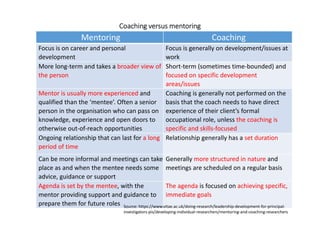
Coaching versusCoaching versusCoaching versusCoaching versus mentoringmentoringmentoringmentoring
Mentoring Coaching
Focus is on career and personal
development
Focus is generally on development/issues at
work
More long-term and takes a broader view of
the person
Short-term (sometimes time-bounded) and
focused on specific development
areas/issues
Mentor is usually more experienced and
qualified than the ‘mentee’. Often a senior
person in the organisation who can pass on
knowledge, experience and open doors to
otherwise out-of-reach opportunities
Coaching is generally not performed on the
basis that the coach needs to have direct
experience of their client’s formal
occupational role, unless the coaching is
specific and skills-focused
Ongoing relationship that can last for a long
period of time
Relationship generally has a set duration
Can be more informal and meetings can take
place as and when the mentee needs some
advice, guidance or support
Generally more structured in nature and
meetings are scheduled on a regular basis
Agenda is set by the mentee, with the
mentor providing support and guidance to
prepare them for future roles
The agenda is focused on achieving specific,
immediate goals
Source: https://www.vitae.ac.uk/doing-research/leadership-development-for-principal-
investigators-pis/developing-individual-researchers/mentoring-and-coaching-researchers
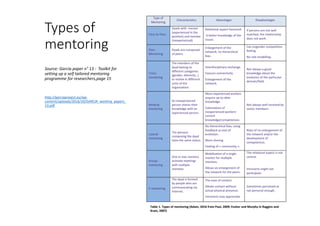
Types of
mentoring
Source: Garcia paper n° 13 : Toolkit for
setting up a self tailored mentoring
programme for researchers,page 15
http://garciaproject.eu/wp-
content/uploads/2016/10/GARCIA_working_papers_
13.pdf
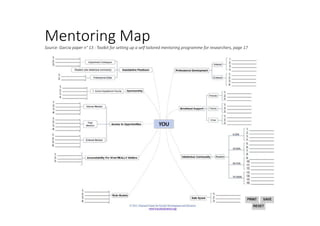
Mentoring MapSource: Garcia paper n° 13 : Toolkit for setting up a self tailored mentoring programme for researchers, page 17
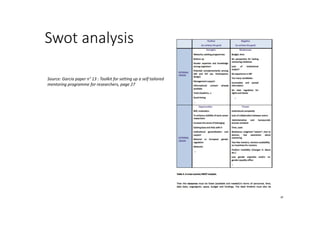
Swot analysis
Source: Garcia paper n° 13 : Toolkit for setting up a self tailored
mentoring programme for researchers, page 27
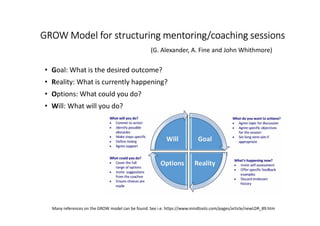
GROWGROWGROWGROW Model forModel forModel forModel for structuringstructuringstructuringstructuring mentoringmentoringmentoringmentoring/coaching sessions/coaching sessions/coaching sessions/coaching sessions
• Goal: What is the desired outcome?
• Reality: What is currently happening?
• Options: What could you do?
• Will: What will you do?
(G. Alexander, A. Fine and John Whithmore)
Many references on the GROW model can be found. See i.e. https://www.mindtools.com/pages/article/newLDR_89.htm
Goal setting exercise- a template to
help mentees defining their goals
• 1. What do you want out of life?
• 2. What professional positions or roles would you like to have in your career?
• 3. Where do you want to be one year from now? What about three years from
now? Or five years
• from now?
• 4. Can you achieve your career objectives with your current skill set? If not,
what skills or training
• might you need to reach your career objectives?
• 5. What will you be able to do as a result of achieving your goal? Or, how will
your life be different as a
• result of achieving your goal?
• 6. What character traits and competencies do you need to obtain your
objectives? Do you have these
• traits and competencies or do you need to develop them?
• 7. Are your objectives consistent with your philosophy of life?
(http://www. insuranceinstitute.ca)
Initial questions to the mentor
• Are my career success goals still appropriate?
• Have I chosen the right signifiers of success?
• Have I got my priorities right for to uncover mismatches between effort
and impact?
• What else should I be thinking about at this stage?
Really helpful in the context of monitoring your progress when you need a
clear perspectives on things done and thing still to do
Being able to monitor your progress is an essential skill for most positions,
allowing you to better organise your workload and to ensure that you're
taking regular, well-structured steps towards achieving goals. In the
context of a research leadership career it can be more challenging, since
the outcomes may be less easily quantified
After your 1st meeting, as mentee,
ask yourself these questions:
• Do they understand your goals?
• How often are they available to meet?
• Do they have the same philosophy towards work/life
balance as you?
• Have they been a successful mentor in the past?
• What is their mentorship philosophy?
• Do they seem supportive?
• Do you get along?
• Would you feel comfortable coming to them with a
problem?
When is it over?
When they have reached their goals or when mentees and
mentors believe it is time to move on, they should end the
relationship.
Formally ending the relationship will help them maintain good
relations going forward.
This could be expressly stated in the ‘rules of the game’
prepared for both mentors and mentees by the organization.
A switch in perspective : how
mentees can support mentors ;-)
• Remember, you have valuable skills to share. What could you teach your
mentor that would make their life easier?
• Junior members of staff and postgraduates usually have social media
skills; advice that a mentor without those skills would find valuable.
• Just because someone is further along the career path does not mean
that they know everything. I have supervised students who had brilliant
ideas and approached problems with a fresh perspective.
• Carving out a successful academic career can be difficult, with many
setbacks along the way. Having someone on your side as your champion
can make all the difference to succeeding in building your academic
track-record.
• Good mentors, especially awesome mentors, are hard to find. In the
meantime, to widen your knowledge, consider taking advantage of
blogs, forums, as sources of inspiration.
Is an in-house mentoring program
right for your organisation?
Mentoring Advantage programme of CIP Society, a division of the Insurance Institute, Canada
(http://www. insuranceinstitute.ca) suggest to Answer true or false quiz for organizations:
1. Mentoring is ideal for helping staff with issues of work/life balance.
2. Our managers are expected to coach their staff on a variety of things, so mentoring is not
needed.
3. Acting as a mentor can improve the person’s job performance.
4. Having a mentoring program can create a climate of favouritism.
5. Our organization has an Employee Assistance Program (EAP), so we don’t need a mentoring
program.
6. The skills necessary to be an effective mentor cannot be taught so if our organization doesn’t
have people with solid mentoring skills the program will flop.
7. Workers who have been mentored are more inclined to act as mentors.
8. Once a mentoring program is solidly established, monitoring is not important.
9. Mentoring goes hand-in-hand with training and development initiatives as well as performance
evaluation.
10. Our organization cannot afford to institute an in-house mentoring program.
Answers can be found on : https://www.insuranceinstitute.ca/-/media/Mentoring/Mentoring-PDF-tools/True-or-false-quiz-
for-organizations.pdf
MentoringMentoringMentoringMentoring researchersresearchersresearchersresearchers----
Useful docs
Institutional mentoring programme
Euraxess Top IV (Gr. No:786133), Task 2.3 Community of Practice
Webinar for Euraxess Staff & Career Development Center
Mentoring programme
Here are some ways to signal your organization’s commitment to a mentoring
programme:
• Include top management in the program design and administration.
• Market the program to staff
• Tell about the program when recruiting
• Encourage top leaders to participate as mentors
• Let program participants use work time for their mentoring activities.
• Reward staff for participating
• Hold events that spotlight the program (for example, a kickoff) and ensure
that high-level management attend the events
• Ensure the program administrator is effective, approachable, and available:
this is Euraxess staff 
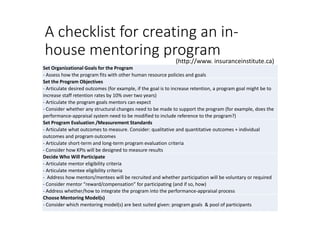
A checklist for creating an in-
house mentoring program
Set Organizational Goals for the Program
- Assess how the program fits with other human resource policies and goals
Set the Program Objectives
- Articulate desired outcomes (for example, if the goal is to increase retention, a program goal might be to
increase staff retention rates by 10% over two years)
- Articulate the program goals mentors can expect
- Consider whether any structural changes need to be made to support the program (for example, does the
performance-appraisal system need to be modified to include reference to the program?)
Set Program Evaluation /Measurement Standards
- Articulate what outcomes to measure. Consider: qualitative and quantitative outcomes + individual
outcomes and program outcomes
- Articulate short-term and long-term program evaluation criteria
- Consider how KPIs will be designed to measure results
Decide Who Will Participate
- Articulate mentor eligibility criteria
- Articulate mentee eligibility criteria
- Address how mentors/mentees will be recruited and whether participation will be voluntary or required
- Consider mentor “reward/compensation” for participating (and if so, how)
- Address whether/how to integrate the program into the performance-appraisal process
Choose Mentoring Model(s)
- Consider which mentoring model(s) are best suited given: program goals & pool of participants
(http://www. insuranceinstitute.ca)
Formal agreement? An example
We [fill in the names of the mentor and mentee] have met and have decided to commit to
working together in a mentor/mentee relationship.
Goals and objectives
• We agree to enter into a mentoring relationship to focus on: [list the goals and objectives
you have set]
We agree to work together on the following to help the mentee achieve the goals and
objectives described above: [list specific actions you may have agreed upon]
Ways of working together: To help ensure that the relationship is beneficial and satisfying for
both of us, we have also discussed and agreed on the ways we will work together, including:
• We agree to do our best to meet [fill in how often and by what method(s), for
example, in person, by phone, e-mail, etc.]
• We agree to the following guidelines: [fill out any other guidelines you have
established – if there aren’t any, you can omit this item]
Feedback: We agree to be open to feedback and we agree to provide feedback respectfully,
honestly, and professionally.
Confidentiality: We agree that confidentiality is critical and we agree that we will not
mention to anyone else anything we learn about each other or anything that we discuss
unless both of us agree – in advance – that we may share anything we learn as a result of this
relationship.
Professionalism and ethics: We agree to behave professionally and to adhere to the CIP
Society’s Code of Ethics.
(http://www. insuranceinstitute.ca)
MentoringMentoringMentoringMentoring researchersresearchersresearchersresearchers----
References
Euraxess Top IV (Gr. No:786133), Task 2.3 Community of Practice
Webinar for Euraxess Staff & Career Development Center
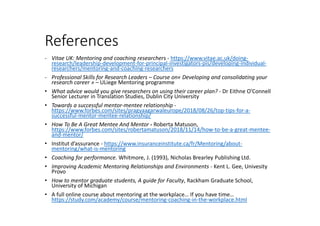
References
- Vitae UK: Mentoring and coaching researchers - https://www.vitae.ac.uk/doing-
research/leadership-development-for-principal-investigators-pis/developing-individual-
researchers/mentoring-and-coaching-researchers
- Professional Skills for Research Leaders – Course on« Developing and consolidating your
research career » – ULiege Mentoring programme
• What advice would you give researchers on using their career plan? - Dr Eithne O'Connell
Senior Lecturer in Translation Studies, Dublin City University
• Towards a successful mentor-mentee relationship -
https://www.forbes.com/sites/pragyaagarwaleurope/2018/08/26/top-tips-for-a-
successful-mentor-mentee-relationship/
• How To Be A Great Mentee And Mentor - Roberta Matuson,
https://www.forbes.com/sites/robertamatuson/2018/11/14/how-to-be-a-great-mentee-
and-mentor/
• Institut d’assurance - https://www.insuranceinstitute.ca/fr/Mentoring/about-
mentoring/what-is-mentoring
• Coaching for performance. Whitmore, J. (1993), Nicholas Brearley Publishing Ltd.
• Improving Academic Mentoring Relationships and Environments - Kent L. Gee, Univesity
Provo
• How to mentor graduate students, A guide for Faculty, Rackham Graduate School,
University of Michigan
• A full online course about mentoring at the workplace… If you have time…
https://study.com/academy/course/mentoring-coaching-in-the-workplace.html
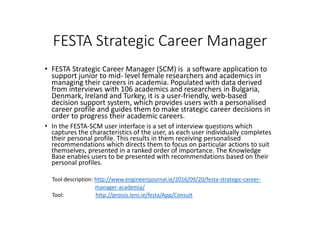
FESTA Strategic Career Manager
• FESTA Strategic Career Manager (SCM) is a software application to
support junior to mid- level female researchers and academics in
managing their careers in academia. Populated with data derived
from interviews with 106 academics and researchers in Bulgaria,
Denmark, Ireland and Turkey, it is a user-friendly, web-based
decision support system, which provides users with a personalised
career profile and guides them to make strategic career decisions in
order to progress their academic careers.
• In the FESTA-SCM user interface is a set of interview questions which
captures the characteristics of the user, as each user individually completes
their personal profile. This results in them receiving personalised
recommendations which directs them to focus on particular actions to suit
themselves, presented in a ranked order of importance. The Knowledge
Base enables users to be presented with recommendations based on their
personal profiles.
Tool description: http://www.engineersjournal.ie/2016/09/20/festa-strategic-career-
manager-academia/
Tool: http://proisis.lero.ie/festa/App/Consult
Mentoring programme on EU organisations websites
• Vitae UK - https://www.vitae.ac.uk
• KUL - https://admin.kuleuven.be/personeel/opleiding-
ontwikkeling/mentoring
• UGhent - https://www.ugent.be/en/work/mobility-
career/postdoc-talent-management/mentoring/overview.htm
• ULiege
• http://www.hec.ulg.ac.be/fr/hec-liege/accelerateurs-
talents/mentoring-au-feminin
• http://www.openbordersmba.com/sites/default/files/upload
s/HEC/Accelerateurs/Charte_HEC-
ULg%20Fe%CC%81minin%202018.pdf
• https://www.recherche.uliege.be/cms/c_10289096/fr/psrl
Please share with the buddy group
your good practices, other useful
tools and references!
Euraxess Top IV (Gr. No:786133), Task 2.3 Community of Practice
Webinar for Euraxess Staff & Career Development Center
Thanks! Brigitte and Isabelle; euraxess@uliege.be
Please share with the buddy group:
good practices, other useful tools and references ,
thanks !
Brigitte and Isabelle
euraxess@uliege.be

Mentoring researchers - useful documents

  • 1.
    MentoringMentoringMentoringMentoring researchersresearchersresearchersresearchers---- Useful documents EuraxessTop IV (Gr. No:786133), Task 2.3 Community of Practice Webinar for Euraxess Staff & Career Development Center Isabelle Halleux, Research Office Brigitte Ernst, Euraxess Services Centre euraxess@uliege.be
  • 2.
    MentoringMentoringMentoringMentoring researchersresearchersresearchersresearchers---- Useful docs Mentoring EuraxessTop IV (Gr. No:786133), Task 2.3 Community of Practice Webinar for Euraxess Staff & Career Development Center
  • 3.
    Coaching versusCoaching versusCoachingversusCoaching versus mentoringmentoringmentoringmentoring Mentoring Coaching Focus is on career and personal development Focus is generally on development/issues at work More long-term and takes a broader view of the person Short-term (sometimes time-bounded) and focused on specific development areas/issues Mentor is usually more experienced and qualified than the ‘mentee’. Often a senior person in the organisation who can pass on knowledge, experience and open doors to otherwise out-of-reach opportunities Coaching is generally not performed on the basis that the coach needs to have direct experience of their client’s formal occupational role, unless the coaching is specific and skills-focused Ongoing relationship that can last for a long period of time Relationship generally has a set duration Can be more informal and meetings can take place as and when the mentee needs some advice, guidance or support Generally more structured in nature and meetings are scheduled on a regular basis Agenda is set by the mentee, with the mentor providing support and guidance to prepare them for future roles The agenda is focused on achieving specific, immediate goals Source: https://www.vitae.ac.uk/doing-research/leadership-development-for-principal- investigators-pis/developing-individual-researchers/mentoring-and-coaching-researchers
  • 4.
    Types of mentoring Source: Garciapaper n° 13 : Toolkit for setting up a self tailored mentoring programme for researchers,page 15 http://garciaproject.eu/wp- content/uploads/2016/10/GARCIA_working_papers_ 13.pdf
  • 5.
    Mentoring MapSource: Garciapaper n° 13 : Toolkit for setting up a self tailored mentoring programme for researchers, page 17
  • 6.
    Swot analysis Source: Garciapaper n° 13 : Toolkit for setting up a self tailored mentoring programme for researchers, page 27
  • 7.
    GROWGROWGROWGROW Model forModelforModel forModel for structuringstructuringstructuringstructuring mentoringmentoringmentoringmentoring/coaching sessions/coaching sessions/coaching sessions/coaching sessions • Goal: What is the desired outcome? • Reality: What is currently happening? • Options: What could you do? • Will: What will you do? (G. Alexander, A. Fine and John Whithmore) Many references on the GROW model can be found. See i.e. https://www.mindtools.com/pages/article/newLDR_89.htm
  • 8.
    Goal setting exercise-a template to help mentees defining their goals • 1. What do you want out of life? • 2. What professional positions or roles would you like to have in your career? • 3. Where do you want to be one year from now? What about three years from now? Or five years • from now? • 4. Can you achieve your career objectives with your current skill set? If not, what skills or training • might you need to reach your career objectives? • 5. What will you be able to do as a result of achieving your goal? Or, how will your life be different as a • result of achieving your goal? • 6. What character traits and competencies do you need to obtain your objectives? Do you have these • traits and competencies or do you need to develop them? • 7. Are your objectives consistent with your philosophy of life? (http://www. insuranceinstitute.ca)
  • 9.
    Initial questions tothe mentor • Are my career success goals still appropriate? • Have I chosen the right signifiers of success? • Have I got my priorities right for to uncover mismatches between effort and impact? • What else should I be thinking about at this stage? Really helpful in the context of monitoring your progress when you need a clear perspectives on things done and thing still to do Being able to monitor your progress is an essential skill for most positions, allowing you to better organise your workload and to ensure that you're taking regular, well-structured steps towards achieving goals. In the context of a research leadership career it can be more challenging, since the outcomes may be less easily quantified
  • 10.
    After your 1stmeeting, as mentee, ask yourself these questions: • Do they understand your goals? • How often are they available to meet? • Do they have the same philosophy towards work/life balance as you? • Have they been a successful mentor in the past? • What is their mentorship philosophy? • Do they seem supportive? • Do you get along? • Would you feel comfortable coming to them with a problem?
  • 11.
    When is itover? When they have reached their goals or when mentees and mentors believe it is time to move on, they should end the relationship. Formally ending the relationship will help them maintain good relations going forward. This could be expressly stated in the ‘rules of the game’ prepared for both mentors and mentees by the organization.
  • 12.
    A switch inperspective : how mentees can support mentors ;-) • Remember, you have valuable skills to share. What could you teach your mentor that would make their life easier? • Junior members of staff and postgraduates usually have social media skills; advice that a mentor without those skills would find valuable. • Just because someone is further along the career path does not mean that they know everything. I have supervised students who had brilliant ideas and approached problems with a fresh perspective. • Carving out a successful academic career can be difficult, with many setbacks along the way. Having someone on your side as your champion can make all the difference to succeeding in building your academic track-record. • Good mentors, especially awesome mentors, are hard to find. In the meantime, to widen your knowledge, consider taking advantage of blogs, forums, as sources of inspiration.
  • 13.
    Is an in-housementoring program right for your organisation? Mentoring Advantage programme of CIP Society, a division of the Insurance Institute, Canada (http://www. insuranceinstitute.ca) suggest to Answer true or false quiz for organizations: 1. Mentoring is ideal for helping staff with issues of work/life balance. 2. Our managers are expected to coach their staff on a variety of things, so mentoring is not needed. 3. Acting as a mentor can improve the person’s job performance. 4. Having a mentoring program can create a climate of favouritism. 5. Our organization has an Employee Assistance Program (EAP), so we don’t need a mentoring program. 6. The skills necessary to be an effective mentor cannot be taught so if our organization doesn’t have people with solid mentoring skills the program will flop. 7. Workers who have been mentored are more inclined to act as mentors. 8. Once a mentoring program is solidly established, monitoring is not important. 9. Mentoring goes hand-in-hand with training and development initiatives as well as performance evaluation. 10. Our organization cannot afford to institute an in-house mentoring program. Answers can be found on : https://www.insuranceinstitute.ca/-/media/Mentoring/Mentoring-PDF-tools/True-or-false-quiz- for-organizations.pdf
  • 14.
    MentoringMentoringMentoringMentoring researchersresearchersresearchersresearchers---- Useful docs Institutionalmentoring programme Euraxess Top IV (Gr. No:786133), Task 2.3 Community of Practice Webinar for Euraxess Staff & Career Development Center
  • 15.
    Mentoring programme Here aresome ways to signal your organization’s commitment to a mentoring programme: • Include top management in the program design and administration. • Market the program to staff • Tell about the program when recruiting • Encourage top leaders to participate as mentors • Let program participants use work time for their mentoring activities. • Reward staff for participating • Hold events that spotlight the program (for example, a kickoff) and ensure that high-level management attend the events • Ensure the program administrator is effective, approachable, and available: this is Euraxess staff 
  • 16.
    A checklist forcreating an in- house mentoring program Set Organizational Goals for the Program - Assess how the program fits with other human resource policies and goals Set the Program Objectives - Articulate desired outcomes (for example, if the goal is to increase retention, a program goal might be to increase staff retention rates by 10% over two years) - Articulate the program goals mentors can expect - Consider whether any structural changes need to be made to support the program (for example, does the performance-appraisal system need to be modified to include reference to the program?) Set Program Evaluation /Measurement Standards - Articulate what outcomes to measure. Consider: qualitative and quantitative outcomes + individual outcomes and program outcomes - Articulate short-term and long-term program evaluation criteria - Consider how KPIs will be designed to measure results Decide Who Will Participate - Articulate mentor eligibility criteria - Articulate mentee eligibility criteria - Address how mentors/mentees will be recruited and whether participation will be voluntary or required - Consider mentor “reward/compensation” for participating (and if so, how) - Address whether/how to integrate the program into the performance-appraisal process Choose Mentoring Model(s) - Consider which mentoring model(s) are best suited given: program goals & pool of participants (http://www. insuranceinstitute.ca)
  • 17.
    Formal agreement? Anexample We [fill in the names of the mentor and mentee] have met and have decided to commit to working together in a mentor/mentee relationship. Goals and objectives • We agree to enter into a mentoring relationship to focus on: [list the goals and objectives you have set] We agree to work together on the following to help the mentee achieve the goals and objectives described above: [list specific actions you may have agreed upon] Ways of working together: To help ensure that the relationship is beneficial and satisfying for both of us, we have also discussed and agreed on the ways we will work together, including: • We agree to do our best to meet [fill in how often and by what method(s), for example, in person, by phone, e-mail, etc.] • We agree to the following guidelines: [fill out any other guidelines you have established – if there aren’t any, you can omit this item] Feedback: We agree to be open to feedback and we agree to provide feedback respectfully, honestly, and professionally. Confidentiality: We agree that confidentiality is critical and we agree that we will not mention to anyone else anything we learn about each other or anything that we discuss unless both of us agree – in advance – that we may share anything we learn as a result of this relationship. Professionalism and ethics: We agree to behave professionally and to adhere to the CIP Society’s Code of Ethics. (http://www. insuranceinstitute.ca)
  • 18.
    MentoringMentoringMentoringMentoring researchersresearchersresearchersresearchers---- References Euraxess TopIV (Gr. No:786133), Task 2.3 Community of Practice Webinar for Euraxess Staff & Career Development Center
  • 19.
    References - Vitae UK:Mentoring and coaching researchers - https://www.vitae.ac.uk/doing- research/leadership-development-for-principal-investigators-pis/developing-individual- researchers/mentoring-and-coaching-researchers - Professional Skills for Research Leaders – Course on« Developing and consolidating your research career » – ULiege Mentoring programme • What advice would you give researchers on using their career plan? - Dr Eithne O'Connell Senior Lecturer in Translation Studies, Dublin City University • Towards a successful mentor-mentee relationship - https://www.forbes.com/sites/pragyaagarwaleurope/2018/08/26/top-tips-for-a- successful-mentor-mentee-relationship/ • How To Be A Great Mentee And Mentor - Roberta Matuson, https://www.forbes.com/sites/robertamatuson/2018/11/14/how-to-be-a-great-mentee- and-mentor/ • Institut d’assurance - https://www.insuranceinstitute.ca/fr/Mentoring/about- mentoring/what-is-mentoring • Coaching for performance. Whitmore, J. (1993), Nicholas Brearley Publishing Ltd. • Improving Academic Mentoring Relationships and Environments - Kent L. Gee, Univesity Provo • How to mentor graduate students, A guide for Faculty, Rackham Graduate School, University of Michigan • A full online course about mentoring at the workplace… If you have time… https://study.com/academy/course/mentoring-coaching-in-the-workplace.html
  • 20.
    FESTA Strategic CareerManager • FESTA Strategic Career Manager (SCM) is a software application to support junior to mid- level female researchers and academics in managing their careers in academia. Populated with data derived from interviews with 106 academics and researchers in Bulgaria, Denmark, Ireland and Turkey, it is a user-friendly, web-based decision support system, which provides users with a personalised career profile and guides them to make strategic career decisions in order to progress their academic careers. • In the FESTA-SCM user interface is a set of interview questions which captures the characteristics of the user, as each user individually completes their personal profile. This results in them receiving personalised recommendations which directs them to focus on particular actions to suit themselves, presented in a ranked order of importance. The Knowledge Base enables users to be presented with recommendations based on their personal profiles. Tool description: http://www.engineersjournal.ie/2016/09/20/festa-strategic-career- manager-academia/ Tool: http://proisis.lero.ie/festa/App/Consult
  • 21.
    Mentoring programme onEU organisations websites • Vitae UK - https://www.vitae.ac.uk • KUL - https://admin.kuleuven.be/personeel/opleiding- ontwikkeling/mentoring • UGhent - https://www.ugent.be/en/work/mobility- career/postdoc-talent-management/mentoring/overview.htm • ULiege • http://www.hec.ulg.ac.be/fr/hec-liege/accelerateurs- talents/mentoring-au-feminin • http://www.openbordersmba.com/sites/default/files/upload s/HEC/Accelerateurs/Charte_HEC- ULg%20Fe%CC%81minin%202018.pdf • https://www.recherche.uliege.be/cms/c_10289096/fr/psrl
  • 22.
    Please share withthe buddy group your good practices, other useful tools and references! Euraxess Top IV (Gr. No:786133), Task 2.3 Community of Practice Webinar for Euraxess Staff & Career Development Center Thanks! Brigitte and Isabelle; euraxess@uliege.be
  • 23.
    Please share withthe buddy group: good practices, other useful tools and references , thanks ! Brigitte and Isabelle euraxess@uliege.be