Monitoring CO in Ambient Air
Direct Reading NDIR Method
CO Methods of analysis
Methods available to monitor CO in ambient air
• IR Absorption
• IR Absorption GFC
• Open path spectrometry, ( IR DOAS)
EC9830 GFC CO Analyzer
• Gas Filter Correlation Carbon Monoxide (CO) Analyzer
• NDIR Gas Filter correlation technique The EC9830 analyzer operates by
measuring CO absorption of IR radiation at highly specific wavelengths near 4.7
microns.
• The Analyzer uses an Optical Bench with a 5-meter folded path-length.
• The gas filter correlation wheel facilitates rejection of interference and the narrow
band -pass filter ensures measuring only the CO-sensitive IR wavelengths.
• The CO content of the sample is continuously measured from a user-supplied air
stream of which the instrument extracts 1 SLPM (standard liter per minute) of
sample.
EC9830 GFC CO Analyzer
• Operation
While the instrument is operating, the filter wheel is continuously rotating.
First, consider the difference in the detector signals between the CO and
the N2 cells. signal passes CO cell,which is the reference signal. And the
signal that passes the N2 cell which is the measurement signal this is
composed of all wavelengths not absorbed by CO. The third signal is the
dark current signal which is the signal without IR. The rotation of GFW
creates the “reference” and “measure” phases. The reference and
measure phase signal share the same source, detector, optical path; only
the amount of CO in the sample cell can effect the difference in intensity
between the two phases.
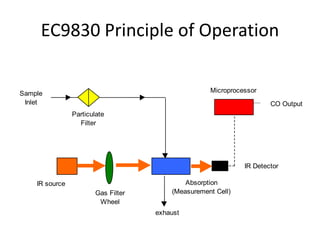
EC9830 Principle of Operation
Sample
Inlet
Particulate
Filter
Absorption
(Measurement Cell)
IR Detector
Microprocessor
CO Output
exhaust
IR source
Gas Filter
Wheel
EC9830 GFC CO Analyzer
Optical Bench with Multiple Path
EC9830 GFC CO Analyzer
Analyzer Specifications
• Range: 0 - 50 ppm to 200 ppm
• Resolution: 0.01 ppm
• Precision: 0.1 ppm
• Lower detectable reading: 0.05 ppm
• Noise: 0.025 ppm
• Sample Flow Rate 1.0 slpm
• Rise/Fall time, 95% of scale: Less than 40 seconds
• Temperature range 5º to 40 º C

Co analyzer updated

  • 1.
    Monitoring CO inAmbient Air Direct Reading NDIR Method
  • 2.
    CO Methods ofanalysis Methods available to monitor CO in ambient air • IR Absorption • IR Absorption GFC • Open path spectrometry, ( IR DOAS)
  • 3.
    EC9830 GFC COAnalyzer • Gas Filter Correlation Carbon Monoxide (CO) Analyzer • NDIR Gas Filter correlation technique The EC9830 analyzer operates by measuring CO absorption of IR radiation at highly specific wavelengths near 4.7 microns. • The Analyzer uses an Optical Bench with a 5-meter folded path-length. • The gas filter correlation wheel facilitates rejection of interference and the narrow band -pass filter ensures measuring only the CO-sensitive IR wavelengths. • The CO content of the sample is continuously measured from a user-supplied air stream of which the instrument extracts 1 SLPM (standard liter per minute) of sample.
  • 4.
    EC9830 GFC COAnalyzer • Operation While the instrument is operating, the filter wheel is continuously rotating. First, consider the difference in the detector signals between the CO and the N2 cells. signal passes CO cell,which is the reference signal. And the signal that passes the N2 cell which is the measurement signal this is composed of all wavelengths not absorbed by CO. The third signal is the dark current signal which is the signal without IR. The rotation of GFW creates the “reference” and “measure” phases. The reference and measure phase signal share the same source, detector, optical path; only the amount of CO in the sample cell can effect the difference in intensity between the two phases.
  • 5.
    EC9830 Principle ofOperation Sample Inlet Particulate Filter Absorption (Measurement Cell) IR Detector Microprocessor CO Output exhaust IR source Gas Filter Wheel
  • 6.
    EC9830 GFC COAnalyzer Optical Bench with Multiple Path
  • 7.
    EC9830 GFC COAnalyzer Analyzer Specifications • Range: 0 - 50 ppm to 200 ppm • Resolution: 0.01 ppm • Precision: 0.1 ppm • Lower detectable reading: 0.05 ppm • Noise: 0.025 ppm • Sample Flow Rate 1.0 slpm • Rise/Fall time, 95% of scale: Less than 40 seconds • Temperature range 5º to 40 º C

Editor's Notes