Monitoring Ozone in Ambient Air
Direct Reading – UV Photometry
UV ABSORPTION METHOD
• Ozone is continuously measured by ultraviolet absorption photometry.
• In the ultraviolet analyzer, a mercury vapor lamp is used to produce
ultraviolet radiation at 254 nm which is absorbed by the ozone in the air
sample. The ozone signal is determined by the difference between
ambient air containing ozone and ambient air with the ozone removed
or scrubbed.
• The ultraviolet analyzer is calibrated by comparison with an ozone
photometer which is certified as a transfer standard. The transfer
standard is certified against absolute ozone photometers located at the
California Air Resources Board test and laboratory facilities or NIST. The
minimum detectable level of UV monitors is about 2-5 ppbv.
UV ABSORPTION METHOD
• Interference's
• Water vapor may also interfere with the UV method when water vapor
concentrations are high and variable. These interference's appear to be due to
the condensation of water vapor on imperfect absorption cell windows and Ozone
scrubber.
• In tropical area we recommend the installation of heated “ Ozone Scrubber” to
reduce interference's from water vapour.
EC9810 Principle
Sample
Inlet
Particulate
Filter
Absorption
(Measurement Cell)
Detector
Microprocessor
O3 Output
exhaust
UV source
EC9810 Operation
The EC9810 ozone monitor is a US EPA equivalent method (U.V.) photometer.
This measurement principal is based on the ozone’s characteristics of
absorbing U.V.light at a wavelength of 253.7 nm. Two measurements of a
U.V. lamp’s light intensities are taken in a measurement cycle. In the first,
an air sample is passed directly to the sample cell, the second is directed
through the ozone scrubber. The scrubber function is to selectively
remove the ozone from the sample for the reference portion of the
measurement cycle,leaving all other potential interference’s intact.
These interference’s are then compensated by the differential process of
subtracting the measurement cycle from the reference cycle to produce
an ozone measurement.
Theory of operation cont.
– To avoid interference from a number of compounds absorbing light at
254 nm, the predominant wavelength emitted by the UV lamp, such
compounds include aromatics HC,NO, SO2,H2O and others including instability
of the light source. The scrubber selectively removes O3 but passes the
interfering compounds. Thus, the intensity ratio described in the previous
paragraph is a function of only ozone absorption.
Ozone Analyzers in use in India
• Envirotech commissioned the first Ozone
Analyzer at Hyderabad in 2006
• Early users of Ozone Analyzers supplied by Envirotech:
– Tata Power, Mumbai
– UP Pollution Control Board – Kanpur, Varanasi and Agra
– Sri Ramchandra Institute, Chennai
– Annamalai University, Chennai
– NIT, Trichy
Siting of Monitoring Station
Note that ozone is a reactive gas that is absorbed by vegetation,
measurements should therefore be carried out well away from plant life.
O3 Networks should sample 3-5m above ground level and more than 20 m
away from trees. Sampling manifolds should be made of material that is
inert to ozone, such as glass, Teflon,FEP, residence time of the sample gas
should be as short as possible. The sample lines to the analyzer should be
kept as short as possible to avoid losses, and should be thermally isolated
to prevent condensation. Any ambient NO present in the sample air will
react with some of the ozone during the residence time in the sample line.
EC9810 Specifications
• Ozone Range: 0 - 20 ppm
• Resolution: 0.001 ppm
• Precision : 0.001 ppm
• Zero drift 30 day: 0.001 ppm
• Span drift 30 day: 0.002 ppm/C0 or 0.5%
• Temperature range: 5-40 C0
• EPA designated range: 0 - 50 to 0 - 1000 ppb
• Sample flow: 0 - 0.5 to 0 - 0.75 slpm
Theory of operation cont.
Where:
(O3)= O3 concentration (ppm)
a= absorption coefficient of O3=308 atm -1
cm-1
l= optical path length (cm)
T= sample temperature (Ko
)
P= sample pressure, torr
L= correction factor for O3 losses
)
L
10
()
P
760
()
273
T
()
I
I
ln
al
1-
(=)(O
6
o
OUT3
Theory of operation cont.
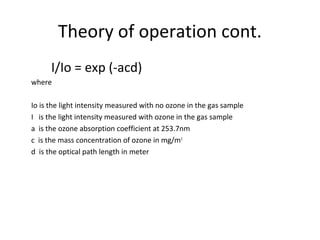
I/Io = exp (-acd)
where
Io is the light intensity measured with no ozone in the gas sample
I is the light intensity measured with ozone in the gas sample
a is the ozone absorption coefficient at 253.7nm
c is the mass concentration of ozone in mg/m3
d is the optical path length in meter

Ozone

  • 1.
    Monitoring Ozone inAmbient Air Direct Reading – UV Photometry
  • 2.
    UV ABSORPTION METHOD •Ozone is continuously measured by ultraviolet absorption photometry. • In the ultraviolet analyzer, a mercury vapor lamp is used to produce ultraviolet radiation at 254 nm which is absorbed by the ozone in the air sample. The ozone signal is determined by the difference between ambient air containing ozone and ambient air with the ozone removed or scrubbed. • The ultraviolet analyzer is calibrated by comparison with an ozone photometer which is certified as a transfer standard. The transfer standard is certified against absolute ozone photometers located at the California Air Resources Board test and laboratory facilities or NIST. The minimum detectable level of UV monitors is about 2-5 ppbv.
  • 3.
    UV ABSORPTION METHOD •Interference's • Water vapor may also interfere with the UV method when water vapor concentrations are high and variable. These interference's appear to be due to the condensation of water vapor on imperfect absorption cell windows and Ozone scrubber. • In tropical area we recommend the installation of heated “ Ozone Scrubber” to reduce interference's from water vapour.
  • 4.
  • 5.
    EC9810 Operation The EC9810ozone monitor is a US EPA equivalent method (U.V.) photometer. This measurement principal is based on the ozone’s characteristics of absorbing U.V.light at a wavelength of 253.7 nm. Two measurements of a U.V. lamp’s light intensities are taken in a measurement cycle. In the first, an air sample is passed directly to the sample cell, the second is directed through the ozone scrubber. The scrubber function is to selectively remove the ozone from the sample for the reference portion of the measurement cycle,leaving all other potential interference’s intact. These interference’s are then compensated by the differential process of subtracting the measurement cycle from the reference cycle to produce an ozone measurement.
  • 6.
    Theory of operationcont. – To avoid interference from a number of compounds absorbing light at 254 nm, the predominant wavelength emitted by the UV lamp, such compounds include aromatics HC,NO, SO2,H2O and others including instability of the light source. The scrubber selectively removes O3 but passes the interfering compounds. Thus, the intensity ratio described in the previous paragraph is a function of only ozone absorption.
  • 7.
    Ozone Analyzers inuse in India • Envirotech commissioned the first Ozone Analyzer at Hyderabad in 2006 • Early users of Ozone Analyzers supplied by Envirotech: – Tata Power, Mumbai – UP Pollution Control Board – Kanpur, Varanasi and Agra – Sri Ramchandra Institute, Chennai – Annamalai University, Chennai – NIT, Trichy
  • 8.
    Siting of MonitoringStation Note that ozone is a reactive gas that is absorbed by vegetation, measurements should therefore be carried out well away from plant life. O3 Networks should sample 3-5m above ground level and more than 20 m away from trees. Sampling manifolds should be made of material that is inert to ozone, such as glass, Teflon,FEP, residence time of the sample gas should be as short as possible. The sample lines to the analyzer should be kept as short as possible to avoid losses, and should be thermally isolated to prevent condensation. Any ambient NO present in the sample air will react with some of the ozone during the residence time in the sample line.
  • 9.
    EC9810 Specifications • OzoneRange: 0 - 20 ppm • Resolution: 0.001 ppm • Precision : 0.001 ppm • Zero drift 30 day: 0.001 ppm • Span drift 30 day: 0.002 ppm/C0 or 0.5% • Temperature range: 5-40 C0 • EPA designated range: 0 - 50 to 0 - 1000 ppb • Sample flow: 0 - 0.5 to 0 - 0.75 slpm
  • 10.
    Theory of operationcont. Where: (O3)= O3 concentration (ppm) a= absorption coefficient of O3=308 atm -1 cm-1 l= optical path length (cm) T= sample temperature (Ko ) P= sample pressure, torr L= correction factor for O3 losses ) L 10 () P 760 () 273 T () I I ln al 1- (=)(O 6 o OUT3
  • 11.
    Theory of operationcont. I/Io = exp (-acd) where Io is the light intensity measured with no ozone in the gas sample I is the light intensity measured with ozone in the gas sample a is the ozone absorption coefficient at 253.7nm c is the mass concentration of ozone in mg/m3 d is the optical path length in meter