DIAGNOSTIC MEASURES IN
NERVOUS SYSTEM
• The major diagnostic measures related to Central Nervous System are:-
– Lumbar puncture
– CSF analysis
– Cerebral angiography
– CT
– MRI
– Magnetic resonance angiography
– PET scan
– SPECT scan
– Cerebral ultrasound
– EEG
– EMG
– Myelography
– Evoked potential
LUMBAR PUNCTURE AND CSF
ANALYSIS
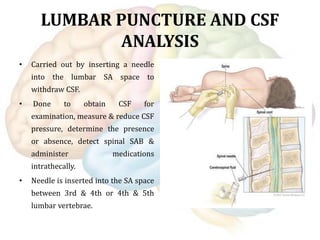
• Carried out by inserting a needle
into the lumbar SA space to
withdraw CSF.
• Done to obtain CSF for
examination, measure & reduce CSF
pressure, determine the presence
or absence, detect spinal SAB &
administer medications
intrathecally.
• Needle is inserted into the SA space
between 3rd & 4th or 4th & 5th
lumbar vertebrae.
• Specimens are obtained for cell count, culture &
glucose & protein testing.
• Specimen should be sent to lab immediately
because changes will take place & alter result if
allowed to stand.
• Lumbar puncture and CSF analysis.
• Result:. 70-200 mmh20- normal CSF pressure with the
pt in lateral recumbent .
• Should be clear & color less.
• Pink, blood-tinged or grossly bloody CSF may indicate
a cerebral contusion, laceration or hemorrhage.
COMPLICATIONS:
• Herniation of intracranial contentsb.
• Spinal epidural abscess/hematoma.
• Meningitis.
• Temporary voiding problems.
• Slight increase of temperature.
• Backache or spasms.
• Stiffness of neck.
• Post lumbar puncture headache
POST LUMBAR PUNCTURE
HEADACHE
• Caused by CSF leakage at the puncture site. The fluid
continues to escape into the tissues by way of the
needle track, from the spinal canal. It is then absorbed
promptly by the lymphatics.
• As a result, the supply of CSF in the cranium is
depleted at point at which it is insufficient to maintain
proper mechanical stabilization of the brain.
• This leakage of CSF allows settling of the brain
when the patient assumes an upright position,
producing tension & stretching the venous sinuses
and pain-sensitive structures.
• Both traction and pain are lessened & the leakage
is reduced when the pt lies down.
NURSING INTERVENTIONS
• Signed consent and void before the procedure. Use
small gauged needles.
• Instruct to relax to avoid traumatic or bloody tap, fetal
position. A local anesthetic will be used.
• Patient remains on prone position 2 – 3 hours post
procedure
• Headache is managed by rest, analgesics & hydration
CT SCAN
• It is a non-invasive and painless
procedure & has a high degree
of sensitivity for detecting
lesions.- makes use of a narrow
x-ray beam to scan the head in
successive layers. The images
provide cross sectional views of
the brain or other organs.-
performed first without
contrast then with IV contrast
enhancement.-
NURSING INTERVENTIONS
• patient lies in adjustable table with the head in
fixed position while the scan system rotates
around the head & produces cross-sectional
images.
• The patient must stay still because motion will
distort the image
• Teaching the patient about the need to lie quietly and still
throughout the procedure.
• Sedation can be used if agitation, restlessness or confusion
will interfere with a successful study.
• Instruct patient to be on nothing per oral for at least 4
hours.
• Monitoring pt for allergic reaction of contrast agent and
other side effects
• Increase hydration to flush out contrast
• It is useful in showing metabolic changes in
the brain (Alzheimer’s), locating lesion
(tumor, epileptogenic lesion), identifying
blood flow and O2 metabolism in patients
with strokes, evaluating new therapies for
brain tumors and revealing biochemical
abnormalities associated with mental
illness.
ELECTROENCEPHALOGRAPHY
• Represents a record of the
electrical activity generated
in the brain. Obtained
through electrodes applied in
the scalp or through
electrodes applied within the
brain tissue.
• Provides a physiologic
assessment of cerebral
activity.
• Electrical activity of brain is recorded using scalp
electrodes. Evaluates seizure disorders, cerebral disease,
CNS effects of systemic diseases, brain injury, brain death.
Specific tests may be done to evaluate brains electrical
response to lights and loud noises
• Nurses Responsibility
– Before: Tell patient procedure is noninvasive and without danger of
electric shock.
– Determine if any medications (e-8, tranquilizers, anti – seizure
drugs) should be withheld.
– After: Resume medications and have patient wash electrode paste
out of hair.
• Useful test for diagnosing and evaluating seizure
disorders, coma, or organic brain syndromes.
Tumors brain abscesses, blood clots, and infection
may cause abnormal patterns in electrical activity.
NURSING INTERVENTIONS
• Patient is deprived of sleep.
• Anti-seizures, tranquilizers, stimulants, depressants are
withheld 24-48 hours (can alter/mask abnormal wave patterns
of seizure disorders.
• No coffee, tea, chocolate & cola (all stimulants)
• Meal should NOT be omitted - altered blood glucose change
brain wave.
• Patient is informed that it would take 45-60 minutes for awake
& 12 hours for sleep EEG.
MYELOGRAPHY
• An x-ray of the spinal subarachnoid space taken
after the injection of contrast agent into the spinal
subarachnoid space through a lumbar puncture.
• Shows any distortion of the spinal cord or spinal
dural sac caused by tumors, cysts, herniated
vertebral disks or other lesions
NURSING INTERVENTIONS
• Information of the procedure; meal prior to
procedure is omitted;
• Sedative may be given
• After procedure, patient may lie in bed with HOB
at 30-45 degrees for 3 hours.
Electromyography
• Electromyography (EMG) is the recording of electrical activity
associated with innervation of skeletal muscle. Needle
electrodes are inserted into the muscle to record specific motor
units. Normal muscle at rest shows no electrical activity.
Electrical activity occurs only when the muscle contracts.
• Activity may be altered in diseases of muscle (eg, myopathic
conditions) or in disorders of muscle innervation (eg, segmental
or LMN lesions, peripheral neuropathic conditions).
• Nurses Responsibility
– Before: Explain procedure. Tell patient that pain and discomfort are
associated with insertion of needles. HCPs may caffeine) restrict
simulants (e.g. caffeine) 2-3 hrs prior.
– After Assess needle sites for hematoma or inflammation. Give as-
needed analgesics.
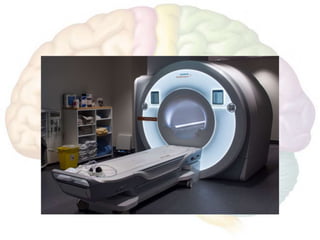
MAGNETIC RESONANCE IMAGING
• Helps identify cerebral abnormality more early
and clearly than other test by using a highly
magnetic field.
• The test may be done with or without a contrast.
• The magnet causes hydrogen ions in the body
(protons) to align like small magnets and emit
signals which are converted into images.
NURSING REPONSIBILITIES
• Remove all metal objects from the patient and inside the
examination room.
• Instruct patient that it is painless but he may hear loud
thumping
• Inform that he or she may communicate to the staff via a
microphone inside the scanner.
• For claustrophobic patients, sedation may be used.
• Ask about history of pacemaker or cochlear implants.
CEREBRAL ANGIOGRAPHY
• X – ray study of cerebral
circulation after injection of a
dye to a selected artery (usually
femoral artery) under local
anesthesia and heparinized
saline.
• Valuable for detection of
aneurysm, AV malformations
and other vascular diseases.
• Series of X-rays are taken.
NURSING RESPONSIBILITIES
• Ensure well hydration and clear
liquids before the test.
• Instruct to void before the test.
• Location of peripheral pulses are
marked with a felt – tip pen.
• Shave the area (groin).
• Instruct to remain immobile during
the test, brief feeling of warmth
behind the eyes, face, jaw, teeth,
tongue and lips and a metallic taste
after dye injection..
• After the test, monitor for signs
and symptoms of occlusion,
apply cold compress to relive
hematoma.
• Closely observe for bleeding.
• Instruct the patient to expect a
warm feeling over the face and
metallic taste when the dye is
injected.
CEREBRAL ULTRASOUND
• Ultrasound imaging of the head
uses sound waves to produce
pictures of the brain and
cerebrospinal fluid. It is most
commonly performed on infants,
whose skulls have not completely
formed.
• A transcranial Doppler ultrasound
evaluates blood flow in the brain's
major arteries. Ultrasound is safe,
noninvasive, and does not use
ionizing radiation.
Positron Emission Tomography (PET)
• Computerized nuclear imaging technique that
produces images of actual organ functioning.
Patient either inhales radioactive gas or injected,
that emits positively charged particles
• It produces a 3-D image of functional processes in
the body by detecting the radiation emitted by
photons .
• The system detects pairs of gamma rays emitted indirectly by
positron emitting radionuclide (tracer), which was previously
injected in body on a biologically active molecule.
• 3-D images of tracer concentration within the body are then
constructed by computer analysis
• Modification of PET is called SPECT.
– SPECT uses less precise but more stable and
commercially available isotopes to measure cerebral
blood flow.
NURSING INTERVENTIONS
• Patient preparation
• Explanation of the test
• Teaching patient of inhalation techniques
• Sensation
EVOKED POTENTIAL
• Evoked potentials (EPs) are a
useful diagnostic test to help
identify abnormalities of the
peripheral and central nervous
system that may help explain
why the patient is having pain
or functional disability.
• It used to assess the trasmit
time of afferent pathway of the
cerebral hemisphere and the
brain stem.
• Stimulus used are .
• Visual, entering the body
through the eyes
• Auditory, entering through the
ears
• Somatosensory stimulation or
touch, when sensations enter
via the skin
• Evoked potentials :- electrical activity associated
with nerve conduction along sensory pathways is
recorded by electrodes placed on skin and scalp. A
Stimulus generates the impulse. Increases in the
normal time from stimulus onset to a given peak
(latency) indicate slowed nerve conduction or nerve
damage. Used to diagnose disease (e.g, MS), locate
nerve damage, and monitor function during surgery.
Can diagnose disorders of the visual or auditory
systems because it shows if a sensory impulse is
reaching the right part of brain.
• Nurses Responsibility
– Before: Explain procedure to patient. Have patient
shampoo hair before test.
Elecroneurograpy
• Elecroneurograpy conduction (nerve studies) Measures
nerve conduction velocity of peripheral nerves. involves
applying a brief electrical stimulus to a distal portion of
a sensory nerve and recording the resulting wave of
depolarization at a point proximal to the stimulation.
The time between the stimulus onset and the first wave
of depolarization at the recording electrode is measured.
Damaged nerves have slower conduction velocities.
• Nurses Responsibility
– Before: Explain procedure to patient For example, a stimulus
can be applied to the forefinger and a recording electrode
placed over the median nerve at the wrist will detect the
speed of the conduction.
Magnetoencephalography
• Magnetoencephalography :- Uses a
biomagnetometer to detect magnetic fields
generated by neural activity, Can accurately
pinpoint the part of the brain involved in a
stroke, seizure or other disorder or injury.
Measures , extracranial magnetic fields and
scalp electric field (EEG).
• Nurses Responsibility
– Before: Explain procedure to patient. MEG, a
passive sensor, does not make a physical contact
with patient.
CNS DIAGNOSTIC TESTS

CNS DIAGNOSTIC TESTS

  • 1.
  • 2.
    • The majordiagnostic measures related to Central Nervous System are:- – Lumbar puncture – CSF analysis – Cerebral angiography – CT – MRI – Magnetic resonance angiography – PET scan – SPECT scan – Cerebral ultrasound – EEG – EMG – Myelography – Evoked potential
  • 3.
    LUMBAR PUNCTURE ANDCSF ANALYSIS • Carried out by inserting a needle into the lumbar SA space to withdraw CSF. • Done to obtain CSF for examination, measure & reduce CSF pressure, determine the presence or absence, detect spinal SAB & administer medications intrathecally. • Needle is inserted into the SA space between 3rd & 4th or 4th & 5th lumbar vertebrae.
  • 4.
    • Specimens areobtained for cell count, culture & glucose & protein testing. • Specimen should be sent to lab immediately because changes will take place & alter result if allowed to stand.
  • 5.
    • Lumbar punctureand CSF analysis. • Result:. 70-200 mmh20- normal CSF pressure with the pt in lateral recumbent . • Should be clear & color less. • Pink, blood-tinged or grossly bloody CSF may indicate a cerebral contusion, laceration or hemorrhage.
  • 6.
    COMPLICATIONS: • Herniation ofintracranial contentsb. • Spinal epidural abscess/hematoma. • Meningitis. • Temporary voiding problems. • Slight increase of temperature. • Backache or spasms. • Stiffness of neck. • Post lumbar puncture headache
  • 7.
    POST LUMBAR PUNCTURE HEADACHE •Caused by CSF leakage at the puncture site. The fluid continues to escape into the tissues by way of the needle track, from the spinal canal. It is then absorbed promptly by the lymphatics. • As a result, the supply of CSF in the cranium is depleted at point at which it is insufficient to maintain proper mechanical stabilization of the brain.
  • 8.
    • This leakageof CSF allows settling of the brain when the patient assumes an upright position, producing tension & stretching the venous sinuses and pain-sensitive structures. • Both traction and pain are lessened & the leakage is reduced when the pt lies down.
  • 9.
    NURSING INTERVENTIONS • Signedconsent and void before the procedure. Use small gauged needles. • Instruct to relax to avoid traumatic or bloody tap, fetal position. A local anesthetic will be used. • Patient remains on prone position 2 – 3 hours post procedure • Headache is managed by rest, analgesics & hydration
  • 10.
    CT SCAN • Itis a non-invasive and painless procedure & has a high degree of sensitivity for detecting lesions.- makes use of a narrow x-ray beam to scan the head in successive layers. The images provide cross sectional views of the brain or other organs.- performed first without contrast then with IV contrast enhancement.-
  • 11.
    NURSING INTERVENTIONS • patientlies in adjustable table with the head in fixed position while the scan system rotates around the head & produces cross-sectional images. • The patient must stay still because motion will distort the image
  • 12.
    • Teaching thepatient about the need to lie quietly and still throughout the procedure. • Sedation can be used if agitation, restlessness or confusion will interfere with a successful study. • Instruct patient to be on nothing per oral for at least 4 hours. • Monitoring pt for allergic reaction of contrast agent and other side effects • Increase hydration to flush out contrast
  • 13.
    • It isuseful in showing metabolic changes in the brain (Alzheimer’s), locating lesion (tumor, epileptogenic lesion), identifying blood flow and O2 metabolism in patients with strokes, evaluating new therapies for brain tumors and revealing biochemical abnormalities associated with mental illness.
  • 14.
    ELECTROENCEPHALOGRAPHY • Represents arecord of the electrical activity generated in the brain. Obtained through electrodes applied in the scalp or through electrodes applied within the brain tissue. • Provides a physiologic assessment of cerebral activity.
  • 15.
    • Electrical activityof brain is recorded using scalp electrodes. Evaluates seizure disorders, cerebral disease, CNS effects of systemic diseases, brain injury, brain death. Specific tests may be done to evaluate brains electrical response to lights and loud noises • Nurses Responsibility – Before: Tell patient procedure is noninvasive and without danger of electric shock. – Determine if any medications (e-8, tranquilizers, anti – seizure drugs) should be withheld. – After: Resume medications and have patient wash electrode paste out of hair.
  • 16.
    • Useful testfor diagnosing and evaluating seizure disorders, coma, or organic brain syndromes. Tumors brain abscesses, blood clots, and infection may cause abnormal patterns in electrical activity.
  • 17.
    NURSING INTERVENTIONS • Patientis deprived of sleep. • Anti-seizures, tranquilizers, stimulants, depressants are withheld 24-48 hours (can alter/mask abnormal wave patterns of seizure disorders. • No coffee, tea, chocolate & cola (all stimulants) • Meal should NOT be omitted - altered blood glucose change brain wave. • Patient is informed that it would take 45-60 minutes for awake & 12 hours for sleep EEG.
  • 19.
    MYELOGRAPHY • An x-rayof the spinal subarachnoid space taken after the injection of contrast agent into the spinal subarachnoid space through a lumbar puncture. • Shows any distortion of the spinal cord or spinal dural sac caused by tumors, cysts, herniated vertebral disks or other lesions
  • 20.
    NURSING INTERVENTIONS • Informationof the procedure; meal prior to procedure is omitted; • Sedative may be given • After procedure, patient may lie in bed with HOB at 30-45 degrees for 3 hours.
  • 21.
    Electromyography • Electromyography (EMG)is the recording of electrical activity associated with innervation of skeletal muscle. Needle electrodes are inserted into the muscle to record specific motor units. Normal muscle at rest shows no electrical activity. Electrical activity occurs only when the muscle contracts. • Activity may be altered in diseases of muscle (eg, myopathic conditions) or in disorders of muscle innervation (eg, segmental or LMN lesions, peripheral neuropathic conditions). • Nurses Responsibility – Before: Explain procedure. Tell patient that pain and discomfort are associated with insertion of needles. HCPs may caffeine) restrict simulants (e.g. caffeine) 2-3 hrs prior. – After Assess needle sites for hematoma or inflammation. Give as- needed analgesics.
  • 22.
    MAGNETIC RESONANCE IMAGING •Helps identify cerebral abnormality more early and clearly than other test by using a highly magnetic field. • The test may be done with or without a contrast. • The magnet causes hydrogen ions in the body (protons) to align like small magnets and emit signals which are converted into images.
  • 23.
    NURSING REPONSIBILITIES • Removeall metal objects from the patient and inside the examination room. • Instruct patient that it is painless but he may hear loud thumping • Inform that he or she may communicate to the staff via a microphone inside the scanner. • For claustrophobic patients, sedation may be used. • Ask about history of pacemaker or cochlear implants.
  • 25.
    CEREBRAL ANGIOGRAPHY • X– ray study of cerebral circulation after injection of a dye to a selected artery (usually femoral artery) under local anesthesia and heparinized saline. • Valuable for detection of aneurysm, AV malformations and other vascular diseases. • Series of X-rays are taken.
  • 26.
    NURSING RESPONSIBILITIES • Ensurewell hydration and clear liquids before the test. • Instruct to void before the test. • Location of peripheral pulses are marked with a felt – tip pen. • Shave the area (groin). • Instruct to remain immobile during the test, brief feeling of warmth behind the eyes, face, jaw, teeth, tongue and lips and a metallic taste after dye injection.. • After the test, monitor for signs and symptoms of occlusion, apply cold compress to relive hematoma. • Closely observe for bleeding. • Instruct the patient to expect a warm feeling over the face and metallic taste when the dye is injected.
  • 27.
    CEREBRAL ULTRASOUND • Ultrasoundimaging of the head uses sound waves to produce pictures of the brain and cerebrospinal fluid. It is most commonly performed on infants, whose skulls have not completely formed. • A transcranial Doppler ultrasound evaluates blood flow in the brain's major arteries. Ultrasound is safe, noninvasive, and does not use ionizing radiation.
  • 28.
    Positron Emission Tomography(PET) • Computerized nuclear imaging technique that produces images of actual organ functioning. Patient either inhales radioactive gas or injected, that emits positively charged particles • It produces a 3-D image of functional processes in the body by detecting the radiation emitted by photons .
  • 29.
    • The systemdetects pairs of gamma rays emitted indirectly by positron emitting radionuclide (tracer), which was previously injected in body on a biologically active molecule. • 3-D images of tracer concentration within the body are then constructed by computer analysis • Modification of PET is called SPECT. – SPECT uses less precise but more stable and commercially available isotopes to measure cerebral blood flow.
  • 30.
    NURSING INTERVENTIONS • Patientpreparation • Explanation of the test • Teaching patient of inhalation techniques • Sensation
  • 31.
    EVOKED POTENTIAL • Evokedpotentials (EPs) are a useful diagnostic test to help identify abnormalities of the peripheral and central nervous system that may help explain why the patient is having pain or functional disability. • It used to assess the trasmit time of afferent pathway of the cerebral hemisphere and the brain stem. • Stimulus used are . • Visual, entering the body through the eyes • Auditory, entering through the ears • Somatosensory stimulation or touch, when sensations enter via the skin
  • 32.
    • Evoked potentials:- electrical activity associated with nerve conduction along sensory pathways is recorded by electrodes placed on skin and scalp. A Stimulus generates the impulse. Increases in the normal time from stimulus onset to a given peak (latency) indicate slowed nerve conduction or nerve damage. Used to diagnose disease (e.g, MS), locate nerve damage, and monitor function during surgery. Can diagnose disorders of the visual or auditory systems because it shows if a sensory impulse is reaching the right part of brain. • Nurses Responsibility – Before: Explain procedure to patient. Have patient shampoo hair before test.
  • 33.
    Elecroneurograpy • Elecroneurograpy conduction(nerve studies) Measures nerve conduction velocity of peripheral nerves. involves applying a brief electrical stimulus to a distal portion of a sensory nerve and recording the resulting wave of depolarization at a point proximal to the stimulation. The time between the stimulus onset and the first wave of depolarization at the recording electrode is measured. Damaged nerves have slower conduction velocities. • Nurses Responsibility – Before: Explain procedure to patient For example, a stimulus can be applied to the forefinger and a recording electrode placed over the median nerve at the wrist will detect the speed of the conduction.
  • 34.
    Magnetoencephalography • Magnetoencephalography :-Uses a biomagnetometer to detect magnetic fields generated by neural activity, Can accurately pinpoint the part of the brain involved in a stroke, seizure or other disorder or injury. Measures , extracranial magnetic fields and scalp electric field (EEG). • Nurses Responsibility – Before: Explain procedure to patient. MEG, a passive sensor, does not make a physical contact with patient.