Practical Malware Analysis
Ch 11: Malware Behavior
Last revised 10-27-20
Downloaders and Launchers
Downloaders
• Download another piece of malware
– And execute it on the local system
• Commonly use the Windows API
URLDownloadtoFileA, followed by a
call to WinExec
Launchers (aka Loaders)
• Prepares another piece of malware for
covert execution
– Either immediately or later
– Stores malware in unexpected places, such as
the .rsrc section of a PE file
Backdoors
Backdoors
• Provide remote access to victim machine
• The most common type of malware
• Often communicate over HTTP on Port 80
– Network signatures are helpful for detection
• Common capabilities
– Manipulate Registry, enumerate display
windows, create directories, search files, etc.
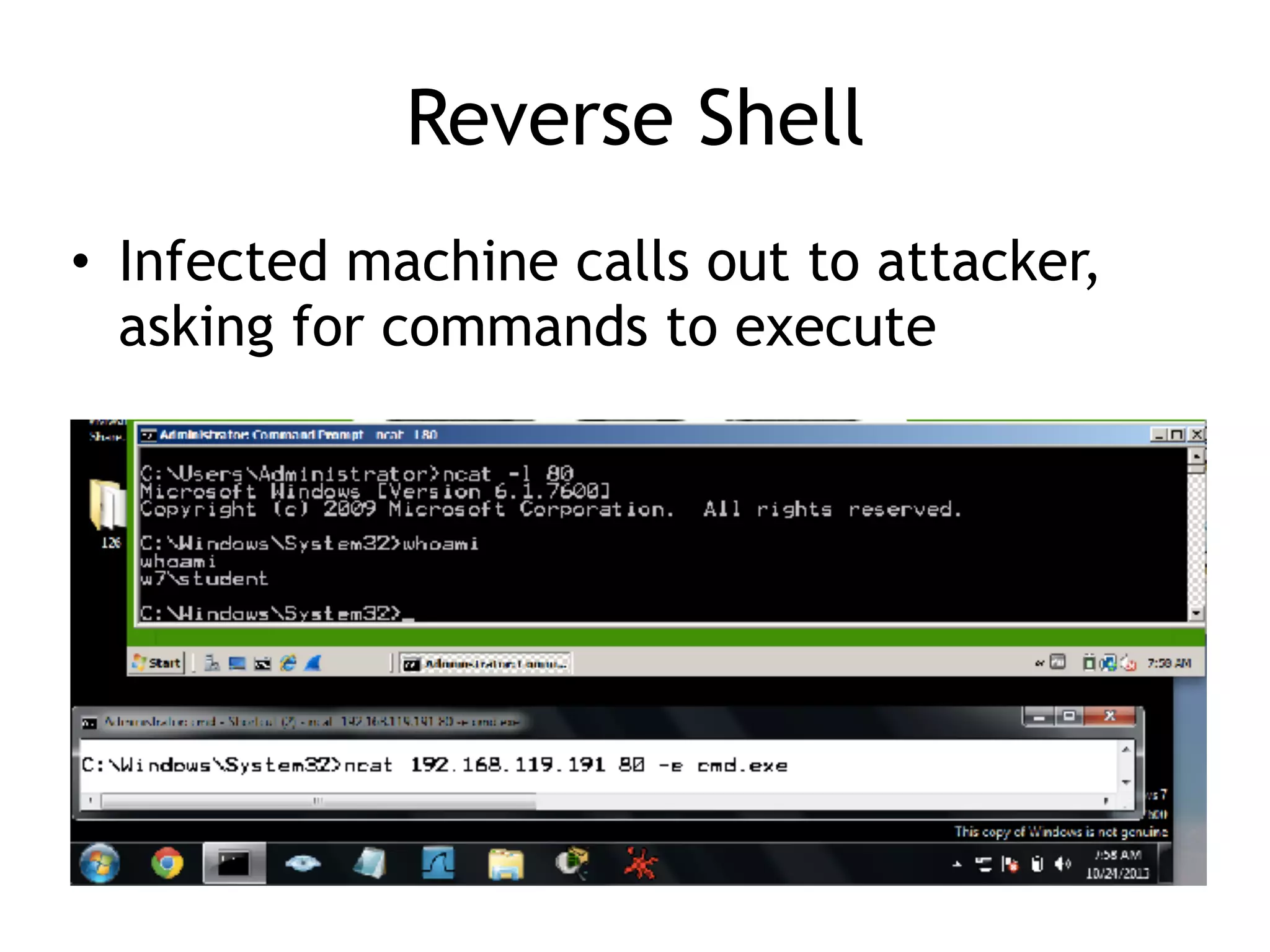
Reverse Shell
• Infected machine calls out to attacker,
asking for commands to execute
Windows Reverse Shells
• Basic
– Call CreateProcess and manipulate
STARTUPINFO structure
– Create a socket to remote machine
– Then tie socket to standard input, output,
and error for cmd.exe
– CreateProcess runs cmd.exe with its
window suppressed, to hide it
Windows Reverse Shells
• Multithreaded
– Create a socket, two pipes, and two threads
– Look for API calls to CreateThread and
CreatePipe
– One thread for stdin, one for stdout
RATs
(Remote Administration Tools)
• Ex: Poison Ivy
Botnets
• A collection of compromised hosts
– Called bots or zombies
Botnets v. RATs
• Botnet contain many hosts; RATs control
fewer hosts
• All bots are controlled at once; RATs
control victims one by one
• RATs are for targeted attacks; botnets are
used in mass attacks
Credential Stealers
Credential Stealers
• Three types
–Wait for user to log in and steal
credentials
–Dump stored data, such as password
hashes
–Log keystrokes
GINA Interception
• Windows XP's Graphical Identification and
Authentication (GINA)
– Intended to allow third parties to customize
logon process for RFID or smart cards
– Intercepted by malware to steal credentials
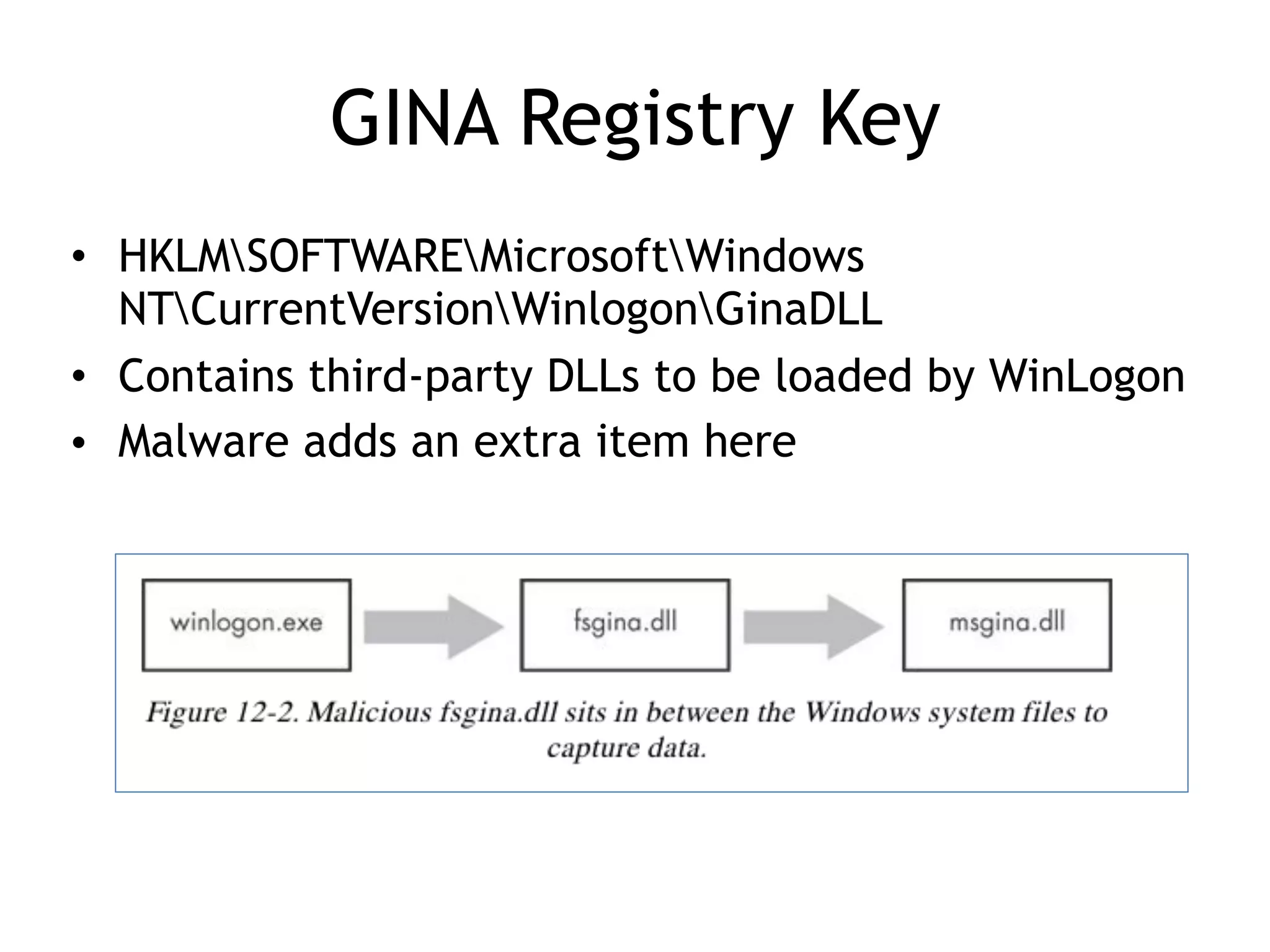
• GINA is implemented in msgina.dll
– Loaded by WinLogon executable during logon
• WinLogon also loads third-party customizations
in DLLs loaded between WinLogon and GINA
GINA Registry Key
• HKLMSOFTWAREMicrosoftWindows
NTCurrentVersionWinlogonGinaDLL
• Contains third-party DLLs to be loaded by WinLogon
• Malware adds an extra item here
MITM Attack
• Malicious DLL must export all functions
the real msgina.dll does, to act as a MITM
– More than 15 functions
– Most start with Wlx
–Good indicator
–Malware DLL exporting a lot of Wlx
functions is probably a GINA interceptor
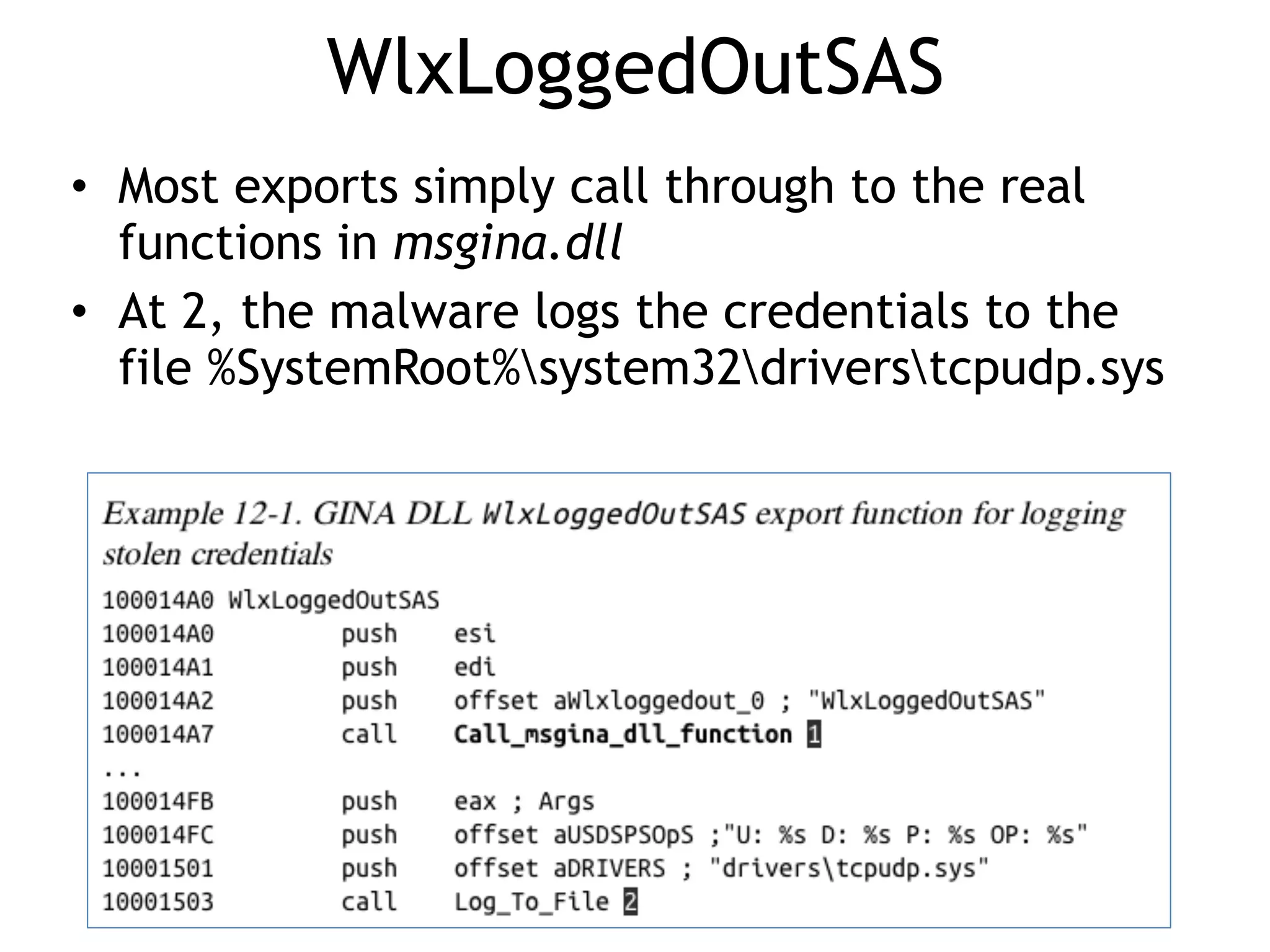
WlxLoggedOutSAS
• Most exports simply call through to the real
functions in msgina.dll
• At 2, the malware logs the credentials to the
file %SystemRoot%system32driverstcpudp.sys
GINA is Gone
• No longer used in Windows Vista and later
• Replaced by Credential Providers
• Link Ch 11c
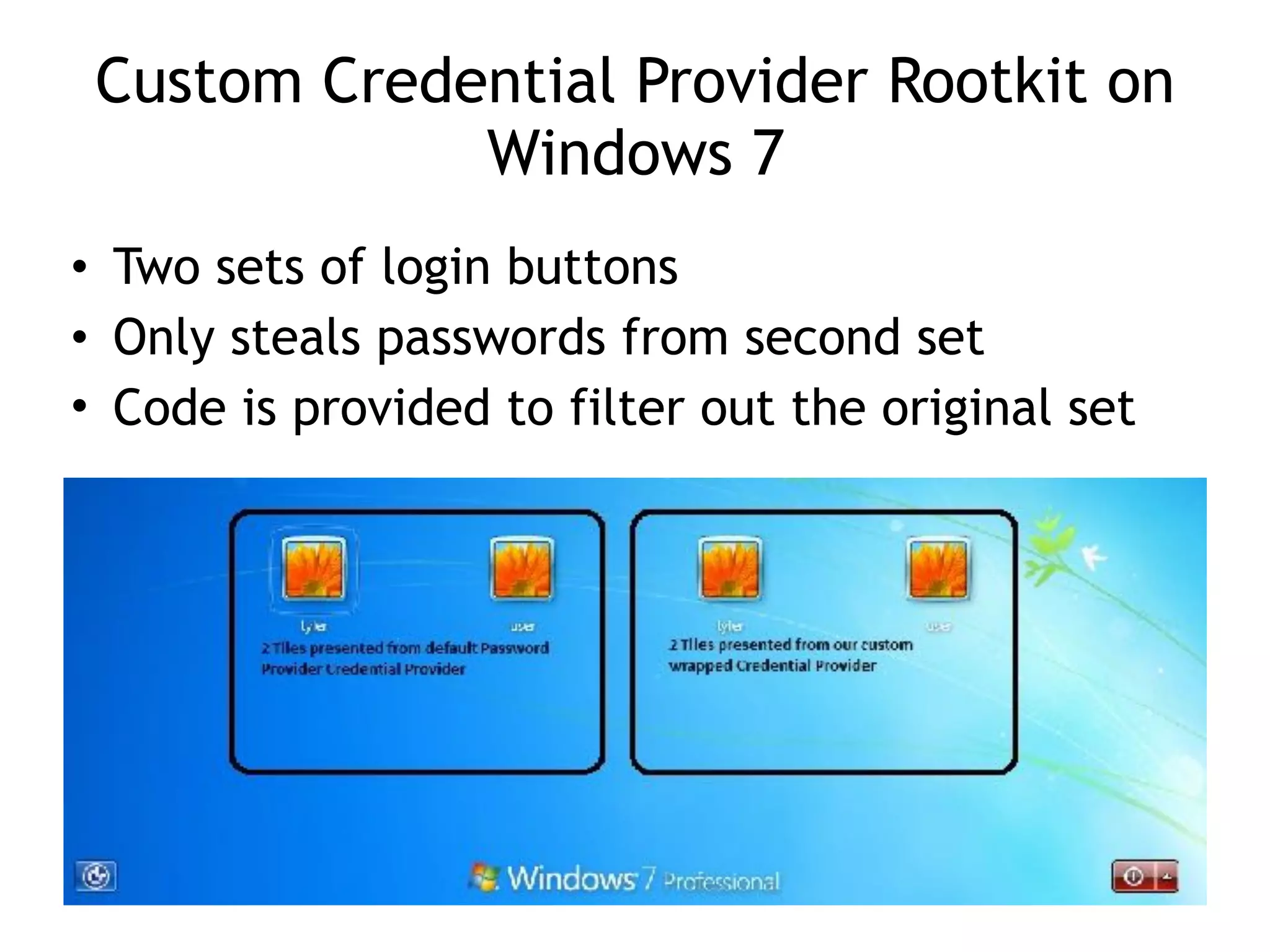
Custom Credential Provider Rootkit on
Windows 7
• Two sets of login buttons
• Only steals passwords from second set
• Code is provided to filter out the original set
Hash Dumping
Hash Dumping
• Windows login passwords are stored as LM
or NTLM hashes
– Hashes can be used directly to authenticate
(pass-the-hash attack)
– Or cracked offline to find passwords
• Pwdump and Pass-the-Hash Toolkit
– Free hacking tools that provide hash dumping
– Open-source
– Code re-used in malware
– Modified to bypass antivirus
Pwdump
• Injects a DLL into LSASS (Local Security
Authority Subsystem Service)
– To get hashes from the SAM (Security Account
Manager)
– Injected DLL runs inside another process
– Gets all the privileges of that process
– LSASS is a common target
• High privileges
• Access to many useful API functions
Pwdump
• Injects lsaext.dll into lsass.exe
– Calls GetHash, an export of lsaext.dll
– Hash extraction uses undocumented Windows
function calls
• Attackers may change the name of the
GetHash function
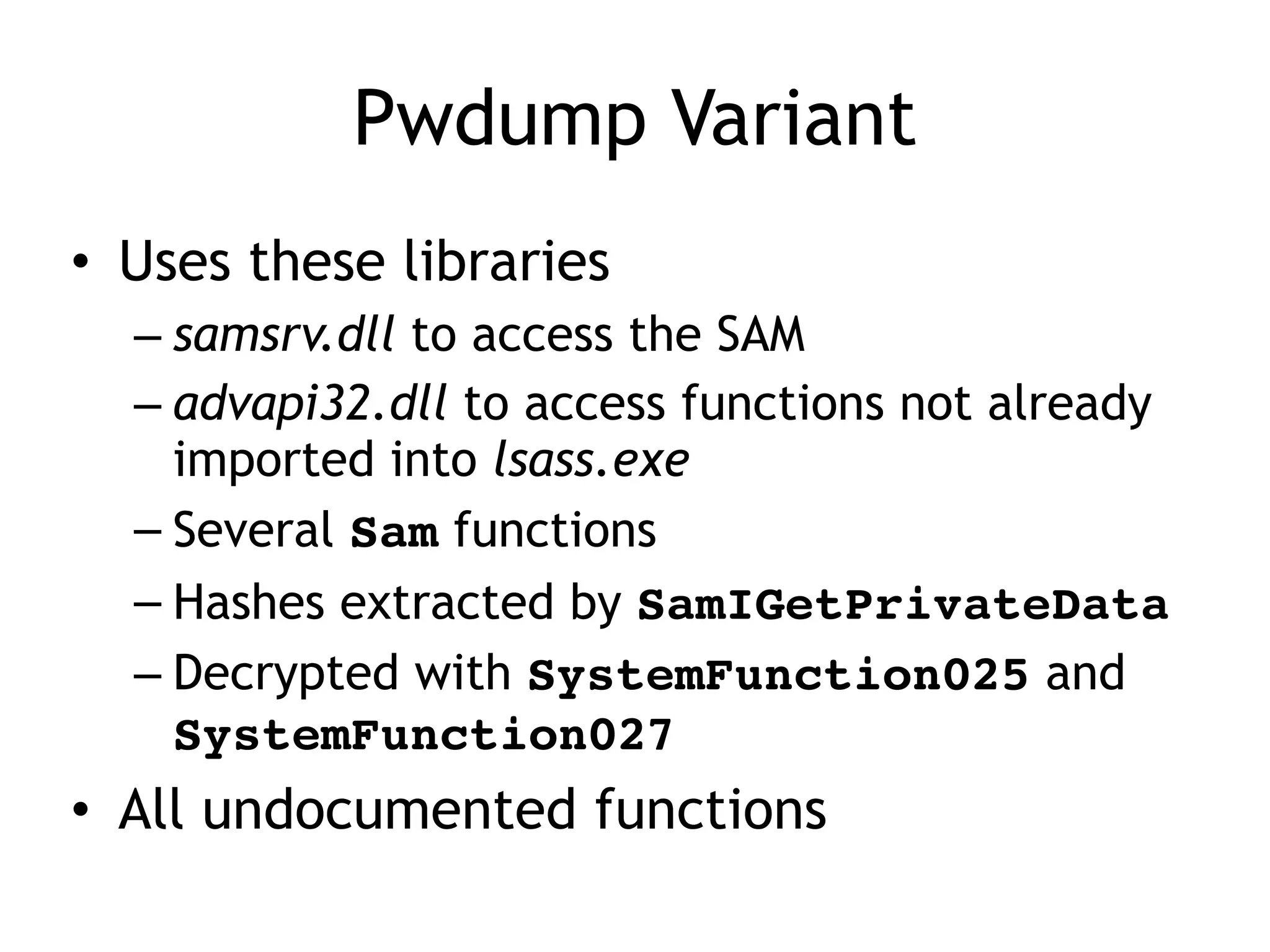
Pwdump Variant
• Uses these libraries
– samsrv.dll to access the SAM
– advapi32.dll to access functions not already
imported into lsass.exe
– Several Sam functions
– Hashes extracted by SamIGetPrivateData
– Decrypted with SystemFunction025 and
SystemFunction027
• All undocumented functions
Pass-the-Hash Toolkit
• Injects a DLL into lsass.exe to get hashes
– Program named whosthere-alt
• Uses different API functions than Pwdump
Ch 11a
Keystroke Logging
• Kernel-Based Keyloggers
– Difficult to detect with user-mode
applications
– Frequently part of a rootkit
– Act as keyboard drivers
– Bypass user-space programs and protections
Keystroke Logging
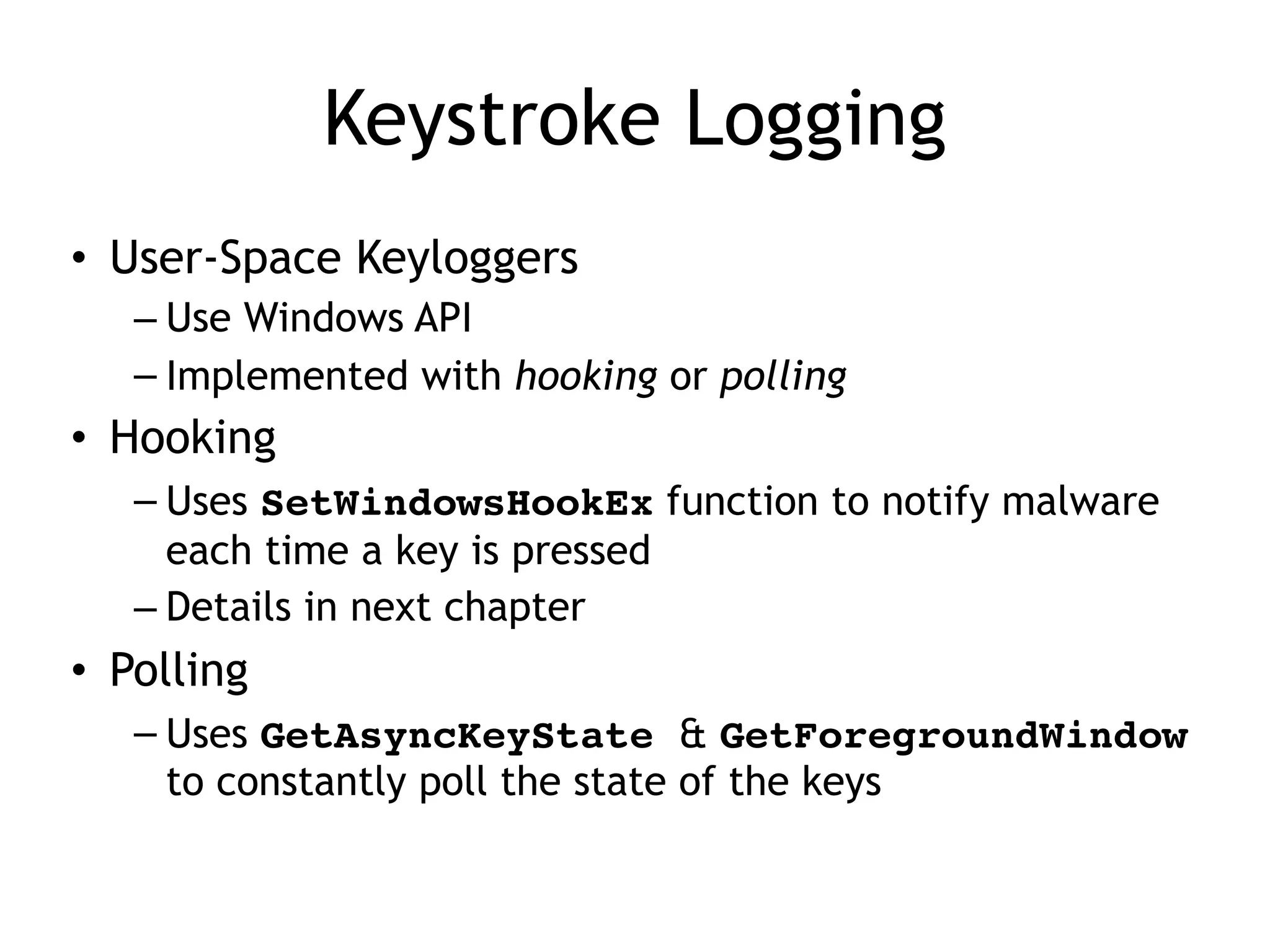
• User-Space Keyloggers
– Use Windows API
– Implemented with hooking or polling
• Hooking
– Uses SetWindowsHookEx function to notify malware
each time a key is pressed
– Details in next chapter
• Polling
– Uses GetAsyncKeyState & GetForegroundWindow
to constantly poll the state of the keys
Polling Keyloggers
• GetAsyncKeyState
– Identifies whether a key is pressed or
unpressed
• GetForegroundWindow
– Identifies the foreground window
– Loops through all keys, then sleeps briefly
– Repeats frequently enough to capture all
keystrokes
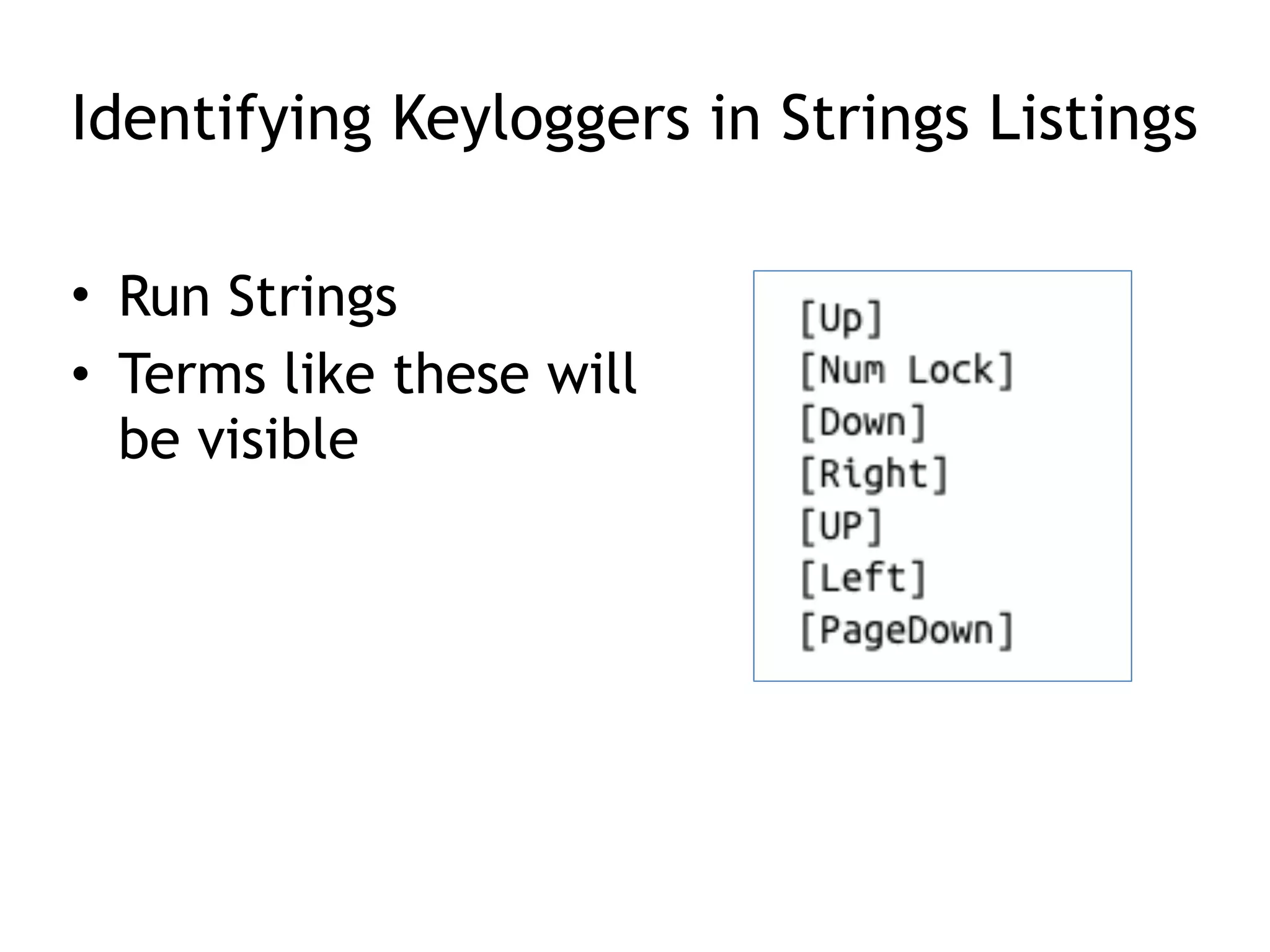
Identifying Keyloggers in Strings Listings
• Run Strings
• Terms like these will
be visible
Persistence Mechanisms
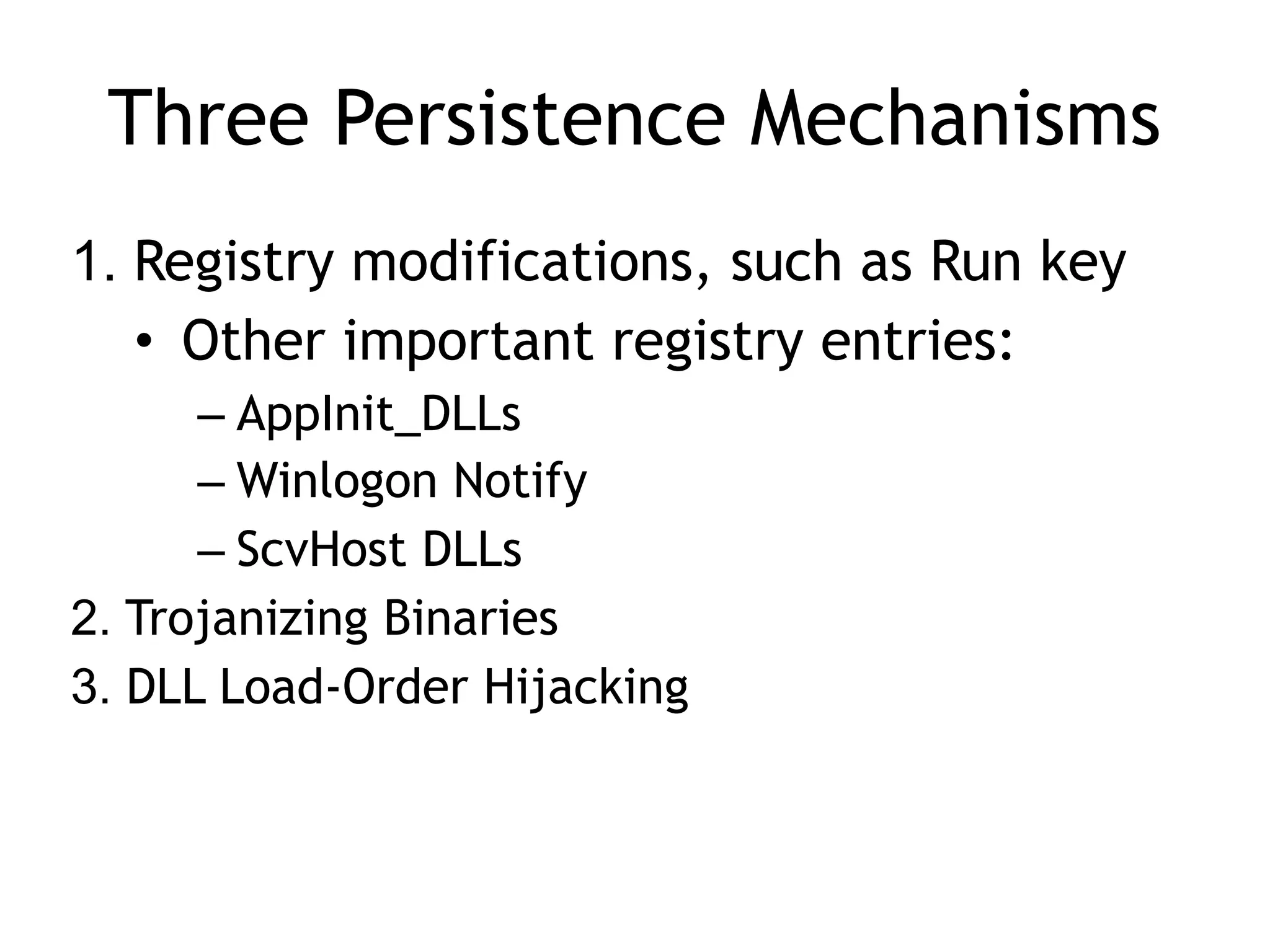
Three Persistence Mechanisms
1. Registry modifications, such as Run key
• Other important registry entries:
– AppInit_DLLs
– Winlogon Notify
– ScvHost DLLs
2. Trojanizing Binaries
3. DLL Load-Order Hijacking
Registry Modifications
• Run key
– HKEY_LOCAL_MACHINE SOFTWARE
Microsoft Windows CurrentVersion Run
– Many others, as revealed by Autoruns
• ProcMon shows all registry modifications
when running malware (dynamic analysis)
• Can detect all these techniques
Process Monitor
AppInit DLLs
• AppInit_DLLs are loaded into every process
that loads User32.dll
– This registry key contains a space-delimited list
of DLLs
– HKEY_LOCAL_MACHINE SOFTWARE
Microsoft Windows NT CurrentVersion
Windows
– Many processes load them
– Malware will call DLLMain to check which
process it is in before launching payload
AppInit DLLs Security
• Beginning with Windows Vista,
AppInit_DLLs are disabled by default.
• Beginning with Windows 7, the AppInit_DLL
infrastructure supports code signing.
• Starting with Windows 8, the entire
AppInit_DLL functionality is disabled
when Secure Boot is enabled, regardless of
code signing or registry settings
• From Wikipedia
Winlogon Notify
• Notify value in
– HKEY_LOCAL_MACHINE SOFTWARE
Microsoft Windows
– These DLLs handle winlogon.exe events
– Malware tied to an event like logon, startup,
lock screen, etc.
– It can even launch in Safe Mode
SvcHost DLLs
• Svchost is a generic host process for services
that run as DLLs
• Many instances of Svchost are running at once
• Groups defined at
– HKEY_LOCAL_MACHINE SOFTWARE Microsoft
Windows NT CurrentVersion Svchost
• Services defined at
– HKEY_LOCAL_MACHINE System
CurrentControlSet Services ServiceName
Process Explorer
• Shows many
services running in
one svchost
process
• This is the netsvcs
group
ServiceDLL
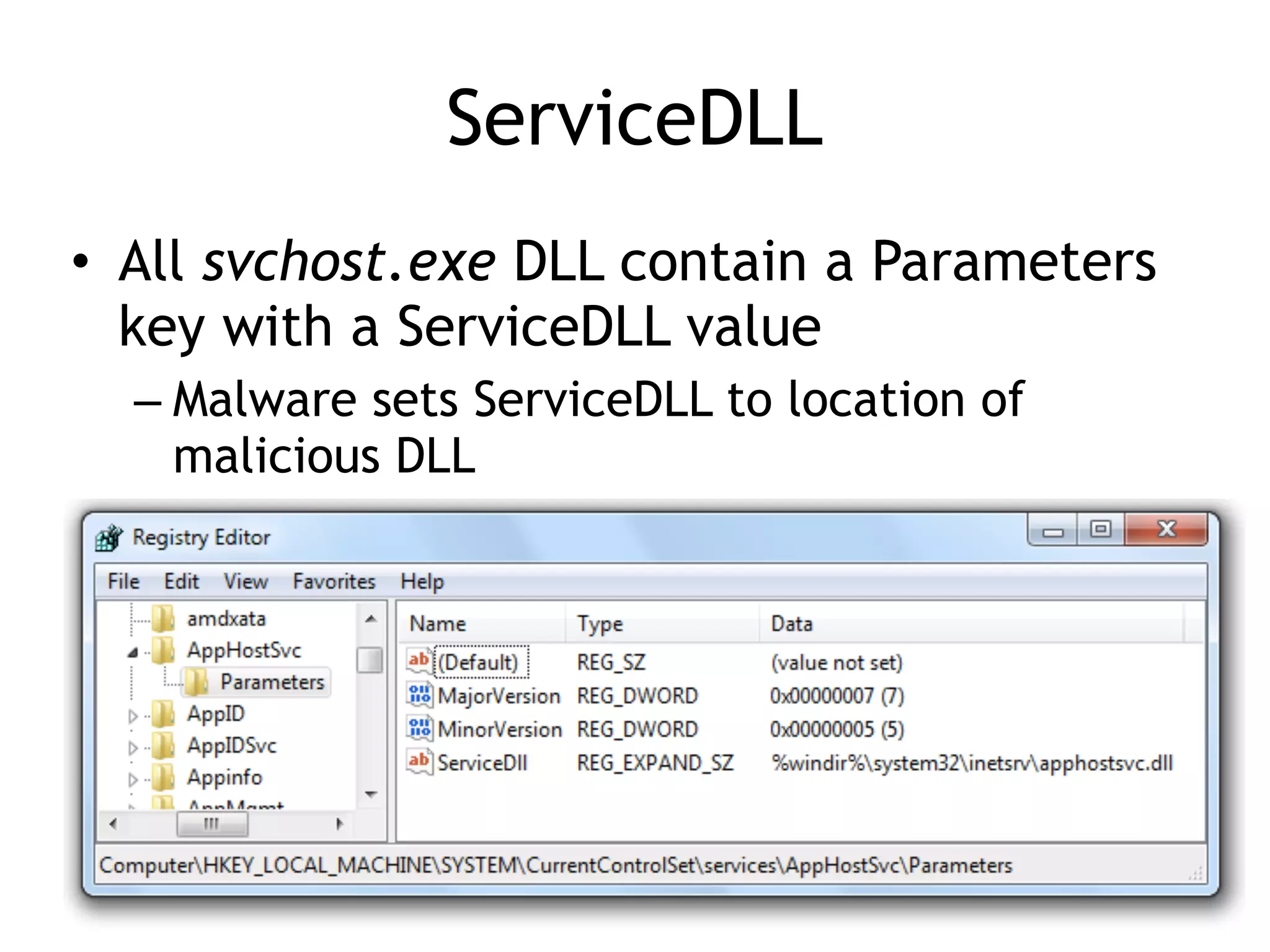
• All svchost.exe DLL contain a Parameters
key with a ServiceDLL value
– Malware sets ServiceDLL to location of
malicious DLL
Groups
• Malware usually adds itself to an existing
group
– Or overwrites a non-vital service
– Often a rarely used service from the netsvcs
group
• Detect this with dynamic analysis
monitoring the registry
– Or look for service functions like
CreateServiceA in disassembly
Ch 11b
Trojanized System Binaries
• Malware patches bytes of a system binary
• To force the system to execute the malware
the next time the infected binary is loaded
• DLLs are popular targets
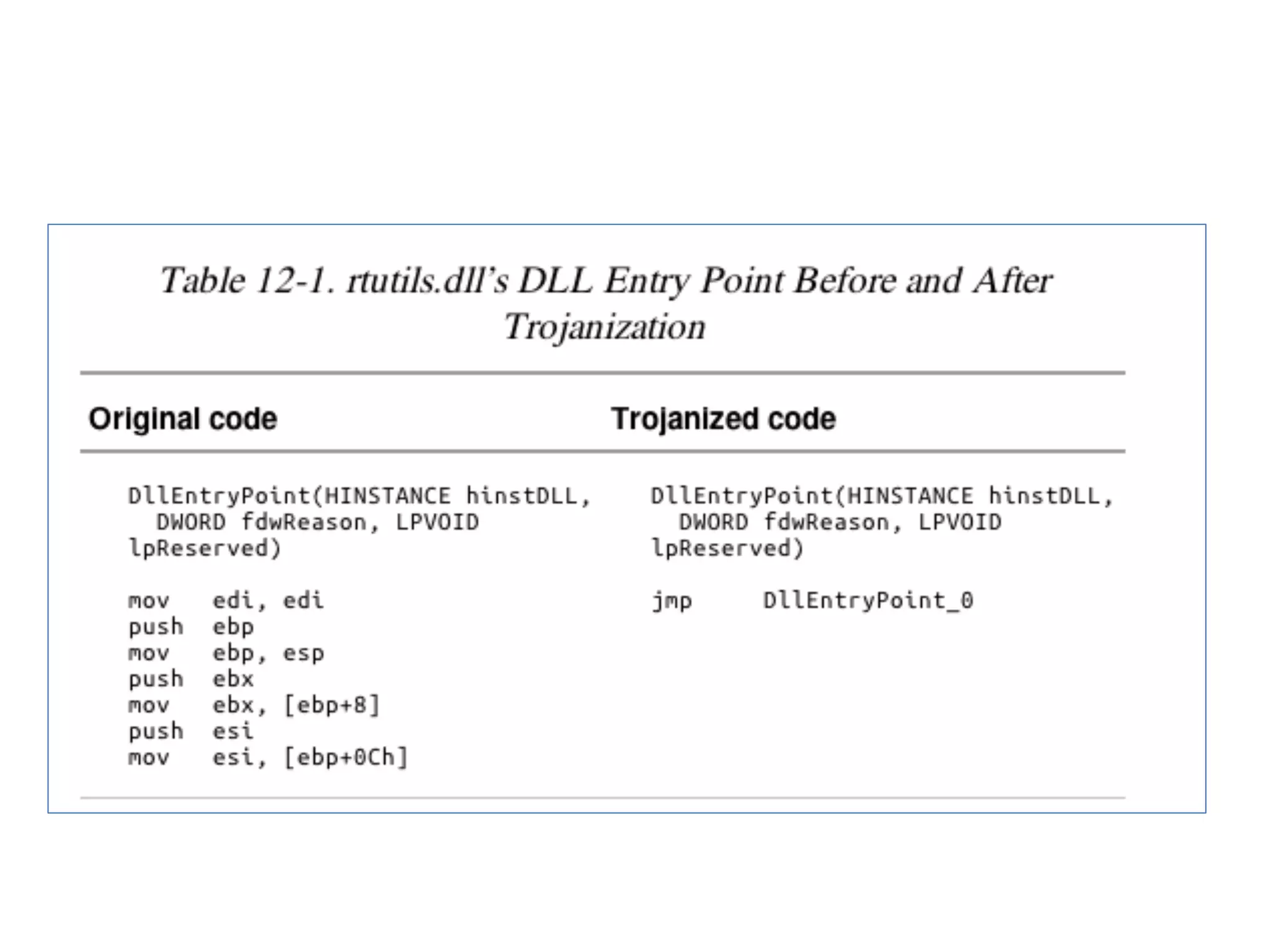
• Typically the entry function is modified
• Jumps to code inserted in an empty portion of
the binary
• Then executes DLL normally
DLL Load-Order Hijacking
KnownDLLs Registry Key
• Contains a list of specific DLL locations
• Overrides the search order for listed DLLs
• Makes them load faster, and prevents load-
order hijacking
• DLL load-order hijacking can only be used
– On binaries in directories other than System32
– That load DLLs in System32
– That are not protected by KnownDLLs
Example: explorer.exe
• Lives in Windows
• Loads ntshrui.dll from System32
• ntshrui.dll is not a known DLL
• Default search is performed
• A malicious ntshrui.dll in Windows will
be loaded instead
Many Vulnerable DLLs
• Any startup binary not found in System32
is vulnerable
• explorer.exe has about 50 vulnerable DLLs
• Known DLLs are not fully protected,
because
– Many DLLs load other DLLs
– Recursive imports follow the default search
order
DLL Load-Order Hijacking Detector
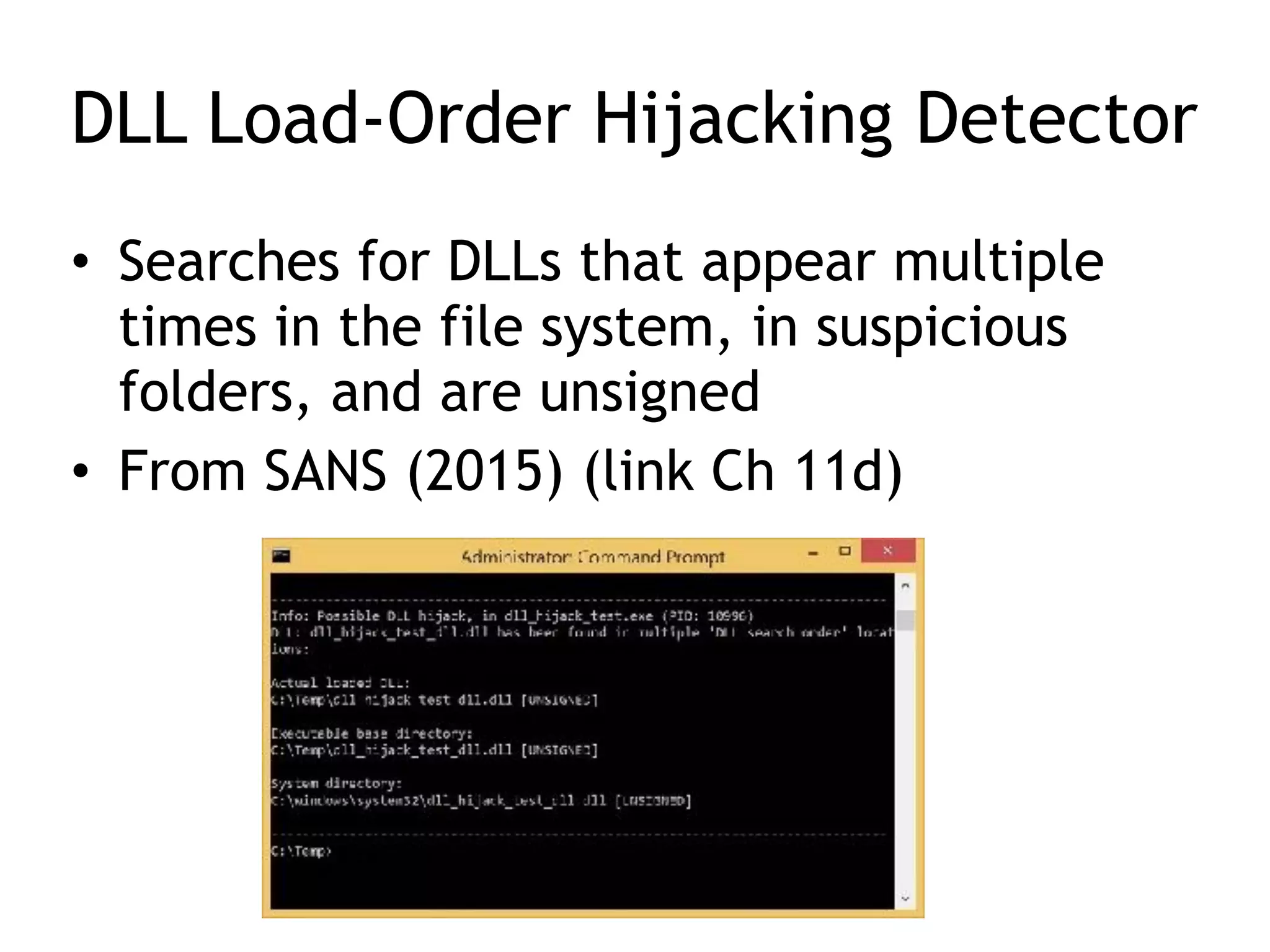
• Searches for DLLs that appear multiple
times in the file system, in suspicious
folders, and are unsigned
• From SANS (2015) (link Ch 11d)
Privilege Escalation
No User Account Control
• Most users run Windows XP as
Administrator all the time, so no privilege
escalation is needed to become
Administrator
• Metasploit has many privilege escalation
exploits
• DLL load-order hijacking can be used to
escalate privileges
Using SeDebugPrivilege
• Processes run by the user can't do
everything
• Functions like TerminateProcess or
CreateRemoteThread require System
privileges (above Administrator)
• The SeDebugPrivilege privilege was
intended for debugging
• Allows local Administrator accounts to
escalate to System privileges
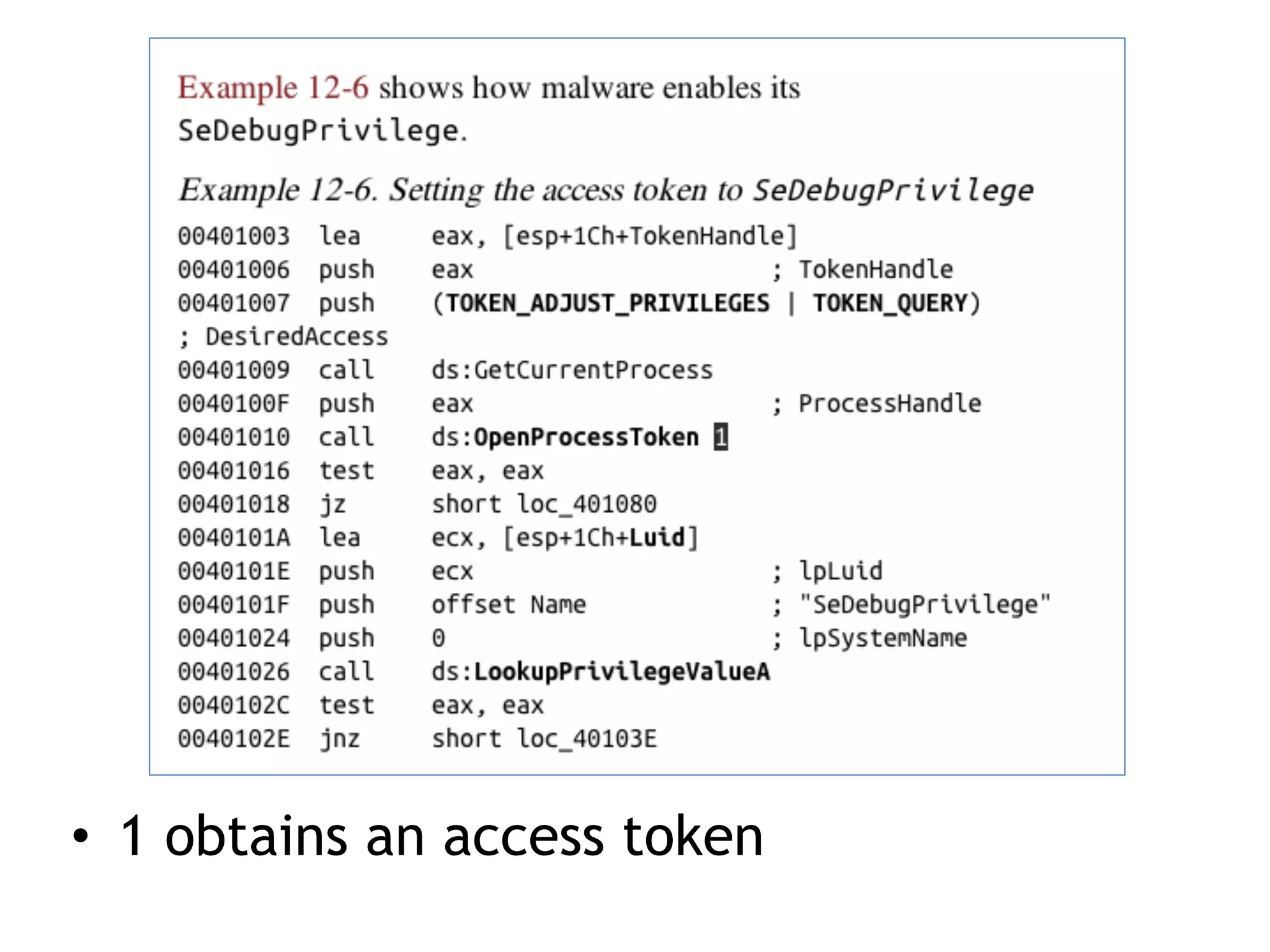
• 1 obtains an access token
• 2 AdjustTokenPrivileges raises privileges to
System
Covering Its Tracks—
User-Mode Rootkits
User-Mode Rootkits
• Modify internal functionality of the OS
• Hide files, network connections,
processes, etc.
• Kernel-mode rootkits are more powerful
• This section is about User-mode rootkits
IAT (Import Address Table) Hooking
• May modify
– IAT (Import Address Table) or
– EAT (Export Address Table)
• Parts of a PE file
– In a DLL in RAM
– This technique is old and easily detected
IAT Hooking
Inline Hooking
• Overwrites the API function code
• Contained in the imported DLLs
• Changes actual function code, not
pointers
• A more advanced technique than IAT
hooking
Ch 11c

CNIT 126 Ch 11: Malware Behavior

  • 1.
    Practical Malware Analysis Ch11: Malware Behavior Last revised 10-27-20
  • 2.
  • 3.
    Downloaders • Download anotherpiece of malware – And execute it on the local system • Commonly use the Windows API URLDownloadtoFileA, followed by a call to WinExec
  • 4.
    Launchers (aka Loaders) •Prepares another piece of malware for covert execution – Either immediately or later – Stores malware in unexpected places, such as the .rsrc section of a PE file
  • 5.
  • 6.
    Backdoors • Provide remoteaccess to victim machine • The most common type of malware • Often communicate over HTTP on Port 80 – Network signatures are helpful for detection • Common capabilities – Manipulate Registry, enumerate display windows, create directories, search files, etc.
  • 7.
    Reverse Shell • Infectedmachine calls out to attacker, asking for commands to execute
  • 8.
    Windows Reverse Shells •Basic – Call CreateProcess and manipulate STARTUPINFO structure – Create a socket to remote machine – Then tie socket to standard input, output, and error for cmd.exe – CreateProcess runs cmd.exe with its window suppressed, to hide it
  • 9.
    Windows Reverse Shells •Multithreaded – Create a socket, two pipes, and two threads – Look for API calls to CreateThread and CreatePipe – One thread for stdin, one for stdout
  • 10.
  • 11.
    Botnets • A collectionof compromised hosts – Called bots or zombies
  • 12.
    Botnets v. RATs •Botnet contain many hosts; RATs control fewer hosts • All bots are controlled at once; RATs control victims one by one • RATs are for targeted attacks; botnets are used in mass attacks
  • 13.
  • 14.
    Credential Stealers • Threetypes –Wait for user to log in and steal credentials –Dump stored data, such as password hashes –Log keystrokes
  • 15.
    GINA Interception • WindowsXP's Graphical Identification and Authentication (GINA) – Intended to allow third parties to customize logon process for RFID or smart cards – Intercepted by malware to steal credentials • GINA is implemented in msgina.dll – Loaded by WinLogon executable during logon • WinLogon also loads third-party customizations in DLLs loaded between WinLogon and GINA
  • 16.
    GINA Registry Key •HKLMSOFTWAREMicrosoftWindows NTCurrentVersionWinlogonGinaDLL • Contains third-party DLLs to be loaded by WinLogon • Malware adds an extra item here
  • 17.
    MITM Attack • MaliciousDLL must export all functions the real msgina.dll does, to act as a MITM – More than 15 functions – Most start with Wlx –Good indicator –Malware DLL exporting a lot of Wlx functions is probably a GINA interceptor
  • 18.
    WlxLoggedOutSAS • Most exportssimply call through to the real functions in msgina.dll • At 2, the malware logs the credentials to the file %SystemRoot%system32driverstcpudp.sys
  • 19.
    GINA is Gone •No longer used in Windows Vista and later • Replaced by Credential Providers • Link Ch 11c
  • 20.
    Custom Credential ProviderRootkit on Windows 7 • Two sets of login buttons • Only steals passwords from second set • Code is provided to filter out the original set
  • 21.
  • 22.
    Hash Dumping • Windowslogin passwords are stored as LM or NTLM hashes – Hashes can be used directly to authenticate (pass-the-hash attack) – Or cracked offline to find passwords • Pwdump and Pass-the-Hash Toolkit – Free hacking tools that provide hash dumping – Open-source – Code re-used in malware – Modified to bypass antivirus
  • 23.
    Pwdump • Injects aDLL into LSASS (Local Security Authority Subsystem Service) – To get hashes from the SAM (Security Account Manager) – Injected DLL runs inside another process – Gets all the privileges of that process – LSASS is a common target • High privileges • Access to many useful API functions
  • 24.
    Pwdump • Injects lsaext.dllinto lsass.exe – Calls GetHash, an export of lsaext.dll – Hash extraction uses undocumented Windows function calls • Attackers may change the name of the GetHash function
  • 25.
    Pwdump Variant • Usesthese libraries – samsrv.dll to access the SAM – advapi32.dll to access functions not already imported into lsass.exe – Several Sam functions – Hashes extracted by SamIGetPrivateData – Decrypted with SystemFunction025 and SystemFunction027 • All undocumented functions
  • 27.
    Pass-the-Hash Toolkit • Injectsa DLL into lsass.exe to get hashes – Program named whosthere-alt • Uses different API functions than Pwdump
  • 28.
  • 29.
    Keystroke Logging • Kernel-BasedKeyloggers – Difficult to detect with user-mode applications – Frequently part of a rootkit – Act as keyboard drivers – Bypass user-space programs and protections
  • 30.
    Keystroke Logging • User-SpaceKeyloggers – Use Windows API – Implemented with hooking or polling • Hooking – Uses SetWindowsHookEx function to notify malware each time a key is pressed – Details in next chapter • Polling – Uses GetAsyncKeyState & GetForegroundWindow to constantly poll the state of the keys
  • 31.
    Polling Keyloggers • GetAsyncKeyState –Identifies whether a key is pressed or unpressed • GetForegroundWindow – Identifies the foreground window – Loops through all keys, then sleeps briefly – Repeats frequently enough to capture all keystrokes
  • 33.
    Identifying Keyloggers inStrings Listings • Run Strings • Terms like these will be visible
  • 34.
  • 35.
    Three Persistence Mechanisms 1.Registry modifications, such as Run key • Other important registry entries: – AppInit_DLLs – Winlogon Notify – ScvHost DLLs 2. Trojanizing Binaries 3. DLL Load-Order Hijacking
  • 36.
    Registry Modifications • Runkey – HKEY_LOCAL_MACHINE SOFTWARE Microsoft Windows CurrentVersion Run – Many others, as revealed by Autoruns • ProcMon shows all registry modifications when running malware (dynamic analysis) • Can detect all these techniques
  • 37.
  • 38.
    AppInit DLLs • AppInit_DLLsare loaded into every process that loads User32.dll – This registry key contains a space-delimited list of DLLs – HKEY_LOCAL_MACHINE SOFTWARE Microsoft Windows NT CurrentVersion Windows – Many processes load them – Malware will call DLLMain to check which process it is in before launching payload
  • 39.
    AppInit DLLs Security •Beginning with Windows Vista, AppInit_DLLs are disabled by default. • Beginning with Windows 7, the AppInit_DLL infrastructure supports code signing. • Starting with Windows 8, the entire AppInit_DLL functionality is disabled when Secure Boot is enabled, regardless of code signing or registry settings • From Wikipedia
  • 40.
    Winlogon Notify • Notifyvalue in – HKEY_LOCAL_MACHINE SOFTWARE Microsoft Windows – These DLLs handle winlogon.exe events – Malware tied to an event like logon, startup, lock screen, etc. – It can even launch in Safe Mode
  • 41.
    SvcHost DLLs • Svchostis a generic host process for services that run as DLLs • Many instances of Svchost are running at once • Groups defined at – HKEY_LOCAL_MACHINE SOFTWARE Microsoft Windows NT CurrentVersion Svchost • Services defined at – HKEY_LOCAL_MACHINE System CurrentControlSet Services ServiceName
  • 42.
    Process Explorer • Showsmany services running in one svchost process • This is the netsvcs group
  • 44.
    ServiceDLL • All svchost.exeDLL contain a Parameters key with a ServiceDLL value – Malware sets ServiceDLL to location of malicious DLL
  • 45.
    Groups • Malware usuallyadds itself to an existing group – Or overwrites a non-vital service – Often a rarely used service from the netsvcs group • Detect this with dynamic analysis monitoring the registry – Or look for service functions like CreateServiceA in disassembly
  • 46.
  • 47.
    Trojanized System Binaries •Malware patches bytes of a system binary • To force the system to execute the malware the next time the infected binary is loaded • DLLs are popular targets • Typically the entry function is modified • Jumps to code inserted in an empty portion of the binary • Then executes DLL normally
  • 49.
  • 50.
    KnownDLLs Registry Key •Contains a list of specific DLL locations • Overrides the search order for listed DLLs • Makes them load faster, and prevents load- order hijacking • DLL load-order hijacking can only be used – On binaries in directories other than System32 – That load DLLs in System32 – That are not protected by KnownDLLs
  • 51.
    Example: explorer.exe • Livesin Windows • Loads ntshrui.dll from System32 • ntshrui.dll is not a known DLL • Default search is performed • A malicious ntshrui.dll in Windows will be loaded instead
  • 52.
    Many Vulnerable DLLs •Any startup binary not found in System32 is vulnerable • explorer.exe has about 50 vulnerable DLLs • Known DLLs are not fully protected, because – Many DLLs load other DLLs – Recursive imports follow the default search order
  • 53.
    DLL Load-Order HijackingDetector • Searches for DLLs that appear multiple times in the file system, in suspicious folders, and are unsigned • From SANS (2015) (link Ch 11d)
  • 54.
  • 55.
    No User AccountControl • Most users run Windows XP as Administrator all the time, so no privilege escalation is needed to become Administrator • Metasploit has many privilege escalation exploits • DLL load-order hijacking can be used to escalate privileges
  • 56.
    Using SeDebugPrivilege • Processesrun by the user can't do everything • Functions like TerminateProcess or CreateRemoteThread require System privileges (above Administrator) • The SeDebugPrivilege privilege was intended for debugging • Allows local Administrator accounts to escalate to System privileges
  • 57.
    • 1 obtainsan access token
  • 58.
    • 2 AdjustTokenPrivilegesraises privileges to System
  • 59.
  • 60.
    User-Mode Rootkits • Modifyinternal functionality of the OS • Hide files, network connections, processes, etc. • Kernel-mode rootkits are more powerful • This section is about User-mode rootkits
  • 61.
    IAT (Import AddressTable) Hooking • May modify – IAT (Import Address Table) or – EAT (Export Address Table) • Parts of a PE file – In a DLL in RAM – This technique is old and easily detected
  • 62.
  • 63.
    Inline Hooking • Overwritesthe API function code • Contained in the imported DLLs • Changes actual function code, not pointers • A more advanced technique than IAT hooking
  • 64.