DR. PRIYA KUBENDIRAN PROF. DR.K.S. CHENTHIL IMCU
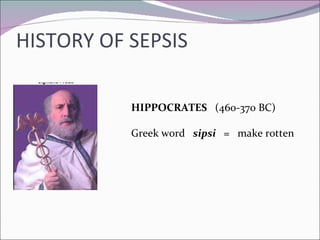
HISTORY OF SEPSIS HIPPOCRATES   (460-370 BC) Greek word  sipsi  =  make rotten
IBN SINA  (979-1037 BC) - the coincidence of blood putrefaction (septicaemia) and fever HERRMAN BOERHAVE  (1668-1738), a doctor in Leyden, thought that toxic substances in the air were the cause for sepsis.
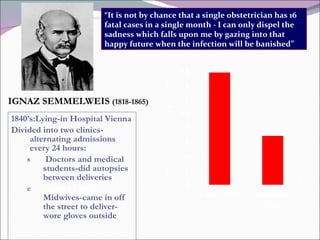
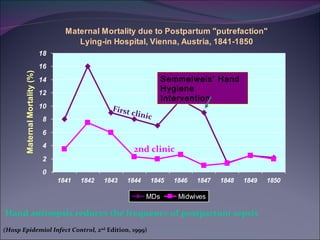
IGNAZ SEMMELWEIS  (1818-1865) 1840’s:Lying-in Hospital Vienna Divided into two clinics- alternating admissions every 24 hours: Doctors and medical students-did autopsies between deliveries Second Clinic:  Midwives-came in off the street to deliver-wore gloves outside “ It is not by chance that a single obstetrician has 16 fatal cases in a single month - I can only dispel the sadness which falls upon me by gazing into that happy future when the infection will be banished”
Semmelweis’ Hand Hygiene Intervention  Hand antisepsis reduces the frequency of postpartum sepsis  (Hosp Epidemiol Infect Control,  2 nd  Edition, 1999) First clinic 2nd clinic
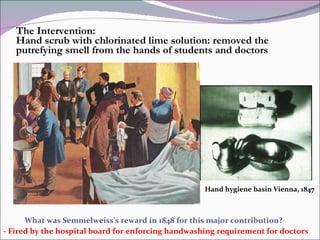
The Intervention: Hand scrub with chlorinated lime solution: removed the putrefying smell from the hands of students and doctors Hand hygiene basin Vienna, 1847 What was Semmelweiss’s reward in 1848 for this major contribution?  - Fired by the hospital board for enforcing handwashing requirement for doctors
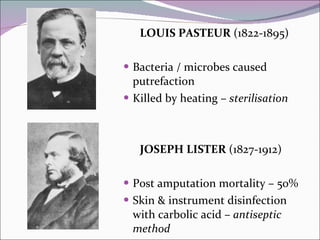
LOUIS PASTEUR  (1822-1895) Bacteria / microbes caused putrefaction Killed by heating –  sterilisation JOSEPH LISTER  (1827-1912) Post amputation mortality – 50% Skin & instrument disinfection with carbolic acid –  antiseptic method
HUGO SCHOTTMULLER  (1867-1936) Modern definition of sepsis(1914):  "Sepsis is present if a focus has developed from which pathogenic bacteria, constantly or periodically, invade the blood stream in such a way that this causes subjective and objective symptoms.” “Therapy should not be directed against bacteria in the blood but against the released bacterial toxins”
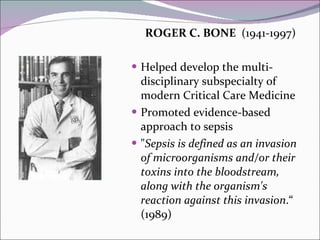
ROGER C. BONE  (1941-1997) Helped develop the multi-disciplinary subspecialty of modern Critical Care Medicine  Promoted evidence-based approach to sepsis  " Sepsis is defined as an invasion of microorganisms and/or their toxins into the bloodstream, along with the organism's reaction against this invasion .“ (1989)
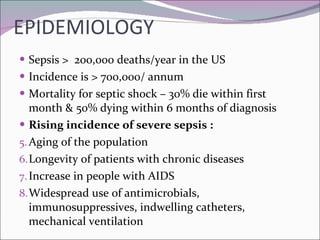
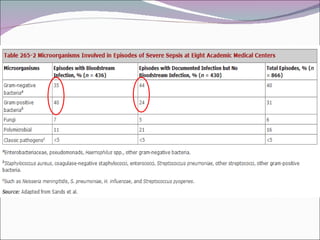
EPIDEMIOLOGY Sepsis >  200,000 deaths/year in the US Incidence is > 700,000/ annum Mortality for septic shock – 30% die within first month & 50% dying within 6 months of diagnosis Rising incidence of severe sepsis : Aging of the population Longevity of patients with chronic diseases Increase in people with AIDS Widespread use of antimicrobials, immunosuppressives, indwelling catheters, mechanical ventilation
 
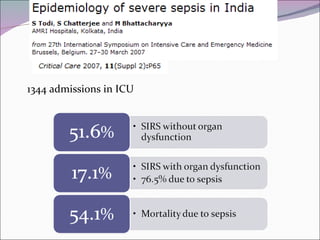
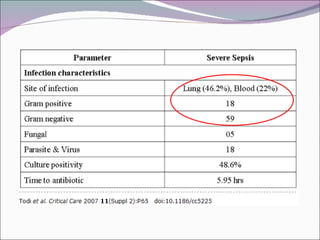
1344 admissions in ICU
 
Regional data
SURVIVING SEPSIS CAMPAIGN In 2002, spearheaded by the  ESICM  (European Society of Intensive Care Medicine),  ISF  (International Sepsis Forum) and  SCCM  (Society of Critical Care Medicine) Aim   :  improving the diagnosis, survival, and management of patients with sepsis by addressing the challenges associated with it.
 
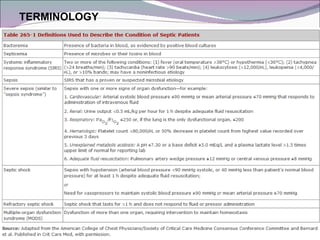
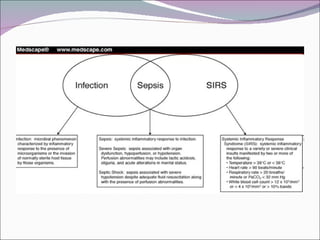
TERMINOLOGY
 
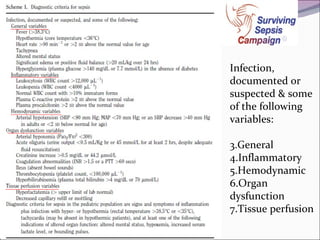
Infection, documented or suspected & some of the following variables:  General Inflammatory Hemodynamic Organ dysfunction Tissue perfusion
 
REFERENCES : Harrison’s  17 th   edn Infectious diseases - Dale Internet  -German sepsis society -Critical care 2007 -Surviving sepsis campaign 2008 -Medscape

CME: Introduction to Sepsis

  • 1.
    DR. PRIYA KUBENDIRANPROF. DR.K.S. CHENTHIL IMCU
  • 2.
    HISTORY OF SEPSISHIPPOCRATES (460-370 BC) Greek word sipsi = make rotten
  • 3.
    IBN SINA (979-1037 BC) - the coincidence of blood putrefaction (septicaemia) and fever HERRMAN BOERHAVE (1668-1738), a doctor in Leyden, thought that toxic substances in the air were the cause for sepsis.
  • 4.
    IGNAZ SEMMELWEIS (1818-1865) 1840’s:Lying-in Hospital Vienna Divided into two clinics- alternating admissions every 24 hours: Doctors and medical students-did autopsies between deliveries Second Clinic: Midwives-came in off the street to deliver-wore gloves outside “ It is not by chance that a single obstetrician has 16 fatal cases in a single month - I can only dispel the sadness which falls upon me by gazing into that happy future when the infection will be banished”
  • 5.
    Semmelweis’ Hand HygieneIntervention Hand antisepsis reduces the frequency of postpartum sepsis (Hosp Epidemiol Infect Control, 2 nd Edition, 1999) First clinic 2nd clinic
  • 6.
    The Intervention: Handscrub with chlorinated lime solution: removed the putrefying smell from the hands of students and doctors Hand hygiene basin Vienna, 1847 What was Semmelweiss’s reward in 1848 for this major contribution? - Fired by the hospital board for enforcing handwashing requirement for doctors
  • 7.
    LOUIS PASTEUR (1822-1895) Bacteria / microbes caused putrefaction Killed by heating – sterilisation JOSEPH LISTER (1827-1912) Post amputation mortality – 50% Skin & instrument disinfection with carbolic acid – antiseptic method
  • 8.
    HUGO SCHOTTMULLER (1867-1936) Modern definition of sepsis(1914): "Sepsis is present if a focus has developed from which pathogenic bacteria, constantly or periodically, invade the blood stream in such a way that this causes subjective and objective symptoms.” “Therapy should not be directed against bacteria in the blood but against the released bacterial toxins”
  • 9.
    ROGER C. BONE (1941-1997) Helped develop the multi-disciplinary subspecialty of modern Critical Care Medicine Promoted evidence-based approach to sepsis " Sepsis is defined as an invasion of microorganisms and/or their toxins into the bloodstream, along with the organism's reaction against this invasion .“ (1989)
  • 10.
    EPIDEMIOLOGY Sepsis > 200,000 deaths/year in the US Incidence is > 700,000/ annum Mortality for septic shock – 30% die within first month & 50% dying within 6 months of diagnosis Rising incidence of severe sepsis : Aging of the population Longevity of patients with chronic diseases Increase in people with AIDS Widespread use of antimicrobials, immunosuppressives, indwelling catheters, mechanical ventilation
  • 11.
  • 12.
  • 13.
  • 14.
  • 15.
    SURVIVING SEPSIS CAMPAIGNIn 2002, spearheaded by the ESICM (European Society of Intensive Care Medicine), ISF (International Sepsis Forum) and SCCM (Society of Critical Care Medicine) Aim : improving the diagnosis, survival, and management of patients with sepsis by addressing the challenges associated with it.
  • 16.
  • 17.
  • 18.
  • 19.
    Infection, documented orsuspected & some of the following variables: General Inflammatory Hemodynamic Organ dysfunction Tissue perfusion
  • 20.
  • 21.
    REFERENCES : Harrison’s 17 th edn Infectious diseases - Dale Internet -German sepsis society -Critical care 2007 -Surviving sepsis campaign 2008 -Medscape

Editor's Notes

  • #5 In 1846 Ignaz Semmelweis, obstetrician at Vienna general hospital observed that women whose babies were delivered by students and physicians in the First Clinic at the General Hospital of Vienna consistently had a higher mortality rate than those whose babies were delivered by midwives in the Second Clinic. He noted that physicians who went directly from the autopsy suite to the obstetrics ward had a disagreeable odor on their hands despite washing their hands with soap and water upon entering the obstetrics clinic. His theory: puerperal fever, which was causing the deaths, was caused by “cadaverous particles” transmitted from the autopsy suite to the obstetrics ward via the hands of students and physicians.
  • #6 After Semmelweis insisted that students and physicians clean their hands with a chlorine solution between each patient, the maternal mortality rate in the First Clinic dropped. Maternal mortality rate in the First Clinic dropped dramatically and remained low for years. This is the first evidence indicating that cleansing heavily contaminated hands with an antiseptic agent between patient contacts may reduce healthcare-associated transmission of contagious diseases more effectively than handwashing with plain soap and water.
  • #7 In May 1847 Semmelweiss insisted that students and physicians clean their hands with a chlorine solution, similar to the one pictured here, between each patient in the clinic. It took him until 1863, more than 15 years after his findings, to publish his work "Aetiology, terminus and prophylaxis of puerperal fever" . The failure to achieve a professional reputation and the unrelenting opposition of the medical establishment may have facilitated the development of psychiatric symptoms. Semmelweis was eventually committed to a lunatic asylum where he died from a wound infection probably as a result of the beatings he underwent there. It is an irony of fate that he died from a disease that he dedicated his life to fight.
  • #8 French chemist louis pasteur Lister – surgeon at glasgow royal infirmary
  • #9 for the first time, the source of infection as a cause of sepsis came into focus
  • #10 it appeared that the development of ARDS was a result of an inflammatory reaction and thus caused by substances produced in the diseased body. In the 1980s it was discovered that this inflammatory reaction was not only apparent in the lungs but in the whole body. Hence it became clear that the onset of sepsis did not derive from an infectious focus alone, but that the host response against infection must in some way play a role.
  • #17 Phase I of the Surviving Sepsis Campaign was initiated in October 2002 with the Barcelona Declaration to improve survival in severe sepsis, and phase III will be dedicated to the use of the management guidelines to evaluate the impact on clinical outcome. During the first phase, campaign leaders introduced the initiative at major international critical care medicine conferences. They developed a six-point action plan to reduce global mortality from severe sepsis by 25% by 2009. The second phase of the campaign focused on creating guidelines for sepsis management Phase three of the campaign involves translating the guidelines into clinical practice. Phase 4 New initiatives and continuing activities of the Surviving Sepsis Campaign are underway.They include further analysis of the aggregate database, which now includes more than 30,000 patient charts. The 2008 Guidelines are being revised by a committee representing 27 global organizations to incorporate recently published evidence.  Revision of the existing treatment bundles will follow.