Abdulsathar CH
The Third International Consensus
Definitions for Sepsis and Septic
Shock (Sepsis-3)
 JAMA
February 23, 2016
 Mervyn Singer, MD, FRCP1; Clifford
S. Deutschman, MD, MS2; Christopher
Warren Seymour, MD, MSc3; et al
 Definitions of sepsis and septic shock were
last revised in 2001
 Considerable advances have since been made
into the pathobiology, management, and
epidemiology of sepsis
 the European Society of Intensive Care
Medicine and the Society of Critical Care
Medicine convened a task force of 19 critical
care, infectious disease, surgical, and
pulmonary specialists in January 2014.
 The societies each nominated co-chairs (Drs
Deutschman and Singer), who selected
members according to their scientific
expertise in sepsis epidemiology, clinical
trials, and basic or translational research.
 The group engaged in iterative discussions
via 4 face-to-face meetings between January
2014 and January 2015,emailcorrespondence,
and voting.
Limitations of previous definitions
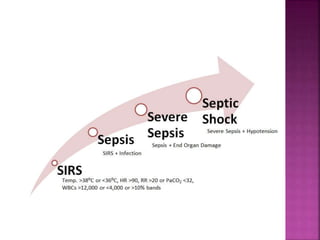
1.an excessive focus on inflammation
2. the misleading model that sepsis follows a
continuum through severe sepsis to shock
3. inadequate specificity and sensitivity of the
systemic inflammatory response syndrome
(SIRS) criteria
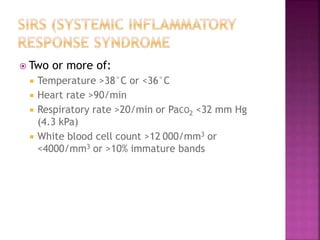
 Two or more of:
 Temperature >38°C or <36°C
 Heart rate >90/min
 Respiratory rate >20/min or PaCO2 <32 mm Hg
(4.3 kPa)
 White blood cell count >12 000/mm3 or
<4000/mm3 or >10% immature bands
 • Sepsis is the primary cause of death from
infection, especially if not recognized and
treated promptly. Its recognition mandates
urgent attention.
 • Sepsis is a syndrome shaped by pathogen
factors and host factors (eg, sex, race and
other genetic determinants, age,
comorbidities, environment) with
characteristics that evolve over time. What
differentiates sepsis from infection is an
aberrant or dysregulated host response and
the presence of organ dysfunction.
 Sepsis-induced organ dysfunction may be occult;
therefore, its presence should be considered in
any patient presenting with infection.
Conversely, unrecognized infection may be the
cause of new-onset organ dysfunction. Any
unexplained organ dysfunction should thus raise
the possibility of underlying infection.
 • The clinical and biological phenotype of sepsis
can be modified by preexisting acute illness,
long-standing co morbidities, medication, and
interventions.
 • Specific infections may result in local organ
dysfunction without generating a dysregulated
systemic host response.
 The current use of 2 or more SIRS criteria to
identify sepsis was unanimously considered
by the task force to be unhelpful. Changes in
white blood cell count, temperature, and
heart rate reflect inflammation, the host
response to “danger” in the form of infection
or other insults. The SIRS criteria do not
necessarily indicate a dysregulated, life-
threatening response.
 1 in 8 patients admitted to critical care units
in Australia and New Zealand with infection
and new organ failure did not have the
requisite minimum of 2 SIRS criteria to fulfill
the definition of sepsis (poor concurrent
validity)
Organ Dysfunction or Failure
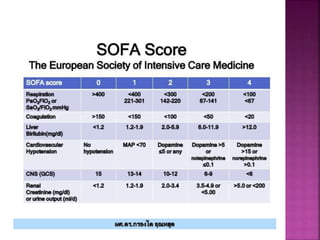
 The predominant score in current use is the
Sequential Organ Failure Assessment (SOFA)
 laboratory variables, namely, PaO2, platelet
count, creatinine level, and bilirubin level,
are needed for full computation.
 Despite its worldwide importance, public
awareness of sepsis is poor.Furthermore, the
various manifestations of sepsis make
diagnosis difficult, even for experienced
clinicians.
 health care practitioners require improved
clinical prompts and diagnostic approaches
to facilitate earlier identification and an
accurate quantification of the burden of
sepsis.
 Sepsis is defined as life-threatening organ
dysfunction caused by a dysregulated host
response to infection.
 Organ dysfunction can be identified as an acute
change in total SOFA score ≥2 points consequent to
the infection.
 The baseline SOFA score can be assumed to be zero in
patients not known to have preexisting organ
dysfunction.
 A SOFA score ≥2 reflects an overall mortality risk of
approximately 10% in a general hospital population
with suspected infection. Even patients presenting
with modest dysfunction can deteriorate further,
emphasizing the seriousness of this condition and the
need for prompt and appropriate intervention, if not
already being instituted.
 In lay terms, sepsis is a life-threatening
condition that arises when the body’s
response to an infection injures its own
tissues and organs.
 Patients with suspected infection who are
likely to have a prolonged ICU stay or to die
in the hospital can be promptly identified at
the bedside with qSOFA, ie, alteration in
mental status, systolic blood pressure ≤100
mm Hg, or respiratory rate ≥22/min.
 Septic shock is a subset of sepsis in which
underlying circulatory and cellular/metabolic
abnormalities are profound enough to
substantially increase mortality.
 Patients with septic shock can be identified
with a clinical construct of sepsis with
persisting hypotension requiring vasopressors
to maintain MAP ≥65 mm Hg and having a
serum lactate level >2 mmol/L (18 mg/dL)
despite adequate volume resuscitation. With
these criteria, hospital mortality is in excess
of 40%.
Respiratory rate ≥22/min
Altered mentation
Systolic blood pressure ≤100 mm Hg
A parsimonious clinical model developed with
multivariable logistic regression identified
that any 2 of 3 clinical variables—Glasgow
Coma Scale score of 13 or less, systolic blood
pressure of 100 mm Hg or less, and
respiratory rate 22/min or greater—offered
predictive validity (AUROC = 0.81; 95% CI,
0.80-0.82) similar to that of the full SOFA
score outside the ICU.
 In patients with suspected infection within
the ICU, the SOFA score had predictive
validity (AUROC = 0.74; 95% CI, 0.73-0.76)
superior to that of this model (AUROC = 0.66;
95% CI, 0.64-0.68), likely reflecting the
modifying effects of interventions (eg,
vasopressors, sedative agents, mechanical
ventilation). Addition of lactate
measurement did not meaningfully improve
predictive validity but may help identify
patients at intermediate risk.
 sepsis is a broad term applied to an
incompletely understood process. There are,
as yet, no simple and unambiguous clinical
criteria or biological, imaging, or laboratory
features that uniquely identify a septic
patient
 The new definition of sepsis reflects an up-
to-date view of pathobiology, particularly in
regard to what distinguishes sepsis from
uncomplicated infection.
 offers easily measurable clinical criteria that
capture the essence of sepsis
 most of the data were extracted from US
databases
 This simple bedside score may be particularly
relevant in resource-poor settings in which
laboratory data are not readily available
 The task force recommendations should not,
however, constrain the monitoring of lactate
as a guide to therapeutic response or as an
indicator of illness severity.
 The combination of hyperlactatemia with
fluid-resistant hypotension identifies a group
with particularly high mortality and thus
offers a more robust identifier of the
physiologic and epidemiologic concept of
septic shock than either criterion alone
 The task force focused on adult patients yet
recognizes the need to develop similar
updated definitions for pediatric populations
Conclusions
 These updated definitions and clinical criteria
should clarify long-used descriptors and
facilitate earlier recognition and more timely
management of patients with sepsis or at risk of
developing it.
 This process, however, remains a work in
progress. As is done with software and other
coding updates,
 the task force recommends that the new
definition be designated Sepsis-3, with the 1991
and 2001 iterations being recognized as Sepsis-1
and Sepsis-2, respectively, to emphasize the
need for future iterations.
Derek C. Angus, M.D., M.P.H., and Tom van der
Poll, M.D., Ph.D.
 November
 21, 2013, at NEJM.org.
review article
 Sepsis is one of the oldest and most elusive
syndromes in medicine
 Hippocrates claimed that sepsis was the
process by which flesh rots, swamps generate
foul airs, and wounds fester.1
 Galen later considered sepsis a laudable
event, necessary for wound healing.
 With the confirmation of germ theory by
Semmelweis, Pasteur, and others, sepsis was
recast as a systemic infection, often
described as “blood poisoning,” and assumed
to be the result of the host's invasion by
pathogenic organisms that then spread in the
bloodstream
 The number of cases in the United States
exceeds 750,000 per year
 Studies from other high-income countries
show similar rates of sepsis in the ICU.9
 The incidence of severe sepsis outside
modern ICUs, especially in parts of the world
in which ICU care is scarce, is largely
unknown
 Adhikari et al. estimated up to 19 million
cases worldwide per year.10 The true
incidence is presumably far higher.
 Severe sepsis occurs as a result of both
community-acquired and health care–
associated infections.
 Pneumonia is the most common cause,
accounting for about half of all cases,
followed by intraabdominal and urinary tract
infections.
 Blood cultures are typically positive in only
one third of cases, and in up to a third of
cases, cultures from all sites are negative.
 Staphylococcus aureus and Streptococcus
pneumoniae are the most common gram-
positive isolates
 Escherichia coli, klebsiella species, and
Pseudomonas aeruginosa predominate among
gram-negative isolates.
 An epidemiologic study of sepsis showed that
during the period from 1979 to 2000, gram-
positive infections overtook gram-negative
infections
 However, in a more recent study involving
14,000 ICU patients in 75 countries, gram-
negative bacteria were isolated in 62% of
patients with severe sepsis who had positive
cultures, gram-positive bacteria in 47%, and
fungi in 19%.
 risk factors for organ dysfunction are less
well studied but probably include the
causative organism and the patient's genetic
composition, underlying health status, and
preexisting organ function, along with the
timeliness of therapeutic intervention
 Age, sex, and race or ethnic group all
influence the incidence of severe sepsis
 It is higher in infants and elderly persons
than in other age groups, higher in males
than in females, and higher in blacks than in
whites.
 Many studies have focused on polymorphisms
in genes encoding proteins implicated in the
pathogenesis of sepsis, including cytokines
and other mediators involved in innate
immunity, coagulation, and fibrinolysis.
However, findings are often inconsistent
 The clinical manifestations of sepsis are
highly variable, depending on the initial site
of infection, the causative organism, the
pattern of acute organ dysfunction, the
underlying health status of the patient, and
the interval before initiation of treatment
 Acute organ dysfunction most commonly
affects the respiratory and cardiovascular
systems
 Respiratory compromise is classically
manifested as the acute respiratory distress
syndrome (ARDS), which is defined as
hypoxemia with bilateral infiltrates of
noncardiac origin
 Cardiovascular compromise is manifested
primarily as hypotension or an elevated
serum lactate level
 The brain and kidneys are also often
affected.
 Central nervous system dysfunction is
typically manifested as obtundation or
delirium. Imaging studies generally show no
focal lesions
 Acute kidney injury is manifested as
decreasing urine output and an increasing
serum creatinine level and frequently
requires treatment with renal-replacement
therapy
 Paralytic ileus, elevated aminotransferase
levels, altered glycemic control,
thrombocytopenia and disseminated
intravascular coagulation, adrenal
dysfunction, and the euthyroid sick syndrome
are all common in patients with severe
sepsis.5
 Before the introduction of modern intensive
care with the ability to provide vital-organ
support, severe sepsis and septic shock were
typically lethal.
 Even with intensive care, rates of in-hospital
death from septic shock were often in excess
of 80% as recently as 30 years ago
 mortality is now closer to 20 to 30%
 Those who survive often have impaired
physical or neurocognitive functioning, mood
disorders, and a low quality of life
 Host Response
 Innate Immunity
 Coagulation Abnormalities
 Anti-inflammatory Mechanisms and
Immunosuppression
 Organ Dysfunction
 The Surviving Sepsis Campaign, an
international consortium of professional
societies involved in critical care, treatment
of infectious diseases, and emergency
medicine, recently issued the third iteration
of clinical guidelines for the management of
severe sepsis and septic shock
 The most important elements of the
guidelines are organized into two “bundles”
of care: an initial management bundle to be
accomplished within 6 hours after the
patient's presentation and a management
bundle to be accomplished in the ICU
 The principles of the initial management bundle
are to provide cardiorespiratory resuscitation
and mitigate the immediate threats of
uncontrolled infection
 Resuscitation requires the use of intravenous
fluids and vasopressors, with oxygen therapy and
mechanical ventilation provided as necessary.
 The initial management of infection requires
forming a probable diagnosis, obtaining cultures,
and initiating appropriate and timely empirical
antimicrobial therapy and source control (i.e.,
draining pus, if appropriate).
 The choice of empirical therapy depends on
the suspected site of infection, the setting in
which the infection developed
 intravenous antibiotic therapy should be
started as early as possible and should cover
all likely pathogens
 It has not been determined whether
combination antimicrobial therapy produces
better outcomes than adequate single-agent
antibiotic therapy in patients with severe
sepsis
 Current guidelines recommend combination
antimicrobial therapy only for neutropenic
sepsis and sepsis caused by pseudomonas
species.
 Empirical antifungal therapy should be used
only in patients at high risk for invasive
candidiasis
 De-escalation of initial broad-spectrum
therapy may prevent the emergence of
resistant organisms, minimize the risk of
drug toxicity, and reduce costs
 The only immunomodulatory therapy that is
currently advocated is a short course of
hydrocortisone (200 to 300 mg per day for up to
7 days or until vasopressor support is no longer
required) for patients with refractory septic
shock.
Recent Failures
 One of the great disappointments during the past
30 years has been the failure to convert
advances in our understanding of the underlying
biologic features of sepsis into effective new
therapies
 antilipopolysaccharide or anti–
proinflammatory cytokine strategies
 antithrombin or activated protein C
 The only new agent that gained regulatory
approval was activated protein C
 Eli Lilly, to withdraw the drug from the
market
 The recent decision to stop further clinical
development of CytoFab, a polyclonal anti–
tumor necrosis factor antibody
 Among the agents with broader
immunomodulatory effects, glucocorticoids have
received the most attention.
 Intravenous immune globulin is also associated
with a potential benefit, but important questions
remain,and its use is not part of routine
practice.
 Activated protein C mutants that lack
anticoagulant properties are examples of more
targeted drug development and were shown to
provide protection from sepsis-induced death in
animals, without an increased risk of bleeding
 Severe sepsis and septic shock represent one
of the oldest and most pressing problems in
medicine
 With advances in intensive care, increased
awareness, and dissemination of evidence-
based guidelines, clinicians have taken large
strides in reducing the risk of imminent
death associated with sepsis
 However, as more patients survive sepsis,
concern mounts over the lingering sequelae
of what was previously a lethal event
 Advances in molecular biology have provided
keen insight into the complexity of pathogen
and alarm recognition by the human host and
important clues to a host response
 However, harnessing that information to
provide effective new therapies has proved
to be difficult
 newer, smarter approaches to clinical-trial
design and execution are essential to
improve the outcomes of sepsis
Thank you

Sepsis newer aspects

  • 1.
  • 2.
    The Third InternationalConsensus Definitions for Sepsis and Septic Shock (Sepsis-3)  JAMA February 23, 2016  Mervyn Singer, MD, FRCP1; Clifford S. Deutschman, MD, MS2; Christopher Warren Seymour, MD, MSc3; et al
  • 3.
     Definitions ofsepsis and septic shock were last revised in 2001  Considerable advances have since been made into the pathobiology, management, and epidemiology of sepsis
  • 4.
     the EuropeanSociety of Intensive Care Medicine and the Society of Critical Care Medicine convened a task force of 19 critical care, infectious disease, surgical, and pulmonary specialists in January 2014.  The societies each nominated co-chairs (Drs Deutschman and Singer), who selected members according to their scientific expertise in sepsis epidemiology, clinical trials, and basic or translational research.
  • 5.
     The groupengaged in iterative discussions via 4 face-to-face meetings between January 2014 and January 2015,emailcorrespondence, and voting. Limitations of previous definitions 1.an excessive focus on inflammation 2. the misleading model that sepsis follows a continuum through severe sepsis to shock 3. inadequate specificity and sensitivity of the systemic inflammatory response syndrome (SIRS) criteria
  • 6.
     Two ormore of:  Temperature >38°C or <36°C  Heart rate >90/min  Respiratory rate >20/min or PaCO2 <32 mm Hg (4.3 kPa)  White blood cell count >12 000/mm3 or <4000/mm3 or >10% immature bands
  • 8.
     • Sepsisis the primary cause of death from infection, especially if not recognized and treated promptly. Its recognition mandates urgent attention.  • Sepsis is a syndrome shaped by pathogen factors and host factors (eg, sex, race and other genetic determinants, age, comorbidities, environment) with characteristics that evolve over time. What differentiates sepsis from infection is an aberrant or dysregulated host response and the presence of organ dysfunction.
  • 9.
     Sepsis-induced organdysfunction may be occult; therefore, its presence should be considered in any patient presenting with infection. Conversely, unrecognized infection may be the cause of new-onset organ dysfunction. Any unexplained organ dysfunction should thus raise the possibility of underlying infection.  • The clinical and biological phenotype of sepsis can be modified by preexisting acute illness, long-standing co morbidities, medication, and interventions.  • Specific infections may result in local organ dysfunction without generating a dysregulated systemic host response.
  • 10.
     The currentuse of 2 or more SIRS criteria to identify sepsis was unanimously considered by the task force to be unhelpful. Changes in white blood cell count, temperature, and heart rate reflect inflammation, the host response to “danger” in the form of infection or other insults. The SIRS criteria do not necessarily indicate a dysregulated, life- threatening response.
  • 11.
     1 in8 patients admitted to critical care units in Australia and New Zealand with infection and new organ failure did not have the requisite minimum of 2 SIRS criteria to fulfill the definition of sepsis (poor concurrent validity) Organ Dysfunction or Failure  The predominant score in current use is the Sequential Organ Failure Assessment (SOFA)  laboratory variables, namely, PaO2, platelet count, creatinine level, and bilirubin level, are needed for full computation.
  • 13.
     Despite itsworldwide importance, public awareness of sepsis is poor.Furthermore, the various manifestations of sepsis make diagnosis difficult, even for experienced clinicians.  health care practitioners require improved clinical prompts and diagnostic approaches to facilitate earlier identification and an accurate quantification of the burden of sepsis.
  • 14.
     Sepsis isdefined as life-threatening organ dysfunction caused by a dysregulated host response to infection.  Organ dysfunction can be identified as an acute change in total SOFA score ≥2 points consequent to the infection.  The baseline SOFA score can be assumed to be zero in patients not known to have preexisting organ dysfunction.  A SOFA score ≥2 reflects an overall mortality risk of approximately 10% in a general hospital population with suspected infection. Even patients presenting with modest dysfunction can deteriorate further, emphasizing the seriousness of this condition and the need for prompt and appropriate intervention, if not already being instituted.
  • 15.
     In layterms, sepsis is a life-threatening condition that arises when the body’s response to an infection injures its own tissues and organs.  Patients with suspected infection who are likely to have a prolonged ICU stay or to die in the hospital can be promptly identified at the bedside with qSOFA, ie, alteration in mental status, systolic blood pressure ≤100 mm Hg, or respiratory rate ≥22/min.
  • 16.
     Septic shockis a subset of sepsis in which underlying circulatory and cellular/metabolic abnormalities are profound enough to substantially increase mortality.  Patients with septic shock can be identified with a clinical construct of sepsis with persisting hypotension requiring vasopressors to maintain MAP ≥65 mm Hg and having a serum lactate level >2 mmol/L (18 mg/dL) despite adequate volume resuscitation. With these criteria, hospital mortality is in excess of 40%.
  • 17.
    Respiratory rate ≥22/min Alteredmentation Systolic blood pressure ≤100 mm Hg A parsimonious clinical model developed with multivariable logistic regression identified that any 2 of 3 clinical variables—Glasgow Coma Scale score of 13 or less, systolic blood pressure of 100 mm Hg or less, and respiratory rate 22/min or greater—offered predictive validity (AUROC = 0.81; 95% CI, 0.80-0.82) similar to that of the full SOFA score outside the ICU.
  • 18.
     In patientswith suspected infection within the ICU, the SOFA score had predictive validity (AUROC = 0.74; 95% CI, 0.73-0.76) superior to that of this model (AUROC = 0.66; 95% CI, 0.64-0.68), likely reflecting the modifying effects of interventions (eg, vasopressors, sedative agents, mechanical ventilation). Addition of lactate measurement did not meaningfully improve predictive validity but may help identify patients at intermediate risk.
  • 19.
     sepsis isa broad term applied to an incompletely understood process. There are, as yet, no simple and unambiguous clinical criteria or biological, imaging, or laboratory features that uniquely identify a septic patient  The new definition of sepsis reflects an up- to-date view of pathobiology, particularly in regard to what distinguishes sepsis from uncomplicated infection.  offers easily measurable clinical criteria that capture the essence of sepsis
  • 20.
     most ofthe data were extracted from US databases  This simple bedside score may be particularly relevant in resource-poor settings in which laboratory data are not readily available  The task force recommendations should not, however, constrain the monitoring of lactate as a guide to therapeutic response or as an indicator of illness severity.
  • 21.
     The combinationof hyperlactatemia with fluid-resistant hypotension identifies a group with particularly high mortality and thus offers a more robust identifier of the physiologic and epidemiologic concept of septic shock than either criterion alone  The task force focused on adult patients yet recognizes the need to develop similar updated definitions for pediatric populations
  • 22.
    Conclusions  These updateddefinitions and clinical criteria should clarify long-used descriptors and facilitate earlier recognition and more timely management of patients with sepsis or at risk of developing it.  This process, however, remains a work in progress. As is done with software and other coding updates,  the task force recommends that the new definition be designated Sepsis-3, with the 1991 and 2001 iterations being recognized as Sepsis-1 and Sepsis-2, respectively, to emphasize the need for future iterations.
  • 23.
    Derek C. Angus,M.D., M.P.H., and Tom van der Poll, M.D., Ph.D.  November  21, 2013, at NEJM.org. review article
  • 24.
     Sepsis isone of the oldest and most elusive syndromes in medicine  Hippocrates claimed that sepsis was the process by which flesh rots, swamps generate foul airs, and wounds fester.1  Galen later considered sepsis a laudable event, necessary for wound healing.  With the confirmation of germ theory by Semmelweis, Pasteur, and others, sepsis was recast as a systemic infection, often described as “blood poisoning,” and assumed to be the result of the host's invasion by pathogenic organisms that then spread in the bloodstream
  • 25.
     The numberof cases in the United States exceeds 750,000 per year  Studies from other high-income countries show similar rates of sepsis in the ICU.9  The incidence of severe sepsis outside modern ICUs, especially in parts of the world in which ICU care is scarce, is largely unknown  Adhikari et al. estimated up to 19 million cases worldwide per year.10 The true incidence is presumably far higher.
  • 26.
     Severe sepsisoccurs as a result of both community-acquired and health care– associated infections.  Pneumonia is the most common cause, accounting for about half of all cases, followed by intraabdominal and urinary tract infections.  Blood cultures are typically positive in only one third of cases, and in up to a third of cases, cultures from all sites are negative.
  • 27.
     Staphylococcus aureusand Streptococcus pneumoniae are the most common gram- positive isolates  Escherichia coli, klebsiella species, and Pseudomonas aeruginosa predominate among gram-negative isolates.  An epidemiologic study of sepsis showed that during the period from 1979 to 2000, gram- positive infections overtook gram-negative infections
  • 28.
     However, ina more recent study involving 14,000 ICU patients in 75 countries, gram- negative bacteria were isolated in 62% of patients with severe sepsis who had positive cultures, gram-positive bacteria in 47%, and fungi in 19%.  risk factors for organ dysfunction are less well studied but probably include the causative organism and the patient's genetic composition, underlying health status, and preexisting organ function, along with the timeliness of therapeutic intervention
  • 29.
     Age, sex,and race or ethnic group all influence the incidence of severe sepsis  It is higher in infants and elderly persons than in other age groups, higher in males than in females, and higher in blacks than in whites.  Many studies have focused on polymorphisms in genes encoding proteins implicated in the pathogenesis of sepsis, including cytokines and other mediators involved in innate immunity, coagulation, and fibrinolysis. However, findings are often inconsistent
  • 30.
     The clinicalmanifestations of sepsis are highly variable, depending on the initial site of infection, the causative organism, the pattern of acute organ dysfunction, the underlying health status of the patient, and the interval before initiation of treatment  Acute organ dysfunction most commonly affects the respiratory and cardiovascular systems
  • 31.
     Respiratory compromiseis classically manifested as the acute respiratory distress syndrome (ARDS), which is defined as hypoxemia with bilateral infiltrates of noncardiac origin  Cardiovascular compromise is manifested primarily as hypotension or an elevated serum lactate level
  • 32.
     The brainand kidneys are also often affected.  Central nervous system dysfunction is typically manifested as obtundation or delirium. Imaging studies generally show no focal lesions  Acute kidney injury is manifested as decreasing urine output and an increasing serum creatinine level and frequently requires treatment with renal-replacement therapy
  • 33.
     Paralytic ileus,elevated aminotransferase levels, altered glycemic control, thrombocytopenia and disseminated intravascular coagulation, adrenal dysfunction, and the euthyroid sick syndrome are all common in patients with severe sepsis.5
  • 34.
     Before theintroduction of modern intensive care with the ability to provide vital-organ support, severe sepsis and septic shock were typically lethal.  Even with intensive care, rates of in-hospital death from septic shock were often in excess of 80% as recently as 30 years ago  mortality is now closer to 20 to 30%  Those who survive often have impaired physical or neurocognitive functioning, mood disorders, and a low quality of life
  • 35.
     Host Response Innate Immunity  Coagulation Abnormalities  Anti-inflammatory Mechanisms and Immunosuppression  Organ Dysfunction
  • 36.
     The SurvivingSepsis Campaign, an international consortium of professional societies involved in critical care, treatment of infectious diseases, and emergency medicine, recently issued the third iteration of clinical guidelines for the management of severe sepsis and septic shock  The most important elements of the guidelines are organized into two “bundles” of care: an initial management bundle to be accomplished within 6 hours after the patient's presentation and a management bundle to be accomplished in the ICU
  • 37.
     The principlesof the initial management bundle are to provide cardiorespiratory resuscitation and mitigate the immediate threats of uncontrolled infection  Resuscitation requires the use of intravenous fluids and vasopressors, with oxygen therapy and mechanical ventilation provided as necessary.  The initial management of infection requires forming a probable diagnosis, obtaining cultures, and initiating appropriate and timely empirical antimicrobial therapy and source control (i.e., draining pus, if appropriate).
  • 38.
     The choiceof empirical therapy depends on the suspected site of infection, the setting in which the infection developed  intravenous antibiotic therapy should be started as early as possible and should cover all likely pathogens  It has not been determined whether combination antimicrobial therapy produces better outcomes than adequate single-agent antibiotic therapy in patients with severe sepsis
  • 39.
     Current guidelinesrecommend combination antimicrobial therapy only for neutropenic sepsis and sepsis caused by pseudomonas species.  Empirical antifungal therapy should be used only in patients at high risk for invasive candidiasis  De-escalation of initial broad-spectrum therapy may prevent the emergence of resistant organisms, minimize the risk of drug toxicity, and reduce costs
  • 40.
     The onlyimmunomodulatory therapy that is currently advocated is a short course of hydrocortisone (200 to 300 mg per day for up to 7 days or until vasopressor support is no longer required) for patients with refractory septic shock. Recent Failures  One of the great disappointments during the past 30 years has been the failure to convert advances in our understanding of the underlying biologic features of sepsis into effective new therapies
  • 41.
     antilipopolysaccharide oranti– proinflammatory cytokine strategies  antithrombin or activated protein C  The only new agent that gained regulatory approval was activated protein C  Eli Lilly, to withdraw the drug from the market  The recent decision to stop further clinical development of CytoFab, a polyclonal anti– tumor necrosis factor antibody
  • 42.
     Among theagents with broader immunomodulatory effects, glucocorticoids have received the most attention.  Intravenous immune globulin is also associated with a potential benefit, but important questions remain,and its use is not part of routine practice.  Activated protein C mutants that lack anticoagulant properties are examples of more targeted drug development and were shown to provide protection from sepsis-induced death in animals, without an increased risk of bleeding
  • 43.
     Severe sepsisand septic shock represent one of the oldest and most pressing problems in medicine  With advances in intensive care, increased awareness, and dissemination of evidence- based guidelines, clinicians have taken large strides in reducing the risk of imminent death associated with sepsis  However, as more patients survive sepsis, concern mounts over the lingering sequelae of what was previously a lethal event
  • 44.
     Advances inmolecular biology have provided keen insight into the complexity of pathogen and alarm recognition by the human host and important clues to a host response  However, harnessing that information to provide effective new therapies has proved to be difficult  newer, smarter approaches to clinical-trial design and execution are essential to improve the outcomes of sepsis
  • 45.