DAT630

Clustering
Darío Garigliotti | University of Stavanger
16/10/2017
Introduction to Data Mining, Chapter 8
Supervised vs.
Unsupervised Learning
- Supervised learning

- Labeled examples (with target information) are
available
- Unsupervised learning

- Examples are not labeled
Outline
- Clustering

- Two algorithms:

- K-means
- Hierarchical (Agglomerative) Clustering
Clustering
Clustering
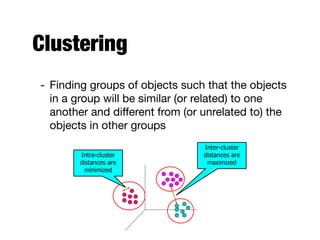
- Finding groups of objects such that the objects
in a group will be similar (or related) to one
another and different from (or unrelated to) the
objects in other groups
Inter-cluster
distances are
maximized
Intra-cluster
distances are
minimized
Why?
- For understanding

- E.g., biology (taxonomy of species)
- Business (segmenting customers for additional
analysis and marketing activities)
- Web (clustering search results into subcategories)
- For utility

- Some clustering techniques characterize each
cluster in terms of a cluster prototype
- These prototypes can be used as a basis for a
number of data analysis and processing techniques
How many clusters?
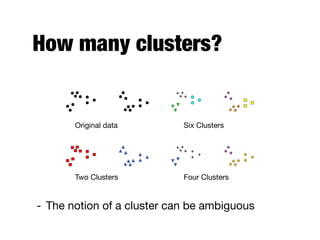
- The notion of a cluster can be ambiguous
Original data
Four ClustersTwo Clusters
Six Clusters
Types of Clustering
- Partitional vs. hierarchical

- Partitional: non-overlapping clusters such that each
data object is in exactly one cluster
- Hierarchical: a set of nested clusters organized as a
hierarchical tree
- Exclusive vs. non-exclusive

- Whether points may belong to a single or multiple
clusters
Types of Clustering (2)
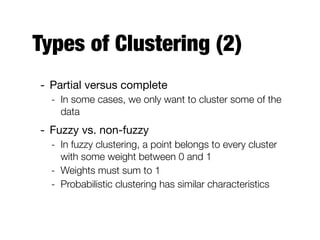
- Partial versus complete

- In some cases, we only want to cluster some of the
data
- Fuzzy vs. non-fuzzy

- In fuzzy clustering, a point belongs to every cluster
with some weight between 0 and 1
- Weights must sum to 1
- Probabilistic clustering has similar characteristics
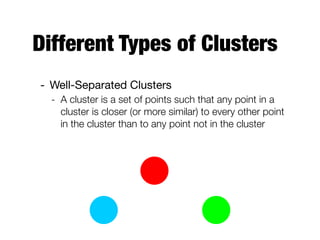
Different Types of Clusters
- Well-Separated Clusters

- A cluster is a set of points such that any point in a
cluster is closer (or more similar) to every other point
in the cluster than to any point not in the cluster
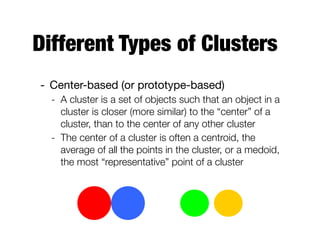
Different Types of Clusters
- Center-based (or prototype-based)

- A cluster is a set of objects such that an object in a
cluster is closer (more similar) to the “center” of a
cluster, than to the center of any other cluster
- The center of a cluster is often a centroid, the
average of all the points in the cluster, or a medoid,
the most “representative” point of a cluster
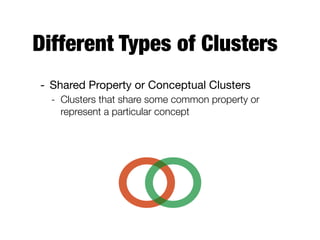
Different Types of Clusters
- Shared Property or Conceptual Clusters

- Clusters that share some common property or
represent a particular concept
Notation
- x an object (data point)

- m the number of points in the data set

- K the number of clusters

- Ci the ith cluster

- ci the centroid of cluster Ci

- mi the number of points in cluster Ci
K-means Clustering
K-means
- One of the oldest and most widely used
clustering techniques

- Prototype-based clustering

- Clusters are represented by their centroids
- Finds a user-specified number of clusters (K)
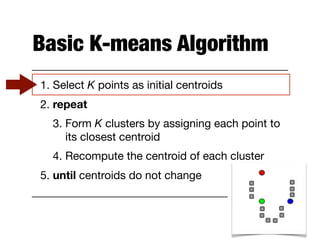
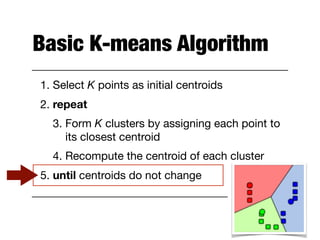
Basic K-means Algorithm
1. Select K points as initial centroids

2. repeat

3. Form K clusters by assigning each point to
its closest centroid

4. Recompute the centroid of each cluster

5. until centroids do not change
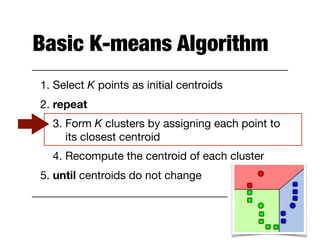
Basic K-means Algorithm
1. Select K points as initial centroids

2. repeat

3. Form K clusters by assigning each point to
its closest centroid

4. Recompute the centroid of each cluster

5. until centroids do not change
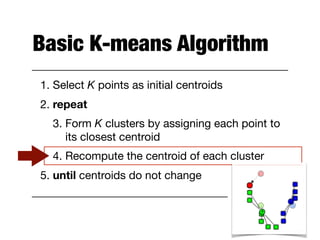
Basic K-means Algorithm
1. Select K points as initial centroids

2. repeat

3. Form K clusters by assigning each point to
its closest centroid

4. Recompute the centroid of each cluster

5. until centroids do not change
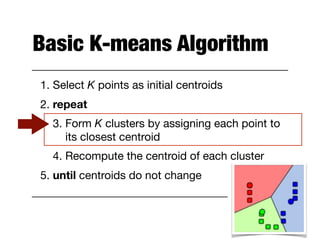
Basic K-means Algorithm
1. Select K points as initial centroids

2. repeat

3. Form K clusters by assigning each point to
its closest centroid

4. Recompute the centroid of each cluster

5. until centroids do not change
Basic K-means Algorithm
1. Select K points as initial centroids

2. repeat

3. Form K clusters by assigning each point to
its closest centroid

4. Recompute the centroid of each cluster

5. until centroids do not change
Basic K-means Algorithm
1. Select K points as initial centroids

2. repeat

3. Form K clusters by assigning each point to
its closest centroid

4. Recompute the centroid of each cluster

5. until centroids do not change
1. Choosing Initial
Centroids
- Most commonly: select points (centroids)
randomly

- They may be poor
- Possible solution: perform multiple runs, each with a
different set of randomly chosen centroids
3. Assigning Points to the
Closest Centroid
- We need a proximity measure that quantifies
the notion of "closest"

- Usually chosen to be simple

- Has to be calculated repeatedly
- See distance functions from Lecture 1

- E.g., Euclidean distance
4. Recomputing Centroids
- Objective function is selected

- I.e., what is it that we want minimize/maximize
- Once the objective function and the proximity
measure are defined, we can define
mathematically the centroid we should choose

- E.g., minimize the squared distance of each point to
its closest centroid
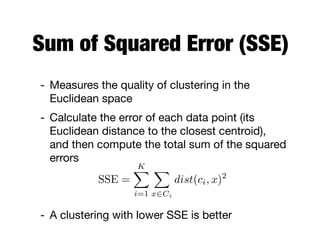
Sum of Squared Error (SSE)
- Measures the quality of clustering in the
Euclidean space

- Calculate the error of each data point (its
Euclidean distance to the closest centroid),
and then compute the total sum of the squared
errors

- A clustering with lower SSE is better
SSE =
KX
i=1
X
x2Ci
dist(ci, x)2
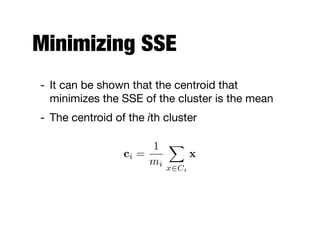
Minimizing SSE
- It can be shown that the centroid that
minimizes the SSE of the cluster is the mean

- The centroid of the ith cluster
ci =
1
mi
X
x2Ci
x
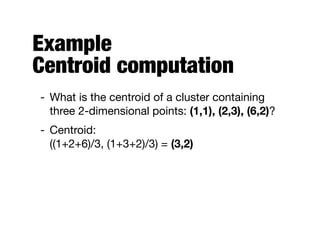
Example

Centroid computation
- What is the centroid of a cluster containing
three 2-dimensional points: (1,1), (2,3), (6,2)?

- Centroid:

((1+2+6)/3, (1+3+2)/3) = (3,2)
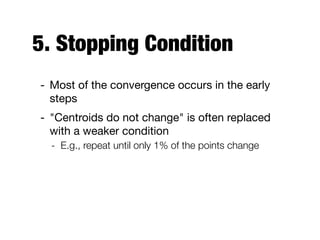
5. Stopping Condition
- Most of the convergence occurs in the early
steps

- "Centroids do not change" is often replaced
with a weaker condition

- E.g., repeat until only 1% of the points change
Exercise
Note
- There are other choices for proximity,
centroids, and objective functions, e.g.,

- Proximity function: Manhattan (L1)

Centroid: median

Objective function: minimize sum of L1 distance of an
object to its cluster centroid
- Proximity function: cosine

Centroid: mean

Objective function: maximize sum of cosine sim. of an
object to its cluster centroid
What is the complexity?
- m number of points, n number of attributes, 

K number of clusters

- Space requirements: O(?)

- Time requirements: O(?)
Complexity
- m number of points, n number of attributes, 

K number of clusters

- Space requirements: O((m+K)*n)

- Modest, as only the data points and centroids are
stored
- Time requirements: O(I*K*m*n)

- I is the number of iterations required for convergence
- Modest, linear in the number of data points
K-means Issues
- Depending on the initial (random) selection of
centroids different clustering can be produced

- Steps 3 and 4 are only guaranteed to find a
local optimum

- Empty clusters may be obtained

- replacement of centroid by (i) farthest point to any
other centroid, or (ii) chosen among those in the
cluster with highest SSE
K-means Issues (2)
- Presence of outliers must sometimes be kept

- E.g. all points must be clustered in data
compression
- In general outliers may be addressed by
eliminating them to improve clustering

- Before: by outlier detection techniques
- After: eliminating (i) points whose SSE is high, or (ii)
directly small clusters as likely outliers
K-means Issues (3)
- Postprocessing for reducing SSE

- and ideally not introducing more clusters
- How? Alternating splitting and merging steps
- Decrease SSE by more clusters

- Splitting (e.g., cluster with highest SSE)
- Introducing new centroid
- Less clusters by trying not to increase SSE

- Dispersing (a cluster e.g. with lowest SSE)
- Merging 2 clusters (e.g. with closest centroids)
Bisecting K-means
- Straightforward extension of the basic K-
means algorithm

- Idea: 

- Split the set of data points to two clusters
- Select one of these clusters to split
- Repeat until K clusters have been produced
- The resulting clusters are often used as the
initial centroids for the basic K-means
algorithm
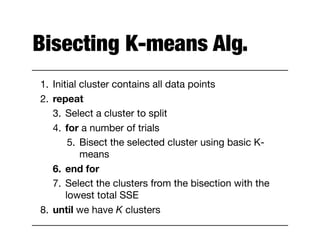
Bisecting K-means Alg.
1. Initial cluster contains all data points

2. repeat

3. Select a cluster to split

4. for a number of trials

5. Bisect the selected cluster using basic K-
means

6. end for
7. Select the clusters from the bisection with the
lowest total SSE

8. until we have K clusters
Selecting a Cluster to Split
- Number of possible ways

- Largest cluster
- Cluster with the largest SSE
- Combine size and SSE
- Different choices result in different clusters
Hierarchical Clustering
- By recording the sequence of clusterings
produced, bisecting K-means can also
produce a hierarchical clustering
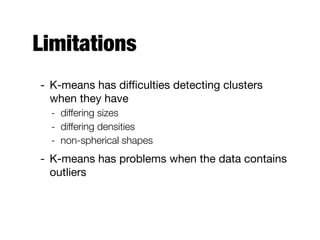
Limitations
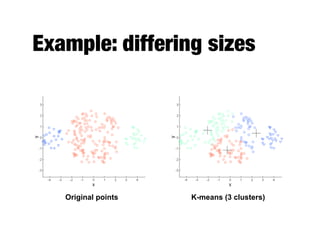
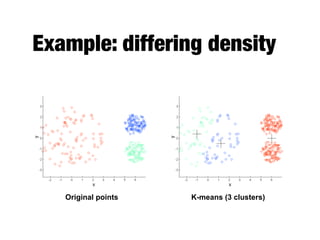
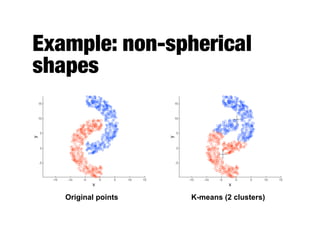
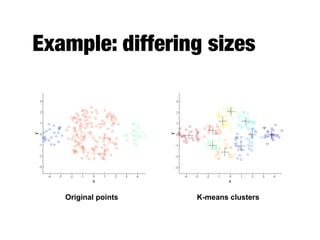
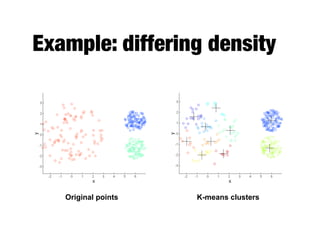
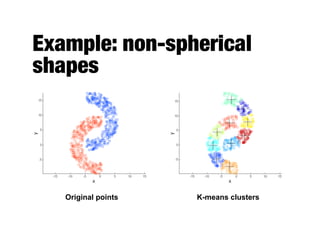
- K-means has difficulties detecting clusters
when they have 

- differing sizes
- differing densities
- non-spherical shapes
- K-means has problems when the data contains
outliers
Example: differing sizes
K-means (3 clusters)Original points
Example: differing density
K-means (3 clusters)Original points
Example: non-spherical
shapes
K-means (2 clusters)Original points
Overcoming Limitations
- Use larger K values

- Natural clusters will be broken into a number of
sub-clusters
Example: differing sizes
Original points K-means clusters
Example: differing density
Original points K-means clusters
Example: non-spherical
shapes
Original points K-means clusters
Summary
- Efficient and simple

- Provided that K is relatively small (K<<m)
- Bisecting variant is even more efficient and
less susceptible to initialization problems

- Cannot handle certain types of clusters

- Problems can be overcome by generating more
(sub)clusters
- Has trouble with data that contains outliers

- Outlier detection and removal can help
Hierarchical Clustering
- Two general approaches

- Agglomerative

- Start with the points as individual clusters
- At each step, merge the closest pair of clusters
- Requires a notion of cluster proximity
- Divisive

- Start with a single, all-inclusive cluster
- At each step, split a cluster, until only singleton
clusters of individual points remain
Agglomerative Hierarchical
Clustering
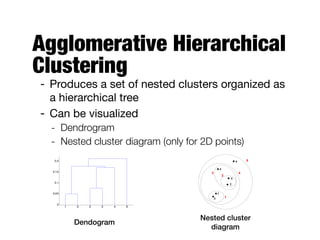
- Produces a set of nested clusters organized as
a hierarchical tree

- Can be visualized

- Dendrogram
- Nested cluster diagram (only for 2D points)
1 3 2 5 4 6
0
0.05
0.1
0.15
0.2
1
2
3
4
5
6
1
2
3 4
5
Dendogram
Nested cluster

diagram
Strengths
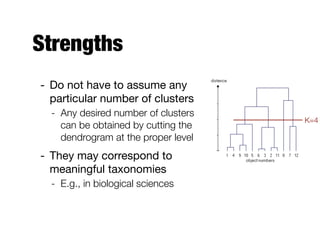
- Do not have to assume any
particular number of clusters

- Any desired number of clusters
can be obtained by cutting the
dendrogram at the proper level
- They may correspond to
meaningful taxonomies

- E.g., in biological sciences
K=4
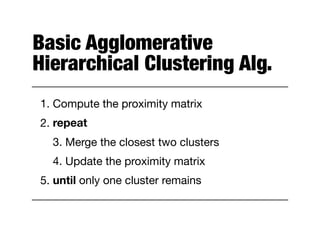
Basic Agglomerative
Hierarchical Clustering Alg.
1. Compute the proximity matrix

2. repeat

3. Merge the closest two clusters

4. Update the proximity matrix

5. until only one cluster remains
Example

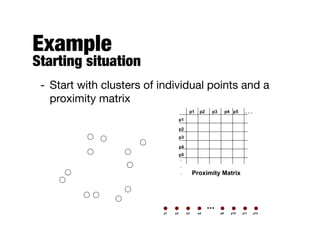
Starting situation
- Start with clusters of individual points and a
proximity matrix
p1
p3
p5
p4
p2
p1 p2 p3 p4 p5 . . .
.
.
. Proximity Matrix
...
p1 p2 p3 p4 p9 p10 p11 p12
Example

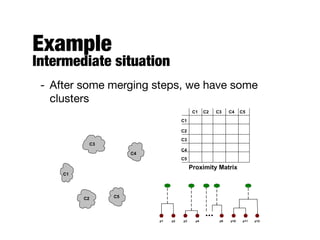
Intermediate situation
- After some merging steps, we have some
clusters
C1
C4
C2 C5
C3
C2C1
C1
C3
C5
C4
C2
C3 C4 C5
Proximity Matrix
...
p1 p2 p3 p4 p9 p10 p11 p12
Example

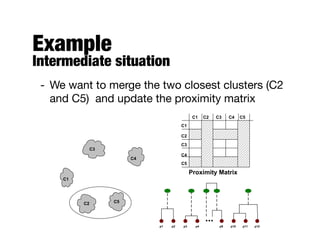
Intermediate situation
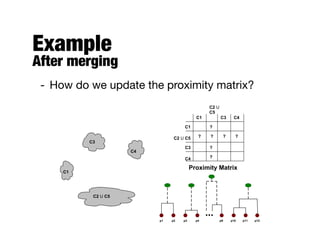
- We want to merge the two closest clusters (C2
and C5) and update the proximity matrix
C1
C4
C2 C5
C3
C2C1
C1
C3
C5
C4
C2
C3 C4 C5
Proximity Matrix
...
p1 p2 p3 p4 p9 p10 p11 p12
Example

After merging
- How do we update the proximity matrix?
C1
C4
C2 U C5
C3
? ? ? ?
?
?
?
C2 U
C5
C1
C1
C3
C4
C2 U C5
C3 C4
Proximity Matrix
...
p1 p2 p3 p4 p9 p10 p11 p12
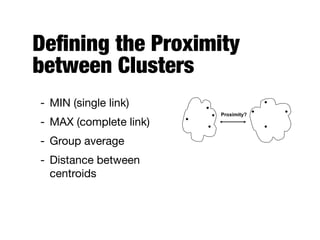
Defining the Proximity
between Clusters
- MIN (single link)

- MAX (complete link)

- Group average

- Distance between
centroids
Proximity?
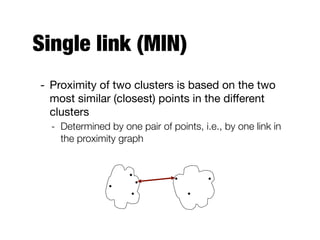
Single link (MIN)
- Proximity of two clusters is based on the two
most similar (closest) points in the different
clusters

- Determined by one pair of points, i.e., by one link in
the proximity graph
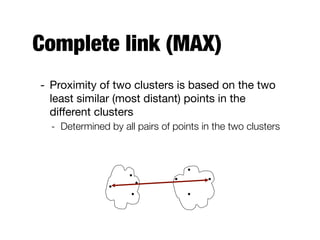
Complete link (MAX)
- Proximity of two clusters is based on the two
least similar (most distant) points in the
different clusters

- Determined by all pairs of points in the two clusters
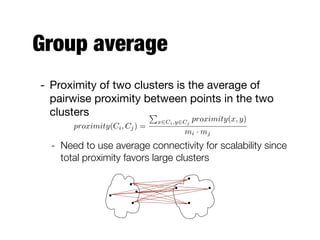
Group average
- Proximity of two clusters is the average of
pairwise proximity between points in the two
clusters

- Need to use average connectivity for scalability since
total proximity favors large clusters
proximity(Ci, Cj) =
P
x2Ci,y2Cj
proximity(x, y)
mi · mj
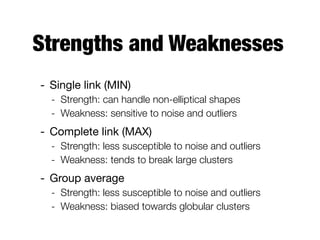
Strengths and Weaknesses
- Single link (MIN)

- Strength: can handle non-elliptical shapes
- Weakness: sensitive to noise and outliers
- Complete link (MAX)

- Strength: less susceptible to noise and outliers
- Weakness: tends to break large clusters
- Group average

- Strength: less susceptible to noise and outliers
- Weakness: biased towards globular clusters
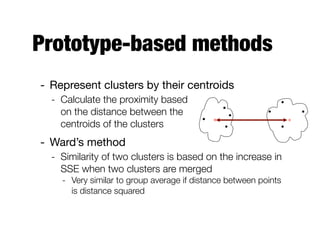
Prototype-based methods
- Represent clusters by their centroids

- Calculate the proximity based 

on the distance between the 

centroids of the clusters
- Ward’s method

- Similarity of two clusters is based on the increase in
SSE when two clusters are merged
- Very similar to group average if distance between points
is distance squared
× ×
Exercise
Key Characteristics
- No global objective function that is directly
optimized

- No problems with choosing initial points or
running into local minima

- Merging decisions are final

- Once a decision is made to combine two clusters, it
cannot be undone
What is the complexity?
- m is the number of points

- Space complexity O(?)
- Time complexity O(?)
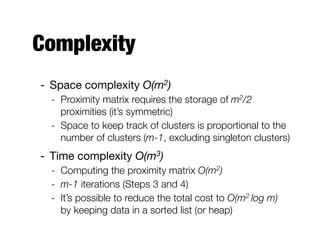
Complexity
- Space complexity O(m2)
- Proximity matrix requires the storage of m2/2
proximities (it’s symmetric)
- Space to keep track of clusters is proportional to the
number of clusters (m-1, excluding singleton clusters)
- Time complexity O(m3)

- Computing the proximity matrix O(m2)
- m-1 iterations (Steps 3 and 4)
- It’s possible to reduce the total cost to O(m2 log m)
by keeping data in a sorted list (or heap)
Summary
- Typically used when the underlying application
requires a hierarchy

- Generally good clustering performance

- Expensive in terms of computation and storage

Machine Learning - Clustering

  • 1.
    DAT630
 Clustering Darío Garigliotti |University of Stavanger 16/10/2017 Introduction to Data Mining, Chapter 8
  • 2.
    Supervised vs. Unsupervised Learning -Supervised learning - Labeled examples (with target information) are available - Unsupervised learning - Examples are not labeled
  • 3.
    Outline - Clustering - Twoalgorithms: - K-means - Hierarchical (Agglomerative) Clustering
  • 4.
  • 5.
    Clustering - Finding groupsof objects such that the objects in a group will be similar (or related) to one another and different from (or unrelated to) the objects in other groups Inter-cluster distances are maximized Intra-cluster distances are minimized
  • 6.
    Why? - For understanding -E.g., biology (taxonomy of species) - Business (segmenting customers for additional analysis and marketing activities) - Web (clustering search results into subcategories) - For utility - Some clustering techniques characterize each cluster in terms of a cluster prototype - These prototypes can be used as a basis for a number of data analysis and processing techniques
  • 7.
    How many clusters? -The notion of a cluster can be ambiguous Original data Four ClustersTwo Clusters Six Clusters
  • 8.
    Types of Clustering -Partitional vs. hierarchical - Partitional: non-overlapping clusters such that each data object is in exactly one cluster - Hierarchical: a set of nested clusters organized as a hierarchical tree - Exclusive vs. non-exclusive - Whether points may belong to a single or multiple clusters
  • 9.
    Types of Clustering(2) - Partial versus complete - In some cases, we only want to cluster some of the data - Fuzzy vs. non-fuzzy - In fuzzy clustering, a point belongs to every cluster with some weight between 0 and 1 - Weights must sum to 1 - Probabilistic clustering has similar characteristics
  • 10.
    Different Types ofClusters - Well-Separated Clusters - A cluster is a set of points such that any point in a cluster is closer (or more similar) to every other point in the cluster than to any point not in the cluster
  • 11.
    Different Types ofClusters - Center-based (or prototype-based) - A cluster is a set of objects such that an object in a cluster is closer (more similar) to the “center” of a cluster, than to the center of any other cluster - The center of a cluster is often a centroid, the average of all the points in the cluster, or a medoid, the most “representative” point of a cluster
  • 12.
    Different Types ofClusters - Shared Property or Conceptual Clusters - Clusters that share some common property or represent a particular concept
  • 13.
    Notation - x anobject (data point) - m the number of points in the data set - K the number of clusters - Ci the ith cluster - ci the centroid of cluster Ci - mi the number of points in cluster Ci
  • 14.
  • 15.
    K-means - One ofthe oldest and most widely used clustering techniques - Prototype-based clustering - Clusters are represented by their centroids - Finds a user-specified number of clusters (K)
  • 16.
    Basic K-means Algorithm 1.Select K points as initial centroids 2. repeat 3. Form K clusters by assigning each point to its closest centroid 4. Recompute the centroid of each cluster 5. until centroids do not change
  • 17.
    Basic K-means Algorithm 1.Select K points as initial centroids 2. repeat 3. Form K clusters by assigning each point to its closest centroid 4. Recompute the centroid of each cluster 5. until centroids do not change
  • 18.
    Basic K-means Algorithm 1.Select K points as initial centroids 2. repeat 3. Form K clusters by assigning each point to its closest centroid 4. Recompute the centroid of each cluster 5. until centroids do not change
  • 19.
    Basic K-means Algorithm 1.Select K points as initial centroids 2. repeat 3. Form K clusters by assigning each point to its closest centroid 4. Recompute the centroid of each cluster 5. until centroids do not change
  • 20.
    Basic K-means Algorithm 1.Select K points as initial centroids 2. repeat 3. Form K clusters by assigning each point to its closest centroid 4. Recompute the centroid of each cluster 5. until centroids do not change
  • 21.
    Basic K-means Algorithm 1.Select K points as initial centroids 2. repeat 3. Form K clusters by assigning each point to its closest centroid 4. Recompute the centroid of each cluster 5. until centroids do not change
  • 22.
    1. Choosing Initial Centroids -Most commonly: select points (centroids) randomly - They may be poor - Possible solution: perform multiple runs, each with a different set of randomly chosen centroids
  • 23.
    3. Assigning Pointsto the Closest Centroid - We need a proximity measure that quantifies the notion of "closest" - Usually chosen to be simple - Has to be calculated repeatedly - See distance functions from Lecture 1 - E.g., Euclidean distance
  • 24.
    4. Recomputing Centroids -Objective function is selected - I.e., what is it that we want minimize/maximize - Once the objective function and the proximity measure are defined, we can define mathematically the centroid we should choose - E.g., minimize the squared distance of each point to its closest centroid
  • 25.
    Sum of SquaredError (SSE) - Measures the quality of clustering in the Euclidean space - Calculate the error of each data point (its Euclidean distance to the closest centroid), and then compute the total sum of the squared errors - A clustering with lower SSE is better SSE = KX i=1 X x2Ci dist(ci, x)2
  • 26.
    Minimizing SSE - Itcan be shown that the centroid that minimizes the SSE of the cluster is the mean - The centroid of the ith cluster ci = 1 mi X x2Ci x
  • 27.
    Example
 Centroid computation - Whatis the centroid of a cluster containing three 2-dimensional points: (1,1), (2,3), (6,2)? - Centroid:
 ((1+2+6)/3, (1+3+2)/3) = (3,2)
  • 28.
    5. Stopping Condition -Most of the convergence occurs in the early steps - "Centroids do not change" is often replaced with a weaker condition - E.g., repeat until only 1% of the points change
  • 29.
  • 30.
    Note - There areother choices for proximity, centroids, and objective functions, e.g., - Proximity function: Manhattan (L1)
 Centroid: median
 Objective function: minimize sum of L1 distance of an object to its cluster centroid - Proximity function: cosine
 Centroid: mean
 Objective function: maximize sum of cosine sim. of an object to its cluster centroid
  • 31.
    What is thecomplexity? - m number of points, n number of attributes, 
 K number of clusters - Space requirements: O(?) - Time requirements: O(?)
  • 32.
    Complexity - m numberof points, n number of attributes, 
 K number of clusters - Space requirements: O((m+K)*n) - Modest, as only the data points and centroids are stored - Time requirements: O(I*K*m*n) - I is the number of iterations required for convergence - Modest, linear in the number of data points
  • 33.
    K-means Issues - Dependingon the initial (random) selection of centroids different clustering can be produced - Steps 3 and 4 are only guaranteed to find a local optimum - Empty clusters may be obtained - replacement of centroid by (i) farthest point to any other centroid, or (ii) chosen among those in the cluster with highest SSE
  • 34.
    K-means Issues (2) -Presence of outliers must sometimes be kept - E.g. all points must be clustered in data compression - In general outliers may be addressed by eliminating them to improve clustering - Before: by outlier detection techniques - After: eliminating (i) points whose SSE is high, or (ii) directly small clusters as likely outliers
  • 35.
    K-means Issues (3) -Postprocessing for reducing SSE - and ideally not introducing more clusters - How? Alternating splitting and merging steps - Decrease SSE by more clusters - Splitting (e.g., cluster with highest SSE) - Introducing new centroid - Less clusters by trying not to increase SSE - Dispersing (a cluster e.g. with lowest SSE) - Merging 2 clusters (e.g. with closest centroids)
  • 36.
    Bisecting K-means - Straightforwardextension of the basic K- means algorithm - Idea: - Split the set of data points to two clusters - Select one of these clusters to split - Repeat until K clusters have been produced - The resulting clusters are often used as the initial centroids for the basic K-means algorithm
  • 37.
    Bisecting K-means Alg. 1.Initial cluster contains all data points 2. repeat 3. Select a cluster to split 4. for a number of trials 5. Bisect the selected cluster using basic K- means 6. end for 7. Select the clusters from the bisection with the lowest total SSE 8. until we have K clusters
  • 38.
    Selecting a Clusterto Split - Number of possible ways - Largest cluster - Cluster with the largest SSE - Combine size and SSE - Different choices result in different clusters
  • 39.
    Hierarchical Clustering - Byrecording the sequence of clusterings produced, bisecting K-means can also produce a hierarchical clustering
  • 40.
    Limitations - K-means hasdifficulties detecting clusters when they have - differing sizes - differing densities - non-spherical shapes - K-means has problems when the data contains outliers
  • 41.
    Example: differing sizes K-means(3 clusters)Original points
  • 42.
    Example: differing density K-means(3 clusters)Original points
  • 43.
  • 44.
    Overcoming Limitations - Uselarger K values - Natural clusters will be broken into a number of sub-clusters
  • 45.
    Example: differing sizes Originalpoints K-means clusters
  • 46.
    Example: differing density Originalpoints K-means clusters
  • 47.
  • 48.
    Summary - Efficient andsimple - Provided that K is relatively small (K<<m) - Bisecting variant is even more efficient and less susceptible to initialization problems - Cannot handle certain types of clusters - Problems can be overcome by generating more (sub)clusters - Has trouble with data that contains outliers - Outlier detection and removal can help
  • 49.
  • 50.
    Hierarchical Clustering - Twogeneral approaches - Agglomerative - Start with the points as individual clusters - At each step, merge the closest pair of clusters - Requires a notion of cluster proximity - Divisive - Start with a single, all-inclusive cluster - At each step, split a cluster, until only singleton clusters of individual points remain
  • 51.
    Agglomerative Hierarchical Clustering - Producesa set of nested clusters organized as a hierarchical tree - Can be visualized - Dendrogram - Nested cluster diagram (only for 2D points) 1 3 2 5 4 6 0 0.05 0.1 0.15 0.2 1 2 3 4 5 6 1 2 3 4 5 Dendogram Nested cluster
 diagram
  • 52.
    Strengths - Do nothave to assume any particular number of clusters - Any desired number of clusters can be obtained by cutting the dendrogram at the proper level - They may correspond to meaningful taxonomies - E.g., in biological sciences K=4
  • 54.
    Basic Agglomerative Hierarchical ClusteringAlg. 1. Compute the proximity matrix 2. repeat 3. Merge the closest two clusters 4. Update the proximity matrix 5. until only one cluster remains
  • 55.
    Example
 Starting situation - Startwith clusters of individual points and a proximity matrix p1 p3 p5 p4 p2 p1 p2 p3 p4 p5 . . . . . . Proximity Matrix ... p1 p2 p3 p4 p9 p10 p11 p12
  • 56.
    Example
 Intermediate situation - Aftersome merging steps, we have some clusters C1 C4 C2 C5 C3 C2C1 C1 C3 C5 C4 C2 C3 C4 C5 Proximity Matrix ... p1 p2 p3 p4 p9 p10 p11 p12
  • 57.
    Example
 Intermediate situation - Wewant to merge the two closest clusters (C2 and C5) and update the proximity matrix C1 C4 C2 C5 C3 C2C1 C1 C3 C5 C4 C2 C3 C4 C5 Proximity Matrix ... p1 p2 p3 p4 p9 p10 p11 p12
  • 58.
    Example
 After merging - Howdo we update the proximity matrix? C1 C4 C2 U C5 C3 ? ? ? ? ? ? ? C2 U C5 C1 C1 C3 C4 C2 U C5 C3 C4 Proximity Matrix ... p1 p2 p3 p4 p9 p10 p11 p12
  • 59.
    Defining the Proximity betweenClusters - MIN (single link) - MAX (complete link) - Group average - Distance between centroids Proximity?
  • 60.
    Single link (MIN) -Proximity of two clusters is based on the two most similar (closest) points in the different clusters - Determined by one pair of points, i.e., by one link in the proximity graph
  • 61.
    Complete link (MAX) -Proximity of two clusters is based on the two least similar (most distant) points in the different clusters - Determined by all pairs of points in the two clusters
  • 62.
    Group average - Proximityof two clusters is the average of pairwise proximity between points in the two clusters - Need to use average connectivity for scalability since total proximity favors large clusters proximity(Ci, Cj) = P x2Ci,y2Cj proximity(x, y) mi · mj
  • 63.
    Strengths and Weaknesses -Single link (MIN) - Strength: can handle non-elliptical shapes - Weakness: sensitive to noise and outliers - Complete link (MAX) - Strength: less susceptible to noise and outliers - Weakness: tends to break large clusters - Group average - Strength: less susceptible to noise and outliers - Weakness: biased towards globular clusters
  • 64.
    Prototype-based methods - Representclusters by their centroids - Calculate the proximity based 
 on the distance between the 
 centroids of the clusters - Ward’s method - Similarity of two clusters is based on the increase in SSE when two clusters are merged - Very similar to group average if distance between points is distance squared × ×
  • 65.
  • 66.
    Key Characteristics - Noglobal objective function that is directly optimized - No problems with choosing initial points or running into local minima - Merging decisions are final - Once a decision is made to combine two clusters, it cannot be undone
  • 67.
    What is thecomplexity? - m is the number of points - Space complexity O(?) - Time complexity O(?)
  • 68.
    Complexity - Space complexityO(m2) - Proximity matrix requires the storage of m2/2 proximities (it’s symmetric) - Space to keep track of clusters is proportional to the number of clusters (m-1, excluding singleton clusters) - Time complexity O(m3) - Computing the proximity matrix O(m2) - m-1 iterations (Steps 3 and 4) - It’s possible to reduce the total cost to O(m2 log m) by keeping data in a sorted list (or heap)
  • 69.
    Summary - Typically usedwhen the underlying application requires a hierarchy - Generally good clustering performance - Expensive in terms of computation and storage