Cloud Deployment
Model
Yong Heui Cho @ Mokwon University
Some of slides are referred to and all credits should go to:
[1] K. Chandrasekaran, Essentials of Cloud Conputing, CRC Press, 2015.
2
Cloud Service
5. Node.js Applications
6. Cloud Computing Architecture
7. Cloud Deployment Model
9. Cloud Service Model
3
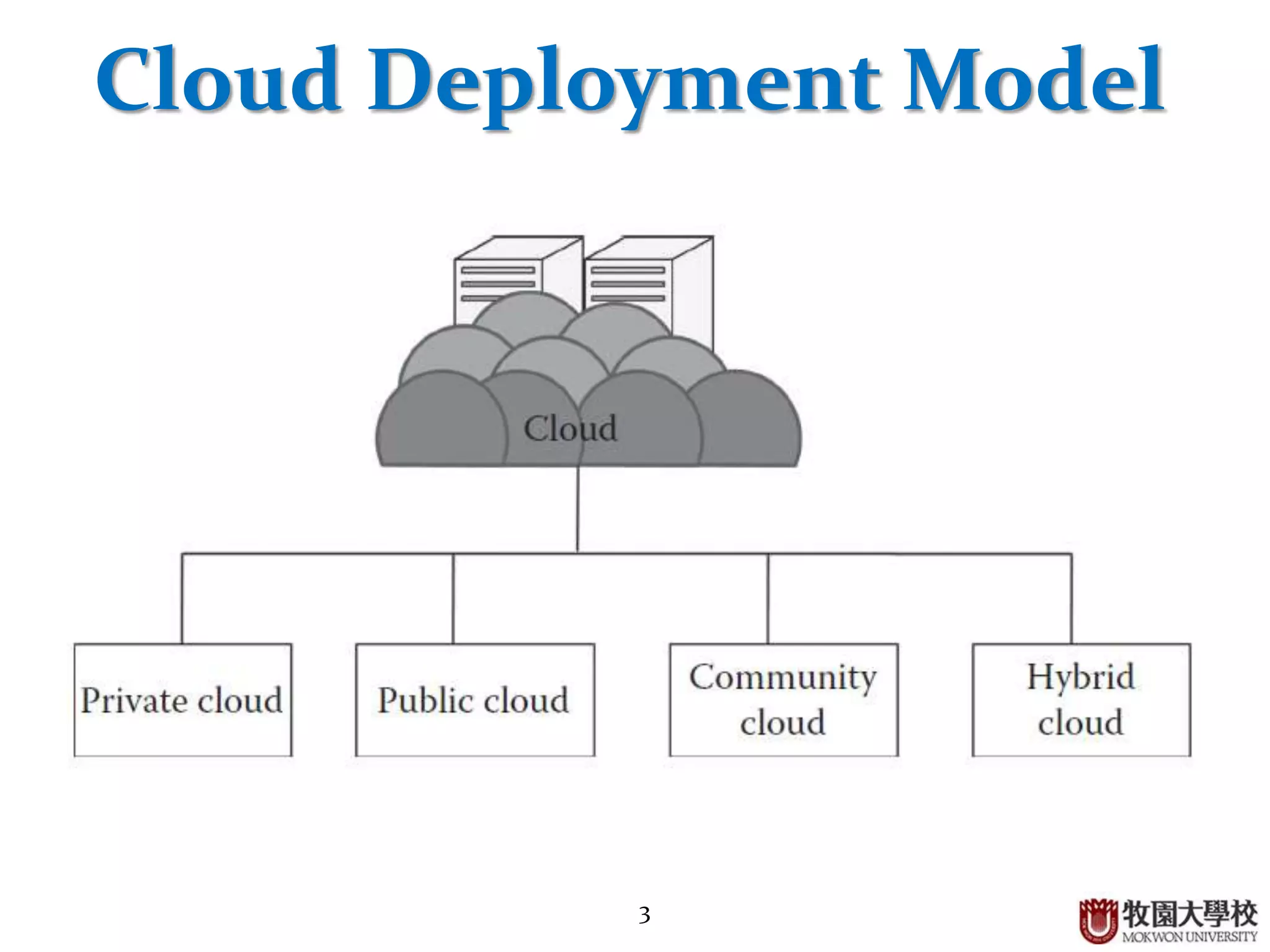
Cloud Deployment Model
4
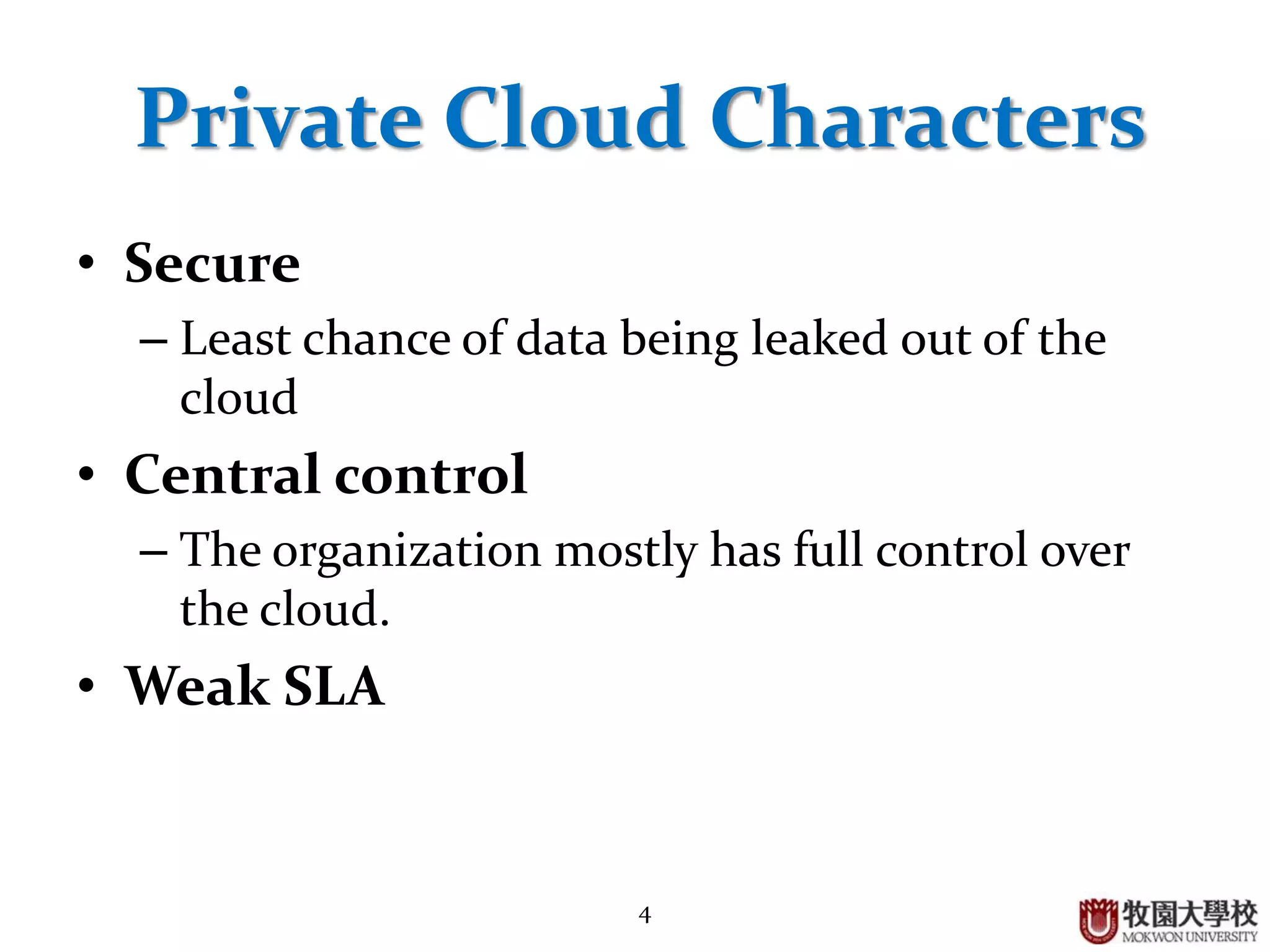
Private Cloud Characters
• Secure
– Least chance of data being leaked out of the
cloud
• Central control
– The organization mostly has full control over
the cloud.
• Weak SLA
5
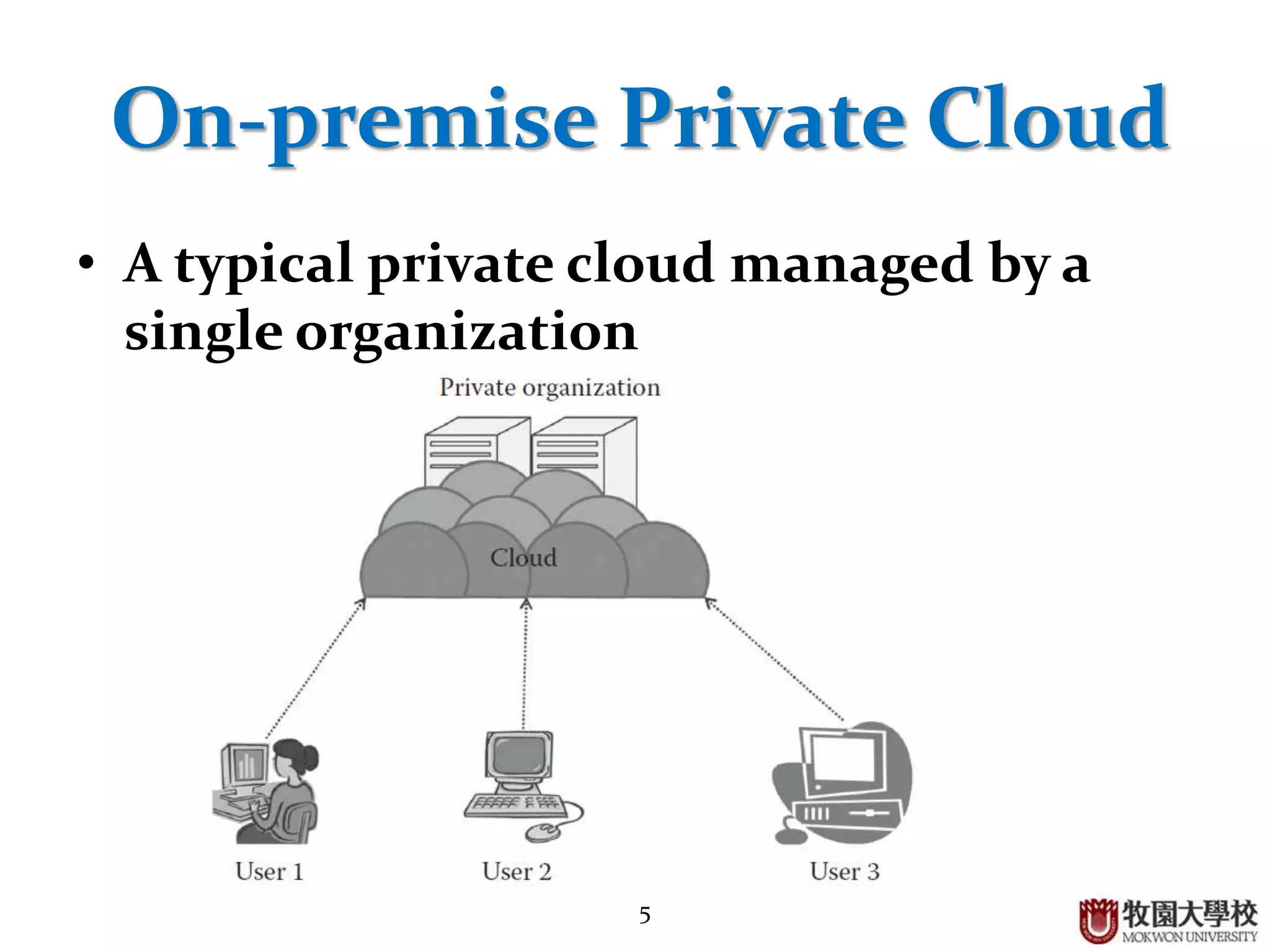
On-premise Private Cloud
• A typical private cloud managed by a
single organization
6
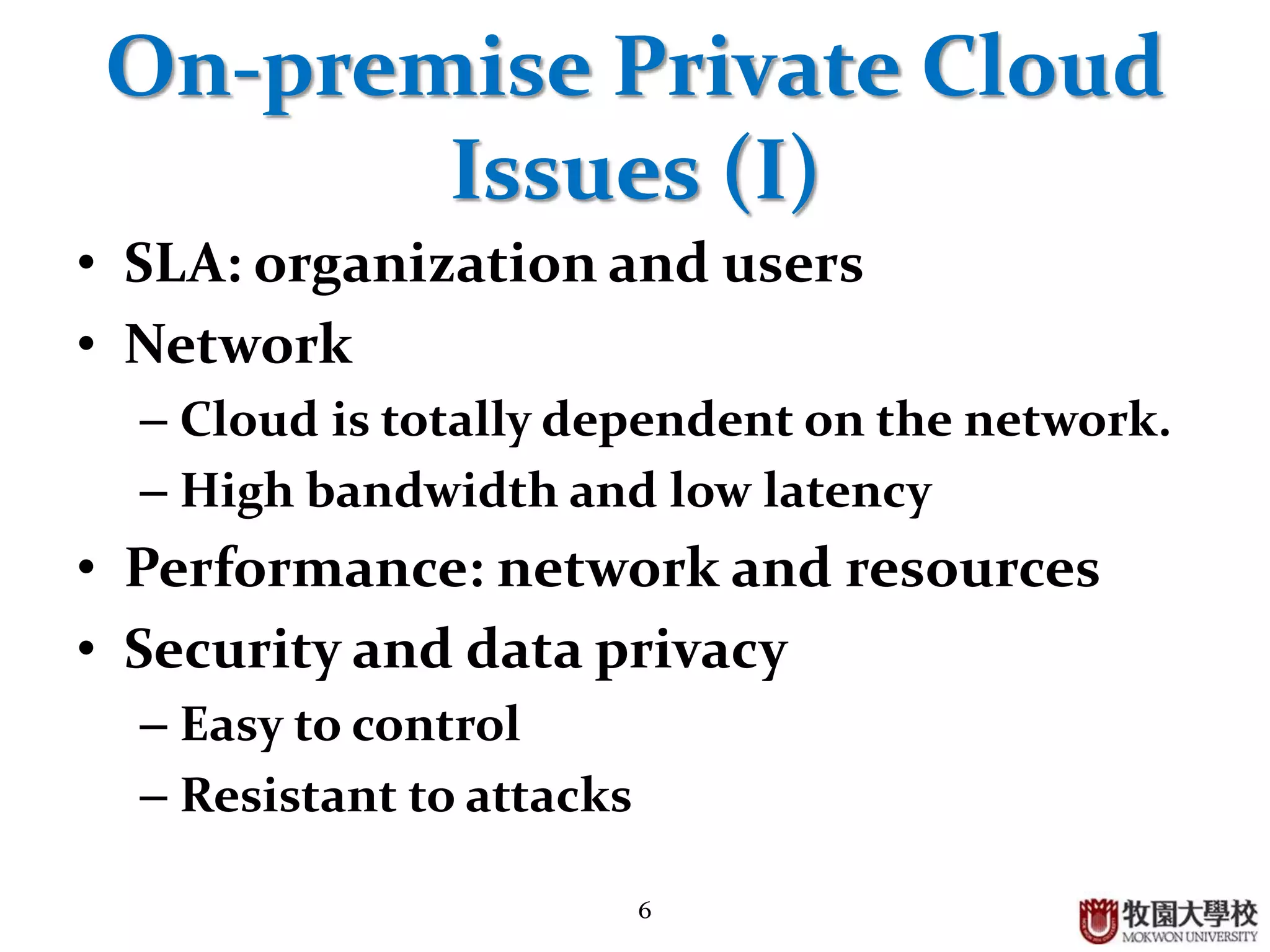
On-premise Private Cloud
Issues (I)
• SLA: organization and users
• Network
– Cloud is totally dependent on the network.
– High bandwidth and low latency
• Performance: network and resources
• Security and data privacy
– Easy to control
– Resistant to attacks
7
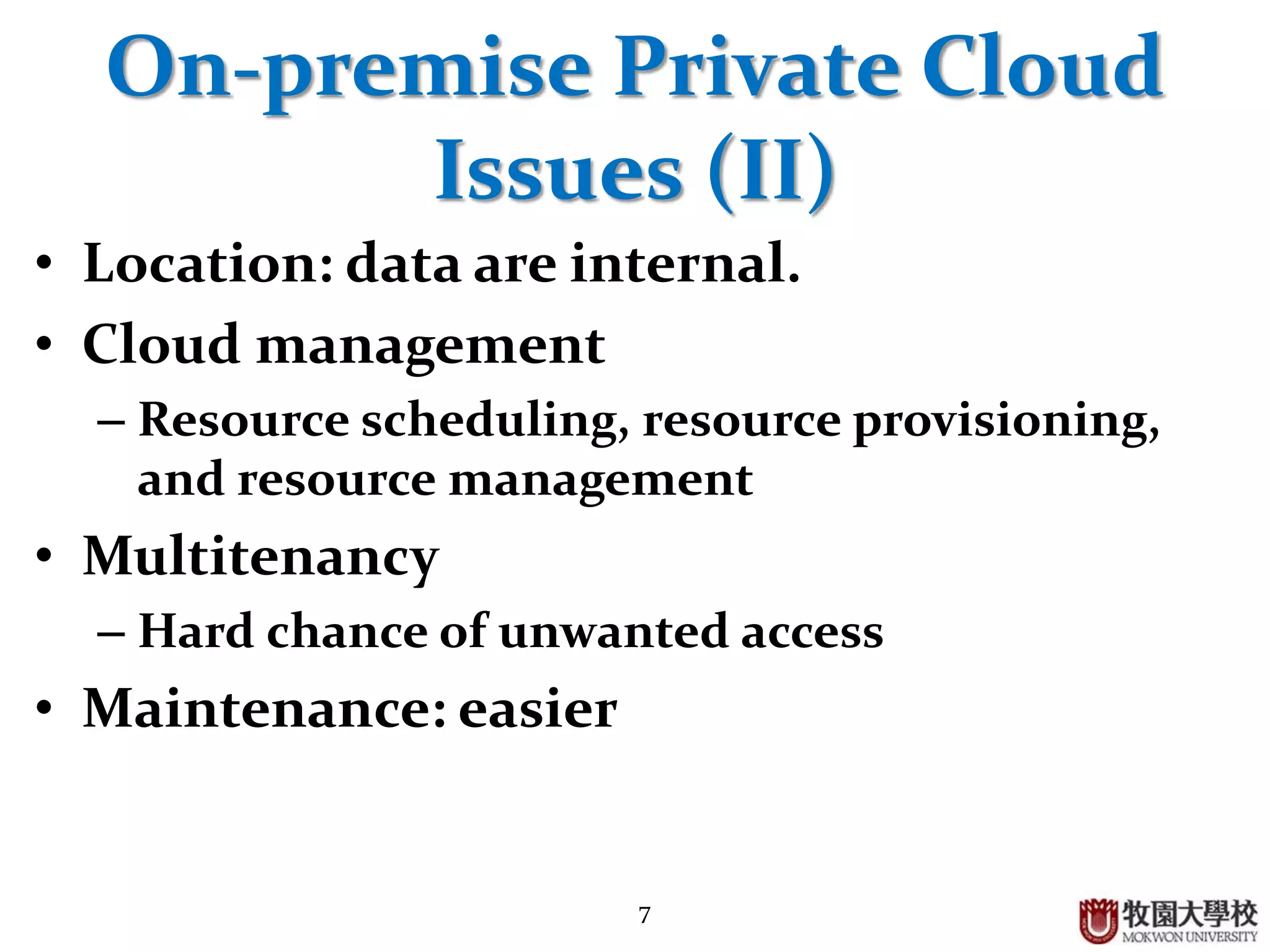
On-premise Private Cloud
Issues (II)
• Location: data are internal.
• Cloud management
– Resource scheduling, resource provisioning,
and resource management
• Multitenancy
– Hard chance of unwanted access
• Maintenance: easier
8
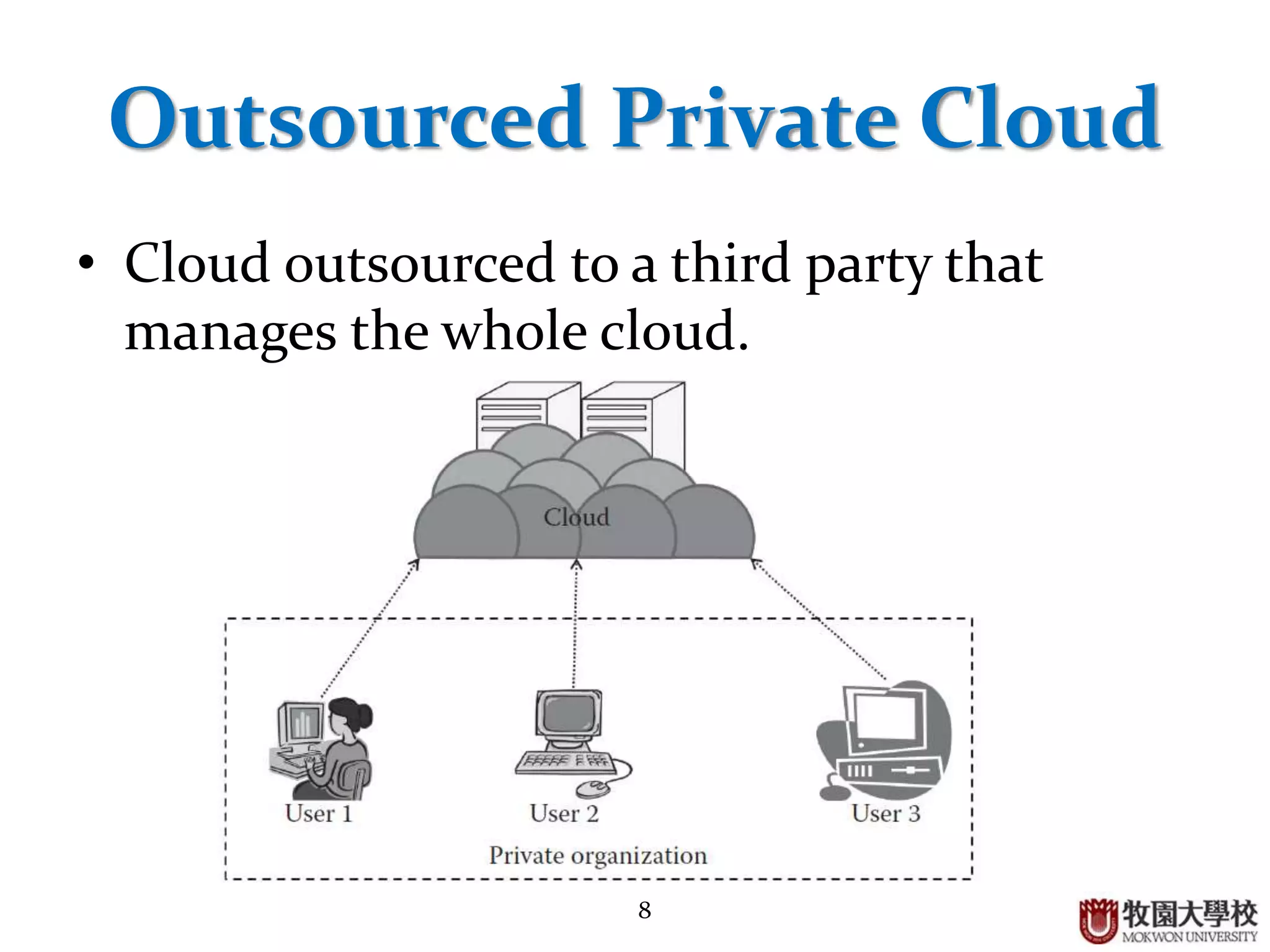
Outsourced Private Cloud
• Cloud outsourced to a third party that
manages the whole cloud.
9
Outsourced Private Cloud
Issues (I)
• SLA: strict with the third party
• Network: usually connected with
Internet
• Security and privacy
– The outsourced cloud is less secure.
• Laws and conflicts: when deployed
outside the country
10
Outsourced Private Cloud
Issues (II)
• Location: outside the organization
• Performance: depends on the third
party
• Maintenance: maintained by the third
party
11
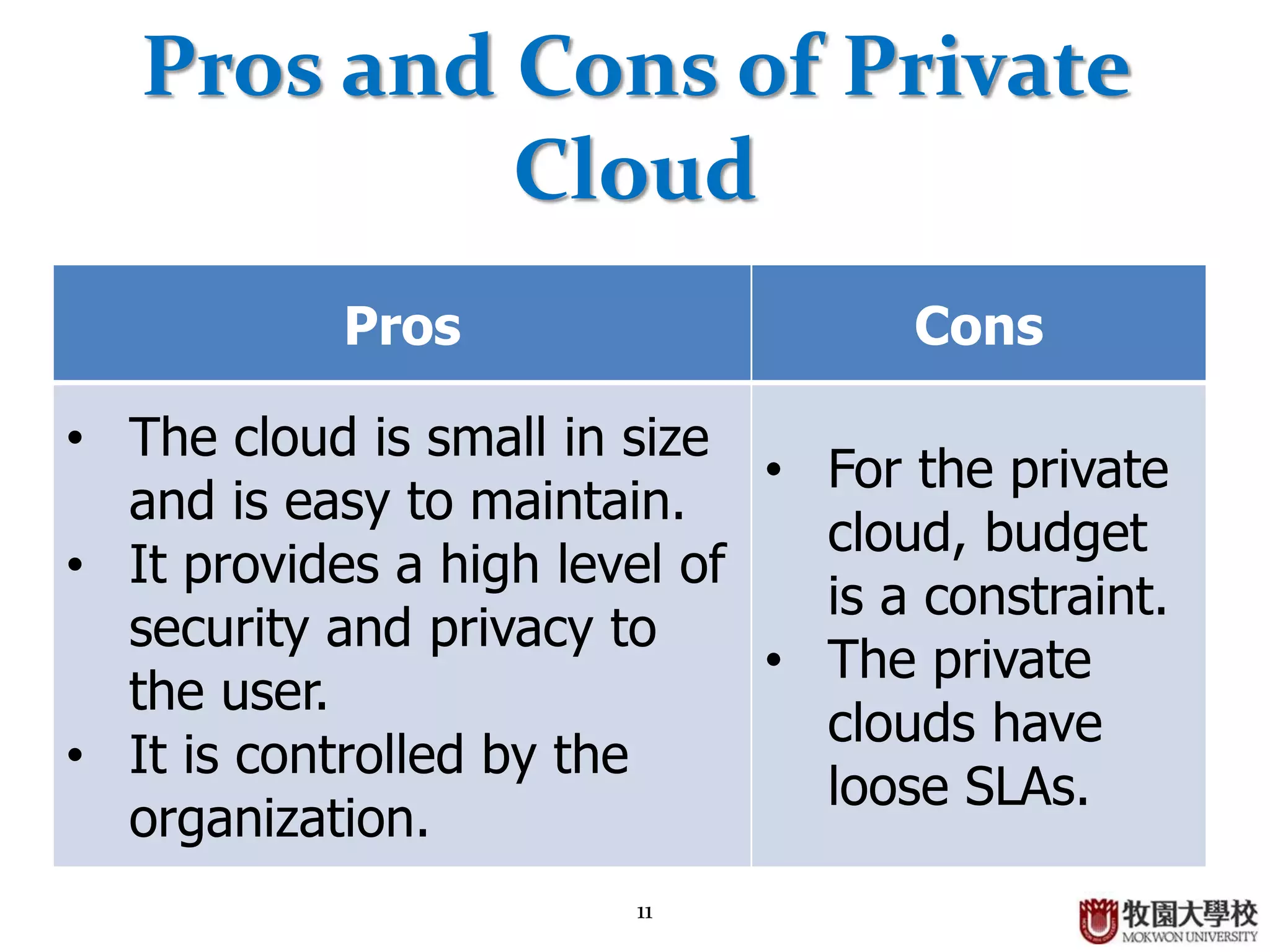
Pros and Cons of Private
Cloud
Pros Cons
• The cloud is small in size
and is easy to maintain.
• It provides a high level of
security and privacy to
the user.
• It is controlled by the
organization.
• For the private
cloud, budget
is a constraint.
• The private
clouds have
loose SLAs.
12
Public Cloud
• Public cloud providers usually accept all
requests, and hence the resources are
almost infinite.
13
Public Cloud Characters
• Highly scalable: the resources are large
enough for requests.
• Affordable: pay-as-you-go basis
• Less secure: though the SLA ensures
privacy.
• Highly available: anywhere and anytime
with proper permission
• Stringent SLA
14
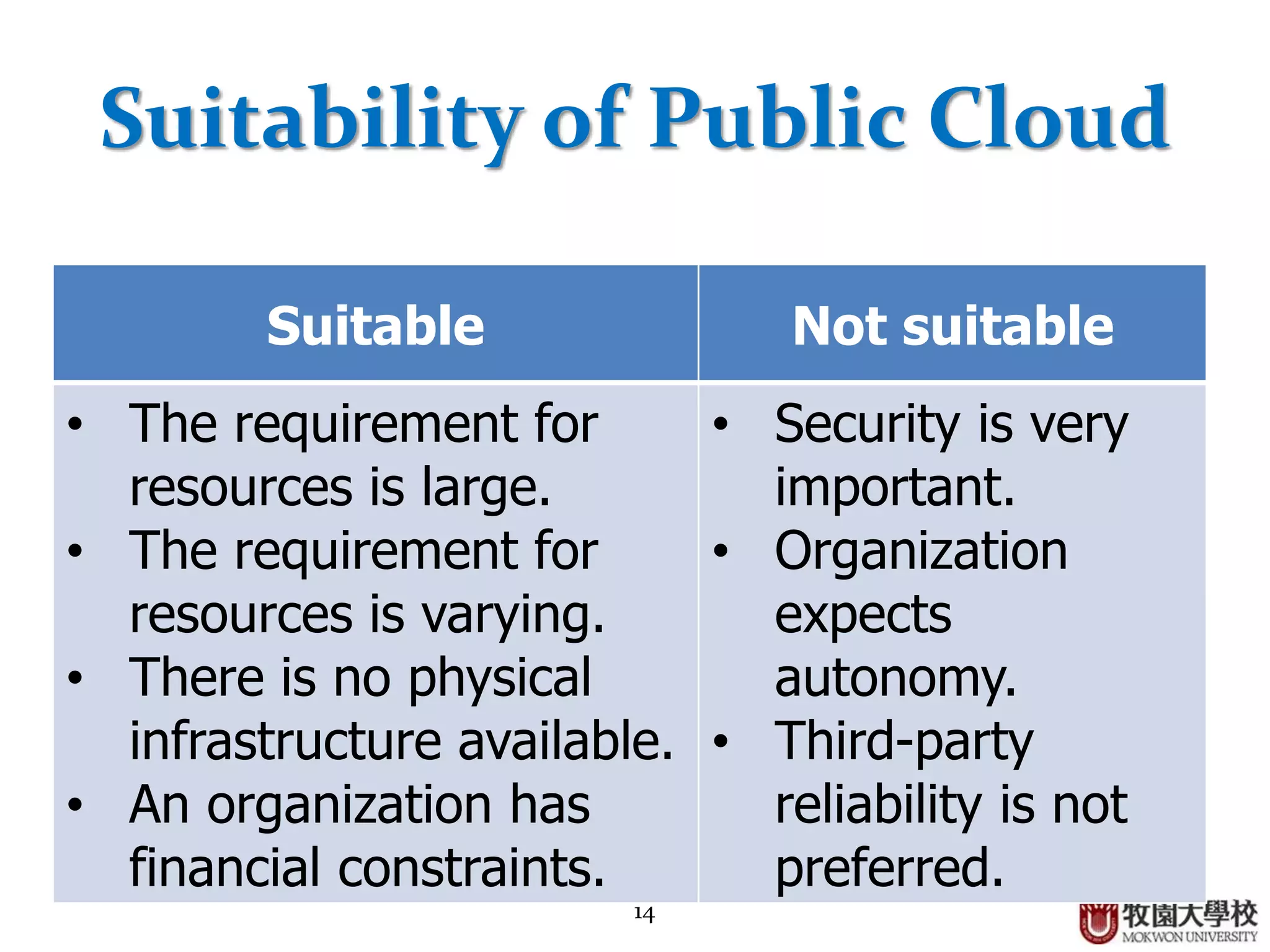
Suitability of Public Cloud
Suitable Not suitable
• The requirement for
resources is large.
• The requirement for
resources is varying.
• There is no physical
infrastructure available.
• An organization has
financial constraints.
• Security is very
important.
• Organization
expects
autonomy.
• Third-party
reliability is not
preferred.
15
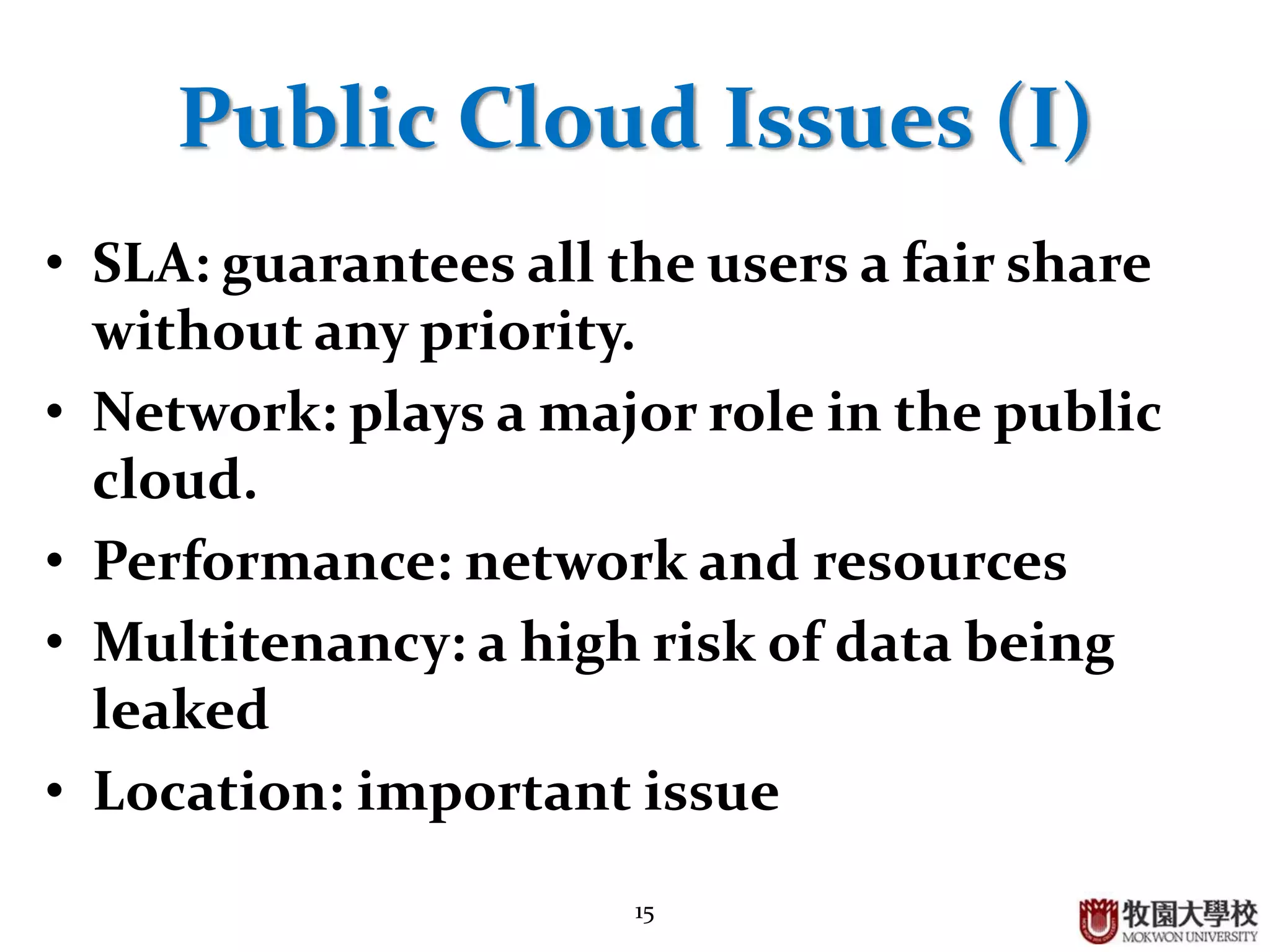
Public Cloud Issues (I)
• SLA: guarantees all the users a fair share
without any priority.
• Network: plays a major role in the public
cloud.
• Performance: network and resources
• Multitenancy: a high risk of data being
leaked
• Location: important issue
16
Public Cloud Issues (II)
• Security and data privacy: the biggest
challenges
• Laws and conflicts: data in different
countries
• Cloud management: related to SLA
• Maintenance: very crucial
17
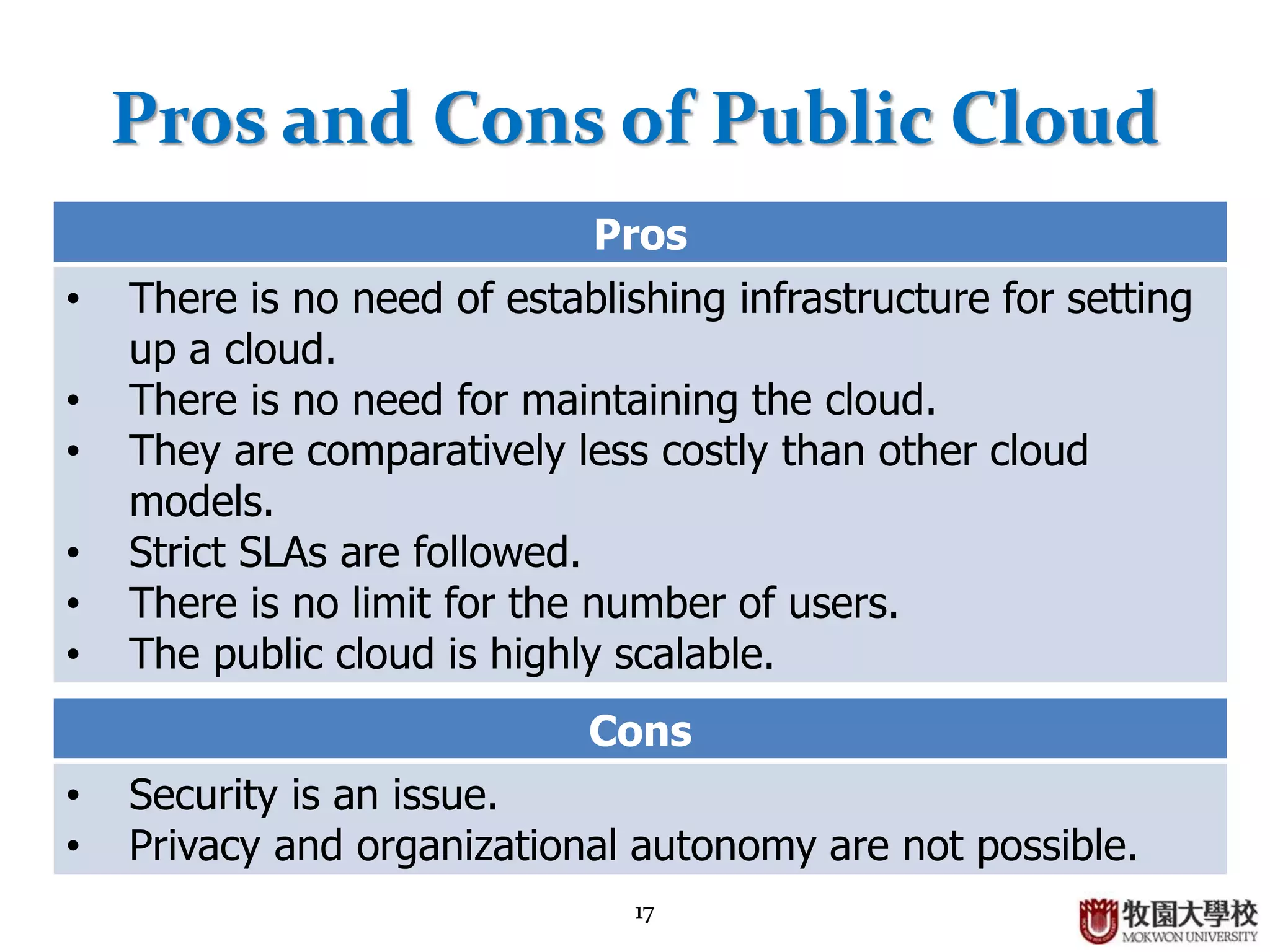
Pros and Cons of Public Cloud
Pros
• There is no need of establishing infrastructure for setting
up a cloud.
• There is no need for maintaining the cloud.
• They are comparatively less costly than other cloud
models.
• Strict SLAs are followed.
• There is no limit for the number of users.
• The public cloud is highly scalable.
Cons
• Security is an issue.
• Privacy and organizational autonomy are not possible.
18
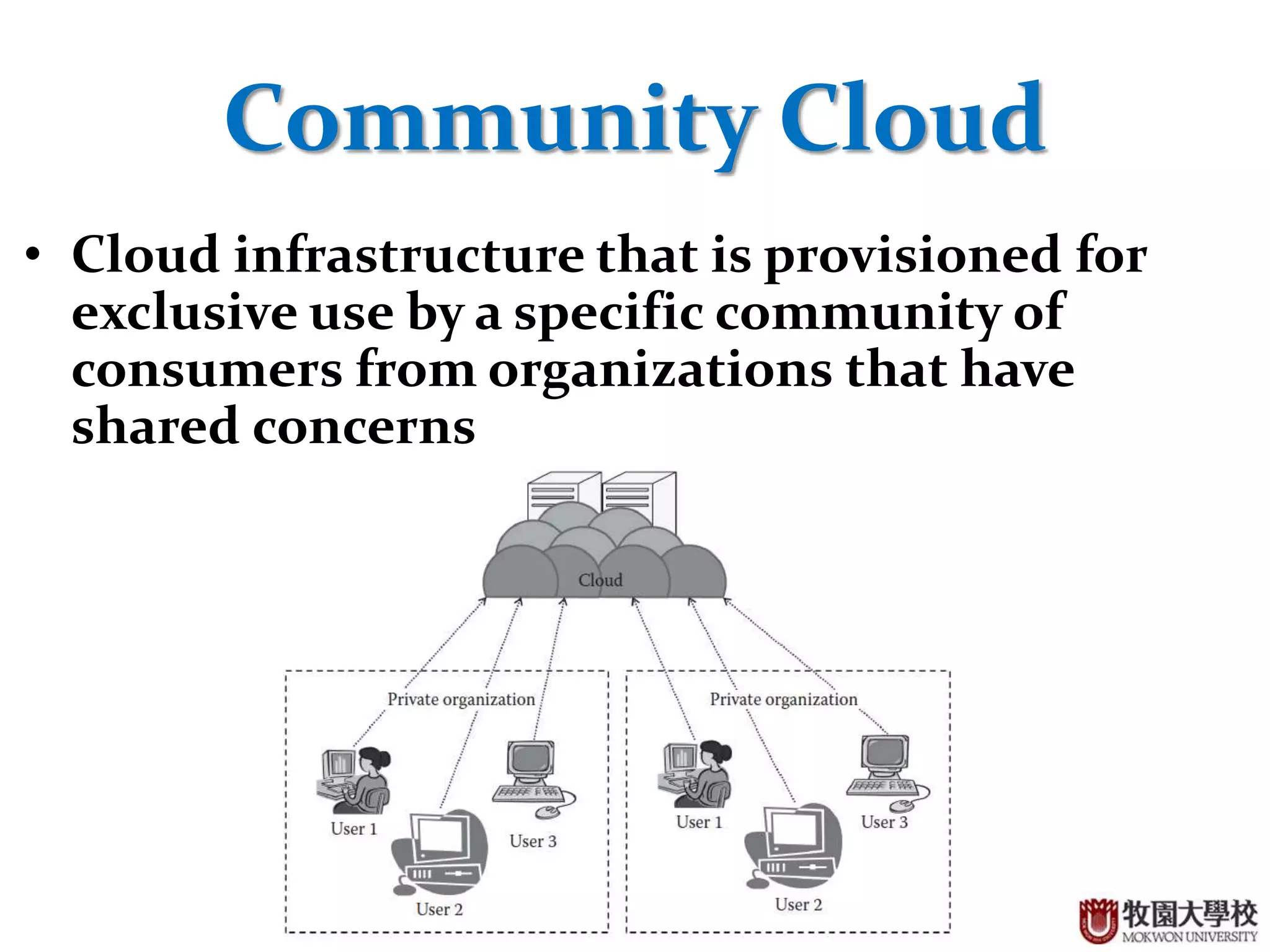
Community Cloud
• Cloud infrastructure that is provisioned for
exclusive use by a specific community of
consumers from organizations that have
shared concerns
19
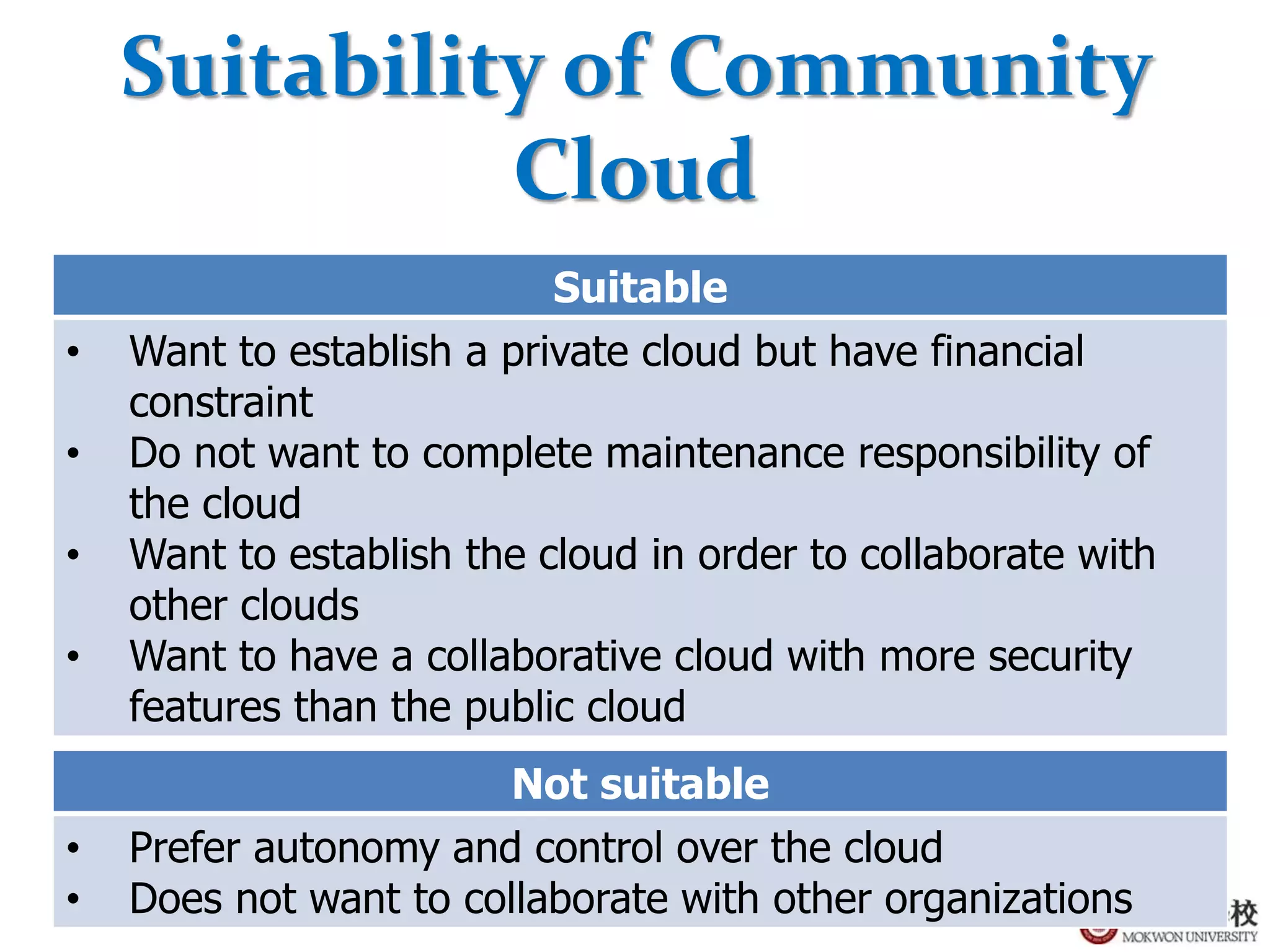
Suitability of Community
Cloud
Suitable
• Want to establish a private cloud but have financial
constraint
• Do not want to complete maintenance responsibility of
the cloud
• Want to establish the cloud in order to collaborate with
other clouds
• Want to have a collaborative cloud with more security
features than the public cloud
Not suitable
• Prefer autonomy and control over the cloud
• Does not want to collaborate with other organizations
20
Pros and Cons of
Community Cloud
Pros Cons
• It allows establishing a low-
cost private cloud.
• It allows collaborative work
on the cloud.
• It allows sharing of
responsibilities among the
organization.
• It has better security than
the public cloud.
• Autonomy of an
organization is lost.
• Security features
are not as good as
the private cloud.
• It is not suitable if
there is no
collaboration.
21
Hybrid Cloud
• Cloud infrastructure that is a composition
of two or more distinct cloud
infrastructures
22
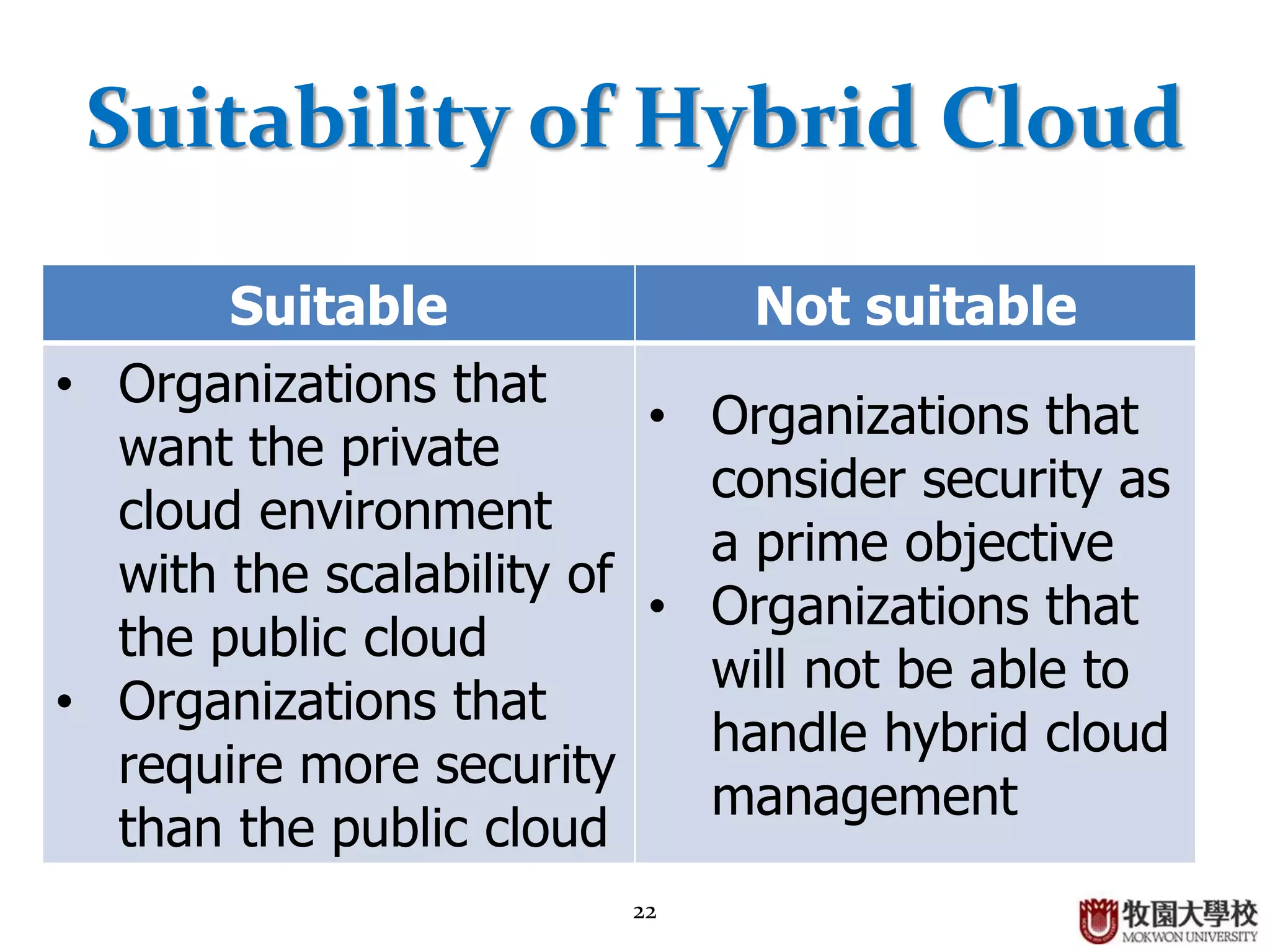
Suitability of Hybrid Cloud
Suitable Not suitable
• Organizations that
want the private
cloud environment
with the scalability of
the public cloud
• Organizations that
require more security
than the public cloud
• Organizations that
consider security as
a prime objective
• Organizations that
will not be able to
handle hybrid cloud
management
23
Pros and Cons of Hybrid
Cloud
Pros Cons
• It gives the power of
both the private and
public clouds.
• It is highly scalable.
• It provides better
security than the public
cloud.
• The security features
are not as good as
the public cloud.
• Managing a hybrid
cloud is complex.
• It has stringent SLAs.

Cloud Deployment Model

  • 1.
    Cloud Deployment Model Yong HeuiCho @ Mokwon University Some of slides are referred to and all credits should go to: [1] K. Chandrasekaran, Essentials of Cloud Conputing, CRC Press, 2015.
  • 2.
    2 Cloud Service 5. Node.jsApplications 6. Cloud Computing Architecture 7. Cloud Deployment Model 9. Cloud Service Model
  • 3.
  • 4.
    4 Private Cloud Characters •Secure – Least chance of data being leaked out of the cloud • Central control – The organization mostly has full control over the cloud. • Weak SLA
  • 5.
    5 On-premise Private Cloud •A typical private cloud managed by a single organization
  • 6.
    6 On-premise Private Cloud Issues(I) • SLA: organization and users • Network – Cloud is totally dependent on the network. – High bandwidth and low latency • Performance: network and resources • Security and data privacy – Easy to control – Resistant to attacks
  • 7.
    7 On-premise Private Cloud Issues(II) • Location: data are internal. • Cloud management – Resource scheduling, resource provisioning, and resource management • Multitenancy – Hard chance of unwanted access • Maintenance: easier
  • 8.
    8 Outsourced Private Cloud •Cloud outsourced to a third party that manages the whole cloud.
  • 9.
    9 Outsourced Private Cloud Issues(I) • SLA: strict with the third party • Network: usually connected with Internet • Security and privacy – The outsourced cloud is less secure. • Laws and conflicts: when deployed outside the country
  • 10.
    10 Outsourced Private Cloud Issues(II) • Location: outside the organization • Performance: depends on the third party • Maintenance: maintained by the third party
  • 11.
    11 Pros and Consof Private Cloud Pros Cons • The cloud is small in size and is easy to maintain. • It provides a high level of security and privacy to the user. • It is controlled by the organization. • For the private cloud, budget is a constraint. • The private clouds have loose SLAs.
  • 12.
    12 Public Cloud • Publiccloud providers usually accept all requests, and hence the resources are almost infinite.
  • 13.
    13 Public Cloud Characters •Highly scalable: the resources are large enough for requests. • Affordable: pay-as-you-go basis • Less secure: though the SLA ensures privacy. • Highly available: anywhere and anytime with proper permission • Stringent SLA
  • 14.
    14 Suitability of PublicCloud Suitable Not suitable • The requirement for resources is large. • The requirement for resources is varying. • There is no physical infrastructure available. • An organization has financial constraints. • Security is very important. • Organization expects autonomy. • Third-party reliability is not preferred.
  • 15.
    15 Public Cloud Issues(I) • SLA: guarantees all the users a fair share without any priority. • Network: plays a major role in the public cloud. • Performance: network and resources • Multitenancy: a high risk of data being leaked • Location: important issue
  • 16.
    16 Public Cloud Issues(II) • Security and data privacy: the biggest challenges • Laws and conflicts: data in different countries • Cloud management: related to SLA • Maintenance: very crucial
  • 17.
    17 Pros and Consof Public Cloud Pros • There is no need of establishing infrastructure for setting up a cloud. • There is no need for maintaining the cloud. • They are comparatively less costly than other cloud models. • Strict SLAs are followed. • There is no limit for the number of users. • The public cloud is highly scalable. Cons • Security is an issue. • Privacy and organizational autonomy are not possible.
  • 18.
    18 Community Cloud • Cloudinfrastructure that is provisioned for exclusive use by a specific community of consumers from organizations that have shared concerns
  • 19.
    19 Suitability of Community Cloud Suitable •Want to establish a private cloud but have financial constraint • Do not want to complete maintenance responsibility of the cloud • Want to establish the cloud in order to collaborate with other clouds • Want to have a collaborative cloud with more security features than the public cloud Not suitable • Prefer autonomy and control over the cloud • Does not want to collaborate with other organizations
  • 20.
    20 Pros and Consof Community Cloud Pros Cons • It allows establishing a low- cost private cloud. • It allows collaborative work on the cloud. • It allows sharing of responsibilities among the organization. • It has better security than the public cloud. • Autonomy of an organization is lost. • Security features are not as good as the private cloud. • It is not suitable if there is no collaboration.
  • 21.
    21 Hybrid Cloud • Cloudinfrastructure that is a composition of two or more distinct cloud infrastructures
  • 22.
    22 Suitability of HybridCloud Suitable Not suitable • Organizations that want the private cloud environment with the scalability of the public cloud • Organizations that require more security than the public cloud • Organizations that consider security as a prime objective • Organizations that will not be able to handle hybrid cloud management
  • 23.
    23 Pros and Consof Hybrid Cloud Pros Cons • It gives the power of both the private and public clouds. • It is highly scalable. • It provides better security than the public cloud. • The security features are not as good as the public cloud. • Managing a hybrid cloud is complex. • It has stringent SLAs.