Database Systems
Design, Implementation, and Management
11e
Transaction Processing and
Concurrency Control
By: Christian Alfred M. Villena, LPT, MIT
Learning Objectives
2
 In this chapter, students will learn:
 About database transactions and their properties
 What concurrency control is and what role it plays in
maintaining the database’s integrity
 What locking methods are and how they work
Learning Objectives
3
 In this chapter, students will learn:
 How stamping methods are used for concurrency
control
 How optimistic methods are used for concurrency
control
 How database recovery management is used to
maintain database integrity
Transaction
4
 Logical unit of work that must be entirely completed
or aborted
 Consists of:
 SELECT statement
 Series of related UPDATE statements
 Series of INSERT statements
 Combination of SELECT, UPDATE, and INSERT
statements
Transaction
5
 Consistent database state: All data integrity
constraints are satisfied
 Must begin with the database in a known consistent
state to ensure consistency
 Formed by two or more database requests
 Database requests: Equivalent of a single SQL
statement in an application program or transaction
 Consists of a single SQL statement or a collection of
related SQL statements
Evaluating Transaction Results
6
 Not all transactions update database
 SQL code represents a transaction because it accesses a
database
 Improper or incomplete transactions can have
devastating effect on database integrity
 Users can define enforceable constraints based on
business rules
 Other integrity rules are automatically enforced by the
DBMS
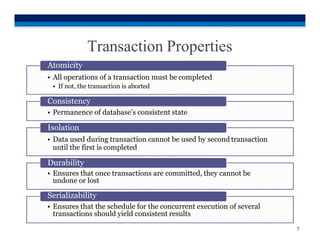
Transaction Properties
Atomicity
• All operations of a transaction must be completed
• If not, the transaction is aborted
Consistency
• Permanence of database’s consistent state
Isolation
• Data used during transaction cannot be used by second transaction
until the first is completed
Durability
• Ensures that once transactions are committed, they cannot be
undone or lost
Serializability
• Ensures that the schedule for the concurrent execution of several
transactions should yield consistent results
7
Transaction Management with SQL
8
 SQL statements that provide transaction support
 COMMIT
 ROLLBACK
 Transaction sequence must continue until:
 COMMIT statement is reached
 ROLLBACK statement is reached
 End of program is reached
 Program is abnormally terminated
Transaction Log
9
 Keeps track of all transactions that update the
database
 DBMS uses the information stored in a log for:
 Recovery requirement triggered by a ROLLBACK
statement
 A program’s abnormal termination
 A system failure
Concurrency Control
10
 Coordination of the simultaneous transactions
execution in a multiuser database system
 Objective - Ensures serializability of transactions in a
multiuser database environment
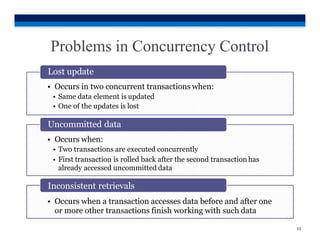
Problems in Concurrency Control
Lost update
• Occurs in two concurrent transactions when:
• Same data element is updated
• One of the updates is lost
Uncommitted data
• Occurs when:
• Two transactions are executed concurrently
• First transaction is rolled back after the second transaction has
already accessed uncommitted data
Inconsistent retrievals
• Occurs when a transaction accesses data before and after one
or more other transactions finish working with such data
11
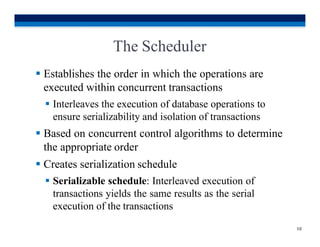
The Scheduler
12
 Establishes the order in which the operations are
executed within concurrent transactions
 Interleaves the execution of database operations to
ensure serializability and isolation of transactions
 Based on concurrent control algorithms to determine
the appropriate order
 Creates serialization schedule
 Serializable schedule: Interleaved execution of
transactions yields the same results as the serial
execution of the transactions
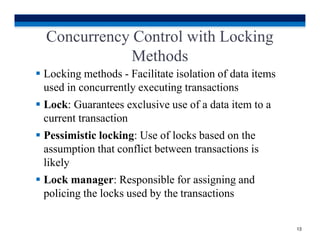
Concurrency Control with Locking
Methods
13
 Locking methods - Facilitate isolation of data items
used in concurrently executing transactions
 Lock: Guarantees exclusive use of a data item to a
current transaction
 Pessimistic locking: Use of locks based on the
assumption that conflict between transactions is
likely
 Lock manager: Responsible for assigning and
policing the locks used by the transactions
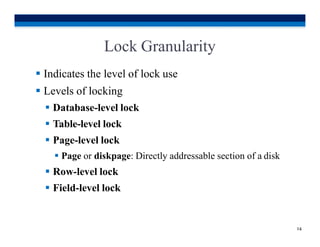
Lock Granularity
14
 Indicates the level of lock use
 Levels of locking
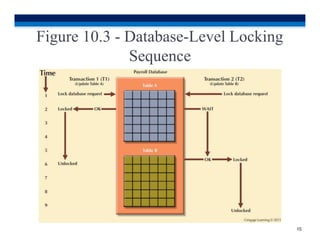
 Database-level lock
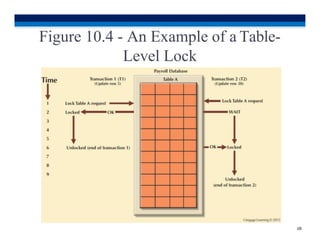
 Table-level lock
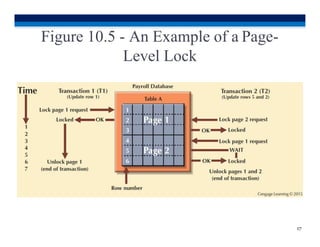
 Page-level lock
 Page or diskpage: Directly addressable section of a disk
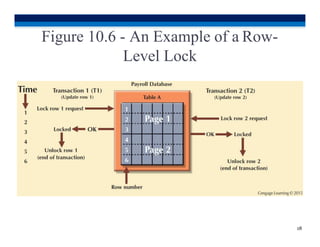
 Row-level lock
 Field-level lock
Figure 10.3 - Database-Level Locking
Sequence
15
Figure 10.4 - An Example of a Table-
Level Lock
16
Figure 10.5 - An Example of a Page-
Level Lock
17
Figure 10.6 - An Example of a Row-
Level Lock
18
TO BE CONTINUED

1. Transaction Processing and Concurrency Control.pptx

  • 1.
    Database Systems Design, Implementation,and Management 11e Transaction Processing and Concurrency Control By: Christian Alfred M. Villena, LPT, MIT
  • 2.
    Learning Objectives 2  Inthis chapter, students will learn:  About database transactions and their properties  What concurrency control is and what role it plays in maintaining the database’s integrity  What locking methods are and how they work
  • 3.
    Learning Objectives 3  Inthis chapter, students will learn:  How stamping methods are used for concurrency control  How optimistic methods are used for concurrency control  How database recovery management is used to maintain database integrity
  • 4.
    Transaction 4  Logical unitof work that must be entirely completed or aborted  Consists of:  SELECT statement  Series of related UPDATE statements  Series of INSERT statements  Combination of SELECT, UPDATE, and INSERT statements
  • 5.
    Transaction 5  Consistent databasestate: All data integrity constraints are satisfied  Must begin with the database in a known consistent state to ensure consistency  Formed by two or more database requests  Database requests: Equivalent of a single SQL statement in an application program or transaction  Consists of a single SQL statement or a collection of related SQL statements
  • 6.
    Evaluating Transaction Results 6 Not all transactions update database  SQL code represents a transaction because it accesses a database  Improper or incomplete transactions can have devastating effect on database integrity  Users can define enforceable constraints based on business rules  Other integrity rules are automatically enforced by the DBMS
  • 7.
    Transaction Properties Atomicity • Alloperations of a transaction must be completed • If not, the transaction is aborted Consistency • Permanence of database’s consistent state Isolation • Data used during transaction cannot be used by second transaction until the first is completed Durability • Ensures that once transactions are committed, they cannot be undone or lost Serializability • Ensures that the schedule for the concurrent execution of several transactions should yield consistent results 7
  • 8.
    Transaction Management withSQL 8  SQL statements that provide transaction support  COMMIT  ROLLBACK  Transaction sequence must continue until:  COMMIT statement is reached  ROLLBACK statement is reached  End of program is reached  Program is abnormally terminated
  • 9.
    Transaction Log 9  Keepstrack of all transactions that update the database  DBMS uses the information stored in a log for:  Recovery requirement triggered by a ROLLBACK statement  A program’s abnormal termination  A system failure
  • 10.
    Concurrency Control 10  Coordinationof the simultaneous transactions execution in a multiuser database system  Objective - Ensures serializability of transactions in a multiuser database environment
  • 11.
    Problems in ConcurrencyControl Lost update • Occurs in two concurrent transactions when: • Same data element is updated • One of the updates is lost Uncommitted data • Occurs when: • Two transactions are executed concurrently • First transaction is rolled back after the second transaction has already accessed uncommitted data Inconsistent retrievals • Occurs when a transaction accesses data before and after one or more other transactions finish working with such data 11
  • 12.
    The Scheduler 12  Establishesthe order in which the operations are executed within concurrent transactions  Interleaves the execution of database operations to ensure serializability and isolation of transactions  Based on concurrent control algorithms to determine the appropriate order  Creates serialization schedule  Serializable schedule: Interleaved execution of transactions yields the same results as the serial execution of the transactions
  • 13.
    Concurrency Control withLocking Methods 13  Locking methods - Facilitate isolation of data items used in concurrently executing transactions  Lock: Guarantees exclusive use of a data item to a current transaction  Pessimistic locking: Use of locks based on the assumption that conflict between transactions is likely  Lock manager: Responsible for assigning and policing the locks used by the transactions
  • 14.
    Lock Granularity 14  Indicatesthe level of lock use  Levels of locking  Database-level lock  Table-level lock  Page-level lock  Page or diskpage: Directly addressable section of a disk  Row-level lock  Field-level lock
  • 15.
    Figure 10.3 -Database-Level Locking Sequence 15
  • 16.
    Figure 10.4 -An Example of a Table- Level Lock 16
  • 17.
    Figure 10.5 -An Example of a Page- Level Lock 17
  • 18.
    Figure 10.6 -An Example of a Row- Level Lock 18
  • 19.