Cloud Computing
          Bharat Bodage
            ING Softwares,Pune
Contents

What is Cloud Computing ?
Features of Cloud Computing
Types of Clouds
Deployment Models
Key Technology : Virtualization
Advantages of Cloud Computing
Cloud Computing Market Size
Examples of Cloud Computing
Difficulties for Cloud Computing
References
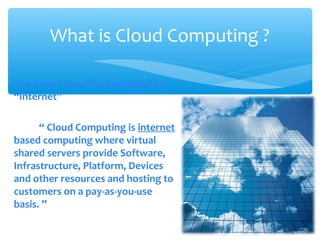
What is Cloud Computing ?

The term “Cloud” is analogical to
“Internet”

      “ Cloud Computing is internet
based computing where virtual
shared servers provide Software,
Infrastructure, Platform, Devices
and other resources and hosting to
customers on a pay-as-you-use
basis. ”
Features of Cloud Computing

 Easy to Use
 Virtualized
 Application Programming Interface (API)
 Multi-Tenancy
 Pay-as-per-use
 Scalability
 Maintenance
 Security
Architecture of Cloud Computing

    Front End
     It comprises to client’s device (or computer network)
     and some applications needed for accessing cloud
     computing system.
    Back End
      It refers to cloud itself. It includes various computer
      machines, data storage system and servers.

Middleware is used to allow computers that are connected on
network to communicate each other. Middleware
administered all the information about client’s demand and
traffic ensuring smooth functioning of system.
Types of Clouds


         SaaS
  Software as a Service

        PaaS
 Platform as a Service


         IaaS
Infrastructure as a Service
SaaS
             Software as a Service


 Software functionality is offered within cloud
 Increasingly popular with SMEs/SMBs
                   (Small and Mid size Businesses)
 Quite Expensive
 Service delivered through browser
 No Hardware or Software to manage

Ex: SalesForce CRM, Google Apps, Wipro w-SaaS
PaaS
             Platform as a Service


 Provides Platform where applications and
                 services can be developed and
   hosted
 Service delivered through browser
 Provides API (Application Programming Interface)
 Platform management is critical task


Ex: Google App Engine, Window Azure (platform)
IaaS
             Infrastructure as a Service


   Provides Resources as services
   Virtualized Environment
   Foundation for SaaS and PaaS
   Whole cloud information viz. servers, routers,
    hardware based load balancing, firewalls and
    other network equipment's are provides IaaS

Ex: Amazon EC2, SQL Azure, FlexiScale
Deployment Models

 Public Cloud:
       It is traditional cloud computing where resources are dynamically
provisioned on a fine grained, self service basis over internet of from off-
site third party provider.

  Community Cloud:
       If several organizations have similar requirement and seek to share
infrastructure to realize the benefits of cloud computing then community
cloud can be established. This is having higher cost than public cloud
because this is having only fewer users as compared to public cloud.
However this option may offer higher level of privacy, security or policy
compliance.
Deployment Models Contd…

   Hybrid Cloud:
      It means two separate clouds joined together (public, private,
internal, community) or combination of virtualized cloud server instances
used together with real physical hardware. Hybrid cloud is use of physical
hardware and virtualized cloud server instances together to provide a single
common device.

   Private Cloud:
      Private cloud describe offering’s that deploy cloud computing on
private networks. It consists of applications or virtual machines in company’s
own set of hosts. Hence to recover from failure, ability to scale up or down
depending upon demand.
Key Technology: Virtualization


                                      App      App      App

      App      App      App           OS       OS        OS

         Operating System              Hypervisor/ VM Impl.

            Hardware                        Hardware

        Traditional Stack               Virtualized Stack

  Virtual machine is to abstract the hardware of single computer
into several different executing environment by creating illusion
that each separate execution environment is running on its own
private machine.
Advantages of Cloud Computing


 Pay-as-per-Use
 Location Independence
 Increased Flexibility
 Abstraction (Allows enterprise to focus on its core)
 Resource Sharing
 Instant scalability
Cloud Computing Market Size


  According to study conducted by Forbes, the global market for
enterprise cloud based services will grow from $ 12.1 billion in 2010
to $ 35.6 billion in 2015. The year-on-year growth rate will be 43% in
2011, but it will decrease to 13% over next five years. Software as a
Service(SaaS) will account for 70% of revenue in 2010, while 30%
will be related to Infrastructure as a Service(IaaS).
  Another report states worldwide revenue from public IT cloud
services exceeded $ 16 billion in 2009 and is forecasted to reach $
55.5 billion in 2014, representing a compound annual growth
rate(CAGR) of 27.4 %.
Examples of Cloud Computing

The NY Times
      Amazon EC2 (Elastic Compute Cloud)
Nasdaq
       Amazon EC2                     Taylor Woodrow
                                           Google Apps
ESPN
       Right Scale using Amazon EC2
CSS                                   Major League Baseball
       Amazon EC2
                                           Joyent
British Telecom
      3 Tera
Difficulties for Cloud Computing

  Continuous high availability
  Consistency
  Performance Issues
  Legal and political problem of data store and
    translation across region
   Scalability of all components
   Security
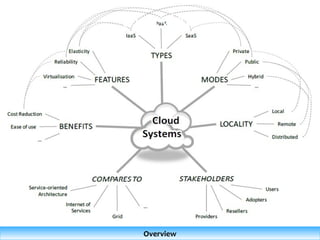
Overview


  Overview
References

www.tecno-pulse.com
www.luitinfotech.com
The Future of Cloud Computing
                  -Lutz Schubert

A Short Introduction to Cloud Computing
                  -David Chappell
Thank You !!!

Cloud computing by Bharat Bodage

  • 1.
    Cloud Computing Bharat Bodage ING Softwares,Pune
  • 2.
    Contents What is CloudComputing ? Features of Cloud Computing Types of Clouds Deployment Models Key Technology : Virtualization Advantages of Cloud Computing Cloud Computing Market Size Examples of Cloud Computing Difficulties for Cloud Computing References
  • 3.
    What is CloudComputing ? The term “Cloud” is analogical to “Internet” “ Cloud Computing is internet based computing where virtual shared servers provide Software, Infrastructure, Platform, Devices and other resources and hosting to customers on a pay-as-you-use basis. ”
  • 5.
    Features of CloudComputing Easy to Use Virtualized Application Programming Interface (API) Multi-Tenancy Pay-as-per-use Scalability Maintenance Security
  • 6.
    Architecture of CloudComputing Front End It comprises to client’s device (or computer network) and some applications needed for accessing cloud computing system. Back End It refers to cloud itself. It includes various computer machines, data storage system and servers. Middleware is used to allow computers that are connected on network to communicate each other. Middleware administered all the information about client’s demand and traffic ensuring smooth functioning of system.
  • 7.
    Types of Clouds SaaS Software as a Service PaaS Platform as a Service IaaS Infrastructure as a Service
  • 8.
    SaaS Software as a Service Software functionality is offered within cloud Increasingly popular with SMEs/SMBs (Small and Mid size Businesses) Quite Expensive Service delivered through browser No Hardware or Software to manage Ex: SalesForce CRM, Google Apps, Wipro w-SaaS
  • 9.
    PaaS Platform as a Service Provides Platform where applications and services can be developed and hosted Service delivered through browser Provides API (Application Programming Interface) Platform management is critical task Ex: Google App Engine, Window Azure (platform)
  • 10.
    IaaS Infrastructure as a Service Provides Resources as services Virtualized Environment Foundation for SaaS and PaaS Whole cloud information viz. servers, routers, hardware based load balancing, firewalls and other network equipment's are provides IaaS Ex: Amazon EC2, SQL Azure, FlexiScale
  • 11.
    Deployment Models PublicCloud: It is traditional cloud computing where resources are dynamically provisioned on a fine grained, self service basis over internet of from off- site third party provider. Community Cloud: If several organizations have similar requirement and seek to share infrastructure to realize the benefits of cloud computing then community cloud can be established. This is having higher cost than public cloud because this is having only fewer users as compared to public cloud. However this option may offer higher level of privacy, security or policy compliance.
  • 12.
    Deployment Models Contd… Hybrid Cloud: It means two separate clouds joined together (public, private, internal, community) or combination of virtualized cloud server instances used together with real physical hardware. Hybrid cloud is use of physical hardware and virtualized cloud server instances together to provide a single common device. Private Cloud: Private cloud describe offering’s that deploy cloud computing on private networks. It consists of applications or virtual machines in company’s own set of hosts. Hence to recover from failure, ability to scale up or down depending upon demand.
  • 13.
    Key Technology: Virtualization App App App App App App OS OS OS Operating System Hypervisor/ VM Impl. Hardware Hardware Traditional Stack Virtualized Stack Virtual machine is to abstract the hardware of single computer into several different executing environment by creating illusion that each separate execution environment is running on its own private machine.
  • 14.
    Advantages of CloudComputing Pay-as-per-Use Location Independence Increased Flexibility Abstraction (Allows enterprise to focus on its core) Resource Sharing Instant scalability
  • 15.
    Cloud Computing MarketSize According to study conducted by Forbes, the global market for enterprise cloud based services will grow from $ 12.1 billion in 2010 to $ 35.6 billion in 2015. The year-on-year growth rate will be 43% in 2011, but it will decrease to 13% over next five years. Software as a Service(SaaS) will account for 70% of revenue in 2010, while 30% will be related to Infrastructure as a Service(IaaS). Another report states worldwide revenue from public IT cloud services exceeded $ 16 billion in 2009 and is forecasted to reach $ 55.5 billion in 2014, representing a compound annual growth rate(CAGR) of 27.4 %.
  • 16.
    Examples of CloudComputing The NY Times Amazon EC2 (Elastic Compute Cloud) Nasdaq Amazon EC2 Taylor Woodrow Google Apps ESPN Right Scale using Amazon EC2 CSS Major League Baseball Amazon EC2 Joyent British Telecom 3 Tera
  • 17.
    Difficulties for CloudComputing Continuous high availability Consistency Performance Issues Legal and political problem of data store and translation across region Scalability of all components Security
  • 18.
  • 19.
    References www.tecno-pulse.com www.luitinfotech.com The Future ofCloud Computing -Lutz Schubert A Short Introduction to Cloud Computing -David Chappell
  • 20.