Presentation on
CLOUD COMPUTING
By –
Ankita Khadatkar , 6-ET
Introduction
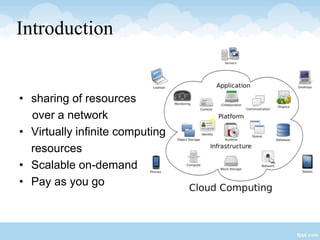
• sharing of resources
over a network
• Virtually infinite computing
resources
• Scalable on-demand
• Pay as you go
Definition of Cloud Computing
• "Clouds are vast resource pools with on-demand
resource allocation.
– Jan Pritzker
• “The analogy that finally made sense to them is
what I will call 'cloud dining.‘”
– Omar Sultan
• "Cloud computing is ... the user-friendly version
of grid computing.“
– Trevor Doerksen
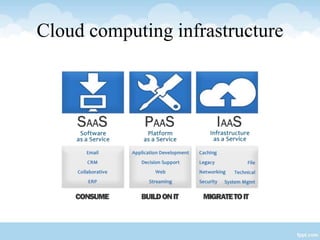
Cloud computing infrastructure
SaaS
• SaaS is a complete operating environment with
applications, management, and the user interface.
• In the SaaS model, the application is provided to the
client through a thin client interface and customers
responsibilities begins and ends with entering and
managing its data and user interaction
PaaS
• PaaS provides virtual machines, operating systems,
applications, services, development framework,
transactions and control structure
• The client can deploy its applications on the cloud
infrastructure or use application that were
programmed using languages tools
• Service provider manages cloud infrastructure,
operating systems and enabling software
IaaS
• It provides virtual machine, virtual storage, virtual
infrastructure and other hardware assets as
resources that clients can provide
• IaaS service provider manages all the infrastructure
while client is responsible for all other aspects of
deploy
• This can include operating system, applications and
user interaction
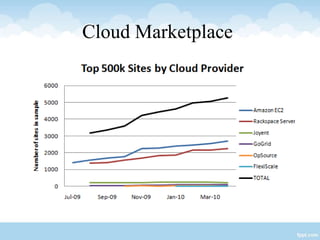
Cloud Marketplace
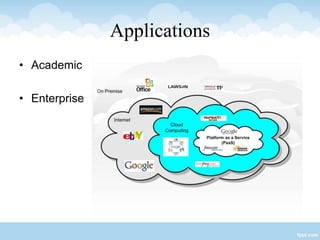
Applications
• Academic
• Enterprise
Advantages
• Scale and cost
• Change management
• Next generation architecture
• Choice and agility
• On demand service
Disadvantages
• Internet is mandatory
• Lack of control
• security
Conclusion
• Leaders in the industry, such as IBM, Google, and
Microsoft have provided their initiatives in promoting
cloud
• Big IT companies are also building their own version
of cloud
• Cloud is the next generation technology
• It can be modified to be used by everyone
References
– http://en.wikipedia.org/wiki/Cloud_computing
– http://www.webopedia.com/TERM/C/cloud_computing.html
– cloudperspectives pdf
– Cloud Computing: Implementation, Management, and Security
by John W. Rittinghouse , James F. Ransome
– Fundamentals of Cloud Computing by Prasanta
Pattnaik , Manas Kabat , Souvik Pal
– astudyofcloudcomputing-090517112358-phpapp01, Presentation
on slide share
– Introduction to Cloud Computing,Rajkumar Buyya,James
Broberg1andAndrzej Goscinski,William Voorsluys, Published
Online: 3 JAN 2011
– Cloud Workload Profiling and Deployment Control
Cloud computing

Cloud computing

  • 1.
    Presentation on CLOUD COMPUTING By– Ankita Khadatkar , 6-ET
  • 2.
    Introduction • sharing ofresources over a network • Virtually infinite computing resources • Scalable on-demand • Pay as you go
  • 3.
    Definition of CloudComputing • "Clouds are vast resource pools with on-demand resource allocation. – Jan Pritzker • “The analogy that finally made sense to them is what I will call 'cloud dining.‘” – Omar Sultan • "Cloud computing is ... the user-friendly version of grid computing.“ – Trevor Doerksen
  • 4.
  • 5.
    SaaS • SaaS isa complete operating environment with applications, management, and the user interface. • In the SaaS model, the application is provided to the client through a thin client interface and customers responsibilities begins and ends with entering and managing its data and user interaction
  • 6.
    PaaS • PaaS providesvirtual machines, operating systems, applications, services, development framework, transactions and control structure • The client can deploy its applications on the cloud infrastructure or use application that were programmed using languages tools • Service provider manages cloud infrastructure, operating systems and enabling software
  • 7.
    IaaS • It providesvirtual machine, virtual storage, virtual infrastructure and other hardware assets as resources that clients can provide • IaaS service provider manages all the infrastructure while client is responsible for all other aspects of deploy • This can include operating system, applications and user interaction
  • 8.
  • 9.
  • 10.
    Advantages • Scale andcost • Change management • Next generation architecture • Choice and agility • On demand service
  • 11.
    Disadvantages • Internet ismandatory • Lack of control • security
  • 12.
    Conclusion • Leaders inthe industry, such as IBM, Google, and Microsoft have provided their initiatives in promoting cloud • Big IT companies are also building their own version of cloud • Cloud is the next generation technology • It can be modified to be used by everyone
  • 13.
    References – http://en.wikipedia.org/wiki/Cloud_computing – http://www.webopedia.com/TERM/C/cloud_computing.html –cloudperspectives pdf – Cloud Computing: Implementation, Management, and Security by John W. Rittinghouse , James F. Ransome – Fundamentals of Cloud Computing by Prasanta Pattnaik , Manas Kabat , Souvik Pal – astudyofcloudcomputing-090517112358-phpapp01, Presentation on slide share – Introduction to Cloud Computing,Rajkumar Buyya,James Broberg1andAndrzej Goscinski,William Voorsluys, Published Online: 3 JAN 2011 – Cloud Workload Profiling and Deployment Control